Feathers of the Firebird

The year’s favourite books: Ursula Dubosarsky

Today it’s my pleasure to welcome Ursula Dubosarsky to my blog, to write about her favourite book of the year.

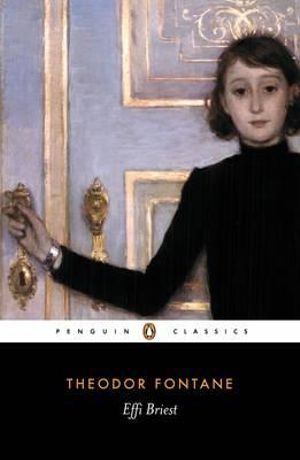
Effi Briest by Theodore Fontane (1895)

A friend bought me this Penguin edition of the classic German novel as a gift in a second-hand bookshop after we’d had lunch together a few months ago. I read it quickly, that same night.   It’s frequently classified as another great nineteenth century novel about adultery, along with Madame Bovary, The Age of Innocence or Anna Karenina.   But I found it much more disturbing than any of those and I’m not sure why – I don’t usually analyse my responses to books too much. But I remain very upset by it.  Perhaps because despite the apparently genial and civilised milieu, it’s far closer to the savagery of the murderous adultery of Therese Raquin –  and yet the characters seem not to notice it right to the devastating end, including Effi herself.  I see that Rainer Fassbinder made a film of the novel in 1974 (which I haven’t seen) and gave it this title: Fontane Effi Briest or Many People Who Are Aware of Their Own Capabilities and Needs Just Acquiesce to the Prevailing System in Their Thoughts and Deeds, Thereby Confirming and Reinforcing It.     Hmm.


Ursula Dubosarsky is a multi-award winning Australian writer of over 50 books for children. Her website is at https://ursuladubosarsky.squarespace.com/

The year’s favourite books: introduction

Today I’m starting a new blog series, The year’s favourite books, in which authors and illustrators contribute guest posts about a favourite book (or books, if they can’t choose just one!) which they read this year. The books don’t  have to be new (though it might be, of course!) or in any particular genre, or for any particular age group–just books that my blog guests enjoyed reading and/or that are special to them in some way.

I’m kicking off the series with two of my own favourites this year (yes, I couldn’t choose just one and even two was hard to keep to!), one for adults, one for children: the adult one by an eminent Australian author whose books I’ve always enjoyed; the children’s book by a Canadian author-illustrator I’ve only just discovered, despite his having published several immensely popular and award-winning books.

So here they are:

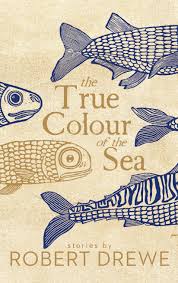
The True Colour of the Sea, by Robert Drewe

This beautiful, gripping and evocative collection of short stories, that came out in mid-2018 but which I didn’t catch up with till early 2019, shows Robert Drewe’s light yet precise touch at its most masterly. The sea, in all its simplicity yet mystery, has been at the centre of much of his writing, and this collection is certainly no exception, with stories set on islands and on the coast, and at different periods of time, with the sea always more than a mere backdrop to human dramas, comedies, crimes and mysteries, but in fact often a trigger, a catalyst, for them. I just loved this book, which I read over several days in summer. Beautiful writing, unpredictable twists, vivid characters and a satirical eye that is never misanthropic: these are some of the great pleasures of this collection, which is one to savour over the holidays.


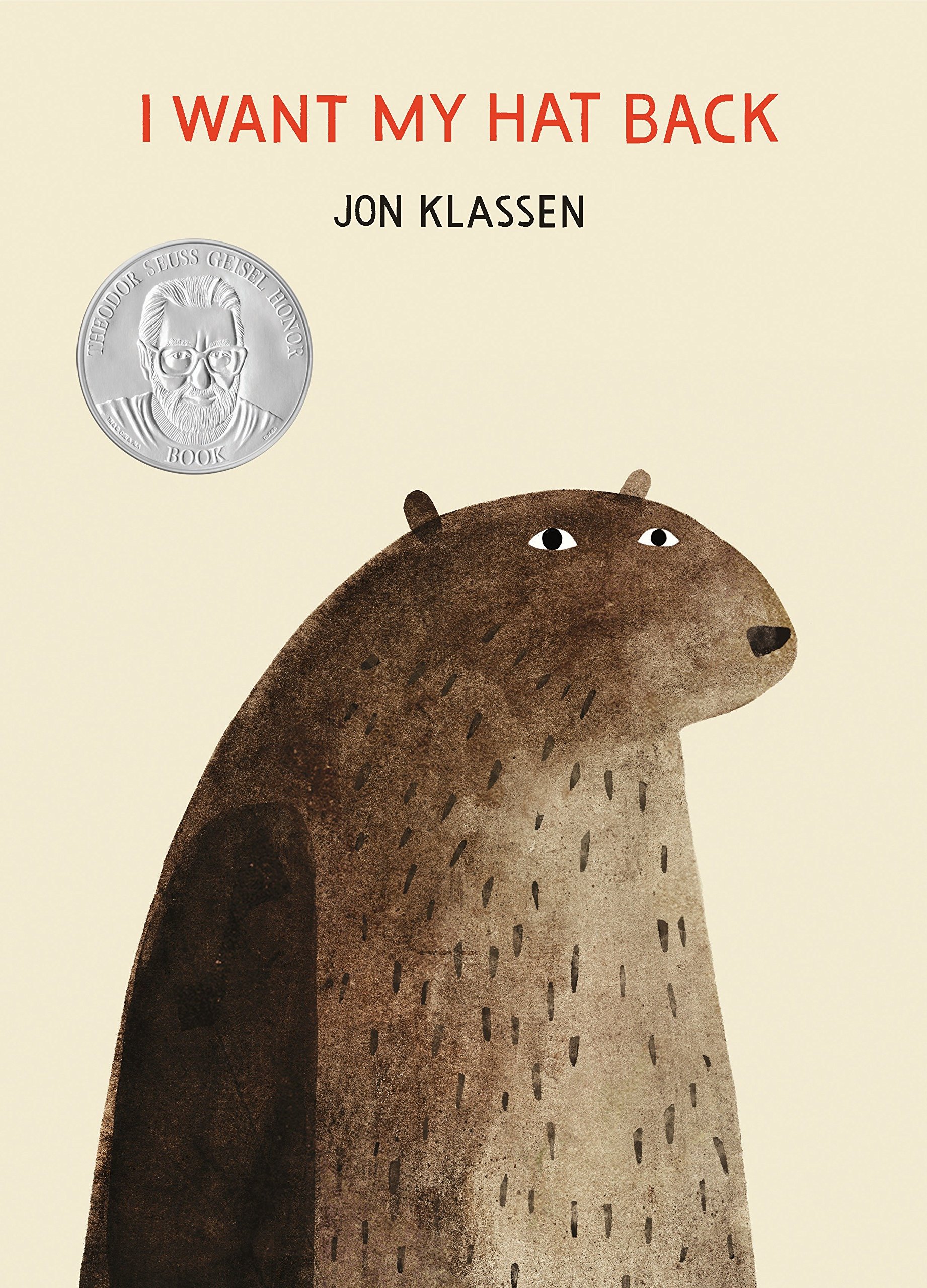
I Want My Hat Back, written and illustrated by Jon Klassen

I first came across this picture book(originally published in 2011) by chance one day this year, browsing in a city bookshop for a present for a certain beloved little person. I was startled and gripped by the story and by Klassen’s unique style of illustration, which combines sophistication and simplicity. The cumulative text, around a bear who has lost his hat and is looking for it everywhere, shows those twin aspects too, and its ending has quite a twist–what exactly, well, you’ll have to see for yourself! In an interview in 2016, Klassen mentioned that the publisher had wanted him to change the ending, but that he’d stood his ground. When you read the book, you can see why there’d been that initial nervousness(though the book went on to be hugely successful). In our family, I Want My Hat Back aroused quite a bit of discussion, with different opinions expressed as to the underlying theme: and that ending! (Mind you, the little person for whom it was intended just enjoyed it unreservedly).


Guest post by Simon Groth on crowdfunding an innovative book project

Imagine… ‘a novel with twelve chapters that can be shuffled into any order, yet will always present as a cohesive story arc.’

Imagine… ‘a print run where each individual copy contains chapters that have been arranged at random, each one a unique version of the story, created just for you.’

Imagine…’a story with nearly half a billion possible combinations, with each copy being one of a kind, yet all of them telling the same story.’

Imagine…Ex Libris, an extraordinary, innovative book project which can be supported right now in a crowdfunding campaign. The brainchild of writer and publishing professional Simon Groth, Ex Libris promises to be both a fascinating literary/publishing experiment and an intriguing reading experience.

I’m delighted to be bringing readers today a guest post by Simon about the experience of crowdfunding this innovative project. Enjoy–and consider supporting the campaign!

Talking to an imagined audience

by Simon Groth

It was late. It had been a long day at work, but now all was quiet. My family slept or futzed around on phones upstairs. I had set up the microphone and my phone on a tripod. I was ready to start talking to myself.

Well, not myself exactly. Talking to an imagined audience is something I am familiar with, after all it’s what I’m doing right now writing these words. I just don’t normally do it out loud. I had prepared a script that ran for about three and a half minutes that I more or less memorised. I just had to deliver it. Emote. Make it sound casual. Shoot it straight down the lens.

This wasn’t my first attempt. I’m not a natural in front of the camera and, a couple of weeks prior to this, I enlisted a friend to help me. She had an SLR camera and put together a nicely framed and lit version of an almost identical speech. The experience was crucial in helping me find my feet, but I wasn’t satisfied with the performance. I looked uncomfortable, aware that I was using up someone else’s time with take after take. I also wanted to tweak the text, now I heard it back in my own voice. So I made the decision to try again in my own time and keep going until I had something closer to what I needed.

I have gained a whole new appreciation for what actors do. I had to take breaks every now and then. After a while, I stopped counting takes. I repeated the same phrases over and over, trying desperately to make it sound like I was just talking off the top of my head. I don’t know if I succeeded in this, but the video that resulted seems to be doing its job.

All of which is a long-winded introduction to the crowdfunding campaign I have just launched. Wait, what? I haven’t told you about it yet? Let me correct that for you.

Ex Libris is a book containing chapters that randomly change their order with every copy made. Yeah, very much my kind of novel, right? It’s a story that has nearly half a billion possible combinations and the campaign is looking to launch a small print run where every copy is a unique artefact. Check out the campaign here.

Though I’ve supported a few, I’ve never attempted my own crowdfunding campaign before. Partly this is because I correctly anticipated the gut-wrenching fear of failure that now pervades my every waking moment. But it’s also because, until now, I never had a project that had quite the right fit for it. The relationship between reader and writer is always intimate, but the knowledge that your copy is a text that exists for you alone paradoxically makes you want to find other readers to compare your experience with. It builds a community around its story. What better project to bring to a platform dedicated to raising community support?

Distilling a story with a complicated structure and a lot of interweaving characters and events into a three-minute video is difficult enough, but in this case the story has to also make way for an explanation of how the book itself will be made. It’s a lot of information to cram in while at the same time making the message as intriguing and compelling as possible, the linguistic equivalent of an acrobatic routine. But the response to the project so far has been wonderful and generous, so I’ll take that as a good sign that the pitch communicates well. To push the metaphor, we’ll see in the next few weeks if I stick the landing.

But all this was in future on that late Tuesday night as I adopted my most confident voice, stared down my phone, and repeated myself for hours. At one point, my son came downstairs.

‘Who are you talking to?’ he said.

‘No one,’ I said. ‘And everyone.’


The crowdfunding campaign for Ex Libris is underway until 25 November 2019.

https://www.pozible.com/project/ex-libris

Simon Groth is a writer with books, stories, and articles published in Australia and internationally. His most recent book is Infinite Blue (with Darren Groth, Orca 2018). He has also created a series of experimental publishing projects including the 24-Hour Book and stories publishing to billboards.

simongroth.com


Some photos from the 2019 HNSA conference

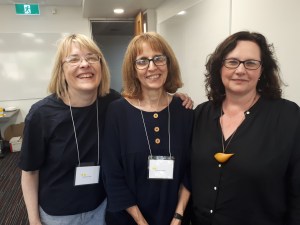
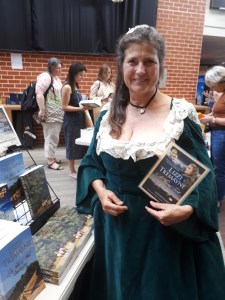
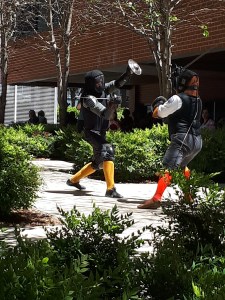
Over the weekend, I was at the biennial conference of the Historical Novel Society of Australasia(HNSA) which this year was held in the pleasant and spacious surroundings of the University of Western Sydney’s Parramatta South campus. It was a fabulous weekend, with a program filled to the brim with brilliant speakers and thought-provoking presentations, as well as excellent food and a collegial, convivial atmosphere, an excellent conference bookshop, great organisation, many catch-ups with friends, including fellow writers, meeting new people too–and witnessing some great demonstrations of armour and fencing! Here are some photos from the three days of the conference–and congratulations to all the HNSA team for a truly exceptional conference-I was proud to be involved.


A beautiful and astonishing example of serendipity

Sometimes, life can hand you a beautiful example of serendipity, a gift of simple grace and joy, which makes you feel connections across time and place that are just spine-tingling…Such a thing happened to me just recently, something which connected my childhood scribbling self with my present scribbling self, in the most unexpected of ways. It’s a whole story in itself, so in order to do it justice, I have to start with some context, with some scene-setting, before I move to what happened in the present day…

So, in an entry in my diary, written as a 12 year old (a diary I still have), there’s a mention of a book I was writing, titled The Twins’ Highlands Holiday. Everything in the entry except for that title is written in French (as indeed it is in the rest of the diary); but the English title clearly showed that I had ambitions for a fiction readership beyond my immediate family 🙂  And it also showed clearly the influence of one of my favourite writers at the time, Enid Blyton. I especially loved her mysteries series, the Famous Five and the Secret Seven, but also her story anthologies which could be consumed in bite size pieces(though being a voracious reader, I never stopped at one bite!) My parents rarely bought new English-language books for us(that was reserved for French-language titles, like Tintin, Asterix, Alexandre Dumas, Jules Verne etc); So most of those books I borrowed from the library or occasionally we might find some in second-hand shops, like the legendary White Elephant in Chatswood which my mother took us to during the holidays(we lived in Sydney’s North Shore area) and where we children might be allowed to select books to take home(she also loved rummaging amongst the shop’s astonishing mass of books, records, old china, curios, records, vintage clothes etc).

I had come across the entry in that old diary earlier this year, in preparation for an essay I was writing; and I thought then, I wish I still had that story! But it had vanished long ago, and all that remained was the title, a title straight out of Blyton, though maybe not the Highlands part, for that very English writer. As a twelve year old I had never been to the Highlands, though I loved stories set there(I’d also read and loved Robert Louis Stevenson’s Kidnapped, a very different kettle of fish to Blyton, of course!) So I’d combined twins and holiday–very Blyton–with a whiff of adventure in the heather, a la Robert Louis Stevenson. I don’t recall anything about the story or what happened in it..but seeing it mentioned there in the diary(mentioned in more than one entry actually, as I diligently reported progress on writing it) made me remember the sheer excitement of writing as a child, copying my favourite authors but doing it all in my own way.  And I thought, I know the Highlands bit came from Stevenson, but I wonder which Blyton it was which inspired the rest?  Oh well, probably a mix of several, I thought.

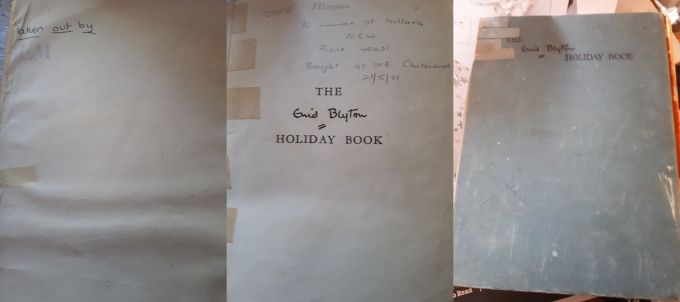
The Twins’ Holiday Holiday went into the essay. And that was it. Except it wasn’t. The astonishment, the serendipity, was still to come. A few weeks ago, I received a direct Facebook message from a fellow author, Pat Simmons. I hadn’t met Pat in person, but I did know her work: and had recently bought her latest lovely picture book, Ziggy’s Zoo(illustrated by Vicky Pratt) for some dear little people in my life. Anyway, Pat had messaged me about something she’d found, quite by chance. A book. An Enid Blyton anthology, called ‘The Holiday Book’, with a name, address, telephone number and date carefully written on the flyleaf, obviously by the proud owner. And here I’ll pass the story over to Pat herself, to explain:

My local ‘op shop’ sits close to the bus stop in Thirroul. A bus stop I frequently use when travelling home to Scarborough. As the buses almost always run late, I often have time to browse the ‘op shop’ and seek out treasures.

A few weeks ago, I spied a book of Enid Blyton short stories, sitting all by itself on a high shelf. Inside the book I read a name and address. Definitely not a local address and, seemingly, written some years ago. The name was ‘Sophie Masson.’

Could it be THE Sophie Masson I wondered? I took a photo of the inscription and messaged it to Sophie. She confirmed that the book had indeed belonged to her some years ago.

It was great to return the book to its original owner and to ponder on the book’s journey.

I could hardly believe it as I looked at the photos Pat had sent. It was definitely my handwriting as a 12 year old (just the same as in the diary!) and it carefully noted my name, address, phone number(which I still remembered by heart as we’d had it drummed into us by our parents, in case we ever got lost!) as well as the place and date we’d bought it–the W.E., Chatswood, the White Elephant of course, and in May, only a few days after my twelfth birthday. So it was already second-hand when we bought it, but I had clearly loved it and put my mark on it.

I was so excited! And even more so when Pat very kindly sent the book to me, and opening it, I was suddenly plunged back into the world of my childhood, not only because of the stories, the pictures, and my owner’s inscription–I was sure now that this was the book that had inspired the Blytonesque part of that story I’d written as a twelve year old–but also  because of something else written on the page facing the flyleaf. ‘Taken out By’ it read in my writing: and underneath a stamp somewhat shakily reading L M. I knew at once who LM was of course; my younger brother, Louis. And he, along with my other siblings, had been one of the visitors at the ‘library’ I ran with attempted firmness at home, acting the part of the librarian, complete with stamp (I just loved those stamps!). Very likely that my cheeky rebel of a brother broke every library rule I attempted to impose, but he had clearly meekly submitted to being stamped into Enid Blyton’s Holiday Book (I showed it to him next time I saw him of course, much to his amazed amusement!)

What a journey indeed that book must have gone on over the decades since I had first held it in my hands and officiously stamped it! It had not followed me from childhood into adolescence; my mother must have got rid of it, along with other books we had outgrown, when we left home, or when she and my father left Australia to go back to France. She would have given it to another secondhand shop, no doubt, but in northern Sydney somewhere–but how it had ended up on the South Coast, in Pat’s neighbourhood op shop in Thirroul, a little battered but still in remarkably good shape, considering, is a mystery. I presume other children along the way, maybe several other children, had enjoyed and loved it, or it would not have stayed intact. As to me, I had forgotten it, until that moment when I read Pat’s message. Yet I had written my name and contact in it so carefully, obviously fearing that I might lose it, and trying to ensure that it would find its way back to me.

Which of course, eventually, it did….

And I’m still feeling that rush of pure, simple pleasure about the lovely serendipity of it all.
 

Conferences, exhibitions, launches: a very busy few weeks coming up!

Later this month and into next month, I am going to be having a very busy and very interesting literary time!

First up is the wonderful Historical Novel Society of Australasia Conference, which this year is being held at the University of Western Sydney in Parramatta, Sydney, from October 25 to 27. The biennial HNSA conference is one of my favourite literary events: there’s always really interesting speakers, a fabulous program, and a warm, collegial atmosphere. This year’s certainly no exception, and I’m privileged to be involved with the Conference in several ways: as a speaker, a workshop presenter, judge of the HNSA short story contest, and, a great honour, being the Conference Patron as well. Looking forward so much to it! Tickets are still available for this fantastic event, so check out the program here.

Next up is the Artstate Festival, to be held in Tamworth, October 31 to November 3. I’m involved in this in several ways, as an author, a small-press publisher, and a contributor to an anthology and an exhibition, both of which will be launched in Tamworth during that time. On October 31, wearing my Christmas Press hat, I’ll be participating, with my Christmas Press partners as well as  fellow local publishing house Little Pink Dog Books, in the Creative Hot Spot Publisher Pitch Day, which will give children’s writers and illustrators an opportunity to pitch work to one or both publishing houses.

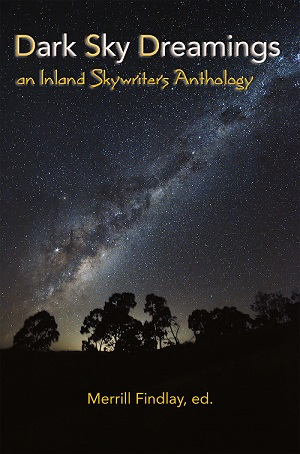
That evening, I’ll don my author hat again, as a contributor to the fabulous anthology Dark Sky Dreamings: An Inland Skywriters Anthology, which is themed around people’s relationship with the sky in all its aspects, and which will be launched at a great astronomy-themed event, in conjunction with the Tamworth Regional Astronomy Club, at Bicentennial Park in Tamworth at 8.30 pm: telescopes and stars will be a feature of this unusual launch!

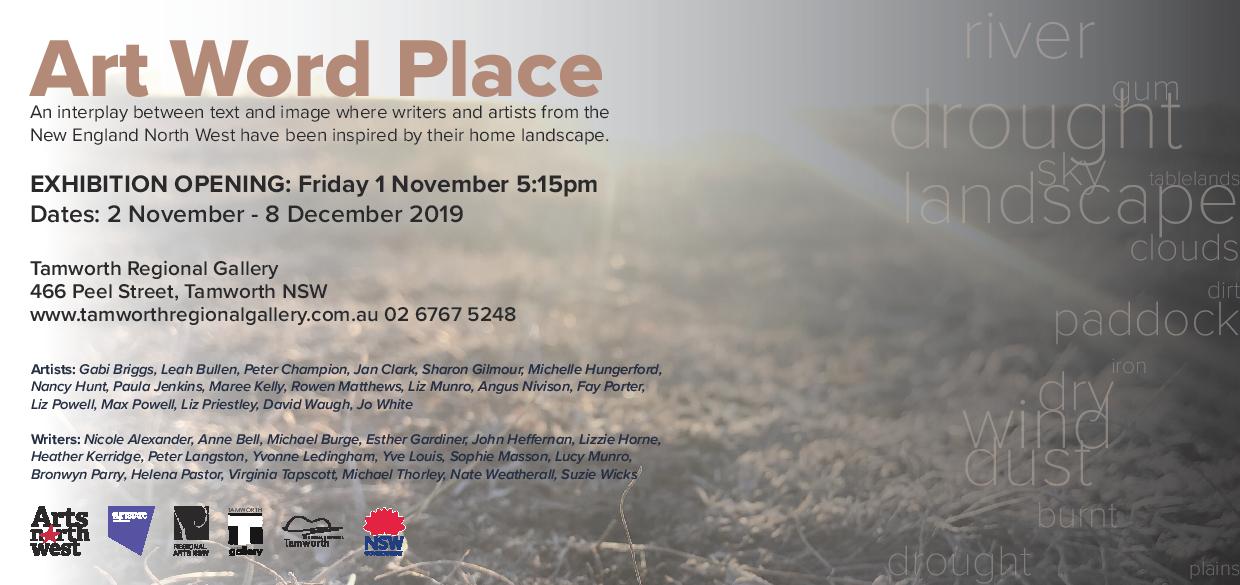
Then on November 1, I’m speaking at an Artstate/Arts North West event called Authors’ Cafe, where authors chat with readers and other interested people about their work. That the evening, I’ll be attending the opening of an exhibition called Art Word Place, which is an Arts North West project, where New England-based writers were paired with New England-based visual artists to create joint works. I’m one of the writers, and I had the good fortune to be paired with the fantastic painter Angus Nivison. His visual response to my poem is just extraordinary! If you’re in the region, come check it and all the other works out, the opening is on at the Tamworth Regional Art Gallery at 5.15 pm on November 1, but the exhibition itself is on till December 8.

There will be other events later in November that I’m a part of, in Armidale, Sydney and Melbourne, but I will write about them later, in a separate blog post. It is certainly a very busy time!


Letter to my unpublished self…

Fellow author Monique Mulligan asked me to contribute to her blog series, ‘A letter to my unpublished self’. It was an unusual, and most enjoyable and thought-provoking thing to do. Here’s a short extract:

Dear Sophie

Hey, there. You’ve always wanted to be an author. A published author. And most days, you think, yes, I’ll get there. You love writing. You know it’s what you were born to do. You believe in your heart that one day, there will be a beautiful book in the shops with your name on it. And you work hard at it. So hard!

And you’re resilient. You pick yourself up after rejections, you bounce back up, you find another option, another possibility, another reason to hope it’ll happen. But occasionally, when yet another manuscript gets rejected, when yet another story fails to get into a competition shortlist, when you are working at yet another crappy menial job to earn a derisory bit of money in between frantically typing up yet another query letter, you think, maybe that nagging little voice in the glum depths of writer limbo is right. It’s too hard….

Read the whole thing here.

Creating There’s A Tiger Out There

Today is the official publication date of my picture book with Ruth Waters, There’s A Tiger Out There(Little Hare) and to celebrate Ruth and I have written pieces on the creation of the book. Enjoy!

Creation of the text, by Sophie Masson

There’s a Tiger Out There began in a dream. In the dream, I was in my house, looking out at the garden, when I glimpsed her: silent stripes gliding through our garden, yellow eyes shining. And with a grip of the heart that was half thrill and half fear, I knew there was a tiger out there and that if I went out—who knew what would happen? Now, it’s not an uncommon occurrence for me to have big cats—lions and tigers, especially—suddenly appear in my dreams, but in this case, it felt different. It felt like this tiger was different, her eyes fixed on me, and when I woke up, I knew why. It was because she wanted to be in a story!

So I began work on transposing her from the realm of dream to the realm of imagination. The first words came quickly, and the first draft was quite simple—just pretty much recounting that dream glimpse and that mix of feelings on seeing her savage, elemental splendour in the midst of our humble familiar garden. ‘There’s a tiger watching me with eyes as bright as sunrise/’ I wrote, ‘There’s a tiger sleek as shadow/stripes of midnight on her fur.’  After I showed the text to my agent Margaret Connolly, who loved it and sent it to Margrete Lamond, who was then the publisher at Little Hare and also loved it, that first draft went through many changes, in collaboration first with Margrete and then, when she left, with Alyson O’Brien, who also loved it and helped me bring the text to its final form. Early on, the draft had transformed from a simple ‘I’ eye-view to the point of view of two siblings, one older and bolder, one younger and more timid, who see a tiger ‘out there’ and react in their different ways—with a twist at the end, of course! It was a story, I realised, about sibling relations, about imagination, about love and adventure and mystery—and the thrill of a good scare!

When I first saw Ruth Waters’ gorgeous collage images, I was so excited! She had completely understood the spirit of my text and created a richly-imagined, warm and distinctive visual world, where the tiger as much as the siblings was completely at home. It was as if that was how I had always seen the world of my story: not only a perfect fit, but extending and expanding it in the most satisfying way.

And of course I just adore the finished book, with Hannah Janzen’s gorgeous design!

Creation of the illustrations, by Ruth Waters

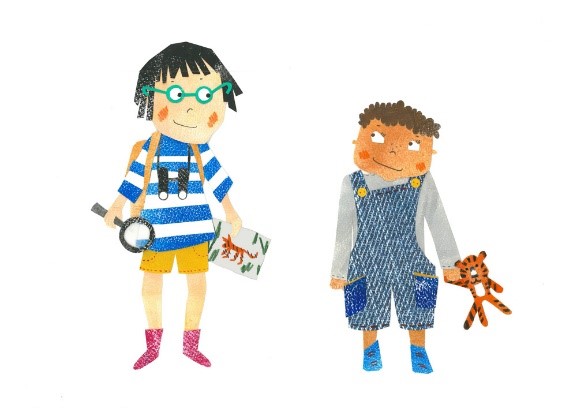
I remember the day I received the email from Alyson from Little Hare Books. I had to re-read it several times. You want me to illustrate a picture book? Me? I had previously written and illustrated my own story but had been waiting for the opportunity to work on someone else’s tale. That said, I opened the manuscript with some trepidation – what if I can’t connect with the story?  I needn’t have worried. As I read each line, I instantly pictured who the characters were, how they looked and what kind of personality they had. A little bit bossy, know-it-all, older sister. A younger brother who adores and does anything she tells him.

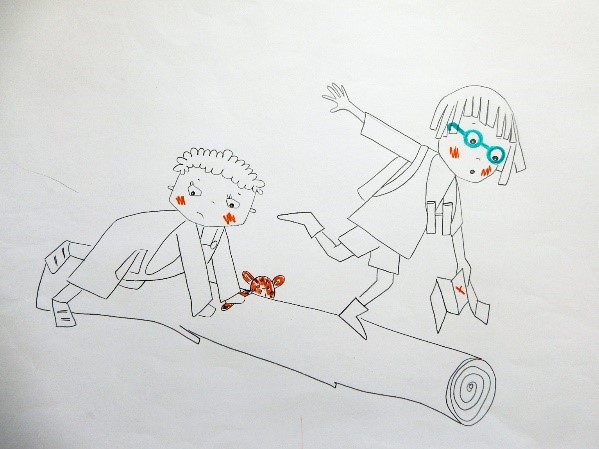
The first stage of the making process was to create a series of character sketches in pencil.  Since I work in collage, I also created a collage version to give Alyson a better idea of how they would finally look. I sent these off and waited for her comments. We went back and forth until we were both happy.


Character Sketches

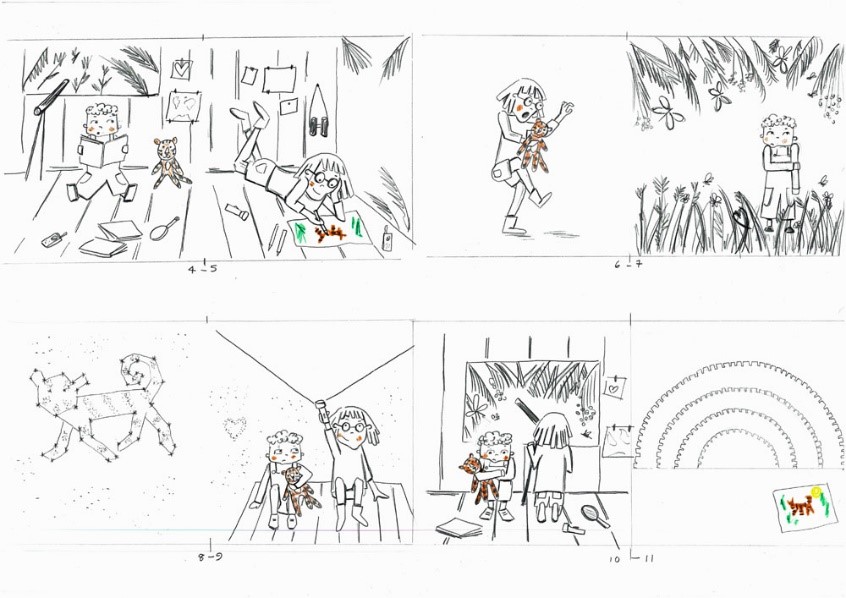
The next stage was to figure out how the text should be split across 32-or-so pages and come up with a rough idea of how each page would look. I had already made the decision that the ‘real’ tiger should only appear on the last double page spread. This way, not only the children in the story but the reader would not be entirely sure whether there really is a tiger. Another idea was to give the little boy a cuddly toy tiger – this would act as a visual tool to help the reader conjure up the idea that there is a tiger out there. Another idea, inspired by the line ‘cross my heart’ – which appears throughout the story – was to place a hidden heart-shape on every page. Sometimes the heart shape is made from a blade of grass or appears as a ripple in the water.  I also spent quite a bit of time making sure there was enough variety in terms of perspectives – wide shots verses close-up, double page spreads verses one page of illustration.  At this point I also decided on the colour palette – I decided we should go bright – to match the vibrant orange of the tiger.


Storyboard and colour palette


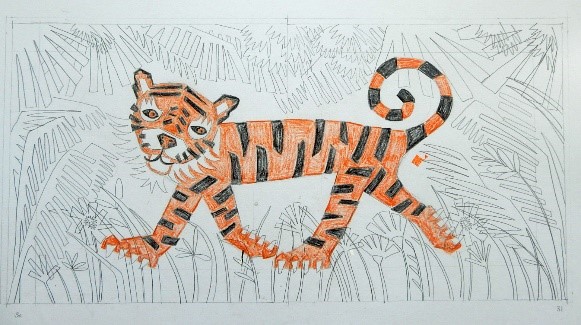
The storyboard was then sent to Little Hare and over a few weeks we made little tweaks. Once I got the thumbs up – I made the final sketches to scale and then got to work prepping the paper.

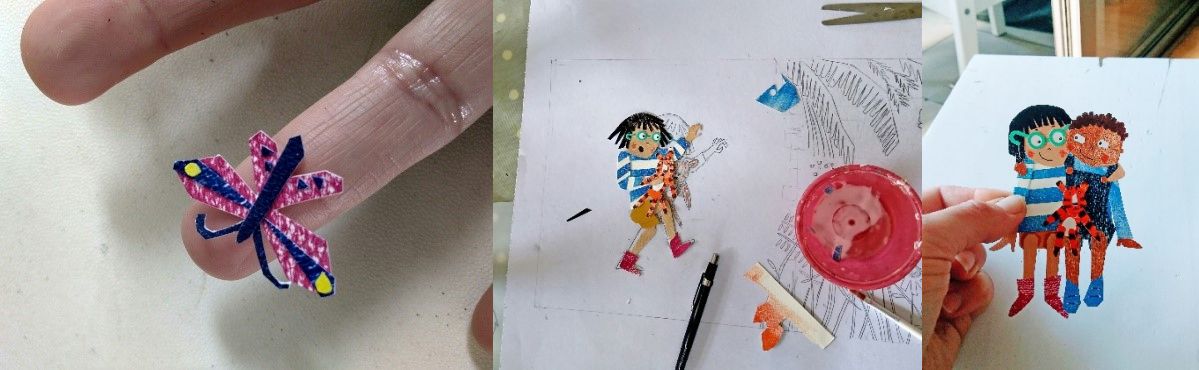
Final sketch and prepping the paper!


To create the collages, I first roll acrylic paint on to a variety of textured paper. Then, working with the final sketches, I trace, cut and stick! All of my illustrations are made entirely by hand. It is labour intensive but I much prefer it to using a computer. The other plus about collage is it’s flexibility as I can keep moving the pieces around until I am happy and, only then, glue them down.

Every time I finished a double page spread, I would scan and send it to Little Hare for their thoughts. To me this proved to be an efficient way of working as it allowed me to make tweaks as I went along, rather making lots of changes at the end – when time is tight.

Watch videos of the making process:


Overall the entire project took about 3-4 months. Much quicker than usual due to my own time constraints (normally I would allocate 6 months). I then packaged it all up and hand delivered it to Little Hare’s production office!


The whole project was a joy to work on from start to finish. And I learnt so much along the way.

Ruth Waters | http://www.ruth-waters.com | https://www.instagram.com/ruthpwaters/

The Accusation: an interview with Wendy James

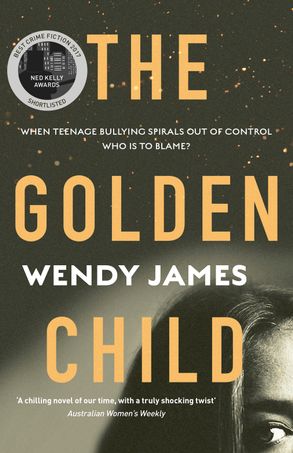
I am delighted today to be bringing you an interview with the fabulous author Wendy James, whose multi-layered domestic noir novels, with their gripping, twisty plots, complex characters with brilliantly-observed relationships, and sharp commentary on contemporary life, have earned great acclaim and a devoted readership. I certainly always much look forward to reading her books, because I know I’m in for a real reading treat(and I’m not just saying that because as well as being a fellow author, Wendy is a dear friend!) A couple of years ago I interviewed her when her previous book, the extraordinary novel The Golden Child came out; and today, I’m interviewing her about her brand-new novel, The Accusation, a disturbing, suspenseful read which plunges us into a world of small-town secrets and social-media storms, with at the heart of it, a monstrous accusation which will pit two women against each other. But who is telling the truth? Who is lying? As events unfold with frightening rapidity, everyone takes sides…

First of all, Wendy, congratulations on your new novel! It’s a brilliant, gripping and disturbing thriller and very contemporary in feel, yet as you mention in your afterword, it’s inspired by a classic crime novel, Josephine Tey’s The Franchise Affair.  Can you tell us a bit about that, and how the idea developed from that initial inspiration, including how it diverges from it?

I’ve been a fan of Tey’s work for a long time. Then a few years ago I came across a piece by UK author Sarah Waters,  discussing the novel as being very decidedly of a particular time and place ( the book was first published in 1948) — and not necessarily in a complimentary way. This sent me back to the original story, the 18th century Canning affair,  and it also really got me thinking — how would such a story play out in the twenty-first century? What was interesting was how so many elements of the 18th century story — and especially the polarising nature of the scandal — seemed even more relevant now.
The novel diverges from Tey’s quite a bit — not only because of the temporal issues, but because the shift in location, a small rural Australian town rather than the UK, changes more than you’d imagine. The class elements, which are very pronounced in Tey’s novel, are still important, but of course play out rather differently in the Australian context. The Suzannah of my novel is very different to the main character in Tey’s — she’s not a quiet, penurious, spinster, but an ex-soap star — rather worldly and world weary. In Tey’s novel Betty Kane didn’t have the option of becoming an instant celebrity as my Ellie Canning does — fame didn’t have quite the same cachet back then.
Do you think social media and the 24 hour news cycle has made people quicker to rush to judgment than in the past? Or not?

I don’t think they’ve made us any faster to rush to judgement — I’m quite sure we’ve always done that — but what they’ve done is given us a  platform to air that judgement in public  – a virtual town square, if you like. It feels like a return to the days when people were publicly shamed, put in the stocks, publicly pilloried — and in some cases had their lives ruined because of the righteous justice of the  mob.

In the novel, the media pits images of women against each other– for example, the young, ‘innocent’ figure of Ellie Canning, as against the ‘corrupted’ figure of middle-aged Suzannah Wells, who is the target of Ellie’s accusation. Why do you think people still respond to such stereotypes?
Ha! I guess it satisfies some primal desire. I suppose we so badly want beauty and youth to correspond to goodness and innocence — and age and relative beauty to represent the opposite. It’s Snow White and the wicked queen,  Cinderella and the wicked stepmother. It’s altogether satisfying, and seems only fair.  The fact that Suzannah was once in a similar position—young,  beautiful, famous,  and universally admired—makes it a very bitter pill.
The portrayal of Mary, Suzannah’s difficult mother, who is suffering from an unspecified dementia-like illness, is a tour de force of unflinching yet compassionate observation. How did you create her character?
I’m glad you like Mary. I think she’s one of my favourite characters. She came from two places. I really enjoyed the figure of the mother in Tey’s novel—she was acid tongued and brutally honest in a way that would be almost entirely impossible to make sympathetic these days. I actually didn’t originally have a mother figure  — but then I started to think about what someone like Suzannah,  who is a single woman of a particular age,  might have happening in her life — and a dependent mother seemed just right. Mary also lightened things a little — which I like when things get a bit too intense. She was great way to reveal certain things at just the right ( or occasionally, for poor Suzannah, wrong)
Small-town life is often a focus in your novels. What is it that makes that kind of setting interesting for you as a novelist?
I think the fact that even introverts can’t get away with being anonymous in small towns. And there’s always the fact of not being a local. I’ve had the experience of being both a local (there were five generations of my family in Bourke when I was growing up) and then not a local in other small places — and in both cases there are some interesting dynamics. Being a complete  outsider — for Suzannah – and one who has a relationship with someone who’s utterly local – is also an interesting position.
The revelation of the unexpected villain–villains, rather–uncovers a disturbing plot and a gross betrayal. Tell us something about how you put the pieces together.
I can’t tell too much, or I’ll give the game away. I can say that the fact that the villain of the real case remains unclear ( indeed, in the real case both Canning and Wells/Squires were arrested) freed me up when it came to making a decision about who I wanted the bad guy/s to be. It took me a while to decide, to be honest — it could be made plausible either way.
The Golden Child, your previous novel, also revolved partly around the power of social media. What is your view on how it and the fake news that proliferates with it has impacted on society?
I think so much of what we hear now isn’t so much ‘news’ as what people think or feel about the news. And then this in itself becomes and, in many cases, directs the news. And there have been so many changes — good and bad — in how we live and interact, fuelled by technology and social media. It’s  a bit like one of those dreams where you’re driving somewhere fast, but your foot is stuck on the accelerator and you can’t quite see over the dashboard: it’s exhilarating — such speed, such power! — but simultaneously terrifying.. You know it could all end very badly.
Finally, I believe that there are TV series plans for The Golden Child. Can you tell us a bit about that?

It’s very exciting. Fox21 and Temple Hill Productions  ( Fault in our Stars, Twilight) optioned the book last year and it’s currently in series development at FX Network in the US. Fingers crossed we get that beautiful green light happening!

………………………………………………………………………………………………………………………………………………

More about The Accusation: 

Somebody is lying.

After eighteen-year-old Ellie Canning is found shivering and barely conscious on a country road, her bizarre story of kidnap and escape enthrals the nation. Who would do such a thing? And why?

Local drama teacher Suzannah Wells, once a minor celebrity, is new to town. Suddenly she’s in the spotlight again, accused of being the monster who drugged and bound a teenager in her basement. As stories about her past emerge, even those closest to her begin to doubt her innocence.

And Ellie? The media can’t get enough of her. She’s a girl-power icon, a social-media star. But is she telling the truth?

A powerful exploration of the fragility of trust and the loss of innocence, from the author of The Golden Child and The Mistake.

More about Wendy:

Wendy James is the celebrated author of eight novels, including the bestselling The Mistake and the compelling The Golden Child, which was shortlisted for the 2017 Ned Kelly Award for crime. Her debut novel, Out of the Silence, won the 2006 Ned Kelly Award for first crime novel, and was shortlisted for the Nita May Dobbie award for women’s writing. Wendy has a PhD from the University of New England and works as an editor at the Australian Institute of Health Innovation, Macquarie University. She lives in Newcastle with her husband and the youngest of her four children, and writes some of the sharpest and most topical domestic noir novels in the country.