Lorena and I are so delighted to be already seeing the most wonderful first reviews of Satin, even in advance of the book’s official publication day on March 1! (It’s in shops however now). There are two, published this week: one’s in Buzz Words, and the review is written by author and editor Dannielle Viera; the other is on Read Plus and is by children’s literature specialist Fran Knight.
Here’s an extract from the Buzz Words review:
Inspired by the satin bowerbird, Sophie Masson’s mesmerising fable is infused with melancholy. Sibilant alliteration snakes across the pages as Satin silently seeks a life without loneliness. Children aged four and older will empathise with Satin’s longing for love and emerge from the story with a steadfast belief in the power of sharing to strengthen connection.
Exuding sapphire and shadow, Lorena Carrington’s illustrations serve as a moody backdrop to Sophie’s wistful words. Satin is shown in silhouette, which heightens the heartache of his solitude. Only when the protagonist begins to bestow his blue upon others does Lorena lighten the ambience with pinks, yellows, and greens – it is the dawn of a new life for Satin.
With all the atmosphere of a modern fairy tale or fable, Satin will entrance readers with its overwhelming sense of longing as Satin searches for things that are blue…..
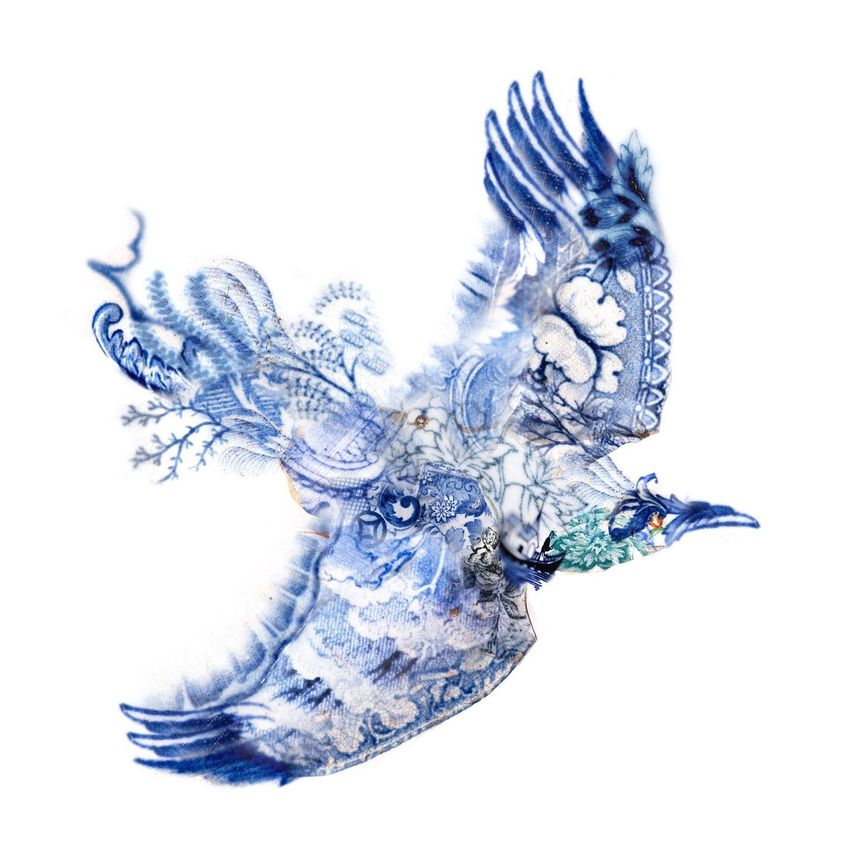
The illustrations are wonderful, full of layers of different blues, on some pages in broken crockery, and marvellously pieced together on the endpapers. Kids will love collecting their own pieces of blue to see how they can be fitted together and try mosaics for themselves.
In this lovely post, Lorena writes about how she created the stunning visual world of the book.
When Sophie asked if I was interested in working on Satin with her, she had barely finished her sentence before I said yes! I love working with her, and the story sounded so beautiful and intriguing. I also immediately had wonderful visions of all that blue… And it perfectly combined two things I’d worked with before. Some of my earliest montage work included shards of willow pattern plates, and I had also been doing a lot of work with cyanotypes, an early photographic process that has the most glorious blue emulsion. And the fact that Satin gathers objects to create his beautiful thing is exactly how I work too! It was perfect.
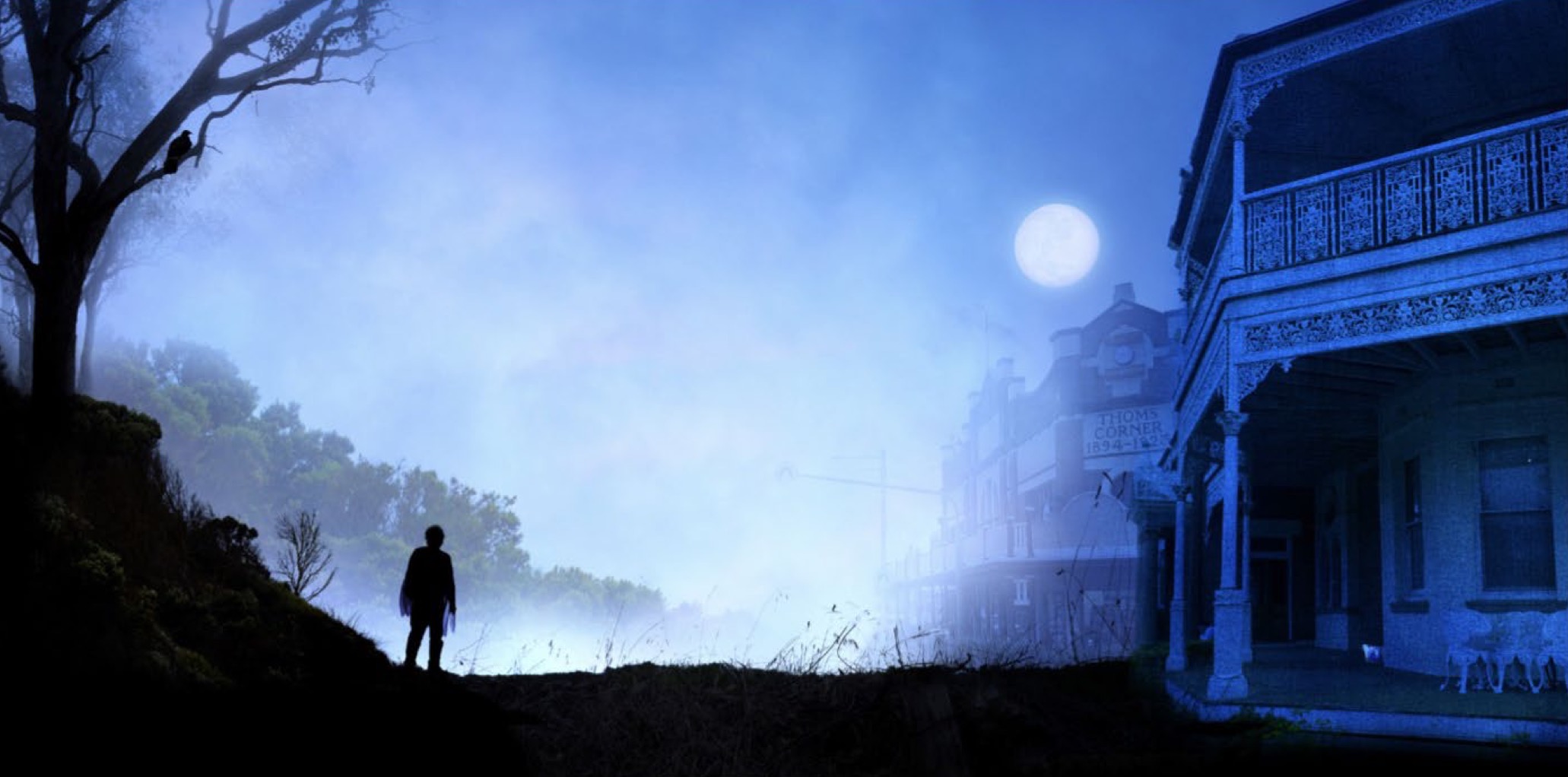
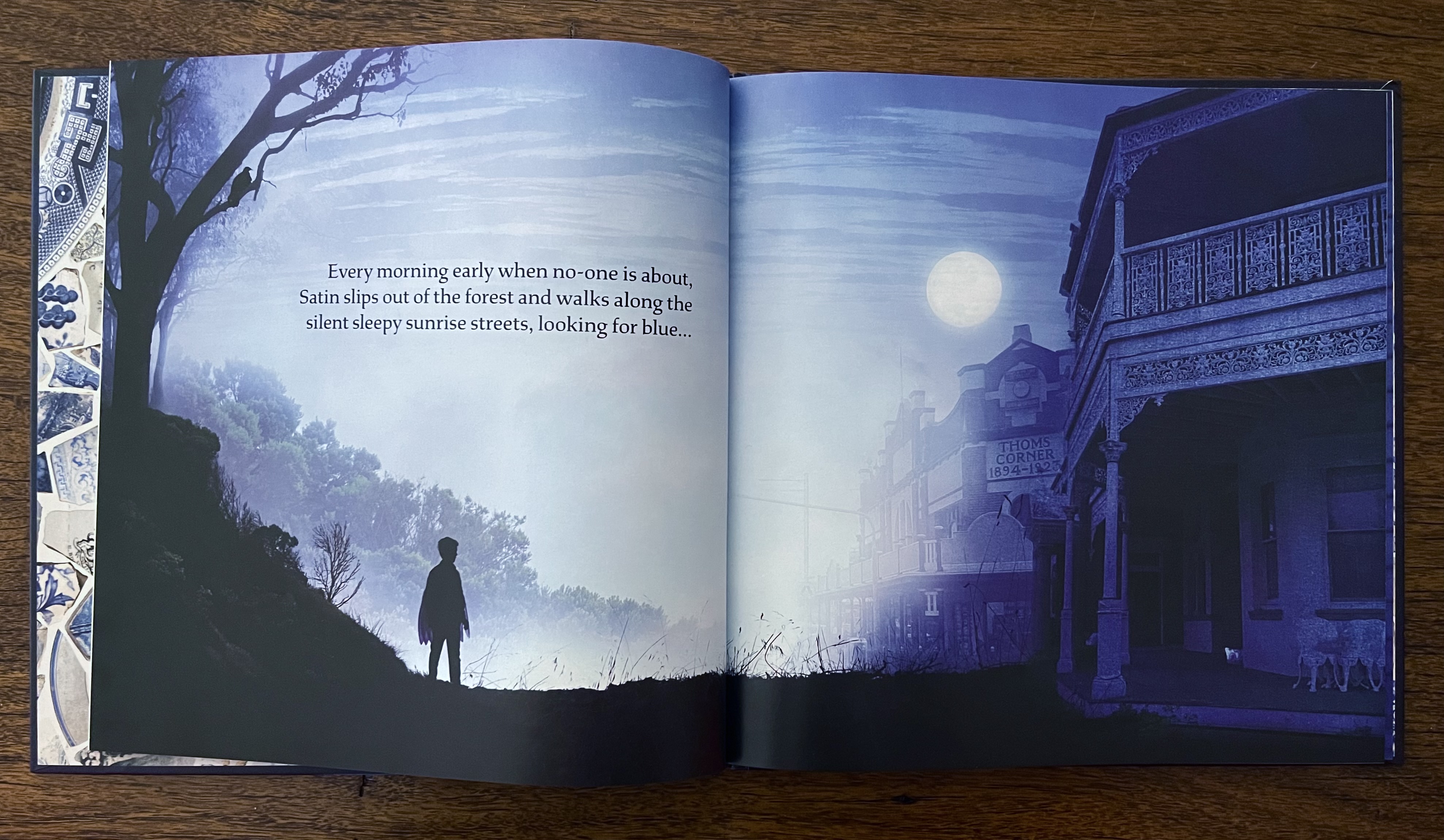
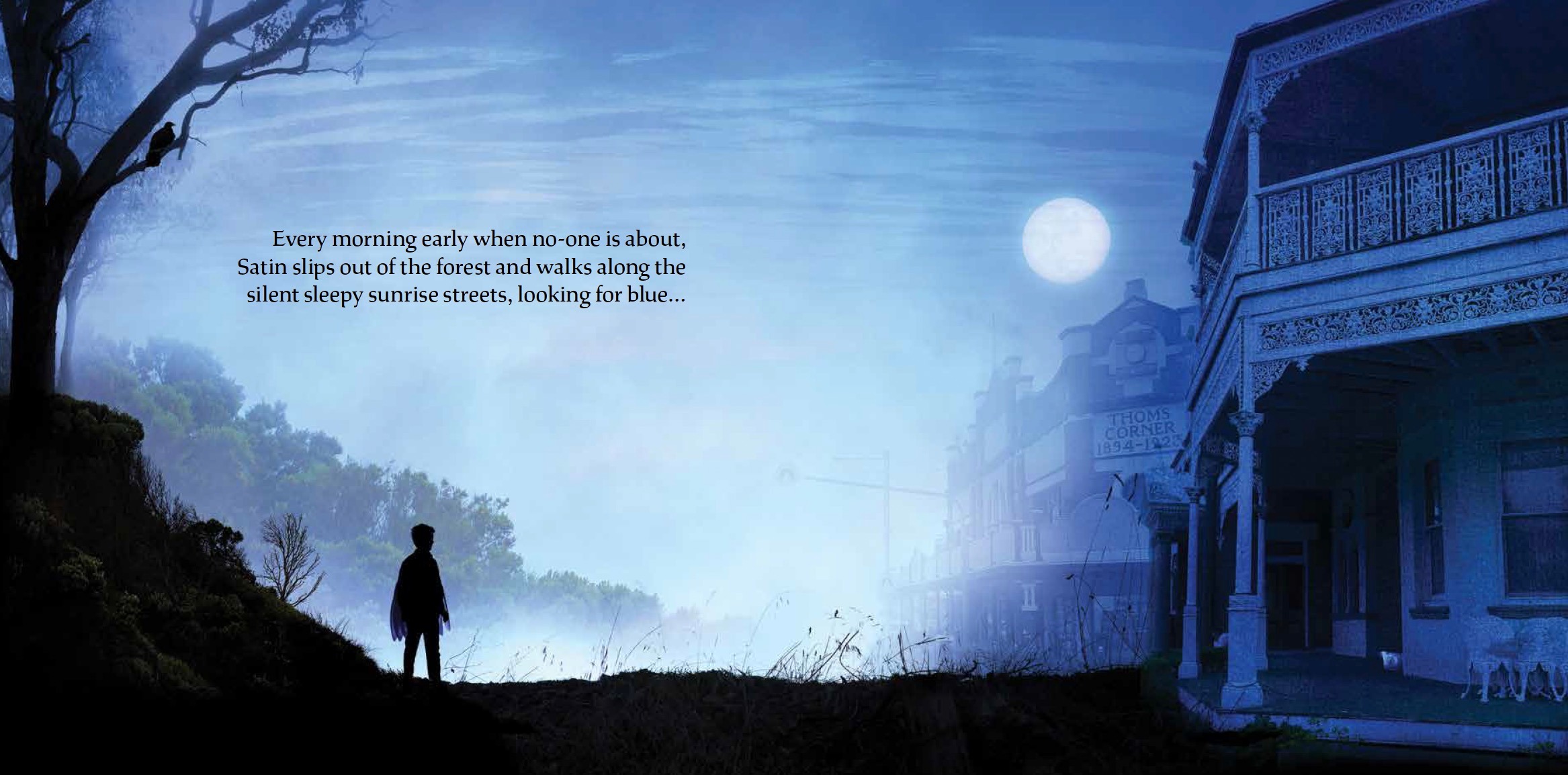
These are the first sample images I made for Satin, which we sent as part of our book proposal to the wonderful Anna at MidnightSun. They remain essentially unchanged in the final book, though you maybe be able to spot a few differences in the versions of the first image. As you can see, they are built up with layers of photographic images: the buildings, the silhouetted foreground landscape and figure, the bird, distant trees and the full moon against the misty sky… The pair underneath are more painterly. The elements are still photographic, but they are layered over a rich wash of painted cyanotype, giving a textured deep blue.
And here they are in the book:
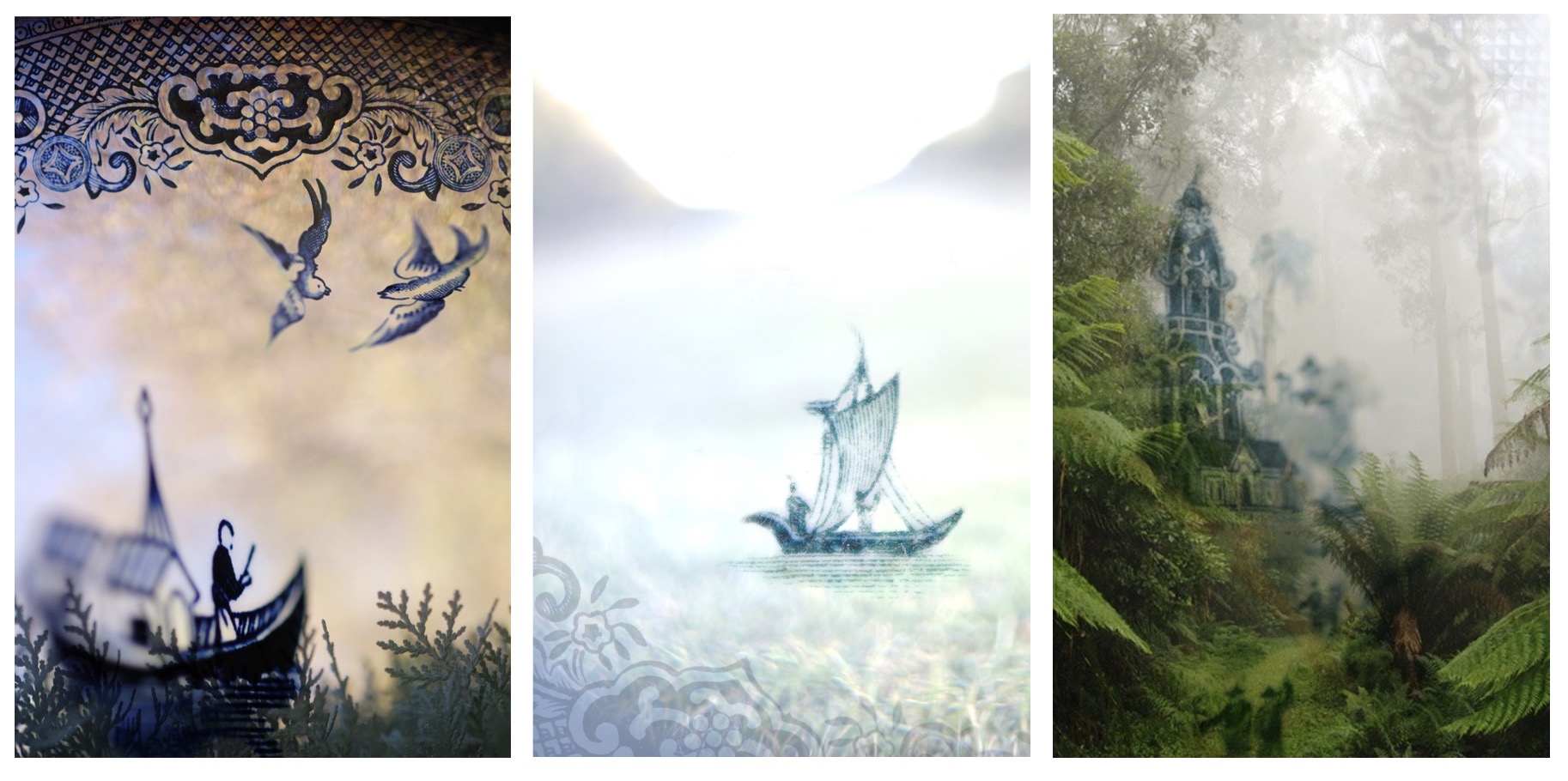
You’ll find many shards of blue china in Satin, many featuring the famous Willow pattern. Some of my earliest montage artworks were based around that same pattern. The images were made from shards of china I found in my backyard and the local landscape, and the landscapes themselves. Creating the illustrations for Satin felt like a delightful full-circle return to my early work. Here are three examples from around 2009.
The other slightly different element I’ve introduced to these illustrations, are splashes of painterly blue. The ‘paint’ is actually created with cyanotype chemistry, which is painted onto paper, and them exposed in the sun to create a rich blue. It’s wonderful cross between painting and photography, and lets you combine the two in wonderful ways. On this illustration spread, I’ve painted the splotches of blue, and digitally inserted the photographic elements.
I felt such an immediate affinity for Satin. He explores his surroundings, looking for interesting things, so that he can make something beautiful, which is exactly how I work, and Sophie’s extraordinarily beautiful prose made Satin such a pleasure to work on. I really hope you find inspiration and beauty in it too.
In just ten days or so, Satin, my picture book with Lorena Carrington, will be released by MidnightSun Publishing. And in anticipation of that, Lorena and I thought you might be interested to read about how the book came about, and what the process of creating it was like. Today, I’m talking about my side of it, how the text came into being, in one of those amazing, inspirational moments that are such a blessing in a writer’s life…
In May 2021, my husband David and I were travelling by car from our home in northern NSW on our way to attend the Bendigo Writers’ Festival in Victoria, a two-day journey from our place. It was somewhere on the road before we reached the town of West Wyalong that I suddenly glimpsed, on the side of the road, a bird with satiny, very dark blue plumage. Though I saw it for just an instant as we flashed past, I knew at once what it was—a male satin bowerbird. But what was it doing there, all by itself? Satin bowerbirds are shy, it’s not easy to see them, and they certainly don’t make a habit of hanging around near roads! I knew they like to collect blue things to decorate their nests: so had it spotted a special blue there?
In that moment, something else flashed into my mind, a title: Satin. I could see a character: a lonely young man, or was he a bird? Or both? Words began to flow onto my small travel notebook (I wasn’t driving of course!) By the time we reached West Wyalong where we were to stay overnight, I already had the glimmer of an idea for a special picture book text, and by the time we got to Bendigo the next day, that idea had firmed up.
When I met up with my friend Lorena Carrington in Bendigo, I excitedly told her about it. Lorena’s a wonderful illustrator and she and I had already worked on two books together, retellings of French fairy tales and medieval French Arthurian stories, and that had been a wonderful collaborative experience. I was very much hoping she might be interested in the idea of Satin—and to my delight, she was, at once! We started talking about how it might work: usually for a picture book you don’t have writer and illustrator together at the start, usually the writer sends in a text and the publisher then chooses the illustrator. But we just knew this book had to be with the two of us. And I had an idea who perhaps might be interested in such an unusual book…
After getting back home, I worked on the story, first in my bigger usual notebook, and then on the computer.
I then sent it to Lorena, who created some gorgeous sample illustrations. And then I contacted the wonderful Anna Solding at MidnightSun Publishing and told her about the book. She loved the idea and immediately wanted to see what we’d done. So we sent the text and the samples—and within a week, she got in touch. The MidnightSun Publishing team loved it and wanted to publish it. So exciting! And as we worked with the wonderful people at MidnightSun, and Satin’s world came to brilliant life in Lorena’s spellbindingly beautiful illustrations, I kept thinking of that moment when I unexpectedly glimpsed a shy blue-loving satiny bird by the side of the road. Pure magic, that’s what it felt like: and pure magic to see it developing into such a very beautiful, very special book.
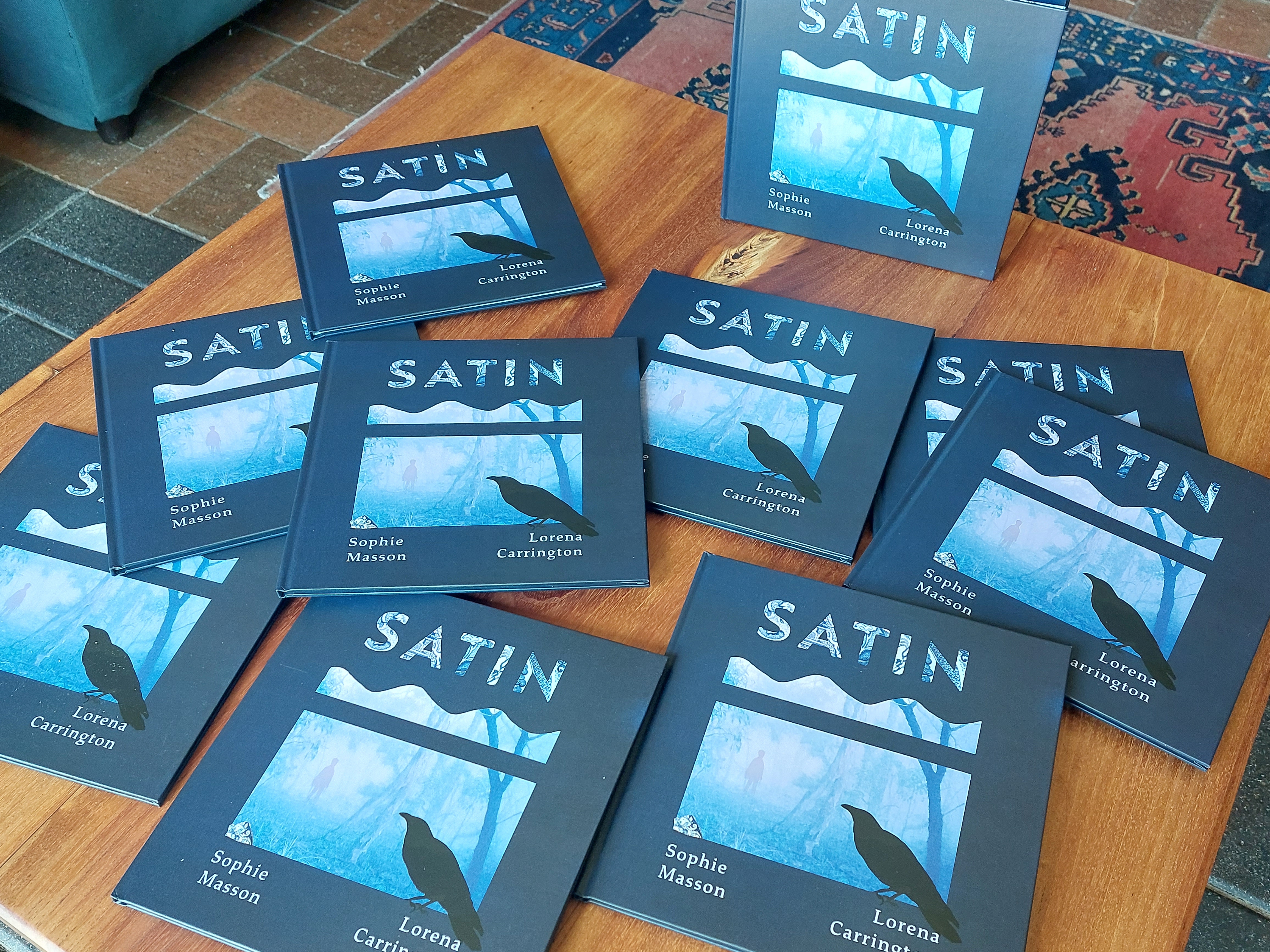
Lorena Carrington and I will be celebrating the launch of our picture book, Satin (MidnightSun Publishing)in Sydney on Tuesday March 14, 4pm at the lovely Better Read than Dead bookshop in Newtown. Lorena and I are both coming in person from our respective homes-mine in regional NSW, Lorena’s in regional Victoria–for it, and we’ll be reading the book, talking about how we created it, and of course signing books!
Everyone very welcome, children and adults, you just need to register(it’s all free of course) so the bookshop can have an idea of numbers. Here’s the link, to register.
I’ve had to sit on this super exciting news for ages, but now it’s been announced by the publisher, so I can announce it in my turn now!
In November 2023, my new novel for adults, The Paris Cooking School, will be published under my new pen-name of Sophie Beaumont, by wonderful Ultimo Press. It was acquired by them via my lovely agent Margaret Connolly, who has encouraged, supported and helped to inspire me every step of the way as I’ve been creating the novel. And it’s been an absolutely wonderful experience working with publisher Alex Craig and the Ultimo Press team, and I’m looking forward so much to the rest of the process!
This is a book that I have so loved writing, which has taken me in a new and exciting direction in terms of my writing, a delicious novel about love, hope, second chances–and food! And it’s also a love letter to the most beautiful city in the world.
Here below is the publisher’s announcement. I’ll be writing more about the book as the months go on, and starting a special page for it on this blog too, but in the meantime you can follow the Paris Cooking School on Facebook and/or Instagram, where I’ll be posting news, pics, bits and pieces.
The official announcement from Ultimo Press!
Oh la la, do we have a delicious novel on its way to you 🍓
It was impossible not to be enticed by The Paris Cooking School by Sophie Beaumont. It’s a treat for the soul – a delectable novel about love, hope and the consolations of the perfect strawberry tart.
Sophie says, ‘I love Paris. It’s as simple as that. Steeped in history, yet fresh as morning bread, elegant as spun sugar yet earthy as onion tart, it’s a city of delicious contrasts and magical charm. It’s also a place of potential and possibility: the perfect setting for a story of second chances. And of course, there’s the food! I loved writing this book so much: and I hope readers love it too.’
Publisher Alex says, ‘The Paris Cooking School is a sheer delight, and I couldn’t be happier working with Sophie on a gorgeous novel set in a city she knows inside out. Following three women’s stories during a springtime in Paris, this novel is for anyone who dreams of the what-ifs and second acts, escaping to the City of Lights, and learning to cook the French way.’
This piece of mine, about one of my favourite childhood books, was published in the wonderful books magazine, Slightly Foxed, in issue 18, in 2008. I know a lot of people share the same fond memory of Nicholas Stuart Gray’s gorgeous book, The Stone Cage(and his other lovely works) so thought I would republish it here, as a new year’s gift. Hope you enjoy!
Nicholas Stuart Gray
by Sophie Masson
first published in Slightly Foxed, issue 18, 2008.
If you were a bookworm as a child, your memories are measured not only in family or school or public events, but in stories you read. You remember vividly the smell, the touch, the sight of certain books. You clearly remember picking them up from the shelf—an ordinary act—and then the extraordinary happening, as you open the book and fall straight into another world. The pure pleasure of it, the immediate liberation. For me, who loved fairytales and fantasy, who longed to go through the looking-glass, the wardrobe, stepping through the borders into another world, where anything might happen, it was also a blessed escape from the confusing, disturbing and tumultuous family dramas that dominated my childhood. In those stories of other worlds, I found pleasure and consolation, transformation and possibility. And I found my own calling as a writer.
It can be dangerous revisiting those important, beloved stories, as an adult, for it’s not just a book that might be found wanting, but memory itself. And yet, when it works, when the barriers of time dissolve before the sheer magic of a real storyteller, it is probably the most thrilling experience a reader can have.
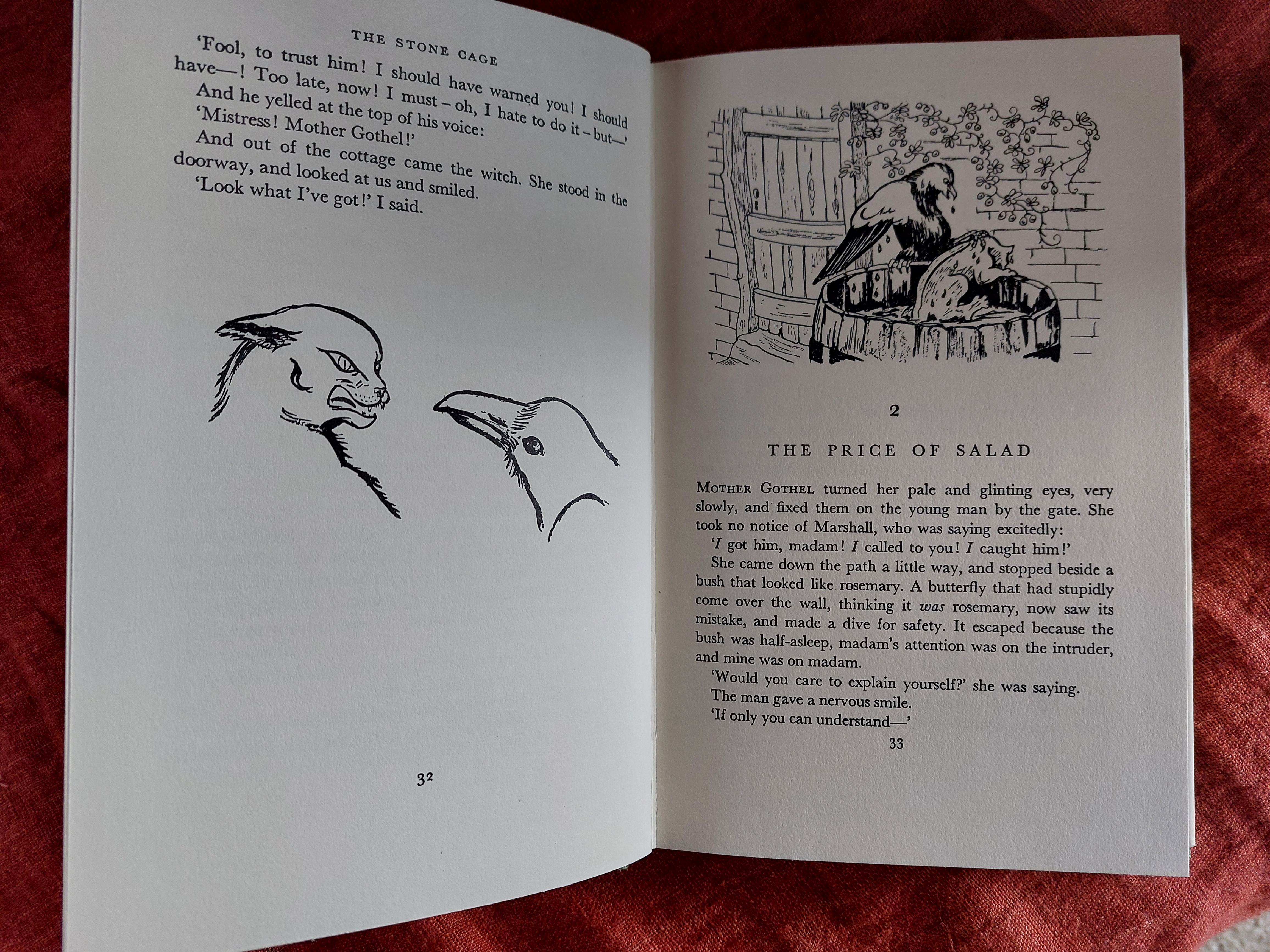
The Stone Cage, by Nicholas Stuart Gray, was one of those books that I remember clearly not only because they were so good to read, but because they were also so influential on me as a developing writer. Picking it up again after a gap of more than three decades was one of those magical moments that made me rediscover not only my childhood self, but also the reason why the book stands out in my memory. For from the very first sentence, you are plunged into a briskly unsentimental fairytale world, tartly guided by Tomlyn the witch’s cat:
Ever heard of a ‘dog’s life’? I’ll bet you have. Everyone has. Means a low, miserable kind of life. Full of kicks and curses, and nothing much to eat. I don’t know, I’m sure—what about a cat’s life, then? There’s not much said about that, is there? Nine lives, yes—but what sort of lives are these supposed to be? I’ll tell you the sort I had—a dog’s life.
I have to admit it isn’t every cat who lives with a witch, though.
And what a witch! Bad-tempered old —! No, it’s not fair to a cat or she-dog, to liken her to one of them. Let’s say she was a bad-tempered old beldam, and leave it at that. She hated people. She hated Marshall, her raven. She hated her bats and her toads. She hated me. Sometimes I think she even hated herself. A great old hater, was madam.
A naïve young stranger intrudes on this loveless, isolated mini-dictatorship, and is forced to pay a terrible price for his presumption, as he must give up his only child to the witch. And so the poor child is taken from her parents and put into a world where no-one trusts anyone else, love isn’t allowed to exist, and bitterness and cruelty reign. But all is not lost, for this is a very special child indeed, who will achieve an extraordinary miracle, greater than the greatest of spells, greater even than the most malevolent hatred.
As I read, I was swept along, just as in childhood, on the irresistible tide of a gripping story that for all its wit, humour, accessibility and clarity is also a compassionate, tender and complex evocation of the transforming power of love. But it’s certainly not all sweetness and light. Going way beyond a mere retelling of the fairytale of Rapunzel, on which it’s based, The Stone Cage reaches deep into the darkest, most painful aspects of life, as well as its most beautiful and joyous. In the way of the best children’s literature, it attains a profundity that’s all the more remarkable because of its sheer lucidity and unpretentiousness.
I finished The Stone Cage exactly as I’d done all those years ago: with tears in my eyes, and a thrilling heart, for the book also ends in one of the most perfectly judged, moving yet unsentimental scenes of its kind. Allied to my renewed love was a keenly increased admiration for the artistry of the author, which had easily stood the test of time. The characterisation is superb, the dialogue crisp, the pace good, the combination of light and dark subtly achieved. And the beauty of the style! Fluid, graceful, it is humble—in that it doesn’t draw attention to itself—and yet it’s fresh, distinctive, individual. The Stone Cage had been so important to me because everything in it worked. It was all so natural, so flowing, so multi-layered, its world richly imagined, yet delicately evoked. It was a real masterpiece, a novel just about perfect both in concept and execution, and timeless in its appeal, a novel that should have just as many young readers now as it did back then.
Aye, there’s the rub. For The Stone Cage is out of print, and has been for a long time. In fact, and rather astonishingly, in a culture like Britain’s that generally does value its children’s literature, all of Nicholas Stuart Gray’s books are presently out of print. Beautiful, original and accessible though The Stone Cage, Mainly in Moonlight, Grimbold’s Other World, Down in the Cellar, The Seventh Swan, and his other works are, they are unobtainable except through second-hand shops and the Internet, although some are still in libraries. It’s not as if modern children don’t like them, or don’t understand them, either; I know of lots of young readers who, introduced to Gray’s books by their parents, have loved them just as much, and have found them just as easy to read. It’s not as if there’s anything dated or offensive in them, no obvious or hidden misogyny or racism or class stuff or anything like that. There is nothing really to properly explain this puzzling situation, other than that they’ve simply been overlooked.
And yet, Gray’s work has deeply influenced many of today’s writers working in the fields of children’s literature and of fantasy—Garth Nix and Neil Gaiman and Cecila Dart-Thornton, for instance. I’m certainly not the only reader-turned-writer to remember Gray’s books with great love and respect. Australian children’s novelist Cassandra Golds, author of the acclaimed Clair de Lune, wrote to me about the huge impact on her of one of Gray’s books, Down in the Cellar :’I will never forget the Sunday afternoon on which I finished reading it. I remember feeling a kind of mysterious desolation, partly because I’d finished reading it and would never be able to read it for the first time again, but partly also because I KNEW I had now read the best book I was ever going to read. And I felt, then and still, that the only possible response to that experience was to become a children’s author myself.’ As an eighteen year old, Cassandra had written the author a fan letter, and she still treasures his modest, graceful reply, in which he said, amongst other things: ‘As all my books and plays are only written for myself and not for any imagined audiences, readers, age-groups, publishers, etc, it is always a delightful surprise to get proof that anyone BUT myself ever reads or sees them..’
Perhaps that answer gives a clue as to why Gray’s work is not recognised as it should be. This was not a man who blew his own trumpet, not a writer who sought publicity, but one who loved his work and felt privileged to be doing it, and who was too humble to thrust himself forward. Who was perhaps also at heart a rather private, reserved, even secretive person, despite his long association with theatre, which many people would consider the home of trumpet-blowing, egotistical extroverts. Certainly, when I went to research his life, I found precious little information.
Nicholas Stuart Gray was a Highland Scot, born in 1922, the eldest of four children. As a child, he wrote stories and plays for his siblings. Not one to bend easily to the routines of school, he left at the age of fifteen, to become an actor. He kept writing as well, and his first play was produced two years later. His first children’s play to be published was Beauty and the Beast(1951), and from then, he wrote and produced a good many plays for children, before turning his hand to novels and short stories(where I think his true gifts flowered). Some of his novels, like The Stone Cage (1963), he also adapted for the stage: he told Cassandra Golds that he himself played Tomlyn in the play’s premiere at the Edinburgh Festival and its subsequent successful seasons in London and on tour. (That would have been something to see! ) He never married or had children. His plays fell out of fashion, but his novels and short stories continued to be published until his untimely death from cancer in 1980, and right into the late 80’s, we were still seeing frequent reprintings of his books.
But in the last fifteen years or so, there have been no more new editions. In this new Golden Age of children’s literature, it’s more than time to bring his books back so that a whole new generation can fall under their spell. Any publishers out there listening?
As a present-day coda to the end of my piece: as I mentioned in the article, second-hand copies of The Stone Cage are not easy to track down–and I’m certainly hanging onto my own beautiful hardcover copy, found by chance in a secondhand bookshop in Oxford some years ago . So it always astonished me that The Stone Cage hasn’t been republished, but when, five years ago, on behalf of the little publishing house I’m involved in, I made enquiries as to who might own the rights, it appeared that no-one was actually sure what had happened to them. Gray had no direct descendants, though he did have extended family, but a letter to an address I was kindly given by the ALCS (Authors’ Licensing and Collecting Society) in the UK went unanswered.
The rest of the program is great too, with sessions on true crime, historical fiction, how to get a book project back on track, and more. See the full program here. Concurrently with the Festival also is the High Country Writers’ Retreat.
I am so looking forward to the publication next year of Satin, my forthcoming picture book with the wonderful illustrator Lorena Carrington, to be published by MidnightSun Publishing in March 2023. I am really excited about this book, which came about in the most magical way (which I’ll write about in another post, later), and which I think is going to be just loved by both children and adults.
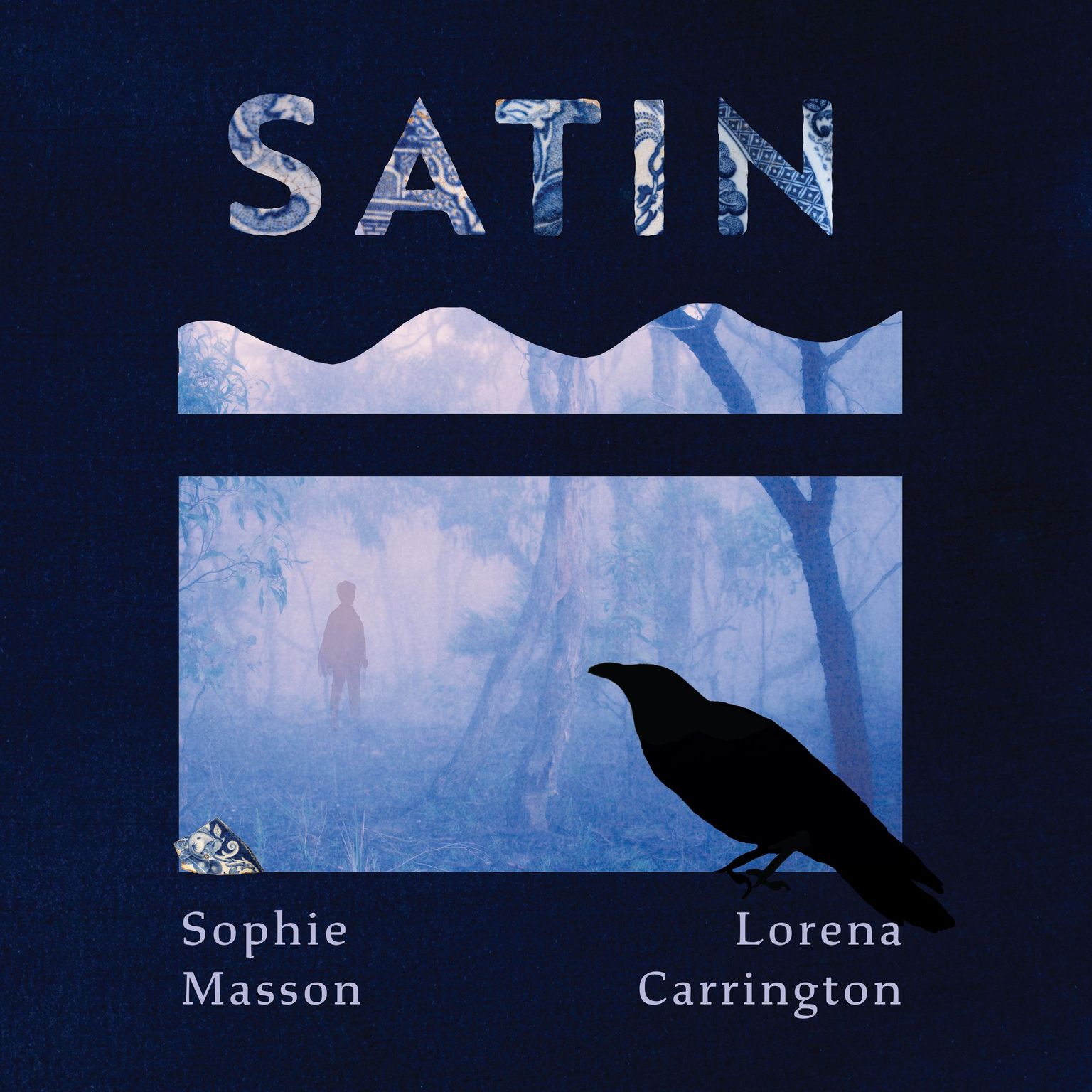
Here’s the gorgeous cover:
And here’s the blurb:
Every morning early, when no-one’s about, Satin slips out of the forest and walks along the sleepy sunrise streets, looking for blue…
He’s collected all kinds of blues, from all kinds of places. He’s making something beautiful, with all those blues. But something’s missing, and he doesn’t know what it is. And then, one day, he comes to a street he’s never been in before. And what he finds there will change his lonely life forever.
A beautiful, haunting fable by award-winning writer Sophie Masson and acclaimed illustrator Lorena Carrington.
Lorena’s exquisite, superb creation of Satin’s visual world is just stunning in its depth and beauty, conveying a mix of natural enchantment and human warmth which goes right to the heart of the story. (Below is a sneak peek at the first page spread)
I am so happy that Lorena is co-creator with me on this gorgeous book, and so happy too that it was taken on by such a wonderful publisher as Anna Solding of Midnight Sun.
I thought readers of this blog might enjoy my latest post around the craft of fiction, reposted from the wonderful site Writer Unboxed. This one’s on food in fiction.
In life, people’s days are punctuated by meals. Food is an important part of our lives: of course, we need it for survival, but it’s much more than that. It’s pleasure, it’s penance, it’s anxiety, it’s joy—depending on our relationship with it. Eating together or alone, eating at home or out in restaurants and cafes, eating on the go or around the family table: it’s all part of the fabric of human life, all over the globe.
And in fiction? Well, it always used to puzzle me, as a kid, when people in books never stopped to eat or drink or you never got to hear what was for lunch, if it was mentioned. For me as a child, it was important to know: my diary as a twelve-year-old is full of mentions of the delicious things my mother had cooked up for us that day, or the yummy thing I’d bought at the school canteen that day (which my mother would have considered rubbish) or, conversely, the yuckiness of something I’d been made to try by a friend, such as vegemite—an Australian classic but not to my taste. Sure, I’m from a French background and food was intensely important in our family, but we certainly weren’t alone in that. To read a story in which there was no mention of food at all seemed odd. But to read one in which exotic delights like ginger pop (as in Enid Blyton) were mentioned—often!—was such fun. I had no idea at the time what ginger pop was but it sounded exciting, like the adventures the Famous Five or Secret Seven went on. And when Edmund, in The Lion, The Witch and the Wardrobe, is offered endless Turkish Delight by the White Witch to bribe him to betray his siblings, I was horrified, but understood. Hard to resist Turkish Delight! Growing up through adolescence and into adulthood, I never lost my interest in food and cooking, and never ceased to wonder why in some novels, people seemed to exist on air.
When it came to writing my own books, that was never an issue. Food always appeared, whether glancingly or more substantially, in both my fiction for young readers and for adults. Sometimes it was just for the sheer pleasure of the description, sometimes to evoke an atmosphere, sometimes to symbolize something about a character. I couldn’t imagine leaving it out altogether. In my recent adult novel, for example, A Hundred Words for Butterfly, which is set in the French part of the Basque country, where my mother’s family is from, food functions very much too as an expression of an ancient, distinctive culture and landscape, as well as illuminating certain aspects of family. If you’re interested, the publisher produced a lovely, free digital magazine which featured some of my Basque family recipes as well as entries from a microlit competition they ran, as part of the publicity for my book.
Right now, I’m working on another adult novel in which food—and especially the creation of dishes and meals–is absolutely central, indeed a crucial part of the characters’ emotional journey. That’s a challenge in itself: because of course you can overdo it. You can cook up too rich a stew, you can overwhelm the senses with too many smells and tastes, you can nauseate the reader with too much indigestible detail. You can’t be too self-indulgent; but equally, you can’t be too restrained. It’s a fine line to tread.
I’d read recently a number of contemporary novels which featured food as a central theme—ranging from Jenny Colgan’s Meet Me at The Cupcake Café, to Erica Bauermeister’s The School of Essential Ingredients to Amy Tan’s Joy Luck Club, and others, all of which handled the food theme adeptly and enjoyably and with great diversity too. They all showed something important to me as a writer: in a time when people watch cooking shows for fun and cookbooks sell like, well, hotcakes, at the same time there’s less time for many around the actual stove or table. Getting the balance of ingredients right in a food-themed novel is more important than ever. Sure, they’re about dreams, escape, pleasure: but also about being grounded, about rediscovering simple things, about the basic human joy of creating something delicious that for the enchanted space of a good meal might unite us all.
Delighted to see a wonderful review of Inside Story (for which I was one of the principal writers and compilers) in the latest issue of the prestigious children’s literature publication, Magpies Magazine. See below.
There’s also, in the same issue, a three-page interview with me and Kathy Creamer, another of the main writers/compilers, about how the book was created and produced. Not available online, but you can check out Magpies Magazine subscriptions here: for anyone interested in Australian and New Zealand children’s books, Magpies is an absolute must!