The Mirror of Honour and Love: a woman’s view of chivalry

I’ve always been interested in the Middle Ages, especially the chivalric period between the 12th and 15th centuries, and wrote this essay some years ago, after the publication of my historical fantasy trilogy, The Lay Lines Trilogy,  released in an omnibus edition as Forest of Dreams. The trilogy was inspired by the shadowy life and extraordinary work of 12th century writer Marie de France, one of the writers mentioned in this essay. I’m republishing the essay today and hope readers find it interesting–and with some relevance to our times as well!

THE MIRROR OF HONOUR AND LOVE:
a woman’s view of chivalry

by Sophie Masson


Chivalry. Isn’t that a bloke’s thing? Isn’t it do with being a man-at-arms, with strapping on armour, and sallying forth into the wildwood on your horse, your lady’s token on your arm, to right wrongs and do great deeds? Isn’t the only role of the woman in chivalry to be the inspirer, the Muse of a paragon of the knightly virtues? Well, yes–and no. Chivalry was much more than that. And its ideals encompassed both sexes, actively.

As the French-derived term chivalry indicates–it is originally from chevalerie, meaning horsemanship, literally–it came about as a means of codifying and disciplining a mounted order of military types. Mounted men-at-arms–knights, in the English word, which by the way derives from the same root as knife, referring to weapons–could be a damn nuisance in the early and later Middle Ages. The way they were regarded by many people is perhaps best summed up in the German proverb, Er will Ritter an mir werden; ie, he wants to play the knight over me, ride roughshod over me. That is, these mounted men were regarded as tyrannical bullies, delinquents and pests. That they were more often than not is indisputable; a combination of young man’s energy, a lack of efficiently centralised civic or moral teaching(the State did not really exist, and the Church struggled mightily to tame the warriors for centuries), and the fact that on a horse you could quickly get away from the scene of your crimes, mixed with a kind of carte blanche, a blind eye turned to your hi-jinks by the man–or woman–who paid your wages when you were at war with their rivals or enemies(but cut you loose when they didn’t need you, leaving you to fend for yourself), made for quite a potent little cocktail of public nuisance. The Middle Ages was a young person’s period; though many people did live on into old age, the average age of death for a woman was thirty-three; for a man, especially a knight, it was under thirty. The often wild energy, idealism and exaltation that characterises medieval culture comes from that demographic fact. This was real youth culture.

But as time went on, and the disorder of the post-Roman period, the invasions, and the Norman adventures receded, and prosperity and peace descended in Europe, due to some kind of balance being precariously achieved, more attention was being paid to the fact that the youth had not only to be kept in line, but also to be given a channel for their energies which would make them both more productive, and more disciplined. Added to that was the change in peacetime culture, particularly in England and France, with women becoming more prominent again, able to provide a guiding hand. Modern people all too often view the Middle Ages through distorting mirrors; and one of the most distorting is the idea of medieval women’s position. In fact, it is probably true to say that women in the Middle Ages, especially after about the eleventh and up to the fifteenth centuries, enjoyed a level of relative freedom not equalled until the twentieth. The fall of Rome had also made many of her laws recede into the distance, slowly; Roman statute law was notably more misogynist than the customary law of the tribal groups the Empire had conquered. Celtic and Germanic women enjoyed a degree of freedom that scandalised the Romans: perhaps the greatest and most serious of the rebellions against Rome in Britain occurred when an arrogant Roman governor flouted the realpolitik of his masters and cut across British customary law by refusing to ratify the awarding of the chieftainship of the Iceni to the widowed Queen Boudicca, or Boadicea.

Now as the Middle Ages advanced and people forgot about Roman law, or cheerfully ignored it, opting instead for a mixture of old and new in their customary law, so the position of women improved. Please don’t think I’m talking modern feminism here. Medieval society, like pre-Roman society, was one of kinship and hierarchy(which is NOT the same as class, by the way). If you were related to the right people, if you were part of the clan, you had a right to exercise the rights given to you on that basis, no matter what your sex. So women in the Middle Ages, as in the Celtic and Germanic worlds, could openly be chiefs, could command armies, run huge estates and businesses, inherit and so forth, in a way that women in Roman times and women in the Renaissance–which rediscovered Roman law and reinstated many of the old ways, including the institutionalised repression of women–could not, or only do through subterfuge. The thing was that medieval people recognised custom, and its pre-eminence; kinship, and its inextricable centrality; hierarchy which meant that everyone had a place but that people could move between them, in case of great personal merit (eg there were quite a number of serfs who became knights).

What we now think of as chivalry came out of that world. It began, as a codified idea, in the twelfth century, in the courts of two famous and talented and powerful women of the time: the extraordinary Eleanor of Aquitaine, and her daughter, Marie of Champagne. Eleanor was a force of nature, a brilliant figure whose true stature is only now being rediscovered. Sole heir to the vast lands of Aquitaine, the teenaged Eleanor married the pious, shy Louis VII of France, who was no match for her wilfulness and talents. She went along with him on Crusade, as an important person in her own right, had several children with him, including Marie, then tiring of him and his font-frog ways, and infatuated with the younger, sexy Henri Plantagenet d’Anjou, a.k.a. Henry II of England, she concocted an excuse to get rid of Louis. She even managed to persuade the Pope to grant her a annulment on the basis of too-close kinship to her former husband, and so, despite having had several children with Louis, was able to enter into legal marriage with Henry.

Effigy of Eleanor of Aquitaine on her tomb in Fontrevaud Abbey in France.

She and Henry were a match for each other, but too much so in many ways; though they had six more children, and for a long time had a strong relationship, Henry’s roving eye and bad temper, and Eleanor’s sometimes arrogant pride proved the undoing of a partnership that had had all Europe enthralled. During the happy times, she ran her own court separately in Poitiers, and was the patron of artists, poets, musicians and philosophers. It was at this court, and at her daughter Marie’s in Champagne that the codes of chivalry and of courtly love were established, in close contact with the great ladies, and a flourishing literary and social culture was born. Eleanor and Marie were aware not only of the delinquent tendencies of knights, but also of the boredom of ladies–and of the many sexual adventures that went on. They would encourage the concept of a new form of chivalry, which would not only emphasise prowess in arms and great deeds, as had been the case in the past, but also the great adventure of love, the way that it helped in the journey to self-knowledge and integration. It would mean that women would have a central part in the culture, as muses and inspirers certainly, but also as honourable beings in their own right.

Secular Woman in Romance, and Sacred Woman, the Madonna, dominated medieval culture from the twelfth century, in the process turning a rather rough and ready culture to a most beautiful, subtle and richly patterned one. As well, contact with the East meant that philosophy, astrology and astronomy, and the natural sciences in general, flourished.

So, what were the distinguishing elements of chivalry? I have devised a list of the Seven Qualities of Honour, gleaned from various medieval books, qualities which were firmly to be sought after by both men and women. These are:

Franchise, or frankness(ie openness of mind and honesty); Pitié, or Compassion; Courage; Courtoisie, or Courtesy; Sagesse, or Wisdom; Largesse, or Generosity; and Temperance, or Moderation. As is obvious, these were not sex-limited characteristics. Within those seven qualities, we can get a sense of the characteristics admired by twelfth century medieval culture. Hotheadedness was to be restrained; greed and avarice, always pet hates of the times(and major problems)cast into the darkness; ignorant yobbo behaviour firmly rejected. Respect for the other, and for oneself as a growing soul is iabsolutely ntrinsic to the chivalric tradition. It is intended to carry through into all aspects of one’s life; at its best it is truly impressive. It is pointless to keep saying, as some modern writers do, that the ideal wasn’t always lived up to; what ideal ever is? The fact is that this ideal genuinely changed a whole society, and laid the groundwork for many other social developments in the future.

Writers like Chrétien de Troyes and André le Chapelain–or Andreas Capellanus, as he’s often known–wrote books demonstrating and portraying the new ways of being and relating between the sexes: incidentally also changing the face of literature(the romance being the true ancestor not only of the novel in general but of fantasy!) As time went on, more and more writers, inspired by the beauty and depth of the ideas embodied within the notions of chivalry, explored it in ever greater depth. Many of these (in the main) male writers saw Woman as Muse: whether spiritually as well as romantically, like Ramon Llull, for instance, or practically and realistically, like Godefroi de Charny (both men wrote books on chivalry which are still in print today). Of course, there were also those who fought hard against the new works and their implicit validation of women as real human beings, worthy of respect,

a manuscript of Le Roman de Renart, held in the Bibliotheque Nationale de France.

true love, and even adoration. Such a one was Jean de Meung, writer of Le Roman de la Rose, or Romance of the Rose, which especially in its second part is an anti-woman diatribe, and the mostly anonymous authors of the cynical, savagely amusing and often obscene Roman de Renart, or The Romance of Reynard the Fox, an extraordinary anthromorphic ‘novel ‘ in many episodes, which in many ways could be seen as the anti-romance. (Mind you the Roman de Renart is something of an equal-opportunity offender, satirising both men and women)

Between idealism and misogyny, though, there were also those who saw women as equal partners in the great journey of life, and of the quest for honour, and the development of the soul that chivalry represented. At least two of those writers were women: the twelfth century writer Marie de France (not the same person as Marie de Champagne, incidentally!)and the early fifteenth century Christine de Pisan. Marie wrote fiction: lais, or lays, narrative poems, romances based on Celtic motifs, full of love, magic, humour and adventure. But Christine was a non-fiction writer, who wrote hugely popular and influential books on the achievements and behaviour of women. Some of these were intended as self-help guides; others as witty and fierce ripostes to anti-woman propagandists. Two of her books, La Cité des dames, or City of Ladies, and its sequel, The Treasury of the City of Ladies, examine at length about the ways in which women achieve honour and respect, and the ways in which the chivalric code can be applied to everyday life.

Let’s have a look at some of the things these women writers said. Marie, who has a rather salty tongue and sardonic eye and ear for the way people behave, is particularly preoccupied with love and the different ways in which lovers act. She firmly tells her audience that chivalry and courtliness are about real things, including sexual things, and that hypocrites and coy flittergibbets are without honour:

The professional beauty will mince

and preen her feathers, and wince

At showing she favours a man,

unless it’s all for her gain.

But a worthy lady of wisdom and valour

will not be too proud to show her favour

and enjoy the love of her man

in every way that she can.

(this quote is from Marie’s poem Guigemar–the translation is my own, you can find it in Forest of Dreams).

Marie’s outlook is that of an upper-class medieval woman, fluent in several languages, moving easily around Europe, sure of her place and independent within it. She roundly chastises those snooty critics from her time who say that what she writes about is not serious literature, or that it is immodest, or ‘untrue’, because it has magic in it. (Such wet blanket critics still exist in our time of course!) She is very concerned with female honour, and makes it quite clear that women must show as much courage, courtesy, generosity, etc, as men. She has several examples of female characters who run a love affair from beginning to end, fight, travel, and so on; just as she has a female character, werewolf knight Bisclavret’s merciless wife, who is punished severely–not for being a woman but for being faithless. This savage justice is equally meted out to men who transgress the code.

Women really did live by this code; there are numerous examples of women left in charge of large estates who faithfully and bravely mounted the defence of those estates against the enemies of their house, and were praised for it by chroniclers of the time. Medieval people had a horror of treachery and cowardice; the two were often felt to go hand in hand. The fact you were a woman did not absolve you from keeping to the ideals of chivalry, in times of crisis and in your ordinary life. And in her fiction, Marie demonstrates clearly both the complex realities of medieval life, and what was considered honourable for both sexes.

From the twelfth to the early fifteenth is quite a jump. We come here to the tail-end of the code of chivalry–we have been through the culture-shaking hideousness of the Black Death, and are close to the shift in thinking represented by humanism and the Reformation. In this climate, propaganda against women was growing, though some of the old chivalric spirit remained and indeed never went away altogether. Women of all backgrounds were still very much in evidence in ordinary life, in all kinds of ways; the cruel Roman-derived statutes, which wiped out many customary rights of inheritance and divorce and so on, had not yet been applied.
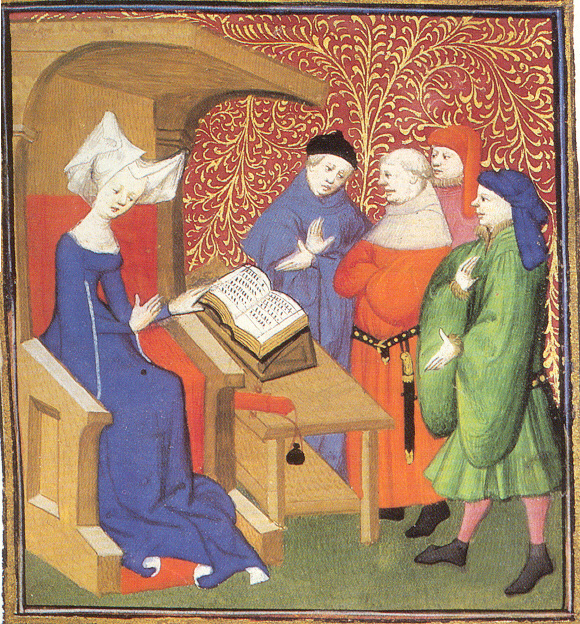
Christine de Pisan presenting her work, from a painting of the time

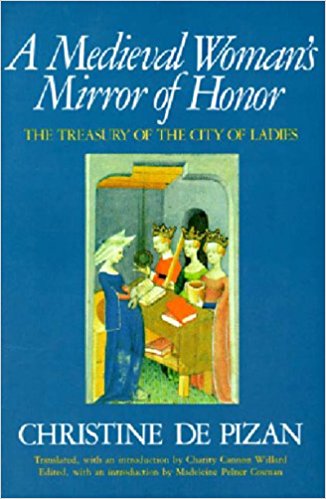
Christine de Pisan, a prolific and indefatigable writer who proselytised tirelessly for the recognition of the talents, achievements and potential of women, gave her advice and insights in the form of allegory and exposition. She was enormously influential and popular; her own life story is an inspiration. Left a widow at a young age, with small children to support, Italian-born Christine launched into a professional career as a writer in early fifteenth-century Paris. She was not one to bite her tongue, but took part vigorously in many of the intellectual debates of the day, her sharp intelligence, comprehensive education and refusal to be beaten thrilling her fans and infuriating her enemies. She launched into a lively denunciation of the anti-woman Romance of the Rose, pointing out tartly the many faults in its logic and its humanity, and La Cité des dames was conceived as a direct riposte to Jean de Meung’s jeremiads(The Romance of the Rose still being popular in her time. ) In the book, she used the device of three allegorical figures: Dame Reason, with her mirror of self-knowledge, the ‘mirror held up to nature’, as she called it; Dame Rectitude, with her rod of peace; and Dame Justice, with her cup from whence she pours out stability and equilibrium, to frame a discourse in which a ‘City of Ladies’ can be constructed, which allows women to fully develop their talents and potential. In so doing, she refuted many of the criticisms of women made by contemporary writers, and highlighted the achievements of women in many areas. The sequel, The Treasury of the City of Ladies (republished a few years ago, in English, as The Medieval Woman’s Mirror of Honour), was more of a self-help and advice book, tailored not only to aristocratic women but to women of all social backgrounds, from rich merchants to poor cottage women. The thrust of her argument is that, in order to act honourably, women do not need to fight against nature, but to follow selectively and intelligently the dictates of their truest selves. Real self-knowledge and respect for others, so central to chivalry, is also the centre of Christine’s words to her readers, the armour she advises them to put on to sally forth into the great adventure of life. From it grow all those qualities of honour, from courage and generosity to openness of mind and temperance, compassion and courtesy–and the result is true wisdom. For that was the aim of chivalry:  a way of reaching one’s own fullest potential as a human being, but always tied in to the presence, the needs, and the worth of other people too. Chivalry, both male and female, recognised that each of us is, indeed, our brother’s or sister’s keeper–but also courageously responsible for our own actions. It is an ideal which is of increasing and urgent relevance in the world we live in today.
 

Fairy tales, history and collaboration: an interview with Kate Forsyth

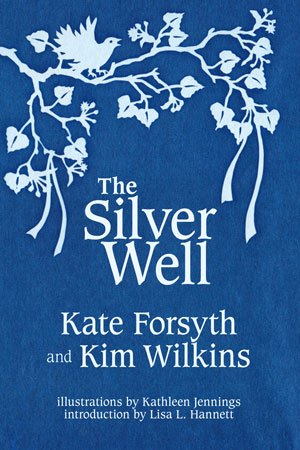
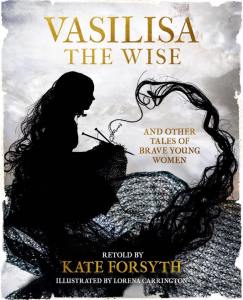
Today I am delighted to bring readers an interview with Kate Forsyth, centred on two great new books which are wonderfully rich collaborations between herself and other creators: Vasilisa the Wise and other Tales of Brave Young Women, illustrated by Lorena Carrington(Serenity Press) and The Silver Well, a collection of interlinked short stories written by Kate and her friend and fellow author Kim Wilkins, illustrated by Kathleen Jennings(Ticonderoga Publications). Both are truly special books, beautiful in concept, words, pictures and production values, and after enjoying them both very much, I wanted to know more about how the books came about.

Kate, you’ve always been a lover of fairy-tales and used them a lot in your work–and of course now you also have a doctorate in them! How did you and Lorena come to work together on Vasilisa the Wise & Other Tales of Brave Young Women? How did you choose what stories to retell?

I’ve loved fairy-tales and fairy-tale retellings since I was a child, and first studied them in my undergraduate degree. Eventually I undertook a Doctorate of Creative Arts, focusing on the history and meaning of ‘Rapunzel’ for my theoretical work and writing a retelling of the tale as my creative component (my novel Bitter Greens).

When I had finished my doctorate, I wanted to buy myself a piece of fairy-tale inspired art as a present to myself. So I began to look around but most of the art I saw was quite childish. Then a writer friend of mine, Allison Tait, asked me on twitter if I’d seen Lorena’s work (Allison did not know I was actively looking for fairy-tale inspired artwork, she just thought I’d be interested.)

I went and looked at Lorena’s website and just fell in love with her dark, eerie & sophisticated creations. I bought one of her pieces and we began to email each other, talking about our shared interest in fairy-tales and gardens and books and art. We essentially became pen-pals.

Lorena told me that she was working on a series of artworks inspired by little-known stories which featured brave clever heroines. How wonderful, I said. I’ve always wanted to write a collection of tales like that. So we came up with the crazy idea of working together. We had no idea if anyone would be interested in publishing it, we just did it for the pleasure of making something beautiful with a kindred spirit.

Lorena had already created images for three tales – ‘Vasilisa the Wise’, ‘A Bride For Me Before A Bride for You’ and ‘The Stolen Child’ (I had bought one of the images from the latter as my present to myself). We decided we would work on seven tales, as it is such a fairy-tale number, and then I made a few suggestions for tales that I thought would work well. ‘The Singing, Springing Lark’ is one of my favourite stories to perform as an oral storyteller and so that was my first choice. ‘Katie Crackernuts’ was a tale I had already retold for the online story platform The Pigeonhole and so we decided to include that one too. I also suggested ‘The Toy Princess’, a literary tale written by the Pre-Raphaelite writer Mary de Morgan. The last tale took us a little longer to find. We both suggested a few different possibilities, but they were too similar in theme, motif or plot to stories we already had. In the end, we settled on ‘The Rainbow Prince, a story I had loved as a child.

At the end of each story, there are notes by Lorena and yourself, giving an insight into the background of the story but also why it speaks to you. Why did you choose to include this background information?

 I wanted readers to know where the tales came from, and who first told or recorded them. I find the history and meaning of fairy-tales so fascinating. And both Lorena and I felt giving a little insight into our creative purposes and processes would enrich the reading experience too.

What was it like working so closely with each other on this project?

 It was just wonderful. We never had a disagreement or problem. I love Lorena’s art and she loves my writing, and so we worked with a great deal of trust in each other’s ability to create something beautiful.

Would you think of doing another collection like this?
Oh yes, we are working on another collection right now. It will be called Molly Whuppie & Other Tales of Clever Young Women, and will be published in 2019.

Turning now to The Silver Well, can you tell us a bit about how it came about?

Kim Wilkins is one of my oldest and dearest friends. We first met 20 years ago when both of our first novels were shortlisted for the Aurealis Award (Kim won!) We then read each other’s books and just loved them. We live in different cities but always catch-up when in each other’s towns, or when we are overseas at the same time.

A year or so ago we did a ‘In Conversation’ event together at the Brisbane Writers Festival. As we walked towards the auditorium, our student minder asked us how we knew each other. We told her about having our first books published at the same time, and then I said, ‘next year is actually our 20th anniversary.  Twenty years since we were first published! And I’ll have had 39 books published. Such a shame I can’t write one extra to make it 40 books in 20 years.’

Kim Wilkins

Then Kim said, ‘How funny. I’ll have had 29 books published in the same time period. If I wrote an extra one, it’d be 30 books in 20 years.’

‘We should write a book together,’ I said.

‘Great idea!’ she said.

And that’s how it all came about.

It’s a great concept–a series of stories about the same place throughout history, where the silver well is a recurring motif. I really like the ways in which you and Kim have linked the stories without it at all feeling obtrusive–the links are subtle and satisfying. Did you and Kim sit down and sketch out the general shape first? How did you choose which periods in history to set stories in?

After our session at the Brisbane Writers Festival, we went back to my hotel room and had dinner and drank a bottle of Veuve champagne (our favourite), and began to throw ideas around. The concept of seven stories set in the same place at different times was our very first idea.

Within seconds we decided to set it in Cerne Abbas, because Kim and I had spent the loveliest week there the previous year (along with our friend Lisa Hartnett). Because we are both so interested in history and folklore, we had actually bought a few books about the village from one of the local stores and so already knew quite a bit about its past.

We decided to write three stories each, plus a frame story set in contemporary times. Then we simply had to decide which historical periods each story should be set in. Again, we decided straightaway. Kim said, ‘Bags early medieval time,’ and I said, ‘Bags the Second World War’, because these were both periods we loved and knew a lot about. We both love the Victorian era, but Kim bagged it first and so I chose to set a story during the English Civil War, which I had studied intensively for my series of historical children’s novels which begins with The Gypsy Crown. I also wanted to set one of the stories around the dissolution of the abbey in Tudor times, another favourite period of mine. Then we thought we should have a story set during the period when the abbey was absolutely pivotal to the village’s life. So Kim took that era.

By the time we had finished our bottle of champagne, we had the whole book plotted out.

Though it’s the work of two writers, the book feels like an organic whole, stories seamlessly flowing into each other. How did you and Kim pull it off so well? Tell us about the actual process. How did you organise your writing–did you write at the same time or in sequence? Did you decide on characters together, or individually? 

We each worked on our own stories independently, and only showed it to the other when we had a polished first draft. The idea of having connected characters grew organically, and needed just a slight tweak here and there to make it work. I wrote the frame story, set in contemporary times, and Kim wove in some extra details. Otherwise, we did not touch each other’s stories.

What were the challenges?

For both of us, the difficulty was making time in our hectic schedules to write the stories. We both had punishing deadlines for novels, plus the usual teaching and touring commitments. We made a promise to each other that we would drop the project if either of us found it too hard, or if our friendship came under strain, but somehow we managed to find enough time in the cracks of our days to get the work done.

Kathleen Jennings’ lovely line drawings are also very much part of the appeal of this lovely book. When did she become involved in the process?

On the day that Kim and I first decided we were going to write a book together! We sat in my hotel room scribbling down ideas, and thought how lovely it would be to produce a book with exquisite line drawings in it. We both thought of Kathleen at once, and we texted her and asked her if she’d be willing. She said yes at once. We also texted Russell Farr at Ticonderoga Publications to see if he’d be interested in publishing it (Russ has known us both for 20 years too) and he also said yes without hesitation. So that very first evening was very productive indeed!

What have you learned from the process of collaboration? 

The most important thing is, I think, trusting your partner, and allowing them complete creative freedom. We might not have worked so easily and joyously together if we had been constantly criticising each other’s work. Both Kim and I love each other’s writing style and so we just focused on making our own stories the best they could be, and then read each other’s stories with a great deal of anticipation and pleasure.

 Both The Silver Well and Vasilisa the Wise were published by small presses–in The Silver Well‘s case, Ticonderoga Publications, in Vasilisa’s, Serenity Press. And your earlier non-fiction work, The Rebirth of Rapunzel, was also published by a small press, Fablecroft Publishing. All of course are gorgeous books, flawlessly and elegantly produced, and showcasing just what wonderful work small press publishers do in this country. For you, as an author, what are the pleasures–and challenges!–of working with small press?

It was utter joy to work with all three of these small press publishers! They were all so passionate about the projects, and so willing to work with us to get exactly the look we wanted. I didn’t have any problems or challenges, really. We are all professionals, and we understand how the market works. And the books are finding readers, despite the smaller publicity and marketing budgets. The first print run of Vasilisa the Wise sold out in pre-orders!

Interview with Jana Hunter, author of Sleepy Meadows

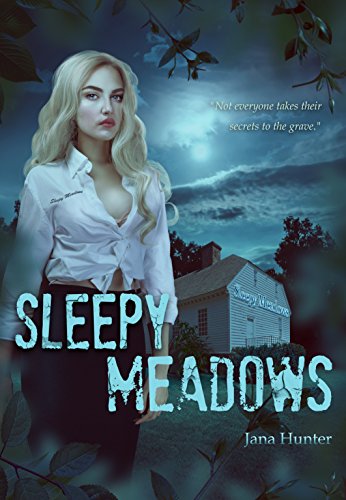
 Today, I’m very pleased to bring you an interview with new author Jana Hunter, whose first novel, Sleepy Meadows, has just been released as a Kindle ebook. Sleepy Meadows is an unusual fantasy/mystery novel, centred on young necromancer Kylie McGovern, who is working in her late father’s funeral home, Sleepy Meadows, in an Australian country town. As the blurb describes, her life is simple and quiet which is just how she likes it, but all that changes when her boss, the seemingly respectable Uncle Bob, goes missing and a murder victim is found in the crematorium. Drawn into a web of inter-generational revenge and family secrets, Kylie’s own life begins to unravel as she works desperately to find out where Uncle Bob is and clear her own name. Though she has been raised to believe her power is an evil to be suppressed, as the bodies begin to mount up, it seems that only her skill as a necromancer will save Kylie from taking the fall….
First of all, Jana, congratulations on the release of Sleepy Meadows! Exciting times for you! Tell us about how the idea came to you.  
Thank you so much, I’m very proud of the way it turned out. I’ve always loved reading Urban Fantasy, it’s such an underrated genre, but most of what I read was set in the US or Britain, so I thought there was room for an Australian take on it. Also, I think country towns are rich with the potential for uncanny happenings; there are so many odd stories that you hear and it just seems to have more magical potential. In fact, the idea for Sleepy Meadows came to me while I was staying with my grandma on her farm. There was a catalogue on her table for a local funeral parlour featuring two creepy looking middle-aged men smiling woodenly in black suits, and it got me wondering about that profession, and why there seem to be so few young, female undertakers. And it made total sense to me that a funeral home would be the perfect place for a closet Necromancer to work.
Sleepy Meadows has a most unusual setting, in a funeral home( though it’s an inspired choice for a necromancer like your main character Kylie McGovern!) Was it based on a real place and did you have to research much?
Sleepy Meadows is not based on any particular funeral home, that is pure fantasy, but I did do a fair bit of research into rural funeral homes and the embalming process etc. That said, I have to admit that I took poetic licence in a few spots.
How did you go about creating Kylie and the other characters in your book? Which were your favourites, and which most challenging, in terms of creative process?
The characters evolved organically, which is something I love about writing – they surprise you, they take on a life of their own. Funnily enough, the murderer was not who I originally planned, and I had some trouble abandoning my intended villain for someone who was supposed to just be a sideline character, but I’m glad it worked out the way it did. I also had some feedback from early readers that my protagonist Kylie was too morally-grey and she needed to be sweetened-up a bit. But I’m glad I left her as she is: “Creepy and quiet, and a little morally-challenged”.
What’s been the reaction from readers so far?
So far the response has been really positive, which is a relief.
What’s next? Are you planning any more books featuring Kylie? Or will you be writing something completely different next time? 
Sleepy Meadows is the first in a series, so I am working on the sequel now, as well as a different, more traditional portal-fantasy novel.
What are your top tips for new and aspiring writers?
My top tips for any aspiring writer is to read widely and to be consistent with your writing practice. Little by little becomes a lot.
Jana Hunter lives in Armidale NSW, where she can usually be found in a coffee shop, writing. You can find her on instagram at: https://www.instagram.com/janahunterauthor/
You can buy the book here.

Fiction, prediction and diversity: an interview with Hazel Edwards

Today I’m very pleased to interview popular author Hazel Edwards about her new book for adult readers, Celebrant Sleuth, set in a country town and centred around the character of Quinn, an unusual woman who lives in a romantic but non-sexual relationship with her partner Art, and who as well as being a celebrant in great demand at weddings, funerals and other life rituals, also has a knack for solving mysteries of all sorts.

Hazel, how did the idea for ‘Celebrant Sleuth’ first come about? 

I’d observed celebrants in action at Australian weddings, name-days and funerals. Most are very personable.

They are problem-solvers. They have to handle dramatic situations with difficult people and heightened tension. Apt words in emotive ceremonies are their business.

The role seemed versatile enough for a sleuth character who needed to move into different settings and cultures to solve mysteries. For diverse age groups too.

Like many others, our family is spread across generations and cultures and friends are re-committing, divorcing or blending.

So I’d been to a few celebrations, commitments and an increasing number of funerals.

That seemed like a good starting point to research the role of celebrant. As a believer in participant-observation, I considered qualifying as a celebrant by doing the course, but then decided it was more effective to interview the experts.

In early 2016, well before the Same Sex Marriage law debates, I moved into serious interviewing.  More than twenty-five celebrants on phone or Skype or in person. But it wasn’t all serious, most celebrants had a sense of humour, which was vital because I was collecting anecdotes for my mystery plots.  I needed the absurd inbetween the tragic and the romantic.

Most fictional detectives have a ‘backstory’ but Quinn, the celebrant/detective in Celebrant Sleuth, has a most unusual one. Can you tell us how you came to create her, including any research you had to do? 

 Usually I create a detailed dossier for each of my characters. Quinn required a bit more research because I needed to get the gender vocabulary right as well as find out about the job of celebrant.

Earlier, I’d been invited to various literary festivals in connection with our co-written trans YA novel ‘f2m;the boy within’ (2010).

On a panel, I met an extremely articulate and thoughtful asexual in her early thirties, who challenged me to write about her gender circumstances. She was NOT a celebrant.  She was a park ranger. But the idea of juxtaposing a romantic personality in a longterm relationship within the character of a celebrant who had a job involving romance interested me.  ‘I prefer icecream to sex’ was one of her very quotable comments to me, as she explained the differences between being asexual  (feeling no sexual attraction to any gender) and being a ‘romantic’ desiring and giving affection which is different from being aromantic.

She became one of my ‘expert’ readers.  Along with the celebrants, actors, caterers, lawyers, mothers-in-law, actors and photographers I interviewed. And the multiple florists in fabulously perfumed shops.  The only problem was fictional time. Everything needed to happen in under an hour, just like in a wedding or funeral.

But it’s taken about 2 years to write in ‘real time’, between 6 am and 8 am daily. My brain was clear then and could cope with plotting clues. The mysteries are episodic, with celebrant Quinn solving problems in settings including the football hall of fame, retirement village chapel and a few inter-relationships of florist, caterer and media in the country township during an economic downturn. Millionaire retirement village owner, eighty-something Flora is feisty and falls for a younger man. I had to create a whole ‘fictitious’ township of intersecting roles. And get the street geography right.

There are several stories in Celebrant Sleuth: cases ranging from murder to theft to missing wills. Did you write them in sequence or not?

 No. I didn’t write in sequence.

The tight opening, Introducing Quinn, was written last as the viewpoint was always a challenge.  Initially I imagined a kind of voice- over which could adapt for television, but also the issue of asexual gender had to be explained indirectly for a mainstream audience but was not the central theme of the book. First person enabled less use of pronouns

I wrote each chapter as a separate ceremony with a problem or crime solved by Quinn the sleuth. But I didn’t want a murder per chapter. That seemed Agatha-Christie-ish, depopulating one small country town. The settings were a challenge because I needed to create a country town, small enough for the characters to bump into each other via their other roles like caterer or florist.

I tried to vary the mood and pace of the chapters and the type of ceremony, not all were weddings. And I had to check the facts about types of death… and set up the circumstances and motives. After trialling them with my test readers.

‘Celebrant’ is an Australian term and often confused with ‘celibate’ or ‘psyche’ or ‘Celebrity’ so I had qualms using it for the title.

Amused that my publisher BookPOD has used the meta tag Clean crime to describe ‘Celebrant Sleuth’.

‘I do…or die’…was the last minute subtitle to include all circumstances.

What has been the reaction of readers?

Really positive.  Celebrants are thrilled with their job being featured.  Diverse gender groups are delighted to have an asexual hero. Others like the small town mystery.

My expert test readers picked me up on a few technicalities. ACE as the name of Quinn’s partner was inappropriate as it is a term used by asexual groups. Pure coincidence I used that name as I was trying to give alphabetical and simple names to characters.  Ace became Art. Coronial and forensic pathology procedures.  Legal stuff.  Uniformity of retirement village streetfronts and use of ramps.  Youngest legal age of bride.

But the greatest legal challenge has been the Same Sex Marriage laws changing the terminology in my commitment chapter. Last minute updates.  So far I haven’t been accused of being politically opportunistic in using such a topical gender situation. The reality is I started writing two years ago. It was serendipitous topicality which had the law being changed on the day I was checking the galleys and had to change clues since wedding services differ from commitment in the legal wording and papers, but there will still be people who choose to commit rather than marry.

The cover has ambiguous and symbolic silhouettes and that was deliberate. Designer Lee Burgemeestre is multi talented and is also a celebrant so she brought an experienced eye.

My favourite anecdote relates to lost rings and metal detectors on the beach. Closely followed by dogs as Best Man.  And the professional afternoon- tea eaters who turn up as rent-a-crowd for the scones, raspberry jam and clotted cream provided by one funeral parlour, even if they didn’t know the deceased.

Some readers are intrigued by the blurb.

‘I buried my father, married my sister and sorted the missing will.’

Quinn, a celebrant with style and a few obsessions but a good heart, solves quirky problems, mysteries and the occasional murder at weddings, funerals and naming ceremonies in her country town.

Ex-actor with a great voice who writes eulogies to die for! Not forgetting a few quotable ‘Quinn’s Laws of Relativity’. A romantic, but asexual, Quinn lives with her long term partner Art who runs community Channel Zero.

The workstyle of a celebrant is never routine. Fake I.D. Fraud. Fights, even to the death, over wills and inheritance … Mislaid rings. Lost bride. Food poisoning.   Clients of varied ages and cultures are well looked after. Even vintage millionairess Flora with the much younger lover who might be a con-artist.

Quinn solves most problems but not always in the expected way

Why have you included Quinn’s Theories of Relativity at the end?

To characterize Quinn as many celebrants do write their original material.

Most people only know Albert Einstein from t-shirt quotes, but …

I admit I occasionally adapt his ‘Theory of….’quotes for funerals or weddings. Not really plagiarism because I always mention Einstein, just an updated tribute to the most significant science philosopher (in my opinion). One of my heroes and gives a bit of gravitas to a service.

Quinn’s Theory of Relativity

The likelihood of the relationship ending in divorce is directly related to the number of arguments during rehearsals, obsessive preparation and the bride’s budget on self.

My favourite is: Quinn’s Theory of Funeral Secrets

‘At a funeral, we acknowledge the life of the person and maybe the many identities, actions and secret lives of which the family and friends were unaware. For some a shock, for others a relief.’

 Are you planning any more ‘Celebrant Sleuth’ stories?

Yes.  But only if optioned for television. I’m realistic about the number of options which are never made.

Currently there is a great demand for celebrants to perform weddings for same-sex couples who previously had commitment services or who had married under the laws of elsewhere.  But the demand for commitments, re-commitments, funerals and naming ceremonies will continue.


Celebrant Sleuth by Hazel Edwards is published by Bookpod and is available through all good bookstores. Formats: paperback and ebook.


2017 Book Discovery 8: Elisabeth Storrs’ pick

In the latest of the book discovery posts, Elisabeth Storrs writes about her pick.

The Summons, by David Whish-Wilson, is far from light summer reading but my 2017 discovery of this dark and compelling tale provided me with a potent insight into the Nazis’ obsession into the occult. Set in 1934 Berlin, the story traces the impact on WW1 veteran, Dr Paul Mobius, when he is summoned by the SS to join Himmler’s Special Witch Work Unit. At the same time he becomes embroiled in another Nazi scheme which threatens the safety of his charge, the young simple-minded Carl.

Mobius is a fragile character, tormented by the horrors of the Great War, who nevertheless shows nerve enough to defy ‘the summons’ and escape with Carl to the country. Here, with his newly found love, Monika, the historian finds the promise of happiness. However, the tentacles of Nazi eugenic philosophy have already infiltrated the psyche of the rural community. Mobius must stay true to his own beliefs, and muster both physical and moral courage, as he is inexorably drawn to Wewelsburg Castle, the headquarters of bizarre and brutal SS experiments.

Whish-Wilson’s writing is superb, relaying both gentle humour, deep pathos and increasing menace. Ordinary Germans are depicted in the early stages of the sinister spread of Nazi doctrine and yet their lives are also portrayed as mundane and relatable.

I was drawn to the novel because I am researching the distortion of history by another of Himmler’s think-tanks to justify Lebensraum. The plight of a museum curator faced with making a Faustian Bargain is central to my own WIP set in WW2 Berlin and Russia. Whish-Wilson’s book sets a high bar. It is simultaneously touching and disturbing; an exploration of a troubled soul, growing doom, and an unexpected love for an unconventional woman and a threatened child-like youth. Pitched to prescient readers, the power of the novel is in us knowing the fate awaiting each.


Elisabeth Storrs has long had a passion for the history, myths and legends of the ancient world. She graduated from University of Sydney in Arts Law, having studied Classics. Her curiosity piqued by an Etruscan sarcophagus depicting a couple embracing for eternity, she discovered the little known story of the struggle between Etruscan Veii and Republican Rome and the inspiration to write the Tales of Ancient Rome Saga. She is also the co-founder of the Historical Novel Society Australasia. She is now hurtling centuries forward to write Treasured, a novel which tells the story of stolen loot, crazy Nazi archaeology, and the lost Trojan gold.

Childhood Christmas/Noels d’enfance: a bilingual memoir piece for the season

Today, in honour of the Christmas season, I’m republishing a piece which I wrote in English and in French (separately) and which first appeared in the now sadly defunct French Living Magazine several years ago. It’s about the Christmases of my childhood, which were always wonderful and set me up with a lifelong love of this beautiful season. I’m republishing the piece both in its English and French versions. And at the very end, there’s a recipe for the very simple and delicious Christmas log(Bûche de Noël) I describe my mother making, and which has stayed in our family as a staple of the Christmas table.

Merry Christmas, season’s greetings, and a happy New Year to all my readers!

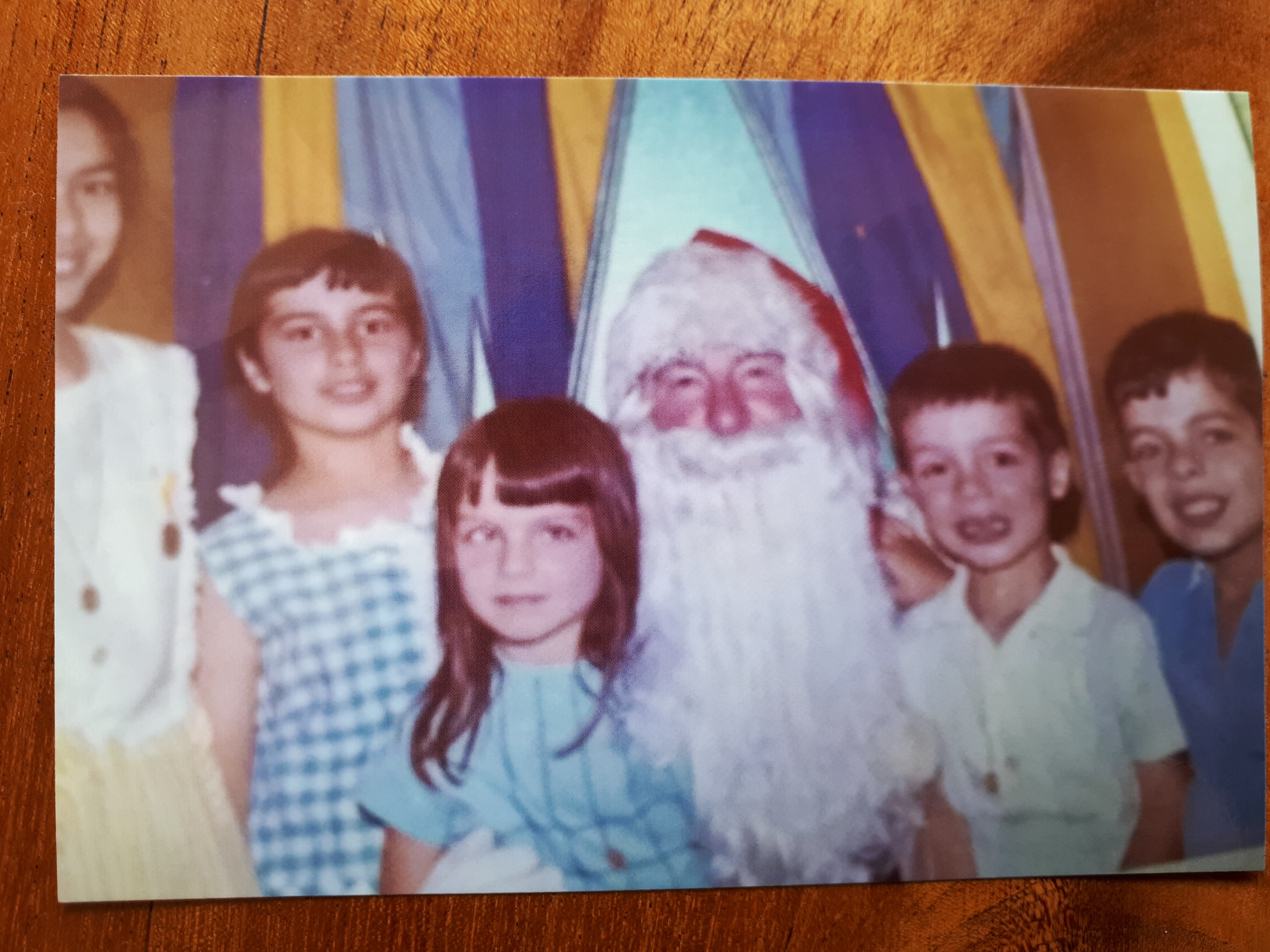
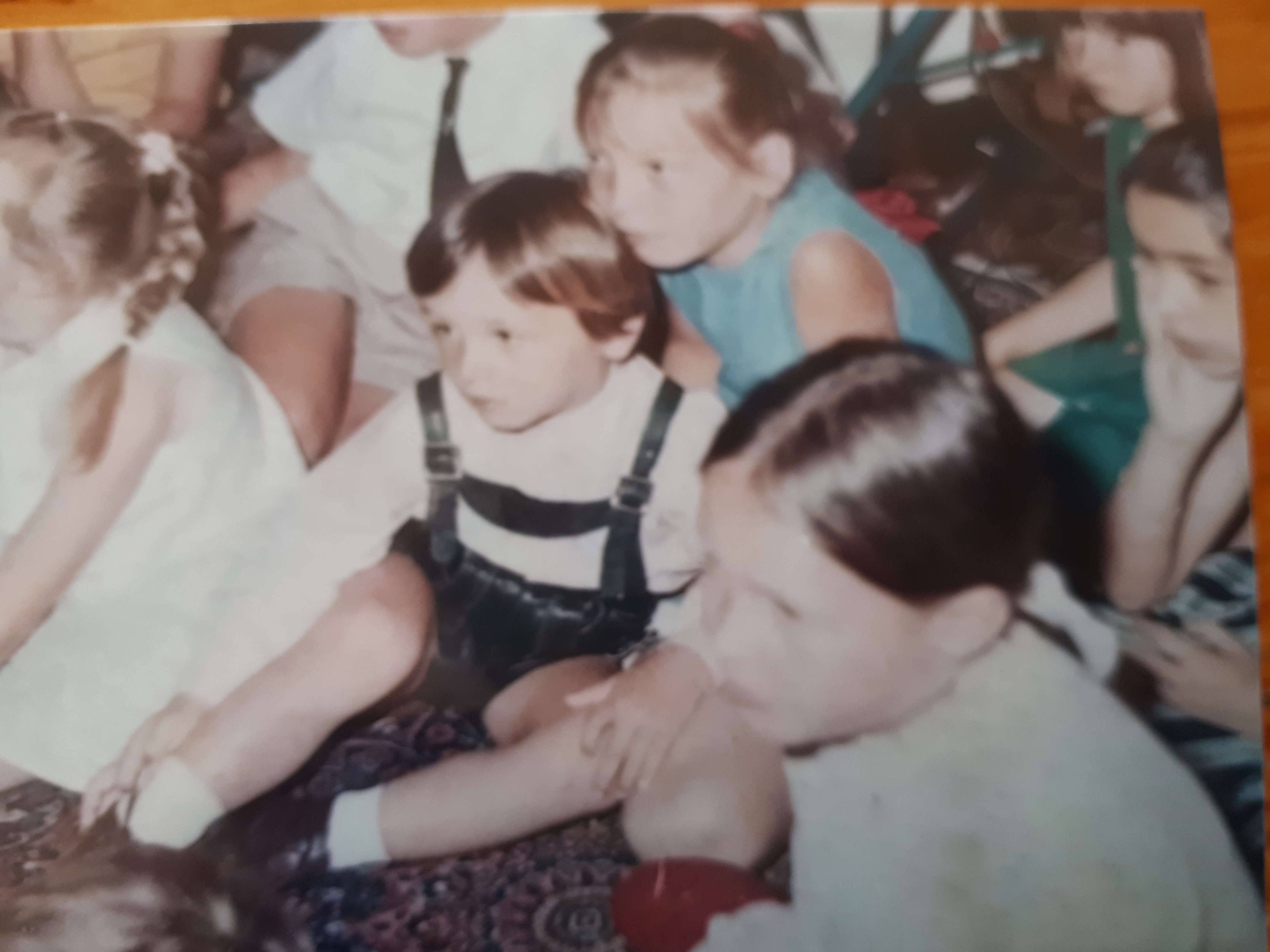
Seeing Santa in David Jones, in childhood. I am at very edge on left, in yellow dress, Camile standing next to me, Gabrielle and Bertrand on Santa’s lap, and Louis at far right.

Childhood Christmas

Christmas! Even the letters of the word to me glitter like the candles that shone on the festive tables of my childhood. My parents arranged our lives to the rhythm of traditional festivals: Easter, Mardi Gras, the Assumption, All Saints: but Christmas was by far the most important festival in our family. It was an enchanting time, a time when fairytales and religious stories seemed to come together in a warm and joyful atmosphere.

In Australia as in France, our parents gave us Christmases both extraordinary and traditional; something that later, as a mother myself, I took enormous pleasure in continuing. Some things my husband and I changed; we didn’t do the ‘réveillon’, for example—but the memory of wonderful childhood Christmases was something I was determined to give our children.

As a child, I would wait for Christmas in a kind of dreamy impatience; every year it was the same and every year I would wait for each predictable yet surprising stage of the great festival. In Sydney, that would start the week before Christmas, on a Saturday, when my father would take my sister Camille and I to David Jones in the city. (We also went with Maman to see Santa with the little ones during the week). First we looked in delight at the beautiful windows with their traditionally festive themes; then we would go onside the shop to choose the beautiful dress that would be one of our presents—the only one not from Father Christmas. Usually, it was with my mother that we went shopping, but here it was my father who enjoyed taking us with him. (Later, our brothers and little sister were taken too before it all ended when we were teenagers.) Lace, ribbons, fine lawns, velvets, vivid colours, it would all be paraded before us then, once the dress was chosen(my father of course had the last word!) we went to the store’s restaurant for lunch, an unusual treat!

The Christmas tree was ordered that week but would only be bought home two days before Christmas. But even before that you had to get out the boxes of decorations, the crystal balls, the satin stars, the little wooden figurines, the little birds with silky feathers and sequinned eyes, etc, to make sure nothing was broken. There again it was my father who was the master of ceremonies—we were allowed to look with wide eyes but not touch. But we were allowed to hand him, if we were very careful, the lovely clay figures for the Nativity scene. That would be prepared a day or two before the arrival of the Christmas tree. First my father would choose large pebbles or rather small rocks, which he arranged in the form of a grotto—his theory being that was what the Biblical stable had been. The whole was placed on the mantelpiece and then twigs and dried leaves were arranged artfully around it to represent the landscape. Mary and Joseph were placed at one end of the mantelpiece, to represent the fact they were journeying towards Bethlehem; at the opposite end of the mantelpiece were placed the three kings or wise men, as they’d be studying the skies before the birth of Jesus, and a little closer, the shepherds would be minding their flocks on a rock which represented a hillside near Bethlehem. Every day, May and Joseph got closer to the grotto; but baby Jesus stayed in tissue-paper in the box till very late on Christmas Eve when he would appear between his parents, now firmly settled in the grotto. At this moment too the shepherds had come close, two angels appeared above the grotto, and in their Oriental corner the three kings began their long journey which would only end at Twelfth Night, Epiphany, January 6, when they would arrive before the grotto to give their gifts of gold and perfumes to baby Jesus. (A day we celebrated with le Gateau des Rois, the King-cake, where there was always a broad bean hidden—whoever found the broad bean was king or queen for the day, and excused from chores such as the washing-up!)

In Sydney, my father worked for a big French construction firm, and several years running, the company director and his wife threw a Christmas party at their gorgeous harbourside home in Point Piper for the children of employees, the week before Christmas. They stopped doing that when I was around 9 (no doubt because of the large expense involved!), but they were wonderful parties. Not only was there a huge and delicious afternoon tea, a gigantic Christmas tree, exciting games with great prizes, and a Disney film to watch in the home theatre, but happiness of happiness, each child had been allowed to request from Father Christmas whatever he or she wanted. One year stood out for me in particular: I’d asked for a bride doll; my younger sister Camille a baby doll. Alas! When she set eyes on my doll, resplendent in her white lace, she was furiously jealous, grabbed it out of my hands and decapitated it, from sheer spite! My beautiful doll Isabelle had to spend Christmas headless and had to go quickly to the doll hospital at New Year..

Christmas time at home was magical. A day before Christmas, the tree arrived at our place. That evening, my father decorated the tree and the eldest children were allowed to hand him the precious decorations: the fragile glass baubles, wooden figures, tin soldiers, silk birds, strings of glass beads and tinsel; the younger children could look but not touch. Once the tree was loaded with its lovely shining burden, we would stay there looking at it in wonder; hardly even hearing Maman telling us to each get a pair of shoes to put under the tree, ready for Father Christmas the next day. But if that day was interesting, the next day was the one we really waited impatiently for. For that day would be the day of presents, and of the réveillon, certain years; we didn’t do the réveillon every year(it depended on how tired our parents felt!) but it is that memory I want to evoke now.

All day, Maman would cook the food for the réveillon meal, and we would help her, or rather, we buzzed around getting in the way. If we were at Sydney rather than France for Christmas(which was more than often the case), Maman would adapt traditional dishes for a summer rather than a winter Christmas. She avoided heating up a house that was already hot with dishes that needed too long in the oven: so, no roast turkey or geese for example but a beef roast cooked rare or other such meat(the main dish varied from year to year)and no hot starters either, but good fresh seafood, oysters, mussels, prawns, crayfish. And though we always had a Christmas log cake, it was a little different from such cakes traditionally served in France; this one was not even cooked but made with crushed sponge finger biscuits, mixed with melted butter, a little sugar, an egg and hot strong coffee, shaped into a log, put in the fridge to set then later covered with melted chocolate and out back into the fridge till it was time to serve it. This antipodean Christmas log has also figured in my children’s Christmases, as I have kept up the practical and delicious tradition of my mother.

So, Christmas Eve went by in cooking and for us children in airing feverish theories as to what we’d find near our shoes under the Christmas tree, in a few hours. As to me, who clung fervently to belief  in Father Christmas and in fairies too till the age of 11 or 12,  I worried that Father Christmas might forget us or might get sick or have an accident in a sky that was so full of planes already! I was determined I wouldn’t go to sleep but would await his arrival that night; but every time, it was the same thing. We children would be in bed by six o’clock that evening; first, I’d not be able to close my eyes; then half past eleven would come, when our parents woke us up to go to midnight mass, and I’d always be surprised to discover I’d been fast asleep. We were allowed, before going to Mass, to have a peek in the living room where the glittering tree, smelling warmly of the forest, reigned, with, at its foot, a pile of presents. No way were we allowed to open them before mass; but what joy to see them there, and what exquisite torture was the wait!

Outside, it was dark, for it was midnight, but the church was full of light, the choir was singing joyful carols, baby Jesus smiled between his proud parents, and soon it would be the time for us to open our presents and to eat the magnificent meal Maman had prepared, which in the light of the candles looked like a royal feast. It was Christmas, really Christmas, a day we preferred even to our own birthdays–for not only did it last longer, but everyone seemed filled with a joyful spirit and all that was ordinary and humdrum and boring disappeared in a beautiful, warm and unforgettable enchantment.

Watching a film at the company children’s Christmas party, aged about 7. I am at far right at edge of pic, chin in hand, blue dress.

Noëls d’enfance

Noël! Les lettres même de ce mot brillent pour moi sur la page, comme les bougies qui brillaient sur la table de fête de mon enfance. Mes parents ont fait vivre notre enfance aux rythmes des fêtes traditionelles; de Pâques, de Mardi Gras, de l’Assomption, de la Toussaint, mais Noël etait de loin la plus importante fête dans notre famille. C’était une période d’enchantement, un moment où le conte de fées et l’histoire sainte se réunissaient merveilleusement dans une ambiance chaleureuse et joyeuse.

En Australie comme en France, nos parents nous ont offert des Noëls à la fois extraordinaires et traditionnels; chose que plus tard, mère moi-meme, j’ai pris énormement de plaisir à continuer. Certaines choses mon mari et moi ont changé; nous ne faisons pas le réveillon, par exemple; mais le souvenir de Noëls enfantins merveilleux est quelque chose que je tenais absolument à donner à nos enfants.

Enfant, j’attendais Noël avec une sorte d’impatience rêveuse; tous les ans c’était la même chose et tous les ans j’attendais les étapes prévisibles mais surprenantes de la grande fête. A Sydney, ça commencait le samedi avant Noël quand notre père nous amenaient, ma soeur Camille et moi, chez David Jones, à ‘la city’. (Nous allions avec Maman aussi avec les petits pendant la semaine voir le Père Noël) Nous nous extasions devant les belles vitrines avec leurs thèmes traditionnels de fêtes et puis nous rentrions dans le grand magasin pour choisir les belles tenues que nos parents nous offraient chaque année —le seul cadeau que nous savions n’était pas apporté par le Père Noël. D’habitude, c’était avec notre mère que nous allions faire les magasins—mais là c’était mon père qui se faisait une joie de nous accompagner. (Plus tard, les garçons et ma petite soeur y sont allés aussi.) Dentelles, rubans, tissus fins, velours, couleurs chatoyantes: tout le matin ça défilait devant nous et puis une fois la robe choisie(mon père ayant bien sûr le dernier mot!), nous déjeunions au restaurant du magasin, chose exceptionelle!

Le sapin de Noël lui-même avait déjà été commandé, mais n’arriverait à la maison que deux jours avant le grand jour; mais il fallait quand même sortir auparavant les boites pleines de décorations: des boulles en cristal, d’étoiles en satin, de petits bonhommes en bois, de petits oiseaux au plumage en soie et aux yeux faits de sequins, etc, pour être bien sur qu’il n’y avait rien de cassé. Là encore c’était mon père qui était maitre de cérémonie—nous avions le droit de regarder( avec nos yeux bien ronds!) mais pas de toucher. Mais nous avions le droit de lui passer, si nous faisions trés attention, les ravissants personnages en argile pour la crèche.

La crèche, elle, se préparait un jour ou deux avant l’arrivée du sapin. D’abord mon père choisissait des gros cailloux dans le jardin, qui, mis l’un sur l’autre, ferait fonction de crèche, ou plutot de grotte, endroit où, mon pere théorisait, l’étable de la Bible se serait plutot trouvée. Le tout était placé sur la cheminée, et puis on arrangeait des feuilles mortes et des petites branches, pour représenter le paysage. Marie et Joseph étaient placés à un bout de la cheminée, pour représenter le fait qu’ils eéaient en route pour Bethlehem; au point opposé, les rois-mages etaient placés, car eux étudaient les cieux avant la naissance de Jesus, et un peu plus prés, les bergers et leurs moutons etaient placés sur une roche qui representait une des collines prés de Bethlehem. Chaque jour, Marie et Joseph s’approchait de la grotte, mais le petit Jesus restait dans sa boite jusqu’a trés tard la veille de Noel, quand il apparaissait entre ses parents, maintenant bien établis dans la grotte. A ce moment là aussi se rapprochaient les bergers, deux anges apparaissaient au dessus de la grotte, et dans leur coin d’Orient au fin fond de la cheminée, les rois-mages commençaient leur long voyage qui ne s’achèverait que le jour de l’Epiphanie, le 6 janvier, quand ils arriveraient devant la grotte pour donner leurs cadeaux d’or et de parfums au petit Jesus. (Jour ou nous célébrons leur arrivée avec le Gâteau des Rois, ou il y avait toujours une fève cachée—celui ou celle qui trouverait la fève serait le roi ou la reine pour la journée, et dispense/ée des corvées telles que la vaisselle!)

Mon père travaillait pour une grande compagnie française de construction, et plusieurs années, le directeur de la compagnie a offert une fête pour tous les enfants d’employés, la semaine avant Noël; cela a cessé quand j’étais encotre trés jeune, vers 8  ans, et je m’en souviens que d’une de ces fêtes somptueuses, et cela à cause d’un évenement particulier. Non seulement y a t’il eu un goûter merveilleux, un arbre de Noël gigantesque, des jeux passionants, et un film de Mickey a visionner, mais comble de bonheur, chaque enfant avait pu demander au Père Noël ce qu’il ou elle voulait (c’était la compagnie qui payait).J’avais demandé une poupée habillée en robe de mariée; ma soeur Camille une poupée-bébé. Hélas! Quand elle a vu la mienne, superbe dans sa robe en dentelle blanche, elle est devenue jalouse furieuse, s’en est emparée et l’a decapitée, de pur depit! Ma belle poupée a du passer Noël sans tête et aller dare-dare à l’hopital des poupées au Nouvel An..

Mais la plupart de temps dans mon enfance, il n y avait pas de fête de Noël hors de la maison. Un jour avant la veille de Noël, le sapin arrivait chez nous. Ce soir-la, mon père décorait l’arbre et là encore les plus grands avaient le droit de lui passer les précieux bibelots; les plus petits pouvaient regarder mais surtout pas toucher! Une fois le sapin chargé de son beau fardeau étincelant, nous restions là tous à le regarder avec émerveillement; n’entendant presque pas Maman qui nous appelait pour venir chercher une paire de chaussures chacun pour mettre sous l’arbre, prêts pour le Pere Noël le lendemain.

Mais si ce jour la etait passionant, le lendemain, la veille de Noël , était le jour qu’on attendait avec le plus d’impatience. Car ce jour là était le jour des cadeaux, et du réveillon, certaines années. On ne faisait pas toujours le réveillon; ça dependait de l’année(et de la fatigue de nos parents!), mais c’est celui-la que je vais évoquer maintenant.

Toute la journée, Maman faisait la cuisine pour le repas du réveillon, et nous l’aidions, ou plutot, nous nous empressions de jouer à la mouche du coche. Si on était à Sydney pour Noël (ce qui était le plus souvent le cas) Maman adaptait les plats traditionnels pour un Noël estival plutot qu’hivernal. Elle évitait de chauffer la maison déjà assez chaude avec des plats qui doivent aller trop longtemps au four: donc pas de dinde ou d’oie rotie par exemple, mais un rôti de boeuf cuit trés vite ou autre viande rapidement cuite(le plat principal changeait tous les ans)pas d’entrées chaudes, mais des bons produits de la mer tous frais, huitres, moules, crevettes, langoustines. Et quoique nous avions toujours une Bûche de Noël elle etait un peu différente des bûches traditionellement servies sur les tables de Noël françaises; celle-ci ne se cuit même pas, mais est faite de biscuits à la cuillère reduits en poudre, mélangés avec du beurre fondu, du sucre, un oeuf et du café fort, le mélange arrangé en forme de bûche, mis au frigo, puis plus tard recouvert de chocolat fondu et remis au frigo jusqu’au dessert du réveillon. Cette Bûche facon australe a fait partie aussi de tous les Noëls de mes enfants, car j’ai gardé cette tradition pratique et delicieuse de ma mère.

Donc, la journée de la veille de Noël se passait en cuisine et pour nous enfants en tout cas en théories fièvreuses sur ce qu’on trouverait prés de nos chaussures dans quelques heures. Quant à moi, qui a cru fermement au Père Noël,comme aux fées, d’ailleurs, jusqu’a l’âge d’onze ou douze ans, je me faisais du souci au cas où le Père Noël nous oublierait, ou tomberait malade, ou aurait un accident, car, me disais-je, il y a déjà tellement d’avions qui sillonnent les cieux..Je me disais que je ne m’endormirais pas, ce soir là, que j’attendrais son arrivée; mais chaque fois, c’était la même chose. Nous, les enfants, étaient au lit à six heures du soir; d’abord je n’arrivais pas à fermer les yeux; mais arrivé onze heures et demie du soir, quand nos parents nous reveillaient pour aller à la messe de minuit, j’etais toujours surprise de decouvrir qu’en fait j’avais bel et bien dormi! Nous avions droit, avant de partir à la messe, de jeter un coup d’oeil dans le salon ou le sapin, étincelant de bougies, de cristal et de guirlandes, et sentant bon la forêt, tronait magnifiquement avec, à ses pieds, un déversement ruisselant de cadeaux. Pas de question de les ouvrir avant la messe; mais quelle joie de les voir là, et quelle douce tourmente, l’attente!

Dehors, il faisait noir, car il était presque minuit, mais l’église etait pleine de lumière, le choeur chantait des cantiques joyeux, le petit Jesus souriait entre ses parents ravis, et puis bientôt ce serait le temps ou on pourrait ouvrir nos cadeaux et manger le magnifique repas que Maman avait preparé et qui, dans la lumière des bougies, ressemblait à des festins de cour royale. C’etait Noël,  vraiment Noël ; un jour que nous préférions même à nos propres anniversaires—car non seulement durait-il plus longtemps, mais tout le monde semblait rempli de joie de vivre et tout ce qui était ordinaire et ennuyeux avait disparu pour le moment dans une féerie ravissante, chaleureuse et inoubliable.


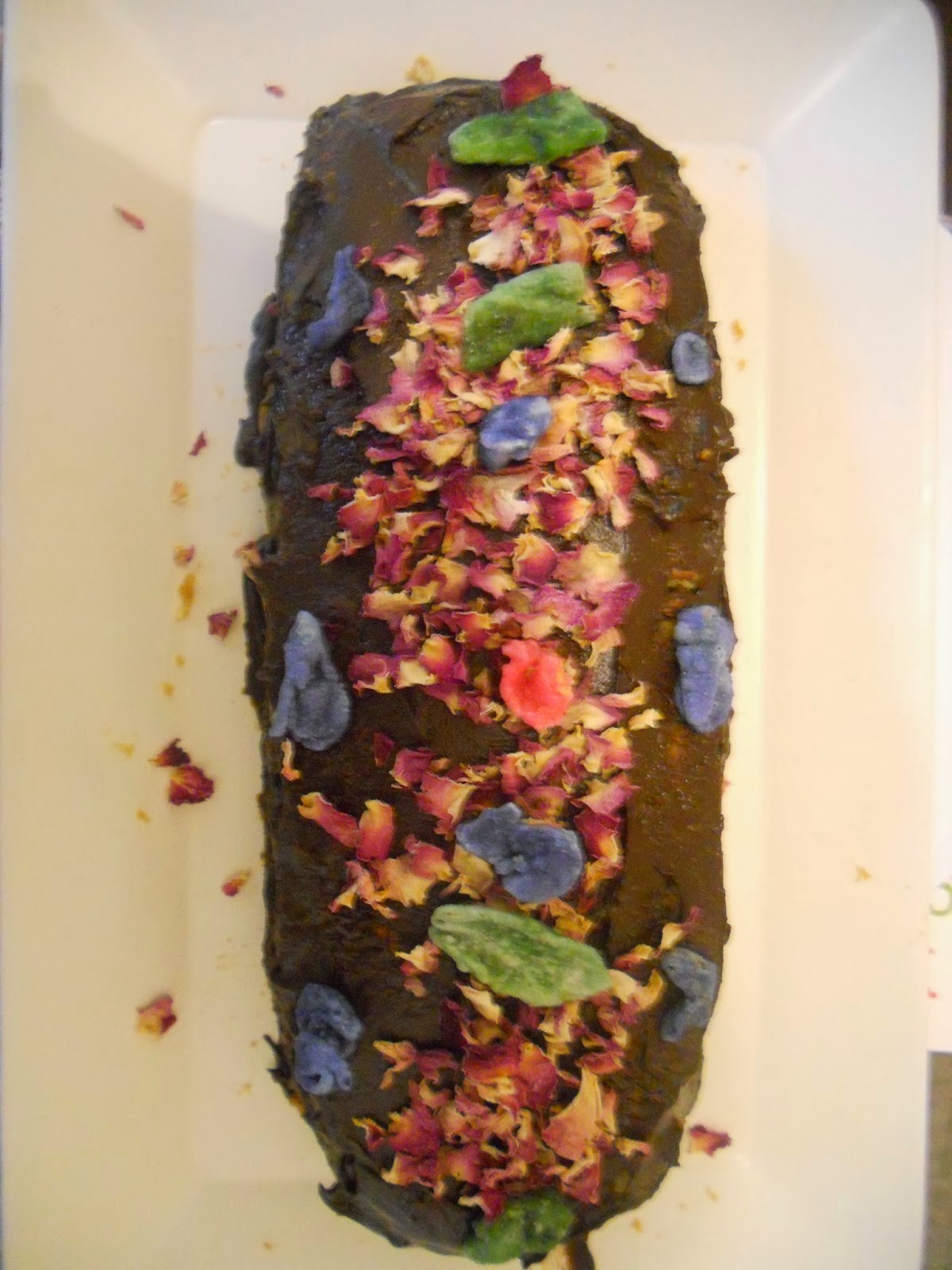
Super easy Christmas log (needs no baking, can be made Christmas Eve).
As noted above, this was my mother’s invention, we had it every Christmas when we were kids, and I still make it every Christmas.
Ingredients:
1 packet sponge finger biscuits
200 g unsalted butter, melted
1 or 2 eggs(depending on how much mixture you have)
half to 3/4 cup hot strong sweet coffee(a good instant coffee works fine)
Cooking chocolate, melted with a little cream.
Crush all the biscuits, add the hot sweet coffee, the melted butter, and mix well. Add the slightly beaten egg(or two). You need to obtain a good stiff mix that you can easily shape into a log. That’s what you do then–shape it into a log, and then put it in fridge till it is set. Meanwhile melt the chocolate over a low heat with a little cream, stir till all melted and glossy. Spread over the cake, on the top and sides. Put in fridge to set overnight. You can also decorate the top with angelica leaves, almonds, sugar holly, whatever you feel like!

2017 Book Discovery 7: Jean Kent’s pick

Jean Kent writes about her 2017 book discovery today.

The Little Prince, by Antoine de Saint-Exupery, is my rediscovered gem for 2017.  For some time this book has been near the top of the tottering pile beside my bed, waiting for that mysterious moment that the best books have, when it would become just the right one for me to reach for.

I love the gentle wisdom and wit of this story of a pilot who has had to land his damaged plane in the desert and his encounter with a ‘little prince’ who has also fallen from the sky – from a very small asteroid, where he usually lives alone, with one rose for company and the possibility of watching forty-four sunsets in one day for consolation.

Although it has the lovely, simple clarity of a children’s story, there is so much poignant adult experience here as well.  I wasn’t very far into the book when I came across a friend whose wife had recently died, sitting beside Lake Macquarie, taking a photo of the sunset.  Every day, he said, he did this now.  I went home, read a little further and found the little prince saying: ‘You know, when a person is very, very sad, they like sunsets.’

This edition also has all the qualities that make a printed book more special to me than a digital version.  It is just slightly larger than my hand, which makes it a pleasure to hold.  The paper is silky and white, and the print and line drawings are so crisp it is as if the ink has just dried.  The cover, too, with its delicate painting of the wistful, golden-haired boy-prince, is irresistible.

I bought my copy at the Red Wheelbarrow bookshop in the Marais, Paris.  So even though this is an English translation, that connection immediately makes me feel as though I’m partly in France while I’m reading.  Which, of course, adds to the joy …


Jean Kent has published eight books of poetry.  Her most recent book is Paris in my Pocket (Pitt Street Poetry), a selection of poems written during a residency at the Literature Board’s Keesing Studio, Paris.  She lives at Lake Macquarie, NSW.  She also posts poems and occasional Jottings at http://jeankent.net/

2017 Book Discovery 6: Sandy Fussell’s pick

Sandy Fussell tells us about her 2017 book discovery today.

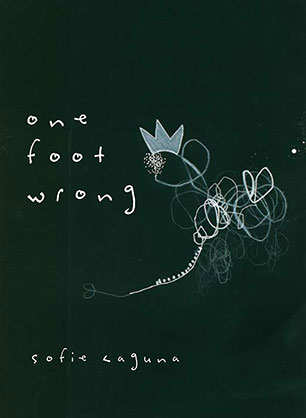
My 2017 Discovery Book is The Choke by Sofie Laguna, although to be honest, it’s more of a discovery trail that began in 2009 when I spotted the cover for One Foot Wrong in a bookstore. I read the blurb and was hooked.

A few years later, I read The Eye of the Sheep in August, and even though there were still four months of the year to go, I told everyone, even Facebook, that it was my favourite book for 2014. When it won the Miles Franklin the following year, I smiled a lot and said, “I told you so” whenever I thought I could get away with it.

Even though I write for children, I’d never read any of Sofie’s children’s books. So, I began to search backwards. There were lots of discoveries then. I was lucky to discover a copy of the out-of-print picture book Stephen’s Music, in a Canberra second-hand bookstore. It’s another favourite. Sofie has a magical way with words. For me words have always been a form of music. In Year 6, I asked for The Complete Works of Shakespeare for my birthday. Not because I was smart, in fact, I didn’t understand much of it at all. I just liked the music the words made when I read them aloud. That’s was Sofie does when she writes. She makes word music.

But back to 2017. As a reviewer, I received an advance copy of The Choke. It sat on my desk for a while because I wanted the luxury of reading it in one sitting. Most of my reading is very fractured, wedged into slivers of time in between things I’d rather not be doing.

For Book Week, I had a school visit that involved two-and-a-half hours train travel each way. I don’t mind that. It’s not travel time, it’s reading time. I read The Choke, all the way from the South Coast to Hawkesbury River Station.

The Choke is the story of ten-year-old Justine, who lives with her grandfather, a damaged veteran of the Burma Railway. The name of the book is a reference to a place on the Murray River where the banks narrow. Large chunks of my own childhood were spent on a narrow section of the Nepean River, with my sister and the girl next door. I would sit and read (no surprises there) and the others would fish, and we’d explore a little north and a little south. It was innocent fun. But for Justine, The Choke is place where good and evil happens.

Some parts of the story cut close to my bones. The isolation of being different and wanting different things with no-one to understand or help clear the obstacles. Recently, I read an interview where Sofie spoke about visiting the thin part of the Murray, how it always floods but the gums still grow under the water, like Justine does. Ultimately Justine’s issues were darker and more violent than my experience, and the story hurt on a level deeper than what I brought to it as the reader.

When I got to Hawkesbury River Station, I had one page to go. I’m always early for appointments so there was time to sit in the morning sun and read through to the end. And when I’d finished, I took a deep breath, and everything I’d read overwhelmed me. I was sobbing. Not crying. Sobbing.

So, here’s why The Choke is my 2017 favourite Book Discovery.  Adult books told through a child’s eyes always resonate with me, the language is beautiful, and the narrative is heartbreaking. Absolutely gut-wrenching.


Sandy Fussell is an internationally published children’s author who loves words, numbers and the Internet. Enthusiastic about school visits, cultural diversity in literature and ICT in education, she is often found in a school library waving her practice sword or teaching a Minecraft-based writing workshop. You can find her here www.sandyfussell.com

2017 Book Discovery 5: Yvonne Low’s pick

In the latest in this blog series, Yvonne Low is presenting her book discovery of the year.

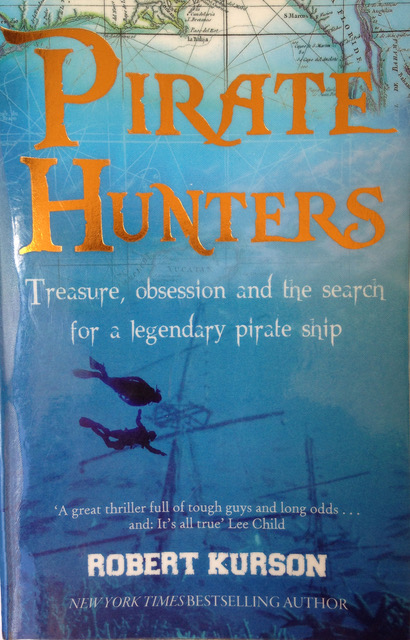
Pirate Hunters, by Robert Kurson, is a gripping read about real-life modern day divers, who are passionate to the point of obsession, about undersea diving and searching for sunken treasure.  The pirates of the old swash-buckling days have always held an interest for me from childhood when I used to love reading comic-strip stories of the pirate Blackbeard and other buccaneers.
The action takes place in the Dominican Republic, in the Caribbean Sea and details the tireless search for a long-lost pirate ship from the 1680s, during the Golden Age of Piracy.  The book was a real eye-opener about the lengths people will go to, to find the ultimate treasure and the fascinating historical research which helped the divers in their quest.
I love to travel and enjoy reading travel memoirs from exotic locations, so Pirate Hunters was the perfect book to take away with me on a recent beach holiday.  I could gaze out to sea and imagine what sunken galleons and buried history might be waiting to be discovered…
Yvonne Low is a writer and illustrator, whose illustrations have appeared in Christmas Press books, most recently for A Christmas Menagerie.  Yvonne is currently working on illustrations for another Christmas Press middle-grade novel, set in space!

Mermaid’s treasure, by Yvonne Low