Word of Mouth TV: an interview with Kate Forsyth and Sarah Mills

Today I’m delighted to bring you a great interview I recently conducted with writers–and now TV presenters!–Kate Forsyth and Sarah Mills, who very recently launched a book show with a difference. The Word of Mouth TV concept combines some of Kate’s and Sarah’s favourite things: food, books and friendship, to create lively, engaging TV, delicious in terms both of body and mind! The first episode, with authors and husband and wife writing team Graeme Simsion and Anne Buist, was most enjoyable, featuring great conversation, yummy food, and great literary–and cooking!-insights. I loved it, and am looking forward very much to the next episode. But while I’m waiting, I thought it would be great to talk to Kate and Sarah about why and how they’ve put together this excellent show with film-maker Claire Absolum. Enjoy! (And subscribe to Word of Mouth TV You Tube channel and website–it’s free!)

Photograph of Kate Forsyth and Sarah Mills by Claire Absolum.

Kate and Sarah, congratulations on the launch of Word of Mouth TV and the show’s first episode! It’s a fabulous concept–innovative and appealing, with so much scope for fun and warmth, and a great title too! How did you first come up with the idea?

Sarah: It was one of those ideas that took a long time to manifest. The idea struck me about six years ago when I was in one of my aimless dreaming phases. The idea kept revisiting me and I asked Kate about three years ago if she would be interested in doing it. We agreed it was something that the book industry desperately needed because there is so little good news and content serving this industry.

Kate: I thought it was such a brilliant idea, but I didn’t know how we would ever find the time to do it when we had such busy schedules. But we kept talking about it and tossing ideas around. We agreed we wanted it to have really good production values but we didn’t know how we would achieve that when we had no skills or experience in that area. Slowly the idea took hold of our imaginations, though. Once we had our title, it really seemed to come to life.

Sarah: We decided upon Word of Mouth as the title because the Sound Bites that accompany the show involve authors recommending the best books they’ve read lately and their favourite cookbooks – so viewers get their reading tips straight from the author’s mouth.

 Coming up with a great idea is one thing of course: bringing it to fruition quite another!  There must have been a lot of work involved in getting to the launch of the show. How did you get from concept to reality?

Sarah: Yes, well, the idea lay nascent for years because we were both writers and neither of us had camera or video-editing skills. Then former SBS and ABC producer Claire Absolum moved into my neighbourhood and we met through mutual friends. Claire was sitting with me on the day I called Kate: “Remember that idea we were talking about a few years ago about interviewing and cooking with authors? Are you still interested?” And to our relief, she said yes.

Kate: It was complete madness! I had such an intense workload and had sworn I would take on no new projects. But Sarah finding Claire just seemed like a sign from the universe. And I’d actually been thinking about how sad it was that there was no great book chat show anymore.

 Sarah: From there it was just a matter of putting everything together. We all have very complimentary skill sets. Claire obviously has the video production skills, I have creative direction and website production skills (I was a journalist for decades at Fairfax), and public relations, branding and marketing skills, and Kate had the contacts within the industry and styling skills from her time freelancing on magazines. And we are all reasonable cooks. We really liked the idea of three women working together to create the show – there is something magic about the number three. Perhaps we’ll be “Charmed”.

Kate: It just seemed to come together so well – I feel that we’ve found the sweet spot between people who love to watch cooking and lifestyle shows, and people who love to read. We’ve certainly had a great early reception!

The show has very high production values and works really well within its time frame. Not surprising, as you have such a skilled and experienced producer as Claire Absolum on board! Tell us what it’s like actually filming the show.

 Sarah: It’s fun and very tiring. It is only a 10-minute Youtube show but so much ends up on the cutting room floor. Particularly for the first episodes because we were a bit nervous and if it wasn’t one of us making bloopers, it was the other. Or the dog would start whining, or the neighbour would start up with a drill. It seemed a process of endless takes. We are still trying to hone the process.

Kate: We are really learning on the job, aren’t we, Sarah? It took us a while to work out a template for the show, and a balance between the cooking, the eating and the talking. We’ve learnt a huge amount in just a few months.

Sarah: It is also difficult because we all live so far away from each other (about two hours) and we are trying to shoot Word of Mouth TV in our spare time. On the upside, the food is divine and we are collecting recipes for a cookbook at the end of the year. And the champagne … it speaks for itself!

How do you go about choosing books, writers–and recipes? 

Sarah: Kate is plugged into the writing industry so this is her task. We try to interview a mix of authors from all different genres and levels of experience, and Kate is the best positioned to know who are likely to be producing good books.

Kate:  It helps that I have so many friends in the industry, and that I read so much anyway. It means I have a good general knowledge of who is launching new books and whether or not our audience is likely to be interested in it.

Sarah: If we don’t personally like the book, we don’t feature it because we have to review it and we want to be kind in our reviews – we are, after all, authors ourselves. We understand how much heart and soul goes into the production of a novel.

Kate: Our aim is to celebrate books and reading and writing, and to encourage people to read outside their comfort zone. This is after all, one of the great benefits of belonging to a book club.

Sarah: I occasionally suggest books that I think will fit the show too. We also recommend cookbooks on every episode. That process is pretty simple. We both have some well-used and well-loved cookbooks. Then we ask the authors to recommend their favourite books read lately and their favourite cookbooks.

Your motto is ‘food, books and friends’hip: it’s the perfect nurturing combination. What are you hoping viewers will get from it? And what’s the response been so far?

 Sarah: So far everyone who likes books has been really encouraging. We are steadily building a subscription base to the Youtube channel, the website, and to social media feeds such as Twitter and Facebook. The authors have been incredibly supportive as well. Mind you it is fun to be wined and dined and have the opportunity to talk about your book, and the subject of books generally, all at once.

 Kate: We hope to become an integral part of the Australian literary scene, a show that bookworms will love and recommend to their friends to watch. The show comes out every fortnight, so that means we are recommending books twice a month – our hope is that Book Clubs will start watching it together, or using it to help them choose books to read, or simply enjoy what we do on a regular basis.

How many episodes are you hoping to make in the series? 

Sarah: The first season will be 12 episodes, seven of which have already been filmed and the remaining five of which have already been scheduled. Hopefully, by the end of that time, we will have a big enough audience, and sponsorship, to continue filming. We really hope this happens as we’ve had more authors asking to be on the show and they are all so fantastic that we want to interview them all.

Kate: We hope there’ll be many more seasons to come!

 Anything else you’d like to add?

Sarah: Well, towards the end of the season, if we don’t get corporate sponsorship, we might run a crowd-funding campaign. In the meantime, it would be great if readers could subscribe to our Youtube channel www.youtube.com/wordofmouthTV000 because we need 1,000 subscriptions under Youtube’s new rules to be able to earn money from the site. If readers want to hear all the latest news, views and reviews, then they can also subscribe to our website at www.wordofmouthtv.com.au We also have a Facebook and Twitter page that we are having a bit of fun with.

Kate: Every fortnight we give away huge piles of books to our subscribers who help spread the word about the show. We want to foster an atmosphere of joy and excitement about the act of reading, and to support as many other authors as we can.

Writing about World War One…

Today, April 25, is Anzac Day, and the hundredth anniversary of the battle at Villers Brettoneux in northern France on 25 April 1918, where Australian regiments were instrumental in helping to secure the liberation of that area of France. As someone brought up between Australia and France, it’s made me reflect not only on the joint experiences of French and Australian troops and civilians in that terrible war, but also on how difficult it is to try and convey, as a writer, something about those experiences, especially when you are writing for children.

Until a few years ago, I never expected to write about World War One. In both France and Australia, as a child I’d seen, in churches and memorials, the staggeringly long rollcalls of the dead in World War One; a war that seemed not only horrible and tragic but absolutely incomprehensible. World War Two seemed more understandable by comparison, in part because my parents were children during the German occupation of France. I could imagine myself writing about World War Two (though I didn’t, in fact until very recently) ) but not World War One. Partly, perhaps it was because in Australia, Gallipoli loomed large, of course, and I did not feel able to write about it, but also could hardly begin to understand, let alone depict, the ghastly long years of trench warfare on the Western Front.

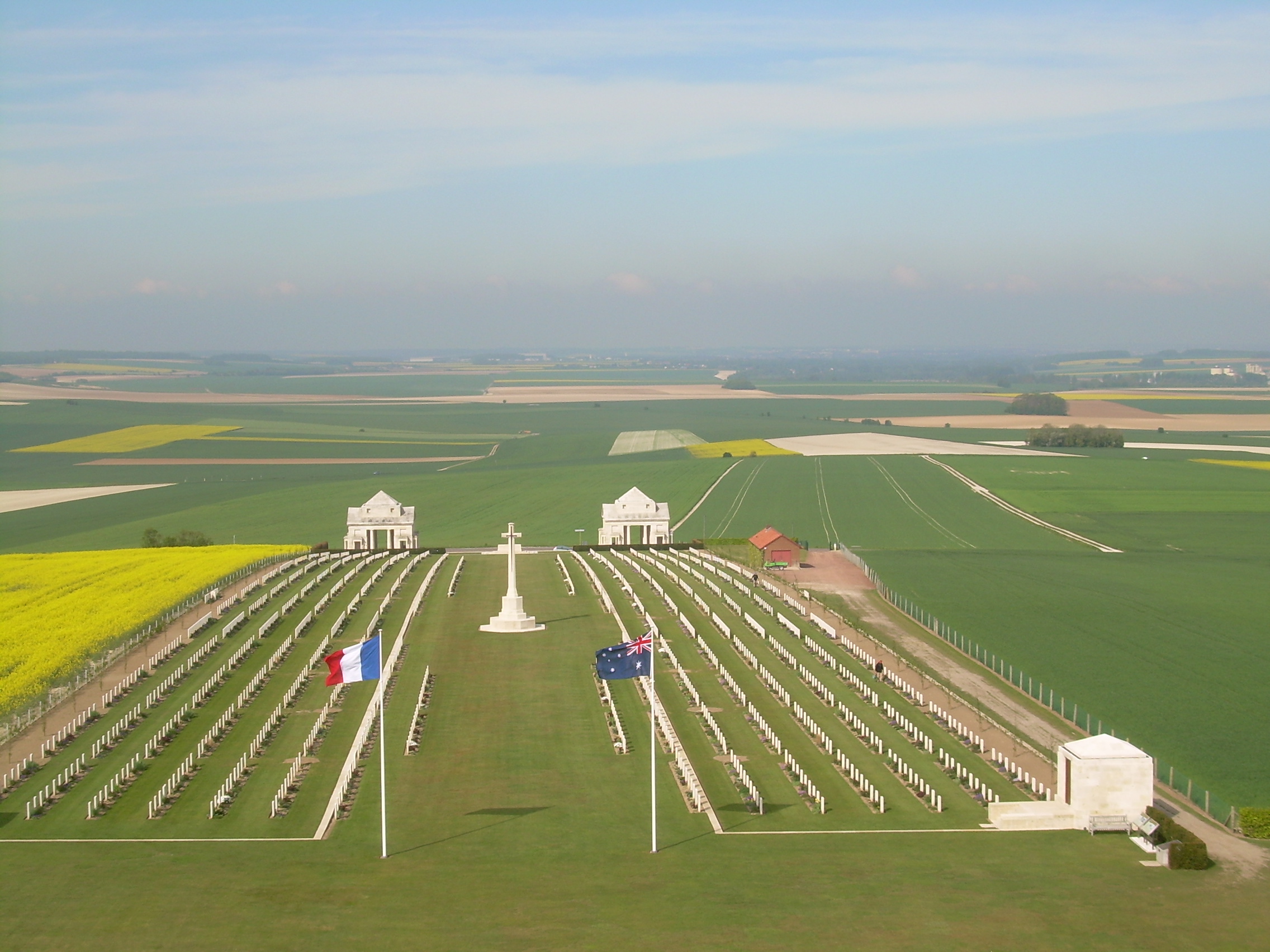
What changed that was, first, a brief visit many years ago to the heartbreakingly big and neat Commonwealth war cemetery just outside Villers-Brettoneux. In the back of my mind, a seed was being planted–and years later, in 2010, it sprouted, inspired by a longer visit–a stay of a few days, in fact, in the pretty, and war-haunted, cathedral city of Amiens and the countryside beyond. Being on the spot, in the quiet streets of the city and the green and pleasant Somme countryside which yet saw so many deaths, looking at memorials and the French Australian museum’s collections of touching photographs of both Australian and French soldiers and the local civilian population, made me change my mind. And also I read about the last year of the war–the way in which in 1918, trench warfare, at least in northern France, gave way not to the pitched open battles of the very beginning of the war, but to a more ‘guerrilla’ style campaign, on both sides, with ambushes and surprise attacks and street-by-street battles in devastated villages. I began to see how I could perhaps tell a story, through the eyes of a young French-Australian character .

So that’s how my first World War One novel, My Father’s War(Scholastic Australia 2011), began. Set in 1918, it is told in the voice of eleven year old Annie, whose Australian soldier father, fighting on the Somme, goes missing, and who goes with her French mother to Amiens to try and find him. Through Annie’s diary unfolds the story of that last year in the war and the experiences of both soldiers and civilians in northern France. It was a story that both flowed naturally from having been in the areas I was writing about and being immersed in pictures and documents of the time, but was also very hard to write. This was a work of fiction so it had to work as an engaging story, especially given the age of my readers, but I also felt a great responsibility to tell it in a way that would not trivialise or falsify. It was a very delicate balance to strike and at times felt almost impossible(and saddening; I found myself weeping several times over scenes) but in the end it worked. Or at least, readers seem to think so–seven years after its release, it is still finding its way into libraries, schools, and homes.

Writing My Father’s War had made me see I could tell a story set in that time. Three years later, my second World War One novel was published. This was 1914 (Scholastic Australia 2014), which from the point of view of Louis Jullian, teenage son of a French diplomat and his Australian wife, told the story of the beginning of that ‘war to end all wars’. It was a very different book, because it was set in a very different time to that of My Father’s War. In 1918, four years of dreadful stalemate and horrendous slaughter had changed the face of Europe, destroying the old order forever.  In 1914, the old order was still there, sleepwalking towards disaster, and even by the end of that year, people imagined that the war might soon be over and things go back to what they’d been before. And my characters might both be French Australian, but they came from very different backgrounds and experiences. Annie had a difficult childhood dominated by war and her father’s absence; Louis, whose childhood was cosmopolitan and carefree, was coming of age at a time when everything would be thrown into question by a conflict that would engulf the world and truth itself. It was just as hard to write this novel as the first; harder even in a way, precisely because it was the beginning: reading about the causes of the war and the chain of events in those fateful few weeks from June 28 1914, when the Archduke Franz Ferdinand was assassinated in Sarajevo, you get a sense both of the so-called ‘inevitability’ of the war but also the fact that it need not have been so. There were times when the momentum could have been halted–but it was not. I chose to tell that story, and the way in which a carefree summer turned into a deadly winter, through Louis’ eyes as he goes from helpless witness of the attack in Sarajevo to scarred and determined young war correspondent on both the Western and Eastern fronts.

Both the novels have had unexpected offshoots: minor characters from My Father’s War inspired a short story of mine, The Other Anzac Day (set during the battle in Villers Brettoneux on 25 April 1918) which was published in a UK collection, Stories of World War One, edited by Tony Bradman(Orchard Books, UK, 2014). This story, told in the voice of Archie, a tough but troubled young Australian soldier, both echoes and contrasts with Annie’s own view of that ‘other Anzac Day’ in My Father’s War. And Louis’ daughter as well as the son of one of his pre-war Austrian friends will be featuring in a novel I’ve been writing, set at the beginning of World War 2 this time, to appear in 2019. In the novel, the experiences of World War One, which transformed the lives of Louis and his friends, haunt the lives of their families too–and of course, by extension, their communities and nations, as the drums of war beat yet again.


More about My Father’s War and 1914:

My Father’s War

By Sophie Masson

(My Australian Story, Scholastic Australia 2011)

ISBN 9781741698282

It scares me a lot, thinking of Dad out there, far away in that dangerous, terrible place, wondering how it will be when he comes back-if he comes back, that is . . .

Annie’s dad has been away for two years, fighting on the Somme battlefields in northern France. For months there has been no word from him, no letters or postcards. Annie and her mother are sick with worry, so they decide to stop waiting-and instead travel to France, to try to find out what has happened to him. There she experiences first-hand what war is like, as she tries to piece together the clues behind her dad’s disappearance. Will Annie ever see her father again?

Teacher’s Notes My Father’s War: http://resource.scholastic.com.au/resourcefiles/8005439_228.pdf

1914

By Sophie Masson

(Australia’s Great War, Scholastic Australia 2014)

ISBN 9781743622476

A small black bottle or a torch came sailing through the air, and landed on the side of the car, close to the Archduke. An instant later came a terrific bang, the road exploded in a shower of dust and stones, and tiny sharp things went flying through the air like angry bees.

In June 1914, Louis and his brother Thomas are enjoying the European summer in a small town near Sarajevo. In the shadow of the assassination of the heir to the Austrian throne, the world erupts into war and Louis’ life changes forever. Old Europe is torn apart and Louis finds himself in the midst of his own battle – and fighting for the truth in war means that sometimes even your own side is against you.

Teacher’s Notes 1914: http://resource.scholastic.com.au/resourcefiles/8284239_24164.pdf

The Spanish Wife: a short story

Today I’m republishing another story of mine–rather Gothic in feel, with a real twist in the tail. It was inspired by a very strange dream, in which I actually heard a voice saying, ‘He was such a grey man, till he came back with a Spanish wife” I woke on those words, intrigued: who was speaking? Who was the ‘grey man’? And what was it about the ‘Spanish wife’? This story was the result of answering those questions. Enjoy!

The Spanish Wife

by Sophie Masson

You’d never have credited it, of Moffat. He was such a grey, precise little man. The sort who is always at his desk a full fifteen minutes before anyone else. The kind whose desk ressembles some general’s abstract plan of attack—never the messy reality of the battlefield. The type of irreproachable bachelor who’s just that—not playing for the other side or anything, but a man who lived a blameless, virtuous, dull life, first with his widowed mother, then when she died, by himself, in a small Holborn flat as neat and grey as his person. He appeared to have no ambitions, no dreams, no hopes, no fears. He had risen in the company only in small steps but did not appear to be resentful of the fact that chaps like Jones or Carey, who’d come in at the same time as he, with pretty much the same qualifications, were streets ahead of him now. He had no enemies, but no friends, either. At least, unless you count me. I took an interest in the funny little chap, for no reason I can really explain, because he is a good deal older than I and not really interested in the same things as I am. My last lady friend, Cora, told me that it was because Moffat made me look good—that his greyness made me look much more sparkling, witty and charming than I really was. But as she said it just before saying I was the most immoral, most selfish man she’d ever met, and slamming the door in my face, we can probably discount that as an explanation. I suppose, if I was to be pushed for an explanation, I was intrigued by him, in a strange way. He seemed to live life in a kind of dream. No, not really a dream; he was like a shadow amongst the solid. Not like a ghost, mind you; ghosts are unexpected things, producing disturbance, fright, an upending of order, what have you. Moffat was the very soul of the expected; the very epitome of unchanging order, always there, never noticed. A nobody, in short.

Until the day when he returned from Spain, with a Spanish wife. The going to Spain was odd enough: the country was in the middle of a bitter civil war, with Reds and Brownshirts and I don’t know what other dismal colours battling it out for control. Why Moffat of all people would go there was a mystery big enough in itself. He was not political in any sense of the word—he’d no more have dreamed of joining one of those hotheaded foreign militias rushing over to drape themselves in the warring colours, than he’d have thought of dancing naked around the office. (The mind boggles!) He had no sense of romance either, none that I’d been able to discern, at least—and certainly the image of sultry senoritas with roses in their teeth and clicking heels and bullfights and all that sort of thing would, I’d have sworn it, simply failed to register with him. He had not, so far as I knew, ever travelled before beyond the various seaside resorts of the South of England. Oh, and once to Cornwall, I believe, but he hadn’t much liked that. Too foreign I suppose. And yet there it was—Moffat had not only gone to Spain, but he’d come back with a Spanish wife. A wife at his age—he was by then in his mid-fifties—was surprising enough. But a Spanish wife—that really took the biscuit. A real revolution, you might say.

Rather to my chagrin, I wasn’t the first to find out. Mrs Evans, the tea-lady, made the discovery. On the day Moffat returned from holidays, Mrs Evans had come in early, at the same time as Moffat himself, and had seen him sitting at his desk, gazing at a photograph. In the deft way of her kind, she had managed to contrive a glimpse.

‘And that’s when I saw her. Gave me quite a turn, I can tell you! Never would’ve thought Mr Moffat had it in him.’

Dolores, her name was, Moffat said. He did not seem at all put out at being caught by Mrs Evans. Indeed, she said, he seemed to positively relish the opportunity to talk about his sudden spouse. He’d met Dolores while on holiday in Spain. They’d ”clicked”, as the saying has it, at once. They married within the fortnight. Yes, he smilingly told the gaping Mrs Evans, she had come back with him to England. He was very happy. Everything was perfect.

‘I am sure it will all end in tears. It isn’t natural, ‘ said Mrs Evans, sagely, as we crowded around her, agog at her story. Moffat was out of the office, on some errand—rumour had it he’d gone to check on his Spanish wife, make sure she was still real, and not a dream. Some of the others in the office were inclined, despite the evidence of the photograph and Moffat’s words—the man had never spun a fantasy in his whole life—to believe that it couldn’t be true, that Moffat had somehow gone a bit senile or, for reasons of his own, was pulling the wool over our collective eyes. But I knew that it must be true—Moffat had no imagination, no mischief, no romance, as I said, in him. Continue reading

Dreamer–a short story

Today I thought I’d republish one of my short stories with a real twist, Dreamer.  Hope you enjoy!

Dreamer

by Sophie Masson

‘So what seems to be the trouble?’ The psychologist spoke rather briskly. He was a busy man, harassed, there weren’t enough hours to the day dealing with trouble such as you wouldn’t read about, and there was something about the woman and boy facing him that made him feel slightly uncomfortable. For a start, they didn’t look like his usual clients. They were very neatly dressed. The woman was mildly pretty, with dark hair and eyes and a soft voice underlaid with the trace of a foreign accent. The boy was thin, nervous, with dark hair and large, pale brown eyes, and he was small for his age, which the woman said was fourteen.  It was more than the sum of these impressions, though that disconcerted the psychologist: mother and son gave off something odd, some unstable mixture of feelings he couldn’t put a name to.

‘What seems to be the trouble?’ he repeated, impatiently.

The woman looked at him, then at her son. Hesitantly, she said, ‘It’s the dream, Doctor. He keeps having the dream, you see.’

The psychologist stared. ‘I beg your pardon?’

The woman shot another look at her child. He didn’t look up, but the psychologist thought he saw a tremor running from the child’s thin shoulders to his folded hands. The woman said, even more hesitantly, ‘It’s the third time he’s had it. I..I thought we must come and see you. It’s not..well, you see, each time has been worse than the last. ‘

‘A recurring nightmare?’ said the psychologist, relieved at being in somewhat familiar territory. Many of his clients had nightmares.

‘Yes. He’s woken up—oh Doctor, he’s woken up scared out of his mind, I’ve had to comfort him for ages, you must help him—help us. You must stop him dreaming..’

The psychologist sighed. ‘I am not a magician,’ he said, gently. ‘And besides, nightmares can be a way of coping with bad things. They can rehearse, in our minds, a trauma which has afflicted us, and attempt to change it so that..’

‘You don’t understand,’ broke in the woman. ‘It’s not like that at all. There’s no trauma in my child’s life. None! The dream..’

‘Perhaps we should let him speak for himself,’ said the psychologist, quietly. He felt he could place the woman now—one of those anxious mothers, either single parents or estranged somehow from the child’s father, devoting herself to the care and protection of her only child. She would not want to believe anything bad had happened to him which might cause him to have nightmares. He’d met people like that before. They didn’t understand what harm they did by their stifling protectiveness. So he ignored her, gently, but firmly. He leant towards the child, and said, ‘Is the dream very bad?’

For the first time, the boy looked up. His eyes were expressionless. For an instant, he looked into the psychologist’s face; then he dropped his gaze again and whispered, ‘Yes.’

‘Will you tell me about it?’ the psychologist said.

The woman made a sudden movement. The boy looked at her, briefly. Then he turned to the psychologist and said, indifferently, ‘If you like.’

It was an unusual dream, there was no doubt about that, thought the psychologist, as he listened to the boy. It had started with the boy dreaming he had arrived in a place he didn’t know but that was somehow familiar to him. It was a large city, but not busy, like a city normally is. Instead, it was very quiet. There were few vehicles about, and though the streets were neat and clean, there was little sign of life. Doors and windows were closed, though you could sense, said the boy, that eyes were looking out at you behind closed shutters. The first time, he’d just stood there in the street in the dream, looking around, not sure where he was but feeling that nagging sense of familiarity. Then, he said, he felt a dread growing on him, a sudden nameless dread that made his heart pound and his skin feel clammy. He was being watched, and not just by the eyes behind the shutters. Something was going to happen, he felt sure of it..

But he’d woken before anything did. He’d woken, very frightened and disturbed, but glad to be awake. The next night, he’d not dreamt at all; but the night after that, the dream had come back..

‘The same dream?’ interrupted the psychologist.

The boy nodded; then shook his head.

‘It’s not quite the same,’ said his mother, anxiously. ‘You see, he..’

‘Let him speak,’ said the psychologist, sternly. She subsided.

The second dream had not been the same as the first, though it had started in the same place, in the streets of that silent city. The boy said that it had begun with him walking away from the place he’d arrived, with the dread still on him, the feeling of being watched. He’d come to a large square, which was dominated by the statue of a man on horseback. He couldn’t see the man’s face, because the statue had its back to him, and before he could go round to have a look, suddenly a crowd began filing into the square, a vast, silent crowd. It was eerie, horrible, that silence; and then as they filed past him, seeming not to see him at all, he saw something even more horrible. Some of them had their mouths open—and he saw they had no tongues! But it was clear that once they’d had them; for there were ragged wounds where their tongues should have been. Oh, it was horrible, said the boy in his flat, precise little voice, and just to see it made my dread come back so strongly I thought I would faint. I wanted to run away, but I could not move;  my limbs were made of lead. Besides, I was being watched; I knew I was being watched, and that if I made a false move, something dreadful would happen to me..And then I woke up.

The psychologist steepled his fingers. It was an unusual case indeed, he thought. He hadn’t come across one quite like it before. Recurring nightmares yes, but not ones that changed—well, progressed, really—in this way. He said, ‘I can see it must have been frightening. What happened in the third dream? ‘

‘That was last night,’ said the woman, breaking in. ‘It was the worst—the very worst. I don’t think he can recount it. It will make him live it all over again. Let me tell you..’ Continue reading

A Boat of Stars: an interview with Margaret Connolly and Natalie Jane Prior

Last week, I went to a very special launch celebrating a very special book: the beautiful multi-author, multi-illustrator poetry collection for children, A Boat of Stars, edited by renowned literary agent Margaret Connolly, 2017 winner of the Pixie O’Harris Award, and award-winning writer Natalie Jane Prior, author of many popular books for children. Published by ABC Books/Harper Collins, it’s a real joyful treasury of brand-new original poems for kids, by an amazing range of Australian authors and illustrators. I am delighted to say that yours truly is not only one of them–I am also lucky enough to have no less than seven poems in the book, illustrated by such wonderful illustrators as Julie Vivas, Lisa Stewart, Sara Acton and Cheryl Orsini. It was such fun celebrating this very special book with the editors and a great many fellow contributors! So today I’m very happy to bring readers an interview with Margaret Connolly and Natalie Jane Prior, about how the book came to be!
First of all, congratulations on an absolutely gorgeous book, Margaret and Natalie! How did the idea for it first come about?

Natalie had written two ‘picture book texts’, Owl and Mouse, which we realised were poems, and the book evolved out of a conversation about what we could do with them. We both love poetry, and fretted that there was no obvious way of getting them published. We knew that there were very few new books of children’s poetry being published, and suddenly realised that there was a gap in the market. By the next morning we were working on a proposal for what eventually became A Boat of Stars.

How did you go about gathering poems initially? And how did you make selections? What were you looking for in each poem?

We were looking for poems that modern Australian children would enjoy, and that reflected their experience of the world. We wanted poems that they would find engaging and amusing, and enjoy returning to, again and again. The book needed to be Australian in its outlook, so poems about Australian animals, and with indigenous content, were essential. When we’d selected about two thirds of the poems we looked critically at what we had, and where there were gaps, and also asked a couple of experienced teachers to identify topics they thought would be useful in the classroom.

You worked closely together as editors. How did the process work for both of you? What were the challenges and discoveries?
We’ve worked together creatively for many years, so it was a natural progression for us to start working as an editorial team.
Did you send particular poems to particular illustrators, or did they choose poems to illustrate, or was it achieved in a different way?

The format of the book allowed for sixty poems, each with an accompanying illustration, and we assigned illustrators to poems, trying to match style and sensibility. We were thrilled when Stephen Michael King agreed to illustrate the cover. We wanted the book to have a cohesive look, and using a core team of five illustrators helped achieve this, with variety from illustrators who worked on one or two poems.

I believe you also worked closely with ABC Books on concept, layout, design etc. It must have been a big job–and it certainly is a superb production! Tell us about how it all worked.

It was a massive job, but one we both enjoyed. We were very involved in the layout and design, including spending a very intensive day in an ABC office mapping out the poem order, and illustrator/poem choices. Chren Byng, our publisher, was wonderful, as was the whole ABC Books team. Chren trusted us to do what we felt was best for the book, but was there to guide and assist whenever needed. She shared our passion and vision, and understood the book right from the start. It was the happiest editorial and publishing experience.

What do you hope young readers and their families will get from A Boat of Stars? And why do you think poetry is important for children?

We hope that the anthology will give children a happy early experience of poetry, and enrich their understanding of words, and rhyme, and rhythm. Poetry, like music, is primal. It’s language operating simultaneously at both its most fundamental, and sophisticated level. Reading poetry teaches children to look sideways, to see the world and themselves from different angles. Modern children are growing up in a troubled world, and this is a skill they are going to need. It’s a weapon in their arsenal for life.

 If you had one line to describe A Boat of Stars–other than the lovely one on the cover, ‘New poems to inspire and enchant’– what would it be?
Australian children need more poetry.

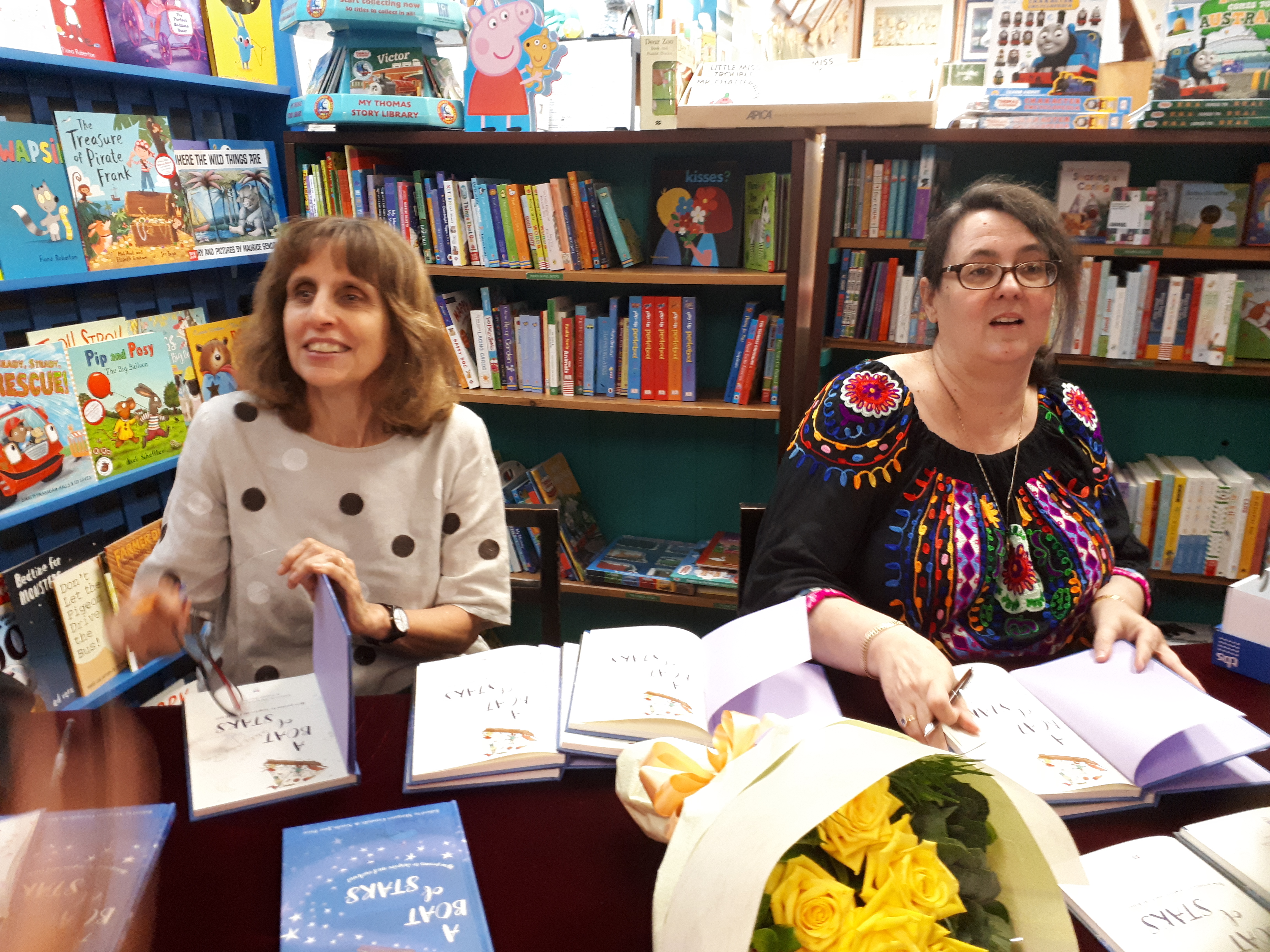
Margaret and Natalie signing copies of the book at the launch at The Children’s Bookshop, Beecroft

The Neptune Clock: a short story

I wrote this story of unexpected magic quite some years ago, and it’s been popular with readers, so I’m republishing it here today. Enjoy!

The Neptune Clock

By Sophie Masson

The summer my grandfather disappeared, I had been with him, as was usual during the holidays. We’d spend the weeks just swimming and fishing and talking. Grandad was a great talker. Mum reckoned he could talk the hind flipper off a dolphin! It was a good picture to have of Grandad, if you know what I mean, because he was really a sea person.

He and Grandma, both. Every year, when she was still alive, they’d lock up the farm and head for the coast. Grandma was a wonderful swimmer; she’d nearly been chosen for the Olympics. It was hard for her, living at the farm; yet she loved it, loved Grandad, too, so she didn’t complain. But when she died, Grandad sold the farm and everything in it, and moved permanently to the coast. He said he felt closer to her that way; reckoned her spirit was in the sea, watching.

The only thing he’d brought back from the farm was the clock. His Neptune clock, as he called it. He had found it in a junk shop years and years ago before he and Grandma were married. I’d known it all my life. You just couldn’t imagine Grandad without it. That clock was a remarkable thing: a grandfather clock, with a glass front, a cedar case, and a carved brass face. Around the Roman numerals were all sorts of sea-figures: dolphins, seashells, a mermaid, seahorses. And the figure of an old man, holding a trident. Neptune, god of the sea, Grandad had said. When I was little, I used to think secretely that Grandad had been the model for Neptune’s face: kindly, thin, as filled with lines as a spider’s web. That clock ticked and tocked and bonged through all our days together; Grandad reckoned that it kept him going. He loved that clock, and used to polish it regularly. And when it stopped, he would open the case with a little key, a lovely brass key in the shape of a dolphin, and start the weights up again. And while he started it, he would tell me endless stories, stories of when he and Grandma were young, stories of the farm and the animals he’d had, stories of the sea. My favourite was that old Scottish story of the selkie–you know, the seal woman who is captured by a fisherman but eventually returns to the sea, leaving her family on land. It’s a sad story, and Grandad’s eyes always looked wet when he told that one. Sometimes I wondered if he thought of Grandma, then, Grandma, who’d so loved the sea, who’d seemed so at home in it…

I’m not sure when I noticed Grandad was a little different, that holiday. I think it started when I found him down at the beach, early one morning, without his beloved rod, just gazing out to sea. ’I saw the dolphins again today,’ he said. He turned to look at me, his blue-green eyes full of excitement. ’They’re coming closer!’ I nodded. I didn’t quite understand his urgency, his excitement, but it was nice to think of them out there, playing, leaping, the brilliant sea sparkling off their skin like scattered gems. Grandad sighed a little, and rubbed at his eyes. ’I don’t really feel much like fishing, these days.’ I looked at him sharply, but he had not sounded weary, only a little restless.

I watched him carefully for the next few days, but he seemed to be just the same as ever. Only occasionally he’d interrupt his talking and look out of the window at something I couldn’t see, but it was only a moment. Next moment he’d be back chatting and spinning yarns. And in its corner the Neptune Clock chimed out its creamy slices of days, chiming in with the rise and fall of his voice.


But then one morning–that morning!–I woke suddenly. The house was perfectly still; almost as if it was listening. Something in the quality of that silence made me jump up and fling clothes on. I ran from my room into the kitchen. No-one there. I looked in Grandad’s room. No-one there. The bathroom door was open–no-one there either. Behind the door, fishing rods, boots and all were still in place. But the clock was silent, its sound stilled, somehow adding to my fear.

There was no-one on the beach, and in the silver light of morning I ran and stumbled across the windswept sand, calling for Grandad. I ran and ran, my heart thumping and swelling with knowledge that I didn’t want to face.

It was near the end of the beach, as you go round into the next one, that I found them. His clothes, I mean. Even then, I shouted, ‘No!’ and looked around frantically for him, my eyes almost splitting from the enormous tears that ran all over my face.

Suddenly, there was an unusual movement in the long rolling waves uncoiling before me. Through the tears, I saw two backs, arching, sleek grey bodies slipping in and out of the silken water. Closer they came, closer; and then…People have told me I’m crazy, since then, that it’s just wishful thinking–but I swear that one of those dolphins’ faces was lined, as crazily as a spider’s web, with humorous, sea-change eyes, eyes that had so often been turned on me. And then I watched the dolphins, playing, leaping, looking for all the world like loving people who have found each other again after a long absence…

I can’t tell you how long I stood there, how long they stayed there. But after a while, I walked back slowly to Grandad’s house. And there, on the hall table was the clock key. I picked it up, and turned it over in my hands. ’It’s time, then,’ I whispered. I inserted the key gently into the keyhole.

It opened easily and there, under the weights, was a note in Grandad’s writing: ’This is your clock now, Jessie. It will be a good friend.’ And then followed instructions for starting up the clock. Carefully, I followed them. Then as the clock started ticking again, I looked up at it–and caught my breath. For the Neptune figure, the one which had once had Grandad’s face, stared back at me with a highly-polished grin, out of a face I knew well. Of course I knew it well. I saw it in my mirror every morning.


Wicked Sheriff and Outlaw Lord

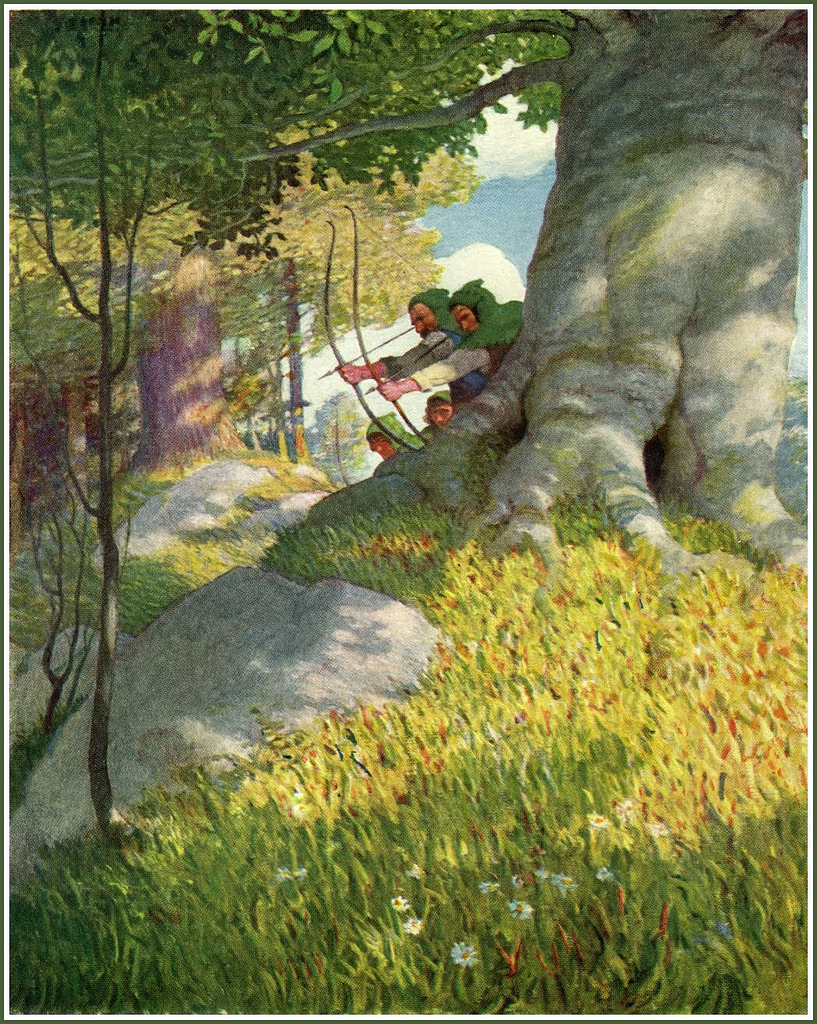
Robin Hood by N.C. Wyeth

Today, I’m republishing a historical essay of mine about a real-life model for the legend of Robin Hood, back in the 11th century and the period of the Norman Conquest. It was inspired partly by research I conducted for the third volume of my big historical fantasy novel, Forest of Dreams, and partly by the fact my husband comes from Worcestershire, an area of England I’ve come to know quite well.

Wicked Sheriff and Outlaw Lord

by Sophie Masson

The legend of Robin Hood is the quintessential English myth. In it, we find all the elements that make up the English—as opposed to the Celtic British—character in the ancient land that the Celts called Logres. Combining ancient magical and symbolic aspects with the trauma of the Norman Conquest, Robin Hood’s legend still has many reverberations in modern England. It could be said, for instance, that the vicious class conflict which characterised English social life–and which still reverberates throughout it to this day–had its origins in the almost total destruction of the native English-speaking Anglo-Saxon aristocracy and its almost complete replacement by French-speaking Norman nobles. This produced a vast gulf of misunderstanding between the two peoples which became, in effect, class-based, for ‘ordinary people’ tended to be native English, whilst ‘the upper crust’ traced its origins to foreign despoilers!

As well as preserving the memory of the hideous physical and moral destruction wrought on Anglo-Saxon culture by the Conquest, the legend of the greenwood lord Robin Hood and his merry men is a perfect distillation of that light, lively and melancholy English spirit which had its most gifted and brilliant expression in the work of William Shakespeare. The slanting, ambiguous, mischievous light of the greenwood and its magic is more powerful, in the end, than the shadow of the castle stronghold in the stories of Robin Hood: an ancient light, that predates the Normans, the Anglo-Saxons, and even the Celts, and symbolises the enduring nature of the land.

It’s always a hard one, conquest. The attempt to brutally suppress a vanquished culture and replace it wholesale usually leads to it haunting the landscape, and the cultural psyche, in a way that eventually takes its toll on the confidence and identity of the conquerors themselves. It’s been the same story all over the world, including of course in Australia. In England, it happened to the Normans. . .

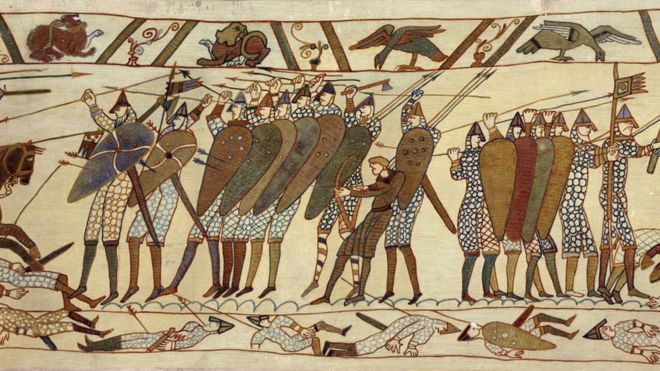
In the year of Our Lord, 1066, thousands of men came ashore at Pevensey under Duke William of Normandy’s lion flag. Attired for battle, William’s warhosts were attracted by the prospect of more loot and plunder than their Norse ancestors(the word ‘Norman’ comes from ‘Norse’ itself)  could ever have dreamed was possible, and also by the joy of teaching their arrogant Anglo-Saxon rivals a lesson they

Scene from the Bayeux Tapestry

wouldn’t forget in a hurry. Lots of men there, twitching with excitement, the thrill of the hunt and of the fabulous rewards promised to them: landless sons, and illegitimate ones; adventurers and pirates and those who followed along just to see what would happen. Like the wolf in the fable, however, they must have a good reason for gobbling up their prey. And so they had it, not one, indeed, but several. Political reason: hadn’t Harold pledged support to William’s right of kingship in England, before Edward the Confessor had died? Religious reason: the Pope had given his blessing to the invasion, because the English Church was going its own way far too often. Cultural reason: the Norse thirst for gold and blood, only thinned a little by la douce France, was rising high. No doubt many of the French breathed a sigh of relief when the Norman army was gone. Personal reason: Duke William, driven by his illegitimacy, driven to conquer England and make it his own, though always his heart stayed in his green Norman fields.

That gathering of men, that roundup of reasons, was to have a far-reaching effect. Those warriors twitching to be gone to battle weren’t to know it: but this was to be the last conquest of England, because it was the most traumatic. And in its trauma would be born the greatest of the English legends: that of the outlaw Robin Hood, and his arch-enemy, the wicked Sheriff. Generations and generations into the future, the affrontement of Saxon and Norman would become metamorphosed into the age-old conflict of freedom and tyranny, of nature and authority, of summer and winter, of wild magic and castle law. And men who were once opponents would become reconciled within it. For the terrible crucible of history distils some potent brews, and the tale of the wicked sheriff and the outlaw lord was one of the most potent of all. And it is fascinating to peer into that crucible of time and watch the ingredients of legend being cooked up before your very eyes.

There, among those men on the English shore, are many who will leave the imprint of their characters and presence on legend. There are the powerful ones, first: greedy Odo, Bishop of Bayeux and William’s half-brother, notorious even amongst the Normans for his rapacity and lust, the epitome of a corrupt and oppressive Church; there is the honourable Ralph de Todeni, or Raoul de Conches,

Arms of d’Abitot family from a ms held in Worcester Cathedral Library

magnanimous when it suited him; there is complex William the King himself, moneybags, tough warrior, harsh legaliser, driven bastard, nature-lover, faithful husband, cold in judgement, the man to whose bureaucratic instincts avant l’heure we owe the inestimably precious Domesday Chronicle, yet the man of whom the Anglo-Saxon Chronicle sadly wrote:

He had castles built

and wretched men oppressed. .

He was fallen into avarice,

and he loved greediness above all. 

He forbade hunting the stags,so also the boars

he loved the stags so very much,

as if he were their father. .

Alas, woe! that any man should be so proud,

raise up and reckon himself above all men.

But it was not only the powerful who made that part of the legend, for if that was not so, the legend would not have become so ingrained. Oppression must be localised and personalised before it becomes more than just a distant story. And so, William’s followers, great and small, in all the corners of that green and pleasant land, all did their bit to help it along.

Urse d’Abetot, or d’Abitot(the medieval chroniclers are notoriously cavalier about names!)was just one of those petty followers. Urse hailed from a tiny place called Saint Jean d’Abetot, on the white cliffs of the Seine near Le Havre. From being a very minor lord in Normandy, a vassal of the powerful Tancarville family, who were chamberlains to William himself, and a mere mention in the invading fleet’s roll call, Urse went on to become Sheriff of the rich Western Midlands county of Worcestershire, and through the marriage of his daughrer Emmeline, allied to one of the greatest of Norman families, the Beauchamps, from whom past and present royal families are descended in one way or the other. Such were the rich rewards of conquest for the conquerors.

Urse bursts into history fully-fledged, as it were, as a perfect example of Norman rapacity, arrogance and violence. His name means Bear, and it is hard to avoid the image of him rampaging heavily through the older culture, looking neither to right nor left as he swipes this hive of honey, and that one, and that one, squashing all the bees in the process. Being no respecter of Anglo-Saxon persons, whether secular or ecclesiastical, he managed to grab one-sixth of the county of Worcestershire for his personal holdings: not only from banished and dispossessed English thanes, or lords, but also from the Church. Illiterate himself, he showed his contempt for the highly literate and cultured monks at Worcester(it was here that the Anglo-Saxon Chronicle was in part written) by building his castle in such a way that his latrines and drains overflowed onto the monastery cemetery. For this, Urse achieved the distinction of being cursed by the Saxon Archbishop of York, Ealdred, who was also the protector of the Worcester monks. Alas, poor Ealdred: the curse has ever been the last refuge of the powerless and vanquished! Ealdred’s words, as recorded by William of Malmesbury, can’t have made the Bear tremble too much:’Thou are called Urse. Have thou God’s curse!’

Sure it is, anyway, that Urse lived on for a good many more years of despoiling(he was Sheriff for 40 years!), whilst Ealdred died only a year after the Conquest. But later, maybe those words came back to haunt Urse, for his only son Roger, the inheritor of all his lands, was banished and disinherited by King Henry I, William’s son, for killing a servant of the King(and thus ensuring that Urse’s heir would now be his daughter Emmeline). The violence displayed by Urse and Roger seems to have lived on in the family: a d’Abitot was one of the four knights who rushed off to Canterbury to answer King Henry II’s exasperated question, ‘Who will rid me of this troublesome priest?’

Like thugs loyal to their gang leader, men like Urse took their vassalage seriously. An eager servant of William, the Sheriff of Worcester helped put down the 1067 rising of the Welsh and the English, as well as the later revolt of the Norman Earl of Hereford. And it was in that 1067 rebellion that we come to the other face of the Robin Hood legend, that of the outlaw lord. For one of the leaders of that rebellion in the West was Prince Eadric of the Magonsaeton tribe of that part of what had once been West Mercia: a famous figure who is known as Edric Silvaticus, or Edric of the Woods; and as Edric the Wild.

Even today, there are stories about Edric in the West Midlands, particularly in Shrosphire, where he had most of his lands; but he also held some in adjoining Worcestershire and Herefordshire. Edric is rumoured to have married a fairy wife, and to sleep under the ancient lead mines of the Stiperstones, waiting for the call that England is in danger again. What is known of Edric’s real history is just as extraordinary. A wild-tempered, darkhaired man who may well have been half-Welsh and half-English, he was the nephew of the infamous Edric Streona, who earlier on in that turbulent century had been instrumental in bringing England to the brink of ruin. Streona was a consummate politician who attempted to play off Saxons and Danes against each other, for his own gain. All these efforts came to naught in the end. For hated and reviled as a traitor by his own people, he was executed by orders of the ferocious English-born Viking ruler, King Canute. Edric the Wild’s own father, Aelfric, was not associated with this, however; and the family were undisturbed in their western lands.

All English thanes who had fought against William at Hastings were dispossessed of all their lands. In this way the new King sought to make an example to all who might try to rebel. Those who had fought against him to protect their lands were, in a neat bit of doublespeak, called traitors, and thus unworthy of holding land at all. In this way he hoped to break the backbone of resistance in England. Many of the dispossessed lords, witnessing the total collapse of their country, did in fact give up, and fled England: some of them ending up as far as Byzantium. Others made whatever accomodations they could with the invaders. Still others took to the woods and harassed the Normans. In the North of the country, this resistance was so strong that William determined to put a stop to it; the subsequent Harrowing of the North was a wound that bled for generations. But in the end, no matter what measures the Anglo-Saxon aristocracy took to protect and fight for their lands, all failed. By 1086, the time of the Domesday Book, there was only a tiny handful of landholders with Anglo-Saxon names left in the whole of England.

Edric the Wild, meanwhile, had not been at Hastings, for whatever reason. He was not dispossessed of his lands immediately. But he did not lie quietly under the Norman yoke and refused to submit to William. Almost immediately, in fact, he gathered support from two erstwhile enemies of his, the Welsh princelings Bleddyn and Rhiwallon, and descended on Herefordshire, harrying the Norman marcher lords in every direction. The historical record is silent on whether Urse the Sheriff met Edric of the Woods in armed combat; but one can certainly assume that their forces would have affronted each other. Edric and his allies were not successful in destroying Norman rule in the Borders; but they harried and harassed the thinly-stretched garrisons in the heavily wooded region to such an extent that William offered him peace.

In 1070 Edric was reconciled to William, but this was not a popular outcome amongst his people, and no doubt the name of the traitor Streona was much bandied about. Whether the old fox William and the lame wolf Edric really trusted each other is open to question: but as William had the reputation of keeping to his promises, and as his ‘protection’ was perhaps preferable to his agent, Urse’s naked rapacity, Edric agreed to keep quiet for the time being. In some ways, this part of the story is like the episode in Robin Hood when the outlaw is lured to the court and made soft with promises and protection by the King, who sees in this a better, more subtle way of keeping Robin under control than the Sheriff’s blunt, brutal approach, which has been a failure. Certainly ordinary people saw it that way, judging by the Shropshire legend of Edric—he is not allowed to die, but must be forever watchful against enemies, because he must expiate his crime of parleying with the invader instead of fighting him.

What happened after this is not entirely clear. But what is certain is that by the time of the Domesday Book, Edric was not a landowner any more. In fact Urse had some of the English thane’s former holdings. What happened to Edric? He must have been outlawed. Did he take part in the earl of Hereford’s rebellion in 1075, and was he punished for that by being deprived of his lands? It seems extraordinary that he might have joined up with a Norman, however rebellious; but those were extraordinary times, when ‘my enemy’s enemy is my friend’ was the only constant. He had engaged in woodland guerilla warfare before; there is no doubt that his cognomen Silvaticus was given for good reasons. Whatever, though, he lost out, like all the other thanes: the outlaw lord brought low not by the wicked sheriff, but by the inexorability of authority, and the crushing of time itself.

And so, Urse prospered, whilst Edric vanished; yet it is not as simple, and saddening, as that. For though it seems as if in this story the wicked Sheriff won, in fact the outlaw lord did not lose. For Edric’s family did not disappear: and the Savages, as they were then called, intermarried in later times with some of the great aristocratic families of England—including the Beauchamps. And their descendants included the Kings of England.

But there was more: for Urse himself, and his deeds, and his glory, were forgotten, doomed to remain as footnotes in history; whilst Edric was immortalised in legend as the consort of an elf princess, leader of a ‘wild hunt’, and became a kind of spirit of the land.  A wryly melancholic, truly English, ending worthy of Shakespeare himself.

The Wild Hunt by Johann William Cordes


The Bluebell Club: a memoir-story

Today I’m republishing a story based on memories of a literary episode in primary school.

The Bluebell Club

by Sophie Masson

Towards the end of my Enid Blyton phase, in late primary school, I founded a wrhiting club, which I called the Bluebell Club, and managed to inveigle some of my friends into it. My younger sister Camille also hung around it sometimes. The name of the club came straight out of Enid Blyton, of course. And I was the President, also of course!

We would sit, we the Bluebell Club, under the trees at the end of the playground, ignoring the bands of boys who sometimes marched past us, arms linked, chanting, ‘We hate girls! We hate girls!’ We knew they were just craving attention, and were jealous of us as we sat there, telling each other calmly the stories we had made up, which was the ritual of the Club. Each member had to bring a story to the week’s meeting; we read them, admired them, and then it was my job to say which was best, and which would be entered in the exercise book that served as the Club’s record.

I loved the Club. It was the perfect venue for recounting the adventures of my favourite creation, Princess Alicia of the rippling blond hair, the wise mind, clever tongue and magic finger. Alicia featured in dozens of adventures I wrote, each profusely illustrated with curly pictures. The Club members listened to the Alicia stories with respect, but then seemed to want to tell their own and to vote for others, not just Alicia. Secretely, I thought that Alicia should win every week, but not even being President could save me from the fate of knowing what would happen, then.

All the other girls, except for my younger sister Camille of course, were real Aussies—they had vegemite, not salami, sandwiches at lunchtime and glamorous parties for their birthdays, with fairy bread and pink cakes and balloons. I never had a party. I wanted one, so badly–and yet I feared that Maman would probably not know the right ‘form’-she’d make a pâté, and real lemonade with lemons, and her cake would be iced just with melted chocolate, not with ‘proper’ icing. I was not yet at the teenage shamed stage–yet I knew, somehow that those things I loved within the four walls of my home would be misunderstood outside them. The Bluebell Club was my way of integrating, of showing that I knew about what I imagined marked out the ‘mainstream’, knowing, despite the lack of a TV in our house, and the fact Maman never bought processed food, about TV programmes and frozen chips. In my stories Alicia always watched Bewitched and Dr Who, and loved frozen chips and green GI cordial.

I talked to Maman about the Bluebell Club, and was amazed when she suggested that we run a proper competition. She would donate a prize for it, she said. My joy at this unexpected offer was tinged with suspicion–would she know what was the right thing to do? I kept dropping hints, saying, well I think a good prize would be a book, hoping that she wouldn’t get it into her head to bake a cake which would look home-made, with dense, delicious yellow flesh and pockmarked brown skin.

She did buy a book–done up in blue tissue, it sat in my bag, innocent and weighty. She hadn’t told me what it was–couldn’t remember, she said, mischievously. But a book was safe. Sure. I took it to school in anticipation, having last week announced the competition. I’d written a story, Alicia’s latest adventure, in which, sheathed in gold brocade and silk hair nets, our heroic princess went to do battle with an alien. I’d had trouble drawing the alien–it looked rather like Maman’s vacuum cleaner. But the story was good drama. I’d rehearsed it to myself, last night in bed.

One of the other girls’ mother had kindly baked a cake for us, as celebration, and we ate it as a preliminary. There it sat, neat as a house on its plate, its walls straight and pale, its roof prettily frosted with white icing, dusted with multi-coloured sprinkles. It looked like a proper shop cake, and I was awed by its beauty. ‘Mum always buys the good packet mixes,’ the girl said, and I gasped with longing. I’d seen those packets in the supermarket—they had names like Snow Vanilla; Royal Chocolate; Pink Marble. Cakes for a Princess Alicia, to eat off golden plates.

When the cake was cut, it proved to have white flesh inside. It must have been a Snow Vanilla. I couldn’t get my eyes off that snowy colour; it was like no cake we ever had, at home. There was none of the sweet denseness of the French butter cake known as quatre-quarts which Maman made a lot; instead, you closed your mouth on an airy lightness, as soft as cloud. Privately, I was a little disappointed; it was like barbe à papa (fairy floss or cotton candy) that looked so magically wonderful but disintegrated into a trickle of pink on your tongue. But I was loudest in praise, for you couldn’t admit that pretty words could hide nothing at all. It was the image that was important, the feeling of riches, of magic, of leisure. No hard mixing and stirring and separating here, no messy egg shells, still with yolk adhering, or showers of flour on the floor. Just a packet, a picture, a pretty name, and hey presto–instant cake! It was like a miracle, I thought. And you can’t question miracles.

When the last crumb of Snow Vanilla had gone, I held up a hand for attention. ’And now for the judging of the competition,’ I announced rather pompously. ’I have here a magnificent prize, for the lucky winner.’ The others watched me a little strangely, I thought. Didn’t they want to know the winner? ‘Let’s read all our stories, and then we’ll see.’
I read the latest adventure of Alicia first, my voice rising and falling. I added an episode ad lib, when the Princess feasted on Snow Vanilla. The others listened, then read their stories. Very ordinary, they seemed to me.

‘Now, we’ll decide the winner,’ I began, but then another girl, the cake girl no doubt, stopped me. ’I’ve told my mum about all this,’ she said, ‘And she said it’s not fair, that you get to be the judge. I bet you’d choose your own story!’

‘I’m tired of Princess Alicia, anyway,’ said another girl. ’Why do you always write about her? She’s boring!’

The meeting broke up in disarray. In my bag, still in its blue tissue, was the prize book. I’d had no chance to bring it out, to display it, no chance to choose the winner, no chance to hand the book over, in its secretive blue. I tried to call them back, but the words wouldn’t come. They were off, chattering, their minds on elastics and skipping. They’d had enough of the Club, too. Possibly enough of me. My earnestness frightened them off. Now I was frightened. I’d thought I’d done so well, queening it over them, but now I realised they’d humoured me, for a while, because there was nothing else to do. Camille stayed for a minute, then said, ‘Don’t worry, I like Alicia. You can read it to me, if you like.’
But I didn’t want to read them to my sister. I could do that any day, at home. I wanted to sit under the trees, with the Bluebell Club, being their President, their admired, imitated President. I wanted to fill the exercise book with our work, with our efficient meetings. It felt like real life, quiet, efficient real life, not the chaotic un-Australianness of our home. But I’d just been voted out of office. Permanently. I knew it. And suddenly, Alicia’s curly hair, her huge eyes, filled me with anger. I tore the story across and put it in the bin.

The book stayed in its blue tissue all day. At home, I opened it at last. ‘The members of the Bluebell Club,’ I told Maman, ‘voted my story the best in the competition!’ I could even believe it, as I opened the collection of illustrated poems Maman had bought (it was a lovely book). Yes, I could even hear their clapping as one by one, the members of the Bluebell Club agreed that Princess Alicia and the Aliens was the best story they had ever heard, and deserving of the first prize. I looked across at Camille. But she said nothing. Her mouth was full of cake. Quatre-quarts, not Vanilla Snow.

The Questing Beast: another story from Arthurian times

This is another Arthurian story I wrote some years ago, set again in the court of Camelot, like The Common Dish which I republished yesterday: unlike it though it’s set at the beginning of the Grail Quest, and the coming of Galahad. And this one is told in Guinevere’s voice.

The Questing Beast

By Sophie Masson

Galahad

May it was, a beautiful Pentecost dusk, when Galahad first came to Camelot. Oh, in a blaze of glory he came, streaking across our sunset sky like a fiery comet, lighting the brilliant way to the end of our world! We saw the brightness, but not the doom; we did not understand that he brought both death and life to the tired land. And we did not pity him. We did not see anything in him to pity..

It was the springtime of the year he came, but the autumn of Camelot. For the great deeds of the past, the vigour and magic of the youth of our world, had dwindled. All the paths, it seemed, had been taken; all the monsters vanquished. We lived in a peace and prosperity unknown to any before us. No wars disturbed our peaceful borders; but the ideals of our past had grown old with our King, and soft with our living. For it is a strange thing that men long for peace when there is war; yet when there is peace, war reigns in their hearts. Melancholy now lived amongst us, where she had been unknown before; yes, and her sister regret, and her daughter despair, and her cousin indifference. The young spent their days in fruitless jousting, in never-ending tournaments of empty valour and foolish risk, in boasting and swaggering; the old in endless recounting of events of long ago: when, they claimed, not only were the deeds more valorous, but also the sun itself shone more brightly in the bluer-than-blue sky!

But there was more than this, something that was dangerous above all else. For the memory of the ways to the Otherworld had grown dim too. The path through the forest of dream had become overgrown and choked with the brambles and vines of our indifference. No longer did the graceful maidens or perilous knights visit us from the immortal realms; and we had almost grown to forget they had ever come at all. The doors and windows of our heart-fastnesses were shut to all marvels, all joy and wonderment, and darkness encroached steadily upon us. So the Wasteland grew around us without our even becoming aware of it; and we bled from invisible wounds, and did not even know it.

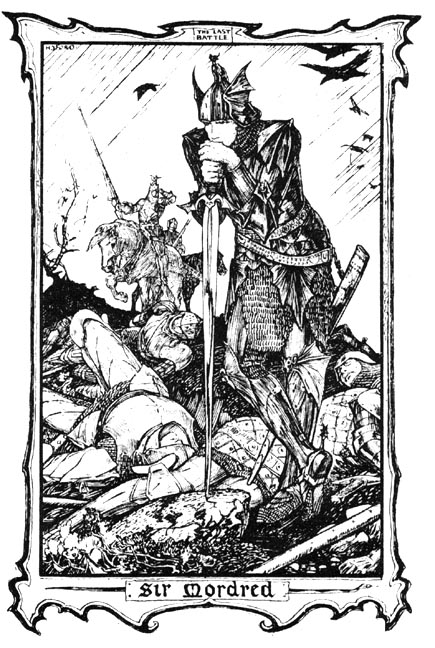
Oh, there were a few of us knew well enough, both of the old and the young. Mordred, for one. He had come to Camelot not long before, and had caused quite a stir. But memories had grown dim at Camelot along with so much else; and long shadows are easily hidden at dusk. Mordred did not remind the Court of any unpalatable things; he was always a smiling villain, and clever, and became quite a leader amongst the young men. But villain as he was, he understood what was lacking, what was missing in this autumnal Camelot. And in this understanding he saw his own chance. But he was also one of the few to understand Galahad for what he truly was: bright sun to his own night, yet kin to him in all but name, and necessary to each other. For if there was no sun, truly, the night would be bleak and overwhelming; but if there were no night, would the sun not seem merciless?

And Perceval, the one they called the Holy Fool. He knew. He had been to the perilous castle, he had seen the maimed piteousness of the Fisher King. He had failed twice to ask the questions that would heal the land. But alone of those there, he knew it was the questions that must be asked, not the answers sought. He and his sister the Lady Dindraine, who was in my household, they were amongst the best of the young ones there; bright with enthusiasm and kindness, both, though hotheaded and impulsive, at times, and in a fair way to losing their brightness, in the enervating atmosphere that was now our world.

Arthur should have known. But melancholy had settled over him like a well-worn cloak; his heart was in mourning, his mind wounded, enshrouded in fog. The anger and coldness that was in Mordred had come from him, after all: the son was a mirror of the father, a demon’s bitter glass, to be sure, but nevertheless reflective. The memory of his ancient double sin–the sin of incest, however unwitting, the sin of then attempting to kill his own son–might have faded from the Court’s memory, but it had never left Arthur. In his earlier years, it had seemed to him that the sum of his honourable deeds and his care for his land of Logres, might be set in the balance with his old sins, and tip it in his favour. But now, he was not so sure. The bewilderment of the past had returned to him in full force, and he had none of the defences of youth to hold up against the darkness anymore. And every evening, now, he was reminded. Every evening, Mordred sat at the table, and led the young knights to their boasting, and swaggering. Every evening, Mordred raised a toast to his father. Every evening, he toasted the Queen, and the First Knight, Lancelot. And every evening, his mouth smiled and smiled like summer, and his eyes were cold as winter.

But Arthur did not look at his son if he could help it; his mouth never formed the name ‘Mordred’. It was his only protest, his only defence. And it availed him little, in people’s minds; for there were many there that spoke, not so secretely, of Arthur’s unfairness and coldness towards his only son, who had always behaved with the utmost respect towards him.

And I? What of me? In that autumn of our world, the power of summer had left me. I was weak with the onset of my nature’s own winter, and sad with the onset of my years’ end. True I had been, in my way, the way that meant I loved two men; but with the years had come an understanding as draining as Arthur’s; that never would the glory and careless pride of our youth return.

Lancelot and Guinevere in youth

It was on such an evening that Galahad came. He came not unknown and unheralded, like the King himself had done, long ago; but blazing out of the darkness, out of the palace shut in on itself for so long. Handsome as the day, with a skin touched with a golden bloom and hair as black as a raven’s wing, he was clad in red armour, with a golden scabbard by his side. He came not orphaned and humble, as did Perceval the Fool; but indeed to claim his rightful place at the table. Yet he did not come in fuss and fight and defensive jealousy, as did Mordred. For Galahad there was no test of valour necessary: his very name was enough, for the Siege Perilous glowed in letters of gold at his approach. Young, assured and strong and bright as a lick of Pentecost flame, he stood before us, not arrogant in his pride, but straight, as someone who knows his true worth, his own truth, who has always known it. Neither he nor the white-clad old man with him, his guide, needed to ask for our silence. Their very presence was enough. The Otherworld had returned to us; summer and winter were one.

Oh, how I remember now the looks on the faces turned towards him! The young ones felt the fire of their loins rushing up instantly into their minds; the older ones knew a bittersweetness rising up to overwhelm them. In all the manly hearts was a longing, all the deeper for being sudden: that it was they, standing straight and proud and tall like that, gazing calmly into all of the waiting faces! And the women–ah, the women knew a longing that they might stand by his side, might share in all he was to ask of them, as mothers, or sisters, or lovers. I understand it, for I felt it, too, so strongly…

I looked across at sweet Dindraine, and saw that her eyes were fixed on the young knight. She was already his: her heart already lost, her soul already promised, her body already aflame! Before long, it would burn with a fire all the greater for being denied, a flame tall and straight and white and consuming.

‘Peace be with you, fair lords,’ said the old man. His voice was soft, yet somehow it made us all tremble. He turned to the King. ‘Sir, I bring you a young knight who is of king’s lineage, and of the kindred of Joseph of Arimathea.’ He paused a while, and his voice dropped to a whisper. But still we heard it, low and thrilling. ‘And through him, all the marvels of this court and of all strong realms shall be accomplished.’

I watched Lancelot’s face then. It was transfigured. His striking, strong face: it was suffused with a  joy I had never seen there before, as he gazed on his only son. I remembered what his castle had been called, when he had lived with the Princess Elaine, mother of Galahad: Joyous Gard. It was this joy for which he had been waiting all his life. Oh, there was nothing selfishly proud, nothing of fatherly swagger about him: of all the men there, Lancelot could see the truest of all. Not with the sharp eyes of hate, like Mordred, or the clear eyes of innocence, like Perceval: but the true eyes of a loving man. Indeed, his son was a shining child to him, though, never, never as dear as his father, and lacking…lacking in something, though I did not know it yet. And seeing Galahad through Lancelot’s eyes, I felt as if a great burden had gone from me, as if I truly understood.

But there was Arthur. Arthur, gazing hungrily, wildly, on Lancelot’s son, as if he would devour him with his eyes. And the pain of it was like a lance in my heart, a frost-tipped lance of endless sorrow.

The King nodded. ‘Sir, you are right welcome here, and the young knight with you.’ Lancelot looked at him then; for Arthur was not immediately warm, in his voice, and the First Knight always was a man frank and bold in his own reactions. But I could see the King was holding in check some great leap of the heart; some terrible yearning; and I longed to help him, but could not.

Galahad bowed, and smiled: not discreetly, but with a grave golden dignity.

‘Sir, I thank you for your courtesy.’

Then the old man brought him around the table, towards the Siege Perilous. And there was another great silence in the hall, a silence that was like fear.

The old man lifted the cloth that had always covered the seat; and he read out in a loud voice the words that had appeared there, in letters of gold:

This is the Siege of Galahad the High Prince.

There was a great sigh then, and a rustle, as everyone got to their feet, craning to see as Galahad slowly sat down on the seat that had always been meant for him. There was no surprise in his face, just that golden smile. And suddenly, I looked across the hall, and saw Mordred. And he was smiling, too. Smiling and smiling, with his mouth and eyes bleak as winter. And for a moment, pity filled me. Mordred did not have his father’s love, his father’s blessing: nothing but his lineage, and the memory of an ancient sin that must be expiated. His place here at Camelot had been forced on Arthur. Here he was, the High Prince; Arthur’s heir; yet it was Lancelot’s son who sat thus enthroned.

Mordred caught my eye. He did not stop smiling; but in his eyes something leapt then, something like a dark, questing beast, blind and wild in its fury.

Galahad was speaking. ‘Go in peace, old man. You have done what was needed of you. Give my respects to my grandfather King Pelles and my mother Princess Elaine. Tell them that my father has greeted me.’

So young, to be so commanding! Yet none of us wondered at it, for in his radiance, half-human, half-Otherwordly, he reminded us of our old contract with the Otherworld, and it gladdened all hearts, the young and the old.


And so the die was cast. The coming of Galahad was truly a great wonder, and many marvels he accomplished as well, after it, but what I remember most of all is the way in which he transformed the court in his short time there. I never saw him again after he left Camelot, but he left an indelible impression on me, as he did on everyone who knew him. Whilst he was there, there were no foolish quarrels, no hasty words, no witless swaggering, and Mordred’s poisonous whispers went unheard. Lancelot went about in a happy daze, so happy that all our old joy was restored. And most of all, the fog seemed to leave Arthur’s eyes, and he seemed not so much reborn as refreshed. Not that he forgot his sins; but that, like so many others, in Galahad’s presence, he felt that truly the balance was there. That he had truly atoned, and that though Galahad was not his son, his very presence at Court was a sign of forgiveness. Arthur even looked on his son Mordred then, and spoke his name, and attempted kindness where tenderness did not yet come naturally. Mordred was becoming uncertain: the dark unhappiness and desperate anger of his heart trembling under the new way of things. Even in the bitterest soil, a loving miracle can make a beautiful flower grow. If it had all lasted longer, who is to know what might have happened?

But that was never Galahad’s aim. Never his destiny. He was the blazing comet, the last brilliance of our wounded land, and not its healer. Earthly harmony held little music for him, for he was of the Grail Family, keepers of the secret flame, the holy blood. Kind he was indeed to Dindraine, but never did he love her as a man loves a woman: for Lancelot’s son though he was, he did not have Lancelot’s soul. Galahad’s being was of light, and had no share in darkness at all. And a man must have both within him if he is to know love, and love is to know him.

When the knights came to Arthur and begged to be allowed to go on the Quest for the Holy Grail, Galahad’s name was on all their lips. Galahad was the shining light. He was the one for whom the Grail had waited, and now he was here, it would be found. The King gave his consent–of course. How could he not? Was it not what they had all been waiting for? At that time, this is what they thought: this would be the healing to end all healings; Camelot would be purified and made whole, forever. They did not think that light blinds and burns as much as it illuminates. None of us remembered. We had been living in the twilight for too long, to remember that morning’s fresh gilt is followed by midday’s burning, and that the setting sun burns brightest of all.

Watching, I could hardly fault them their fervour and worship of the young Grail knight, not when I myself had known such peace when Galahad was there. But he was going; and now I began to see that he had always meant to go. And I began to wonder. What did Camelot mean to him? What did it mean, for one so young, to know he was marked by God? What did it mean, to know one’s conception had not been made in earthly love, but in otherwordly deceit, sweet and good as that deceit might have been? And I could find no answers. Questions, only. I thought, like Perceval, I should be content to know the questions and not seek the answers–but oh, I am too much a part of this unstable world to be able to do so.
And so, the knights would be going, all of them, even Lancelot, only Arthur remaining behind. Only Mordred had not declared for the Quest; the tough vine of his jealousy had sprung up again, and he wanted to make quite sure it was not all a plot to distance him from Camelot, and from Arthur’s favour. But no, perhaps that’s not the full story; perhaps it was truly because he knew.B ecause as I said, he understood Galahad.

Dindraine came to me on the day before they left, to bid me goodbye, for she was going on the Quest, with her brother Perceval, and good Sir Bors, and Galahad her love. She was aflame still, sweet Dindraine: and in her voice and manner was the fervour of one who would lay down their life for their love, for the glory of a deed to impress her name on him forever.

‘Good lady, I ask for your blessing,’ she said,’ for you have always been kind to me, and I have admired you, always.’

‘I give you my blessing joyously,’ I said, ‘for I see that it is in joy you go, and not grim destiny.’

‘Oh, yes,’ she said, and turned wide eyes to me; ‘with Sir Galahad, there is no grim fate, but only the surprise of joy, always!’

I did not show in my eyes or my mouth that I had any doubts. I blessed her, and hoped that God would smile upon her, and that Galahad might see her one day, and love her as much as she loved him. But as I fastened on her cloak the gilt brooch that was my gift to her, I felt such a tremor of fear that I could barely murmur words of farewell. In any case, she hardly heard me; her spirit was already on the road, with the three knights.

But I had Galahad called to my presence, nevertheless. As he stood there before me, so much his father’s son yet so unlike him, I felt a pang of grief unlike any I have ever known, so that for a moment I could barely speak.

‘You sent for me, Lady?’ His voice was low, yet sweet. There was no surprise or wariness in those clear blue eyes, his mother’s eyes: only compassion. Strange, then, that I should feel afraid to continue.

‘Yes, Sir Galahad.’ I made my voice firm. ‘I have been speaking to the Lady Dindraine.’

His eyes lit up. ‘She is a beautiful soul.’

The words were wrenched out of me. ‘Oh, Sir Galahad, do not forget she has a body too! Lovely as the morning, for it is the mirror of her soul, the sacrament of her spirit, and must not be tossed lightly aside.’

His eyes were still clear and blue. ‘Sweet lady, do not fear,’ he said gently. ‘The Lady Dindraine comes willingly.’

‘I know that.’ Somehow, the arguments had thickened on my tongue, but I forced them past my lips. ‘I am a daughter of earth, I know, Sir Galahad, and not like your mother, who is a princess of the Otherworld. But Dindraine is of earth too. And so I am afraid; for our bodies are our souls’ only home in this world.’

‘Dear Lady,’ he said, again, ‘do not fear, for I am her knight, and her friend, and will protect her.’ And his smile was so sweet that all the questions left me.

On the morning they left, then, we made a merry occasion of it, and the air was bright with trumpets and gay with green and blue and red favours .The Questers rode out of the court with a tumult of hooves and a flourishing of mailed hands, and hope and glory and courage rode with them. And at their head, a figure beautiful as the dawn: Galahad himself. And riding behind him, queenly in bearing, with her bright hair up, the Lady Dindraine…

For a moment it was as if we were looking on the morning of our own world, and not just on day’s beginning: and I felt the tears start in my eyes, and thanked God for granting us this sight. I looked at Arthur, and saw that his eyes were full of it too, and we reached out to each other, and our hands clasped, and held firm, and warmth surged through each of us, and renewal, and hope.

But then came Mordred’s slow, thoughtful voice behind us, making us spring apart, as if by instinct.

‘My Lord Arthur, my lady Guinevere–is it not a strange sight indeed?’

Arthur turned. ‘Strange sight, my son? Whatever can you mean?’ His voice held a strain, but he was striving to be fair. For Mordred had decided at the last moment that he would not go, and Arthur had made him see, most plainly indeed, just what he thought of that. Cowardice was a thing he never could stand, and he had accused Mordred roundly of it. But I did not know these things till later, when it was far too late: or I would have told him that cowardice was not a thing Mordred had in him. Many other things, yes, but not that one.

Mordred smiled. And horror rose in me at the sight, for there was winter again in his gaze, the white harshness of frost in his features.

‘Why, great King and Queen, would you not say that yonder line of men looks most uncommonly like a great beast? A great questing beast bright in colour and sinuous in movement, with many and many baying tongues: and its head like a flame?’

We could not help looking, and to our horrified eyes, now that Mordred had spoken and unlocked forbidden things in our minds, the long line of knights did indeed look like some terrible thing, some devouring dragon eating up the land. Some ravaging, wild and wicked thing. And at its head, a flame, pitiless as fire, blind as the sun.

‘Why,’ said Mordred, watching our faces. ‘Why, great Queen, great King, I am sorry if my thoughtless question has caused you pain. I have too lively an imagination, it seems.’

‘Thoughtless…’ echoed Arthur, and his voice was choked. ‘You never did anything except by great thought, Mordred. But imagination–that you do not have. That you cannot take, as well.’ And without another word, he turned on his heel, and was gone from my side.

Mordred raised an eyebrow at me. For a moment, the fear of him was great in me. He was growing strong, and would soon be stronger.

‘My lady Guinevere,’ he said, ‘Forgive me if I have offended you. I meant to be merely amusing: the knights of the Round Table, questing off on the hunt, quivering, like some great eager beast.’

He waited for my reaction; but I hardly heard him. For in that terrible moment, Galahad had turned in his saddle and was looking back towards Camelot. From this distance, I thought I saw uncertainty in his bearing. No longer was he the flame-head of some hideous questing beast, but a young man, still beardless, and alone in all his perfect glory, in our imperfect world. And the sight of him filled my lungs with power, my mind with the question I should have asked him, so that I cried it out loud:

‘Oh, my friends, why do you quest far away for the Grail, when it might live bright within you?’

But they were too far away. They marched away gaily, all unheeding, those doomed bold men, that doomed brave girl: for of that large and shining company, only a pitiful few would return. There was only Mordred to catch my words, and only his wintry smile in answer, as he turned away from me, and followed his father into Camelot.
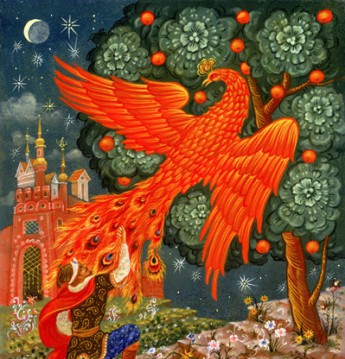
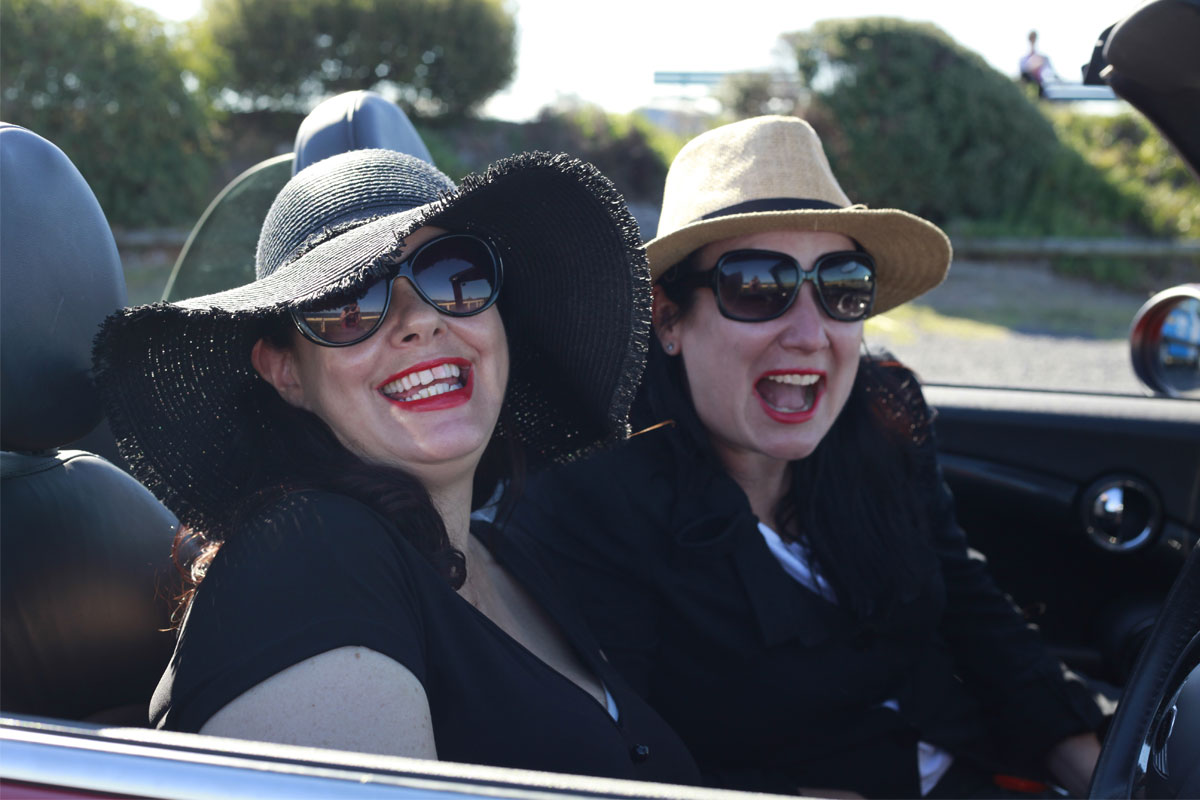
 

The Common Dish: a short story of Arthurian times

Today I’m republishing a short story of mine, The Common Dish, which is inspired by that great medieval body of stories, the Arthurian legend–and the Grail Quest as seen by those who were left behind.

Knights departing on Grail Quest, by Edward Burne-Jones

The Common Dish

by Sophie Masson

May had come in, lusty May, that makes us forget the rigours of winter and think of warmer pleasures than those of the fire. May, bedecked in garlands and blossom, sweeping down the country lanes like a bride, showering all with gladness. Usually, we welcomed her with equal gladness; we danced for her honour, we donned our bright clothes again, drawing them out of chests where they had slept all autumn and winter, under lavender and rosemary, to keep the moths away.  Usually, at this time, the lady of this place, Laurel, my sister, gave orders for sweet pastries to be made, and honeycombs to be brought, and last year’s mead brought out of the cellar, new cheeses to be laid fragrant on well-scrubbed tables, the common dish filled with fine and tasty things for all.  The fields were bright with poppies and meadow-sweet and cowslip; the riverbanks bright with flowering parsley, the skies bright with larks and thrushes and other sweet-voiced birds, the roads bright with knights bound for tourneys and shepherds herding their flocks and ladies going a-maying and children singing new songs.  Everyone was happy, in May-time; everyone, from the lowest to the highest, the King to the lowliest kitchen scullion, the most ancient crone to the handsomest knight, saint and sinner.  Even the ill-favoured and ill-tempered might be happy, at such a time. For blue, bright May was God’s gift to the whole of creation.

But this year was different, for Camelot.  Of course, there was the joy that the Quest had ended, the knights returned.  But so many had not, and so the joy was subdued, blue May less welcomed, and mourning amongst the happiness, like thorns amongst the roses. . . .

We had thought, we who had been left behind, that the great Quest for the Grail would bring an ease, a healing, a return to things as they once had been, before Camelot lost its first bloom.  But it seemed that even such second-hand bliss was not to be found.  The returning knights had each sought a private audience with the King; and no doubt he knew just what it was that had happened, in those magical, distant realms of the otherworld.  He must know just which of his knights had reached the Grail.  But he remained silent about it, too.

There was a great deal of talk, of course, amongst those of us who had not gone, those of us not mentioned in the chronicles, whom it was not thought fitting to inform of such weighty and important things; lots of rumours, passed from mouth to mouth, hand to hand.  We looked at the knights, noting here a new serenity, there a strange fixity of regard, here a gentleness, there a wildness of mien, and judged accordingly as to whether the wonderful vision had been given.  But was that truly a good way to judge? If anything, the Quest seemed to have emphasised each man’s character; accentuating his qualities, and also, alas, his faults.

It was so with my lord Agravain.  Aware that he, as one of the Orkney clan, might be seen as unrefined in the sophisticated court of Camelot, surrounded by such knights as Lancelot du Lac, he was overly anxious about his station, and thus never had been one of the King’s favourite knights.  Yet he had always found his place in the court, before.  In the past, despite his faults, he could at times be an entertaining companion, with a dry sense of humour, and a bright manner of speaking.  Yet even then, he had seemed, to me, like the odd man out, beside his brothers: huge, rumbustious Gawain, gentle Gareth, kind Gaheris—a man of uncertain, perhaps even cruel temper under the jokes, with a jealous discontent under the dryness.  I had felt the sharp edge of his tongue more than once: he was proud to be allied to our house, but not so proud to have a plain sister-in-law whom no man seemed to want.

Unlike his brothers, too, he hated Lancelot, though in front of them, he pretended a manly indifference to the French knight.  But Agravain’s true feelings for Lancelot were even more complicated than this: he hated the Lake Knight, yet he often copied him, the way he walked, the way he held his sword, his slow, grave, sweet smile, his natural grace and courteous French manners.  Except that Agravain, poor soul, could do no more than ape Lancelot: never could he have a fraction of his charm, but only be a pale copy, like a cheap facsimile made by an indifferent scribe.  And knowing this, did he hate the oblivious Lancelot all the more?

Ladies of Camelot tapestry by William Morris and Edward Burne-Jones

Always, before the Quest, Agravain’s faults had been kept in check, by his brothers’ careful kindness, by my sister’s loyal love, by the gentle management of the King and Queen, who found space for all manner of people in their realm.  In those days, he was careful, at least; he did not approach Mordred, who had come to Court just before the Quest began and was already a disturbing influence in Arthur’s once-serene kingdom.  Agravain knew well on which side his bread was buttered.  He went with his brothers questing not because he wished, like them, innocently to gain, if not knowledge and wisdom, at least adventure and mystery, but because all the knights who mattered were going.  And Agravain would certainly not be left behind in that race.

While he was away, Laurel and I spent our days as we had when we were children, and it was plain to see that she relaxed into it, as if she were freed from a burden.  We gave up the dull Frenchified rituals Agravain insisted on, we ate plain meals out of common dishes with the retainers and the servants; we swam in the river and walked in the woods; we read to each other from illustrated books and we spent many hours in pleasant gossip.  Sometimes, Lynete and Lionors, Gaheris’ and Gareth’s wives, would come over to spend time with us, and then, all together, we spoke longingly of the absent ones, and wondered how the Questers were managing; and sighed, that we should be women, and not be able to go with them.  Or at least, Laurel, Lynete and Lionors  did; I reminded them that Dindraine, Perceval’s sister, had gone with them, and Laurel pouted and said that did not count, as everyone knew Dindraine was practically a nun.  Frankly, I had no desire to go on the Quest; there was in me an unease from the very beginning, an unease I could not explain to anyone, not even Laurel.  Perhaps especially not Laurel, who like most of the others in Camelot, was dazzled by the Quest, by the beauty of it, and coincidentally or not, by the unearthly, untouchable beauty of Galahad.  It was a companionable time, that time without men, and soothing to my own troubled spirit, for it is not easy, being an old maid, when you have no intention of becoming a nun. .

Yet on one day, the very day that the Questers came back, my kinswomen destroyed that peace for me, quite innocently.  We had been sitting in the solar, calmly embroidering, and they had been talking, as usual, about their favourite subject, whilst I listened indulgently.

‘What do you think?’ said Lionors, turning to me suddenly.  ‘You are silent.  Could it be. . ‘ and here she twinkled at me—‘that you do not share our admiration for the greatest knight of them all? ‘

‘I do not consider him the greatest knight,’ I said, stiffly.  ‘He has not proven himself.  ‘

‘Unlike his father,’ said Lynete, with that sharp glance that had so flayed poor Gareth when she had first met him.

I coloured, but said nothing.  Laurel sighed.  ‘My poor sister,’ she said, softly.  ‘Lancelot’s heart was taken long ago.  He cannot give it to you, though indeed you are more worthy of it, my dear one, than she who holds it now.  Beauty is not only in the eye, but the soul: true ugliness is never in the features of a loving face. ‘

It was a great shock to me, this thing she said, for it showed me something I had long known, yet hidden from myself, and something which I certainly thought had been hidden from everyone else.

I pushed away my embroidery and stood up.  I could feel a hot denseness in my chest, a tight pain in my throat.  Yet I managed to speak.  ‘You are being foolish and frivolous,’ I snapped.  ‘I am tired of idle talk.  There is work to do.  My lord Agravain will not thank us if we allow the manor to go to ruin in his absence. ‘

They stared at me.  I stared back proudly, and stalked away. I truthfully did not know where I was going, only that I must go.  I walked briskly, blindly away and towards the stream, feeling their eyes on my back, and the hot dense pain in my whole being.

There was a girl, one of the servants, washing the dishes by the stream.  She was a young girl, and uncertain: when she saw me advancing on her like a fury, she gave a little squeak and hurried away, leaving her work.  I smiled harshly to myself: so, in my despairing, angry ugliness, I had frightened her! All the better.  I looked down at the dishes scattered by the stream: the cups, the plates, and the common dish, a huge blue pottery tureen, encrusted with the remains of all too many meals.  My widowed father had had it made, in a pattern that Laurel and I would recognise, for it was just like the dishes we had had at home.  Agravain had never liked it; it was too thick and homely for his tastes, and so it had mostly languished unused, except when he was away, and then, by common consent, Laurel and I would call for it to be put on the table.

I cannot remember doing it: but the next second, the dish was in the stream, broken in several irrepairable pieces.  And I was kneeling by the stream, weeping as if my heart would break too, trying to gather the pieces of the broken dish, yet trying, too, to smash it even more, my hands bleeding from the sharp shards, but uncaring, for my head was filled with a painful, joyful vision, a thing of such bright clarity that for a moment it seemed to have a tangible reality.

I heard running footsteps.  Laurel had found me.  She touched my arm, timidly.

‘Sister,’ she whispered, ‘forgive me, if I have hurt you, unknowingly, I did not mean to.  ‘

I looked at her with love. ‘Laurel,’ I said gently, ‘do not be afraid.  You saw something I had hidden from myself, and I was angry.  But I am not angry any longer, only a little sorry that I.. ‘ I looked down at my hands.  ‘I am sorry, for I broke our father’s gift to you and Agravain. .‘

My sister’s eyes filled with tears, then, and she leant towards me.  But what she was about to say never got said, for I turned my face away from her, towards the woods—and saw a figure come limping out from their lee, a figure leading a skeletal horse, and I knew at once, with a hot, wild, joyful, despairing leap of the heart, that it was Lancelot, back from the Quest.

The parting of Lancelot and Guinevere, by Gustave Dore

Laurel turned her head and saw him too; then she gathered up her skirts and went running, crying out joyfully as she went.  She was followed by Lynete and Lionors, and then by all the people on the manor, the workers in the fields, the servants, the grooms, the kennel-men, the dairymaids.  From all over the manor, people were hurrying, to give their beloved living legend, the Knight of the Lake, a welcome they would never have thought to give their own lord.  And so it was that only I saw Agravain coming in his turn, not from the forest but the opposite direction, from the direction of Camelot, splendidly attired, and riding a magnificent Arab mare.  He rode with a swagger and a certainty that he would be noticed; and I felt almost a pity for him, then, a kind of shameful wound, as our eyes met across the distance, and I saw he knew who the other man was.  But he never checked in his stride, I’ll give him that; indeed, he quickened his pace, and soon drew level with me.

‘Well, my lady,’ he said, his eyes not on me but on that touching little scene by the forest, ‘as you see, I am back from the Quest. ‘

‘So I see,’ I said.  ‘Welcome home, my lord Agravain. ‘ Some strange levity was bubbling in me.  I could not help it.

He smiled thinly.  ‘But I see I am not the only one.  I must welcome my companion home too. He looks ill.  Perhaps the Quest was not a success for him. ‘

His eyes dared me to ask questions.  Obligingly, I said nothing.  What was there to say? I was not a Quester.  My vision had not been of the Grail; but only of the common dish.

The involuntary mockery of my thoughts must have shown in my face, however, for his lips tightened, and he said, ‘Sister-in-law, it is not fitting you are down on your knees, washing dishes like a common scullion.  ‘

‘No,’ I said, ‘I suppose not.  I must remember my station as sister-in-law of a returned Quester knight. ‘

‘Indeed,’ he said, in his vanity misinterpreting my humble face and lowered eyes.  ‘I am glad you understand.  ‘ He paused for a tiny second.   ‘The other– my brother knight Sir Lancelot,’ Agravain went on, ‘has he been here long? Has he seen the King yet? Is there.. . ‘

‘No, my lord,’ I answered, as steadily as I could.  ‘He has not.  ‘

‘Ha,’ said Agravain.  He looked down the slope at the cheering, whooping party, at his own wife, his brothers’ wives, his retainers making merry around the weary, but obviously delighted, Lancelot, ‘In any case,’ he said, slyly, ‘I do not suppose that it is the King he would go rushing off to straight away, do you, sister-in-law? ‘

I looked at him; at the jealousy distorting his face, at the cruelty fully imprinted there now, at the discontent of his bearing, and I felt a tiny pang of fear, for I knew in that instant that Agravain had not come even close to the Grail, and that Lancelot had.  I knew that if Agravain had hated the French knight before, it was as nothing to what he felt now.  My heart ached—with love for Lancelot, with a kind of tender sorrow that he would never know it, with unease for what might follow.  But I gazed steadily into Agravain’s angry eyes and said, quite quietly, ‘I am sure I do not know what you mean, my lord. ‘

‘Pah,’ he said, ‘you’ve always been a fool, blind like all the others, like the King himself.  Prince Mordred was quite right. ‘ And with that, he touched his horse’s flanks, and was off, galloping down the slope towards Lancelot and the others.

But I stood there quietly for a moment, before moving down the slope in my turn. And the wild, hot, despairing feeling grew again in me, and grew, like a vine twining its way around my heart, a thorn bush of wild blooms protecting the vision I had seen.  The vision of the common dish, that is the lot of common humanity, the ones of us left behind, forgotten, our names and histories lost to the chronicles and the legends, but whose breath and liveness, anonymous, can be found in all of the most ancient stories, the oldest songs: the knowledge of love brought to the light of day, the welcome of spring returning, as it always does.  No, it is not the Grail: but it is given to more of us, and may, in the end, prove as wonderful as that holy vessel.  And perhaps, if a person look only for the Grail, and forget the common dish—is that not a forgetting of God’s magnificence, of His love that remembers even the smallest sparrow?  In my heart, I thanked God for His gift, his gift of this blue May morning, of the unremarked, the common miracle, in the midst of the sorrow and the glory and the gathering tragedy of the great ones of this world.

June, from the Tres Riches Heures du Duc de Berry