Publication day of The Giant: and how it all started!

Today, August 1, is the official publication day for The Giant, my new picture book with the wonderful illustrator, Lorena Carrington, and we are so thrilled! Published by MidnightSun Publishing, The Giant is a fable about, yes, a giant! He wakes from a long sleep and happily walks down the mountain to find his old friends in the town–but alas, so much time has passed since he went to sleep that nobody remembers him and everyone runs away in fear–everyone, that is, except for–well, read the book to find out!

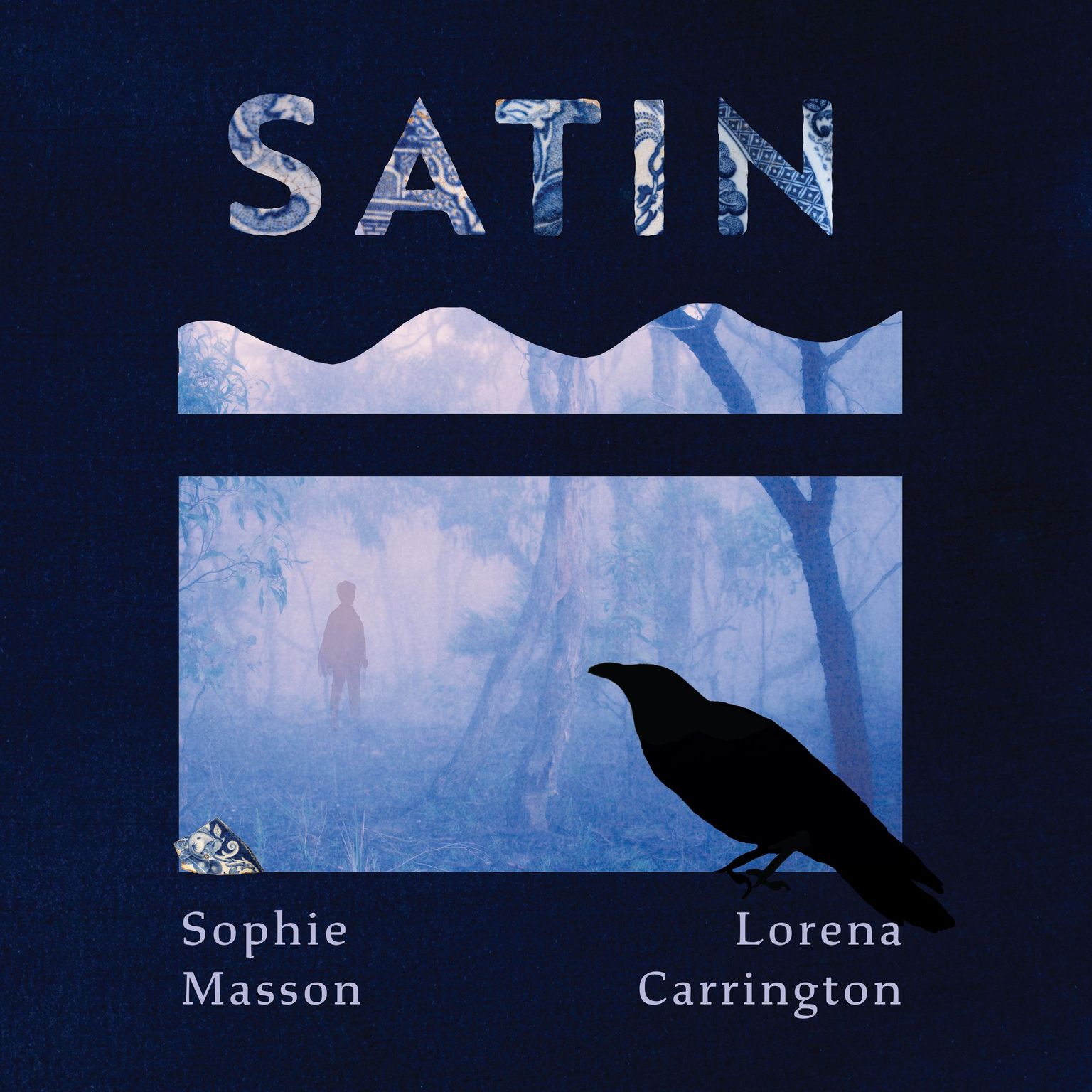
The Giant is my second picture-book collaboration with Lorena, after Satin (MidnightSun Publishing, 2023), which was awarded a Notable Books citation in the 2024 Children’s Book Council Book of the Year Awards. And as with Satin, creating The Giant was an absolute blast of a book to create together with our lovely publisher Anna Solding and her team at MidnightSun Publishing.

To celebrate the book’s publication, Lorena and I have written a bit about how it all came about. Hope you enjoy reading about it–and enjoy reading the book, too!

From Sophie:

The idea for the story of The Giant came into my head one day when I was walking up the road on a sunny but cold winter morning. He just arrived without warning; one minute I was strolling along, just enjoying the walk, the next minute I had stopped abruptly, seeing him so clearly, waking up, yawning and stretching after sleeping in his cave for a very, very long time.

As a child, I had read old stories where great heroes slept for centuries in caves but might wake up one day if they were needed to fight battles. But I knew my giant wasn’t about fighting battles, he was about finding his friends. And I could imagine his excitement as he went out into the sunshine, filled with joy as he thought he could see his friends again. And then his sadness as he realised nobody remembered him…I hurried home then so I could write his story down and find out what happened next to this gentle giant whose tears could make a river rise.

It was wonderful to write it and even more wonderful and thrilling to see the Giant and his world come to life in Lorena’s magical illustrations!
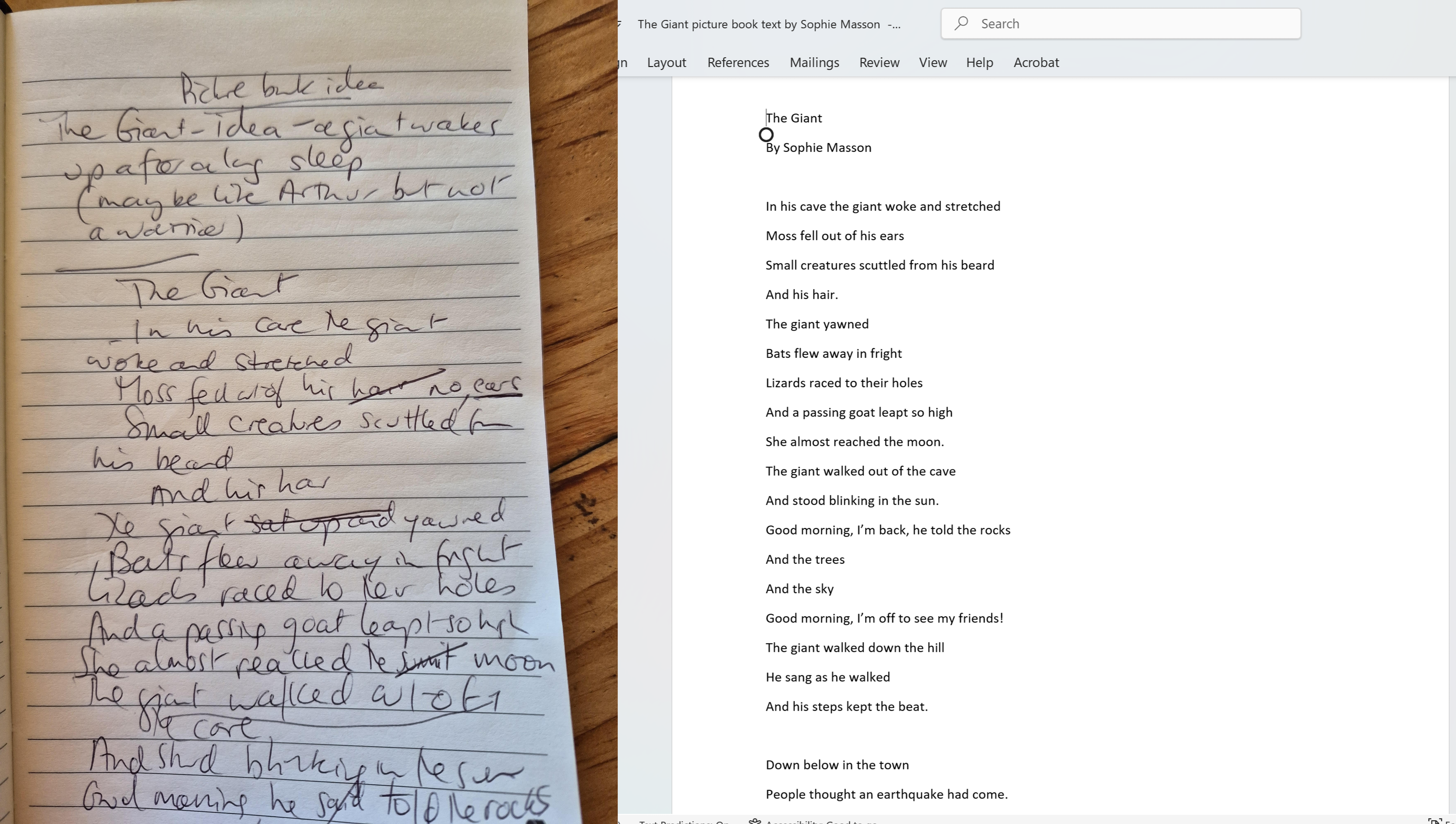
on left, part of the original first draft in my notebook, on right the finished draft on the computer

From Lorena:

I loved Sophie’s gentle giant from the first time I read her story, and I could picture him immediately in my mind. He is made up completely from elements of nature: moss, stick, leaves, little bits and pieces you might find out walking, so I like think of him as being real part of the landscape that he’s in. In fact, most of the illustrations in this book are made with photographs of nature montaged together, along with paper collage, and a little bit of drawing.

I also knew right from the start that I wanted the illustrations to be full of colour. Set over a full day, from sunrise to after dark, the colours change according to the time of day. If you look closely you can see I’ve used photographs of different landscapes to make up landscapes in the giant’s world, and also added some cut paper, little bits of drawings, and added little interesting things here and there. Look out for the drawing of the giant in the book, and see if the scene repeats itself in a different way later in the book. Can you find versions of the birds and the butterfly from the page borders too?

pages showing the changing of the light over the course of the book…
contrasts: the Giant ‘in an old book’ and ‘in real life’...

The Giant, by Sophie Masson and Lorena Carrington, published by MidnightSun Publishing, August 1, 2025. ISBN 9781922858658. Available in all good bookshops around Australia! You can read a few fabulous early reviews here, here and here.

And if you’re in Sydney, we’re having a celebration/launch for The Giant, at the fabulous Better Read than Dead Bookshop in Newton, on September 4 at 6pm. The book will be launched by the wonderful Ursula Dubosarsky and Lorena and I will both be there, to chat and sign books! Here’s the link to book: https://www.betterreadevents.com/events/the-giant-launch-sophie-masson-and-lorena-carrington-with-ursula-dubosarsky
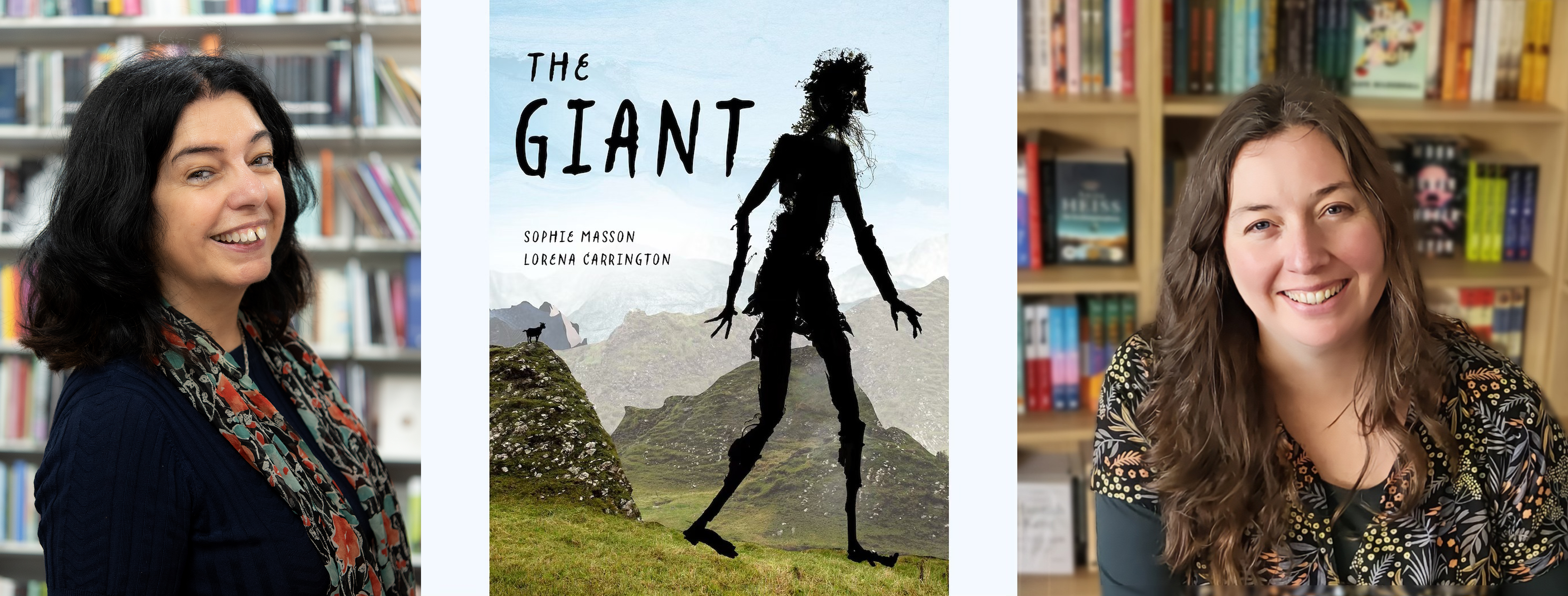
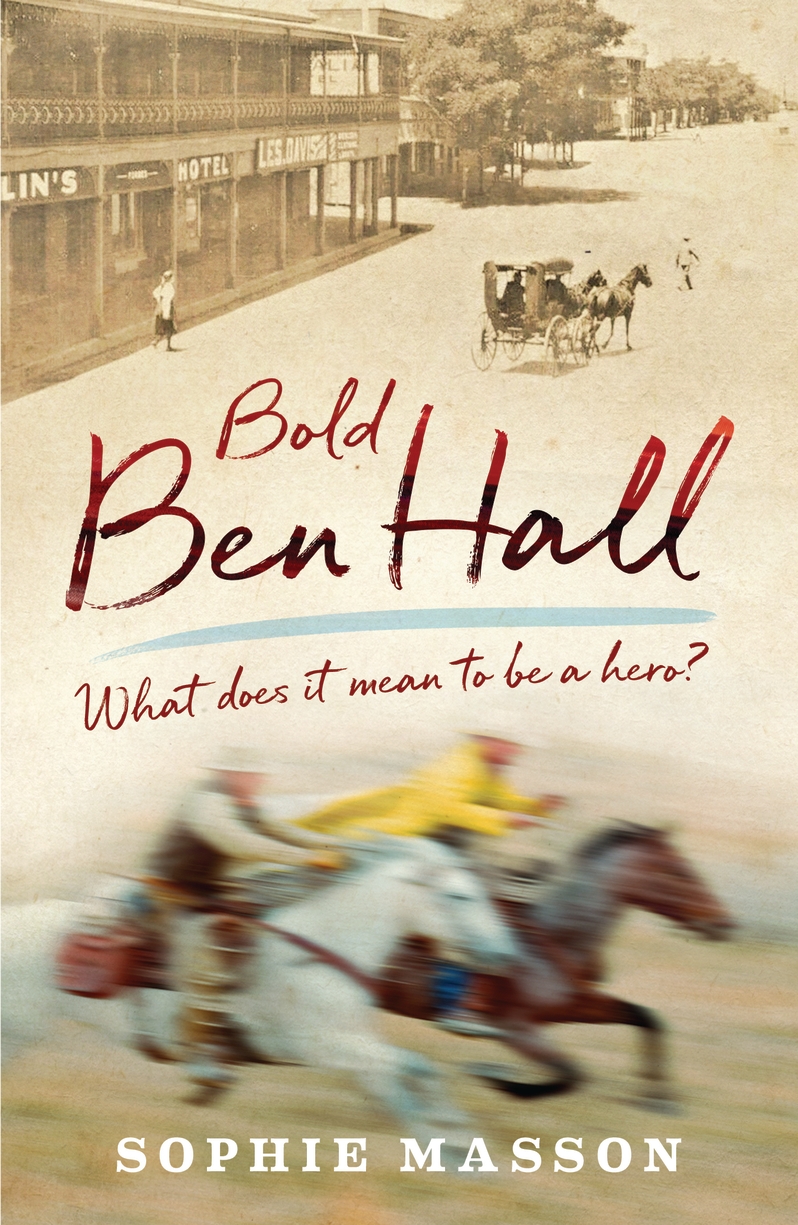
Lovely interview on Brenton Cullen’s blog

I’m delighted to say that I was interviewed by fellow writer Brenton Cullen on his blog, about Bold Ben Hall, research, writing about the past, and quite a few other things. Really enjoyed the interview, hope you do so too!

Here’s a short extract:

1. Congratulations on your latest fantastic historical novel Bold Ben Hall! What prompted you to write this book? 

SM: Thank you, Brenton! Ever since I was a kid I have always been fascinated by the bushranger era, and the larger than life characters who inhabited it, especially those with an interesting backstory, like Ned Kelly (who features in two of my earlier novels, The Hunt for Ned Kelly and Ned Kelly’s Secret) and Ben Hall.

Both men were not ‘common criminals’ but complex figures with both ‘the dark and the bright’ in them (to quote something Ned Kelly once said). And it struck me that I could tell the story of Ben Hall in a way that would highlight that, through the differing viewpoints of two young people of his time.

You can read the whole interview here.

How books get translated

Along with several other writers and literary professionals, I was interviewed recently by writer and journalist Thuy On for Arts Hub, about how Australian books get translated, and the article, which is very interesting, has now been published. You can find it here.

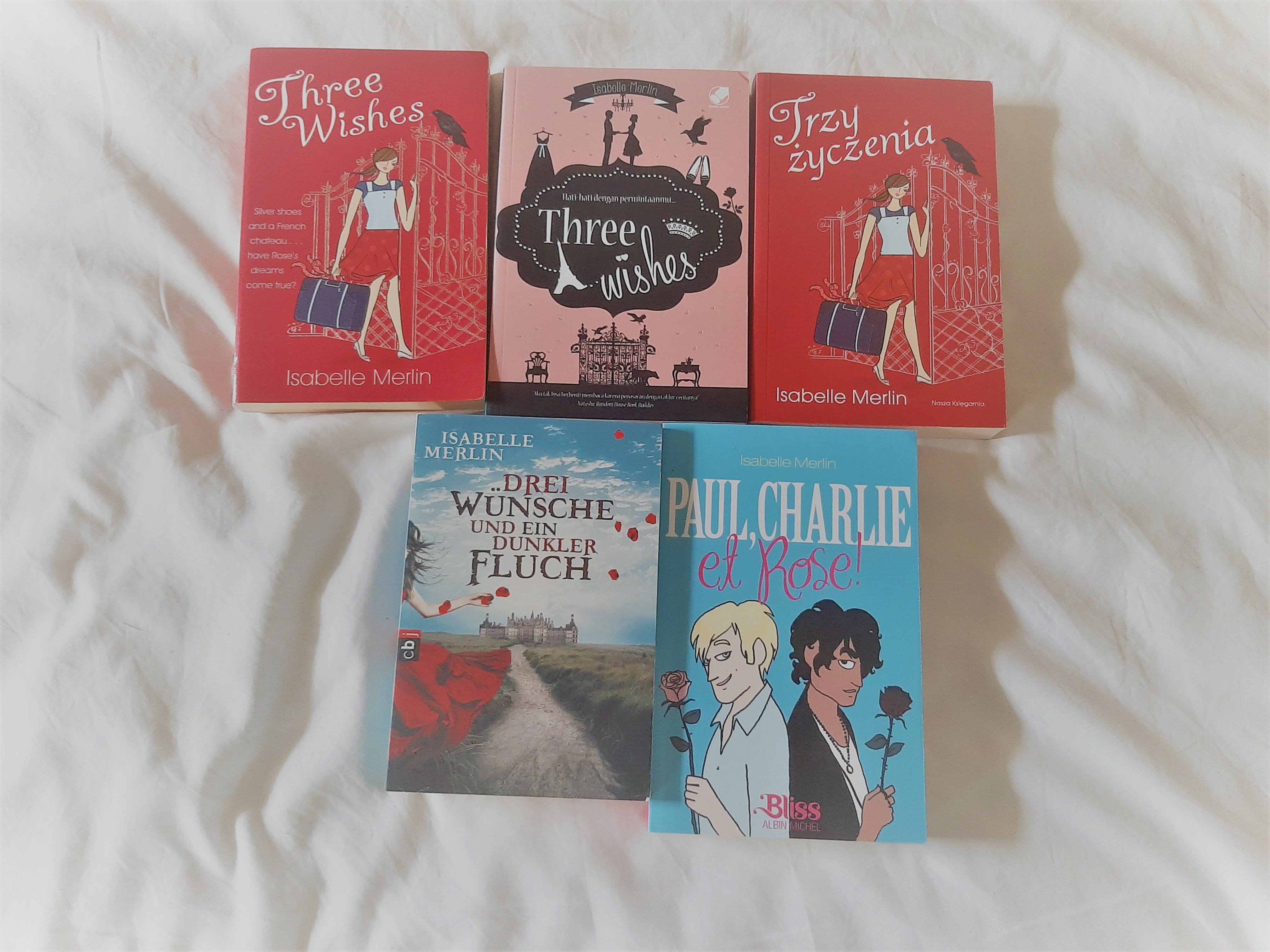
(Below is a pic which illustrates some of what I say regarding translation: it’s the five different editions of Three Wishes, a novel I wrote under the pen-name of Isabelle Merlin. From the top, left, you can see the original Australian edition, the Indonesian one, Polish one, and below them, the German edition and the French edition. )

Working with an editor

Note: This post of mine is reposted from Writer Unboxed, where it was published yesterday. On the WU site, you can also scroll down after the post to see comments, and can add your own. Hope you enjoy!

Working with an editor, by Sophie Masson

I’m just at the very end of the editing process for an upcoming novel of mine, and it’s got me thinking again about the extraordinary job of an editor, and how it’s such a wonderful thing working with them to unearth the final shape and polish of your creation. In my many years as a published author, with many books out there, I can count on less than the fingers of one hand the numbers of times I’ve had a less than good experience with editors. In my experience, they are dedicated, meticulous, intelligent, discreet yet honest professionals who respect both the creative work they are editing and the principles of their craft. In some cases, depending on the book, they’ve helped me to unlock a knotty problem of narrative; or saved me from a continuity error; or helped to polish a less-than-perfect phrase so that it shines as it was intended to.

Because I’m a writer whose first drafts are quite strong—mostly because in fact they are only first drafts in theory, as when I am writing I tend to go over the chapter I wrote the day before I start on the next chapter, and at the end of the week go over again the chapters I’ve written—I tend often not to get big structural edits, but rather more of a light going-over to check structure, then move straight into the first copy-editing. This is quite a forensic process, looking at every aspect of language, as well as continuity, errors of timing or description, and awkward phrasing, rather than plot architecture or characterization overview. It’s about detail, not big picture, and I love this stage, working with the editor to bring out the very best of the details in my novel, so that they can highlight and illuminate my story and my characters. I don’t always agree with the editor; sometimes I will decline a change, and explain my reasons; sometimes, too, the editor’s comments help to inspire me to find a new, different solution. Mostly, though, I agree with their suggestions, because they are based on such a close and careful reading of my work.

The first copy-edit is usually followed by one or two more copy-edits, then the proof, then final pages, each of which is sent to me for review. And each time, as the files go back and forth, something is caught by the editor, some tiny thing that slipped through in the first stages, or some tiny tweak that just gives that final, final buffing of polish. It’s a meticulous but also exhilarating process, as I go through the stages and each time there’s an improvement to my book, no matter how small or subtle. And that goes both for the long works, like novels, and the short works, like picture books (which can in my experience go through as many edits as a novel).

I know that there can be problems with writer/editor relationships; I know that sometimes they aren’t a good fit. In my own career, as I mentioned earlier, there have been a vanishingly small number of times when I haven’t felt comfortable about a particular editing experience and I’ve had to fight a particular interpretation quite strongly. But for the overwhelming majority of my books, working with the editor has been both pleasurable and challenging in the best way—the way that knows that in order for your book to be the best it can be, then you need to be able to see your work objectively, which is exactly the gift that the editor’s skill offers. The irony of course is that a good editor’s work is invisible to the reader–and yet its absence would be all too visible. So three cheers for editors all over—without whom both writers and readers would suffer!

Photo of ‘the invisible editor’ reproduced with permission from ‘Inside Story: the wonderful world of writing, illustrating and publishing children’s books’ (UPA Books, Australia, 2022)

Teachers’ Notes for Satin

There’s some great Teachers’ Notes for Satin now which include something from Lorena and something from me about the creative process behind the book, and also a range of fabulous activities of all kinds around the book. Free to download (below) and use by families, schools and libraries. All rights reserved.

The story of Satin, part 2: creating the visual world

In this lovely post, Lorena writes about how she created the stunning visual world of the book.

When Sophie asked if I was interested in working on Satin with her, she had barely finished her sentence before I said yes! I love working with her, and the story sounded so beautiful and intriguing. I also immediately had wonderful visions of all that blue… And it perfectly combined two things I’d worked with before. Some of my earliest montage work included shards of willow pattern plates, and I had also been doing a lot of work with cyanotypes, an early photographic process that has the most glorious blue emulsion. And the fact that Satin gathers objects to create his beautiful thing is exactly how I work too! It was perfect.

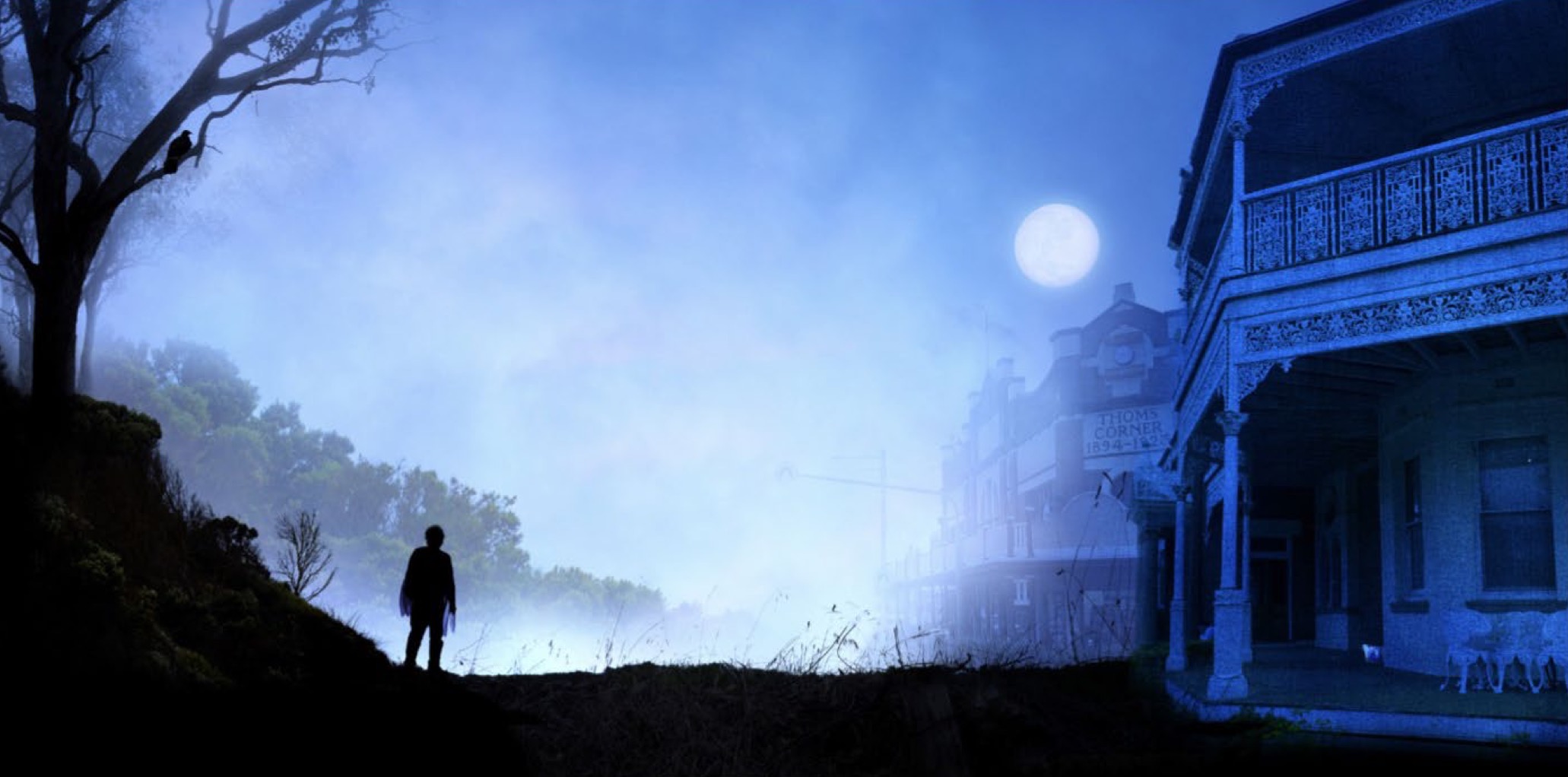
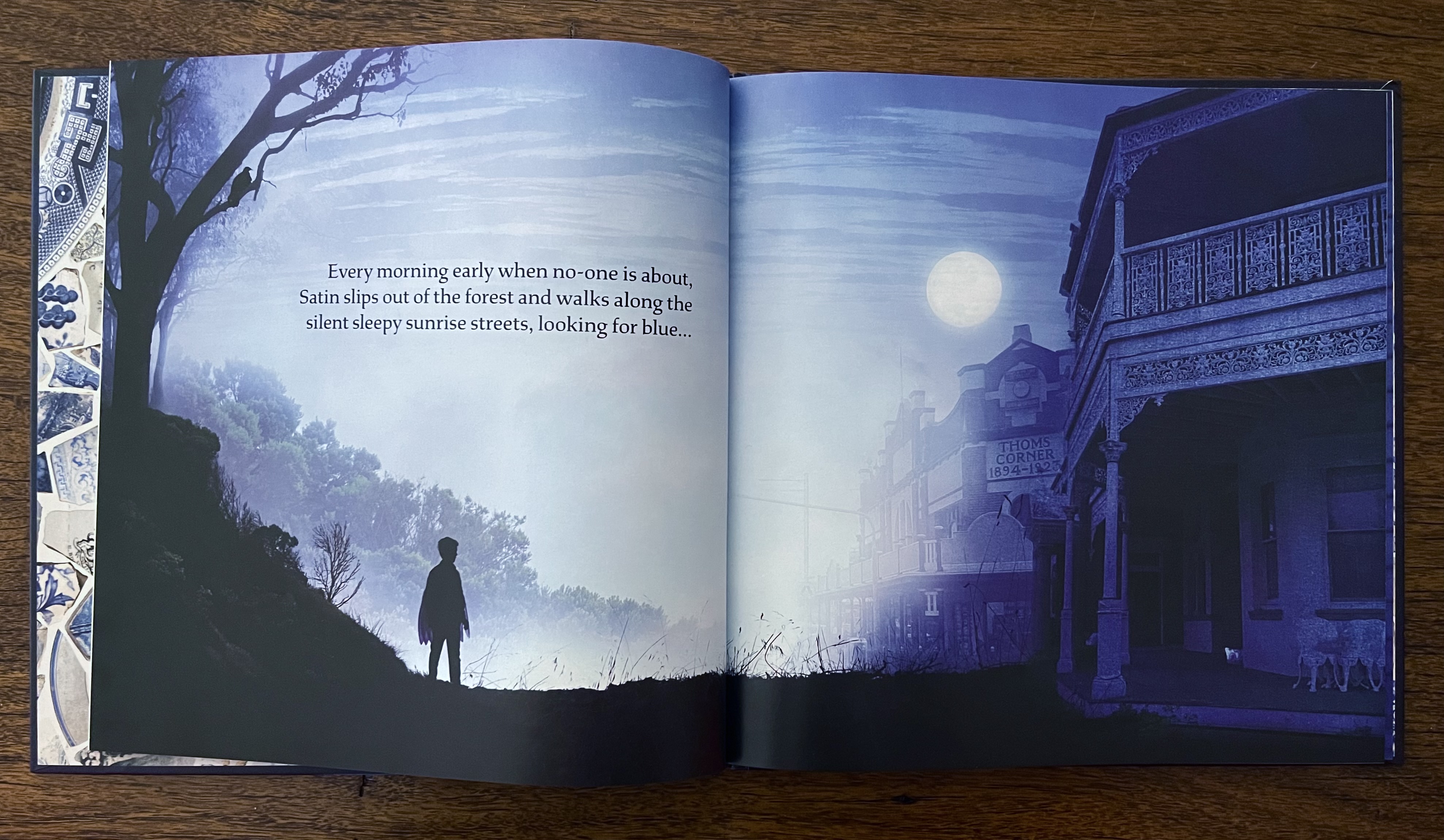
These are the first sample images I made for Satin, which we sent as part of our book proposal to the wonderful Anna at MidnightSun. They remain essentially unchanged in the final book, though you maybe be able to spot a few differences in the versions of the first image. As you can see, they are built up with layers of photographic images: the buildings, the silhouetted foreground landscape and figure, the bird, distant trees and the full moon against the misty sky… The pair underneath are more painterly. The elements are still photographic, but they are layered over a rich wash of painted cyanotype, giving a textured deep blue.

And here they are in the book:

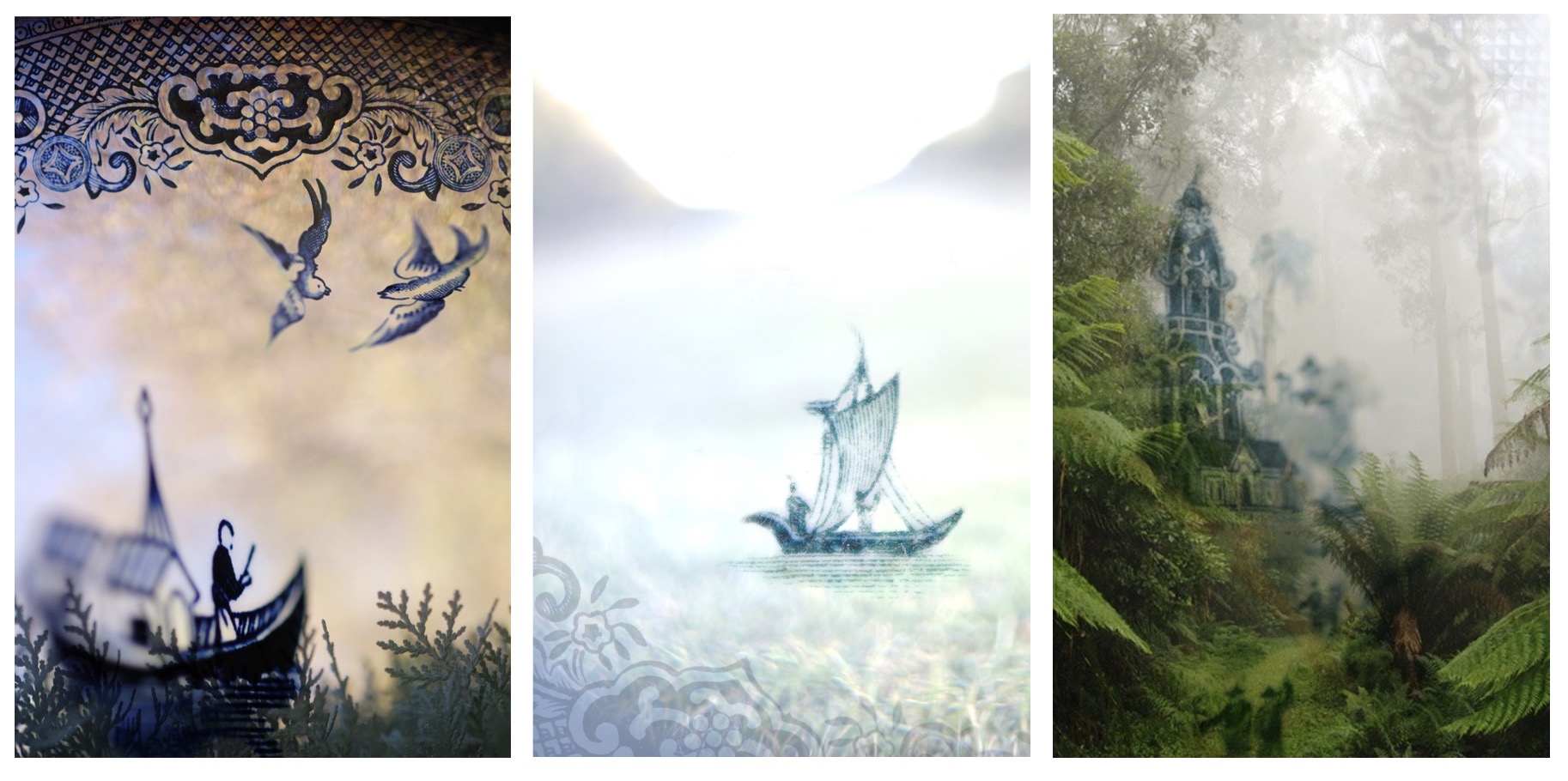
You’ll find many shards of blue china in Satin, many featuring the famous Willow pattern. Some of my earliest montage artworks were based around that same pattern. The images were made from shards of china I found in my backyard and the local landscape, and the landscapes themselves. Creating the illustrations for Satin felt like a delightful full-circle return to my early work. Here are three examples from around 2009.

The other slightly different element I’ve introduced to these illustrations, are splashes of painterly blue. The ‘paint’ is actually created with cyanotype chemistry, which is painted onto paper, and them exposed in the sun to create a rich blue. It’s wonderful cross between painting and photography, and lets you combine the two in wonderful ways. On this illustration spread, I’ve painted the splotches of blue, and digitally inserted the photographic elements.

I felt such an immediate affinity for Satin. He explores his surroundings, looking for interesting things, so that he can make something beautiful, which is exactly how I work, and Sophie’s extraordinarily beautiful prose made Satin such a pleasure to work on. I really hope you find inspiration and beauty in it too.

The story of Satin: Part 1, creating the text

In just ten days or so, Satin, my picture book with Lorena Carrington, will be released by MidnightSun Publishing. And in anticipation of that, Lorena and I thought you might be interested to read about how the book came about, and what the process of creating it was like. Today, I’m talking about my side of it, how the text came into being, in one of those amazing, inspirational moments that are such a blessing in a writer’s life…

In May 2021, my husband David and I were travelling by car from our home in northern NSW on our way to attend the Bendigo Writers’ Festival in Victoria, a two-day journey from our place. It was somewhere on the road before we reached the town of West Wyalong that I suddenly glimpsed, on the side of the road, a bird with satiny, very dark blue plumage. Though I saw it for just an instant as we flashed past, I knew at once what it was—a male satin bowerbird. But what was it doing there, all by itself? Satin bowerbirds are shy, it’s not easy to see them, and they certainly don’t make a habit of hanging around near roads! I knew they like to collect blue things to decorate their nests: so had it spotted a special blue there?

In that moment, something else flashed into my mind, a title: Satin. I could see a character: a lonely young man, or was he a bird? Or both? Words began to flow onto my small travel notebook (I wasn’t driving of course!) By the time we reached West Wyalong where we were to stay overnight, I already had the glimmer of an idea for a special picture book text, and by the time we got to Bendigo the next day, that idea had firmed up.

When I met up with my friend Lorena Carrington in Bendigo, I excitedly told her about it. Lorena’s a wonderful illustrator and she and I had already worked on two books together, retellings of French fairy tales and medieval French Arthurian stories, and that had been a wonderful collaborative experience. I was very much hoping she might be interested in the idea of Satin—and to my delight, she was, at once! We started talking about how it might work: usually for a picture book you don’t have writer and illustrator together at the start, usually the writer sends in a text and the publisher then chooses the illustrator. But we just knew this book had to be with the two of us. And I had an idea who perhaps might be interested in such an unusual book…

After getting back home, I worked on the story, first in my bigger usual notebook, and then on the computer.

I then sent it to Lorena, who created some gorgeous sample illustrations. And then I contacted the wonderful Anna Solding at MidnightSun Publishing and told her about the book. She loved the idea and immediately wanted to see what we’d done. So we sent the text and the samples—and within a week, she got in touch. The MidnightSun Publishing team loved it and wanted to publish it. So exciting! And as we worked with the wonderful people at MidnightSun, and Satin’s world came to brilliant life in Lorena’s spellbindingly beautiful illustrations, I kept thinking of that moment when I unexpectedly glimpsed a shy blue-loving satiny bird by the side of the road. Pure magic, that’s what it felt like: and pure magic to see it developing into such a very beautiful, very special book.

Looking forward to the High Country Writers’ Festival!

Next Saturday, I’ll be heading to Glen Innes for the High Country Writers’ Festival, where I’ll be presenting a workshop on creating children’s books, based on Inside Story: the wonderful world of writing, illustrating and publishing children’s books, which I was involved in writing. I’m really looking forward to it! The workshop is two hours long and features a talk, Q and A, and hands on activity. You can get tickets for the workshop here.

The rest of the program is great too, with sessions on true crime, historical fiction, how to get a book project back on track, and more. See the full program here. Concurrently with the Festival also is the High Country Writers’ Retreat.