Story behind the story 1: And Then authors on their contributions

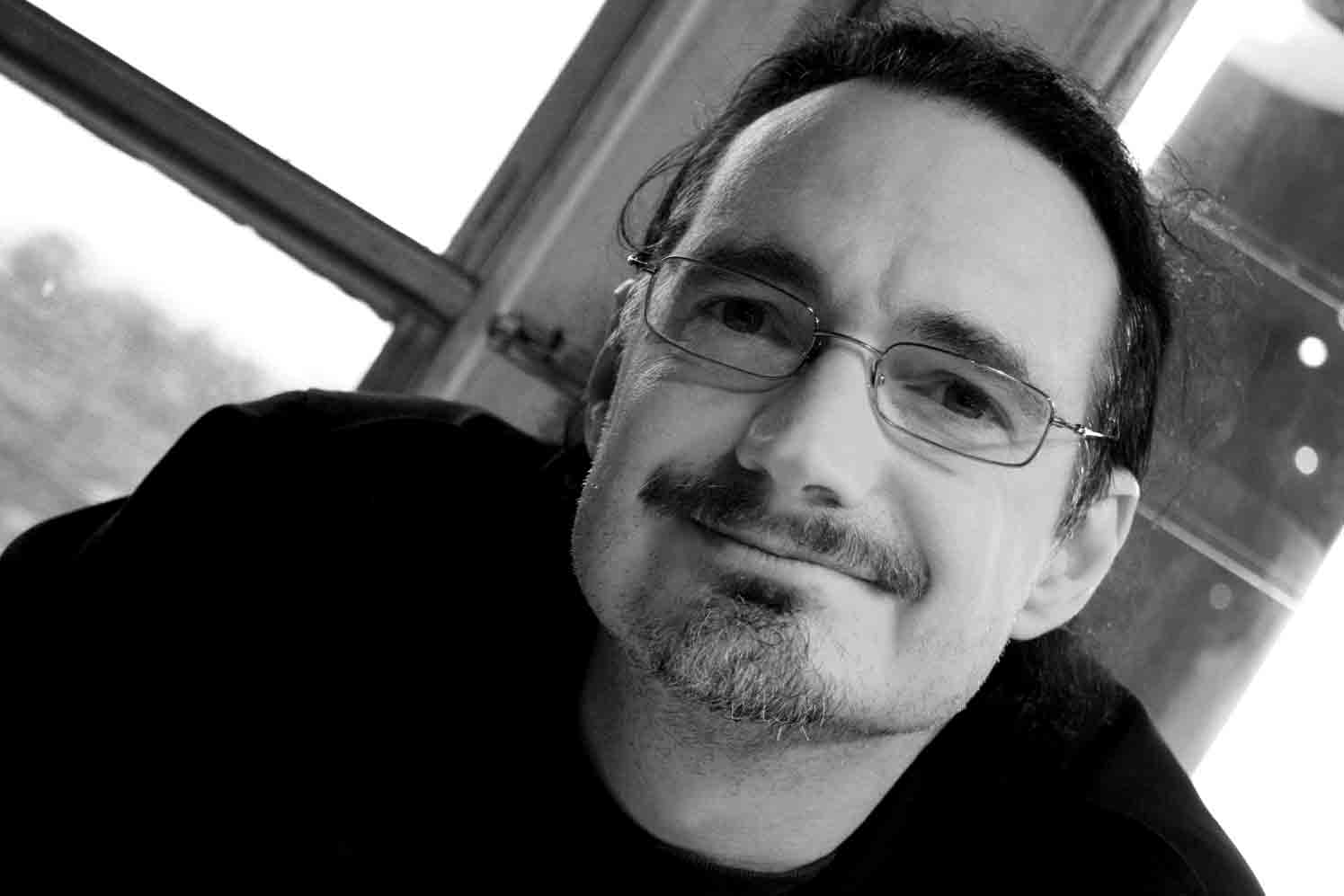
As part of the celebrations around the publication of the fabulous And Then adventure story anthologies, published by Clan Destine Press, I thought I’d ask my fellow contributors to write a few words for readers about the ‘story behind the story’ to tell a little about their individual creation. So I’ll be publishing these in a few instalments, starting today with words from Lucy Sussex, Jason Nahrung, and Emilie Collyer. Oh, and a word or two from me! All of these authors’ stories(including mine) appear in Volume 1.

To recap: each one of us contributing And Then authors was invited by Clan Destine’s Lindy Cameron to create an adventure story which would feature a ‘dynamic duo’, but otherwise we were left pretty much to our own devices as to the rest, and the result is a sparkling and wonderful diversity in two fantastic fat volumes! My own story, The Romanov Opal, was inspired by a conjunction of things: a visit I made to the extraordinary opal mining town of Lightning Ridge some time ago; a fascination with Russian culture and history; a love of classic Agatha Christie half-mystery, half-adventure stories like The Man in the Brown Suit, and an even greater love of Tintin-style adventures. Mix that in with the elegant and turbulent 1950’s, a pair of feisty twins and a legendary jewel, and I had the perfect ingredients for a story that was simply huge fun to write.

So what was the story behind the story for other authors? Read on!

Lucy(left) and Meredith Sussex in Borneo

Lucy(left) and Meredith Sussex in Borneo


Batgirl in Borneo, Lucy Sussex

In 2015 I went to a wedding in Sabah, Borneo. After the ceremony, assorted guests went on a bus ride across north-east Borneo. We saw orangutans and sun-bears, and narrowly avoided a meeting with terrorists. Two days after we ate at a beachside restaurant in Sandakan, Abu Sayyef came raiding across the straits from the Muslim Phillippines, in a rubber dinghy. They kidnapped the manageress, Thien Nyuk Fun and a customer, Bernard Then.  She was released months later, after a ransom, Then got beheaded.

I heard another interpretation of that story only after ‘Batgirl in Borneo’ was copyedited.  In that reading, by a Sabah expat, our visit to the restaurant was the catalyst for events.

If I write that, it would be a very different tale.

jason_bw-webMermaid Club, Jason Nahrung
This is the second of my short stories starring detective Shane Hall and her accidental partner Manasa Chalmers as they negotiate a paranormal Brisbane. This one draws on a memory of how one of my favourite venues in the city was gentrified, as well as looking for an idea of mermaids different to the fairy tale. The story also builds on a larger plot involving my dynamic duo — I really must finish that, one day!
tansybwDeath at the Dragon Club, Tansy Rayner Roberts
My story is one I had been toying with for a while — about a pair of retired assassins and siblings-of-choice who run away from their violent profession and end up joining a circus full of dragons… only to have their old and new worlds collide all over again. This book was a great excuse to write that story, and I’m so glad I did. I hold Kurt and Inga Frostad, and their beloved dragons and their snarky dialogue, very close to my heart, to the point that I got all soppy and nostalgic while proofing. And then I promptly started planning the sequel…

ecollyer_photopiajohnson_051The Panther’s Paw, Emilie Collyer

With so much dystopian fiction around – and feeling increasingly like we are living in a dystopic world of our own creation – I really wanted to write a piece set in a future where we’ve started to get a few things right. I was inspired by what I’d read of the genres solar punk and eco punk so that was my starting point. One of the wonderful things about writing is getting to play god. I had a LOT of fun constructing the social, environmental and cultural norms of this world to reflect what I think would be a fair, sustainable and enlightened way to live. In regards to the characters I wanted to explore a mismatch. Two people who would normally never spend time together but who have complementary attributes. I really love the world I have created in this story and feel there is room to expand the adventures of Eliza Wild and Dash Besen. So look out for more …

Guest post by Karly Lane: Life as a mum and full time writer

lane_karlyToday, I’m very pleased to present a great guest post by bestselling Australian author Karly Lane, as part of her blog tour for her new book, Third Time Lucky. 

Life as a mum and full time writer

by Karly Lane

Become a writer, they said. It’ll be fun, they said… oh, and just to make it extra interesting, do it while you have 4 kids at home and a part time job.

Writing with children…how do I explain this? Okay, picture a battlefield, with explosions and machine gun fire and bombs dropping from the air, all around you… and in the middle of all this you’re trying to write a deeply emotional love scene… that’s kinda what it’s like.

Mum! I’m hungry. Mum! He’s looking at me funny. Mum! She’s trying to put the chook into the freezer. Mum!!!!

Looking back at those first few crazy years of my writing career, I’m surprised that I managed to get one book written, little own four, before I was finally able to give up my part time job and work full time as a writer. Although giving up work was only one aspect, I still had my youngest at home for the first few years, and I can tell you with utmost confidence, Play School and Dora the Explorer DVD’s were a GODSEND. Although, I still have issues with Dora…why was this small child allowed to go exploring alone, where was her mother? She was probably and author, inside, writing a book. ‘Go outside and play, Dora…’

Those first few years were crazy. But it did teach me a lot of important things like; sleep… its completely overrated.

Coffee; will become the only vital food group. God help everyone in the household if we run out though…

It taught me to ignore the noise around you; if anyone ever tells you, you need softly playing piano music and scented candles in order to get you in a creative mood to write—they’ve obviously had far too much time on their hands and quite possibly—a nanny. I’ve written love scenes while refereeing fights between my children. You don’t need music—you need focus. If you’re a mother—you already know how to do more than one thing at a time. It’s called multitasking and if you can do that, you can write a novel while you have kids.9781760291822

I can honestly say, I got more productive writing done during the years I both worked part time and had children at home, than I’ve ever done since. Sure, now, with six hours of just me and the cat at home, writing is a lot more calmer and quiet…but it also gives me opportunities to ‘just go down and sniff the horses for a minute (they smell so good!) or, just go online and see what’s happening on facebook… All dangerous and time wasting ways not to get any writing done.

If there’s anything positive to take away from this, I hope that it’s to shut down that excuse about waiting until the kids go to school, before you start writing that book you want to write… Because putting it off—isn’t getting it written. There won’t ever be a perfect time to start writing—so find a DVD…turn on Playschool…and sit down and do it.

//cdn.thinglink.me/jse/embed.js


About Third Time Lucky:

When her marriage ends, December Doyle returns home to Christmas Creek. Will she conquer her fear of heartbreak? A heart-warming novel about betrayal, ambition and the power of love.

 After a disastrous marriage, December Doyle has returned to her home town to try to pick up the pieces of her life and start again. She’s also intent on helping breathe new life into the Christmas Creek township, so the last thing she needs is trouble.

Bad boy Seth Hunter has also returned to Christmas Creek, and trouble is his middle name. Wrongly convicted of a serious crime in his youth, Seth is now a successful businessman, but he’s intent on settling some old scores.

As teenagers, December and Seth were madly in love, and seeing each other again reawakens past feelings. But will Seth be able to overcome his destructive anger about the past, and can December conquer her fear of heartbreak to make their relationship third time lucky?

By the bestselling author of Second Chance Town, this compelling novel is about betrayal, ambition and the power of forgiveness – and love.

About Karly Lane:

Karly Lane is the best-selling author of nine novels including Second Chance Town, Gemma’s Bluff, and Bridie’s Choice. A certified small town girl, Karly is most happy in a little town where everyone knows who your grandparents were. Her novels range from romantic suspense to family saga, and she is passionate about writing stories that embrace rural Australia and the vast communities within it. She lives on the beautiful Mid North Coast of NSW with her husband and four children.

            Website: http://www.karlylane.com/


A Writer’s Dream, guest post by Glenice Whitting

glenice-whitting-jpgI’m delighted to publish today a guest post by author Glenice Whitting. Her debut novel Pickle to Pie was shortlisted for the Victorian Premier’s Literary awards and won the Ilura Press International Fiction Quest.  During her studies from VCE to PhD she was invited to become a member of The Golden Key International Honour Society and awarded an APA scholarship. Her latest novel, ‘Something Missing’ will be published by MadeGlobal Publishing and launched at Swinburne University 11th December 2016. 

A Writer’s Dream

by Glenice Whitting

Writers often dream of being published and getting their work ‘out there’. I am no exception and I am delighted that my second novel will be launched in December 2016 by MadeGlobal Publishing. ‘Something Missing’ began life as my artefact for my PhD at Swinburne University. It is the story of  two women who changed each other’s life through a friendship that spanned two countries and many decades.

I had just completed my Masters of Creative Writing at Melbourne Uni as a mature aged student when my first novel, Pickle to Pie co-won the Ilura Press International Fiction Quest. This meant a cash advance, plus publication and I was beside myself with excitement. Pickle to Pie was the story of a boy, a great-hearted German Grossmutter and a man caught between two worlds. I had promised myself, if Pickle to Pie was ever published that I would give up my day job. Hairdressing had always augmented the family income through good times and bad. After the book launch I stuck to my promise and sold the salon. I knew I was not a J K Rowling, but I was happy.pickle-to-pie

I had often toyed with the idea of studying for my PhD but never dreamt it could happen. However, to be awarded an APA scholarship meant the opportunity to study at Swinburne University and I grabbed it with both hands. With the help of two supervisors I could learn the craft of writing and understand all the rules. I would then know why I was breaking them. This was my chance to spread my writing wings and fly to the moon.

Did I follow on from the German Australian story? Did I build on the shoe-box of old postcards written in High German found in the bottom of dad’s wardrobe after he died? Or the bookcase filled with A4 folders containing years of German/Australian research? Of course not. Instead, I decided to do what so many writers do. I chose to write something close to my heart: something entirely different. This time it would be a women’s story based on my thirty-five year pen-friendship with an older American poet. It would be a story about two women, a life changing pen-friendship and the lies that led them both to truth.

I wrote in my journal,

‘I am writing an epistolary, autoethnographic novel grounded in both feminism and post modernist paradigms with the aim of revealing women’s hidden stories in the hope of instigating social change. I believe this embedded story of the journey of self discovery and friendship will carry with it the possibility of nothing less than the restoration of faith in human kind.

What lofty aims, but here was a chance to use our letters, interspersed with text, to explore the influence this elderly poet had on a young woman who left school at fourteen to become a hairdresser: a woman who unconsciously yearned for the education given to her brother and denied to her. My ongoing journey into epistolary fiction using letter, diary and journal extracts, plus snippets of poetry, had begun.

For four years I am caught up in a world where my mind keeps bouncing backwards and forwards between my creative writing of this novel and the formal academic exegesis. I try to remain true to my research title;  A Novel and an Exegesis Beyond Epistolarity.

Friends warned me that I would have a meltdown post PhD, but I was convinced that would not happen to me. I was too strong, too resilient. That sort of breakdown only happened to other people. The wail of the ambulance soon bought me back to earth with a thud. To leave my wheelchair and walk on stage wearing the hired floppy Tudor bonnet and colourful gown was a highlight in my life. I had an overwhelming feeling of achievement and self worth that no one could take away from me.

The mature aged student journey from VCE to PhD had required passion, dogged determination and guts, but it had also been the most exciting, exhilarating time in my life. I knew I would miss it and all the friends I’d made along the way.

I took a long hard look at what I’d written, and following the suggestions of American author/editor, Cindy Vallar, I inserted quotation marks to all the dialogue and renamed the manuscript ‘Something Missing’. But, had I, over the years of study, begun to sound as if I’d swallowed a dictionary?

book-cover-newThe third rewrite of the entire manuscript is the one that is being published. It was an invaluable lesson. To be a writer I had to be myself and write the way I really wanted to write, from the heart. I took out the overarching second person narrating character, made both Maggie and Diane third person narration, threw in a handful of suspense and Voilà… ’Something Missing’ was born. It had gone beyond academia, beyond epistolarity into popular fiction. I was over the moon with excitement the day I received the email that Tim Ridgway and Melanie V Taylor of MadeGlobal Publishing loved the story and would be sending a contract etc.

I will always be grateful to fellow colleague and wonderful friend, Wendy J Dunn, author of Author of Dear Heart How Like You This, The Light in the Labyrinth, and Falling Pomegranate Seeds  who recommended I send the manuscript of my novel to her publisher .

It is every writer’s dream to hold their book in their hand. It gives them a chance to thank all the people who have helped along the way. There have been so many people I could list who have patiently and painstakingly worked with me through all three versions of this novel. However, there is an indescribable joy in finally being able to thank them formally, via the acknowledgment page, in the soon to be published last reincarnation of the manuscript, ‘Something Missing’.

 I have asked Wendy Dunn if she will endorse my novel. Below is her generous reply:

 Something Missing narrates the story of a life changing friendship that spans decades and two continents. It is a powerful and beautifully told story of how we grow through the power of friendship – and how relationships change over time. Empathetic, full of life’s truths and wise – Something Missing is a work that stays with you, and speaks to our hearts.  

Interview with Kenn Nesbitt, poet and compiler of One Minute till Bedtime

kennwithbooksIn 2014 I and many other writers received a lovely and unexpected invitation from prominent American children’s poet Kenn Nesbitt, asking if we would be interested in submitting poems for an anthology he was compiling, One Minute Till Bedtime, which would also include such contributors as Jack Prelutsky, Jon Scieszka, Jane Yolen, and Lemony Snicket. Talk about great company! And I was so thrilled when Kenn accepted my poem, Seagull Beach Party.

Two years later, and this week sees the publication of One Minute Till Bedtime. Containing the work of many poets from the US, UK, Australia and Canada, selected by Kenn, and beautifully illustrated by Christoph Niemann, the book is published by Little, Brown and is available around the world, including Australia. To celebrate its publication, I spoke to Kenn about the project, his own career, and children’s poetry in general.

First of all, congratulations on the publication of One Minute till Bedtime, Kenn! It’s lovely to see it out there. How did you come up with the idea for this unique poetry anthology?

Many years ago, the poet Bruce Lansky pointed out to me that most children’s poems can be read in an average of about one minute. Since then, I have tried to encourage teachers to take one minute of their school day to share a poem with their students.

When I was named Children’s Poet Laureate, I decided to create a website called PoetryMinute.org to give teachers a resource where they could easily find one-minute poems to share with their students for every day of the school year.

While I was in the process of creating this site, I was approached by Susan Rich at Little, Brown Books for Young Readers about creating a book around this idea of one-minute poems. She and I decided that bedtime might be the perfect time for a book of short poems, and One Minute till Bedtime was born.one-minute-till-bedtime

The contributing poets come from around the world. How did you go about sourcing poems for the anthology? 

Over the years that I have been writing children’s poems, I have developed relationships with many poets throughout the US, Canada, the UK and Australia. I called on many of these authors, and reached out to lots of other poets whose work I admire. Thank goodness for email and the Internet. A project like this would have been much more difficult 20 years ago!

With its wonderful poems, lively illustrations by Christoph Niemann, and attractive design, One Minute till Bedtime is a most appealing book for children and their parents. And obviously there’s a lot of work behind it. Can you tell us a bit about the process of putting together such a big project with the publisher, Little, Brown?

To begin, I wanted to create a collection that focused on the work of living, working children’s poets, rather than reprinting classic and public domain works. So I sent out a call for submissions to over 200 poets from around the world, looking for brand new poems that had never before appeared in print. I received submissions from roughly 170 different authors. I read them all, highlighting the ones that I thought might work. Once I knew which poems I wanted to include, I printed them all out and spread the papers around my dining room table, looking for natural pairings between poems and organizing them into sections.

Along the way, I tracked everything with spreadsheets, including submissions, selections, the order of the poems, and so on. While I was doing this, Little, Brown was on the hunt for just the right illustrator. Christoph Neimann was a truly inspired choice. His simple, yet incredibly clever illustrations compliment the poems perfectly.

Once the manuscript was completed, Little, Brown began working with Christoph on the illustrations and with me on the process of proofreading, editing, typesetting, and troubleshooting.

In the end, it all came together beautifully. I couldn’t be more proud of this book.

You are a popular and much-published poet. Can you tell us something about your own career, and how you started? What do you think has changed, if anything, over the time you’ve been published, in terms of attitudes to poetry for children?

I began writing poems as a hobby for my own amusement. I wrote for several years before I ever considered trying to get published. I also created a website, poetry4kids.com, in 1997 to share my work with readers online. I had my first poems published in 1998 in an anthology called Miles of Smiles. My first book, The Aliens Have Landed at Our School! was published in 2001. Since then, I have written many more books of children’s poetry, as well as a couple of picture books and a chapter book.

It seems that there are more poets writing for children today than ever before. At the same time, there are fewer individual poetry collections being published. Many children’s poets have instead turned their talents to writing picture books, novels in verse, etc. Large hardcover collections, such as those of Shel Silverstein and Jack Prelutsky, are becoming rare as hens’ teeth. Recent books by Alan Katz and Calef Brown are notable exceptions.

It is my hope that One Minute till Bedtime will not only introduce a new generation of parents and children to the joy of poetry, and showcase the works of today’s best children’s poets, but will also show publishers that poetry is worth pursuing.

You are the US Children’s Poetry Laureate and a tireless advocate for poetry. Why do you think poetry is so important for children? And what more do you think could be done to enhance children’s access to poetry?

I was the Children’s Poet Laureate from 2013-2015. Although I’ve passed that torch to my successor, Jacqueline Woodson, I continue to promote poetry to children, parents, and teachers around the world.

I believe poetry is important for children because it is short, fun, and memorable. (Everyone remembers something by Mother Goose, Dr. Seuss, and probably several other poets of childhood.) This combination makes poetry an easy springboard to reading and writing. Introducing children to poetry can help make them lifelong lovers of the written word.

The best champions for poetry are the earliest ones; parents and teachers. I believe the best way to enhance children’s access to poetry is to encourage parents to read to their kids, and to ask teachers to share poetry in their classrooms. Once they do, they will find that kids can’t get enough.

Interview with Therese Walsh, editor of Author in Progress

12803300_10207051919154843_5638323324479667397_nSome years ago–I think it was back in 2008–I was invited to become a regular contributor to the international writing blog, Writer Unboxed, founded by US writers Therese Walsh and Kathleen Bolton two years previously. Their idea was to create a community of writers who would find guidance, support and encouragement in WU, as well as great advice and tips. That’s certainly proven to be the case, and Writer Unboxed is one of the most popular and respected writing blogs in the world today, garnering several awards as well as an ever-increasing list of followers, a very active Facebook and Twitter presence, and the hosting of a unique conference–or Unconference, as it’s titled!

And now comes the next step: a book which gathers together a great deal of individual and collective wisdom and advice from Writer Unboxed contributors and community. Author in Progress: A No-Holds Guide to What it Really Takes to Get Published (Writers’ Digest Books), is being released today, November 1 and will be available from online booksellers such as Amazon, Barnes and Noble, etc, as well as the Writers’ Digest shop. Edited by Therese Walsh, and with an introduction by respected author James Scott Bell, it features over 50 essays from novelists, editors, agents and contributors from the WU community. The book goes well beyond the usual run of how-to-get-published books: from discussing reasons why people want to write right up to post-publication issues, and much more in between. I’m delighted to say by the way that I have an essay in the book, which is called ‘Writer as Phoenix’, and is in the final section of the book.

And today, I’m delighted to celebrate the publication day of Author in Progress by featuring an interview with its initiator: writer and editor extraordinaire, Therese Walsh.

***************

Welcome to my blog, Therese! How did the idea for Author in Progress come about? What was your vision for the book, and how did that evolve as time went on?

Thanks for having me, Sophie, and for the opportunity to talk about Author in Progress.

The book came about after I met with Phil Sexton at the Writer’s Digest conference last summer (2015). He mentioned the idea of doing a book with them, and that took root with me over a month or so. I had a follow-up phone call with Phil, and he mentioned the freedom we’d have to do the type of book we wanted to do. After that, the idea for Author in Progress fell into place rather quickly, as I considered what I knew to be true about writing a book – because there are some things I always say when someone who is not yet published asks, ‘How did you get published? What did you do?’

The book is broken into parts, following the stages a writer will likely go through on the road to publication: Pre-writing considerations, the writing itself, critique-related topics, educational considerations, rewriting, perseverance, and releasing the project once you’ve served the work.

Author in Progress is a very different kind of how-to writing book, as it doesn’t assume that the journey ends when your book is published. And it offers the advice and experience of many different contributors. How did you go about gathering and editing contributions from so many people?

Assigning essays was much easier than it might have been, in part because Writer Unboxed contributors are exceptional to work with (I’m not at all biased!). I think the other reason it was relatively easy was because of the adaptability of the contributors, in that many could write to several stages of the book. That said, there was a certain magic to the match-ups and I’m particularly pleased with how that went; everyone delivered something about an issue that resonated with them personally.

In terms of gathering and editing, I created a deadline for essayists to turn in their work and that deadline was met almost without exception. I then read over each essay, and suggested revisions when I thought they might make the book stronger. I then did a final edit for clarity—adding headers—and correcting for typos. This is what was then submitted to Writer’s Digest and our in-house editor there, who took everything to the next level in terms of polish and readiness for publication.

Author in Progress is aimed not only at aspiring authors, but also authors who have already been published. What do you think authors at different stages of their careers could get from this book?

One of the things authors will be able to see is that the stages of story creation are cyclical, repeating with every book. Sure, you learn things early on that you apply to each book thereafter, but that doesn’t mean you don’t hit each stage in some way. We’ve included some articles under a header called ‘Eye on the Prize,’ which addresses how a topic (e.g. critique) becomes important in a different way when you’re a published author (e.g. accepting notes from an agent, editor, even readers). We also have boxes throughout the book marked as ‘Pro Tips,’ which, again, help to root the reader in the reality of why something is important if you’re to make a career of writing.

All that said, I think the larger reason published novelists might want a copy of Author in Progress is because when we’re in the middle of a project—or at the start of one—we sometimes forget that all of this is normal. The anxiety, the doubt, the block, the research pitfalls, the need to go deep with character (and how to do that), the need to continue to learn and grow (and what steps you might take to push to the next level). I think even published authors need to remember that we’re not alone, and that the angst is part of the process, too.

Is there any particular tip or bit of advice that you would offer an author starting out on the journey–and those a bit further along?

I would tell that author starting out and an author a bit further along something similar. Writing a book is tough at times. Many of us might say, ‘If I knew how long it would take, what it would ask of me, maybe I wouldn’t have finished… But I’m glad that I did.” Perseverance is one of the key ingredients for any author in progress, and so I’d tell both of those writers to keep going, and remind them that they are not on that road alone. Truly, they are not.

The book is closely associated with Writer Unboxed, the writing blog you founded some years ago with Kathleen Bolton, which has become prominent and respected in both the author community and the publishing industry. Can you tell us about the blog, and about the insights into authorship it has given you?

Writer Unboxed  is my writing family, and it’s my hope that we are other writers’ online family as well. We are dedicated to producing content daily about the craft and business of fiction on our website, but it goes beyond that with our Facebook community (5,000+ writers strong in a promo-free zone) and our Twitter feed (@WriterUnboxed). Our ultimate goal is to provide positive and empowering support for writers of any genre.

I’ve learned a tremendous amount about writing simply by being present for the day-to-day business of the site, but I think the most crucial lesson is that it is truly a cyclical process. You envision. You create. You revise. You learn the lessons the book is there to teach you. You serve the work. You release. Repeat. As someone who hasn’t always had an easy road myself, there’s a lot of power for me personally in seeing that this process is what it is. It’s the job of being an author. It’s not always easy. In fact, it can be grueling and draining and crazy making at times. But it is a wonderful and gratifying thing to be able to do this job—build stories, reach readers. Writer Unboxed has helped me persevere to do just that.

Thank you again, Sophie. Write on!

redo-of-cover-copy


Cover reveal for Two Rainbows!

Drum-roll: very happy to be able to reveal the gorgeous cover of Two Rainbows, the second of my two picture books to appear next year with Little Hare. With strikingly atmospheric pictures by fantastic new illustrator Michael McMahon, it’s an exploration of colour and the very different ways it’s found in city and country life, seen through the eyes of a little girl.The book comes out in July 2017.

two-rainbows-front-cover

Across the Tasman 1: Maria Gill

One of the great pleasures of international travel, for me, is the discovery of another country’s books, writers and illustrators. My latest trip, to New Zealand, was no exception. Through visits to schools, bookshops, libraries and attending the IBBY (International Board of Books for Young People) Conference in Auckland, I was introduced to the work of the country’s fabulous authors and illustrators for children, and also met several of them in person. To my shame I also discovered how little I knew about New Zealand books–I had read and loved the work of world-famous creators of children’s books like Margaret Mahy, Lynley Dodd, Pamela Allen and Maurice Gee, but otherwise I knew very little. I’m not alone in that, in Australia: our cousins across the Tasman might be so close but we know more about British or American children’s literature than we know about that of New Zealand. Anyway, I decided I’d do my small bit to remedy that, not only by buying and reading lots of books but also by presenting interviews with some of those fabulous creators!

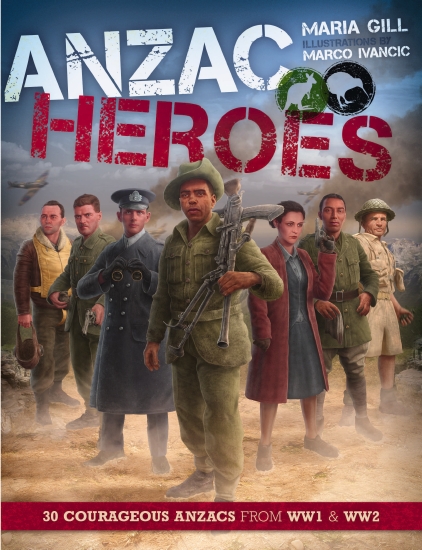
The first interview is with distinguished writer of non-fiction for children, Maria Gill. Her most recent book, Anzac Heroes, which is about the stories of great men and women from both New Zealand and Australia, from both World War One and World War Two, has recently won not only the top non-fiction award in the 2016 New Zealand Book Awards for Children and Young Adults but also the Margaret Mahy Book of the Year Award. The judges praised the book as ‘simply stunning’ with ‘carefully chosen material’, and it’s been flying off the shelves both in New Zealand and Australia. I caught up with Maria to talk to her about it.

How did you first get the idea for Anzac Heroes? How long did it take to go from concept to publication?

I had written two other books about the lives of famous people (New Zealand Hall of Fame, New Zealand Sports Hall of Fame) and when I saw the commemorations for WWI I decided to do another about Anzac Heroes. It was a year of solid writing (from 8am – 6pm, seven days a week), and I also spent two months applying for a grant, organising photographs, editing and getting experts to check the book.

Anzac Heroes is a major work of research but also selection. How did you go about that? What were your criteria in deciding who to include in the book? Did you have an initial list in mind, and did that change as you went along? What were the challenges and discoveries involved in the research?

First, I included army, navy and air force men who had won Victoria Cross medals that fought in a range of battles. However, as time went by my conscience was nagging me; I wanted to include indigenous soldiers and women. I looked closely at what being a hero means; it’s about being exceptionally brave, resilience in the face of extreme hardship, and putting your life at risk to save others. Even though Maori and Aboriginal soldiers were mostly given the jobs of digging trenches and tunnels they volunteered to fight or go out on scouting missions that were incredibly dangerous. Same with women; they weren’t allowed to fight in both wars, but they were near the front line, avoiding bomb and bullet fire to save other people’s lives. Indigenous soldiers and women didn’t receive the highest medals but they absolutely deserved to be included and the book is all the more richer for it.

I had difficulty finding information about some of the lesser known men and women in the book. It required detective work; but for me, the more difficult it is, the more determined I am to find their story. I investigated primary sources such as battalion log books, military records, diaries, and letters; as well as secondary sources such as historical books about certain battles. For Aboriginal soldier Albert Knight I rang people in his home town until I found a family member. They told me to ring other family members and between them we pieced together Albert’s story. They were really thrilled his story was finally being told.

The book is lavishly illustrated with pictures that are well-integrated with the text. Did you work with the illustrator, Marco Ivancic, on that, or were you both creating your part of the book separately?anzac-heroes

I was visiting a lot of museums to find information so every time I went I took my camera and shot lots of images for Marco to use as photo reference. I also spent a day with a military re-enactment group taking close-ups, mid-range and long-range shots of them at all different angles. I also sent him any photographs I had discovered online of the men and women.

The Anzac stories are still very inspiring and important to Australian and New Zealand readers. Why do you think that is?

I think it shows how human kind can survive in the harshest of conditions and be strong, brave, and kind despite what is going on around them. I’d like to think young people will read how difficult it was for the men and women during those two wars, and grow up thinking that war should not be an option to solve problems. The stories also tell of significant historical events that shaped our identity.

Your book has been very well-received, both in New Zealand and Australia, and has major awards.  What’s been the reaction from young readers?

Lots of boys have said how much they want to read the book or bring their own copy in for me to sign it. In a school in Brisbane a young girl came up to me and said she wanted to thank me for including indigenous soldiers because she was Aboriginal and it meant a lot to her that they were included.

Maria Gill talking about Anzac Heroes at The Children's Bookshop, Sydney

Maria Gill talking about Anzac Heroes at The Children’s Bookshop, Sydney

You specialise in non-fiction. Tell us about your other books. And what are you working on now?

I’ve written a picture book (The Last of Maui’s Dolphins), several creative non-fiction picture books (Operation Nest Egg Chick, Rangitoto, The Call of the Kokako) and over 40 educational books for children and teachers. At the moment I’m working on a follow-up to Anzac Heroes due to be published in 2018 with Marco Ivancic as the illustrator.

Maria Gill has written 60 books over the last 14 years. Seven of her books have been finalists in national children’s book awards including ‘Anzac Heroes’ in the 2016 New Zealand Children’s Book Awards. ‘Anzac Heroes’ won the non-fiction category and the Margaret Mahy Book of the Year Award. Maria trained as a Primary school teacher and journalist, but now writes children’s books and educational resources full-time in a small seaside village in New Zealand. www.mariagill.co.nz.


Cover reveal of Once Upon An ABC!

I am thrilled today to be able to reveal the spectacular front cover of Once Upon An ABC, the first of my two picture book titles to come out next year with Little Hare. It’s illustrated by the fantastic Chris Nielsen, whose gorgeous style, bursting with verve and vivid colour, is simply irresistible!

Here’s what the blurb will say: A romp through both the alphabet and the world of folklore..Sophie Masson’s lively verse gathers together a dazzling range of folklore, made vividly contemporary with Chris Nielsen’s striking artwork.

The book will be out in April 2017.

once-upon-an-abc-cover-final

Taking the independent road: an interview with Jon Appleton

Jon_AppletonI’ve known Jon Appleton a long time: since I was a pretty newly-published writer, and he was an articulate teenager passionate about books and writing to the extent that while still at school he founded, wrote, and edited a fabulous magazine called Rippa Reading. Since those days, Jon has gone on to have a stellar career as a publisher, in Sydney and in London, working with great authors and illustrators. And now he’s embarking on a new challenge–taking the independent road, as a new author and self-publisher.

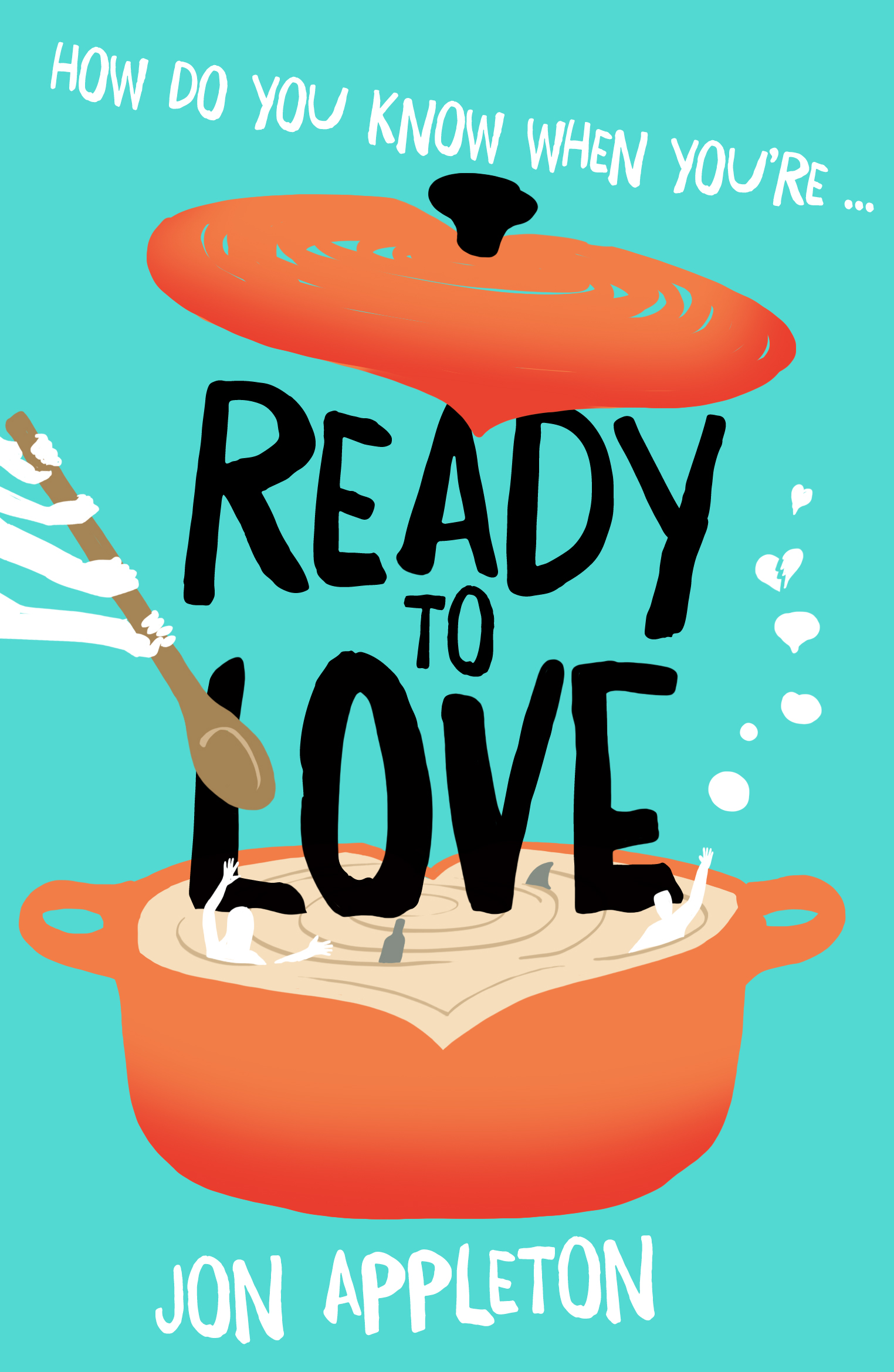
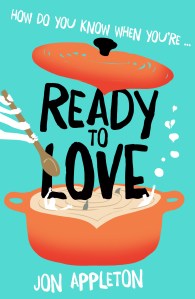
First of all, Jon, congratulations on the release of your first novel, Ready to Love! Can you tell us a bit about it, and its road to publication? 

Thanks, Sophie! Ready to Love is about the way we see ourselves and how we think other people see us, and the different kinds of attachments we form to those around us: family, friends, lovers, colleagues. Ultimately, it’s a rom-com.

Its London setting is quite important to me, and I began the book when I was living in Australia for a year in 2011, feeling quite homesick. I put it aside for twelve months when I came back to England, and then returned to it, working on it continuously for the next two-and-a-half-years.

Comedy is difficult to pitch to agents and publishers, I’m told, because it’s not viewed as a commercial genre. (Of course, we can all think of exceptions!) But I submitted it to agents nonetheless. Quite a few never replied (which I took to mean a ‘no’) but of those who did, several responded encouragingly from a reader’s perspective. I thought, ‘If only I could get past the gatekeepers, to readers, they would enjoy it too.’

Working in publishing, so much of my time was spent rejecting really good books (for reasons not dissimilar from those by which my own work had been rejected), and it was quite dispiriting dishing out ‘no’s all day only to come home to more ‘no’s from the other side of the desk. So I looked into the self-publishing option.

I knew the stigma of self-publishing has lessened dramatically in recent years. At the London Book Fair, there is a whole corner devoted to independent publishing that is reported on and taken very seriously. The timing was right.

I found the right outlet – Clays, the printer, recently established an independent publishing strand of their business – and began the process.

Putting together a book, from manuscript to finished product, is something you have a lot of experience of, in terms of other people’s work. But what was it like being in charge of your own?

I love the completeness of publishing a book – from discussing the concept with the author through to sending them advance copies. So the process of getting Ready to Love was extremely satisfying because I took a very hands-on route. Clays put me in touch with editors, designers, typesetters, Nielsen (who handled the bibliographic data), etc, but I did the legwork. It really helped maintain a sense of ownership of the process.

I sometimes think that writers feel they hand over their work without fully understanding the process – and why should they? But they can always ask! – and feel they’re being excluded. It’s never worse than when a book ends up with a cover a writer doesn’t like and the book fails to make it onto shortlists or in-store promotions. The author feels a sense of surrender when, in fact, the publisher really is on their side – or means to be.

I made all the decisions so I felt very much in control. Let’s hope I made the right decisions …9780993547317
You have just moved from the corporate publishing world to becoming a freelance, independent author/publisher. What has that move been like–the challenges and the pleasures? 

I’ve known so many authors – and freelancers – that I’ve always felt I sort of knew what it was like to be them. I appreciated how isolated authors could feel. I’d sit at my desk, and suddenly think, ‘Haven’t heard from Author X for a while. Wonder what they’re up to …’ and get in touch – particularly in the long periods when there wasn’t anything formal to do on their current book.

That’s changed, in recent years: there’s always something to do on a book, especially after it’s been published. You can revise your Amazon profile or write a blog, or reach out to potential new readers on Twitter. I’ve spent a lot of time in the past couple of years encouraging writers to be active on social media – and we’ve spent more time than ever on revising synopses and pitches (because, for many authors, it is harder to get published than ever before).

Now I’m learning, first-hand, exactly what all that entails. The main thing I’ve learned is to be focused and to think always: ‘What am I trying to do? Who am I trying to reach? What kind of writer/publisher do I want to be?’ I’ve got a blog that explores these questions – www.jonappletonsbooks.com – and it’s very much an exploration and I’d love people to join in. There are no finite, permanent answers!

You worked for a long time as a children’s publisher: but as an author, you are writing adult novels. Do you think your publishing experience has influenced your writing in any way? 

I think I realised early in my career that I love children’s books because I love the idea of children being confident and able through literacy, and cherishing the books they read when young their whole life through. I really like helping an author shape the sound of the voice of, say, an eleven-year-old boy. But I have no interest in trying to locate that youthful voice myself. I’m not one of those children’s editors who read only children’s books. My adult, reading self is nourished by other books which are more akin to the novels I want to write, and write about.

As a teenager you founded a respected literary magazine, Rippa Reading, which focused on books and authors. Can you tell readers about that, and some of your favourite stories from that time?

Rippa Reading was a fan magazine for authors which I began in late 1986 and edited until the end of 1995, just before I moved from Sydney to London. It was published and supported by my old school, SCECGS Redlands and, joyfully, the entire children’s publishing industry. It was an amazing time for which I am hugely grateful.

The magazine was born out of my desire to be a writer and to find out what writers were like, and it led to my career in publishing. Undoubtedly, it was inspired by The School Magazine which not only presented the best in new writing but made its creators available to readers through the magazine’s pages and especially to me with personal friendships with the staff.

There are so many highlights and stories from that time – genuine friendships with brilliant, creative people, many of whom now are no longer with us, but other connections endure 30 years later, like our own! It was fun being part of the CBC committee and appearing on TV and radio to talk about new books. It was an honour to receive awards, and even more so to be an early fan of brilliant new voices, like Jackie French to whom I was introduced by the wonderful Cathie Tasker (through whom you and I met, Sophie!), who was then at HarperCollins and Ursula Dubosarsky, who once taught at Redlands.

But the story I want to share now makes me happy because it brings my connection to Australian children’s books more or less up to date. When I joined Hachette Australia as Children’s Publisher at the end of 2010, I finally got the chance to publish books by Australian authors and illustrators – some of them award-winners but others, excitingly who were new to the industry. The concept for a children’s edition of the bestselling book about Tom Kruse the outback mailman had lingered for some time, but the concept hadn’t been fully realised, nor, crucially, the right illustrator found. I remembered Tim Ide from when I’d done work experience at Omnibus Books back in 1990. (Jane Covernton, who established Omnibus with Sue Williams, was always hugely supportive of Rippa Reading.) One afternoon at Omnibus, I’d been lucky enough to be taken to tea by Tim and Max Fatchen to celebrate their new book, A Country Christmas, which perfectly evoked the South Australian countryside in years gone by. So, many years later, I got in touch with Tim he agreed to work on the book. At that point, everyone in-house (and the author!) felt energised by the project, and it went on to win the Eve Pownall Award in 2012.

What’s your view on the situation for authors, and publishing today–the issues and the opportunities?

For the majority of writers, it’s tough to make a living. The obstacles are numerous: small advances, a paucity of review space, overstretched marketing budgets. More than ever, authors are expected to sell their own books – whether they publish independently, or through a mainstream publisher. That doesn’t suit everyone, I realise, but I do think that, usually, the author is his or her book’s best advocate, so it makes sense. And there are so many ways for authors to engage with readers – it’s not all about author visits and festivals. Authors need to be authorpreneurial, a term I hear a lot now. It takes time away from creative work, of course, but it’s necessary. It’s part of being a writer.

What are you working on next?

I’m planning a new novel, but I’m really aware of the need to make the most of the opportunity created by publishing Ready to Love. So I’m very happy to write about it or talk about it and to engage with people – anywhere! – in the hope that they might choose to read it, and to be receptive to further novels by me. At a practical level, I’d like to recoup some of the cost of publishing it by selling subsidiary rights – audio, translation, US and Canada and, of course, Australia!

I’m also in dialogue with writers’ groups and students who need help not just with writing, but preparing themselves for a writing life. People are aware of the challenges I outlined above (and many others), and part of my new work portfolio is helping them find ways to pitch themselves successfully and achieve an audience in the face of these challenges.
The power of fairy tales: an interview with Katherine Langrish

katherine langrishToday I have the pleasure of interviewing Katherine Langrish, author of a number of wonderful fantasy novels for older children, who has just released her new book–a collection of essays on fairy tale.

Your new book, Seven Miles of Steel Thistles, has just been published by Greystones Press, and unlike your other books, it’s a work of non-fiction: but like your other books, it shares a common element–a fascination with fairy tale and folklore. Why are you so interested in them?

Quite simply, I’ve loved fairy tales and folklore ever since I was a child.  I’ve never understood why some people feel it’s a taste adults ought to grow out of, unless perhaps the only fairy tales they’ve encountered have been the simplest versions retold for very little children.  Fairy tales can be profound and as inexplicable as poetry. As I discuss in the book, a story like the Grimms’ tale ‘The Juniper Tree’ deals with enormous themes – murder, jealousy and abuse as well as birth, resurrection, and joyful communion with the natural world.  It will ‘mean’ something slightly different to everyone who reads or hears it, because it elicits from each person their own emotional and spiritual response.  In fact, this story was probably rewritten by a German romantic poet, but that’s the other fascination of fairy tales.  They don’t ‘belong’ to anyone, they’re anonymous, so they adapt to the voice of whoever’s telling the story. And they’re so old!  People have been telling stories like these for centuries.

It’s such a large topic–did you try to pursue a particular line of inquiry or reflection in the book, or is it more organic? And what challenges and pleasures did you find in putting together the collection?

Many of the essays in the book began life on my blog (see below), although for this collection they were massively rewritten and extended. I did not think I had chosen any specific line of enquiry, but to my own fascination I found as I went through the rewrites that a theme was in fact emerging: that of ‘authenticity’. What does, what can that mean in terms of traditional tales?  Is the ‘earliest’ version of a Seven Miles of Steel Thistlesparticular tale ‘more authentic’ than a later one?  My conclusion was, repeatedly, that while it can be fascinating to trace the history and analogues of a tale, it renews itself on the lips of the latest storyteller.

Did any particular fairy tale or folklore scholars influence you in terms of interpretation and reflection?

There are so many wonderful fairy tale and folklore scholars, an embarrassment of riches, but I have to mention the great Katherine Briggs, whose four volume ‘Dictionary of British Folk-Tales’ is a Bible in the field, and whose other books of fairy lore I love – such as ‘The Anatomy of Puck’ and ‘The Vanishing People’. I like her insistence on the primacy of narrative.  I also love Max Lüthi’s ‘The European Folk Tale’ which so clearly illuminates the form and content of the classic European fairy tale.  Most of the interpretations and reflections in ‘Seven Miles of Steel Thistles’ are my own, however – if only because I read the stories long before I read any of the scholars.

You’ve maintained a blog with the same name as the book, over several years. It’s a wonderful title. Where does it come from, and was the blog a bit of a testing-ground for the book?

The title of both the book and the blog comes from an old Irish fairy tale, ‘The King Who Had Twelve Sons’. In it, the hero has to ride ‘over seven miles of hill on fire, and seven miles of steel thistles, and seven miles of sea’.  I love it as a metaphor for overcoming life’s difficulties, including the sometimes endless-seeming struggle to write well.  I suppose the blog has become a testing-ground for the book, though I never expected a book to come of it. I began the blog simply as a place where I could write about the things I love – children’s literature, fantasy, fairy tales and folk-lore – and where I could talk with others who love them too.  Does it sound too fey a comparison, if I say that the blog turned into a fairy garden and the book has grown up out of it like a tree?

Do you have particular favourites in terms of fairy tales? If so, which–and why?

I do – and I’ve written about some of them in the book.  I’ve already mentioned ‘The Juniper Tree’, and I also love ‘Briar Rose’ and ‘Jorinda and Joringel’.  But the story I love best to tell aloud is the English fairy tale ‘Mr Fox’, a very old version of Bluebeard with a far more intelligent and courageous heroine.

What are your favourite folkloric creatures?

My absolute favourites are the household fairies – the brownies, nisses, tomtes and domovoys which live with human beings and help (and sometimes hinder) them. I’ve written about then in several of my books for children: they’re an independent, mischievous, yet devoted race. They offer their services freely and will stay for so long as they are treated with respect and a dish of cream or oatmeal is left out for them on the hearth.  I love the way stories about them mingle Otherness with domesticity.  And I think they’re very, very old – as old as the story of Rachel in Genesis, who steals the household gods from her father Laban.

Your novels and short stories borrow from several different cultural traditions–can you tell us a little about that?

I began with Scandinavian folk-tales about trolls.  I’d been trying to write a story about a young Viking boy which involved him encountering some of the Norse gods. The story just went completely dead on me – I couldn’t find the way forward at all.  If a god befriends your character, why shouldn’t everything go smoothly for him or her? It seemed to me I was having to find complicated explanations for my hero’s predicaments. Then I began reading folk tales about trolls, and realised the book ought to be about them.  I got rid of the gods entirely as an unwanted extra supernatural level, and the book – ‘Troll Fell’ – worked much better as a fairy tale rather than a fantasy.troll fell

When I came to write the third book in the trilogy, I wanted to take my characters over the sea to ‘Vinland’ – North America – something we know Norse men, and probably Norse women too, actually did.  And there my characters would inevitably encounter Native American people, just as the Greenlanders’ Saga describes. It seemed to me legitimate to introduce Native American characters into the book: it was that or pretend North America was unpopulated, a clear impossibility. What may not have been so legitimate – yet it seemed to me important – was to introduce, as players on the North American scene, creatures in some way parallel to the trolls my Norse characters cohabited with. I thought long and hard about it and spent months of research, trying my best to respect and faithfully represent the culture I described. Whether or not I succeeded is not for me to say. The one thing I was sure about was that there would be no ‘white saviour’ in the book.  My Norse hero owes his life to the Native American characters he meets, not the other way around.  I wrote at length about this issue in an essay called ‘Cultural Appropriation and the White Saviour’, and though the discussion has moved on over the last few years, I still cautiously hold to what I said there.  Here’s the link:

http://steelthistles.blogspot.co.uk/2010/06/cultural-appropriation-and-white.html

In books such as Dark Angels and the Troll trilogy you explore the worlds of what might be called ‘the hidden people’ and their interactions with humans. The idea of a ‘hidden people’ with a wide range of magical powers (from large to small) and alien intelligence but with many similarities to humans and who appear to be drawn to us–if only to exploit us at times–is part of the traditional folklore and stories of many cultures right across the world. Why do you think this is such a universal notion?

Wow, that’s a huge question… and yet maybe it’s a small one too.  Haven’t we all had the experience of laying something down and then minutes later not being able to find it?  It’s so, so frustrating: ‘It has to be there! I know perfectly well I put it there, just before the phone rang!  And now I’ve looked everywhere – and it’s gone!’  The temptation is to blame borrowers, or gremlins, which we know is a joke – but it still makes us feel better to be able to focus the frustration on some invisible, tricksy thing that’s sitting there laughing at us. Maybe it’s a human trait to imagine the universe as personal rather than impersonal. We can deal with the personal, we can understand it and negotiate with it – we humans are very good at that.  Such feelings must have been far, far stronger in the past, before science began coming up with ‘rational’ explanations for everything.dark angels

Incidentally, just where have I put my keys?

You have been a storyteller as well as a writer. How does that influence your fiction?

I began story-telling years ago when I lived in France and our children were small.  I joined a a weekly English-language story session at the Bibliotheque de Fontainebleau for children aged three years and up. It can be quite hard to keep the attention of a group of fifteen to twenty little ones when reading from a picture book: you’re facing them, and you have to keep stopping and turning the book around so they can see the pictures, and that interrupts the flow.  An inspirational friend suggested that we all tried telling stories ‘from the heart’ instead of reading aloud. I loved it. I found you could keep the children’s attention better and they make the pictures in their heads. I continued to tell stories to older groups of children for many years, and learned a lot about pacing a story, about narrative structure, and about the kinds of things children enjoyed – what got them excited, what made them laugh. So yes, I think it really did help my writing, which loosened up and at the same time became more confident. I just – love telling stories.