Story behind the story 1: And Then authors on their contributions

As part of the celebrations around the publication of the fabulous And Then adventure story anthologies, published by Clan Destine Press, I thought I’d ask my fellow contributors to write a few words for readers about the ‘story behind the story’ to tell a little about their individual creation. So I’ll be publishing these in a few instalments, starting today with words from Lucy Sussex, Jason Nahrung, and Emilie Collyer. Oh, and a word or two from me! All of these authors’ stories(including mine) appear in Volume 1.

To recap: each one of us contributing And Then authors was invited by Clan Destine’s Lindy Cameron to create an adventure story which would feature a ‘dynamic duo’, but otherwise we were left pretty much to our own devices as to the rest, and the result is a sparkling and wonderful diversity in two fantastic fat volumes! My own story, The Romanov Opal, was inspired by a conjunction of things: a visit I made to the extraordinary opal mining town of Lightning Ridge some time ago; a fascination with Russian culture and history; a love of classic Agatha Christie half-mystery, half-adventure stories like The Man in the Brown Suit, and an even greater love of Tintin-style adventures. Mix that in with the elegant and turbulent 1950’s, a pair of feisty twins and a legendary jewel, and I had the perfect ingredients for a story that was simply huge fun to write.

So what was the story behind the story for other authors? Read on!

Lucy(left) and Meredith Sussex in Borneo

Lucy(left) and Meredith Sussex in Borneo


Batgirl in Borneo, Lucy Sussex

In 2015 I went to a wedding in Sabah, Borneo. After the ceremony, assorted guests went on a bus ride across north-east Borneo. We saw orangutans and sun-bears, and narrowly avoided a meeting with terrorists. Two days after we ate at a beachside restaurant in Sandakan, Abu Sayyef came raiding across the straits from the Muslim Phillippines, in a rubber dinghy. They kidnapped the manageress, Thien Nyuk Fun and a customer, Bernard Then.  She was released months later, after a ransom, Then got beheaded.

I heard another interpretation of that story only after ‘Batgirl in Borneo’ was copyedited.  In that reading, by a Sabah expat, our visit to the restaurant was the catalyst for events.

If I write that, it would be a very different tale.

jason_bw-webMermaid Club, Jason Nahrung
This is the second of my short stories starring detective Shane Hall and her accidental partner Manasa Chalmers as they negotiate a paranormal Brisbane. This one draws on a memory of how one of my favourite venues in the city was gentrified, as well as looking for an idea of mermaids different to the fairy tale. The story also builds on a larger plot involving my dynamic duo — I really must finish that, one day!
tansybwDeath at the Dragon Club, Tansy Rayner Roberts
My story is one I had been toying with for a while — about a pair of retired assassins and siblings-of-choice who run away from their violent profession and end up joining a circus full of dragons… only to have their old and new worlds collide all over again. This book was a great excuse to write that story, and I’m so glad I did. I hold Kurt and Inga Frostad, and their beloved dragons and their snarky dialogue, very close to my heart, to the point that I got all soppy and nostalgic while proofing. And then I promptly started planning the sequel…

ecollyer_photopiajohnson_051The Panther’s Paw, Emilie Collyer

With so much dystopian fiction around – and feeling increasingly like we are living in a dystopic world of our own creation – I really wanted to write a piece set in a future where we’ve started to get a few things right. I was inspired by what I’d read of the genres solar punk and eco punk so that was my starting point. One of the wonderful things about writing is getting to play god. I had a LOT of fun constructing the social, environmental and cultural norms of this world to reflect what I think would be a fair, sustainable and enlightened way to live. In regards to the characters I wanted to explore a mismatch. Two people who would normally never spend time together but who have complementary attributes. I really love the world I have created in this story and feel there is room to expand the adventures of Eliza Wild and Dash Besen. So look out for more …

2BR02B: the journey of a dystopian film–an interview with Leon Coward

australian-artist-and-composer-leon-cowardI’ve known the extraordinarily talented young creator Leon Coward since he was a pre-teen reader/reviewer flatteringly enthusiastic about my books. Today, Leon’s love of creating art has  led him to work in many different fields–not only literature, but music, visual arts, and now film-making. Involved first as a concept artist for the short film 2BR02B–To Be or Naught to Be, a dystopian work based on one of Kurt Vonnegut’s short stories, Leon went on to take a much greater part in the creation of the film.

The Canadian production, which has already been selected for no less than 15 prestigious short film festivals, has its Australian premiere today, in Sydney. To mark this exciting occasion, I talked with Leon about the creative journey behind the film.

Leon, how did you become involved in the creation of  2BR02B: To be or Naught to Be? 

My background is in graphic design and traditional illustration. The producer Artin John is a childhood friend, and he began co-producing the film and asked for me to create a poster… then concept art… then the mural and other artwork. I had no idea how involved I would later become.

The film is based on a Kurt Vonnegut short story which imagines a dystopian world in which babies are only allowed to be born if another life is terminated. What were the particular challenges involved in adapting the story for film?

The tone was a challenge. It’s easy to show too little or be too graphic, be too nonchalant or be too sombre. You can try to be as true to Vonnegut’s material as possible, but at the end of the day also you’re working with the material that you as a team have generated, not just Vonnegut’s, and that’s what you’ve got to make work. There were a few things from the original story that confused our test audiences – in one instance it was putting jazz at the end of the film, and Vonnegut gets away with it because as a reader you don’t hear it, but we realised it just sounded like cinema lounge music and it spoiled the audience’s mulling over of events.
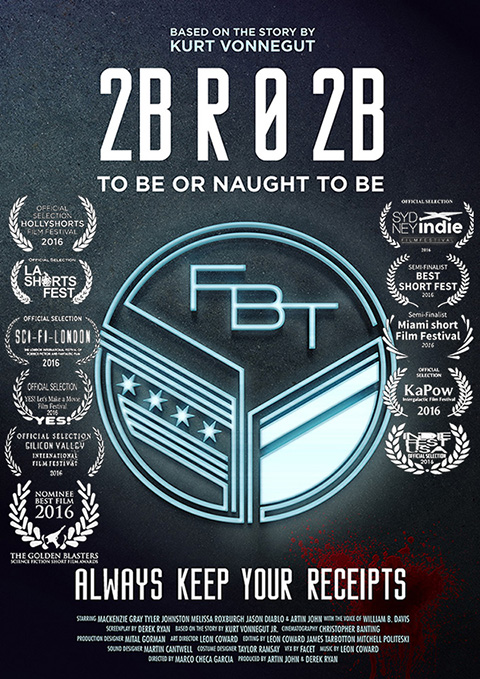
2br02b_federal-bureau-of-termination-poster2BR02B has an ensemble cast, so an editing challenge was working out the balance between them. We’d all thought the film would centre on Wehling and his internal conflict, because his dilemma motivates his actions which affect the other characters – the problem was that while we knew what he was thinking and what he’s gearing himself up to do, the audience didn’t. The first edit was melodramatic simply because the audience was asked to feel for a character they didn’t know. So I shook things up and this was hard because I took an edit to the team and, although the story itself hadn’t changed, what was emphasized had changed. For a long time we were also going for an emotional ending, but after test screenings it was clear the audience were frustrated. My grandmother suggested a twist, and I incorporated it and showed the team without warning them – that way they got to experience it as the audience would.

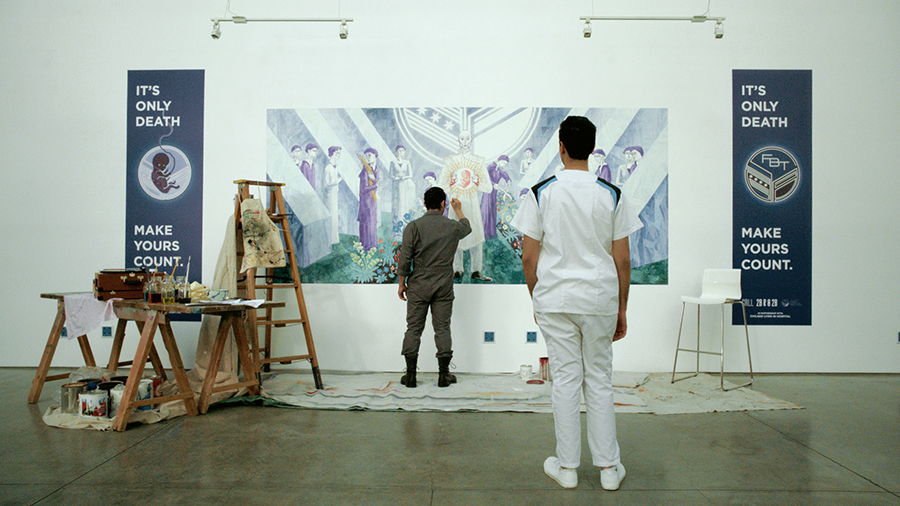
My own big challenges were creating the fictitious ‘Federal Bureau of Termination’ set in Chicago and the Painter’s 16-ft mural. The FBT is represented by Leora, a gas chamber hostess – but other than her and a brief shot of a gas chamber, the FBT doesn’t appear. So to convey the fact that this organization dominated the society, we gave them a brand identity that pervaded everything – corporate signage, posters, banners, badges, tags, earpieces and costume motifs. Vonnegut described a symbolic design for their logo (an ‘eagle perched on a turnstile’), but I approached it as a new branding commission and researched federal seals and local symbols for Chicago. There are a lot of references – the stars and stripes on the US and Chicago flags, the Chicago municipal device (which is a Y for their shaped river), even the wings of their state insect the Monarch butterfly. But there are also a lot of differences to real seals which make it very impersonal, very geometric, skeletal & circuit-like, and no natural symbols.

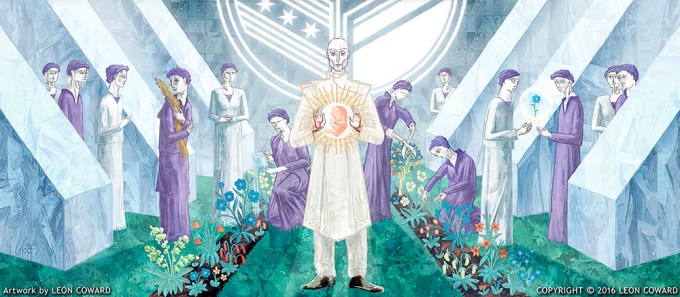
The mural took 6 months to design and finish. It was digitally painted in Sydney, then printed in Canada. All the characters discuss its symbolism and pose for it – if the mural didn’t come across as a genuine work of art, it’d devalue the acting. Its design was driven by story needs and Vonnegut’s prose. It shows a false utopian garden where nurses and FBT staff, dressed in white and purple, symbolically turn soil, plant seeds, and control life and death. Purple is traditional for sacrificial robes, and Dr. Hitz, who is the architect of population control, is painted as a ‘Zeus-like’ figure. The mural had to be recognizably propaganda and contemporary, so our director Marco instructed me to look at Russian war posters, Art Deco and Cubism. At the same time, I knew the mural had to have religious overtones. I’d experimented with a mix of Expressionism and William Blake-esque styles – trying to avoid the ‘communist cornfield worker’ interpretations I’ve seen in student versions of the film, or any specific garden-type, but I was going too far in that direction. My new layout was Art Deco-inspired, using diagonals and circles – essentially it’s an ‘X’ drawing your eyes to Hitz, and the FBT logo acts like a sun, framing Hitz’s head like a halo. I blended Cubism, Futurism and Brutalism with religious styles. The concrete flats, which also mimic the FBT logo, overpower the barest of gardens and help narrow the viewer’s focus, and the floating flower made it futuristic. The style of plants and their millefleur treatment came from The Lady and the Unicorn tapestry and the religiously-themed The Hunt of the Unicorn tapestry. Sir Edward Burne-Jones’ pilgrimage paintings, and especially his Wedding of Psyche, provided the inspiration for the figures, their poses, compositional distribution and costumes (I also referenced medical scrubs). Hitz needed a recognizable inference of himself as a messiah – so Byzantine iconography provided the inspiration for his hands (which are Christ’s) and the haloed foetus, as well as the mural’s forced perspective. For Hitz’s costume there was also a bit of SS uniform and Nehru jacket, dentist and Jedi, and a more contemporary influence from Gehn in Cyan’s Riven, a character who also sees himself as a god. Everywhere you look the message is there, and it was hard to make the mural function as a finished work of art yet still be visibly ‘in-progress’. The aim was to show a society where there is no respect for religious heritage – God is dead, and the FBT is filling the vacancy – and the mural needed to be created that way. It took months of digitally painting and scanning paint textures and brushstrokes, since the mural had to withstand close-ups. Halfway through, Paul Giamatti had scheduling conflicts, and I had to repaint the face for our Hitz replacement, Mackenzie Gray. The mural was printed in strips of paper which overlapped; clear hard-drying gel was applied to give it a texture, and Ferrero-Rocher wrappers (which have a great canvas texture) were used for the gold highlights.2br02b_mural-by-leon-coward-1
The project was an international collaboration over 3 years between crew in Australia, Canada, UK, Mexico and the Netherlands. What were the challenges and advantages involved in such a big undertaking over such distances and different time zones? What did you learn from the experience?

We had cast and crew in Vancouver, myself and other crew in Sydney, an artist in the Netherlands, and a VFX school in Mexico which did effects as part of their professional training. Footage was flown to me in Sydney and I began re-editing with James Tarbotton. Then Martin Cantwell, our brilliant sound designer in London, came onboard. The time differences were okay as calls were early morning or late night, so we’d avoid each others’ work hours – which was important since the film was not a paying project. The separation was a technical disadvantage, since exporting and transferring files adds a lot of time. It’s also important to be able to see, at least once, the person you’re communicating with, in person or Skype, because it makes email writing a lot easier. While there were disadvantages, I think the distance for me and my collaborators in Sydney allowed us to approach the project in a way we mightn’t have otherwise – especially in the editing, where we could respond as a fresh audience without preconceptions, or even knowing what the actors were like out of character.

You worked on many different aspects of the film, as art director, composer, film editor and associate producer. How did you navigate all these different roles? Was there one aspect you preferred above all?

2br02b_left-to-right_jason-diablo-and-australian-artin-johnIn a sense it hasn’t been hard to navigate between the roles because they were prepared for – I had this idea that the Painter would have a gramophone, and that he was listening to Schubert’s “Ave Maria”. When gun-shooting later ensues, the song could provide a macabre serenade. I stuck the gramophone in my concept art, and waited for the idea to take hold – it was influencing the film’s music to some extent without having to be the composer, but ironically I eventually found myself in the role and this wasn’t intentional! There is a some incidental music, but I pushed to have it that the only music was the ‘live’ gramophone so that the music was simply part of the world, and not an ‘invisible’ emotional narrator as film scores often are. The film and the Ave Maria recording were designed and edited around each other: while films are often edited to an existing temp track of unrelated music, this film was edited to a pre-existing recording of Ave Maria, which was later replaced with a tailor-made recording, post editing and sound design. It enabled us to go for a different interpretation too, which would greater contrast the action. We were fortunate to have my sister Imogen Coward, who is both a skilled soprano and conductor, record the version for us that appears in the finished film. We wanted to avoid any artificial stretching or splicing, so we had the unusual challenge of recording in one take, matching the timing of the temp version. We had 2 frames wriggle room, and the edit didn’t have any room to be changed for different timing. It was tiring, but it was worth it because it has a quality that is lost when music, especially singing, is heavily edited.

The film has so far received 5 nominations and 14 international festival selections, including for its Australian premiere at the Sydney Indie Film Festival on October 19. That’s quite an achievement! What do you think are the special qualities of the film which have made it attractive to festival selectors?

While Vonnegut created the story, it’s also the way the cast and crew have interpreted, realized and communicated the story. Derek Ryan, our screenwriter and co-producer, did a good job of cutting away story material that couldn’t be cinematic – so from the start we were all working with a document that concentrated our focus. 2BR02B really takes a cross-section of behaviours in a society where life and death are pushed to absurdities, but there’s no obvious political or moral position in its telling – just the drama of human action, and I think it allows the viewer in on their own terms. I think one of the things that’s helped is how the film feels when you watch it vs what is leaves you thinking about – cinematically it is very static up to a point, and then there’s this burst of drama and the music making it madness, and then just desolation, and that hits the audience. Vonnegut’s narrative was influenced by his experiences as a P.O.W. in Dresden, and even though his story is fiction, the themes are relevant and resonate because the wars have cast such a long shadow. It’s subtle in our film, but the hospital cross is actually a swastika, and the banners flanking the mural are inspired by Nazi banners –  Wehling’s cry “It’s only death” was used on our banners, so instead of his line being spontaneous, it becomes him quoting propaganda which the audience saw earlier.

2br02b_dystopian-chicago

What’s next for you, in terms of films, after this one?

I’m independently developing my own film project – an adaptation of Oscar Wilde’s “The Happy Prince”, and am shifting between generating its music and visual material.

You are also engaged in doing a PhD on aspects of film design. Can you tell us a bit about that?

It essentially provides an analytical process which teases apart a film’s design (if it has one) – whether the story, visuals, acting, music, sound or all their combination. The method is quite straightforward, but its theoretical justification and demonstration is very demanding. The method has had encouraging support from many industry practitioners.

As a multi-talented creator and performer, you are also involved in music, visual arts and literature. Tell us about some of your projects in those fields.

My sister Imogen is director of the chamber orchestra Camerata Academica of the Antipodes, which was founded by my siblings and a group of our young musician friends who we’ve played music together with since childhood. Our concert profits go towards helping support the Don Spencer’s Australian Children’s Music Foundation. Our orchestra has just celebrated its second anniversary and second regional tour in Australia. It’s been a very exciting time for the group. We love playing Baroque music – Vivaldi, Handel and Corelli – but our concerts also include music from a wide range of eras and styles, from the 1500s to today, and the orchestra has premiered some of my music that was written specially for the members. A lot of my own solo projects are on hold until after the PhD, including fine art prints and two picture books, written and illustrated by me, one which has been endorsed by Quentin Blake (Roald Dahl’s illustrator).

I know that you come from a family where the arts are highly valued, and your siblings are both also working in the arts. Can you tell us a bit about how you grew up, and what effect you feel it had on your adult career?

We’ve each ended up musicians – my sister  violin, viola, cello and voice, and she has her PhD in music. My brother has focused on violin, voice and guitar, and he’s also doing his PhD on music and magic performance (he’s been performing illusions for 10 years now). Our parents homeschooled us to university level, and were very keyed in to expanding our interests, skills and activities, but they didn’t try to turn us out as one thing or another and weren’t discouraging. My grandmother recently found some drawings from when I was 5, and I couldn’t draw for nuts. But I meet a lot of parents and kids who restrict activities because there’s no immediate interest or sign of potential. I think the effect it has had for my siblings and me is that we’re not afraid to venture beyond our immediate interests and skills, and that’s allowed us to develop the set of skills we have.

Leon Coward is a published artist and writer, and performed composer and choreographer. He performs on violin, viola, piano and voice with the chamber orchestra Camerata Academica of the Antipodes, and was recently art director, composer, editor and associate producer for the 2016 film adaptation of Kurt Vonnegut’s “2BR02B: To Be or Naught to Be”. He is undertaking a PhD at the University of New England, Australia, and has presented his creative work and research throughout Australasia and internationally, including for the TATE Liverpool UK. Since 2007 Leon has edited and designed the e-zine “The Online Book Group”. In 2009 Leon illustrated “Vietnam Reflections”, by award-winning author Libby Hathorn. In 2011 he was awarded a mentorship by the Australian Society of Authors.
 

Cover reveal for Two Rainbows!

Drum-roll: very happy to be able to reveal the gorgeous cover of Two Rainbows, the second of my two picture books to appear next year with Little Hare. With strikingly atmospheric pictures by fantastic new illustrator Michael McMahon, it’s an exploration of colour and the very different ways it’s found in city and country life, seen through the eyes of a little girl.The book comes out in July 2017.

two-rainbows-front-cover

Across the Tasman 1: Maria Gill

One of the great pleasures of international travel, for me, is the discovery of another country’s books, writers and illustrators. My latest trip, to New Zealand, was no exception. Through visits to schools, bookshops, libraries and attending the IBBY (International Board of Books for Young People) Conference in Auckland, I was introduced to the work of the country’s fabulous authors and illustrators for children, and also met several of them in person. To my shame I also discovered how little I knew about New Zealand books–I had read and loved the work of world-famous creators of children’s books like Margaret Mahy, Lynley Dodd, Pamela Allen and Maurice Gee, but otherwise I knew very little. I’m not alone in that, in Australia: our cousins across the Tasman might be so close but we know more about British or American children’s literature than we know about that of New Zealand. Anyway, I decided I’d do my small bit to remedy that, not only by buying and reading lots of books but also by presenting interviews with some of those fabulous creators!

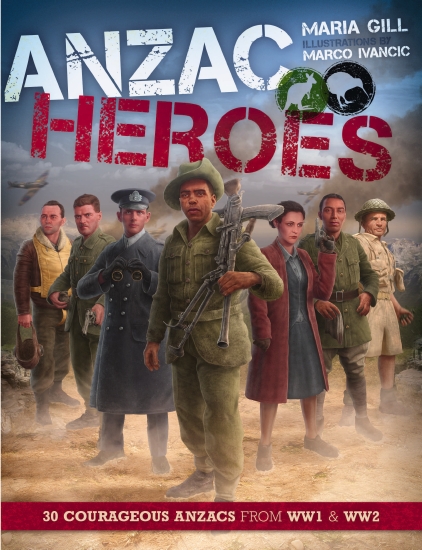
The first interview is with distinguished writer of non-fiction for children, Maria Gill. Her most recent book, Anzac Heroes, which is about the stories of great men and women from both New Zealand and Australia, from both World War One and World War Two, has recently won not only the top non-fiction award in the 2016 New Zealand Book Awards for Children and Young Adults but also the Margaret Mahy Book of the Year Award. The judges praised the book as ‘simply stunning’ with ‘carefully chosen material’, and it’s been flying off the shelves both in New Zealand and Australia. I caught up with Maria to talk to her about it.

How did you first get the idea for Anzac Heroes? How long did it take to go from concept to publication?

I had written two other books about the lives of famous people (New Zealand Hall of Fame, New Zealand Sports Hall of Fame) and when I saw the commemorations for WWI I decided to do another about Anzac Heroes. It was a year of solid writing (from 8am – 6pm, seven days a week), and I also spent two months applying for a grant, organising photographs, editing and getting experts to check the book.

Anzac Heroes is a major work of research but also selection. How did you go about that? What were your criteria in deciding who to include in the book? Did you have an initial list in mind, and did that change as you went along? What were the challenges and discoveries involved in the research?

First, I included army, navy and air force men who had won Victoria Cross medals that fought in a range of battles. However, as time went by my conscience was nagging me; I wanted to include indigenous soldiers and women. I looked closely at what being a hero means; it’s about being exceptionally brave, resilience in the face of extreme hardship, and putting your life at risk to save others. Even though Maori and Aboriginal soldiers were mostly given the jobs of digging trenches and tunnels they volunteered to fight or go out on scouting missions that were incredibly dangerous. Same with women; they weren’t allowed to fight in both wars, but they were near the front line, avoiding bomb and bullet fire to save other people’s lives. Indigenous soldiers and women didn’t receive the highest medals but they absolutely deserved to be included and the book is all the more richer for it.

I had difficulty finding information about some of the lesser known men and women in the book. It required detective work; but for me, the more difficult it is, the more determined I am to find their story. I investigated primary sources such as battalion log books, military records, diaries, and letters; as well as secondary sources such as historical books about certain battles. For Aboriginal soldier Albert Knight I rang people in his home town until I found a family member. They told me to ring other family members and between them we pieced together Albert’s story. They were really thrilled his story was finally being told.

The book is lavishly illustrated with pictures that are well-integrated with the text. Did you work with the illustrator, Marco Ivancic, on that, or were you both creating your part of the book separately?anzac-heroes

I was visiting a lot of museums to find information so every time I went I took my camera and shot lots of images for Marco to use as photo reference. I also spent a day with a military re-enactment group taking close-ups, mid-range and long-range shots of them at all different angles. I also sent him any photographs I had discovered online of the men and women.

The Anzac stories are still very inspiring and important to Australian and New Zealand readers. Why do you think that is?

I think it shows how human kind can survive in the harshest of conditions and be strong, brave, and kind despite what is going on around them. I’d like to think young people will read how difficult it was for the men and women during those two wars, and grow up thinking that war should not be an option to solve problems. The stories also tell of significant historical events that shaped our identity.

Your book has been very well-received, both in New Zealand and Australia, and has major awards.  What’s been the reaction from young readers?

Lots of boys have said how much they want to read the book or bring their own copy in for me to sign it. In a school in Brisbane a young girl came up to me and said she wanted to thank me for including indigenous soldiers because she was Aboriginal and it meant a lot to her that they were included.

Maria Gill talking about Anzac Heroes at The Children's Bookshop, Sydney

Maria Gill talking about Anzac Heroes at The Children’s Bookshop, Sydney

You specialise in non-fiction. Tell us about your other books. And what are you working on now?

I’ve written a picture book (The Last of Maui’s Dolphins), several creative non-fiction picture books (Operation Nest Egg Chick, Rangitoto, The Call of the Kokako) and over 40 educational books for children and teachers. At the moment I’m working on a follow-up to Anzac Heroes due to be published in 2018 with Marco Ivancic as the illustrator.

Maria Gill has written 60 books over the last 14 years. Seven of her books have been finalists in national children’s book awards including ‘Anzac Heroes’ in the 2016 New Zealand Children’s Book Awards. ‘Anzac Heroes’ won the non-fiction category and the Margaret Mahy Book of the Year Award. Maria trained as a Primary school teacher and journalist, but now writes children’s books and educational resources full-time in a small seaside village in New Zealand. www.mariagill.co.nz.


Cover reveal of Once Upon An ABC!

I am thrilled today to be able to reveal the spectacular front cover of Once Upon An ABC, the first of my two picture book titles to come out next year with Little Hare. It’s illustrated by the fantastic Chris Nielsen, whose gorgeous style, bursting with verve and vivid colour, is simply irresistible!

Here’s what the blurb will say: A romp through both the alphabet and the world of folklore..Sophie Masson’s lively verse gathers together a dazzling range of folklore, made vividly contemporary with Chris Nielsen’s striking artwork.

The book will be out in April 2017.

once-upon-an-abc-cover-final

Edible art: Anne Spudvilas’ pavlova volcano

anne spudvilasSomething a bit different today!

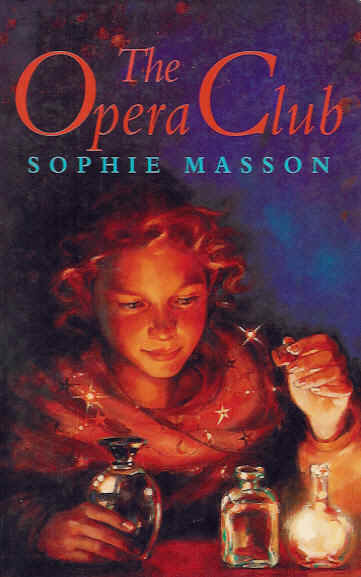
Anne Spudvilas is an absolutely wonderful illustrator based in regional NSW whose rich, gorgeous work has adorned the books of many Australian authors, including myself. I’m very happy to say by the way that the original painting of the glorious cover she did for my 1993 novel, The Opera Club, adorns one of our walls at home–a very kind gift from Anne herself.operaclub (1)

And today, with her permission, I’m presenting on this blog as well as my A la mode frangourou food blog, another gift, another rich and gorgeous work, this time of an edible kind! It’s the pavlova volcano, and it’s absolutely spectacular!

From Anne:

This recipe brings back memories of two wonderful New Year’s Eve celebrations on the Murray River when i first came here.   Julie Chambers, director of the Art Vault where i did two wonderful printmaking residencies,  makes this as the ‘piece de resistance’ at her long long New Year’s Eve dinner table.

 My version of Julie’s specialty.  

Make three pavlovas. Home made are best and if they don’t look too flash it doesn’t matter.  Break them into large pieces and begin to construct your volcano using vanilla icecream and whipped cream to hold it all together. Add 4 punnets of assorted richly coloured berries.  Pour over two more punnets of assorted berries, pureed with 1/2 cup orange juice and 1 tbspn of liqueur added (i love Cointreau).   

 Ah yes, a million calories but SO delicious 🙂
Annes pavolova volcano

A joint celebration of World Poetry Day and The School Magazine

clive_last

School Magazine mascot

WP_20160229_14_40_48_Pro Jackie Hosking of Pass It On had a brilliant idea for today: jointly mark World Poetry Day and the 100-year celebrations of the world’s oldest continuously-running literary magazine for children. Australia’s very own wonderful School Magazine, by a blog tour highlighting children’s poetry published in the Magazine. And I’m delighted to be part of that fabulous blog tour!

First of all, I want to say that not only do I love The School Magazine, but I owe a lot to it. As a young reader of non-English speaking background who came to Australia as a school-age child, The School Magazine was one of the most important factors for me in discovering a world of English-language literature, both Australian and international. And later it nurtured me as an emerging writer, with my first story for children, Platypus Daybreak, published in the Magazine in 1988–and excitingly, it was illustrated by Noela Young, whose pictures I’d so loved as a child in Ruth Park’s The Muddle-Headed Wombat! (That is is one of the great pleasures of being published in the magazine–your pieces are illustrated by some of Australia’s most wonderful illustrators!) Over the years I’ve had lots of things published in the Magazine–short stories, articles, plays, and lately, poetry too. My recent success with poetry in The School Magazine has in fact also played an important part in not only encouraging me to write a great deal more of it–but also successfully submitting it for publication in anthologies both here and overseas, and for that I’m grateful once again to the Magazine.WP_20160229_14_41_27_Pro

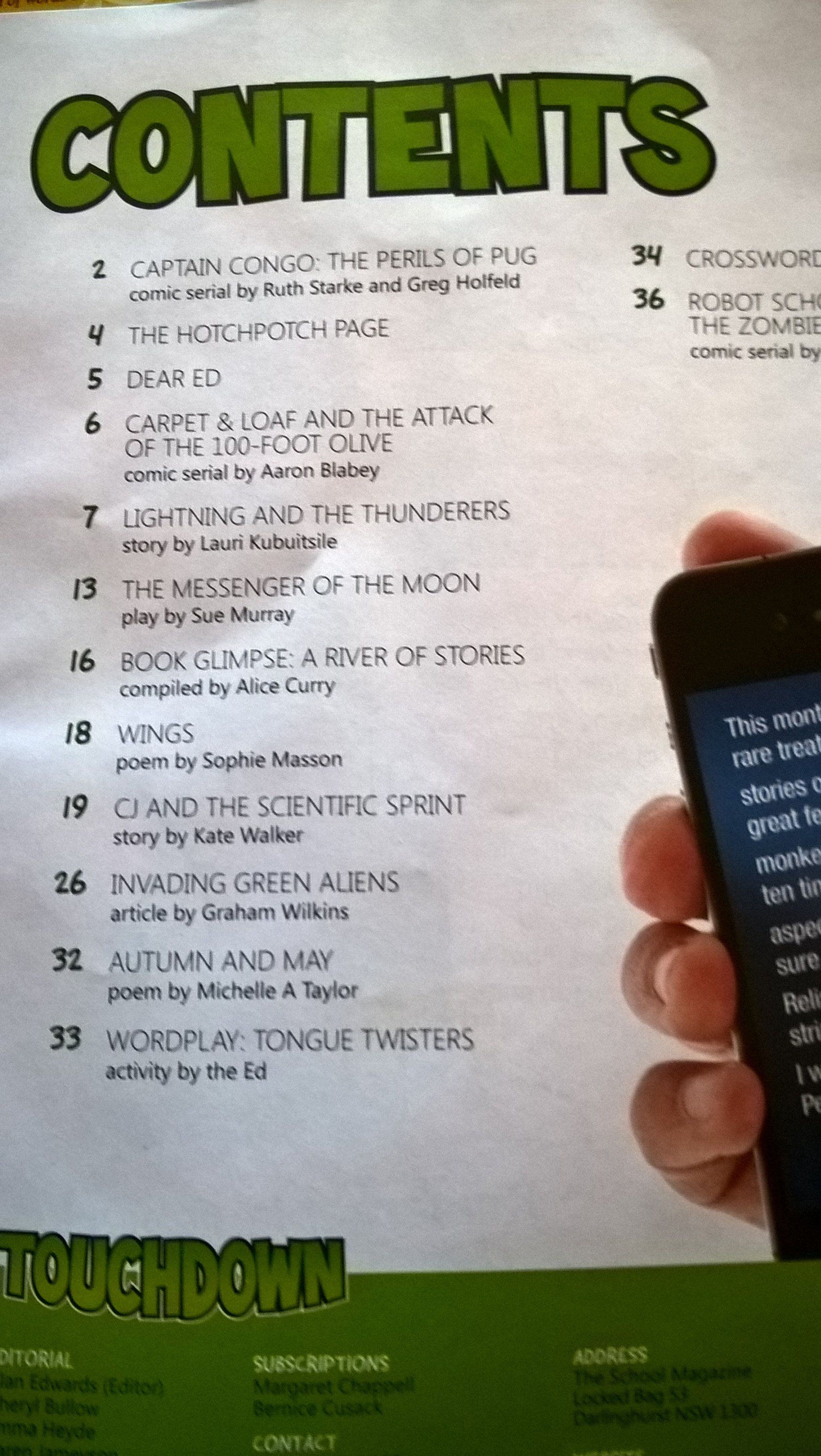
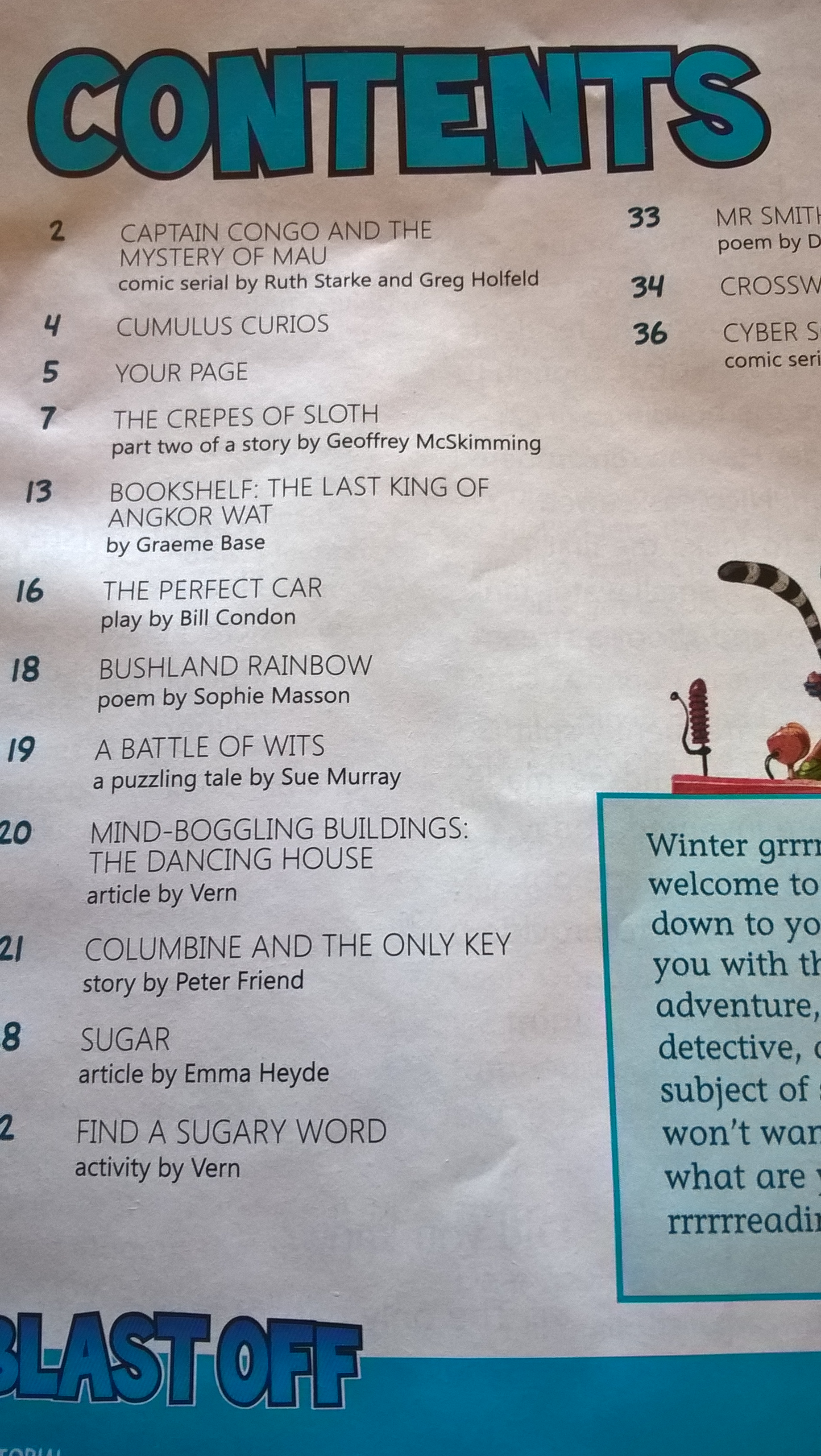
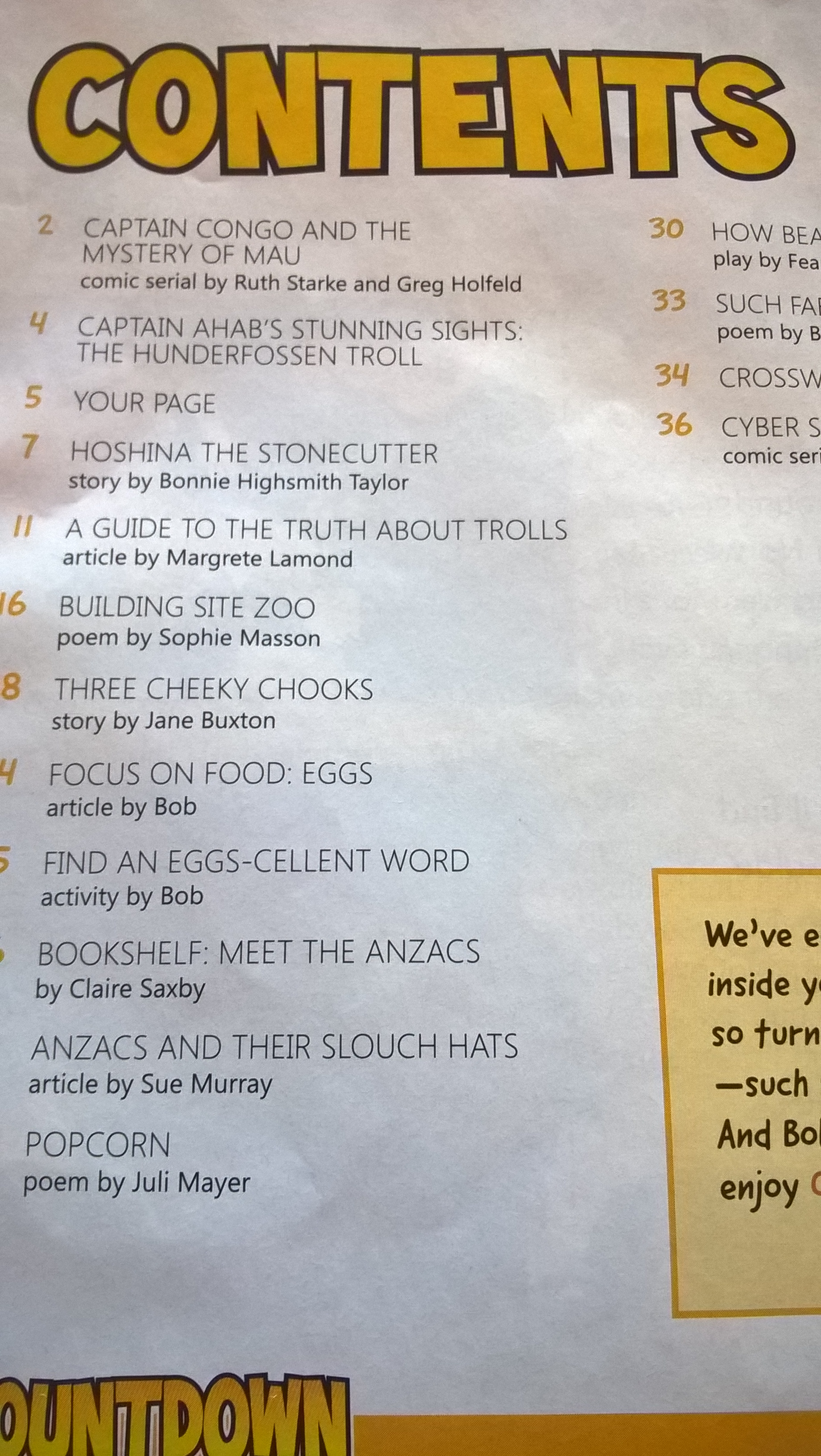
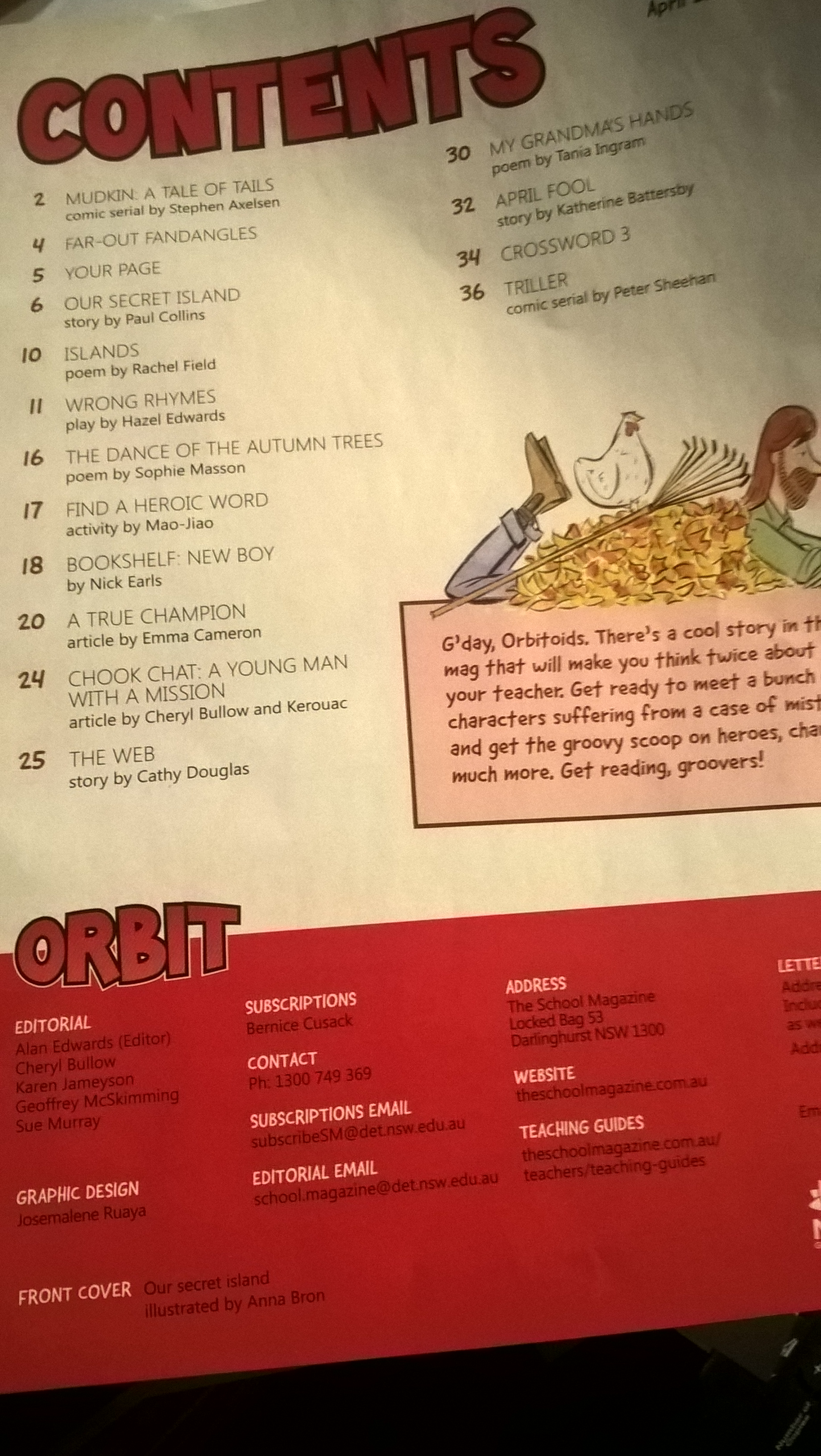
I’ve had three poems published so far in The School Magazine in very recent times–Wings in ‘Touchdown’ May 2014 (illustrated by the great Bronwyn Bancroft); Building Site Zoo in ‘Countdown’, WP_20160229_14_41_14_ProApril 2015; Bushland rainbow in ‘Blast Off’ , June 2015 (both illustrated by the wonderful Matt Ottley) and coming up in April in ‘Orbit’ this year, Dance of the autumn trees, illustrated by Bronwyn Bancroft.WP_20160319_07_08_27_Pro


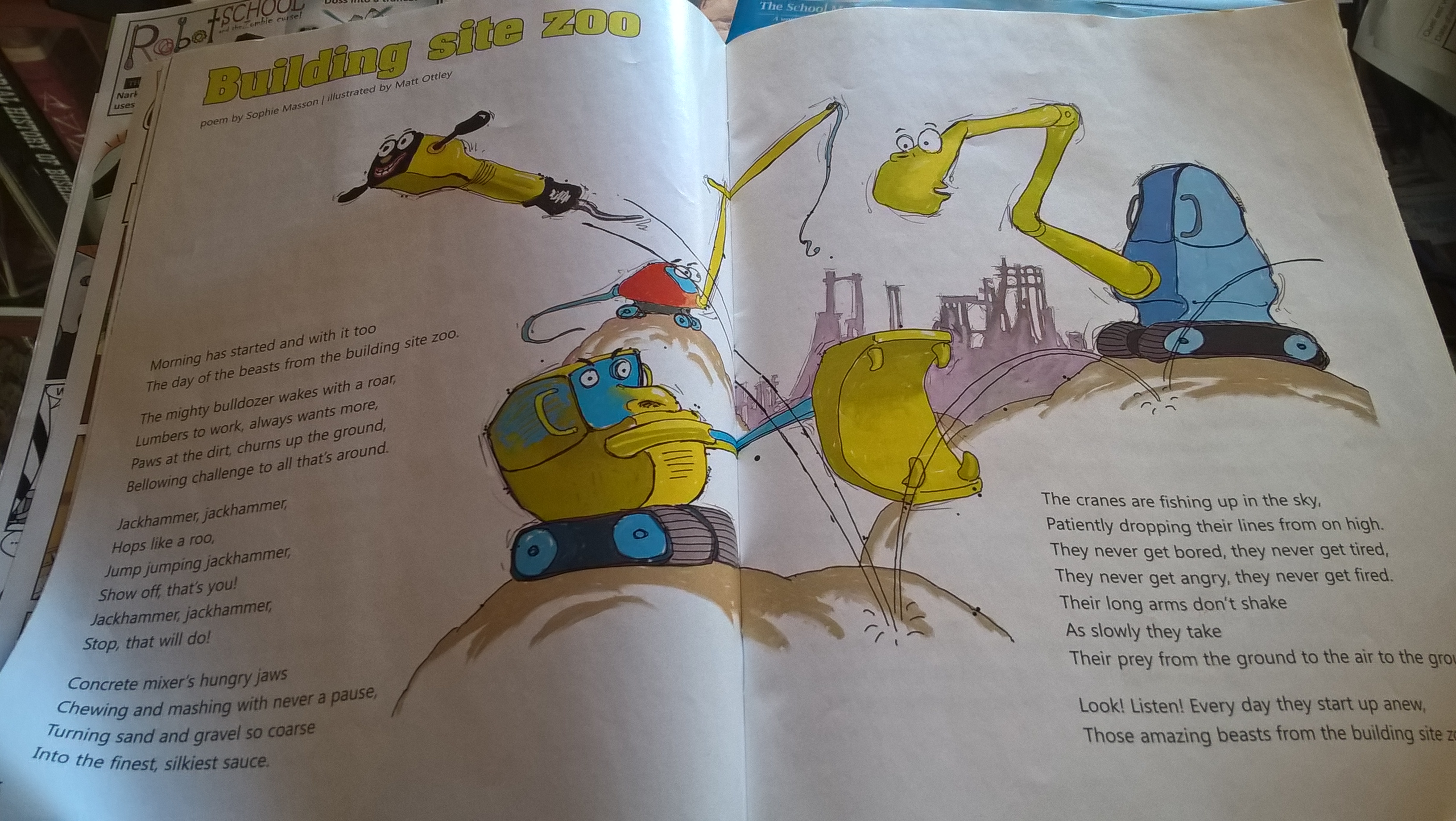
So today I’m republishing here, below, the full text of ‘Building Site Zoo’ , with a pic of that page in the Magazine, for your enjoyment! Happy World Poetry Day to everyone–and a very happy 100th birthday to that great literary treasure, The School Magazine! And below the poem are links to other blogs on the tour.

(Please Note: The poem text is copyright to me, illustration reproduced from The School Magazine, copyright to Matt Ottley, design copyright The School Magazine. )

Building Site Zoo

by Sophie Masson

Morning has started and with it too

The day of the beasts from the building site zoo.


The mighty bulldozer wakes with a roar,

Lumbers to work, always wants more,

Paws at the dirt, churns up the ground,

Bellowing challenge to all that’s around.


Jack hammer, jack hammer,

Hops like a roo,

Jump jumping jack hammer,

Show off, that’s you!

Jack hammer, jack hammer,

Stop, that will do!


Concrete mixer’s hungry jaws

Chewing and mashing with never a pause,

Turning sand and gravel so coarse

Into the finest, silkiest sauce.


The cranes are fishing up in the sky,

Patiently dropping their lines from on high.

They never get bored, they never get tired,

They never get angry, they never get fired.

Their long arms don’t shake

As slowly they take

Their prey from the ground to the air to the ground.


Look! Listen! Every day they start up anew

Those amazing beasts from the building site zoo.

WP_20160229_14_41_56_Pro


Other blogs on the tour:


A literary gift for the festive season

For all the readers who have enjoyed my blog this year, and all those writers, illustrators and publishers who have so generously helped to make Feathers of the Firebird as interesting and informative as it can possibly be by giving of their time, expertise and experiences in fabulous interviews and guest posts, I’d like to thank you by offering a literary gift of mine for the festive season. And in the tradition of the season, which likes to weave in some delicious chills amongst the festive jollity, it’s a spooky story! Set amongst the pulsing heat of an Australian sub-tropical summer, this story, Mel, brings the shiver of ancient myth and legend into the everyday…

Enjoy! And very best wishes to all for a wonderful Christmas, Hanukkah, New Year and all other seasonal festivities!

creekMEL

by Sophie Masson ©


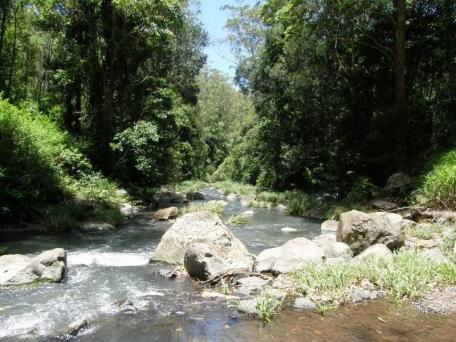
Every summer evening, we village kids used to meet down at the creek. Most days, you could strip off and have a swim, or if you didn’t feel like that, just lie on the grass and drink Coke out of paper cups, and talk. The creek was a great place, really private, with high banks and tall trees growing right to the edge of the water. All of us used to come–from the smallest Grant kid to Mary, my sister, who at 18, and apprenticed to a hairdresser in town, considered herself rather above us all.

Last summer was a really hot one, one which started early. A corrugated iron sky, a sunflare of white fire. A bit of a disaster for our parents, whose avocados and bananas were shrivelling up before they could be properly formed. A bit of a disaster for school, because the teachers were all as unpredictably shrill as cicadas. But a wonderful time for our creek meets, for in that place, the tall trees shaded us from the worse of the glare, and the water was always there, cool as a magpie’s call. We spent as much time as we could down there, eating huge slices of watermelon, drinking huge slices of watermelon, and talking our heads off. Sometimes the little kids would come and drip coldly on to us, and then run away, yelling with laughter, but it didn’t stop our talk. There was more than usual to talk about that summer. Well, the heat, and the strange feeling of heavy waiting in the air, and a tiny prick of danger at the thought of the snake.

We were used to snakes, we sub-tropical North Coast kids. Some of us even kept carpet snakes as pets. But the one we were talking about, then, was different. It had already bitten a couple of people,two middle-aged women from the surrounding area. Both had died. .

Taipan. One of the deadliest snakes in the world. Not supposed to live this far south, it wasn’t, but this one had somehow found its way. It had bitten its second victim one hot night, as she walked barefoot over the grass to the outdoor toilet. Her husband had seen it, rearing, its bright body twisting. That’s how they’d known it had been a taipan. But since then, no-one had seen it, or come across it at all. Taipans were quiet snakes, kept out of the way, experts told us. But if they were cornered, or if you came on them unawares. .

The creek bank was beautiful, not only to us but to other creatures. We knew that snakes came down there to drink, in the cool of the evening. It had never bothered us before. But that summer, we were all a bit jumpy, and the gossip that filled our mouths was sharp and a bit spiteful. If Mary, my sister, wasn’t there, the others would start on her, on her impossible beauty, her impossible haughtiness, her impossible impossibility. And Mary was impossible. When she came down to the creek, she would lie there in her white bikini, her bright, fine hair like red ferns on her brown shoulders. She paid no attention to us. She just wanted us to admire. I know that, even if I am her sister.

Ever since I can remember, people had flocked around Mary. Teachers gave her silver stars simply for being who she was. Strangers in the street stopped and said, ‘Oh, what a lovely child!’ their glance sliding past me, fat little baby and plump toddler that I was. My parents gazed at her sometimes as if they couldn’t believe their eyes. And as she grew older, boys came to her, blundering like moths around a light. And they burnt themselves, too, I can tell you. For our Mary is bright and pitiless as a flame. Sometimes, she’d talk to me, late at night, and giggle about the latest moth that had knocked itself out, and even though I was flattered to be confided in by Mary(see, I was bitten by the same bug as everyone else!)I couldn’t help squirming. There was something sad and embarassing about the thought of those boys, something which I knew Mary couldn’t see. And the strange thing was that I started to feel afraid, somehow, for Mary. I couldn’t have told you why I did; I suppose it was some sort of vague feeling that she was going too far, was tempting fate, if you like. . .

One day Mary turned up with a boy–actually, more a young man, whom none of us had seen before. He was tall, his cap of hair the colour of honey, his eyes a light, rich brown. He was beautiful. I’d never seen such a beautiful person before–except for Mary. Together they stood, seemingly serenely unaware of the effect they were having on the rest of us.

Naomi from next door nudged me painfully in the ribs. ‘What a hunk, hey!’ she mouthed. I didn’t say anything. I didn’t want anyone to say anything. I could just stare at him, mesmerised, and as if he knew, he gave me a little corner smile that vanished almost as soon as it had appeared.

‘This is Mel,’ Mary said. ‘He’s come to live in the old Stevens place. ‘

That dump! It was an old house that had not been lived in for a long time. When we were little, we used to sometimes go up there to play games of let’s pretend. Now, hardly anyone used it, because the forest had just about taken it over, and there was something odd about the place, something that kept even the secret smokers or lovers away. I think it was because it was almost house, almost forest, not quite one or the other, just something in between, that you couldn’t put a name to. . Fancy anyone wanting to live there!

‘I inherited it,’ Mel said. He had a soft, slow voice, and I let its softness wash over me, like a wave. ‘I like it there. It’s very quiet. ‘ Continue reading

Thunderbolt Prize winners: Susan Bennett, winner of the Fiction prize

Susan BennettMy final interview with a Thunderbolt Prize winner is with Susan Bennett, winner of the Fiction category in the Thunderbolt Prize.

First of all, Susan, congratulations on your win! Your winning story, Bittersweet, was described by the Fiction judge, Felicity Pulman, as ‘making use of all five senses’ and being  ‘perfectly shaped, with sensual descriptions.’  How did you come up with the central character, Tilly, the food writer? And how did you create the rich texture of the story?

Tilly?  Well, I like my women characters to be strong and complex – flawed human beings rather than representations of ‘the fairer sex.’  And I think in part the story was a reaction to the pretension that is sometimes associated with cookery.  Tilly is a lot less concerned with those aspects than she is with the joyous celebration of life that cooking and food represents.  But as much her food epiphany gains her access to high society, Tilly never stops being the girl who came from nowhere.  Among all of the new found sensuality that food awakens in her, she retains a hard streak and survival instinct that means she’s fully prepared to deal with the man who crosses her, even if she loves him.

In terms of the texture, much of it came from my own experience.  I got into cooking Mexican food in a big way – proper Mexican food, not Tex-Mex.  Living in Australia I couldn’t find the necessary ingredients, so I had to grow them myself.  I ended up with over eighty chilli plants.

I’m inclined to sleepwalk, and my former partner used to catch me wandering out the bedroom door in the dead of night.  When he asked me where I was going, apparently I would answer, “I’m just off to re-pot that chilli.”   On another occasion he reported that I was tossing and turning in my sleep, crying out, “Bugger it!  I’m not re-potting it, I’m not!  I’m not!”  I figure I must have made it outside some nights without him catching me, because I used to find chilli seeds in the bed when I woke up in the morning.  My chilli crop attracted the attention of the police helicopter, but that’s another story.

Suffice it to say that learning to cook Mexican brought a whole new dimension to my love of cooking.

What attracts you to writing crime fiction?

Sometimes I think it’s because I get to bump people off on the page.  A while ago it dawned on me that my stories kept ending with people dying even when I don’t mean them to.  I noted that so far I have killed men by staking them, poisoning them, shooting them and by one other method that probably shouldn’t be mentioned here.  And more than one mother-in-law hasn’t fared too well in my stories.

Crime fiction is an interesting genre because it is so varied, encompassing every style from the very literary to the hardboiled or cosy.  I like the fact that a lot of crime fiction aimed at the mass market is so well-written.

Can you tell us a bit about your background and writing career?

In terms of work I’ve done everything from selling knives and camping equipment to working in technical support in the early days of personal computers.  I’ve spent a lot of time in mercantile agencies (business reporting, credit ratings, debt collection) and in software houses.  I’m at a crossroads at the moment and I’m not sure what my next step will be.

I settled on the idea of writing as a teenager, or more accurately, I was blessed with an inspirational English teacher who encouraged me to aspire to write professionally, and I will always be grateful to her.  She personally selected books for me from the school library in her own time so that I didn’t have to read what the rest of the class was reading.  Unfortunately I think you have to be an adult to appreciate the gift someone gave you as a kid.  I wish I could thank her now and tell her how much it meant to me.

My writing career has probably taken a different path to most in that I started off writing novels then moved on to short stories, whereas many writers tend to do that the other way around.  Writing short stories at first I missed the wriggle space a novel gives you.  On the other hand with short stories, you get to play around stylistically in a way that I don’t think can be sustained over the course of a novel if you want it to be readable.

What do you hope winning the Thunderbolt Prize for fiction will do for you as a writer?

Specifically, the win pleased me because Bittersweet has been written for the general reader.  It isn’t a particularly literary story, and until now I doubted that stories for mainstream readers could win competitions, so that made me happy.

As far as prizes go generally, I have been through every stage I think it’s possible to go through.  At first I only entered competitions because editors, publishers and agents want to see prizes and commendations, and as those are the people I have to deal with, I felt it necessary to go after those prizes and commendations, but I can’t say I enjoyed the experience at first.  I swore off entering for a while because it was just another source of rejection that I found discouraging.

Conventional wisdom has it that we should keep sending our work out, but I’d argue that if rejection is impacting on your ability to work, then there’s a case for taking a break from submitting, so that’s what I did for a while.  It occurred to me that I just wanted a period to develop a relationship with my own work, without worrying what anyone else thought about it for a while.  I asked myself some questions I hadn’t asked before, like why was I writing, who was it for and what did I want to get out of it – me – not anyone else.

It was an interesting and fruitful exercise because my work opened up a great deal more.  It occurred to me that I had been writing defensively.  When I went back to submitting after that hiatus, I started winning prizes immediately, which has had a surprising effect on my writing.  I suppose it’s the encouragement.  My work has opened up even more, become more ambitious.  I feel more confident about realising the potential in the story.

What do you look for in a good story or novel?

One of the drawbacks to being a writer is that you are so accustomed to looking for faults in your own work, it can tend to make you more sensitive to the flaws in other people’s work too.  I’ve been through stages where I can’t read because the smallest misstep spoils a book for me.  You know you’re in trouble if you can’t read Bill Bryson without nit-picking.

I’ll read everything from Charles Dickens (a favourite) to Silence of the Lambs, but the writing always has to be quality.

You have a food blog, http://fudgingthemenu.blogspot.com.au/ How did that start?

Largely to support a cook’s organiser I have developed, but also as another creative outlet.  Cooking and writing come from the same place with me, but that can be problematic.  Cooking is more immediately gratifying than writing – I mean what’s not to love?  First it makes the house smell great, then you get to taste it, then it leaves you feeling happy.  It’s so much more straightforward than writing and a lot less subjective, but if it satisfies the creative urge too much then I’m inclined not to write.

Conversely, sometimes writing satisfies me so much that I don’t want to cook.  That can be a problem too.  Fortunately, wine is always on hand to solve it.

Thunderbolt Prize winners: Madeleine Gome, winner of the Youth Award

Madeleine Gome Author PhotoToday, I am interviewing the winner of the Youth Award in the Thunderbolt Prize, Madeleine Gome.
First of all, Madeleine, congratulations on your win! How did you come up with the idea of your winning story, Scrap Metal?

My story was actually inspired by true events. I was with my dad, picking up our car from the mechanic. We gave the receptionist the numberplate and all he asked for was a credit card. Without needing any proof of identity we were given the keys and sent on our way.

What attracts you to writing crime fiction?
I don’t specifically set out to write crime fiction. I have never been especially attracted to traditional crime stories which follow the investigation of a crime. I’m more interested in characters and relationships, and the flow of words than creating a rigid storyline or structure.
Can you tell us a bit about your background and writing career?
I started writing before I could read, which seems slightly counterproductive. ‘How the Woodcutter Lived’ was apparently my first story. It was about a woodcutter, living in the forest with his partner and their children who got into all sorts of mischief. When I was seven, I wrote my own Harry Potter novella. The spelling was terrible—my parents only managed to translate it into English by reading everything I wrote with a thick Aussie accent! In terms of my writing career, I won the 2014 Hervey Bay Youth Writing Competition and a piece of my non-fiction will appear in an upcoming edition of The Big Issue.
Your mother, Emma Viskic, is also a crime writer(and winner of the fiction category in the inaugural Thunderbolt Prize in 2013). Do you read each other’s work?
Actually, no. My mum is not allowed to give me advice on three things: music, clothing and writing. Our relationship remains intact through a strict separation of powers! She is sometimes allowed to proofread my writing, for clarity and punctuation, but she knows not to comment on the content. I have read one of her short stories, which I loved, but the similarity between our writing was a little unnerving. We both like simple phrases and are interested in characters and relationships.
What do you hope winning the Youth Award will do for you as a writer?
Winning the Youth Award is incredibly thrilling. I have wanted to be an author for as long as I can remember, so receiving validation for my work is very encouraging. I see it primarily as encouragement to continue writing and continue putting my work out there, and to consider writing a viable part of my future and career.
What do you look for in a good story or novel?
I like novels that make me emotionally invested in the characters and their relationships. I enjoy writing which creates characters and situations I can relate to, and that I care about.  I have to want a certain outcome for the characters, and feel involved in their lives. I also love writing that makes me laugh.