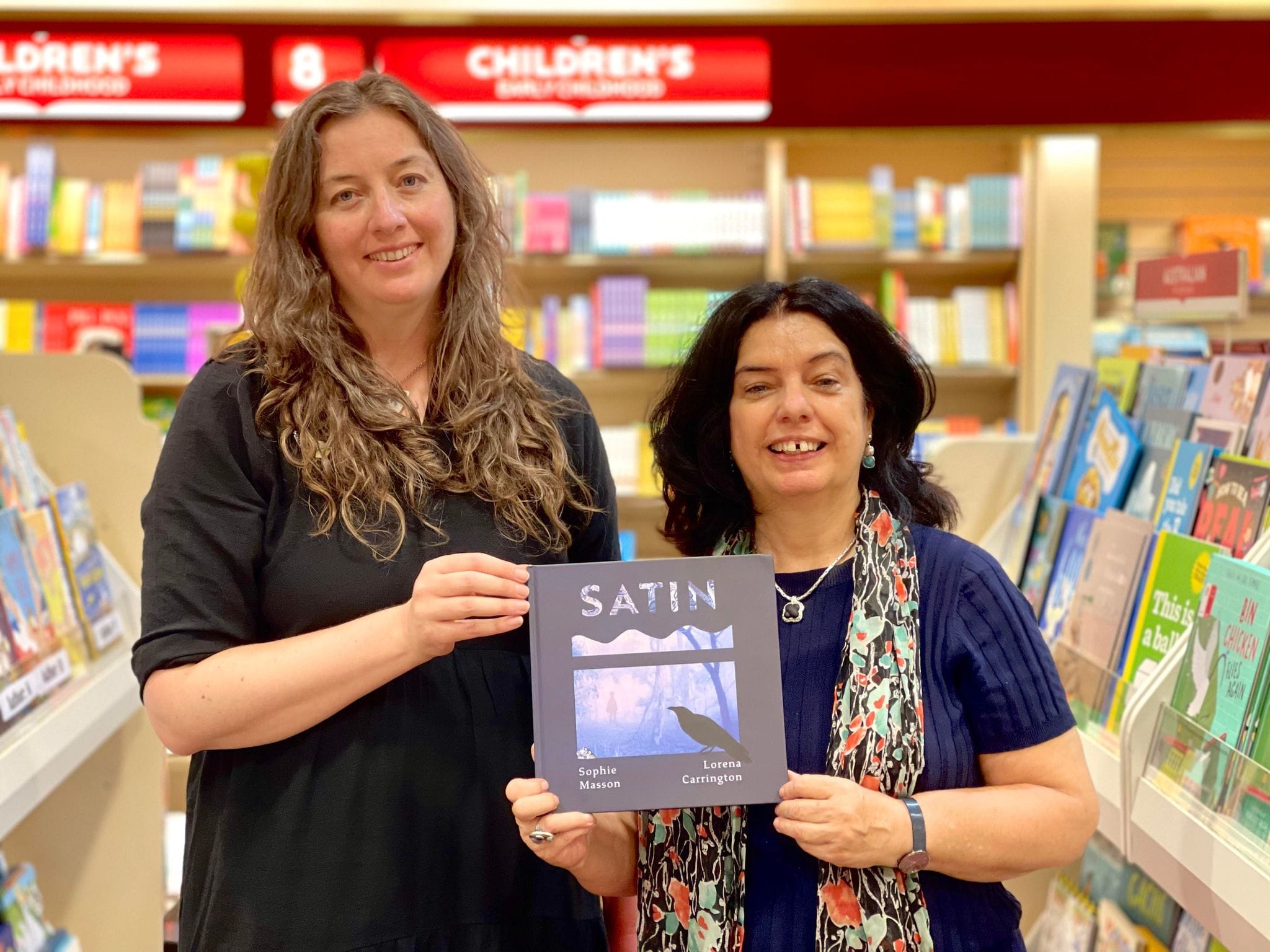
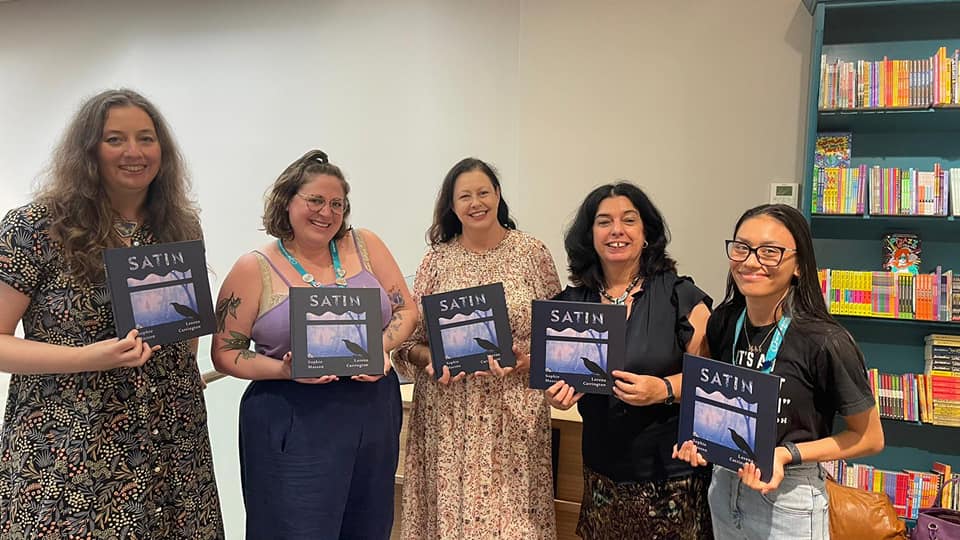
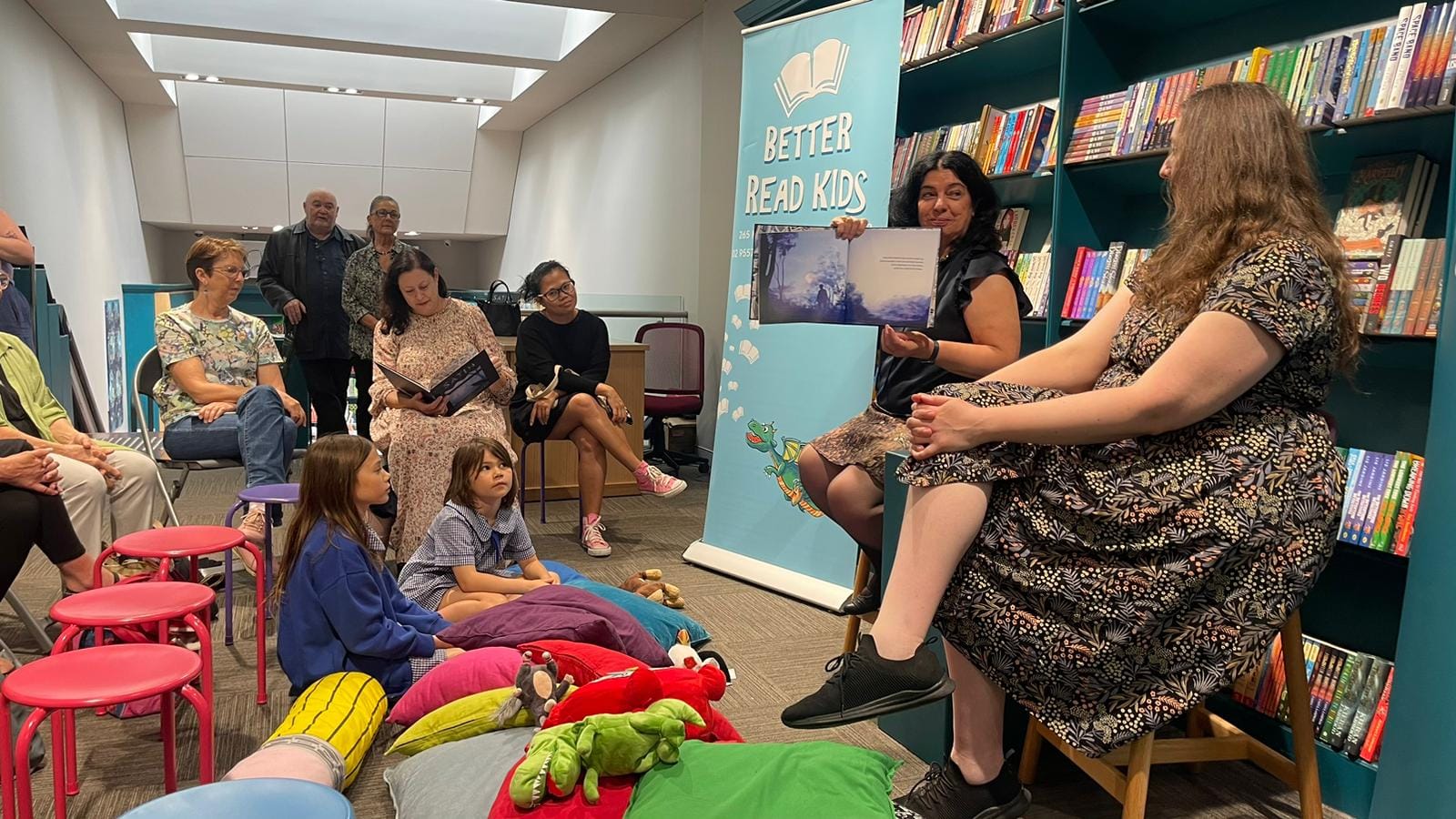
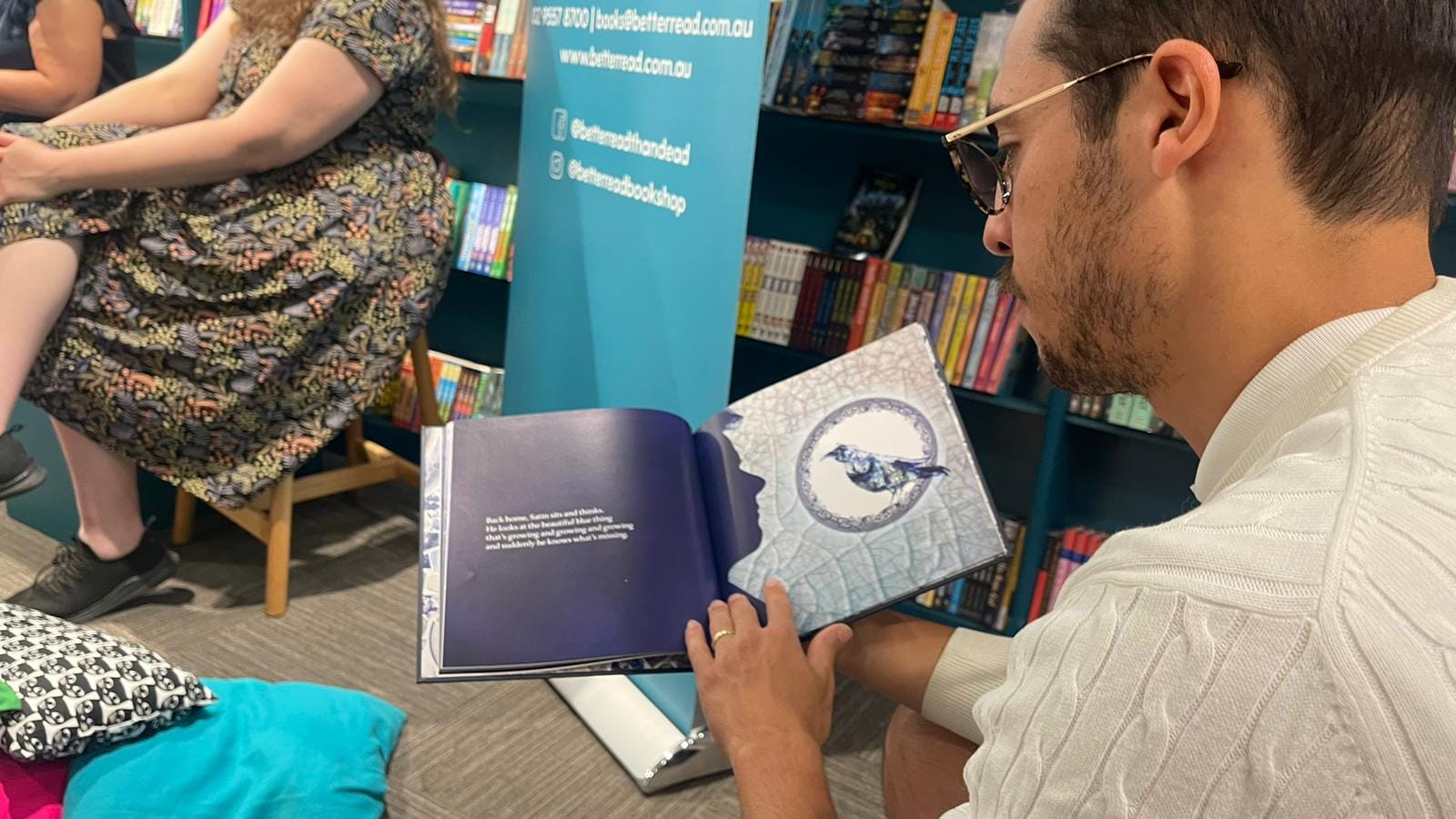
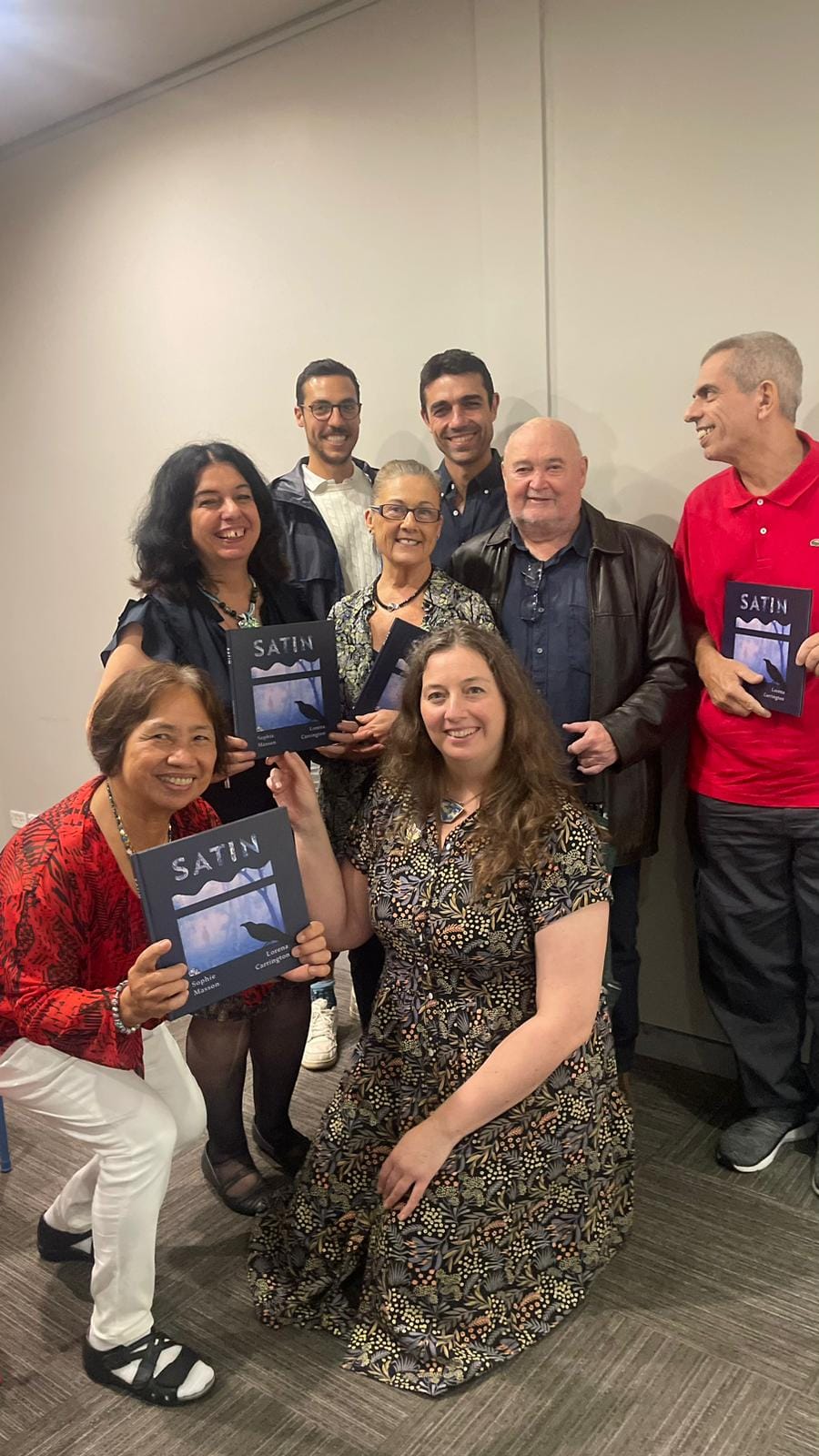
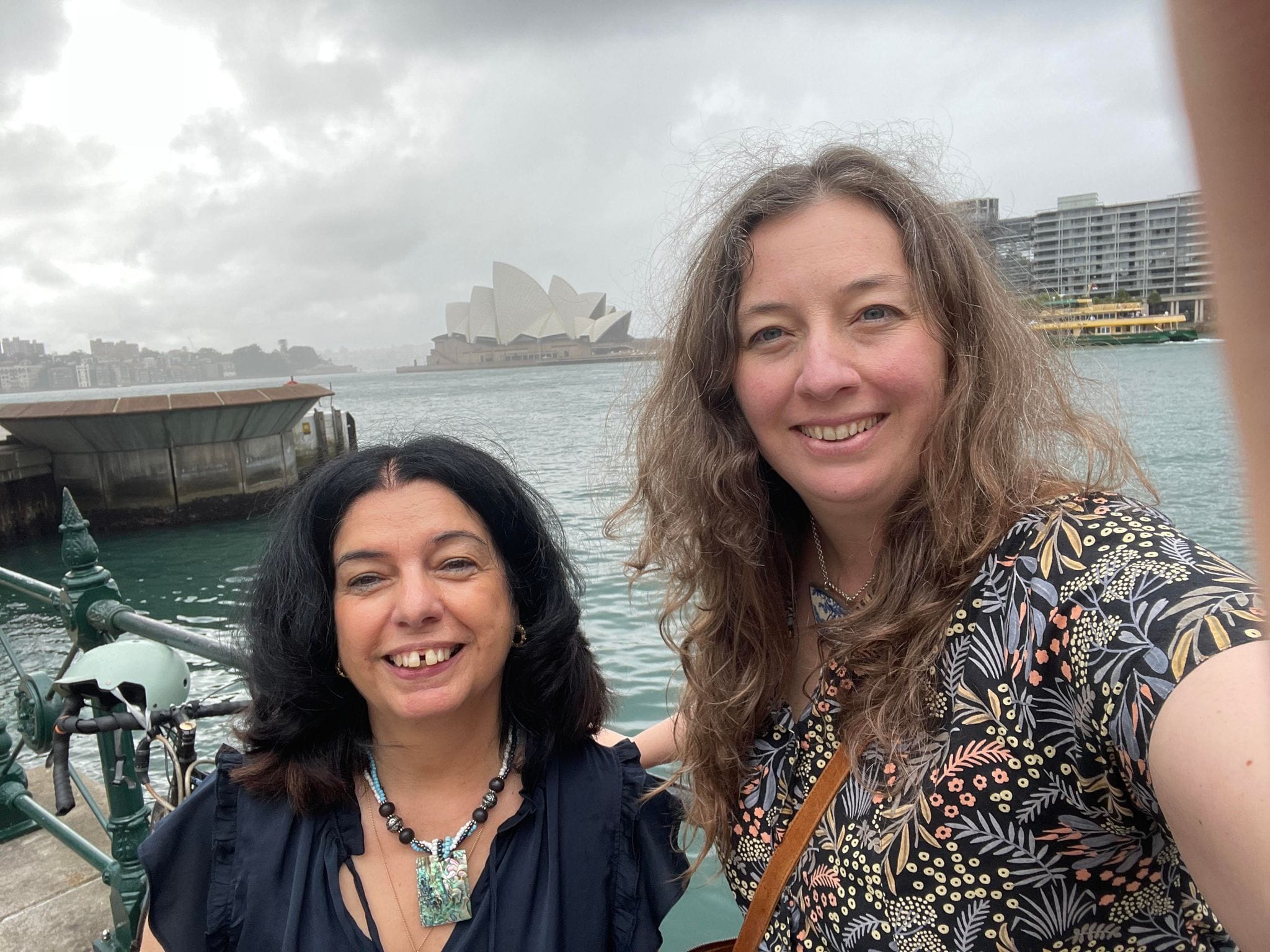
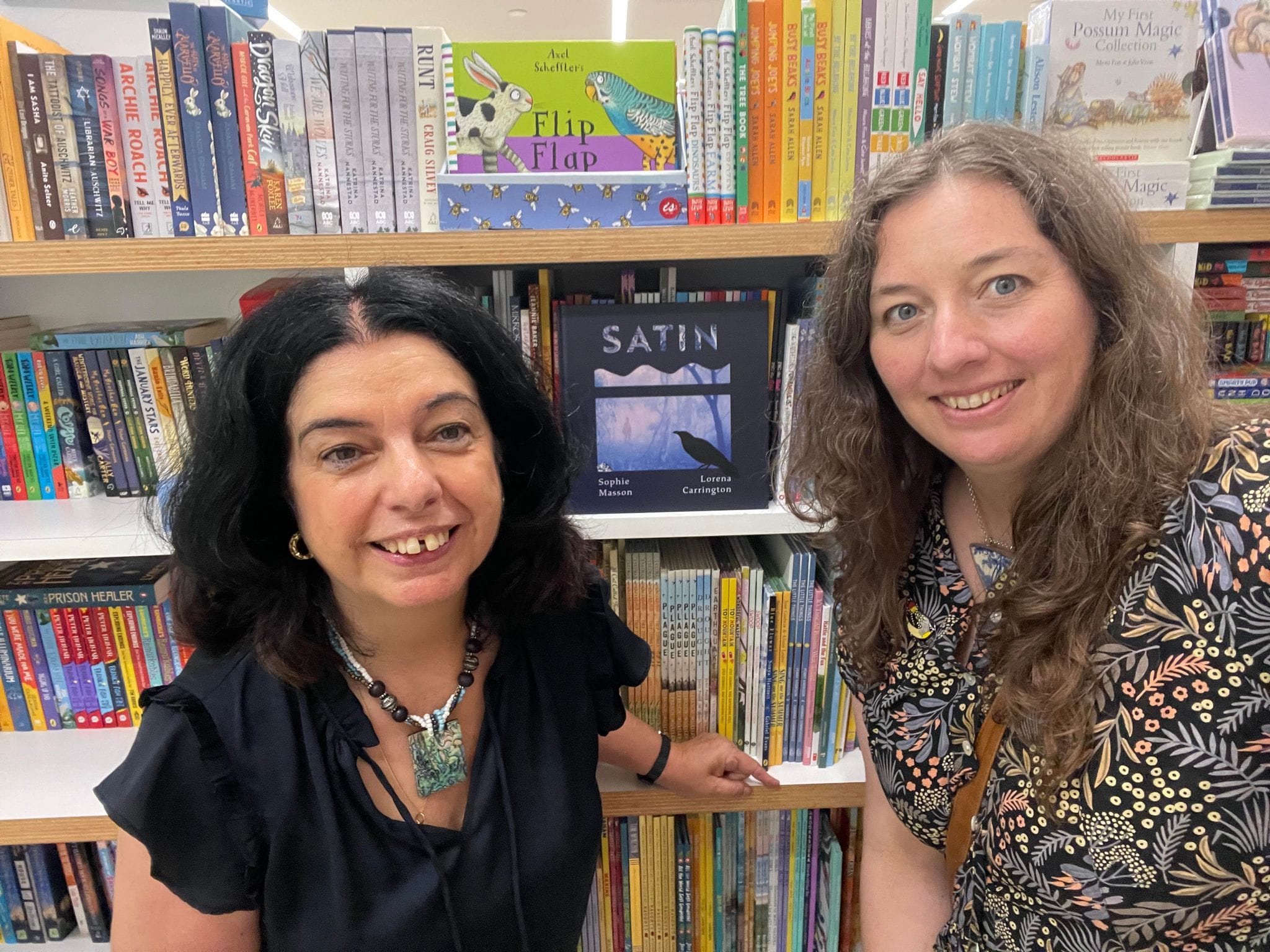
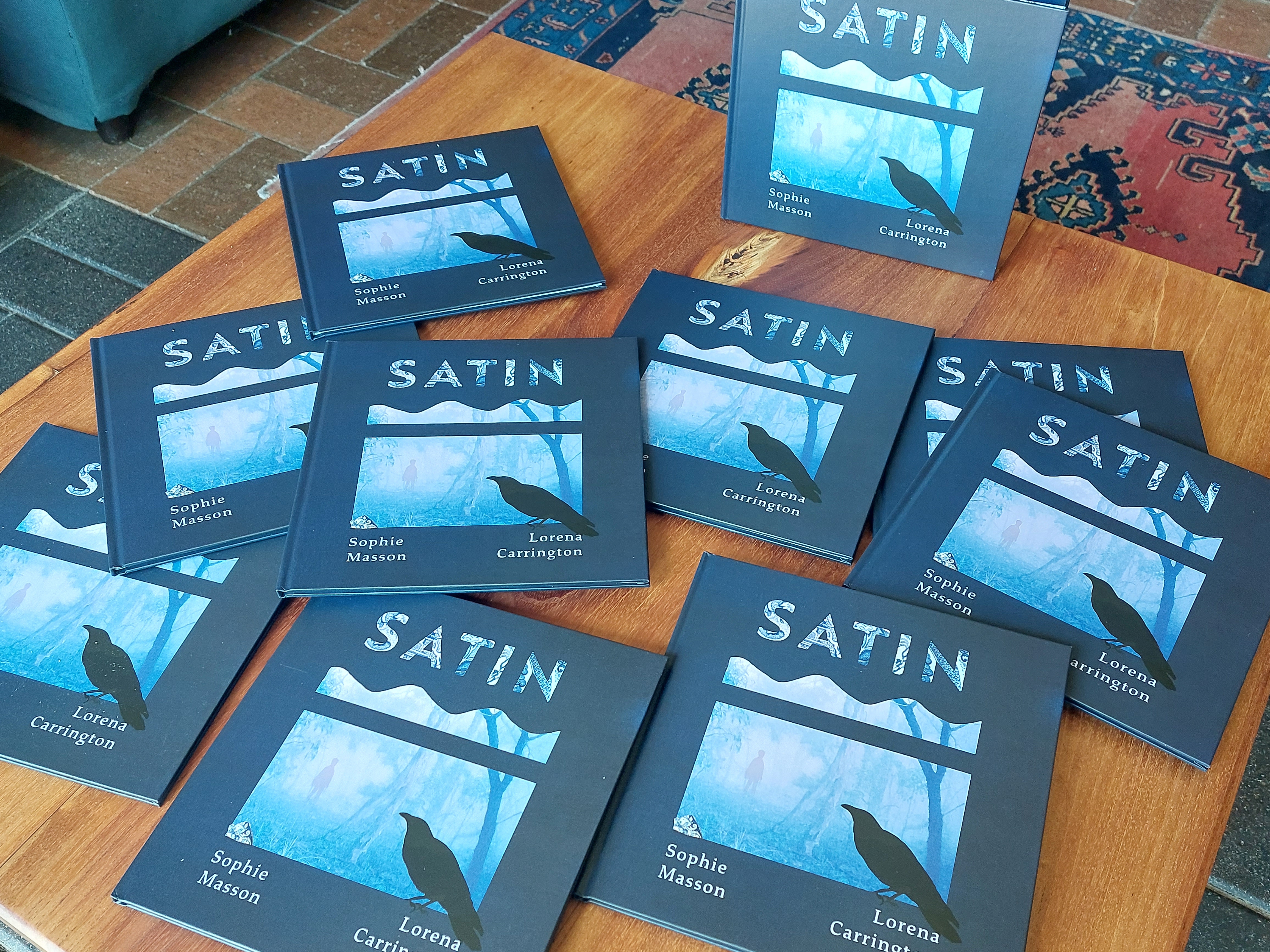
Last week was a real Satin week for Lorena and I, with the fabulous official launch in Sydney and bookshop and school visits. Didn’t have time to put up pics then (was having too much fun!), but here are a few now. Satin really had a most wonderful introduction to the world–may he fly ever higher!
Today is a special day: the official publication of Satin. Yes, the book is now out in the world and Lorena and I are celebrating–and looking forward to the official launch in Sydney on March 14 (all welcome! ) And to mark today, here’s a beautiful review we received only yesterday, from Sydney teacher-librarian Judy Rachwani:
This book is beyond breathtaking. An abundance of concepts that most probably every single person has dealt with or is dealing with can be seen, heard and felt within the deep meanings of the words and the incredible visual images that reflect those meanings. There are concepts of solidarity, loneliness, uniqueness, longing, accumulation of sadness, the importance of contribution and the beauty of the sweet human connection and more.
I truly am finding difficulties using words that give this author and illustrator justice to their in-depth, meaningful and intriguing artful work that has been reflected and processed within this work.
As a reader, this book moved me immensely and took me into the depths of feeling the ‘blues’ but in a very different way. As a teacher, I found it a great resource for the students (upper primary/highschool) to unlock and discuss emotions such as loneliness and longing for connection but also not being aware of that need to connect, the beauty of the connection, being unique and realising the importance of one’s uniqueness to the community around.
Highly recommended for wellbeing discussions, visual literacy and for story telling time too!
Thank you so much, Judy! We are so happy our book is already finding its way into readers’ hearts…
Thank you so much to our wonderful publisher, Anna Solding of MidnightSun Publishing, for loving and believing in this book from the start. And thank you to the wonderful MidnightSun Publishing team, and to everyone who has helped bring our very special Satin into the world.
In anticipation of both the official release of Satin on March 1, and its launch in Sydney on March 14, I’ve done a short video reading of the first few pages of the book. Hope you enjoy!
And if you’re in Sydney on Tuesday March 14, Lorena and I would love to see you at the launch, 4pm at the fabulous Better Read than Dead bookshop in Newtown. We’ll be reading and talking about the book and signing books of course too! Please register at this link(the launch is free, of course, but you can if you like also order the book prior to the launch). Hope to see you there!
In this lovely post, Lorena writes about how she created the stunning visual world of the book.
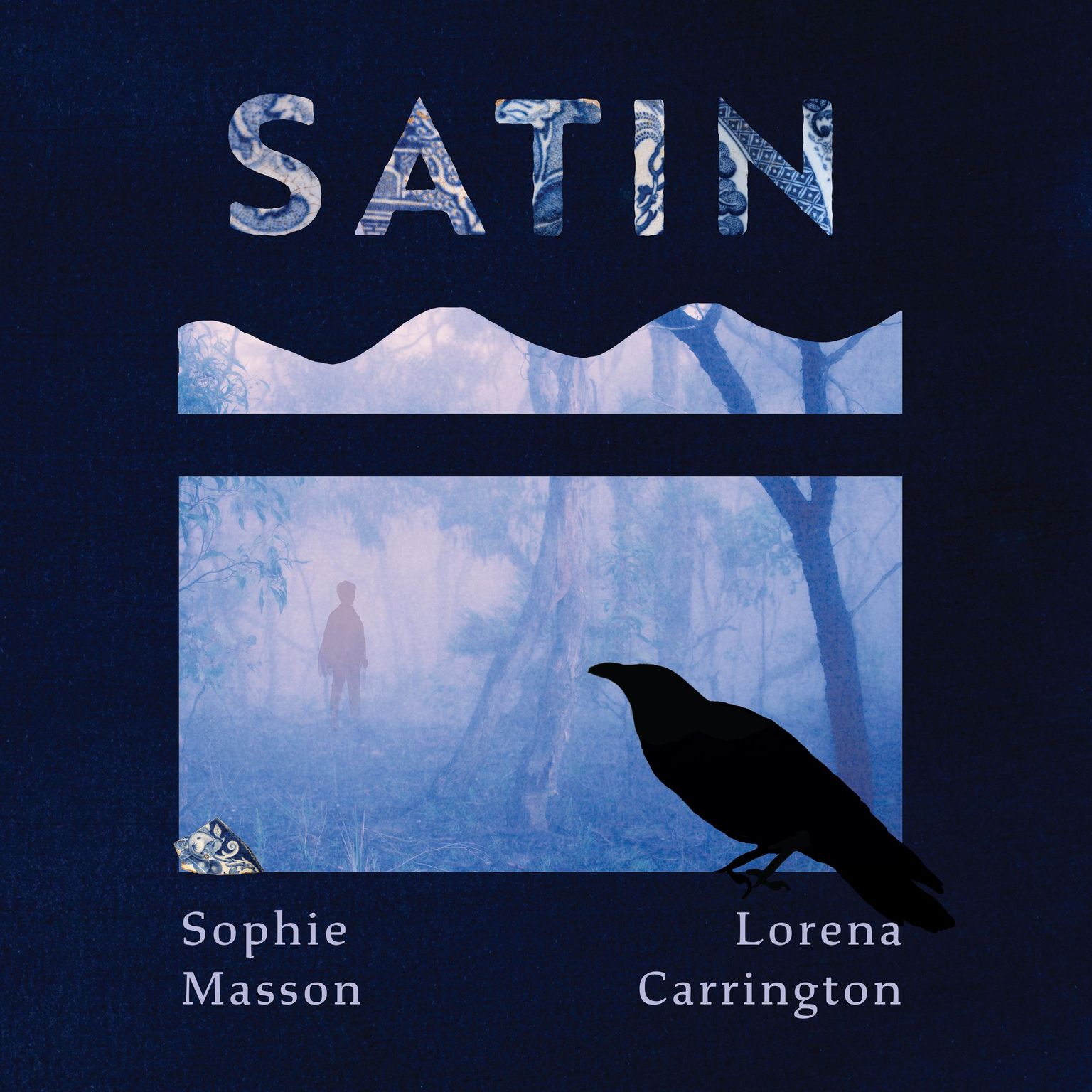
When Sophie asked if I was interested in working on Satin with her, she had barely finished her sentence before I said yes! I love working with her, and the story sounded so beautiful and intriguing. I also immediately had wonderful visions of all that blue… And it perfectly combined two things I’d worked with before. Some of my earliest montage work included shards of willow pattern plates, and I had also been doing a lot of work with cyanotypes, an early photographic process that has the most glorious blue emulsion. And the fact that Satin gathers objects to create his beautiful thing is exactly how I work too! It was perfect.
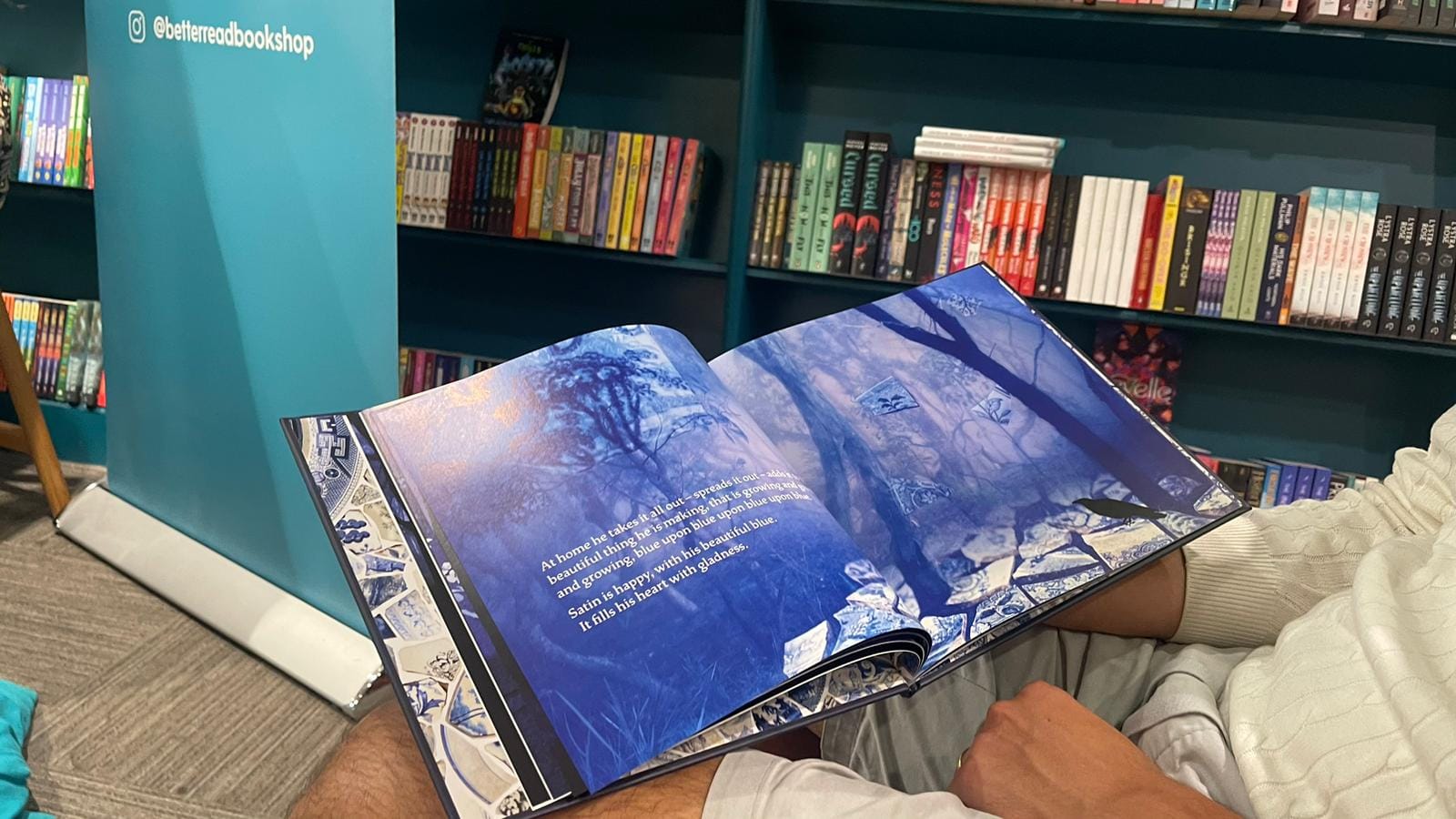
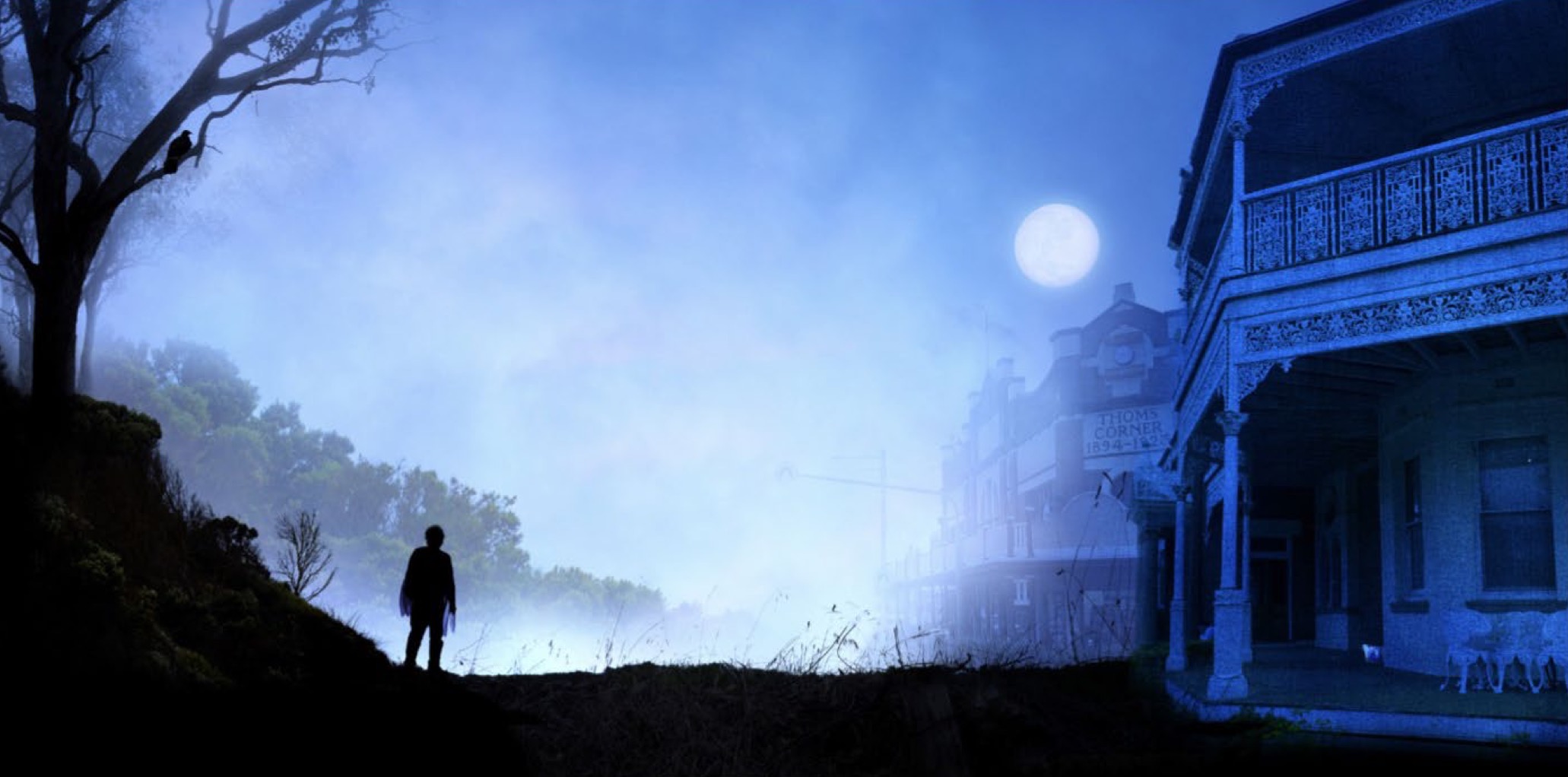
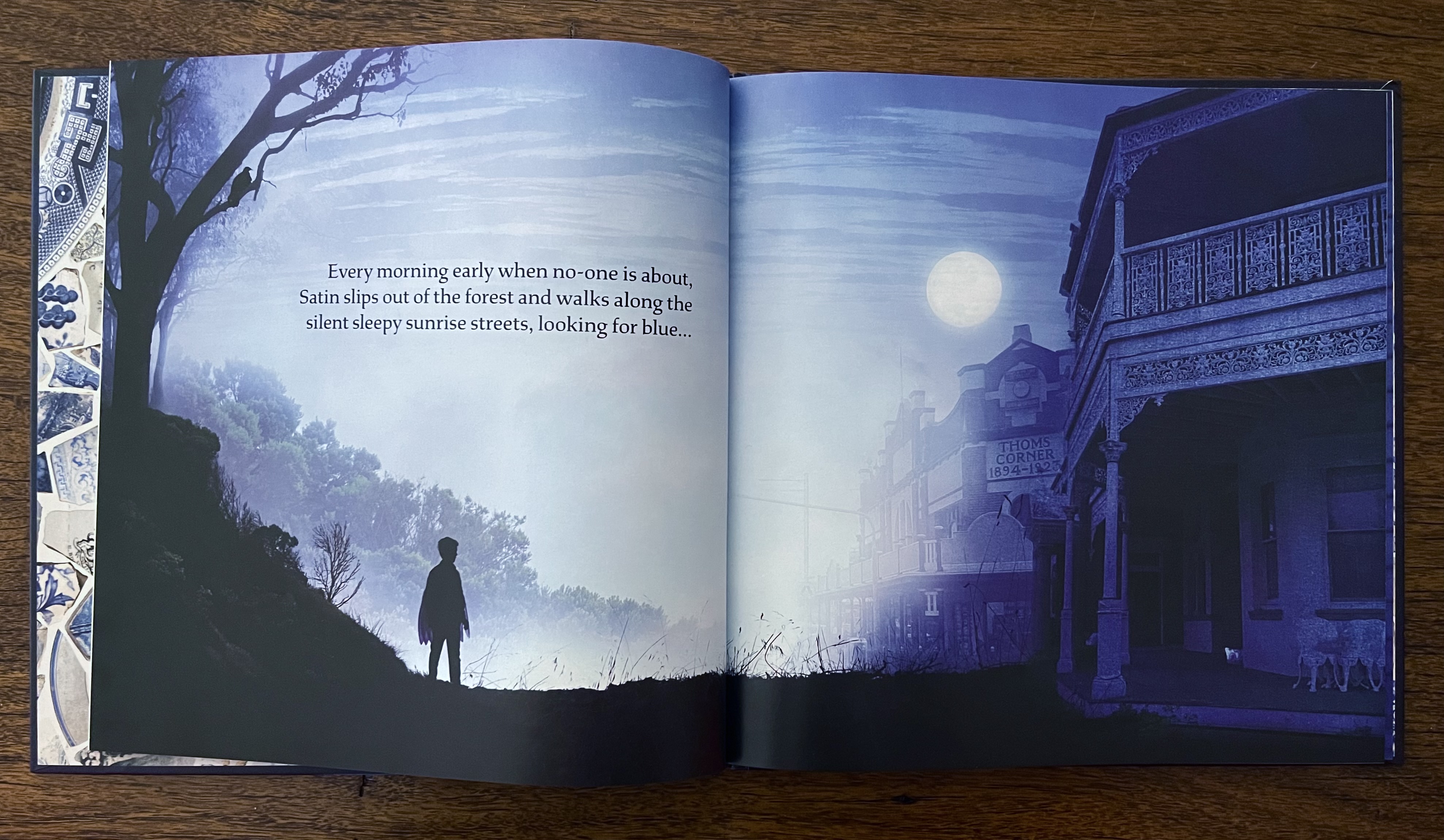
These are the first sample images I made for Satin, which we sent as part of our book proposal to the wonderful Anna at MidnightSun. They remain essentially unchanged in the final book, though you maybe be able to spot a few differences in the versions of the first image. As you can see, they are built up with layers of photographic images: the buildings, the silhouetted foreground landscape and figure, the bird, distant trees and the full moon against the misty sky… The pair underneath are more painterly. The elements are still photographic, but they are layered over a rich wash of painted cyanotype, giving a textured deep blue.
And here they are in the book:
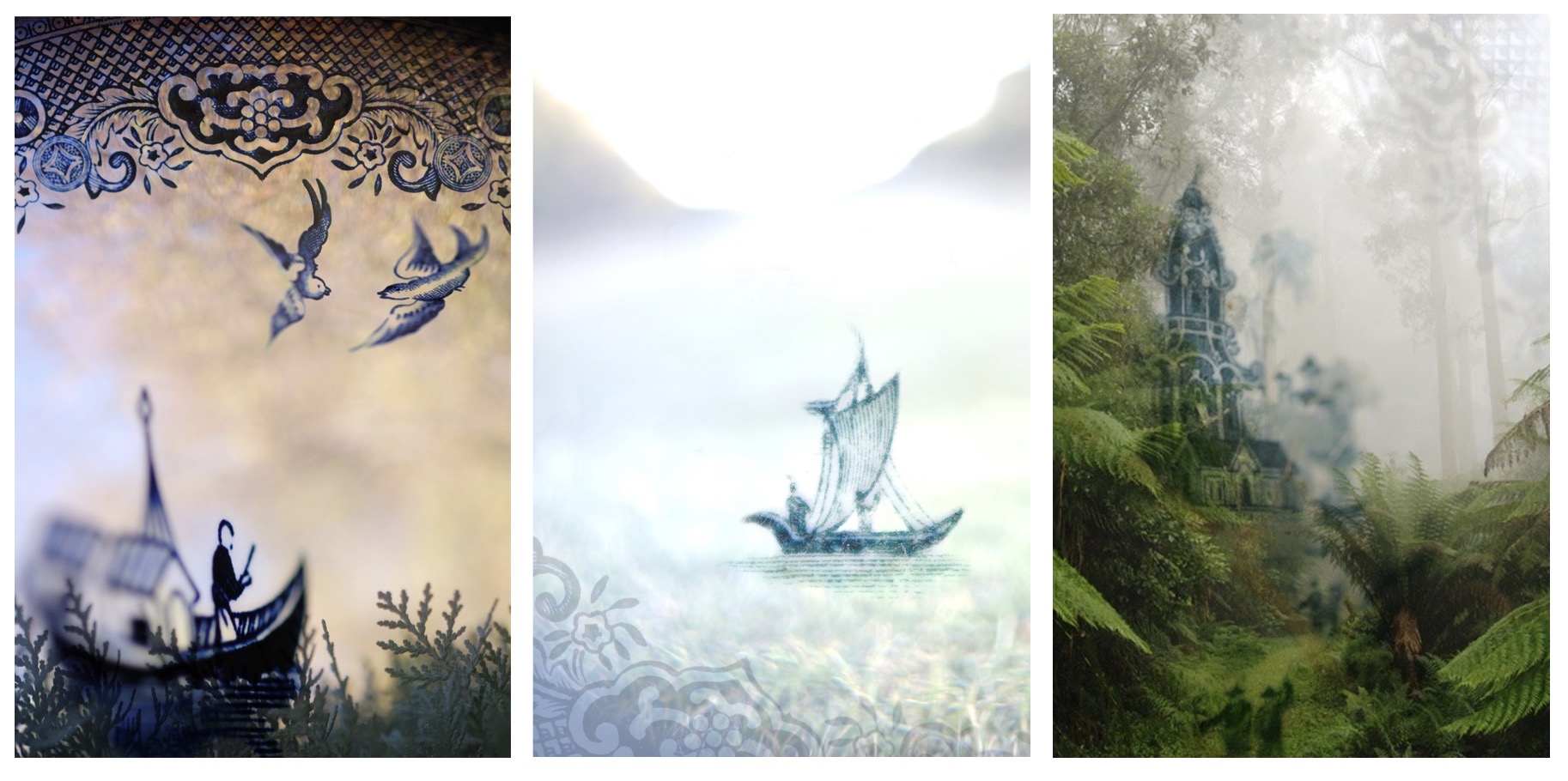
You’ll find many shards of blue china in Satin, many featuring the famous Willow pattern. Some of my earliest montage artworks were based around that same pattern. The images were made from shards of china I found in my backyard and the local landscape, and the landscapes themselves. Creating the illustrations for Satin felt like a delightful full-circle return to my early work. Here are three examples from around 2009.
The other slightly different element I’ve introduced to these illustrations, are splashes of painterly blue. The ‘paint’ is actually created with cyanotype chemistry, which is painted onto paper, and them exposed in the sun to create a rich blue. It’s wonderful cross between painting and photography, and lets you combine the two in wonderful ways. On this illustration spread, I’ve painted the splotches of blue, and digitally inserted the photographic elements.
I felt such an immediate affinity for Satin. He explores his surroundings, looking for interesting things, so that he can make something beautiful, which is exactly how I work, and Sophie’s extraordinarily beautiful prose made Satin such a pleasure to work on. I really hope you find inspiration and beauty in it too.
In just ten days or so, Satin, my picture book with Lorena Carrington, will be released by MidnightSun Publishing. And in anticipation of that, Lorena and I thought you might be interested to read about how the book came about, and what the process of creating it was like. Today, I’m talking about my side of it, how the text came into being, in one of those amazing, inspirational moments that are such a blessing in a writer’s life…
In May 2021, my husband David and I were travelling by car from our home in northern NSW on our way to attend the Bendigo Writers’ Festival in Victoria, a two-day journey from our place. It was somewhere on the road before we reached the town of West Wyalong that I suddenly glimpsed, on the side of the road, a bird with satiny, very dark blue plumage. Though I saw it for just an instant as we flashed past, I knew at once what it was—a male satin bowerbird. But what was it doing there, all by itself? Satin bowerbirds are shy, it’s not easy to see them, and they certainly don’t make a habit of hanging around near roads! I knew they like to collect blue things to decorate their nests: so had it spotted a special blue there?
In that moment, something else flashed into my mind, a title: Satin. I could see a character: a lonely young man, or was he a bird? Or both? Words began to flow onto my small travel notebook (I wasn’t driving of course!) By the time we reached West Wyalong where we were to stay overnight, I already had the glimmer of an idea for a special picture book text, and by the time we got to Bendigo the next day, that idea had firmed up.
When I met up with my friend Lorena Carrington in Bendigo, I excitedly told her about it. Lorena’s a wonderful illustrator and she and I had already worked on two books together, retellings of French fairy tales and medieval French Arthurian stories, and that had been a wonderful collaborative experience. I was very much hoping she might be interested in the idea of Satin—and to my delight, she was, at once! We started talking about how it might work: usually for a picture book you don’t have writer and illustrator together at the start, usually the writer sends in a text and the publisher then chooses the illustrator. But we just knew this book had to be with the two of us. And I had an idea who perhaps might be interested in such an unusual book…
After getting back home, I worked on the story, first in my bigger usual notebook, and then on the computer.
I then sent it to Lorena, who created some gorgeous sample illustrations. And then I contacted the wonderful Anna Solding at MidnightSun Publishing and told her about the book. She loved the idea and immediately wanted to see what we’d done. So we sent the text and the samples—and within a week, she got in touch. The MidnightSun Publishing team loved it and wanted to publish it. So exciting! And as we worked with the wonderful people at MidnightSun, and Satin’s world came to brilliant life in Lorena’s spellbindingly beautiful illustrations, I kept thinking of that moment when I unexpectedly glimpsed a shy blue-loving satiny bird by the side of the road. Pure magic, that’s what it felt like: and pure magic to see it developing into such a very beautiful, very special book.
Lorena Carrington and I will be celebrating the launch of our picture book, Satin (MidnightSun Publishing)in Sydney on Tuesday March 14, 4pm at the lovely Better Read than Dead bookshop in Newtown. Lorena and I are both coming in person from our respective homes-mine in regional NSW, Lorena’s in regional Victoria–for it, and we’ll be reading the book, talking about how we created it, and of course signing books!
Everyone very welcome, children and adults, you just need to register(it’s all free of course) so the bookshop can have an idea of numbers. Here’s the link, to register.
This piece of mine, about one of my favourite childhood books, was published in the wonderful books magazine, Slightly Foxed, in issue 18, in 2008. I know a lot of people share the same fond memory of Nicholas Stuart Gray’s gorgeous book, The Stone Cage(and his other lovely works) so thought I would republish it here, as a new year’s gift. Hope you enjoy!
Nicholas Stuart Gray
by Sophie Masson
first published in Slightly Foxed, issue 18, 2008.
If you were a bookworm as a child, your memories are measured not only in family or school or public events, but in stories you read. You remember vividly the smell, the touch, the sight of certain books. You clearly remember picking them up from the shelf—an ordinary act—and then the extraordinary happening, as you open the book and fall straight into another world. The pure pleasure of it, the immediate liberation. For me, who loved fairytales and fantasy, who longed to go through the looking-glass, the wardrobe, stepping through the borders into another world, where anything might happen, it was also a blessed escape from the confusing, disturbing and tumultuous family dramas that dominated my childhood. In those stories of other worlds, I found pleasure and consolation, transformation and possibility. And I found my own calling as a writer.
It can be dangerous revisiting those important, beloved stories, as an adult, for it’s not just a book that might be found wanting, but memory itself. And yet, when it works, when the barriers of time dissolve before the sheer magic of a real storyteller, it is probably the most thrilling experience a reader can have.
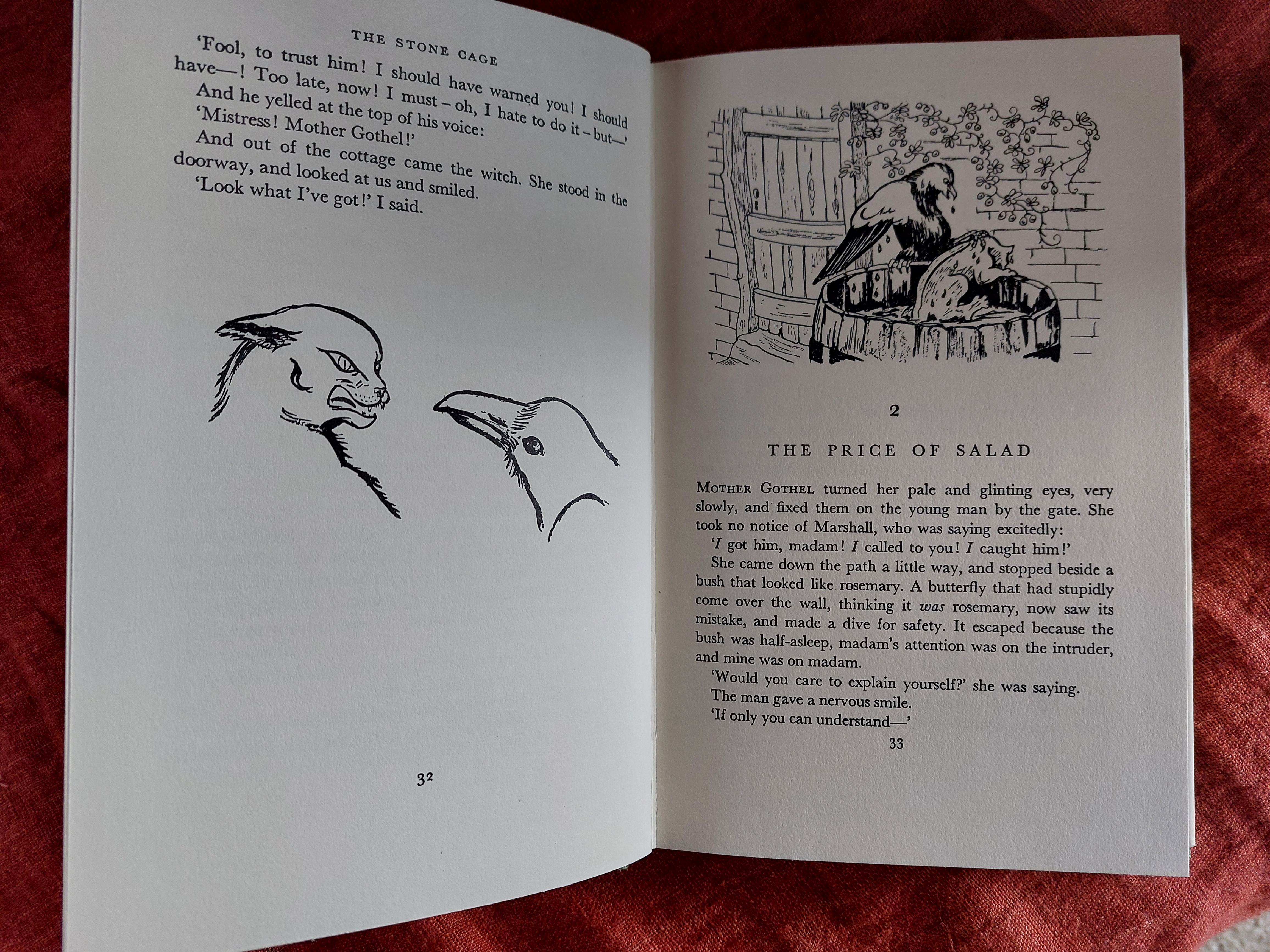
The Stone Cage, by Nicholas Stuart Gray, was one of those books that I remember clearly not only because they were so good to read, but because they were also so influential on me as a developing writer. Picking it up again after a gap of more than three decades was one of those magical moments that made me rediscover not only my childhood self, but also the reason why the book stands out in my memory. For from the very first sentence, you are plunged into a briskly unsentimental fairytale world, tartly guided by Tomlyn the witch’s cat:
Ever heard of a ‘dog’s life’? I’ll bet you have. Everyone has. Means a low, miserable kind of life. Full of kicks and curses, and nothing much to eat. I don’t know, I’m sure—what about a cat’s life, then? There’s not much said about that, is there? Nine lives, yes—but what sort of lives are these supposed to be? I’ll tell you the sort I had—a dog’s life.
I have to admit it isn’t every cat who lives with a witch, though.
And what a witch! Bad-tempered old —! No, it’s not fair to a cat or she-dog, to liken her to one of them. Let’s say she was a bad-tempered old beldam, and leave it at that. She hated people. She hated Marshall, her raven. She hated her bats and her toads. She hated me. Sometimes I think she even hated herself. A great old hater, was madam.
A naïve young stranger intrudes on this loveless, isolated mini-dictatorship, and is forced to pay a terrible price for his presumption, as he must give up his only child to the witch. And so the poor child is taken from her parents and put into a world where no-one trusts anyone else, love isn’t allowed to exist, and bitterness and cruelty reign. But all is not lost, for this is a very special child indeed, who will achieve an extraordinary miracle, greater than the greatest of spells, greater even than the most malevolent hatred.
As I read, I was swept along, just as in childhood, on the irresistible tide of a gripping story that for all its wit, humour, accessibility and clarity is also a compassionate, tender and complex evocation of the transforming power of love. But it’s certainly not all sweetness and light. Going way beyond a mere retelling of the fairytale of Rapunzel, on which it’s based, The Stone Cage reaches deep into the darkest, most painful aspects of life, as well as its most beautiful and joyous. In the way of the best children’s literature, it attains a profundity that’s all the more remarkable because of its sheer lucidity and unpretentiousness.
I finished The Stone Cage exactly as I’d done all those years ago: with tears in my eyes, and a thrilling heart, for the book also ends in one of the most perfectly judged, moving yet unsentimental scenes of its kind. Allied to my renewed love was a keenly increased admiration for the artistry of the author, which had easily stood the test of time. The characterisation is superb, the dialogue crisp, the pace good, the combination of light and dark subtly achieved. And the beauty of the style! Fluid, graceful, it is humble—in that it doesn’t draw attention to itself—and yet it’s fresh, distinctive, individual. The Stone Cage had been so important to me because everything in it worked. It was all so natural, so flowing, so multi-layered, its world richly imagined, yet delicately evoked. It was a real masterpiece, a novel just about perfect both in concept and execution, and timeless in its appeal, a novel that should have just as many young readers now as it did back then.
Aye, there’s the rub. For The Stone Cage is out of print, and has been for a long time. In fact, and rather astonishingly, in a culture like Britain’s that generally does value its children’s literature, all of Nicholas Stuart Gray’s books are presently out of print. Beautiful, original and accessible though The Stone Cage, Mainly in Moonlight, Grimbold’s Other World, Down in the Cellar, The Seventh Swan, and his other works are, they are unobtainable except through second-hand shops and the Internet, although some are still in libraries. It’s not as if modern children don’t like them, or don’t understand them, either; I know of lots of young readers who, introduced to Gray’s books by their parents, have loved them just as much, and have found them just as easy to read. It’s not as if there’s anything dated or offensive in them, no obvious or hidden misogyny or racism or class stuff or anything like that. There is nothing really to properly explain this puzzling situation, other than that they’ve simply been overlooked.
And yet, Gray’s work has deeply influenced many of today’s writers working in the fields of children’s literature and of fantasy—Garth Nix and Neil Gaiman and Cecila Dart-Thornton, for instance. I’m certainly not the only reader-turned-writer to remember Gray’s books with great love and respect. Australian children’s novelist Cassandra Golds, author of the acclaimed Clair de Lune, wrote to me about the huge impact on her of one of Gray’s books, Down in the Cellar :’I will never forget the Sunday afternoon on which I finished reading it. I remember feeling a kind of mysterious desolation, partly because I’d finished reading it and would never be able to read it for the first time again, but partly also because I KNEW I had now read the best book I was ever going to read. And I felt, then and still, that the only possible response to that experience was to become a children’s author myself.’ As an eighteen year old, Cassandra had written the author a fan letter, and she still treasures his modest, graceful reply, in which he said, amongst other things: ‘As all my books and plays are only written for myself and not for any imagined audiences, readers, age-groups, publishers, etc, it is always a delightful surprise to get proof that anyone BUT myself ever reads or sees them..’
Perhaps that answer gives a clue as to why Gray’s work is not recognised as it should be. This was not a man who blew his own trumpet, not a writer who sought publicity, but one who loved his work and felt privileged to be doing it, and who was too humble to thrust himself forward. Who was perhaps also at heart a rather private, reserved, even secretive person, despite his long association with theatre, which many people would consider the home of trumpet-blowing, egotistical extroverts. Certainly, when I went to research his life, I found precious little information.
Nicholas Stuart Gray was a Highland Scot, born in 1922, the eldest of four children. As a child, he wrote stories and plays for his siblings. Not one to bend easily to the routines of school, he left at the age of fifteen, to become an actor. He kept writing as well, and his first play was produced two years later. His first children’s play to be published was Beauty and the Beast(1951), and from then, he wrote and produced a good many plays for children, before turning his hand to novels and short stories(where I think his true gifts flowered). Some of his novels, like The Stone Cage (1963), he also adapted for the stage: he told Cassandra Golds that he himself played Tomlyn in the play’s premiere at the Edinburgh Festival and its subsequent successful seasons in London and on tour. (That would have been something to see! ) He never married or had children. His plays fell out of fashion, but his novels and short stories continued to be published until his untimely death from cancer in 1980, and right into the late 80’s, we were still seeing frequent reprintings of his books.
But in the last fifteen years or so, there have been no more new editions. In this new Golden Age of children’s literature, it’s more than time to bring his books back so that a whole new generation can fall under their spell. Any publishers out there listening?
As a present-day coda to the end of my piece: as I mentioned in the article, second-hand copies of The Stone Cage are not easy to track down–and I’m certainly hanging onto my own beautiful hardcover copy, found by chance in a secondhand bookshop in Oxford some years ago . So it always astonished me that The Stone Cage hasn’t been republished, but when, five years ago, on behalf of the little publishing house I’m involved in, I made enquiries as to who might own the rights, it appeared that no-one was actually sure what had happened to them. Gray had no direct descendants, though he did have extended family, but a letter to an address I was kindly given by the ALCS (Authors’ Licensing and Collecting Society) in the UK went unanswered.
The French Christmas cake, or Bûche de Noël (Christmas log) is a delicious cake, normally consisting of a Swiss roll-type sponge cake, filled with coffee, chestnut or chocolate butter cream and covered with the same cream, then decorated to look like a log, with extra little decorations on top. But in my childhood, my mother invented a new and equally delicious version of it, which was eminently suitable for an Australian summer Christmas. It’s super easy, doesn’t heat the house up–because no baking required at all!–and can be made Christmas Eve. I make it every year. It’s always popular!
I’ve published this recipe before, but not for a while, so here it is again, Maman’s Bûche de Noël.
Ingredients:
1 packet sponge finger biscuits
200 g unsalted butter, melted
1 or 2 eggs(depending on how much mixture you have)
half to 3/4 cup hot strong sweet coffee(a good instant coffee works fine)
Good cooking chocolate, melted with a little cream.
Crush all the biscuits (you can do this in the blender), add the hot sweet coffee, the melted butter, and mix well. Add the slightly beaten egg(or two). You need to obtain a good stiff mix that you can easily shape into a log. That’s what you do then–shape it into a log, and then put it in fridge till it is set. Meanwhile melt the chocolate over a low heat with a little cream, stir till all melted and glossy. Spread over the cake, on the top and sides. Put in fridge to set overnight. You can decorate the top with angelica leaves, almonds, rose petals, candied flowers, whatever you feel like! (Picture above is of one I made a couple of Christmasses ago)
The print edition of A Hundred Words for Butterfly is now available through any bookshop, across Australia! Returning from my big five-week trip to Europe–including to the Basque country–I was delighted to receive copies from my lovely publisher, Bronwyn Mehan of Spineless Wonders, and to meet in person with her and SW team members Camilla Cripps and Bettina Kaiser, on a beautiful sunny day in Sydney!
My new historical novel for children, Sydney under Attack, comes out in early March(Scholastic Australia) and in anticipation I’ve made a little trailer for the book–hope you enjoy!












 Feathers of the Firebird