Interview with Jana Hunter, author of Sleepy Meadows

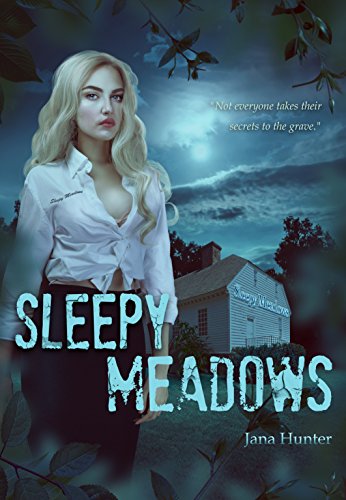
 Today, I’m very pleased to bring you an interview with new author Jana Hunter, whose first novel, Sleepy Meadows, has just been released as a Kindle ebook. Sleepy Meadows is an unusual fantasy/mystery novel, centred on young necromancer Kylie McGovern, who is working in her late father’s funeral home, Sleepy Meadows, in an Australian country town. As the blurb describes, her life is simple and quiet which is just how she likes it, but all that changes when her boss, the seemingly respectable Uncle Bob, goes missing and a murder victim is found in the crematorium. Drawn into a web of inter-generational revenge and family secrets, Kylie’s own life begins to unravel as she works desperately to find out where Uncle Bob is and clear her own name. Though she has been raised to believe her power is an evil to be suppressed, as the bodies begin to mount up, it seems that only her skill as a necromancer will save Kylie from taking the fall….
First of all, Jana, congratulations on the release of Sleepy Meadows! Exciting times for you! Tell us about how the idea came to you.  
Thank you so much, I’m very proud of the way it turned out. I’ve always loved reading Urban Fantasy, it’s such an underrated genre, but most of what I read was set in the US or Britain, so I thought there was room for an Australian take on it. Also, I think country towns are rich with the potential for uncanny happenings; there are so many odd stories that you hear and it just seems to have more magical potential. In fact, the idea for Sleepy Meadows came to me while I was staying with my grandma on her farm. There was a catalogue on her table for a local funeral parlour featuring two creepy looking middle-aged men smiling woodenly in black suits, and it got me wondering about that profession, and why there seem to be so few young, female undertakers. And it made total sense to me that a funeral home would be the perfect place for a closet Necromancer to work.
Sleepy Meadows has a most unusual setting, in a funeral home( though it’s an inspired choice for a necromancer like your main character Kylie McGovern!) Was it based on a real place and did you have to research much?
Sleepy Meadows is not based on any particular funeral home, that is pure fantasy, but I did do a fair bit of research into rural funeral homes and the embalming process etc. That said, I have to admit that I took poetic licence in a few spots.
How did you go about creating Kylie and the other characters in your book? Which were your favourites, and which most challenging, in terms of creative process?
The characters evolved organically, which is something I love about writing – they surprise you, they take on a life of their own. Funnily enough, the murderer was not who I originally planned, and I had some trouble abandoning my intended villain for someone who was supposed to just be a sideline character, but I’m glad it worked out the way it did. I also had some feedback from early readers that my protagonist Kylie was too morally-grey and she needed to be sweetened-up a bit. But I’m glad I left her as she is: “Creepy and quiet, and a little morally-challenged”.
What’s been the reaction from readers so far?
So far the response has been really positive, which is a relief.
What’s next? Are you planning any more books featuring Kylie? Or will you be writing something completely different next time? 
Sleepy Meadows is the first in a series, so I am working on the sequel now, as well as a different, more traditional portal-fantasy novel.
What are your top tips for new and aspiring writers?
My top tips for any aspiring writer is to read widely and to be consistent with your writing practice. Little by little becomes a lot.
Jana Hunter lives in Armidale NSW, where she can usually be found in a coffee shop, writing. You can find her on instagram at: https://www.instagram.com/janahunterauthor/
You can buy the book here.

Fiction, prediction and diversity: an interview with Hazel Edwards

Today I’m very pleased to interview popular author Hazel Edwards about her new book for adult readers, Celebrant Sleuth, set in a country town and centred around the character of Quinn, an unusual woman who lives in a romantic but non-sexual relationship with her partner Art, and who as well as being a celebrant in great demand at weddings, funerals and other life rituals, also has a knack for solving mysteries of all sorts.

Hazel, how did the idea for ‘Celebrant Sleuth’ first come about? 

I’d observed celebrants in action at Australian weddings, name-days and funerals. Most are very personable.

They are problem-solvers. They have to handle dramatic situations with difficult people and heightened tension. Apt words in emotive ceremonies are their business.

The role seemed versatile enough for a sleuth character who needed to move into different settings and cultures to solve mysteries. For diverse age groups too.

Like many others, our family is spread across generations and cultures and friends are re-committing, divorcing or blending.

So I’d been to a few celebrations, commitments and an increasing number of funerals.

That seemed like a good starting point to research the role of celebrant. As a believer in participant-observation, I considered qualifying as a celebrant by doing the course, but then decided it was more effective to interview the experts.

In early 2016, well before the Same Sex Marriage law debates, I moved into serious interviewing.  More than twenty-five celebrants on phone or Skype or in person. But it wasn’t all serious, most celebrants had a sense of humour, which was vital because I was collecting anecdotes for my mystery plots.  I needed the absurd inbetween the tragic and the romantic.

Most fictional detectives have a ‘backstory’ but Quinn, the celebrant/detective in Celebrant Sleuth, has a most unusual one. Can you tell us how you came to create her, including any research you had to do? 

 Usually I create a detailed dossier for each of my characters. Quinn required a bit more research because I needed to get the gender vocabulary right as well as find out about the job of celebrant.

Earlier, I’d been invited to various literary festivals in connection with our co-written trans YA novel ‘f2m;the boy within’ (2010).

On a panel, I met an extremely articulate and thoughtful asexual in her early thirties, who challenged me to write about her gender circumstances. She was NOT a celebrant.  She was a park ranger. But the idea of juxtaposing a romantic personality in a longterm relationship within the character of a celebrant who had a job involving romance interested me.  ‘I prefer icecream to sex’ was one of her very quotable comments to me, as she explained the differences between being asexual  (feeling no sexual attraction to any gender) and being a ‘romantic’ desiring and giving affection which is different from being aromantic.

She became one of my ‘expert’ readers.  Along with the celebrants, actors, caterers, lawyers, mothers-in-law, actors and photographers I interviewed. And the multiple florists in fabulously perfumed shops.  The only problem was fictional time. Everything needed to happen in under an hour, just like in a wedding or funeral.

But it’s taken about 2 years to write in ‘real time’, between 6 am and 8 am daily. My brain was clear then and could cope with plotting clues. The mysteries are episodic, with celebrant Quinn solving problems in settings including the football hall of fame, retirement village chapel and a few inter-relationships of florist, caterer and media in the country township during an economic downturn. Millionaire retirement village owner, eighty-something Flora is feisty and falls for a younger man. I had to create a whole ‘fictitious’ township of intersecting roles. And get the street geography right.

There are several stories in Celebrant Sleuth: cases ranging from murder to theft to missing wills. Did you write them in sequence or not?

 No. I didn’t write in sequence.

The tight opening, Introducing Quinn, was written last as the viewpoint was always a challenge.  Initially I imagined a kind of voice- over which could adapt for television, but also the issue of asexual gender had to be explained indirectly for a mainstream audience but was not the central theme of the book. First person enabled less use of pronouns

I wrote each chapter as a separate ceremony with a problem or crime solved by Quinn the sleuth. But I didn’t want a murder per chapter. That seemed Agatha-Christie-ish, depopulating one small country town. The settings were a challenge because I needed to create a country town, small enough for the characters to bump into each other via their other roles like caterer or florist.

I tried to vary the mood and pace of the chapters and the type of ceremony, not all were weddings. And I had to check the facts about types of death… and set up the circumstances and motives. After trialling them with my test readers.

‘Celebrant’ is an Australian term and often confused with ‘celibate’ or ‘psyche’ or ‘Celebrity’ so I had qualms using it for the title.

Amused that my publisher BookPOD has used the meta tag Clean crime to describe ‘Celebrant Sleuth’.

‘I do…or die’…was the last minute subtitle to include all circumstances.

What has been the reaction of readers?

Really positive.  Celebrants are thrilled with their job being featured.  Diverse gender groups are delighted to have an asexual hero. Others like the small town mystery.

My expert test readers picked me up on a few technicalities. ACE as the name of Quinn’s partner was inappropriate as it is a term used by asexual groups. Pure coincidence I used that name as I was trying to give alphabetical and simple names to characters.  Ace became Art. Coronial and forensic pathology procedures.  Legal stuff.  Uniformity of retirement village streetfronts and use of ramps.  Youngest legal age of bride.

But the greatest legal challenge has been the Same Sex Marriage laws changing the terminology in my commitment chapter. Last minute updates.  So far I haven’t been accused of being politically opportunistic in using such a topical gender situation. The reality is I started writing two years ago. It was serendipitous topicality which had the law being changed on the day I was checking the galleys and had to change clues since wedding services differ from commitment in the legal wording and papers, but there will still be people who choose to commit rather than marry.

The cover has ambiguous and symbolic silhouettes and that was deliberate. Designer Lee Burgemeestre is multi talented and is also a celebrant so she brought an experienced eye.

My favourite anecdote relates to lost rings and metal detectors on the beach. Closely followed by dogs as Best Man.  And the professional afternoon- tea eaters who turn up as rent-a-crowd for the scones, raspberry jam and clotted cream provided by one funeral parlour, even if they didn’t know the deceased.

Some readers are intrigued by the blurb.

‘I buried my father, married my sister and sorted the missing will.’

Quinn, a celebrant with style and a few obsessions but a good heart, solves quirky problems, mysteries and the occasional murder at weddings, funerals and naming ceremonies in her country town.

Ex-actor with a great voice who writes eulogies to die for! Not forgetting a few quotable ‘Quinn’s Laws of Relativity’. A romantic, but asexual, Quinn lives with her long term partner Art who runs community Channel Zero.

The workstyle of a celebrant is never routine. Fake I.D. Fraud. Fights, even to the death, over wills and inheritance … Mislaid rings. Lost bride. Food poisoning.   Clients of varied ages and cultures are well looked after. Even vintage millionairess Flora with the much younger lover who might be a con-artist.

Quinn solves most problems but not always in the expected way

Why have you included Quinn’s Theories of Relativity at the end?

To characterize Quinn as many celebrants do write their original material.

Most people only know Albert Einstein from t-shirt quotes, but …

I admit I occasionally adapt his ‘Theory of….’quotes for funerals or weddings. Not really plagiarism because I always mention Einstein, just an updated tribute to the most significant science philosopher (in my opinion). One of my heroes and gives a bit of gravitas to a service.

Quinn’s Theory of Relativity

The likelihood of the relationship ending in divorce is directly related to the number of arguments during rehearsals, obsessive preparation and the bride’s budget on self.

My favourite is: Quinn’s Theory of Funeral Secrets

‘At a funeral, we acknowledge the life of the person and maybe the many identities, actions and secret lives of which the family and friends were unaware. For some a shock, for others a relief.’

 Are you planning any more ‘Celebrant Sleuth’ stories?

Yes.  But only if optioned for television. I’m realistic about the number of options which are never made.

Currently there is a great demand for celebrants to perform weddings for same-sex couples who previously had commitment services or who had married under the laws of elsewhere.  But the demand for commitments, re-commitments, funerals and naming ceremonies will continue.


Celebrant Sleuth by Hazel Edwards is published by Bookpod and is available through all good bookstores. Formats: paperback and ebook.
 

2017 Book Discovery 8: Elisabeth Storrs’ pick

In the latest of the book discovery posts, Elisabeth Storrs writes about her pick.

The Summons, by David Whish-Wilson, is far from light summer reading but my 2017 discovery of this dark and compelling tale provided me with a potent insight into the Nazis’ obsession into the occult. Set in 1934 Berlin, the story traces the impact on WW1 veteran, Dr Paul Mobius, when he is summoned by the SS to join Himmler’s Special Witch Work Unit. At the same time he becomes embroiled in another Nazi scheme which threatens the safety of his charge, the young simple-minded Carl.

Mobius is a fragile character, tormented by the horrors of the Great War, who nevertheless shows nerve enough to defy ‘the summons’ and escape with Carl to the country. Here, with his newly found love, Monika, the historian finds the promise of happiness. However, the tentacles of Nazi eugenic philosophy have already infiltrated the psyche of the rural community. Mobius must stay true to his own beliefs, and muster both physical and moral courage, as he is inexorably drawn to Wewelsburg Castle, the headquarters of bizarre and brutal SS experiments.

Whish-Wilson’s writing is superb, relaying both gentle humour, deep pathos and increasing menace. Ordinary Germans are depicted in the early stages of the sinister spread of Nazi doctrine and yet their lives are also portrayed as mundane and relatable.

I was drawn to the novel because I am researching the distortion of history by another of Himmler’s think-tanks to justify Lebensraum. The plight of a museum curator faced with making a Faustian Bargain is central to my own WIP set in WW2 Berlin and Russia. Whish-Wilson’s book sets a high bar. It is simultaneously touching and disturbing; an exploration of a troubled soul, growing doom, and an unexpected love for an unconventional woman and a threatened child-like youth. Pitched to prescient readers, the power of the novel is in us knowing the fate awaiting each.


Elisabeth Storrs has long had a passion for the history, myths and legends of the ancient world. She graduated from University of Sydney in Arts Law, having studied Classics. Her curiosity piqued by an Etruscan sarcophagus depicting a couple embracing for eternity, she discovered the little known story of the struggle between Etruscan Veii and Republican Rome and the inspiration to write the Tales of Ancient Rome Saga. She is also the co-founder of the Historical Novel Society Australasia. She is now hurtling centuries forward to write Treasured, a novel which tells the story of stolen loot, crazy Nazi archaeology, and the lost Trojan gold.

2017 Book Discovery 7: Jean Kent’s pick

Jean Kent writes about her 2017 book discovery today.

The Little Prince, by Antoine de Saint-Exupery, is my rediscovered gem for 2017.  For some time this book has been near the top of the tottering pile beside my bed, waiting for that mysterious moment that the best books have, when it would become just the right one for me to reach for.

I love the gentle wisdom and wit of this story of a pilot who has had to land his damaged plane in the desert and his encounter with a ‘little prince’ who has also fallen from the sky – from a very small asteroid, where he usually lives alone, with one rose for company and the possibility of watching forty-four sunsets in one day for consolation.

Although it has the lovely, simple clarity of a children’s story, there is so much poignant adult experience here as well.  I wasn’t very far into the book when I came across a friend whose wife had recently died, sitting beside Lake Macquarie, taking a photo of the sunset.  Every day, he said, he did this now.  I went home, read a little further and found the little prince saying: ‘You know, when a person is very, very sad, they like sunsets.’

This edition also has all the qualities that make a printed book more special to me than a digital version.  It is just slightly larger than my hand, which makes it a pleasure to hold.  The paper is silky and white, and the print and line drawings are so crisp it is as if the ink has just dried.  The cover, too, with its delicate painting of the wistful, golden-haired boy-prince, is irresistible.

I bought my copy at the Red Wheelbarrow bookshop in the Marais, Paris.  So even though this is an English translation, that connection immediately makes me feel as though I’m partly in France while I’m reading.  Which, of course, adds to the joy …


Jean Kent has published eight books of poetry.  Her most recent book is Paris in my Pocket (Pitt Street Poetry), a selection of poems written during a residency at the Literature Board’s Keesing Studio, Paris.  She lives at Lake Macquarie, NSW.  She also posts poems and occasional Jottings at http://jeankent.net/

2017 Book Discovery 6: Sandy Fussell’s pick

Sandy Fussell tells us about her 2017 book discovery today.

My 2017 Discovery Book is The Choke by Sofie Laguna, although to be honest, it’s more of a discovery trail that began in 2009 when I spotted the cover for One Foot Wrong in a bookstore. I read the blurb and was hooked.

A few years later, I read The Eye of the Sheep in August, and even though there were still four months of the year to go, I told everyone, even Facebook, that it was my favourite book for 2014. When it won the Miles Franklin the following year, I smiled a lot and said, “I told you so” whenever I thought I could get away with it.

Even though I write for children, I’d never read any of Sofie’s children’s books. So, I began to search backwards. There were lots of discoveries then. I was lucky to discover a copy of the out-of-print picture book Stephen’s Music, in a Canberra second-hand bookstore. It’s another favourite. Sofie has a magical way with words. For me words have always been a form of music. In Year 6, I asked for The Complete Works of Shakespeare for my birthday. Not because I was smart, in fact, I didn’t understand much of it at all. I just liked the music the words made when I read them aloud. That’s was Sofie does when she writes. She makes word music.

But back to 2017. As a reviewer, I received an advance copy of The Choke. It sat on my desk for a while because I wanted the luxury of reading it in one sitting. Most of my reading is very fractured, wedged into slivers of time in between things I’d rather not be doing.

For Book Week, I had a school visit that involved two-and-a-half hours train travel each way. I don’t mind that. It’s not travel time, it’s reading time. I read The Choke, all the way from the South Coast to Hawkesbury River Station.

The Choke is the story of ten-year-old Justine, who lives with her grandfather, a damaged veteran of the Burma Railway. The name of the book is a reference to a place on the Murray River where the banks narrow. Large chunks of my own childhood were spent on a narrow section of the Nepean River, with my sister and the girl next door. I would sit and read (no surprises there) and the others would fish, and we’d explore a little north and a little south. It was innocent fun. But for Justine, The Choke is place where good and evil happens.

Some parts of the story cut close to my bones. The isolation of being different and wanting different things with no-one to understand or help clear the obstacles. Recently, I read an interview where Sofie spoke about visiting the thin part of the Murray, how it always floods but the gums still grow under the water, like Justine does. Ultimately Justine’s issues were darker and more violent than my experience, and the story hurt on a level deeper than what I brought to it as the reader.

When I got to Hawkesbury River Station, I had one page to go. I’m always early for appointments so there was time to sit in the morning sun and read through to the end. And when I’d finished, I took a deep breath, and everything I’d read overwhelmed me. I was sobbing. Not crying. Sobbing.

So, here’s why The Choke is my 2017 favourite Book Discovery.  Adult books told through a child’s eyes always resonate with me, the language is beautiful, and the narrative is heartbreaking. Absolutely gut-wrenching.


Sandy Fussell is an internationally published children’s author who loves words, numbers and the Internet. Enthusiastic about school visits, cultural diversity in literature and ICT in education, she is often found in a school library waving her practice sword or teaching a Minecraft-based writing workshop. You can find her here www.sandyfussell.com

2017 Book Discovery 5: Yvonne Low’s pick

In the latest in this blog series, Yvonne Low is presenting her book discovery of the year.

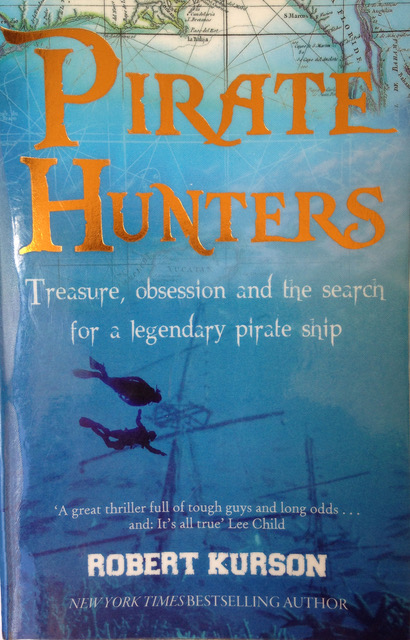
Pirate Hunters, by Robert Kurson, is a gripping read about real-life modern day divers, who are passionate to the point of obsession, about undersea diving and searching for sunken treasure.  The pirates of the old swash-buckling days have always held an interest for me from childhood when I used to love reading comic-strip stories of the pirate Blackbeard and other buccaneers.
The action takes place in the Dominican Republic, in the Caribbean Sea and details the tireless search for a long-lost pirate ship from the 1680s, during the Golden Age of Piracy.  The book was a real eye-opener about the lengths people will go to, to find the ultimate treasure and the fascinating historical research which helped the divers in their quest.
I love to travel and enjoy reading travel memoirs from exotic locations, so Pirate Hunters was the perfect book to take away with me on a recent beach holiday.  I could gaze out to sea and imagine what sunken galleons and buried history might be waiting to be discovered…
Yvonne Low is a writer and illustrator, whose illustrations have appeared in Christmas Press books, most recently for A Christmas Menagerie.  Yvonne is currently working on illustrations for another Christmas Press middle-grade novel, set in space!

Mermaid’s treasure, by Yvonne Low

2017 Book Discovery 4: Catherine Wright’s pick

Today, Catherine Wright tells us about her book discovery of 2017.

Alf Laylah wa Laylah (Tales of 1001 Arabian Nights)

As someone admittedly susceptible to the allure of all things exotic and especially Middle Eastern by nature, this collection of stories has been in my sights for some years. When the librarian showed me the size of each of the three volumes, I nearly lost my nerve and retreated to something less exhausting to hold up. How glad I am that I didn’t!

The stories of Scheherazade in their full glory (beyond the Disney-fied ones of Sindbad and Aladdin) are as mysteriously compelling and evocative as the hype would have it (I am reading the wonderful 2008 Penguin translation by Malcolm and Ursula Lyons). Not only are there the expected sumptuous scenes laden with precious gems, beautiful men and languid-eyed women bedecked in gorgeous silks and scented with musk and ambergris (which do not disappoint), but the nature of the storytelling is entrancing and quite hypnotic in it’s own right.

The indefatigably inventive Scheherazade stays her execution by her vengeful lover-king night after night with tales of tricksy djinns and the very human peccadilloes of its protagonists, interspersed with Rumi-like swatches of poetry and philosophy. No story is completed by the break of dawn, thus delaying her death for another day.

Nothing is linear in the experience of reading this text, with even minor characters telling stories within the main stories, so readers find themselves slipping deliciously down a narrative rabbit-hole, with each twist and turn more fascinating and lush than the last one in what feels a little like the opening of a sequence of Russian dolls. Although the exact provenance of these stories is still contested, it certainly feels very different to the Occidental, somewhat more logic-oriented style of narrative, which can seem a bit peely-wally by comparison. And these stories are unapologetically sensuous, sometimes startling with the very direct sexiness of the action and language.

The only thing that can stick in the craw about this (allegedly) medieval string of tales, is the regular description of women as scheming and untrustworthy (while the poor men are simply at their mercy) but, of course, this spin is not confined to Muslim or Arab stories (cf. Eve, the stories of Lilith and beyond…).

If you can put this to one side, Alf Laylah wa Laylah is a wild and glorious ride which often makes me catch my breath with its wisdom, insight, storytelling virtuosity and sheer beauty. Build up your biceps and give it a shot!

Catherine Wright was born in New England to a pioneering pastoral family, recently returning to live there after many years away. Her prose and poetry have been published in literary journals, installations and anthologies, as well as winning or being shortlisted for several awards, and a picture book of hers was produced for BBC Television CBeebies(Australia). She has been awarded a Varuna Residential Fellowship for 2018.


2017 Book Discovery, 3: Elizabeth Hale’s pick

Today, it’s the turn of Elizabeth Hale to write about her book discovery of 2017.

I’ve made a number of lovely rediscoveries this year, including Susan Cooper’s Over Sea, Under Stone​, about three children who become enmeshed a chase to find Arthurian objects, while on a family holiday in Cornwall.   It’s full of fascinating characters (the seemingly benign housekeeper Mrs Palk is my favourite), and gorgeous scenery, and an allusion to the Helston Furry Dance, which I’d heard of many times but not really looked up.  I spent a happy evening watching youtube clips of the Helston Furry (eg https://www.youtube.com/watch?v=qNdo6wT9Ers), and it brought back memories of reading all sorts of mid-century British fiction in which folk dances, mummers, and other mystical happenings feature.
Another rediscovery is Alan Garner’s wonderful The Weirdstone of Brisingamen, which I found while tidying up bookshelves at my parents’ house.  I read it over and over as a child; I think it was the first fantasy novel I really read by myself.  It’s set in Alderley Edge, in Cheshire, and again, the natural features of the land connect with a very plausible set of old folk beliefs and old magic.  I don’t think I breathed, while reading the scene where the children go through the underground (and sometimes underwater) caves that feature in that landscape.
And last rediscovery is Norton Juster’s divine The Phantom Tollbooth, another of my fantasy favourites as a child.  Here, Milo, a bored child, finds a phantom tolbooth in his apartment, and, getting into a mechanical car, pays the toll, and drives into the allegorical kingdoms of Dictionopolis and Digitopolis, where he works to bring back Rhyme and Reason to the warring kings.  I’ve always loved wordplay, and the wordplay in this is clever and keeps on coming.  A great book for literary kids.
Elizabeth Hale runs the Antipodean Odyssey: Explorations in Children’s Culture and Classical Antiquity​ blog as part of her role leading the Australasian Wing of the Our Mythical Childhood Project.  She teaches children’s and fantasy literature at the University of New England.  

2017 Book Discovery 2: Kathy Creamer’s pick

Kathy Creamer is writing about her 2017 book discovery today.

Cider with Rosie by Laurie Lee

 It was a world full of glass, sparkling and motionless. Vapours had frozen all over the trees and transformed them into confections of sugar. Everything was rigid, locked-up and sealed, and when we breathed the air it smelt like needles and stabbed our nostrils and made us sneeze.

I first discovered Cider with Rosie when I was fourteen, and I was immediately hypnotized by the glorious visions that Laurie Lee’s deliciously descriptive language created in my mind. Through his words, I can go back to the Cotswolds, re-enter childhood and remember the taste of snowflakes on my tongue, glimpse the shimmering icicles that once hung down from thatched roofs, smell the enticing spices of Christmas and touch the gentle face of my long departed grandmother.

I’ve read all of Laurie Lee’s other works, As I walked Out One Midsummer Morning, A Moment of War, I Can’t Stay Long, Village Christmas, and most of his poetry, but Cider with Rosie has remained one of my favourites, a feast for the senses, and it’s a place I like to go to for comfort. I’ve never been without a copy. This Christmas I shall be re-reading, and remembering that long ago, there was once a place as sweet and intoxicating as apple cider.

Kathy Creamer is an illustrator and writer whose work has appeared in numerous books, in Australia and overseas. Most recently, she has illustrated the new edition of Max Fatchen’s A Pocketful of Rhymes(Second Look, 2017) and her work has also appeared in the anthologies A Toy Christmas(Christmas Press, 2016) and A Christmas Menagerie(Christmas Press,2017).