Claire Corbett and Watch Over Me: blog tour interview

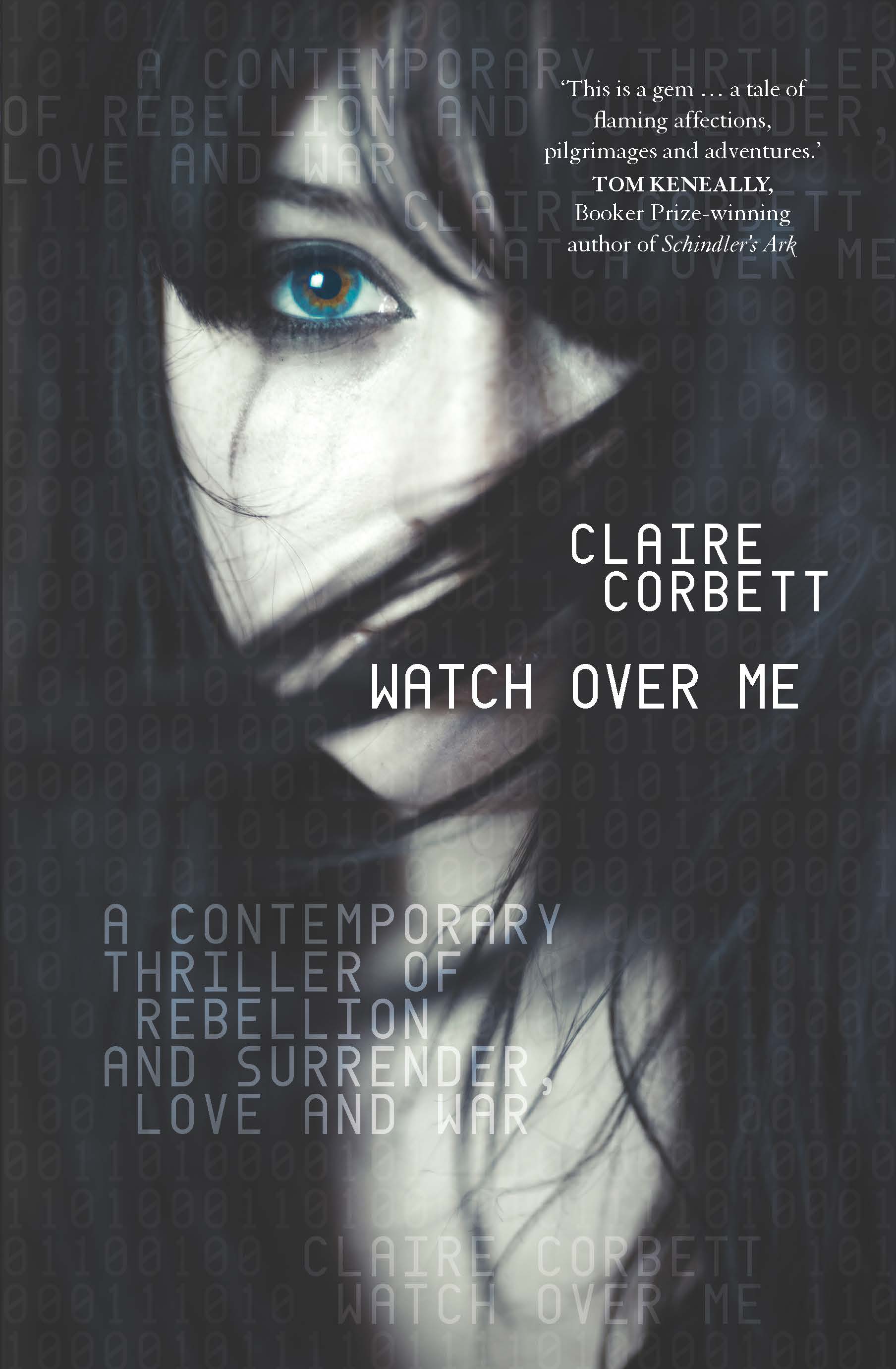
Today I am delighted to welcome Claire Corbett to Feathers of the Firebird, to answer questions about her extraordinary, genre-bending new novel, Watch Over Me, as part of her blog tour for the book.

First of all, congratulations on Watch Over Me, Claire! It’s an absolutely superb novel, highly-charged, atmospheric, passionate and thought-provoking, and I was gripped from the very beginning. How did the idea first come to you, and how did it develop over time?

Thanks, Sophie. It’s probably hard to know the true answer to that question. I’ve been thinking about elements of the story for years, probably since I was a child and heard stories about the war experiences of my grandparents and their families, especially my great-uncle, who was shot down over Belgium and hidden by a farming family that was part of the Resistance.

The ideas in it also grew out of so many things, from the family stories to feminist ideas on the roots of violence both personal and political and partly crystallised by what Kurt Vonnegut said in his novel Bluebeard, that one of the main purposes of war, which is rarely admitted, is to put women in that vulnerable, desperate position, depending on men for protection and even food.

It’s amazing how this is celebrated, you know, all the valorisation of American soldiers handing out stockings and candy bars. Australian soldiers used to boast about how cheaply they could buy Japanese women during the Occupation of Japan: ‘a girl will go all night for one bar of chocolate,’ they’d say. As if exploiting a young girl’s hunger was something to be proud of.

My parents grew up under the German occupation of France, and the stories they told about the complexities of it and the interactions of their families, friends, neighbours, whether willing or not, whether positive or negative, with the invaders, have always haunted me. I found many echoes of those complexities in Watch Over Me, and in fact at one stage you make a specific reference to the famous retort by the actress Arletty at her post-Occupation trial, defending her sexual history during the Occupation. In recent years there has been a great deal more subtle exploration than there used to be in France of the themes of collaboration/resistance, with publications such as Suite Francaise and screen-based narratives such as Un Village Francais. All this is a longish prelude to asking you, was the Occupation a major influence on the themes of your book, and in what way?

Yes, it was a huge influence and I’m pleased it resonated for you. It’s the example that looms so large in our psyches of a complex Occupation between two peoples who have culturally similar backgrounds – it’s not the same as the Occupation of Japan or Americans in Saigon or Baghdad. The French and the Germans understand each other in quite a different way and have so much shared history and I wanted that ambivalence in Watch Over Me. Hiroshima Mon Amour blew me away when I was younger. I didn’t know you were allowed to admit that a French girl could fall in love with a German soldier. Films of treachery and collaboration or even just having to live alongside each other such as Au Revoir Les Enfants, or Lacombe Lucien were a big deal. And that incredible documentary Weapons of the Spirit about the little Huguenot village of Le Chambon whose people hid and saved around 5,000 Jewish kids and adults during the war.

Also, I knew a very interesting French Jewish artist who grew up during the German occupation of Paris and he had many striking stories about that. Again, with the love and hate – they took his father away to Mauthausen concentration camp but the German officer down the street brought his hungry family food and so on. So, his feelings were mixed, to put it mildly. Like so many French people he reserved his real hatred not for the German Army but for the French government and its over-enthusiastic cooperation which he felt went far beyond what they had to do. He’d point out to us the bullet holes in the walls of houses near where he’d lived, show us where the American tanks had only just been able to fit through the narrow streets. As a kid he’d been given food by both German and American soldiers, he saw some of those correspondences.

So, you can see traces of that in the book and of course my reaction to the way women who had relationships with the occupiers were treated after the war by a nation which had done far worse than have sex with the Germans. I recently found out that Norwegian women who had relations with Germans – and the poor kids that resulted – were treated viciously after the war. I was shocked by how victimised the children were.

There are also many other cultural/historical influences I could see in Watch Over Me: American occupations in Afghanistan and Iraq, hints of Russian adventurism in Ukraine and the Arctic, (and if I’m not mistaken, a saying or two from Russia!) Inuit and Sami influences…How did you go about weaving these threads together to create the particular cultural atmosphere of your fictional society?

Yes, you’re right about the Russian sayings! Well, of course the Russians and Ukraine and the Arctic is all real and happening now and shows the plausibility of my story but the funny thing is that I’d written much of it and worked the story out before events in Ukraine. It was weird and kind of scary watching my story come to life. The energy geopolitics underpinning the tale are real – the Lomonsov Ridge, the jockeying for the resources of the Arctic, that is all real.
In terms of cultural atmosphere Port Angelsund has to be a Scandinavian city. I began with my own memories of growing up in Canada – I’m a person with a northern heritage too so I understand some of that – but then I did a lot of research. I made it as real as possible. Every detail is as true to my fictional city’s real location as I could make it. Reflector Awareness Day is real, how they deal with the light and the dark winters, the names of the cakes – all that reflects the reality of the place.

Having said that, it has a mythic quality too. The one violence I did to my city to make it mine was importing the great castle of Prague, which became the Berg. I had good reasons for that and anyone who knows their World War II history will quickly work out why. My real model city for Port Angelsund does not have a castle but some Scandinavian cities do, of course. One way I wove my cultural threads, as the Berg shows, was by layering time – my novel is a book of modern war but it also reflects on wars that affect the history of the West, so there is The Iliad and echoes of WWII and the Balkan wars.

Recognition of the Sámi people was important – there are Indigenous peoples in Europe too and they have lots to teach us about occupation. Again, that reflects my growing up in Canada and Australia – these vast settler societies that base their modern existence on taking entire continents away from their original peoples. We cannot forget that and it shouldn’t be forgotten in Europe either.

The world of the novel mixes glancing mentions of real places—Paris, Finland, for instance—with the much more delineated fictional places, especially ‘Port’ of course, but also the Sequestered Forest, Heartland etc. Though the fictional places have echoes of real places—Scandinavia, the Arctic, the US—they are also very much themselves, jolting the reader out of assumptions based on place. This also occurs with the opposing forces, Garrison and Coalition, which are never associated with any particular ‘real’ nation. Why did you choose to do this, and how did you go about the landscapes and histories of your world?

In a way you’ve answered the question very well – ‘jolting the reader out of assumptions based on place.’ That’s exactly right. I wanted the nations to be unnamed because it could be any nation. All nations are capable of war crimes but we seem unable to think about the morality of actions free from the bias of nationalism. It’s still controversial to call the way Germany was bombed in WWII, the firebombing of Dresden and so on, a war crime but it was.

The My Lai massacre during the Vietnam War was not an aberration, for example. Equivalents to My Lai happened if not every day than every few weeks. In fact there were far bloodier massacres than My Lai but they were covered up http://www.bbc.com/news/world-asia-23427726 . The scale of the slaughter was industrial because the US had no other measure of success than body count: kill anything that moves, was the motto of many US commanders. Dead civilians were counted as dead enemy combatants to keep the kill counts up.

If you read what happened at My Lai, over five hundred civilians – women, children and old people – were rounded up and gunned down in a ditch, women raped, toddlers crawling away being dragged back to be shot, entire families, three generations, wiped out http://www.newyorker.com/magazine/2015/03/30/the-scene-of-the-crime. What kind of soldiers and what kind of war crimes does that remind you of?

Over a hundred and seventy children were executed, including fifty-six babies. We want to believe My Lai was an aberration but it was not and there are tens of thousands of pages of formerly classified documents proving it was not. And yet in a presidential proclamation on the Pentagon’s official Vietnam War Commemoration website, President Obama described American soldiers in that war as ‘fighting heroically to protect the ideals we hold dear as Americans.’ That same site refers to My Lai as an ‘incident.’

People are still whining about popular protests against the Vietnam War. They don’t say that ‘incidents’ like My Lai are what people were protesting about. Protesters didn’t want babies and pregnant women being gunned down and having their skin burnt off by napalm in their name. Imagine that. Those who criticise the protesters choose to ignore that many leaders of the anti-Vietnam War movement were veterans themselves, returned soldiers who knew exactly how bad the war was and what evil was being done.

And this is not even to mention the drenching of those Vietnamese provinces in Agent Orange, which is still causing birth defects. Are we interested in labelling any of this as criminal, as evil? Are we interested in holding anyone to account? Clearly not. There are many more examples that are more current, from the suffocation of hundreds or thousands of Taliban prisoners in shipping containers at Dasht-i-Leili to the agony going on now in Syria and Yemen.

When the US uses napalm or phosphorus or depleted uranium or massacres over 250 civilians in a strike on Mosul or bombs a hospital somehow we’re okay with this. I’m not sure why. But when the ‘bad guys’ do this kind of thing we are shocked. Shocked and angry.

So, I wanted the reader to be uncertain. To suspend judgement. Surely that’s the only way we can learn anything.

I went about the landscapes and histories of my world as I described above – I made every bit as real as possible, based on research on the city that was my model for Port as well as real wars happening now. When I made a big change, like the Berg, I had specific reasons for doing so.

Like your earlier novel, When We Have Wings—which I also loved—this novel is a rich, heady hybrid, blending aspects of speculative fiction and realism. Watch Over Me also stirs in elements from historical fiction, Scandi-noir and highly-charged, and disturbing, romance. How did you keep all these elements in balance?

With a lot of research and writing and then a lot of cutting, including the help of my wonderful editor, Ali Lavau, whom I trust completely. It was the hard work on the editing that made balancing all those strands complement each other.

Watch Over Me unflinchingly yet never simplistically explores the complicated relations between men and women in wartime, and the way in which ‘normal’ gender relations are both upset by it and yet reinforced. This happens both between occupier and occupied, and between the occupied themselves, including the Ultras, with their macho rage against the occupier turned all too often against their own countrywomen. The vulnerable position of children is also poignantly explored. All this is brought out powerfully through the characters, not only the central ones of Sylvie, her family, friends, and her Garrison lover and his mates, but also through a host of beautifully-drawn minor characters, brought to very human and complex life. Can you tell us more about your creation of your characters? Were there any that were particularly hard to portray?

I loved all my characters and found them so fascinating that it made them easy to write – Max the pompous but passionate journalist, brave Erik, sturdy and gifted engineer Gull, my poor forest wild child Goran, the chorus of young single mothers, troubled Vick and even more troubled Captain Elias. I had difficulty with my confused rich girl Karin until I hit on her rebellious support for the Ultras. Of course she would be like that, it came to me, and all at once she came to life. I did have some lovely animal characters too but many things had to be cut.

Will was the hardest to portray because I had to create such a balance of attraction and anger and resentment on both sides. He has to be believably arrogant and capable of violence and full of self-confidence as a young, cocky officer. He is Special Forces, after all. As an occupier he is experiencing what it’s like to be one of the Lords of Creation. And he is young. It is going to go to his head. It would’ve been too easy to make him hateful but I wanted the reader to understand his magnetism for Sylvie, how much she wants to feel his power not so much over her but enveloping her. I wanted to open a gap between his institutional power as an occupier and the sense of him as a person too.

But then there was the opposite danger of idealising Will. Too many novels written about these kinds of relationships try to soften it by making the occupier, the soldier, into a romantic paragon so that it’s okay for the heroine to love him – there’s a bit of that in Suite Francaise. The German officer is too good to be true – a sensitive composer and so on. I made Will a real soldier; he’s not some poet in disguise. It’s heart-breaking that Irene Nemirovsky, who was killed in Auschwitz, writes sympathetically about the German soldiers, sees them as people, people alas who did not see her as a person.

Anything else you’d like to add?

Just that I love how much Port Angelsund itself is a character in the novel. I think we can all relate to that – how a city in wartime – London say, or Paris, becomes even more beloved, and that it changes irrevocably and is both mourned and celebrated. These cities wear their layers of history like geological strata. I felt so grateful, visiting Kyoto, that it hadn’t been hit with a nuclear bomb. Apparently, it was top of the list of targets for atomic weapons and the story goes that American Secretary of War Henry Stimson took it off the list, arguing its cultural importance, and the military kept reinstating it as a target and finally Stimson had to go directly to President Truman to take it off. Some say he’d visited the city, even had his honeymoon there, and understood what would be lost by bombing it.

Paris of course has a similarly incredible story, told in the book Is Paris Burning? Hitler wanted the city destroyed out of pure spite as the Allies advanced. The city was wired to be detonated – TNT in the crypt of Notre Dame! We need to remember how evil the military mindset can be. According to the book, Paris was saved by German General von Choltitz who kept stalling on Hitler’s increasingly furious insistence that the city be blown up. Some dispute this version of events, pointing out von Choltitz had been a ruthless Nazi up until that point http://cultureandstuff.com/2010/02/12/is-paris-burning-did-a-german-general-save-the-city-of-light/. Whatever the truth, there isn’t much doubt that he could have followed Hitler’s orders and left de Gaulle and the Allies to face the French capital’s blackened ruins. And he didn’t.

And that’s finally the point of fiction, of writing, isn’t it? To show the variability of the human heart, to show how critical each and every individual decision is: not to destroy Kyoto, not to destroy Paris, even in the face of so much tragic devastation. That is so important to remember. Even if you are part of great evil, you can still do a good thing. Hundreds of millions of people owe so much to Stimson and von Choltitz yet they will never know those men’s names. How I wish our current crop of politicians would take that idea to heart instead of doubling down on all their horrendous decisions.

Watch Over Me by Claire Corbett is published by Allen & Unwin, RRP $29.99, available now.

More about Watch Over Me:

The pressure of my blood, the beat of my heart, is a message to you. You read each second of my body’s life.

It is the present day. The foggy northern city of Port Angelsund is under occupation by the soldiers of Garrison. Sylvie is a young woman just trying to survive. When she is singled out for punishment at a Garrison checkpoint, a young lieutenant rescues her from torture. Though she knows the terrible risks of collaboration, she cannot stop herself from falling in love. Watched by Garrison’s vast machinery of surveillance, Sylvie discovers she is also under the protective and suspicious gaze of her lover. When her older brother returns on a terrorist mission that will throw the city into chaos, Sylvie’s loyalties are tested beyond breaking point. Her deep bond with her brother and her illicit passion for her Garrison officer are loves that cannot coexist. Whatever she does is betrayal.

In the spirit of Hiroshima Mon Amour and Suite Francaise, this sensual and heart-breaking novel brings the classic conflicts of war and occupation, devotion and treachery, up to the present minute. While the unimaginable power of modern warfare advances, Watch Over Me reminds us that the things at stake—survival, refuge and love—remain the things worth fighting for.

More about Claire Corbett:

Claire Corbett was born in Canada and has worked in film and government policy. Her first novel, When We Have Wings, was published in 2011 and shortlisted for the 2012 Barbara Jefferis Award and the 2012 Ned Kelly Award for Best First Fiction. Her recent fiction and essays have been published in a range of journals, including The Best Australian Stories 2014/2015, Griffith Review, Southerly and Overland. She has written on defence and strategy for The Diplomat, The Strategist and The Monthly.

Website: www.clairecorbett.com

Facebook: https://www.facebook.com/clairecorbettauthor/

Twitter: @ccorbettauthor
//cdn.thinglink.me/jse/embed.js

The Blue Cat: an interview with Ursula Dubosarsky

Today I am delighted to be interviewing dear friend and fellow writer Ursula Dubosarsky as she celebrates the release this week of her latest novel for children, The Blue Cat (Allen and Unwin) Set in 1942, it’s a beautiful, haunting novel whose limpid prose takes us into the mind and heart of an imaginative and observant child, Columba, as she experiences the disruptions of wartime Sydney with her bossy friend Hilda and forms a touching and tentative bond with a disorientated, motherless young refugee, Ellery. Perfectly-pitched, with a vivid portrayal of Columba’s small world, touches of humour and a subtle evocation of the horrors that Ellery and his father have fled from in ‘You-rope’, The Blue Cat is also a mysterious, even mystical work whose heart-wrenching, enigmatic ending stays in your mind long after you close the book. It is another triumph for one of Australia’s most acclaimed authors of children’s fiction, and will no doubt appear on many award lists.

First of all, Ursula, congratulations on the publication of The Blue Cat! Can you tell us a little about how the idea for the story came to you?

Thanks Sophie. Always nerve-wracking when a book comes out!  Like any story the ideas come at you from all sides until finally, mysteriously, you start to write it. When I was a child I was fascinated as all children are by the various tale their parents let slip about their own childhood. My parents both grew up in Sydney during World War Two, which is the time and setting of ‘The Blue Cat’. My mother told us once (and I think she only mentioned it once, or perhaps twice) about the arrival of a German-Jewish refugee in her class one day at Our Lady of Mercy College in Parramatta. Perhaps that’s when it started…

The image of the blue cat is woven throughout the book. Uncanny yet real, creature of dream and creature of fur, it appears and disappears at various times, and seemed to me to bring a feeling both of protection and dread. Is that what you intended? Or did you have something else in mind?

The cat sprang in my mind on a very long flight home to Sydney from Berlin – in the form of the poem that is at the beginning of the book.  I have to say I’ve always been afraid of this cat. Right from the start I thought that there was something sinister, even evil about him,   but I realized when I re-read the book that in fact he’s more ambiguous than that. Sometimes he’s even almost a comforting presence, as you say. So perhaps he’s both. I know that people can be shocked at this apparent indecision of an author about her own work! But I’m afraid all of my books are like that – open windows, (oops! out jumps the cat) perhaps, rather than closed doors.

Columba’s voice is both sharp and dreamy. She sees a lot but doesn’t always understand what she sees. She is very much a child and yet at a certain level in her consciousness she perceives what Ellery and his father have gone through in a more empathetic and certainly more extraordinary way than the adults. How did you balance these different aspects of her character to create such a believable yet unusual presence?

When I’ve taught creative writing, I’ve noticed that if there is one thing I seem quite UNABLE to articulate, that is how to create character. For me this is the most intuitive part of writing – or at least the most hidden and buried from myself. I always feel as if the characters simply exist somewhere else and I’m just putting them on stage. You’re quite right about Columba, who sees and doesn’t understand, but she feels and yet knows something despite that. “The Cloud of Unknowing” one might say – that by surrendering oneself to not knowing you might perhaps get a glimpse of some truth.

You have included authentic documents from 1942 in the book, such as ads, government pamphlets, a letter from the Free French in The School Magazine and an editorial in the Schoolboys Chronicle which I believe was written by your father as a young person! What do you think primary, contemporary documents add to the texture of a historical novel? And can you also briefly comment on some of the other extra material you’ve included, such as pictures?

The book in a way is a kind of collage. I note the definition of collage in Wikipedia:‘A collage may sometimes include magazine and newspaper clippingsribbonspaint, bits of colored or handmade papers, portions of other artwork or texts, photographs and other found objects, glued to a piece of paper or canvas.’ In ‘The Blue Cat’ there is the story of course, written by me, but then there are all those bits and pieces of the past, pasted in between the lines.  I adored making collages as a child at school – that feeling of excitement with the blank page, the glue and all the little bits and pieces of things to be stuck on where and how you chose.

Again, as a student in history classes I always responded very strongly to “primary sources”, those original documents, often ephemeral, that speak directly to us from the period in which they were created. I wanted readers also to have that experience, of reading and seeing the same things that the characters would have read and seen. The editorial by my dad you refer to was from a newspaper that he created and edited at Neutral Bay Public School during the war – as soon as I read it (only a few years ago when it turned up amongst various of his papers) I knew I HAD to include it. I went into the Department of Education office of the School Magazine to read through all the issues of the period of the book. (Thanks School Magazine!) The photograph of Ellery’s watch – I actually bought a vintage watch of the period on the internet, to make sure it was the real thing. I also managed to get a copy of the original air raid advice pamphlet on ebay – as well as the little prayer card of Columba. The copy of Vergil’s Aeneid with those wonderful ghostly annotations in pencil I bought years ago at the Salvation Army in Tempe…

The Blue Cat never specifically mentions the Holocaust, yet it is inevitably in the subtext. How difficult was it to approach the writing of the story in a way that neither overtly flags the horror of what was happening, nor elides it?

When I was a child in the 1960s I knew nothing about the Holocaust, but we all knew that the word Hitler was terrifying. That was something we understood from popular culture – adults are not going to tell children the details of the Holocaust. After all it’s a natural and I think good instinct to protect children from the various horrors of human behavior. The Holocaust is something you learn about, piece by piece, as you grow up. The adults in Columba’s life are not going to tell her what they know, what they guess, about Ellery’s situation. But they are not going to tell her lies either. I suppose in this book I have had to tread that same narrow path.

There is a touch of fairy tale, in its most mysterious yet immediate aspect, in much of The Blue Cat, but especially in the final sections. Can you tell us something about that?

For me not it’s not so much a fairytale as a mythical landscape, some very blessed place.  When I began writing I had in mind this medieval poem by Petronius Arbiter, translated by Helen Waddell. It always summons up Sydney to me, and how the experience of its beauty is a gift that can never be take away from you.

 O SHORE more dear to me than life! O sea!

Most happy I that unto my own lands

Have leave to come at last. So fair a day!

Here it was long ago I used to swim

Startling the Naiads with alternate stroke.

Here is the pool, and here the seaweed sways.

Here is the harbour for a stilled desire.

Yea, I have lived: never shall Fate unkind

Take what was given in that earlier hour.

The Blue Cat is one of a trio of your recent novels, The Golden Day and The Red Shoe being the other two, which are set at very particular points in Australian history, and are focussed around children’s limited yet luminous understanding of the events going on around them. Can you expand a little on that, and what attracted you to writing about those historical periods in particular? And also, and forgive me if this is a silly question—given the ‘colour’ theme of the titles, did you intend them to be a triptych somewhat like the ‘Three Colours’ series of films by the French-Polish film-maker Krzysztof Kieślowski?

I started with ‘The Red Shoe’, set in 1954, and this was purely the result of hearing a program on the radio. I’d had no thought of writing a novel set in the 1950s, but the idea appeared and I got to work. You are right to evoke ‘Three Colours’ – that was something I did have in mind – a dreamy thought of three novels, set in Sydney harbour,  each one a different colour and set in a different decade. In the course of history a decade is nothing! But for a child a decade is their whole lifetime.

Finally, you wrote part of this novel while in Paris, during an Australia Council-funded writer’s residency in the Keesing Studio—a wonderful experience for you I know as it was for me when I was there in 2010! Aside from mention of the fall of France, and the notorious photograph of Hitler in front of the Eiffel Tower, which is reproduced in the book, there is no obvious connection to Paris. But do you feel something of what you experienced in Paris got into the texture of your story?

Before I went to Paris I had imagined that Paris itself would be a more significant part of the book. It didn’t work out that way though, and I have no explanation for that. It just didn’t happen. But the flat we were living in was right next door to the Paris Holocaust Museum, which I visited often and I think perhaps that will be another book altogether.


You can see a trailer for The Blue Cat here and some very interesting snippets, including videos, about the historical background of the book on Ursula’s website, here. You can also read an interview I did with Ursula about her Paris residency on my blog, here.

The journey of a picture book text…

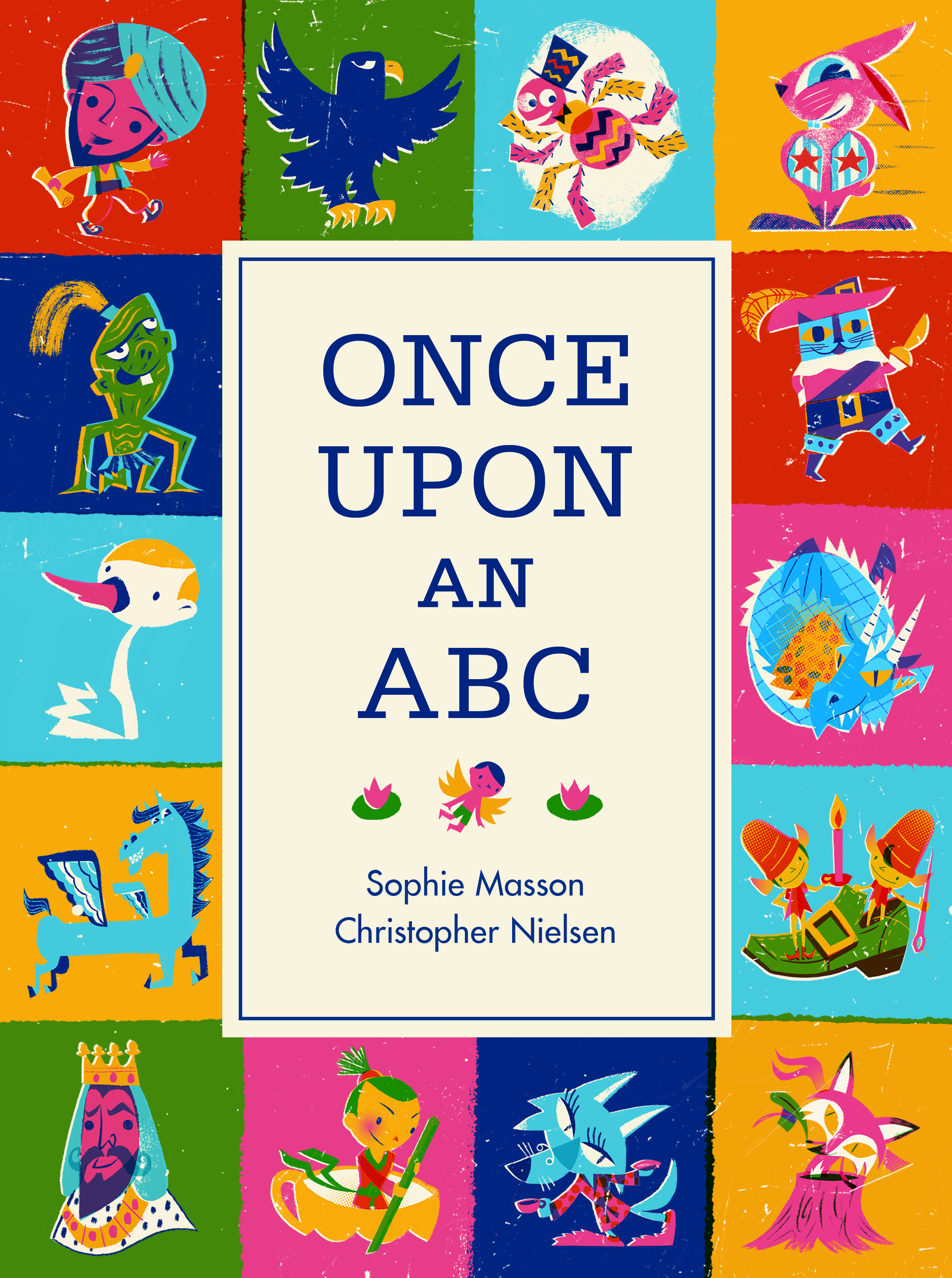
My picture book with Christopher Nielsen, Once Upon An ABC (published by Little Hare), will very soon be officially released(though we had a pre-release launch on March 18!) and to celebrate I thought I’d write about the journey of my text, and how it developed over the two years since I first scribbled down the idea in my notebook. Because picture-book texts may look easy; but let me tell you, they are not!

So–the first glimmer came on a car trip to Sydney in March 2015–I was, I hasten to reassure you, the passenger, not the driver–when I suddenly thought of a great idea: what about an ABC book featuring characters from fairy tale, folk tale and legend? Now anyone who knows me knows I love my traditional tales, but you may not know I also love ABC books, when they’re clever..my favourite being Colin Mc Naughton’s hilarious, brilliant ABC and Things, published in the 90’s. What fun, I thought, and as I always travel with a notebook, out it came and I started scribbling down a few ideas for each letter, as well as a working title, Once upon a Time/Storytime ABC… Below is what that first handwritten draft looks like:

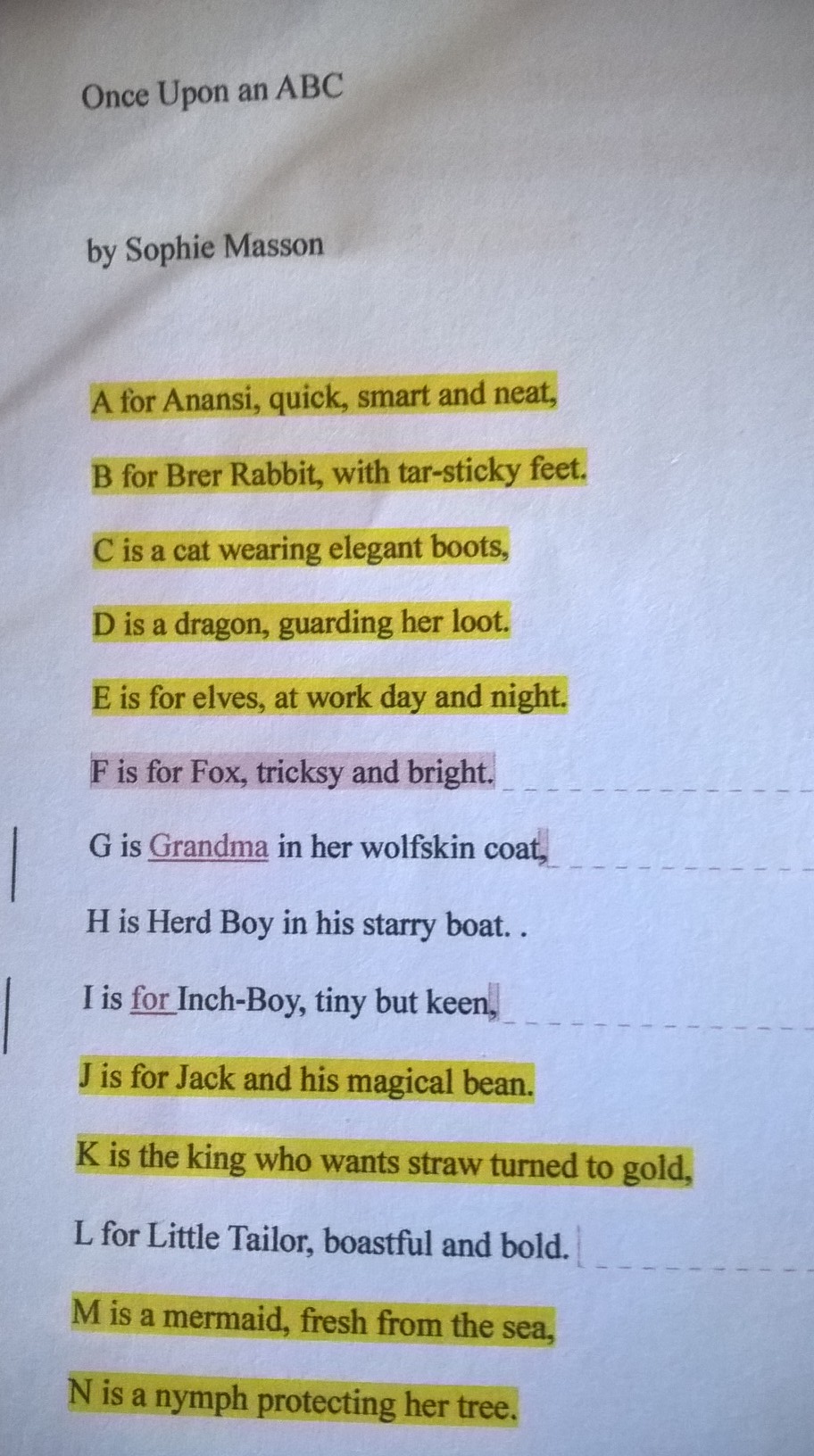
As you can see, it was still embryonic, with a few letters missing and a long way from the final text. But when I got back home, I edited the scribbles, added bits, subtracted others, tweaked the title to ‘Once Upon a Time ABC’, then typed everything up, and here’s the result of that:

It was at this stage that my agent Margaret Connolly first sent the text to Margrete Lamond at Little Hare who responded very positively, loving the idea and the feel of it. But she had a few comments and suggestions to make, such as that I should rethink the mention of Alice at the beginning and Nutcracker at N–that it was better to stick to genuine fairytale and folktale figures, rather than literary ones like those or legendary ones like Robin Hood (The vampires and yeti, too, went) And to replace Alice as A, she suggested, how about Anansi, that wonderful trickster spider-god from African folktale? I agreed very happily–and that gave me the inspiration to give the text a much more multicultural flavour generally.

Over the next few weeks, Margrete and I batted the text backwards and forwards over email, to get it into the best possible shape before it would be presented to an acquisitions meeting. This was a fantastic opportunity for me and my text, for Margrete is an absolutely brilliant and inspirational editor, with a very fine ear. It wasn’t just the characters and wording we discussed, but scansion and metre–the music of a text in verse, without which it sounds banal or clumsy. And the title changed too, to the much better ‘Once Upon An ABC.’ During this time, quite a few of the original characters left the scene, to be replaced by others, but many remained all the way through: for example, Puss in boots at C (cat) Dragon at D, Jack and his beanstalk, Rapunzel, Ogre, Trolls–and Zero the hero! Here’s a new draft, much closer to the final, but not quite there:

After this draft more changes were made, such as that Issun-boshi would be changed to ‘Inch Boy’ which is what it means in Japanese, and Brer Rabbit got ‘tar-sticky ‘rather than ‘very sticky’ feet–so much better! The fairies left the scene and Grandmother and Fox were split up 🙂 The next draft was closer still, but still not quite right:


Still there were tweaks–Grandma in the wolfskin coat was, Margrete felt, too dark for the age group, so I had to think of a different way of putting it–and the ‘tricksy’ fox was changed to ‘crafty’ while the nymph would be brought out from hiding! Meanwhile, Margrete was looking for the right illustrator for the text, so as to present the book as a package at acquisitions–and soon sent me a link to a wonderful new illustrator called Christopher Nielsen who she thought would be perfect. And so did I! And very happily indeed, Chris loved the text!

By now the text was deemed ready enough to go to acquisitions–and in due and very exciting course, I got the good news that it had been accepted, and that Chris could start work on the illustrations!

With Christopher Nielsen at the Children’s Bookshop, Beecroft

But that wasn’t the end of the work on the text, which I kept tweaking here and there with suggestions from Margrete and from another excellent Little Hare editor, Alyson O’Brien, till the text finally reached its final form(and to read that you’ll have to read the book!). On his side Christopher was beavering away on the illustrations. Then one day I got a very exciting email sending me samples of what he had been working on, some of which you can see here at his website. To say I was thrilled by the gorgeous world Chris had created to visually express and extend my text is to understate my feelings as I pored over his illustrations, with their striking blend of retro and contemporary, verve and humour, colour and dynamic movement.

And so now, two and a little bit years from that first scribble in the notebook, my text is in its final shape: as part of the beautiful picture book, Once Upon an ABC, where text and illustrations work together perfectly to create a world of magic, fun, mischief and surprise. It was a wonderful journey, that journey of the text, and I learned a lot from it. But it also reinforced something else for me: how very appreciative of the input of inspired, sensitive editors we writers should always be!


Come celebrate my double launch!

You are invited to come celebrate the launch of two of my new books!

 Jack of Spades, a historical thriller for young adults with cover and illustrations by Yvonne Low (Eagle Books)

To be launched by Pamela Freeman

AND 

Once Upon An ABC, a glorious picture-book romp through fairytale and folklore, illustrated by  Christopher Nielsen (Little Hare)

To be launched by Paul Macdonald

When: Saturday March 18, 2pm

Where: The Children’s Bookshop, 6 Hannah St Beecroft, 2119

Yvonne Low, Christopher Nielsen and myself will be in attendance to sign books.

Hope to see you there!

My prize-winning poem, Paddock Life

I’m very pleased to report that a poem of mine for children, Paddock Life, has won third prize(poetry category) in well-known children’s poet Jackie Hosking’s annual Poetry and Stories in Verse Competition, the results of which have just been announced!

Congratulations to all the prize-winners and highly commendeds, and many thanks to Jackie for running the comp and always supporting poetry for children!

Below is my poem. Hope you enjoy.

paddock-life-pic

Paddock life

by Sophie Masson

Magpie

She has all the morning alive in her throat,

Silvering the air with a fresh stream of notes,

She’s dressed for a show in her black and her white,

And her song will remain even when she takes flight.

Spiders

The spiders spin their silk all over the place

Patiently weaving fine patterns of lace,

Turning grass clumps to cities and fences to art,

As they work and they wait and they prowl and they dart.

Kangaroo

Over the fence, look! There he goes,

That famous acrobat striking a pose!

Up on two legs, then down on four,

And with the tail, he adds one more.

Blue tongue lizard

From his home in a log the blue tongue clumps out

Like a mini dinosaur he stomps and stalks about,

His tongue flicking in

His tongue flicking out.

Cattle

Knee deep in grass, in the bright golden day,

The cattle are making their very slow way

Down to the dam where they’ll drink and they’ll chew

And they’ll stare and they’ll dream the whole day through.


The Golden Child: an interview with Wendy James

It’s my very great pleasure today to bring you a fascinating interview with my dear friend and award-winning Australian writer Wendy James who talks about her new book, The Golden Child, an utterly gripping novel which poses the disturbing question: how well do we ever really know our children? Elegantly written, with richly-textured backgrounds and subtly-depicted characters, this is a memorable novel that will have readers talking about it long after they’ve turned the very last page.


wendy-jamesFirst of all, Wendy, congratulations on the release of The Golden Child! It’s an extraordinarily gripping novel which is also thought-provoking–and not a little chilling!– in its examination of the challenges of contemporary family life. Can you tell us about how it started, and did anything in particular inspire it?

Thanks, Sophie! It’s fabulous to have it out in the world at last!

The nature versus nurture question is one that I’ve always found fascinating.  And that’s where I started with The Golden Child. I wanted to very deliberately create a narrative that ran counter to Lionel Shriver’s We Need to Talk About Kevin. In Shriver’s novel, there was more than a hint that Kevin’s problems began with his mother’s ambivalence. I wanted a mother who, unlike Eva, wasn’t terribly conflicted about motherhood, who found it easy to nurture her children, who wasn’t disappointed in them, or frustrated by her lot.  And I wanted to think about what it might be like to discover that despite this, regardless of the effort, the environment, the endless love given — it can all go horribly wrong. What it might be like to discover that you don’t really know your child at all.

The story is told through several points of view, and not only as straight narrative, but also through blogs and websites and other online media. How did you juggle these very different forms in your writing?

I actually find it quite difficult these days to write a straight narrative from one perspective. There always seems to be another story, in the wings, waiting to be told., Another character, who sees things slightly differently. I guess that’s what interests me most about storytelling. It’s like acting, in that we get to become someone other than ourselves. As for the online narratives, I think online personas are so prevalent now, that it’s quite hard to write anything contemporary that doesn’t include some sort of online component. It’s becoming more and more pervasive in our lives, a big part of how we connect with others, and how we see ourselves. And I think for adolescents — as in my story — it’s now part of working out who they are, an essential element in their ‘becoming’.

Both Beth’s breezy blog and the sinister Golden Child site are masks, or to put it in another way, avatars of the real person behind each. One misrepresentation is innocent; the other is not. Do you think the virtual world encourages deception, and if so, why?

I think it’s more that it allows it rather than encourages it. Although sadly, the anonymity does tend to bring out the worst in some people — the bullies and sadists among us. Along with the whiners and those who suffer from opinion overload. It’s been such a sudden change, a revolution, and I think as in all revolutions, it’s full of frightening unknowns.  I guess it’s like being dumped ion an island with a bunch of strangers, having no rules or regulations, or notions of correct behaviour, and no laws.  It’s a free-for-all at the moment, for sure, but I like to imagine that we’ll calm down, and sort out some boundaries eventually. All the possibilities are exciting— but there’s frightening, damaging aspects, too.golden-child

In The Golden Child you get, as you say, one character whose online life is a fairly benign confection:  Beth uses what’s available to make a good story. It’s something I’ve done myself, and I suspect that most writers do something similar to some extent — we all have to spin that straw of ordinary life into the gold of narrative. The other blogger, the Golden Child, is the true self unmasked — and rather malign self at that!

Social media shaming and cyber bullying are recognised society-wide phenomena and also constitute an added hazard for parents and children, putting final paid, in my opinion, to the never-very-trustworthy proverb, ‘sticks and stones may hurt my bones, but words will never hurt me.’  In your novel, the two mothers–Beth, the mother of the bully, and Andi, the mother of the victim–have to face the devastating consequences of the cruelties of online mob behaviour. Is there any way, do you think, that they–or indeed real parents–could have acted to prevent or at least minimise the damage?

I guess there are ways in which we can police our children’s use of the net far more strictly — there are parental controls available, and ways to stop them accessing certain information — but it becomes so complicated when kids need access for homework. It can be hard to extricate the necessary from the social. I think both Beth and Andi are caught unawares – Andi a little distracted by new motherhood, assuming that all’s okay with her eldest child, enjoying the slight loosening of the apron strings.  And then Beth, who doesn’t like that drift so much, but hasn’t any clue that all is not as it appears on the surface. She’s also so busy, juggling work, marriage, a move, renovations, mothers, children, her blog, everything. I think sometimes we forget that mothers ( and fathers) are also people themselves, who are still trying to sort their own shit out, as well as everyone else’s. And it has to be said that even though things are slowly changing, a greater portion of the emotional and logistical work of parenthood falls largely to the mothers, still. I’ve seen some reviews of the book critical of Beth and Andi, seeing them as being somehow negligent, but no one ever asks what the fathers were doing. And actually, nor do Andi or Beth; the blame is directed inward, as it so often is.

Your novel deftly portrays the different worlds that the adults (not just the parents, but also grandparents) and kids live in. They misunderstand each other often. Or do they? Are they really that different?

I do think there’s some interesting generational stuff going on, but isn’t that just inevitable, the way it always is?  I think these are as superficial as they’ve always been, and the real divisions are still more to do with personality and personal values than generations. For instance, not all teenagers think like Charlotte — that bullying is just how it is, and that we should all just get used to it. And yes, both the grandmothers dislike what they view as helicopter parenting, but for very different reasons:  one is worried about the moral ramifications of over-parenting and privilege; the other grandmother is scathing about what she sees as a type of emotional ‘mollycoddling’ — of allowing your children to be too sensitive.

Your depiction of the kids at the centre of the novel–Charlotte, Lucy, Sophie–is as satisfyingly authentic as that of the adult characters. Do you think there are differences when it comes to creating young as opposed to adult characters, and how do you keep it real?

You know, I actually never really think too hard about that! I was a kid once – and I have a pretty good memory of it. Or of how it felt, if not the details. And then, of course, I’ve been fortunate to be able to observe my own kids growing up. That of-the-moment authenticity is always tricky; it changes — and dates —  so quickly!  I did get my younger kids to check the language, and my daughter added a few choice phrases, and told me when things didn’t work. And in case anyone wants to argue the point, my kids and their friends do actually say lol aloud when something’s funny. That’s language change in action, folks.  LOL.

The mounting suspense in your novel, and the final plot twist, gives it very much the feel of a psychological thriller. Yet there is no straight-out ‘crime’ as such. How did you go about creating that sense of creeping menace whilst also keeping the novel anchored within ‘ordinary’ life?

I actually think that happened without any conscious help from me. Bad kids creep us out; it’s so wrong. And when you juxtapose this with the very ordinary domestic world, which is of course where some of the most horrible things happen, that sense of dread is ramped up exponentially. You know you’re meant to feel dread in a dark alley of a grimy city, surrounded by sinister strangers, but it’s a shock to find that life with nice middle class kids in sunny beachside middle-class suburbia can be as scary as hell too.

The Golden Child could be seen as part of the contemporary genre of so-called ‘domestic suspense’ to which novels such as Liane Moriarty’s Big Little Lies and Lionel Shriver’s We Need to Talk about Kevin might also be said to belong. Are you comfortable with such a description? And why do you think it’s become such a successful genre?

I am completely, in fact, regally happy — probably because I have actually been called Australia’s Queen of Domestic Suspense (thank you Angela Savage!). I think we get so much pleasure from this particular genre because these situations feel so possible; they could all happen to you.  When the betrayal comes from within, from someone you love and trust, it can be horrifying. And it can be impossible to know how to protect yourself. There’s literally nowhere to run, no way to hide.


Wendy James is the mother of two sets of siblings born eight years apart, in the digital and pre-digital ages. She is the author of seven novels, including the bestselling The Mistake. Her debut novel, Out of the Silence, won the 2006 Ned Kelly Award for first crime novel, and was shortlisted for the Nita May Dobbie award for women’s writing. She works as an editor at the Australian Institute of Health Innovation.


Teen Buzz: my workshop on writing YA fiction, next month in Sydney!

nswwcDelighted to announce that I’ll be once again presenting my one-day workshop, Teen Buzz: Writing Great Young Adult Fiction, at the NSW Writers’ Centre in Sydney on March 4. I presented this course last year at the same venue and it seemed very popular with participants! So if you’re interested in finding out more about writing YA today–what’s hot, what publishers are looking for, and how you can best hone your writing to reach a YA audience, complete with fun and useful exercises–come along and join us on Saturday March 4, in the beautiful parklands setting of the Centre!

All details and bookings here.

Story behind the story 8: And Then authors and their contribution

Today Dan Rabarts (story in vol 1) is sharing the fascinating Maori background behind his And Then contribution.

dan-rabartsDan Rabarts and Tipana Tapu

Tipuna Tapu is a post-apocalyptic adventure story, set in a dieselpunk world where every conceivable monster of myth and legend walks the earth, and where humanity struggles to exist in the shadow of dragons, giants, and kaiju. In a far corner of this world, misty Aotearoa, people crowd into places made tapu, sacred, by events of the deep past, or by the sacredness of bones that protect them and keep the hungering taniwha at bay. Our heroes, or perhaps anti-heroes, search for forgotten bones to sell to those who can afford them, and want to keep themselves safe from the taniwha. Which is all good and well, until things turn against them. Suddenly, the bones are more than just profit and loss. They’re a map to a past that just might save Aotearoa from the hell it has fallen into, but can our heroes change their ways in time?

My iwi is Ngati Porou, and my father maintains our histories, our whakapapa, going back many generations. Over the years, he has been sharing these stories with me, among them the narratives that connect our family to our ancestral lands in the Coromandel. This has included discussions of how the remains of our ancestors were handled and stored, of the tapu, or respect, associated with the bones of the dead, and the sacredness of those places, and those remains. So this story has been brewing for a while, and it was only a matter of time before it came out, mashed up with taniwha and motorbikes and nailguns.

Story behind the story 7: And Then authors and their contribution

Today, Kelly Gardiner talks about her story(published in Vol 1)

kellyg1Boots and the Bushranger is set in the early days of the Victorian Gold Rush in the booming town of Castlemaine, where every square foot was dug up and turned over, where people made and drank and lost fortunes or pennies, and where (as we now know, thanks to Clare Wright’s ‘Forgotten Rebels of Eureka’) women were a important part of the goldfields communities.
But what happens when some of those women decide to take the law into their own hands?
It’s the first in what will become a series of stories paying homage to the early sisters of Sherlock, those feisty young women like Hilda Wade and Miss Cayley, who were enormously popular amateur detectives created around the same time as Conan Doyle’s Holmes. I love how so many of those early detective stories were short stories: how much character and humour, how many clues and mysteries, were crammed into a few thousand words.
‘Boots and the Bushranger’ sets our two young heroines at odds with the law and their families, and is (I hope) their first of many brushes with danger, disguise, derring-do … and wombats.

Story behind the story 6: And Then authors and their contributions

Today it’s the turn of Jack Dann and Steven Paulsen(who collaborated on a story in Vol 2 ) and James Hopwood(story in Vol 2 ) to tell us about their And Then contributions.

jack-dann-and-steven-paulsenHarold the Hero and the Talking Sword, Jack Dann and Steven Paulsen

Jack and I have been talking for a while about doing a project together when the opportunity to write a story for Clan Destine’s ‘And Then…’ anthology came up. Jack had showed his story ‘The Talking Sword’ to Lindy Cameron. She loved it, but suggested it be expanded because the brief for the anthology was for stories with two equal protagonists; and in Jack’s original story the demon sword held sway over his ‘sidekick.

So…we started talking; and before long we were not only brainstorming the further adventures of the time-travelling sword, but we were working out how we might bring its unlikely wielder, Harold the Hero, to the fore. We took our inspiration from Homer’s Odyssey and asked ourselves what would happen if the sword somehow lost all its powers. The result is ‘Harold the Hero and the Talking Sword’. It was certainly great fun to write, and we hope it will be just as much fun to read.

hopwood-bioThe Lost Loot of Lima, James Hopwood
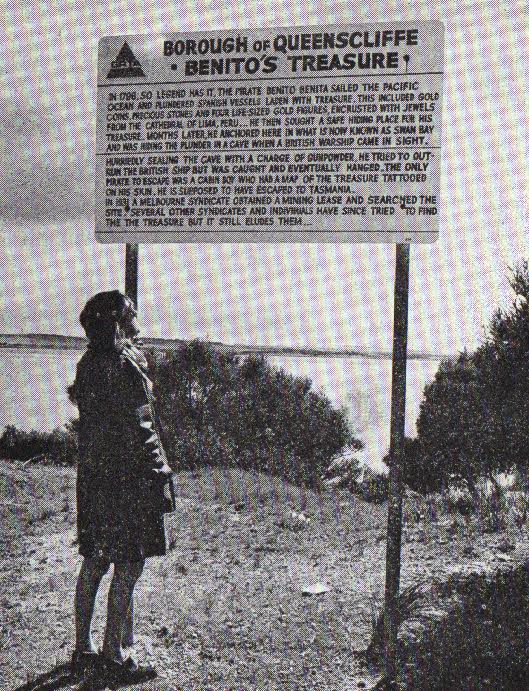
I have always wanted to write a ‘treasure hunt’ adventure story, and while trying to come up with an idea, I can across this old newspaper clipping(below) which suggested that a fantastic treasure trove known as the ‘lost loot of Lima’ was buried in Queenscliff. I immediately wanted to know more, and hit the research trail.
hopwood
My story, a globetrotting adventure, which is set in 1955, follows archaeologists Mark and Sarah Page (known as The Pages of History) as they follow the clues, and race to beat a cadre of neo-Nazis to the treasure.