Free online creative writing exercises on my presentation website

Illustration © Kathy Creamer

Today I’m launching a new, free resources page on my presentation website, www.sophiemassonpresents.com  On the page, I’ll be featuring fun free creative writing exercises for children and adults which people anywhere in the world can access directly from the page, or download for later use as a PDF. To launch the page, I’ve put up the first exercise, Fairytale Flurry, which, as the name indicates, is based around a fairytale theme. I’ve collaborated on it with the fabulous illustrator Kathy Creamer, who has provided three great illustrations as story starters. This exercise is suitable for both children and adults, and is very flexible, so you can add characters, settings, formats, etc, as you like, and shuffle everything around.

I’ll be adding more exercises, around all sorts of themes and genres, as time goes on. Check out the page, and Fairytale Flurry, here–and hope you enjoy!

Celebrating new books in troublesome times 1: Lisa Walker

This new blog series, ‘Celebrating new books in troublesome times’ is about showcasing and celebrating promoting new books that have come out this year, especially but not only those coming out in these next few months, books whose authors were looking forward to celebrating with launches and other events, which have now been cancelled in the face of the situation we all face due to COVID-19. It’s also about giving authors a promotional space with guest posts which I hope may help them to connect with readers.

I first suggested the idea in the fantastic Facebook group set up to help Australian authors with new and upcoming books, Writers Go Forth. Launch. Promote. Party.Several authors contacted me about it, and today I’m featuring the first of them, Lisa Walker, who writes for both adults and young adults, and whose new novel, The Girl with the Gold Bikini  is out with Wakefield Press.

Enjoy! And remember–bookshops are still open for orders, even if online!

Surfing the words to the shore

by Lisa Walker

Writing a book with a surfer-girl heroine has made me reflect on the relationship between surfing and writing in my life. One of my favourite authors, Haruki Murakami, has famously said that everything he knows about writing he has learned from running. For me, it’s surfing.

My surfing and writing journeys both started when I moved to the north coast of New South Wales. The surf was at my doorstep, it seemed a shame to waste it. My hometown is world-famous for its waves. A looming basalt headland captures the big swell and a rocky reef creates smaller waves on the inside. With such waves at my doorstep, what else could I do but buy a surfboard?

So I bought myself a beginner’s surf board – soft and fat. Each time I took it out I challenged myself to stay in the water for a little longer. I floundered around in the whitewash, falling off and getting pummelled by the waves, emerging with nostrils full of saltwater and hair caked in sand. But then I started catching little waves. I glided over the reef. I was hooked.

For twenty years now, I have surfed almost-daily. If I count it up, allowing for times when I was away from home, or the surf wasn’t happening, by even a very conservative reckoning this is thousands of hours immersed in the water.

My process of learning to write was somewhat similar. I got less sand in my hair and water up my nose but the slap downs were still painful. With both writing and surfing, you need to be able to take a pounding and come back for more. It takes hours and hours of thankless practice. You are going to wipe out. Get used to it. I wrote three complete novels before I got my first one published. That’s a lot of words. A lot of practice. A lot of rejections. Every writer and every surfer is different. Different doesn’t mean wrong. You can learn from others, but there’s no point in trying to copy them.

You need to go out as often as possible, no matter the conditions. Some days are good, others not so good, but as long as you keep turning up, you will get somewhere. Once in a while everything goes right. The waves are perfect. The words flow. Those days are rare, but oh so beautiful.

Both writing and surfing are more about the journey than the destination. You don’t surf with the aim of getting to shore. Nor does it make sense to focus on the outcome – the book, rather than the process of getting there. That’s where the magic is. There is always another wave on the horizon, another story to tell.


My social links are:

Website: https://www.lisawalker.com.au/

Facebook: https://www.facebook.com/lisawalkerhome/

Twitter: https://twitter.com/LisaWalkerTweet

Instagram: https://www.instagram.com/lisawalkerwriter/?hl=en

Blog: https://lisawalkerwriter.wordpress.com/


Buy links

Wakefield Press, Booktopia, Readings, Amazon Australia, US, UK

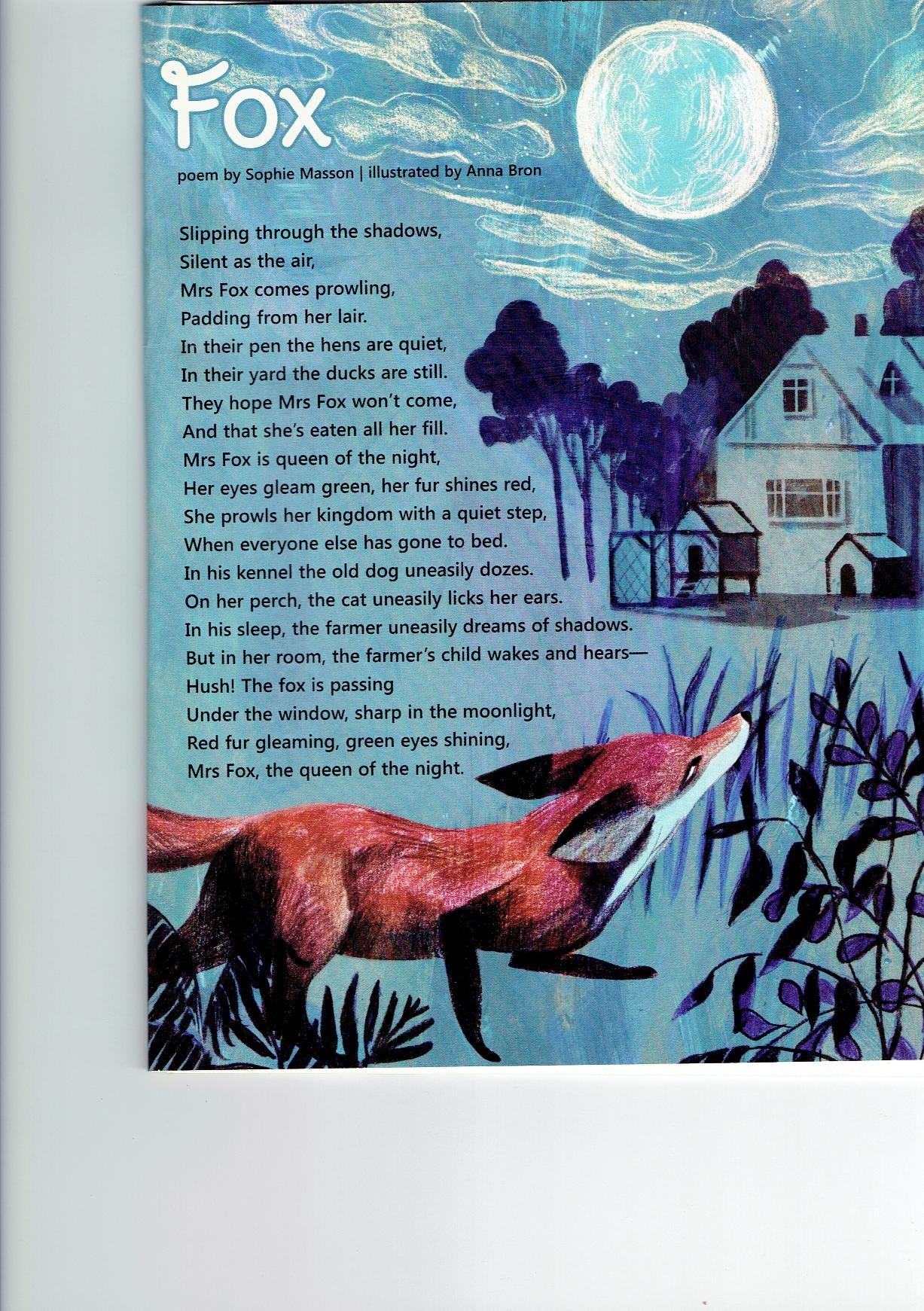
A foxy tale…

About ten days ago, I was sitting at my computer after lunch, writing, when I happened to glance out of the window which looks out over our front yard–and to my astonishment, saw a long, low, and instantly recognisable shape pass rapidly right in front of the pawlonia tree, right in front of my eyes. The fox was utterly oblivious to my presence behind the glass, utterly intent on one of our hens that was calmly scratching away near the front gate. It was only the flash of an instant that I was transfixed by the sight; and then I cried out ‘Fox!’  to David and rushed outside, yelling my head off. As I barrelled out of the door, the fox hardly deviated in his path, heading straight for the hen that still didn’t move, though the others were flapping around in panic, in my mind crying ‘Oh help! Oh fire! Oh fox!’  (a quote brilliantly expressing chooky panic which I’ve never forgotten, from Patricia Wrightson’s wonderful short novel, A Little Fear.) Then the fox suddenly seemed to clock me and my shouting and yelling, turned smartly, and ran out through the garden gate, splendid tail high, abandoning the chook hunt, and disappearing in a flicker of a moment in the long grass across the road.

All the chooks were safe, if a little nervous, except for the bird that the fox had zeroed on, which hardly even appeared to notice that she had escaped certain death. But if she had no apparent idea what had happened, I found the images from it kept popping into my head. Living in the country as we do, over the years I’d seen more than a few sad aftermaths of fox attacks, including on our own poultry; but I had never seen an attack in progress before. Indeed, I think it is a rare sight, though sometimes foxes are surprised in the middle of a killing spree. And I couldn’t get it out of my mind. Of course I’d not had any time at all to snap an actual photo of him (I say ‘him’ because the fox’s size clearly indicated it was a male), and never even thought of picking up my phone before I rushed out 🙂 . But my mind’s camera was clear and bright and vivid. And it clicked through snapshot after snapshot of those instants: it was simply extraordinary, to see that intentness, power and speed, expressed in one superbly built, supremely healthy and confident red body, ears pricked, tail streaming, sharp eyes fixed on that tempting plump prey. And it was also simply surprising–and reassuring, in a funny sort of way!– to know that my reaction, after that very first flash of stunned astonishment at the bold presence of the fox, was to rush out, without hesitation, to confront him and stop him in his tracks. I might be impressed by the sleek, deadly beauty of the fox, but I was certainly not going to let him get his teeth into our hapless, helpless cluckers.

But the fox thriller wasn’t yet finished; its star was not going to let us have the final word, with the thwarted predator sent packing once and for all. We kept the chooks locked up for several days, thinking that the fox would get tired of waiting and would move on to greener pastures. But the chooks weren’t happy, though their pen is large; they’re used to roaming around the block, eating grass and worms, pecking and scratching and dirt-bathing. Besides, what’s the good of having free-range birds if you keep them locked up like prisoners, even if it’s for their own good? So after a week, David let them out, just for a few hours a day, in the little orchard which is fenced and close to the house, and which he can keep an eye on when he’s working outside. All seemed well for a couple of days, and then one day we both had to go out on separate errands, and didn’t think of locking in the chooks. David got back before me–but the fox had got there before him, climbed the fence into the orchard–and well, one chook wasn’t so lucky as that first one. A young rooster lay dead and half-gnawed (ironically one we’d been raising for our own eventual chicken dinner!); but the carnage wasn’t as great as it might have been, because all the other chooks were unharmed, so the fox must have been spooked by something and taken off before he could add to his predator’s tally. And, oddly, the surviving chooks seemed hardly perturbed, no sign of any post-traumatic reaction, despite the fact they must all have been present when the fox killed their brother. Our own reaction of course was quite different to that first episode when the fox had been successfully routed; shame at forgetting to lock in the chooks added to shame at misreading the capacity both for patience and cunning of our vulpine adversary.

So of course now the chooks were locked up, and they’re still locked up. But the foxy tale hasn’t quite ended; because yesterday afternoon, working at my computer again, I happened to look up–and there he was again, a bit further away than the first time, creeping through the long grass near the pine tree, heading for the chook pen, bold as brass again, clearly still intent on checking out opportunities. The chooks were in no danger, the pen is utterly impregnable, as it is enclosed by netting wire not only on all four sides but on top as well: the only way he could conceivably get in is by digging underneath, a risky and time-consuming process that normally only a desperately hungry animal would take on, and this particular one, with his sleek body and shining fur, looks neither hungry nor desperate, but rather carries the air and the M.O of a boldly opportunist gourmet 🙂 But the sight of him still persisting in his campaign, despite the odds, was a signal to us that this isn’t over, not by a long shot, and that this outwitting–outfoxing!–tale was certainly not complete. And somehow, this episode seemed at last to really rattle the chooks, who last night at a time when they should have been cosily in bed on their perches, were pacing about anxiously outside in the pen, making the disturbed clucks that let you know something’s wrong. We went out to check of course, several times; there was no obvious sign of the fox, this time, but somehow there was a sense of his presence, hidden, watchful–waiting.

So my foxy tale ends there, for the moment, maybe waiting, like the fox, for the final twist. And it made me aware of course of our own conflicted reactions to what happened, and to the fox itself. It’s not exactly uncommon, those mixed feelings. People have always had an ambiguous relationship to foxes: seen both as bloodthirsty adversaries, like wolves, but, unlike wolves, traditionally also admired for their patient guile and effrontery. Fiction and poetry are full of that ambiguous image of the fox, from Roald Dahl’s Fantastic Mr Fox, where the fox is clearly the hero, to the disturbing English folktale, Mr Fox, a version of Bluebeard, where the main character is basically a serial killer. But it is perhaps in medieval French literature that we see the most compelling and extraordinary picture, in the shape of the anonymous episodic novel Le Roman de Renart. This represents its fox anti-hero, Renart as the very epitome of the clever, unscrupulous, risk-taking outlaw who preys on the stupidity and herd mentality of the geese and chicken mainstream, but also outwits, through a combination of hypocritical flattery and daring moves, the much more powerful and dangerous, but much less smart, wolf and bear lords. So hugely popular and influential was this novel–which is still both remarkably entertaining and highly disturbing in equal measure–that it changed the very name of the animal itself in French. In Old French, the word for fox was ‘goupil’, but after Le Roman de Renart, that name changed to the given name of its  main character. And so ‘goupil’ became ‘renard’, which is still what it is today.

A few years ago I wrote a retelling of the classic Russian folktale, The Rooster with the Golden Crest, where the tables are turned on the crafty fox by the nice but stupid rooster’s resourceful friends, the cat and the thrush, which was published in my picture book with David Allan, Two Trickster Tales from Russia; and it’s certainly more than possible that one day some fiction of mine will come out of these recent personal foxy encounters experiences; but right now I’d like to finish with a poem I wrote a couple of years ago, after hearing a fox’s screaming call late one night whilst at my father’s place in France. The poem was published later in The School Magazine. In this poem, it’s a vixen, not a dog fox, that’s prowling…


Looking forward to Scone Literary Festival

I’m really looking forward to the Scone Literary Festival, which kicks off on Friday March 13 with a schools program and goes all through the weekend with a fabulous program of talks, readings, workshops and social events, with a great cast of speakers and presenters. There’s also a couple of writing comps, see here.

I’ll be presenting on the Friday at Scone schools and library with the fabulous illustrator Kathy Creamer, and on the Sunday, I’m giving a workshop called Journey of a Book, a practical and entertaining look at the whole writing and publishing process, based on my experience both as an author and a publisher. See the pic at left for all details of the workshop, and how to book.

You can check out the whole three-day program here. 


Revealing the gorgeous cover of French Fairy Tales

Absolutely delighted to be able to reveal the gorgeous cover of my forthcoming book, French Fairy Tales, illustrated by the wonderful Lorena Carrington, to be published by Serenity Press in late October this year!

The book is a collection of five French fairy tales which I’ve chosen, translated and retold. Each means something special to me, and they come from different parts of France, including those where my family originates. Some are stories that have never been translated into English before, and some you might think you know well but which in these entirely newly translated and retold versions will, I think, surprise, and hopefully, delight you!

This project has been a dream of mine for a long time, and creating the retellings was such a pleasure. I am just so thrilled that Serenity Press not only loved them, but also paired me with such a fantastic artist as Lorena, whose extraordinary illustrations, inspired not only by the stories but by her own visits to France, so astonishingly bring to enchanting visual life the magic of these beautiful tales.


Honoured to be featured as first story on striking new podcast series

I am honoured to have an interview with me featured as the very first episode of the brand-new Catastrophic podcast series, a project inspired by the recent–and current!–catastrophic bushfires in Australia and the challenges for the future. Created by the fabulous Kel Butler, the hard-hitting series focusses on a different person’s story in each episode. In my case, it was really the first time I have spoken in such a complete way about our recent stressful experiences in our region of not only constant fire threat over several months but really bad drought over more than a year–the recounting of it all drawn out by Kel’s great interviewing skills. And now that the wonderful rains in our region have brought about a relaxing of the extreme anxiety, I found I was able to reflect on it more…

You can find the complete episode with my interview here (10 minutes long).

I hope listeners find it interesting–and do listen out for other episodes of the series!

The Catastrophic podcast series website is here, (you can subscribe to the series there) and the Facebook page is here: Like it to keep up with news of new episodes and other updates.

Childhood markets: two memories

Today I’m doing something different: republishing a couple of short pieces I wrote some years ago about markets I attended with my family in childhood and adolescence.

St Jean Pied de Port, Pays Basque

We dodge a flock of sheep being driven up the steep cobbled street to the stock-selling part of the

On way to St Jean Pied de Port markets, Pays Basque, in adolescence

ancient markets. Up and down the street are stalls of all kinds, and farmers in the large flat berets characteristic of the Basque country and blue overalls. Many of them are speaking the ancient tongue of the region to each other and the stall-holders while a steady stream of incoming tourists like ourselves rubs shoulders with the locals. I’m a teenager on holidays in the Basque country with my paternal grandmother Mamizou and her two daughters, my aunts Betty and Genevieve, and we’ve driven up into the mountains to the famous markets at Saint Jean Pied de Port, deep in the ancient province of Navarra, on the French Basque side of the Pyrenees. St Jean Pied de Port is a gorgeous medieval town, built of local pink and grey rock, set beside the rushing Nive River, and it has a feeling of ancient fastness which percolates into your veins.

On the way up, we’ve seen some amazing sights: rows of beautiful old houses, a team of men in white shirts and trousers and red belts playing pelote, the Basque handball, against village walls built specially for the purpose; and best of all, a pair of patient oxen harnessed to a haycart. Betty takes a photo of me near—but not too near!–them, and I have for ever the exciting proof that a sight right out of the history books was still alive in the late 70’s in the Basque country. I’m delighted; the past and especially the distant past is my obsession. I’m proud of my maternal Basque heritage but I love all romantic ancient tongue-twisting languages—Gaelic, Welsh, Breton, as well as Basque—and I read old sagas and myths and Arthurian romance and to my relatives’ somewhat pained dismay often dress like something out of the Middle Ages or rather a fantasy-reader’s impression of that period, haunting old-clothes markets and junk shops for turn of the century lace camisoles, long satin nighties worn as dresses and gypsy-style coloured skirts and velvet jackets.
Today though I’ve dressed in black and though my grandmother and aunts aren’t keen on that either, because all-black outfits should in their view be reserved for mourning or else for old peasant women—they haven’t said anything, just in case I might take it into my head to wear something really outrageous. But as we trudge up the cobbles to the market, I’m suddenly aware how out of place we look—my elegant grandmother and aunts in their city clothes and patent leather shoes, and me in my toned-down ‘bohemian’ style. We’re so very obviously tourists, and for a while that’s all I can see. But nobody else seems to notice. The locals couldn’t care less if you’re there or not; this is their own gathering, held since time immemorial, and tourists are the least of their concerns. There are one or two stalls catering specially for tourists, with little Basque flags and knickknacks; but to the locals, they might as well not exist. So soon I forget all about my self-conscious preening and just enjoy taking it all in, the sights, the sounds, the smells..

These markets are famous because they are the focus of the region. Hundreds of farmers come from a wide radius to buy and sell stock and poultry and a bewildering range of farm produce, from eggs and honey and sausage and cheeses to vegetables and fruit and preserves. As well there are any number of stallholders selling things bought by locals as much as tourists, such as pottery or the famous stripy Basque linen which makes such striking tablecloths and aprons. We wander up and down, buying bits and pieces but mostly looking, and I remember another time I was here, several years before, with my father and some of my siblings. That time, Dad had bought a vast wheel of cheese cheap from an old Basque lady with deceptively candid blue eyes. Despite Maman’s sardonic comments–her part-Basque heritage not predisposing her to romanticism about the culture–Dad was excited, thinking he’d not only got something truly authentic, but something that was truly a bargain. (When we got it home the next day to our house, La Nouvelle Terrebonne, near Toulouse he cut it open and discovered it was full of worms. Everyone yelled in horror, except for Dad, who gamely asserted that cheese was only improved when it was worm-riddled; everyone except him refused to touch it. Oddly enough not long after he’d defiantly tasted it, the cheese mysteriously disappeared—and he wouldn’t answer Maman’s sarcastic question as to where his ‘bargain’ had gone!)

Today though there’s no wormy cheese to be seen, or if there is, we don’t buy it, though we stock up on sausage and eggs and honey and fresh herbs and more, with my aunt Betty, the (very fine) cook of the family, examining each purchase as carefully as a local, earning the respect of the stallholders who soon discover that elegant city clothes don’t mean she doesn’t know what she’s looking at!
And then comes my favourite part of all: after an hour or two jaunting through the market we repair to a charming little cafe near the river and eat a wonderful meal of chicken a la Basquaise and salad, followed by a big slice of a delicious, fragrantly fresh Gateau Basque, the whole washed down with light local wine and a small nip of Izarra, a herby local liqueur, afterwards. When my grandmother compliments him on a fine meal, the proprietor tells us all the fresh ingredients came out of this very market. ‘There’s no better in the whole of the country,’ he tells us with superb local assurance, and nobody is disposed to argue with him, not with the sun shining on the Nive, and our bellies cheerfully, happily full.

Flemington Markets, Sydney

Flemington markets, eight o’clock one childhood morning. We’ve had a long and enervating drive through slow Saturday traffic from our sedate northern suburb to the ‘wild west’, and now we’re in this vast corrugated iron shed, with people shouting, gimlet-eyed bargain hunters running you over with heavily laden trolleys, vegetables squashing underfoot, kids getting lost in the melee…

Maman and Dad both love this place. For Maman, who can ‘take or leave’ markets when she’s in Europe, this is a place that makes her feel she is at home, here in this country that will never be home to her. For Dad, though, the love is there because it’s a market, because it’s filled with people, with sights, sounds, smells, life to plunge into with gusto, where the colourful noisy swell of multicultural Australia washes over you in a great human wave. For me as a prickly teenager mortified by looking ‘different’ and by the teasing refusal of our parents to talk English to us in public, it’s somewhere that’s both relaxing–because here no-one cares a bit if you ‘speak foreign’ or not but also a bit confronting– for the same reason. This is a very different Australia to the surfie paradise I imagine my school friends inhabit, and I’m soon overtaken by its vivid atmosphere, forgetting I’m supposed to be trying to be cool in the urge to observe and catalogue and file away things in my head for writing in my notebook later.

There are Italian fruit sellers, Greek olive oil merchants, Turkish sweet-sellers, Anglo vegetable sellers, Arabic souvenir sellers, South American churros vendors, Chinese and Vietnamese greengrocers, Eastern European pickle and smallgoods sellers. There’s chickens and ducks and eggs, mounds of fruit and vegetables, carpets and cheap trousers, kebabs and Turkish delight, dried figs and toffee apples. A tiny, very old Chinese woman stops at a stall, prods a vegetable, clucks in annoyance and contempt, while the seller, an enormous brawny fellow with a strong Australian accent calls out indignantly, “Hey, lady! Them’s for selling!” Maman and Dad walk rapidly down each aisle, like people possessed, hunting down bargains, while we children drag along in their wake, anxious lest we lose them in the swirling crowds, liking it in some strange, unarticulate way and yet embarassed, too, for here you have to shout and argue and comment and even make loud jokes. There’s no mask of reserve, no distance. And so we go along, occasionally clutching at a fallen orange, asking ourselves whether our parents will buy us a toffee apple this time, or whether we’ll get an almond biscuit and a sweet black shot of coffee at the Italian cafe, just down the alleyway.
A new article on publishing matters in New Writing

I’m pleased to announce that my scholarly research article, Signing on the dotted line: the lived experience of book contracts in contemporary Australian small-press publishing, has just been published in the prestigious international journal New Writing. You can read it here.

Thank you to everyone-authors, illustrators, agents, publishers and industry reps–I interviewed, whose frank and illuminating answers provided me with such great material!

Announcement and cover reveal for The Snowman’s Wish

I am delighted to reveal the gorgeous cover of The Snowman’s Wish, my picture book with the amazing illustrator Ronak Taher, which is being published by wonderful Dirt Lane Press in July 2020. Isn’t it a stunner!

Margrete Lamond of Dirt Lane Press has written a lovely post about the book on the Press’ website blog–here’s what she said, below, but you can also read it on the Dirt Blog itself, as well as news about other great Dirt Lane Press projects for 2020.

From the Dirt Lane Press blog:

Our first book for 2020 is The Snowman’s Wish

Once upon a time, author and general Renaissance Woman Sophie Masson woke up with a story fully formed in her mind. She wrote it down and it ended up on our desk. Very few edits later, and some stupendous illustrations later, The Snowman’s Wish is ready for print and, pending the right advance orders (yes, feel free to advance order … we will waive postage on single-copy purchases), will burst onto the shelves of the world in July 2020.

The story is poignant, a little sad, but also the ‘right kind’ of sad, because it also offers hope and beauty. And what beauty … the illustrations are luminous and vibrant and vivid like no others, and such a powerful complement to the elegance of the text. Here is what Emerita Professor Robyn Ewing wrote about the book:

“A rich and joyful exploration of the beauty of our natural world as experienced for the first time, and an assurance that sometimes wishes do come true, to give us much needed hope.”