A new blog series, Small Beginnings: Introduction

I’m starting a great new series on this blog today. It’s called Small Beginnings and it’s a unique look at how authors and illustrators began creating–not their published work, but much earlier than that, as children, teenagers or even young adults (up to early twenties). I think that this is absolutely fascinating in terms of showing how an author or illustrator begins to shape their craft well before the time they even start to think about the possibility of sending off work for publication.

So I’ve asked a number of fellow authors and illustrators to write about what they created in their early years, and if they still have examples of such work, to show us extracts from them. The response has been fantastic and so I’m delighted to inaugurate the series today with something of mine, as an introduction to Small Beginnings.

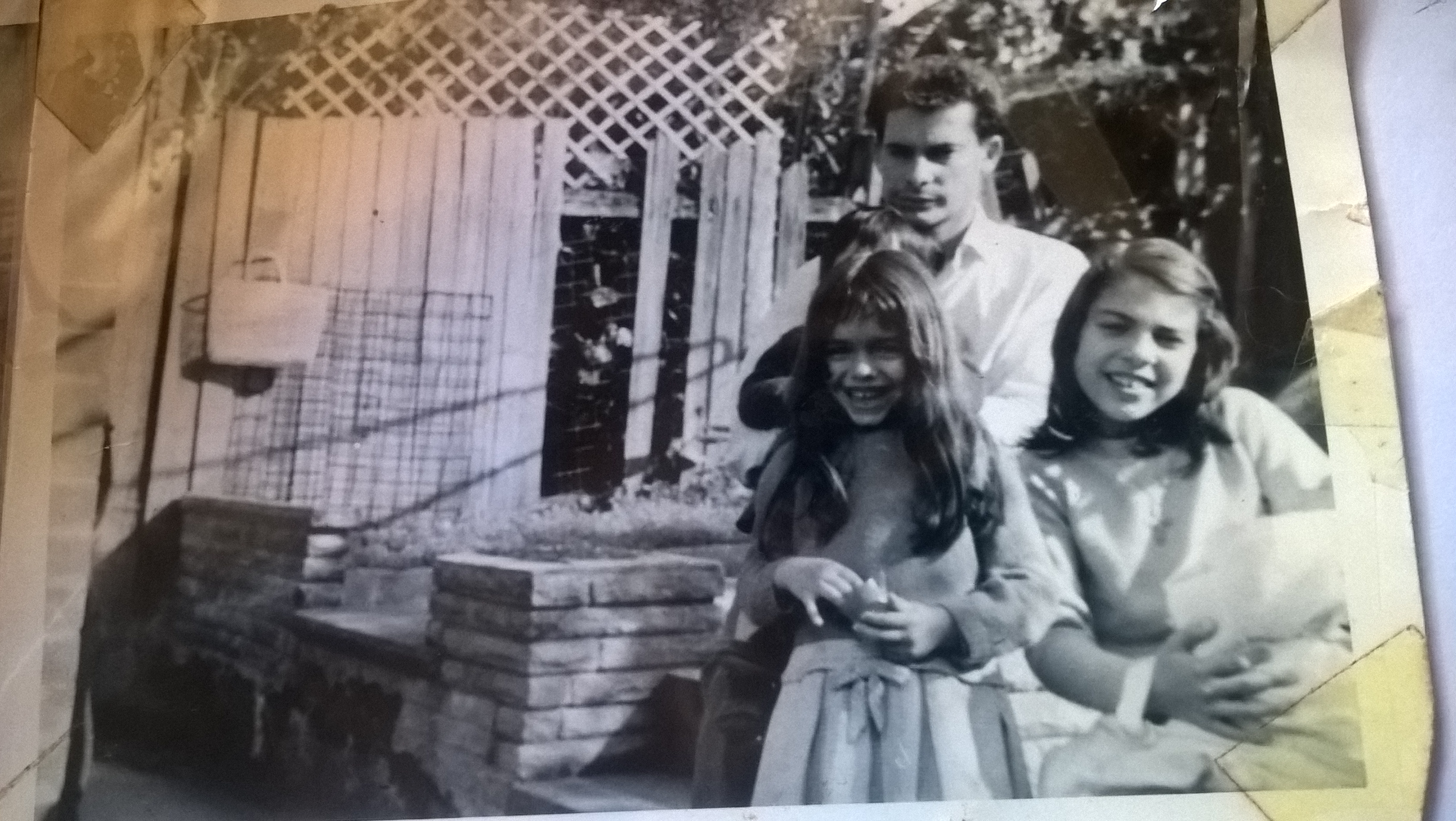
Me aged about 6, with older sister Beatrice(11) and my father.

I wrote a lot as a child and a teenager. I came to Australia from France with my parents and sisters when I was nearly five, and by then I could already read and write a little in French taught by my grandmother, who’d looked after me for some years(due to illness when I was a baby, making me unfit to stay in Indonesia where I’d been born and where my parents were working). I was already mad for stories–oral as well as written and I loved making up my own too. But it was arriving in Australia and starting to write in English that really got me going creatively speaking. I was lucky enough that in all the schools I went to, creative writing was very much encouraged, and at home, we were so surrounded by books and also by the great stories told by my parents that bathing in an atmosphere of story felt totally natural, though the idea that you could be a writer, as a job, didn’t really enter my head till I was well into my teens.

I don’t remember much of the very early stuff I wrote, but a few titles from primary school-age literary projects still stick in my mind: such as The Adventures of Princess Alicia–a lavishly illustrated, multi-episode comic strip story about a heroine who had two attributes I dearly wished I had–not, not a crown, but magic powers: and long blond hair (my hair was long but very dark!) I illustrated this masterpiece too I might add, in the days before I became embarassed by my lack of talent in that direction. And The Life of a Stamp, a

Aged 16, with younger siblings Gabrielle and Bertrand.

Aged 16, with younger siblings Gabrielle(10) and Bertrand (8)

mystery/travel story centred on yes, a wandering stamp which gets posted on the wrong letters and gets in some sticky situations..There was The Twins’ Highland Holiday which was heavily influenced by Enid Blyton’s Famous Five, and there were several poems including one about a ladybird that I got a gold star for in class(I presented the poem written on the back of an illustration of a ladybird). Much of it I remember ‘publishing’ in little books, simply sheets of paper stapled up with hand-drawn covers, with perhaps a little stamp or sticker added to make it look more ‘official’. For a while I even ran a little story club at primary school which I called ‘The Bluebell Club’ (no doubt influenced by Blyton!) in which members read out their own stories. We even had a competition once in which the prize was a book, bought by my mother, who judged the competition–I was very miffed that she didn’t choose mine! As I loved the theatre–I used to go to after school drama classes–I also wrote a lot of plays, very often adaptations of fairy tales, which I wrote, directed and produced and forced my siblings to act in and my parents to watch. My mother was always very kind about these thespian efforts but my father could be quite sardonic about it, slow-hand-clapping and pointing out the narrative flaws rather loudly: an experience which hardened me up for later and occasional poor reviews!

Unfortunately none of that early writing was kept. It’s only when I was in mid-high school that I WP_20160425_11_29_40_Proprotested about parents’ tidying-up urge to chuck everything out and hung on to my writings like a determined limpet! So I have quite a few things from that time–lots of poems, a few short stories, and the beginning of a massive fantasy novel started when I was around 16(and in which I WP_20160425_11_29_11_Prointended to reunite every mythology in the world: nothing like teenage ambition!). And then, from a little later, at 19, a picture book–the text written by me, the illustrations by my youngest sister, Gabrielle, who was 13 at the time. That one survives in its entirety(you can see some pages from it it below).

In all of this what I can see is a young writer who is trying her hand at all sorts of things, enjoying playing around with different forms, flitting around from fantasy to realism, contemporary to historical, light hearted to rather serious, long to short. The craft is rather wonky, but the passion and curiosity–yes, and persistence too!–is very much there. I see, in short, an apprenticeship taking place without my even being aware that it was happening; how could I, when it was so much fun?


The power of fairy tales: an interview with Katherine Langrish

katherine langrishToday I have the pleasure of interviewing Katherine Langrish, author of a number of wonderful fantasy novels for older children, who has just released her new book–a collection of essays on fairy tale.

Your new book, Seven Miles of Steel Thistles, has just been published by Greystones Press, and unlike your other books, it’s a work of non-fiction: but like your other books, it shares a common element–a fascination with fairy tale and folklore. Why are you so interested in them?

Quite simply, I’ve loved fairy tales and folklore ever since I was a child.  I’ve never understood why some people feel it’s a taste adults ought to grow out of, unless perhaps the only fairy tales they’ve encountered have been the simplest versions retold for very little children.  Fairy tales can be profound and as inexplicable as poetry. As I discuss in the book, a story like the Grimms’ tale ‘The Juniper Tree’ deals with enormous themes – murder, jealousy and abuse as well as birth, resurrection, and joyful communion with the natural world.  It will ‘mean’ something slightly different to everyone who reads or hears it, because it elicits from each person their own emotional and spiritual response.  In fact, this story was probably rewritten by a German romantic poet, but that’s the other fascination of fairy tales.  They don’t ‘belong’ to anyone, they’re anonymous, so they adapt to the voice of whoever’s telling the story. And they’re so old!  People have been telling stories like these for centuries.

It’s such a large topic–did you try to pursue a particular line of inquiry or reflection in the book, or is it more organic? And what challenges and pleasures did you find in putting together the collection?

Many of the essays in the book began life on my blog (see below), although for this collection they were massively rewritten and extended. I did not think I had chosen any specific line of enquiry, but to my own fascination I found as I went through the rewrites that a theme was in fact emerging: that of ‘authenticity’. What does, what can that mean in terms of traditional tales?  Is the ‘earliest’ version of a Seven Miles of Steel Thistlesparticular tale ‘more authentic’ than a later one?  My conclusion was, repeatedly, that while it can be fascinating to trace the history and analogues of a tale, it renews itself on the lips of the latest storyteller.

Did any particular fairy tale or folklore scholars influence you in terms of interpretation and reflection?

There are so many wonderful fairy tale and folklore scholars, an embarrassment of riches, but I have to mention the great Katherine Briggs, whose four volume ‘Dictionary of British Folk-Tales’ is a Bible in the field, and whose other books of fairy lore I love – such as ‘The Anatomy of Puck’ and ‘The Vanishing People’. I like her insistence on the primacy of narrative.  I also love Max Lüthi’s ‘The European Folk Tale’ which so clearly illuminates the form and content of the classic European fairy tale.  Most of the interpretations and reflections in ‘Seven Miles of Steel Thistles’ are my own, however – if only because I read the stories long before I read any of the scholars.

You’ve maintained a blog with the same name as the book, over several years. It’s a wonderful title. Where does it come from, and was the blog a bit of a testing-ground for the book?

The title of both the book and the blog comes from an old Irish fairy tale, ‘The King Who Had Twelve Sons’. In it, the hero has to ride ‘over seven miles of hill on fire, and seven miles of steel thistles, and seven miles of sea’.  I love it as a metaphor for overcoming life’s difficulties, including the sometimes endless-seeming struggle to write well.  I suppose the blog has become a testing-ground for the book, though I never expected a book to come of it. I began the blog simply as a place where I could write about the things I love – children’s literature, fantasy, fairy tales and folk-lore – and where I could talk with others who love them too.  Does it sound too fey a comparison, if I say that the blog turned into a fairy garden and the book has grown up out of it like a tree?

Do you have particular favourites in terms of fairy tales? If so, which–and why?

I do – and I’ve written about some of them in the book.  I’ve already mentioned ‘The Juniper Tree’, and I also love ‘Briar Rose’ and ‘Jorinda and Joringel’.  But the story I love best to tell aloud is the English fairy tale ‘Mr Fox’, a very old version of Bluebeard with a far more intelligent and courageous heroine.

What are your favourite folkloric creatures?

My absolute favourites are the household fairies – the brownies, nisses, tomtes and domovoys which live with human beings and help (and sometimes hinder) them. I’ve written about then in several of my books for children: they’re an independent, mischievous, yet devoted race. They offer their services freely and will stay for so long as they are treated with respect and a dish of cream or oatmeal is left out for them on the hearth.  I love the way stories about them mingle Otherness with domesticity.  And I think they’re very, very old – as old as the story of Rachel in Genesis, who steals the household gods from her father Laban.

Your novels and short stories borrow from several different cultural traditions–can you tell us a little about that?

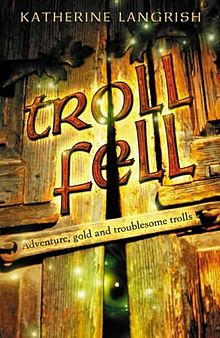
I began with Scandinavian folk-tales about trolls.  I’d been trying to write a story about a young Viking boy which involved him encountering some of the Norse gods. The story just went completely dead on me – I couldn’t find the way forward at all.  If a god befriends your character, why shouldn’t everything go smoothly for him or her? It seemed to me I was having to find complicated explanations for my hero’s predicaments. Then I began reading folk tales about trolls, and realised the book ought to be about them.  I got rid of the gods entirely as an unwanted extra supernatural level, and the book – ‘Troll Fell’ – worked much better as a fairy tale rather than a fantasy.troll fell

When I came to write the third book in the trilogy, I wanted to take my characters over the sea to ‘Vinland’ – North America – something we know Norse men, and probably Norse women too, actually did.  And there my characters would inevitably encounter Native American people, just as the Greenlanders’ Saga describes. It seemed to me legitimate to introduce Native American characters into the book: it was that or pretend North America was unpopulated, a clear impossibility. What may not have been so legitimate – yet it seemed to me important – was to introduce, as players on the North American scene, creatures in some way parallel to the trolls my Norse characters cohabited with. I thought long and hard about it and spent months of research, trying my best to respect and faithfully represent the culture I described. Whether or not I succeeded is not for me to say. The one thing I was sure about was that there would be no ‘white saviour’ in the book.  My Norse hero owes his life to the Native American characters he meets, not the other way around.  I wrote at length about this issue in an essay called ‘Cultural Appropriation and the White Saviour’, and though the discussion has moved on over the last few years, I still cautiously hold to what I said there.  Here’s the link:

http://steelthistles.blogspot.co.uk/2010/06/cultural-appropriation-and-white.html

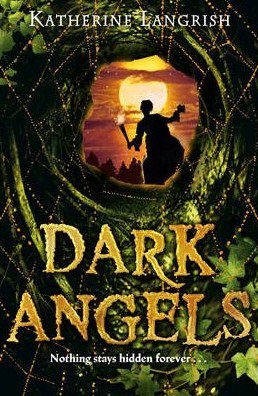
In books such as Dark Angels and the Troll trilogy you explore the worlds of what might be called ‘the hidden people’ and their interactions with humans. The idea of a ‘hidden people’ with a wide range of magical powers (from large to small) and alien intelligence but with many similarities to humans and who appear to be drawn to us–if only to exploit us at times–is part of the traditional folklore and stories of many cultures right across the world. Why do you think this is such a universal notion?

Wow, that’s a huge question… and yet maybe it’s a small one too.  Haven’t we all had the experience of laying something down and then minutes later not being able to find it?  It’s so, so frustrating: ‘It has to be there! I know perfectly well I put it there, just before the phone rang!  And now I’ve looked everywhere – and it’s gone!’  The temptation is to blame borrowers, or gremlins, which we know is a joke – but it still makes us feel better to be able to focus the frustration on some invisible, tricksy thing that’s sitting there laughing at us. Maybe it’s a human trait to imagine the universe as personal rather than impersonal. We can deal with the personal, we can understand it and negotiate with it – we humans are very good at that.  Such feelings must have been far, far stronger in the past, before science began coming up with ‘rational’ explanations for everything.dark angels

Incidentally, just where have I put my keys?

You have been a storyteller as well as a writer. How does that influence your fiction?

I began story-telling years ago when I lived in France and our children were small.  I joined a a weekly English-language story session at the Bibliotheque de Fontainebleau for children aged three years and up. It can be quite hard to keep the attention of a group of fifteen to twenty little ones when reading from a picture book: you’re facing them, and you have to keep stopping and turning the book around so they can see the pictures, and that interrupts the flow.  An inspirational friend suggested that we all tried telling stories ‘from the heart’ instead of reading aloud. I loved it. I found you could keep the children’s attention better and they make the pictures in their heads. I continued to tell stories to older groups of children for many years, and learned a lot about pacing a story, about narrative structure, and about the kinds of things children enjoyed – what got them excited, what made them laugh. So yes, I think it really did help my writing, which loosened up and at the same time became more confident. I just – love telling stories.

To celebrate Shakespeare


will shakespeareToday, April 23, 2016, marks the four hundredth anniversary of Shakespeare’s death, and celebrations of the great writer’s life and work are planned all over the world, including of course in his home town of Stratford Upon Avon. 

As is the case for so many other writers, Shakespeare has been a big influence and inspiration for me, from the time I first encountered his work as a child–something I wrote about in an essay called Puck’s Gift, published in Reimagining Shakespeare for Children and Young Adults, edited by Naomi J.Miller. But instead of telling you about how Shakespeare had influenced me, I thought I’d show it; and celebrate the wonderful Will in my own way, by posting the first chapter from Malvolio’s Revenge (2005), one of the six of my novels which have been directly inspired by his work. Malvolio’s Revenge, set amongst a troupe of travelling players in Louisiana in 1910, is based, of course, on Twelfth Night, which is possibly my favourite of all Shakespeare’s plays.  The other novels are Cold Iron(1998, inspired by A Midsummer Night’s Dream), The Tempestuous Voyage of Hopewell Shakespeare (2003, inspired by The Tempest and Twelfth Night); The Madman of Venice(2009, based on The Merchant of Venice and Romeo and Juliet); The Understudy’s Revenge (2011, based on Hamlet) and My Brother Will (2013, an evocation of a year in Shakespeare’s adolescence, as recounted by his brother Gilbert).

Shakespeare novels shelf

As well, for those interested, there’s Shakespeare’s Last Play, a rather strange little cross between novella and play that I wrote some years ago and published as a free ebook you can read online.

And now, without further ado, let me take you travelling back in time to 1910 in the Louisiana countryside, and a very rainy night..

Malvolio’s Revenge

by Sophie Masson

One


Toby had never seen so much rain. No soft veil of mizzle, no needles of drizzle, not even stormbucket rain, but great  relentless waterfalls, drowning everything: road, wagon, horses, Toby himself. At least it was not cold, he told himself, despite it being Christmas Eve(and some Christmas Eve this was turning out to be!) But no-one could stay warm for long out in this deluge, and Toby was soaked, not to the skin, not to the bone, but to the very marrow of the very bone. His feet sank deep into the mud at every step, the mire sucking at his boots with increasing vigour, as he tried to encourage poor Slender and Shallow to keep struggling on.

The rain had come on with such suddeness, half a mile or so back, that there had been no way they could find shelter quickly, but must keep going as best they could. There should be  houses and even a little settlement not too far away–or so it said on the map–and so Toby had been detailed to guide the anxious draughthorses in the right direction. But even by the light of the lantern he held in his hand, he could barely see more than a few inches in front of his nose.  Occasionally, a tree would loom at him out of the gloom: the strange live oaks one saw everywhere in this place, still green in winter, but ghostly in the pale light of the lantern, with the moss hanging from their drenched black branches like the tattered rags of criminals hanging on the gallows. Far above the sunken road was the levee which held back the huge swollen river, whose muffled but still menacing roar could be heard even through the din of the rain.

Water, water everywhere, thought Toby, sneezing violently and tugging at Slender’s rein to stop him from stumbling. Water–this damned country is only an excuse for land, it’s just a floating bit of driftwood on a huge black current. Our wagon’s a frail little ship, and soon enough we’ll be wrecked, swept away like so much flotsam, drowned by water above and below!

To keep fear away, he cursed quietly to himself; cursed the weather, the benighted place in which he found himself; cursed his uncle’s folly in bringing them out here into this sodden countryside. But most especially, he cursed the memory of self-appointed New Orleans festivities planner Roland Bourgeois Batiste, apparently a ‘good friend’ of Toby’s uncle Theo, who–for a goodly sum of money–was supposed to have organised for them a perfect venue in the city. When they had arrived, however, the flamboyant Monsieur Batiste had advised them that after all there were no theatres that could accomodate the company in the city. After all, he said with many gestures designed to prove his good will and his helplessness–after all, it was coming up to Carnival time, everything was packed full–but out in the country, people hungered after culture. He had taken the liberty of setting up a few places for them, out there. And if their country tour went well, why, it went without saying that it would be a lot easier to prise open New Orleans doors. In fact, the rich planters out in the country would be only too delighted to help open those doors for them, once they’d seen the quality of the show.

Ha! That had been just the way to handle the principal of the Tridlingham Troupe, Toby’s own uncle Theo, thought Toby bitterly. Theo Tridlingham had been a little crestfallen at first, after Batiste’s revelation; but his irrepressibly optimistic nature had taken over, then, and he had actually thanked the swindling son-of-a-seacook! Armed with Batiste’s ‘booking-sheet’, Theo’s optimism, and the rest of the company’s profound resignation, the Troupe had ventured out.

But alas! The Louisiana countryside, if it held people who hungered after culture, sure hid them well, maybe drowned in the swamps or the marshes or the blessed little bayous that covered so much of the place. More than once, the ‘venue’ Batiste had ‘booked’ for them had turned out to be either a figment of the swindler’s imagination, or else the victim of flood or sudden earthquake–for it had sure vanished off the face of the earth. Oh, it was true that once or twice, on an obscure plantation or two, they’d been able to stage Uncle Theo’s pride and joy, his once-modestly-famous play, Malvolio’s Revenge; but what Batiste had carefully failed to tell them was that a good few of the planters hereabouts were still primarily French-speakers and as such supremely uninterested in a once-famous English play that had, almost a lifetime ago, been presented in the London’s West End. And of the rest, most of the richer plantations would not even receive them; and those that did wanted to pay them only by board and lodging–which was uniformly poor. In the little villages and towns in between, they had fared just a little better, which was no great achievement. In the last week or so, in any case, even those little audiences had dwindled to invisibility, as everyone who was anyone at all(and even those who weren’t!) left the dank countryside in readiness to spend Christmas and then the Carnival period in lively, sociable New Orleans, whose doors, of course, had resolutely remained shut…

Unfortunately, these melancholy thoughts led inevitably to images of other things in Toby’s mind, things calculated to arouse not melancholy but fierce longing: namely, memories of the large and comfortable houses around the main square of the city, the fires that must be burning warmly in all those fireplaces, the cosy, noisy taverns, the brightly-lit, never-sleeping streets that at this season would be filling already with Carnival revellers: for Carnival lasted from Twelfth Night to Mardi Gras, and the Christmas period, too, was filled with merrymaking. That had been the idea, originally, in coming here: Uncle Theo was sure his play would go down perfectly in such a buzzing, pleasure-loving city. ‘You’ll see,’ he’d told the company enthusiastically–‘you’ll see, we’ll be box-office magic, in New Orleans! We’ll be eating and living high, my lords and ladies! You just wait and see!’

Living and eating high–ah! How Toby could just see the food laid out on tables–smoking hot pies, fried chicken, fragrant, spicy stews and soups, towering iced and sugared cake confections! Hell! He could more than see–he could actually smell them! The delicious smell filled his nostrils; his eyes closed in ecstasy; he lost his grip on the reins, and fell over in the mud, perilously close to the great wheels of the wagon, the lantern flying from his hand. He had the presence of mind to fling himself sideways, only to come into painful contact with something cold, solid and very hard indeed.

He swore loudly and got groggily to his feet, only to be nearly deafened by a stentorian voice in his ear.  ‘You idiot boy! What do you think you are doing? Do you want to kill us all?’

His uncle was looming over him, his face twisted with fright and anger, the rescued lantern in one hand, the other calming the draughthorses. Toby lost his own temper then. ‘We can’t go any further! We have to stop!’

‘Stop, is it?’ said his uncle, with a sarcastic lilt to his voice. He was drenched, now, too, the water running in great rivulets down his craggy, ruined face. ‘Stop where, may I ask, Toby? Have you found us a nice little tavern, or perchance a warm dry hotel?’

Toby was just about to answer back, hotly, when he saw something that made him forget his anger. ‘Look! Uncle Theo! Over there!’

The dim light of the lantern swinging in his uncle’s hand had fallen on the thing he had nearly knocked himself out on. It was a gatepost. Unmistakeably. A tall, solid gatepost, with something written on it. His uncle realised what it was immediately, too.

‘Hold Slender and Shallow, boy, ‘ he ordered. ‘I want to see properly.’

Toby did as he was told; and his uncle hurried over to the gatepost, and squatted on his heels, uncaring of the mud, holding the lantern high to illuminate the writing. ‘It’s faint,’ he muttered. ‘Let me see..here’s an I..an L, no, two L’s..a Y, is it? Hmm, yes. Then an R, another I, an E..’ He got up, slowly. ‘I do declare! This is a strange thing indeed! Wait here. i’m going to go and see.’ He squelched past Toby, and was soon lost to sight, only the faint glow of the lantern showing where he was going. Toby stood holding the horses, his mind whirling. What had his uncle seen?

‘Toby! Theo!’ A plaintive voice came from behind him, from the wagon. Toby sighed. ‘Yes, Madame Metanche?’ Though he looked in her direction, he could only dimly see her anxious face, peering from the unfastened opening of the covered wagon. The rain was easing off, thank goodness. But a fog was slowly taking its place. A fog that would grow thicker by the moment..

‘Toby! What, in the name of the blessed Virgin, is happening? Why have we stopped?’

‘We are shipwrecked, Madame,’ said Toby, lightly, unable to resist. She was so easy to tease, for the Tridlingham Troupe’s leading lady  did not understand metaphors, or jokes, or irony. She panicked at everything, made vast peaked mountains not merely of molehills, but of the shadow of molehills! He would not have teased her, mind you, if his uncle had been in earshot. Uncle Theo treated Mathilde Metanche like she might be a rare jewel, or perhaps an unexploded bomb.

She gave a little cry. ‘Shipwrecked? What is this you say? Is the river coming down on us? Is that why there is so much water?’

It had been her greatest fear ever since arriving in Louisiana. She did not like the look of the Mississippi, she said, it was too big and the land was too flat, and she didn’t trust the levees. She was sure one day they would burst and the big booming river would sweep everyone away.  ‘It could be,’ Toby muttered gloomily, enjoying his moment of power. ‘It could be.’ And squealed in outrage in the next moment, as his ear was twisted.

‘Stop it, you rascal!’ It was the light voice of Gabriel Harvey, who played all the ‘character’ parts in the troupe–that is to say, he wasn’t handsome or stupid enough to be a leading man, and his dark, rough-cut face with its grey-green eyes was characterful enough. ‘You’re not the one has to calm Mathilde’s hysterics,’ he went on, calmly outstaring Toby’s fury. ‘So what the devil is going on? Where’s Theo?’

‘Down there,’ said Toby, crossly, rubbing at his ear.

‘Down there? In the fog? Has he lost his wits?’

‘Gatepost,’ explained Toby, sullenly. He could see the dim glow returning, the vague shape of his uncle behind it. ‘There’s a house down there somewhere.’

‘Well, thank the stars. Or whatever. ‘

‘Of course, that is, if they’ll let us in.’ A gloomy voice from the wagon. Gabriel laughed. ‘Trust you, Old Fate, to raise our spirits! I wondered why we brought you along.’

Toby couldn’t help grinning. Jean LaFete was the company’s clown–and in real life so morose and pessimistic that Gabriel had nicknamed him Old Fate, a play on the English sound of the clown’s name, which in French actually meant ‘the festival’.

‘Gentlemen!’ Theo Tridlingham squelched up to them. ‘Turn the wagon. There’s a house down there. I spoke to the housekeeper. They’ll take us in for the night, and set us on our way tomorrow. There’s soup and bread, and a warm fire for us, my children! We’ll have a good Christmas Eve, after all.’ He paused. ‘I can’t help but think it’s a lucky omen for us, given the name of this estate. Which is Illyrie! And that’s Illyria in French, my friends!’

They stared at him for an instant. Then Gabriel intoned, in sepulchral tones, ‘Illyria, is it? I would not care if it were Hell itself, opening its gates to us this evening, and the Devil himself who was to be our host! ‘

‘You are a heathen and a savage, Gabriel Harvey,’ came Jean la Fete’s voice. ‘Take care you do not bring disaster down on us with such words! This is a strange, sorcerous country–who knows what ears are listening?’

‘Who knows indeed, Old Fate?’ laughed Gabriel, not at all put out. ‘Come on, then, Theo–lead the way, to Hell or Heaven or Illyria, I care not at all, long as it’s nice and dry!’

And so say all of us, thought Toby as they slowly manoeuvred the horses around to head down the rutted, oak-lined track that led to Illyria.


The translator’s art: an interview with Stephanie Smee

Stephanie Smee portraitTranslation is an art both precise and subtle, and the work of distinguished Australian translator Stephanie Smee has those qualities in abundance. Stephanie has translated several works of French literature into English, and I first met her some years ago, after the publication of her translations of classic French children’s titles by the Countess de Ségur. We got talking about other French classics, and I happened to talk to her about one of my favourite books growing up as a French-speaking child: Michel Strogoff, a great adventure novel by the legendary author Jules Verne.

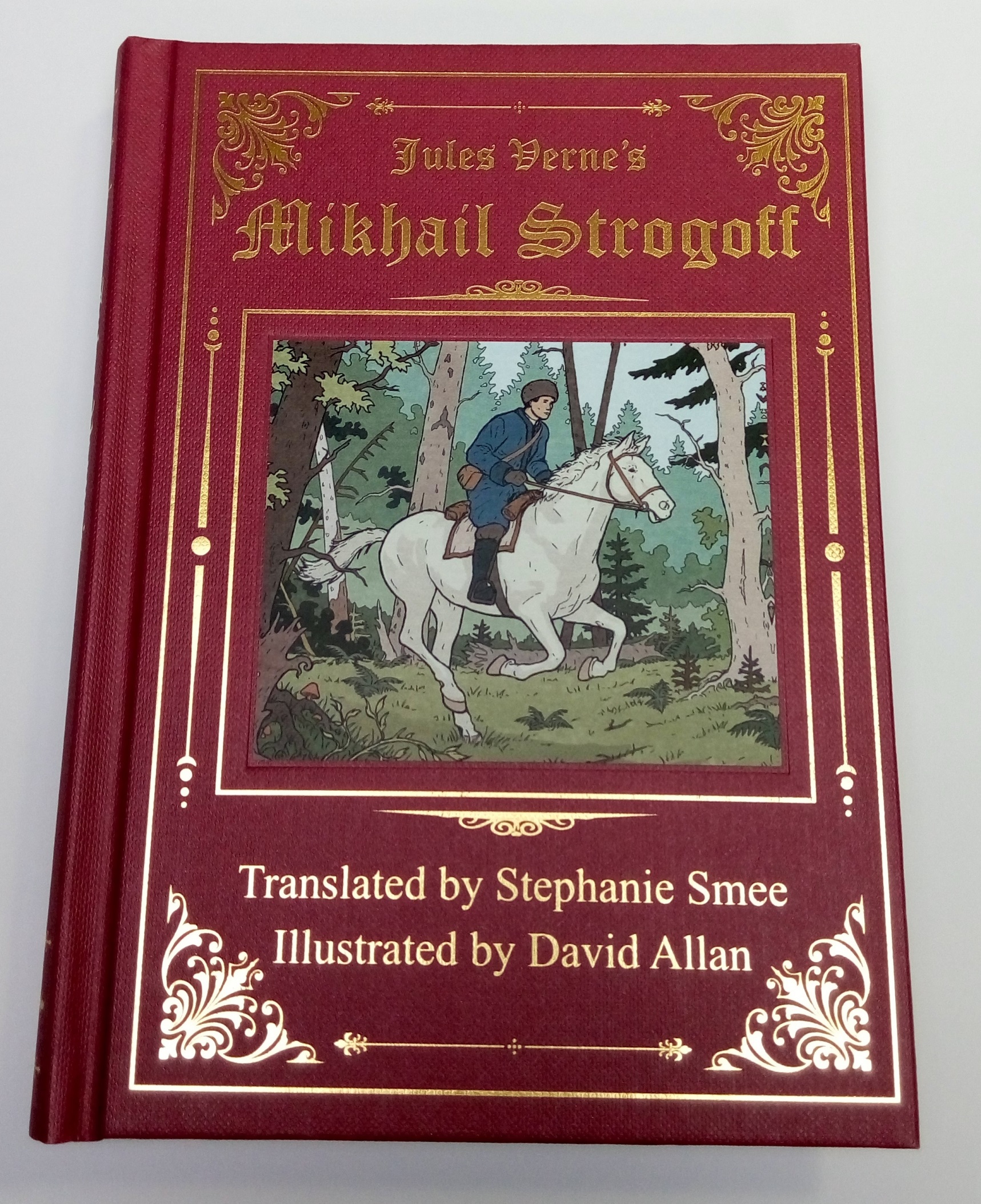
Well, that conversation has led to today, and the publication by Eagle Books of Jules Verne’s Mikhail Strogoff. This is the first English translation of this wonderful book in over a hundred years, and as one of the publishing team at Eagle Books, I worked closely with Stephanie on the project, impressed as ever by her great attention to detail and her thoughtful and perceptive understanding of the literary work she was translating. And so today, to celebrate the release of Jules Verne’s Mikhail Strogoff, I talk to Stephanie about translating the book–and the art of translation in general.

Stephanie, translating Jules Verne’s Mikhail Strogoff was a massive and painstaking undertaking. How did you prepare for it initially?
Like many Anglophone readers, I was really only familiar with those books of Jules Verne that have always been popular with English readers… Around the World in Eighty Days, Twenty Thousand Leagues Under the Sea, and I confess it had been many years since I had read those tales.
So, when discussing with you possible ideas to pitch to English language publishers, your enthusiasm for this historical adventure tale took me a little unawares. However, after getting my hands on an original French edition, and spending some considerable time researching, I realised how enduringly popular Michel Strogoff has been with its French readers. And I became increasingly nonplussed as to how it had slipped from the catalogue of Verne’s other, perennially popular tales which had been translated into English.
How does one prepare for a translation task such as this? A number of readings of the text, of course, which serves to allow your mind to “relax” into the rhythm of the text, but then the close readings are required, and the true breadth of Verne’s rich vocabulary and sentence structure sinks in. At that point, there’s nothing for it but to “dive in”!
 What challenges came up for you as you worked on the book?
 
mikhail strogoff finished 1 front coverVerne’s vocabulary is encyclopaedic, and one can almost sense the glee with which he displays his research into the historical, geographical and cultural specificities of his setting. I was very fortunate to have been given some magnificent 19th century French/French and French/English dictionaries by my father-in-law, Jim Schoff, and there is no doubt these proved very useful in grappling with some of the more obscure terms that came up from time to time. I also found some of the 19th century maps of Russia, Siberia and “Independent Tartary” (again, supplied by my father-in-law) absolutely invaluable. One editorial challenge, with which you were very helpful, was determining the appropriate transliteration of place names. Of course, Verne had transliterated place names from the Russian cyrillic into 19th century French. We then had to settle upon the appropriate way of spelling all of these names for our 21st century Anglophone readership while remaining authentic to the historical setting of the novel. As readers will be aware, customs surrounding the spelling of Russian names can be a moveable feast and often differ from one current newspaper or novel to another, depending on the editorial decisions made. The historical maps I had at my disposal were certainly useful, but again, it was customary in the 19th century for many mapmakers to use French spelling of Russian place names, as it was assumed that educated readers and scholars would have French at their fingertips and unfortunately, we can’t make such assumptions for our readership anymore!  
 
I did often wonder how translators used to manage before the internet allowed us access to so many superb resources, including to such things as 19th century accounts of travellers making their way through the same or similar parts of the world as our hero, Mikhail Strogoff! Images of Tartar battle dress or Siberian towns which I was able to access through Google books often allowed me to create a mental picture of the word-image I was trying to paint with my translation of Verne’s detailed text.
Verne’s narrative is quite straightforward but his style is richly laced with idiomatic and other flourishes. How did you capture that very particular spirit?
 

The longevity of Verne’s popularity, in my opinion, derives from his masterful skills as a storyteller. His tales are built on a driving narrative force that reveals itself to the reader – and thus, to the translator – as we turn the pages. Verne is a great “scene-setter”. And so, he interlaces his chapters with scene-setting descriptions, often packed with information, followed by “lighter” chapters of spirited dialogue. There is nothing staid about his evocative descriptions. Rather, he successfully evokes a landscape which will then be the setting for the following dialogue between his characters, all of whom are very brightly drawn, from the main protagonists, Mikhail Strogoff and Nadia, to the testy muzhik responsible for leading them across the Urals, and to the jocular journalists who act as the entertaining Greek chorus to events as they unfold. All of this to say that the

Strogoff 6

Illustration by David Allan

translator’s task really has to be to imagine herself into the landscape, listen to the rhythm of the descriptions and the dialogue and try to render that same rhythm into English. Where there is a particular urgency to the events unfolding on the page, I’d like to think that a good translator will be able to reflect that same urgency – whether it’s as simple as adhering to similar sentence length, or perhaps through a choice of words that will help make the narrative pop and crackle with that same sense of urgency. Of course, 19th century literature often uses tenses  and moods that are rarely employed in modern literature and ideally, those grammatical nuances will be reflected in the English too, although there is a fine line to be drawn sometimes when translating tenses which would perhaps seem “clunky” or awkward to a modern reader’s ear. As for the dialogue, there is no doubt Verne’s own skill in drawing his characters rendered it a joy to translate their dialogue as it meant I had little difficulty imagining myself into their conversations and under their skins.

At this point, I should also underline my gratitude, not only to my editor and publisher–yourself!–but also to my father, Michael Smee, whose assistance in proof-reading – offering second and third pairs of eyes and ears to “hear” the rhythm of the text – were quite invaluable.
How different was it working on this translation as opposed to those you have worked on before, such as the Countess de Ségur’s classic children’s books?
 
The translation of Mikhail Strogoff was indeed quite an undertaking, and in this respect, it really felt quite different to sitting down to translate the Countess de Ségur’s books, which although quite lengthy for their genre, have a considerably younger target audience to that of Strogoff. (That said, I just received a very enthusiastic message from my 11 year old nephew telling me how much he loved this Mikhail Strogoff finished 2 back coverlatest translation, but that while he had been waiting for his copy to arrive in Boston, he had eagerly revisited all of my translations of the Countess’s books, so there is obviously a little bit of audience cross-over!) In attacking a work like Strogoff, there is a different level of stamina required both in respect of the novel‘slength and the complexity of its vocabulary. Julie Rose’s masterful translation of Les Misérables of course takes that degree of difficulty to a different place altogether! Verne and the Countess de Ségur did at least share some similarities of the epoch in which they were written, being works penned in the 19th century.
Russian-French writer Andrei Makine, in one of his novels, Le Testament Francais, has his narrator say ‘the translator of poetry is the poet’s rival; the translator of prose is the novelist’s slave.’ What is your opinion? Do you have a philosophy of translation? 
 
I can quite understand narrator’s standpoint in Makine’s novel. It suggests a degree of “freedom” that perhaps a translator of poetry might enjoy, compared to the prose translator. But I’m not sure I agree entirely.
While the quote from Makine acknowledges the “originality” of the poet/translator’s new work, I disagree with the suggestion that the translator of prose is in any way more the novelist’s slave, to use that same imagery.  The rules relating to the translation of the ‘form work’ and ‘scaffolding’ of prose might be different to that of a work of poetry but at the end of the day, translators of prose and poetry are both working creatively and originally, both limited by a desire to remain as faithful as possible, not only to the original text, but to its emotion and rhythm. In many ways, as illuminated by the comments below of John Edmunds, renowned translator of the verse-dramas of the likes of Racine and Corneille, translators of poetry might feel more “enslaved” by the need to adhere to the particular poetic structure and rhythm of the original work.
As a translator, I stand most in awe of those who translate poetry but are they the original poet’s “rival”? A good translator of poetry is truly not just any ordinary linguist – they must hear the poetic rhythm in the source language and be able to recreate that beauty, that mystery, that imagery in the target language. It requires decisions about meters, rhyming – whether it is best to try to retain those rhythms in the target translation or stray a little from the source language in order to recreate a rhythm that somehow best captures the original imagery and magic of the poetry.
I recently read John Edmunds’ notes on his extraordinary translations of the plays of Corneille, Racine and Molière (Penguin Classics, 2013). They are illuminating, and in fact suggest that the translator of these “verse-dramas” are, in a way, just as much these play-wright/poet’s slave as their rival. He says:
A translation intended for performance not only must be immediately intelligible to the listening ear, but ideally, I have always thought, should be capable of delivery by a putative bilingual cast in precisely the same way in either version. Like musical scores these verse-dramas have their crescendos, staccatos and rallentandos: in the new medium they need to be preserved. This can be achieved only by maintaining the sentence-structure so that the actor’s breathing-pattern is reproduced, because the pulsation of the performer’s vocal energy is the life of the play. And, clearly, the action has to flow at the same pace as the original. This necessitates a line-by-line rendering.
 
A play written in verse is truly recreated in another language only when it has the formality of disciplined verse-structure. Which form to employ?
 
And Edmunds then goes on to discuss his choice of Shakespearian blank verse “which has a driving impetus and the rhythm of colloquial speech” over the English alexandrine which, he suggests, is “too stately for drama; and the rhythmic beat of our heavily stressed language does not need rhyme to create form.” He also comments that rhyming couplets can sound jokey, at least to British theatre goers “reared on pantomime.” Ultimately, he says, the translator can only do his best with the tools available to him in his own language in reverence to the “supremely gifted authors” one has the privilege of translating.
My own “philosophy” of translating? Many scholars and practitioners have penned many thoughts on this topic and I’m not sure I should be so bold as to add my own. I do know, like John Edmunds, that I feel an enormous sense of privilege to be working as a literary translator, particularly translating the work of a literary figure such as Jules Verne. And even though I am not a translator of poetry, I also know that beautiful prose, too, has its own rhythm, its own fluidity, its own internal mysteries which any good translator must try to encompass in their work. So, if a translator can recreate that original sense of wonder and excitement generated by any good piece of literature, whether it be a work for children or the most fiendishly obscure piece of poetry, then perhaps the translator has succeeded in her task.
 
It’s been said that there aren’t enough novels from non-anglophone countries translated into English. Would you agree? And why do you think that is? 
 
Yes, indeed I do agree – as both an avid reader of translated literature and as a literary translator! Although I hasten to add that I have been very, very fortunate to have a number of my translations published beautifully by both Simon & Schuster (Aust) and of course, Eagle Books. That said, Linda Jaivin, in her essay Found in Translation published in the Quarterly Essay (issue #52, 2013), referred to statistics that are enough to make any literary translator cry.
 “[H]alf of all books available in translation around the world have been translated from English, and only 6 percent are translated into English. The rest are translations between non-English languages… In 1950, American publishers produced 11,022 books, of which 563 were translations. In 2010, the number of books published there climbed past 200,000, but only 341 were originally in other languages. … In 2012, according to Bloomberg, American publishers bought translation rights to only 453 foreign titles; figures in the UK are said to be similar.”
And, she goes on to say, there is no reason to believe the situation is any better in Australia – in fact, she says, it’s probably more dire.
Why is this the case? There are many reasons, but most of them come down to the fact that English has become the “default” language of the world. And at the same time as the rest of the world has adopted an educational approach that emphasises the need to learn English, largely for trade reasons, the number of people who still learn foreign languages in English speaking countries is plummeting. This can only lead to serious cultural insularity and, while learning a foreign language is not an easy task, as Jaivin acknowledges, “a sensible corrective is access to a rich body of global literature in translation.” Yet we are failing on that front, too. Monolingual publishers/editors make it difficult for foreign language publishers to sell their works into the English language market, as they are forced to rely on potted descriptions, quickly translated excerpts, and, only if they’re lucky, some healthy sales figures or reviews in the original language market. The same difficulties confront literary translators trying to pitch ideas to Anglophone publishers. Even when books have earned their stripes in sales and reviews in their native market, I have often been met with the response: “translations are very hard to find space for in the market”.
 
Why  they are any harder to find space for than untested English language books is quite mysterious to this literary translator. Sales in Anglophone markets of Pippi Longstocking and Asterix would, I’m sure, rival sales in their own market, due to their very skilled translators and to the fact that they are quite wonderful books! Yet I do know why. In a market where publishers are being forced to tighten their belts, there is little cash to spare to pay for English language publishing rights, as well as a skilled translator. And I can only assume also that sales and marketing teams must know there is an inherent reluctance or suspicion on the part of readers when it comes to foreign literature. Fortunately, at the same time as so many of the large publishing houses are publishing fewer and fewer works in translation, there are increasing numbers of independent publishers, like Eagle Books, who recognise the need to take a stand against the cultural hegemony of the Anglophone publishing industry and who are making it their business to publish works in translation.
Our wonderfully cosmopolitan and plural society deserves no less, particularly if we mean to engage in a meaningful, reciprocal and generous way with the billions of people on this planet for whom English is not their mother tongue. We need to be able to hear everybody’s stories!
What are you looking at translating next? 
 
I’ve in fact embarked on a terribly entertaining translation project with my Swedish mother. We are translating some very well-known (in the Swedish market) children’s stories by Gösta Knutsson about a little cat called Pelle whose tail was bitten off by a rat when he was a kitten. They were first published in Sweden in the late 1930’s-1940’s and Knutsson continued to write for many decades. They’ve been enormously popular in Sweden since they were first published.  The first three in the series are to be published next year by Piccolo Nero, the children’s imprint of Black Inc publishers.
I’m also working on some submissions involving the translation of some modern French novellas and short stories which I’m very excited about. They’re written in very different language to the 19th century text of Jules Verne, but I’m loving the challenge. They’re wry and erudite, fanciful and yet thoroughly modern… works that are very much for and of our time.

A joint celebration of World Poetry Day and The School Magazine

clive_last

School Magazine mascot

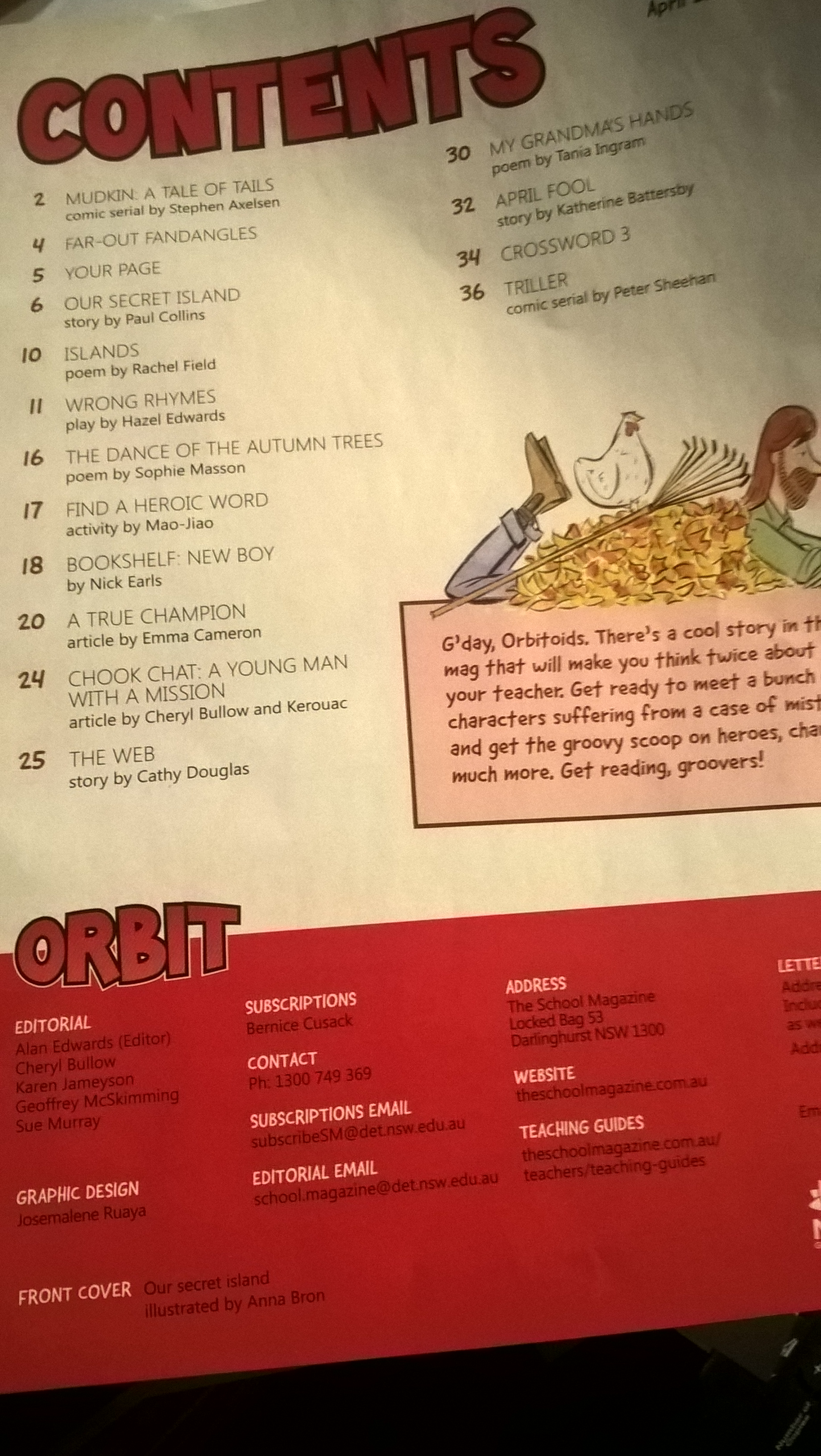
WP_20160229_14_40_48_Pro Jackie Hosking of Pass It On had a brilliant idea for today: jointly mark World Poetry Day and the 100-year celebrations of the world’s oldest continuously-running literary magazine for children. Australia’s very own wonderful School Magazine, by a blog tour highlighting children’s poetry published in the Magazine. And I’m delighted to be part of that fabulous blog tour!

First of all, I want to say that not only do I love The School Magazine, but I owe a lot to it. As a young reader of non-English speaking background who came to Australia as a school-age child, The School Magazine was one of the most important factors for me in discovering a world of English-language literature, both Australian and international. And later it nurtured me as an emerging writer, with my first story for children, Platypus Daybreak, published in the Magazine in 1988–and excitingly, it was illustrated by Noela Young, whose pictures I’d so loved as a child in Ruth Park’s The Muddle-Headed Wombat! (That is is one of the great pleasures of being published in the magazine–your pieces are illustrated by some of Australia’s most wonderful illustrators!) Over the years I’ve had lots of things published in the Magazine–short stories, articles, plays, and lately, poetry too. My recent success with poetry in The School Magazine has in fact also played an important part in not only encouraging me to write a great deal more of it–but also successfully submitting it for publication in anthologies both here and overseas, and for that I’m grateful once again to the Magazine.WP_20160229_14_41_27_Pro

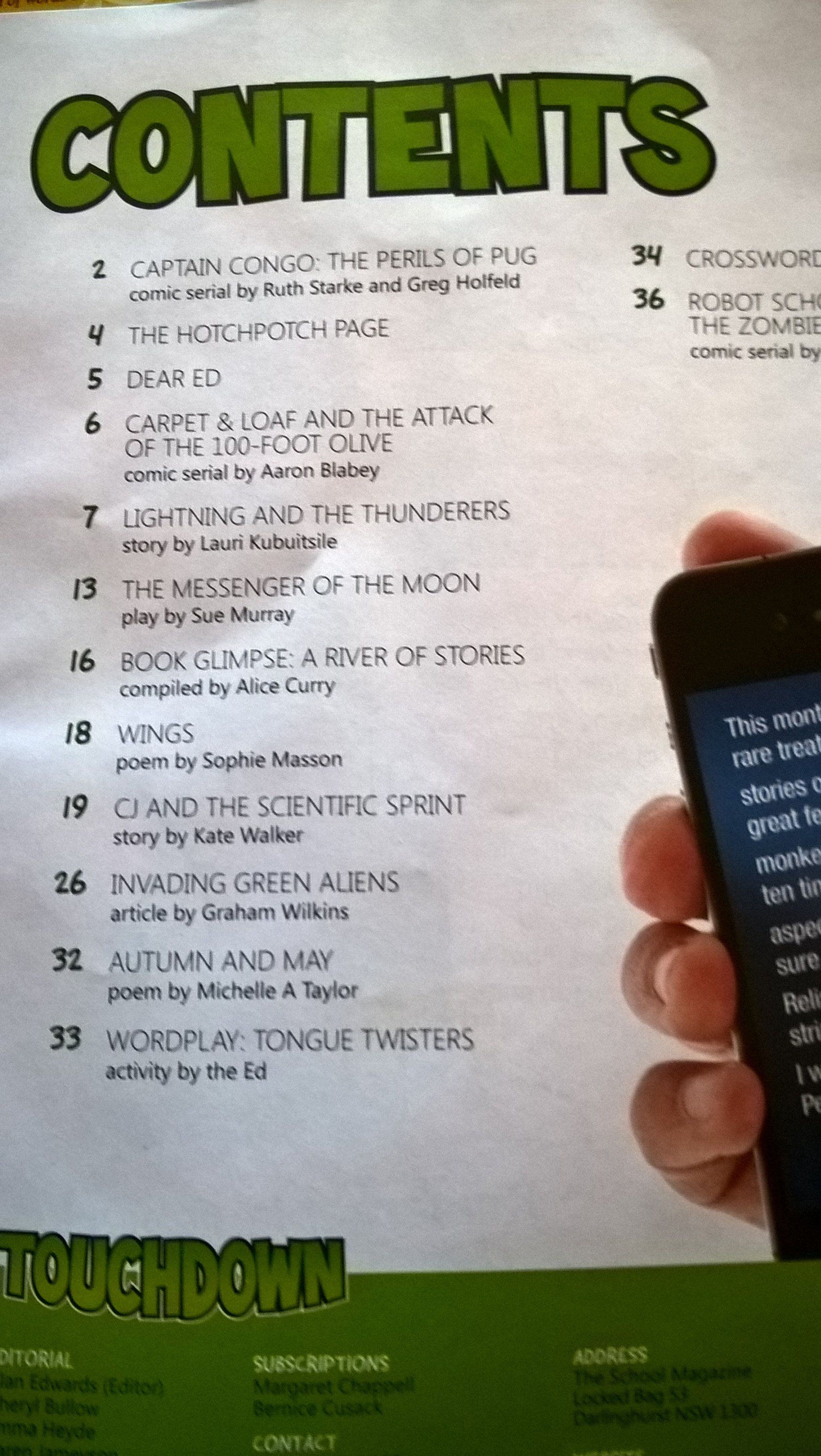
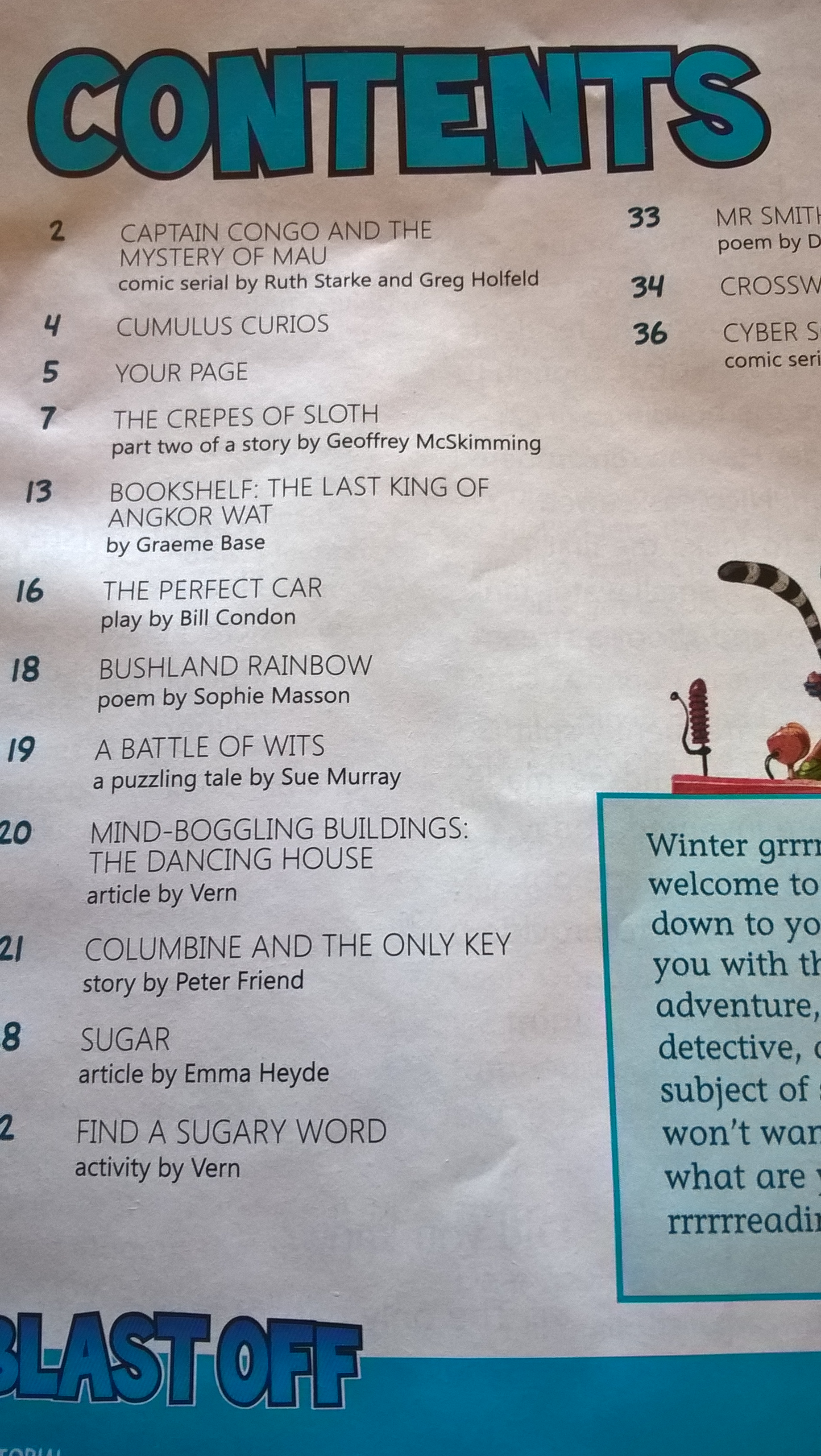
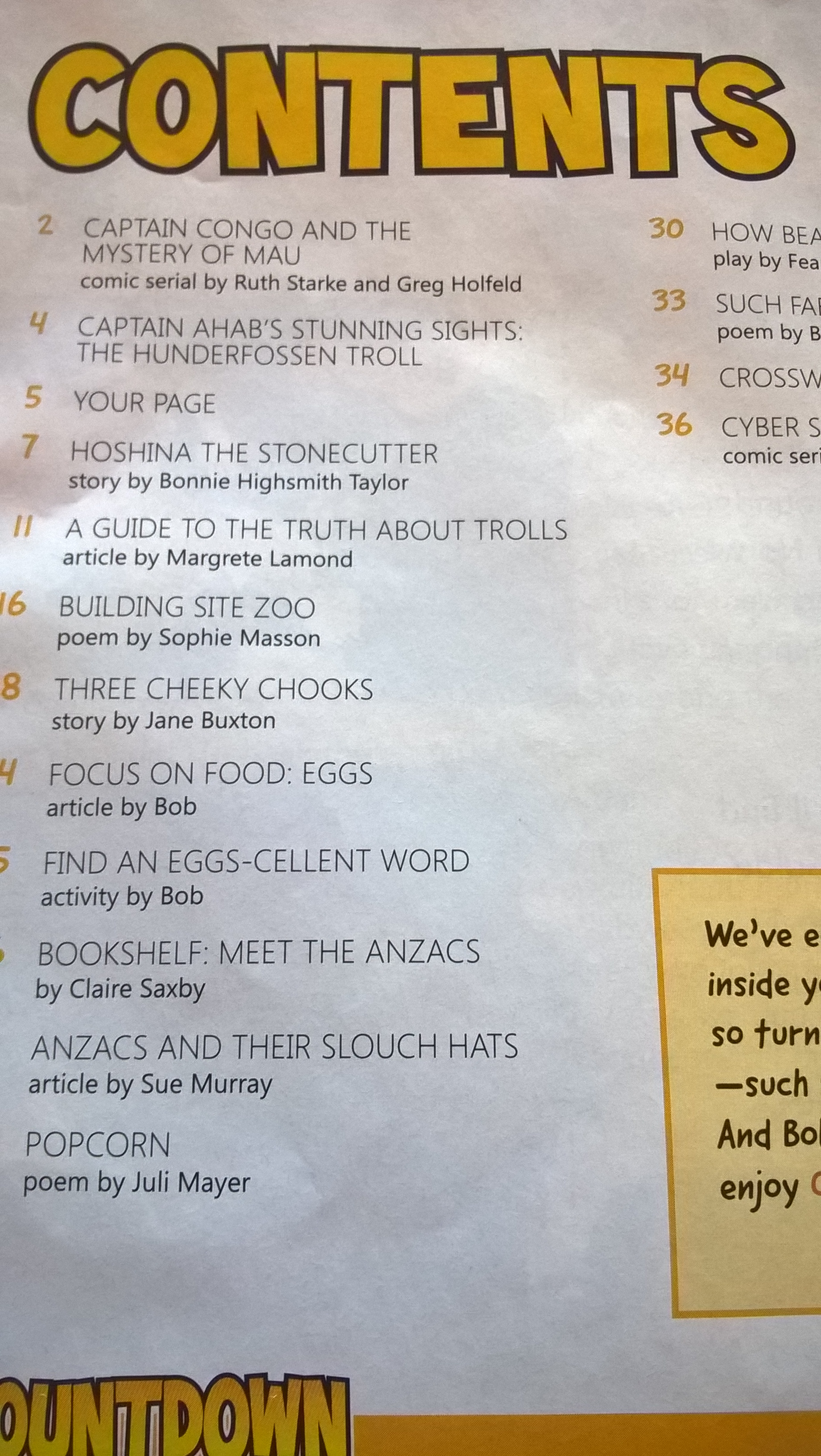
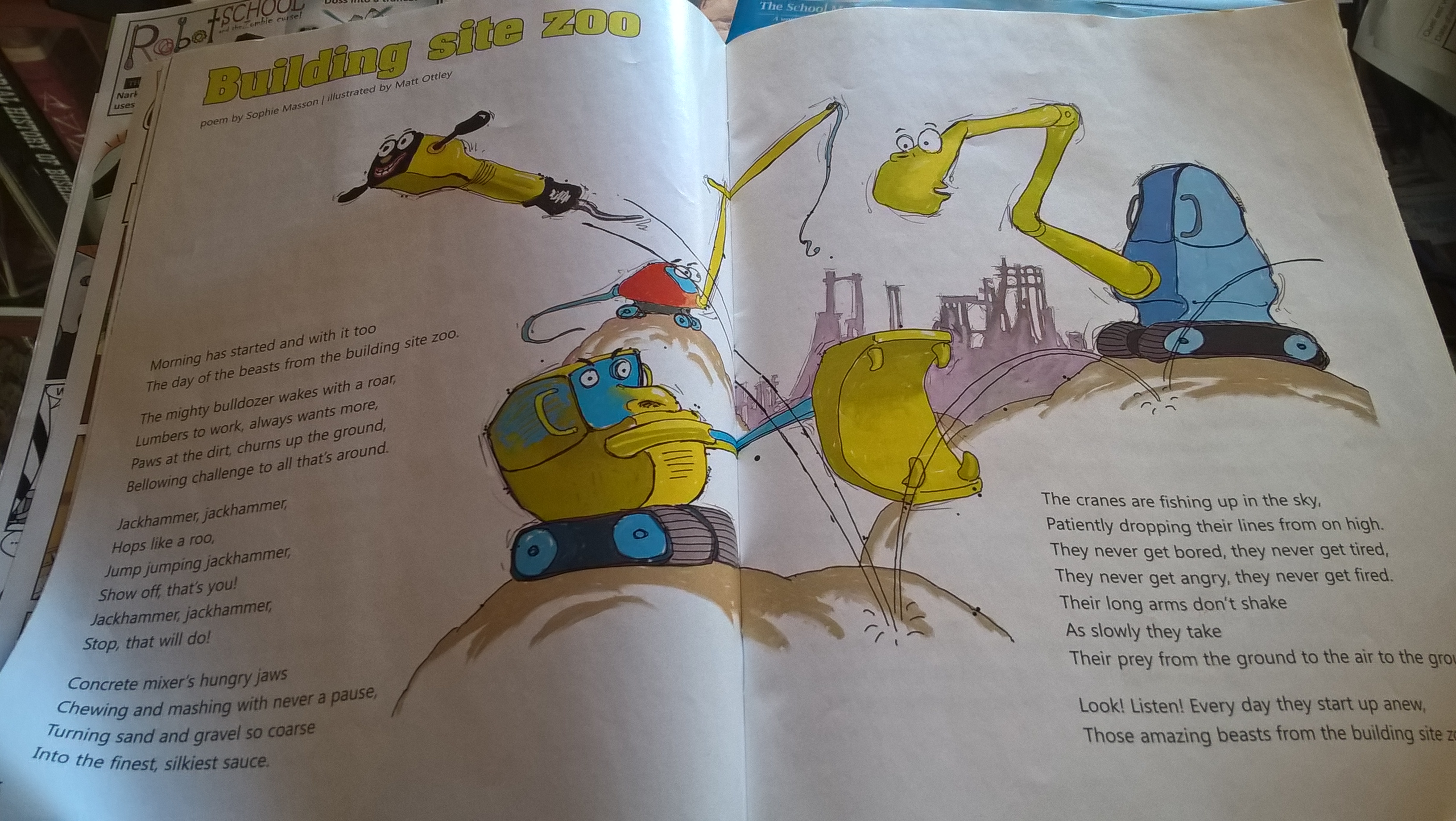
I’ve had three poems published so far in The School Magazine in very recent times–Wings in ‘Touchdown’ May 2014 (illustrated by the great Bronwyn Bancroft); Building Site Zoo in ‘Countdown’, WP_20160229_14_41_14_ProApril 2015; Bushland rainbow in ‘Blast Off’ , June 2015 (both illustrated by the wonderful Matt Ottley) and coming up in April in ‘Orbit’ this year, Dance of the autumn trees, illustrated by Bronwyn Bancroft.WP_20160319_07_08_27_Pro


So today I’m republishing here, below, the full text of ‘Building Site Zoo’ , with a pic of that page in the Magazine, for your enjoyment! Happy World Poetry Day to everyone–and a very happy 100th birthday to that great literary treasure, The School Magazine! And below the poem are links to other blogs on the tour.

(Please Note: The poem text is copyright to me, illustration reproduced from The School Magazine, copyright to Matt Ottley, design copyright The School Magazine. )

Building Site Zoo

by Sophie Masson

Morning has started and with it too

The day of the beasts from the building site zoo.


The mighty bulldozer wakes with a roar,

Lumbers to work, always wants more,

Paws at the dirt, churns up the ground,

Bellowing challenge to all that’s around.


Jack hammer, jack hammer,

Hops like a roo,

Jump jumping jack hammer,

Show off, that’s you!

Jack hammer, jack hammer,

Stop, that will do!


Concrete mixer’s hungry jaws

Chewing and mashing with never a pause,

Turning sand and gravel so coarse

Into the finest, silkiest sauce.


The cranes are fishing up in the sky,

Patiently dropping their lines from on high.

They never get bored, they never get tired,

They never get angry, they never get fired.

Their long arms don’t shake

As slowly they take

Their prey from the ground to the air to the ground.


Look! Listen! Every day they start up anew

Those amazing beasts from the building site zoo.

WP_20160229_14_41_56_Pro


Other blogs on the tour:


On fairytale inspirations: an interview with Kate Forsyth

kateforsyth_0Kate Forsyth is not only one of Australia’s most well-known and popular novelists, but also a recognised expert in the field of fairy tale studies. Today, I’m interviewing her about that central fairy tale inspiration.

Kate, you have long had a great interest in fairy tales, with several of your books taking their inspiration from them, and your contribution to the field recognised in the new edition of the Oxford Companion to Fairy Tales. What is it about these stories that so attracts you?

I like the way these tales are so old, and yet still so powerful and relevant to us now. They are filled with beauty and enchantment and strangeness, taking place in worlds in which anything is possible, and yet on a deeper level they are psychological dramas in which desires and longings and fears oxford companion to fairy taleswhich are universally human are played out and resolved. I also like the way they speak in an archetypal language of symbol and metaphor, like dreams, or poetry, or paintings.

There are quite a number of Australian writers mentioned in the Oxford Companion, including of course yourself and myself too, but also Isobelle Carmody, Margo Lanagan, Garth Nix and Keith Austin (though rather to my dismay, they left out Juliet Marillier). What do you think Australian writers can bring to those traditional tales?

 I find it very interesting that so many Australian writers are drawn to retelling fairy tales. Perhaps it is because these stories are very old, and have never been confined by geographical borders. Perhaps it is because fairy tales connect us to a universal subconscious that speaks across cultural and ethnic divides. I don’t know why – I do know that I think they do it wonderfully well!

You recently completed a PHD which had both a creative component–the novel Bitter Greens, which was published a couple of years ago–and an academic exegesis on the theme of bitter greensRapunzel, which will also soon be published. How did you find it, combining the creative and the academic? What were the challenges along the way?

I wrote Bitter Greens first, and focused all my energies on discovering and writing the story. Bitter Greens retells the Rapunzel fairy tale in a Renaissance Venice setting, interwoven with the true life story of the woman who wrote the tale as it is best known, the 17th century French writer Charlotte-Rose de la Force. Told from the point of view of three very different women, who lived in three different times, it took a huge amount of research – particularly when trying to discover the life of Charlotte-Rose de la Force, who was largely forgotten by history.

While I was researching and writing the novel, I took careful notes and kept my bibliography in order, to make it easier once I began my exegesis. Then it was just a matter of systematically working on successive drafts of the exegesis, turning all my raw data into something readable. It was fascinating but exhausting, particularly since I had a very heavy publishing schedule as well (I also wrote my The Wild Girl, about the Grimm brothers, while working on my doctoral exegesis.) However, I loved every minute of it again, and would love to do it again – it’s a wonderful opportunity to really delve deeply into a subject that fascinates.

You have used Beauty and the Beast as a core inspiration in your most recent novel, The Beast’s Garden. Can you tell us a bit about how you worked in those fairytale elements into the midst of the darkness of the Nazi era?beasts garden

In The Beast’s Garden, I took the Grimm Brothers’ version of the ‘Beauty & the Beast’ fairy tale (which is an astonishingly beautiful tale called ‘The Singing, Springing Lark’), and used its structures and symbols to inspire and inform my own story, which is set in the German underground resistance to the Nazis in Berlin. The use of the fairy tale is subtle and oblique; it provides the symbolic scaffolding of my novel. I am interested in new ways of using old tales.

What are you working on at the moment?

I am working on a new fairytale-infused historical novel, set in the passions, scandals and tragedies of the Pre-Raphaelite circle of artists and poets. Tentatively called BEAUTY IN THORNS, it’s the story behind the creation of a famous series of paintings called ‘The Legend of Briar Rose’ by Edward Burne-Jones. ‘Briar Rose’ is, of course, the Grimm version of ‘Sleeping Beauty’, and so I am exploring its themes of love, death, and rebirth through the lives of thirteen women intimately connected to the Pre-Raphaelites – it is such a fascinating story I am utterly engrossed at the moment (I’m still writing the first draft so I have a long way to go!)

briar rose 1

briar rose 2

Writing ghost stories: an interview with Benedict Ashforth

When I was a child, we lived in a 1920’s house in Sydney that though not all that old, unlike our ancient house in France, had a kind of elusively sinister atmosphere, complete with creaking woodwork and sudden shadows glimpsed out of the corner of your eye. At night, sometimes, I would lie there and imagine those scary characters in the ghost stories I’d just read coming up the stairs, and pinned to my bedclothes in sheer fright, would tell myself I would never read another ghost story again! But I did, of course, drawn to the form by its addictive combination of sharp precision and high-stakes atmosphere, and stories like WW Jacobs’ The Monkey’s Paw and F.Marion Crawford’s The Upper Berth stayed in my reading memory for good.

As an adult, I still enjoy reading–and very occasionally writing!–ghost stories, but the genre does not allow for mistakes and meandering, and it’s not often that you come across really satisfying modern examples of the genre, accomplished in both story and style: such as the novellas of  the modern doyenne of the ghost story, Susan Hill, and the Gothic-flavoured genre-benders of John Harwood. But recently, on Amazon, I discovered the work of Benedict Ashforth, an English writer whose elegantly creepy, chillingly atmospheric, precisely-told ghost stories and novellas offer an intriguing blend of the classic and the contemporary; the gruesome and the melancholy; the sinister and the sad, allied to a strong sense of place which is characteristic of the well-turned ghost story. Intrigued by the stories, I wanted to know more about the writer behind them, and this fascinating interview is the result.

Benedict AshforthCan you tell us about your writing career? What attracted you to writing ghost stories?

I write about ghosts because I know that they exist. I know because I have seen one. I did not imagine it. Someone else was with me and she witnessed it too. Sceptics would argue that it is possible for two people to imagine the same thing, but I would not. As clearly as I see the page on which I now write, I tell you that we saw another person that night, in that room, who had no absolutely no right to be there. I recognised him immediately – I had known him well, before his sudden death six months earlier. The person with me did not recognise him. She had never met him, but she saw him all the same. How did I know that she had seen him? She was screaming just the same as I was. How do you explain that? There’s an old adage amongst authors that you should write about what you know, and I know ghosts. Whilst I might not always tell the tale exactly how everyone would like it told, at the very least I can tell it with authority because I know that it can happen.  

It was the most terrifying experience of my life, but also the most enlightening. It was no longer a matter of belief or disbelief. It was a matter of certainty and fact. We are not always alone here, however much we like to think that we are.

I have always loved writing. I began with short stories and had some success getting in print in anthologies created by small publishing houses. I began writing Abbot’s Keep around five years ago but then shelved it because I couldn’t make it work. When I revisited the project three years later everything fell into place and I had what I thought was a decent little ghost novella. It seemed to be well received and this encouraged me to write more. 

My latest ghost story is VERONA. It’s about an infertile couple who take a short break to Italy only to discover they have awoken an ancient evil.VERONA COVER 4

You write within the classic tradition of the English ghost story, yet you have placed your stories very firmly in contemporary times, unlike, say Susan Hill or John Harwood, who situate theirs in the past. How do you combine the traditional and contemporary in your work?

I am always trying to drag the classic English ghost story from the past, into a more contemporary world, without breaking the form. I like to write in an era prior to the technological boom that changed the way we communicate. By doing so, I hope to create an ‘old school’ feel to the material before then reaching further back into the ancient past. I especially like the 80’s because this was the era that saw Hammer brighten our screens with wonderful technicolour.

I also try to combine the traditional and contemporary by setting the correct tone in the writing. By emulating a Victorian/early Edwardian prose style, I could write about almost anything but the reader will still know, hopefully, somewhere deep inside, that he or she is reading a ghost story.    

Ghost stories are nearly always short–either novellas or short stories–and yours are no exception. What in your view is the reason for that?

Traditionally, ghost stories are told in an old house in front a glowing fire. Shadows dance and stretch about the walls like wretched souls. The tale cannot overstay its welcome but instead must be factual and to the point, building the atmosphere at the outset before gradually sucking the audience into the darkness. It cannot be too long, else the next person will not have their chance to tell their tale. I believe it is the same on the page. The expectation is that fear must be induced gradually but within a reasonable timescale.

The other factor here is that, as an author, you only have a certain length of time in which to suspend the reader’s disbelief. I might well be wrong about this and I probably am given that some ghost stories are full length novels but, from a personal viewpoint, the best ones that I have read are nearly always the shorter ones.

AK ASHFORTHMost of your stories are set in the English countryside. What is it about those settings that you find particularly inspiring?

The English countryside is brimming with history, both modern and ancient. I’ve always been fascinated with what lies just beneath the surface. Whilst Abbot’s Keep is a fictitious Tudor house nestled deep in Berkshire countryside, the actual setting is real enough. I grew up there. Furthermore, there really is a local legend that gold is buried in that area, hidden by an abbot during the Reformation shortly before he was hung drawn and quartered at King Henry VIII’s request.  And so whilst Abbot’s Keep is predominantly a distant homage to MR James’ The Treasure of Abbot Thomas it is also a story that grew from a local history and geography.

The other element I find inspiring about the English countryside is its loneliness. Whilst it is beautiful and green and unmistakeable, it does bring with it a sense of isolation. Again, hopefully this worked well in Abbot’s Keep. I wanted the bleak and remote location to reflect the main characters loss and loneliness. In my ghost story, VERONA, I wanted Dorset’s Jurassic coast to bring with it a sense of ancient history. There really is evidence of a Roman settlement in that area.

The English ghost story is far and away the most developed in the world. Do you think there’s a reason for that?

The ghost story has a tangible and well deserved place in English literature. Even Dickens couldn’t resist it.  Its form has developed and altered over the years but it always possesses the same emotion and tone. Aside from anything else, I think that the quiet, slightly proper and very English logic, juxta positioned against the, some might say, illogical concept of ghosts creates a unique concoction on the page.

Old sins casting long shadows, buried secrets coming back to haunt and someone hell-bent on finding the truth: the ghost story and the murder mystery have several things in common, yet one major difference of course is that there is no real solution to the central issue in a ghost story, and no order being restored. These days, there’s a lot of murder mysteries but not so many ghost stories published– why, do you think?

In simple terms I believe there is a bigger market for murder mysteries. But it shouldn’t be too much of a leap. As you say, ghost stories and mysteries are inseparably linked. I would love those readers who hardly ever read ghost stories to read more.DARKEST PAST COVER FINAL one-page-001

By bringing the ghost story into a more contemporary world, I hope to achieve this, although I know it is a very long way off. The massive success of Susan Hill’s Woman in Black has helped to bring ghost stories to the fore once again and if I can ever achieve half of what she has I would be forever happy.

What have the reactions of readers been like? And on a practical level, as an independent author, how  challenging–or not!– has it been to get the books noticed?

The reaction of the readers has been incredible. The amount of reviews, both good and bad, means I get a very clear and unbiased opinion of the work. As authors we all like a ‘good’ review, but in reality it’s the critical reviews that have had the biggest impact on my work. I read every single one and take something from it. I think you only get better when people are brutally honest in their views. I encourage every reader to review the work­ – whether it’s positive or negative – I want to hear it.  

It is immensely challenging to get your work noticed but it is rewarding if you get it right. I send paperback copies everywhere I can for review. I find that it’s pointless sending electronic copies. They hardly ever get read. I send something that the reviewer can touch and see. Hopefully, the recipient might just open and start reading and, even more hopefully, he or she might just like it enough to finish the book and even say something about it. 

I was lucky enough to be picked out for Kindle Singles for both VERONA and Abbot’s Keep and that has certainly helped my work to reach a wider audience. I will be looking for an agent shortly, once I’ve finished my debut novel, No Contrition.

Who are your favourite writers, whether classic or contemporary, in this genre? And your favourite stories?

In my view, MR James set the standard for storytelling in this field, using England’s rich history and abundance of ancient locations to best effect. His stories were mysterious and intriguing, building a sense of dread without giving too much information and letting the reader conjure the nightmarish detail in his or her mind.  I especially love Casting the Runes.

Jonathan Aycliffe is also brilliant and has been a great inspiration. My favourite of his stories is Whispers in the Dark. Michelle Paver’s Dark Matter is also superb as is the work of Ramsey Campbell, Roald Dahl, Adam Neville, Susan Hill and Graham Masterton to name just a few. I also loved Paul Torday’s The Girl on the Landing. That is a brilliant book.

Follow Benedict Ashforth on Twitter.

Find Benedict Ashforth’s books on Amazon:

Australia

UK

USA

My post on mentoring, on Writer Unboxed

Today, I have a post on mentoring, from both sides of the fence–the mentor and the mentoree–on Writer Unboxed.

Here’s a short extract:

Nobody writes in isolation. Writers experience mentoring in one way or the other at every stage in their careers. Early writing mentors are usually teachers, family and friends. Later, as we take our first steps towards trying to build a career as a writer, other, more professional mentors can improve our understanding of craft, as well as give us the confidence to take those first tentative steps.

You can read the whole thing here.

Guest posting on Felicity Pulman’s blog

I have a guest post today on fellow author Felicity Pulman’s blog. Entitled, ‘A time traveller between worlds’, it’s about how my multicultural background and turbulent family history were more than bit players in turning me into a writer, and particularly a writer of fantasy and other speculative fiction.

Here’s a short extract:

One of the reasons why I took instinctively, from a young age, to reading and later writing fantasy, and also fiction with supernatural elements, is linked to something right at the heart of my childhood. Of course it’s often so for every writer, but in my case it has to do with something very particular. For the classic fantasy tropes of the journey between worlds, the sojourn in strange places, and the sudden irruption of a different, disturbing reality into the everyday is at the heart of my own lived experience as a bilingual person of multicultural background, with a family history that is to say the least, rather complex.

You can read the rest here.

My take on Shakespeare’s final years: a mix of novella and play

A few yshakespeare_williamears ago, I wrote a rather unusual–not to say odd!–piece of writing called Shakespeare’s Last Play, which is a mix of play and novella, set in Stratford, in the last year of Shakespeare’s life. Knowing it was unlikely to attract the interest of publishers, I published it myself as a short e-book through my PressBooks site. It’s available there for reading, free, on a Creative Commons license.

I re-read it the other day and thought it was worthwhile drawing readers’ attention to it again. Here’s the introduction:

I’ve always been fascinated by the fact that in the last few years of his life, Shakespeare retired to his native Stratford and to all intents and purposes never wrote another play, at least not under his own name(there is some indication he may have collaborated with others.) What makes such a great writer, so driven, imaginative and very much a part of London theatre life, suddenly fall silent? What might his life have been like, in those final years at Stratford? These questions, and reading somewhere that not long before Shakespeare’s death, his writer friends Ben Jonson and Michael Drayton and theatre manager John Hemmings visited him in Stratford, were the inspiration for this book.

I chose to write it in an unusual format, half novella, half play, as a way of evoking an atmosphere half-way between the page and the theatre.

You can read the full work here.