A foxy tale…

About ten days ago, I was sitting at my computer after lunch, writing, when I happened to glance out of the window which looks out over our front yard–and to my astonishment, saw a long, low, and instantly recognisable shape pass rapidly right in front of the pawlonia tree, right in front of my eyes. The fox was utterly oblivious to my presence behind the glass, utterly intent on one of our hens that was calmly scratching away near the front gate. It was only the flash of an instant that I was transfixed by the sight; and then I cried out ‘Fox!’  to David and rushed outside, yelling my head off. As I barrelled out of the door, the fox hardly deviated in his path, heading straight for the hen that still didn’t move, though the others were flapping around in panic, in my mind crying ‘Oh help! Oh fire! Oh fox!’  (a quote brilliantly expressing chooky panic which I’ve never forgotten, from Patricia Wrightson’s wonderful short novel, A Little Fear.) Then the fox suddenly seemed to clock me and my shouting and yelling, turned smartly, and ran out through the garden gate, splendid tail high, abandoning the chook hunt, and disappearing in a flicker of a moment in the long grass across the road.

All the chooks were safe, if a little nervous, except for the bird that the fox had zeroed on, which hardly even appeared to notice that she had escaped certain death. But if she had no apparent idea what had happened, I found the images from it kept popping into my head. Living in the country as we do, over the years I’d seen more than a few sad aftermaths of fox attacks, including on our own poultry; but I had never seen an attack in progress before. Indeed, I think it is a rare sight, though sometimes foxes are surprised in the middle of a killing spree. And I couldn’t get it out of my mind. Of course I’d not had any time at all to snap an actual photo of him (I say ‘him’ because the fox’s size clearly indicated it was a male), and never even thought of picking up my phone before I rushed out 🙂 . But my mind’s camera was clear and bright and vivid. And it clicked through snapshot after snapshot of those instants: it was simply extraordinary, to see that intentness, power and speed, expressed in one superbly built, supremely healthy and confident red body, ears pricked, tail streaming, sharp eyes fixed on that tempting plump prey. And it was also simply surprising–and reassuring, in a funny sort of way!– to know that my reaction, after that very first flash of stunned astonishment at the bold presence of the fox, was to rush out, without hesitation, to confront him and stop him in his tracks. I might be impressed by the sleek, deadly beauty of the fox, but I was certainly not going to let him get his teeth into our hapless, helpless cluckers.

But the fox thriller wasn’t yet finished; its star was not going to let us have the final word, with the thwarted predator sent packing once and for all. We kept the chooks locked up for several days, thinking that the fox would get tired of waiting and would move on to greener pastures. But the chooks weren’t happy, though their pen is large; they’re used to roaming around the block, eating grass and worms, pecking and scratching and dirt-bathing. Besides, what’s the good of having free-range birds if you keep them locked up like prisoners, even if it’s for their own good? So after a week, David let them out, just for a few hours a day, in the little orchard which is fenced and close to the house, and which he can keep an eye on when he’s working outside. All seemed well for a couple of days, and then one day we both had to go out on separate errands, and didn’t think of locking in the chooks. David got back before me–but the fox had got there before him, climbed the fence into the orchard–and well, one chook wasn’t so lucky as that first one. A young rooster lay dead and half-gnawed (ironically one we’d been raising for our own eventual chicken dinner!); but the carnage wasn’t as great as it might have been, because all the other chooks were unharmed, so the fox must have been spooked by something and taken off before he could add to his predator’s tally. And, oddly, the surviving chooks seemed hardly perturbed, no sign of any post-traumatic reaction, despite the fact they must all have been present when the fox killed their brother. Our own reaction of course was quite different to that first episode when the fox had been successfully routed; shame at forgetting to lock in the chooks added to shame at misreading the capacity both for patience and cunning of our vulpine adversary.

So of course now the chooks were locked up, and they’re still locked up. But the foxy tale hasn’t quite ended; because yesterday afternoon, working at my computer again, I happened to look up–and there he was again, a bit further away than the first time, creeping through the long grass near the pine tree, heading for the chook pen, bold as brass again, clearly still intent on checking out opportunities. The chooks were in no danger, the pen is utterly impregnable, as it is enclosed by netting wire not only on all four sides but on top as well: the only way he could conceivably get in is by digging underneath, a risky and time-consuming process that normally only a desperately hungry animal would take on, and this particular one, with his sleek body and shining fur, looks neither hungry nor desperate, but rather carries the air and the M.O of a boldly opportunist gourmet 🙂 But the sight of him still persisting in his campaign, despite the odds, was a signal to us that this isn’t over, not by a long shot, and that this outwitting–outfoxing!–tale was certainly not complete. And somehow, this episode seemed at last to really rattle the chooks, who last night at a time when they should have been cosily in bed on their perches, were pacing about anxiously outside in the pen, making the disturbed clucks that let you know something’s wrong. We went out to check of course, several times; there was no obvious sign of the fox, this time, but somehow there was a sense of his presence, hidden, watchful–waiting.

So my foxy tale ends there, for the moment, maybe waiting, like the fox, for the final twist. And it made me aware of course of our own conflicted reactions to what happened, and to the fox itself. It’s not exactly uncommon, those mixed feelings. People have always had an ambiguous relationship to foxes: seen both as bloodthirsty adversaries, like wolves, but, unlike wolves, traditionally also admired for their patient guile and effrontery. Fiction and poetry are full of that ambiguous image of the fox, from Roald Dahl’s Fantastic Mr Fox, where the fox is clearly the hero, to the disturbing English folktale, Mr Fox, a version of Bluebeard, where the main character is basically a serial killer. But it is perhaps in medieval French literature that we see the most compelling and extraordinary picture, in the shape of the anonymous episodic novel Le Roman de Renart. This represents its fox anti-hero, Renart as the very epitome of the clever, unscrupulous, risk-taking outlaw who preys on the stupidity and herd mentality of the geese and chicken mainstream, but also outwits, through a combination of hypocritical flattery and daring moves, the much more powerful and dangerous, but much less smart, wolf and bear lords. So hugely popular and influential was this novel–which is still both remarkably entertaining and highly disturbing in equal measure–that it changed the very name of the animal itself in French. In Old French, the word for fox was ‘goupil’, but after Le Roman de Renart, that name changed to the given name of its  main character. And so ‘goupil’ became ‘renard’, which is still what it is today.

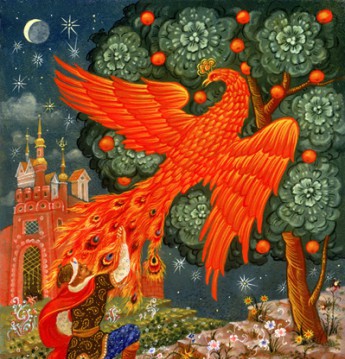
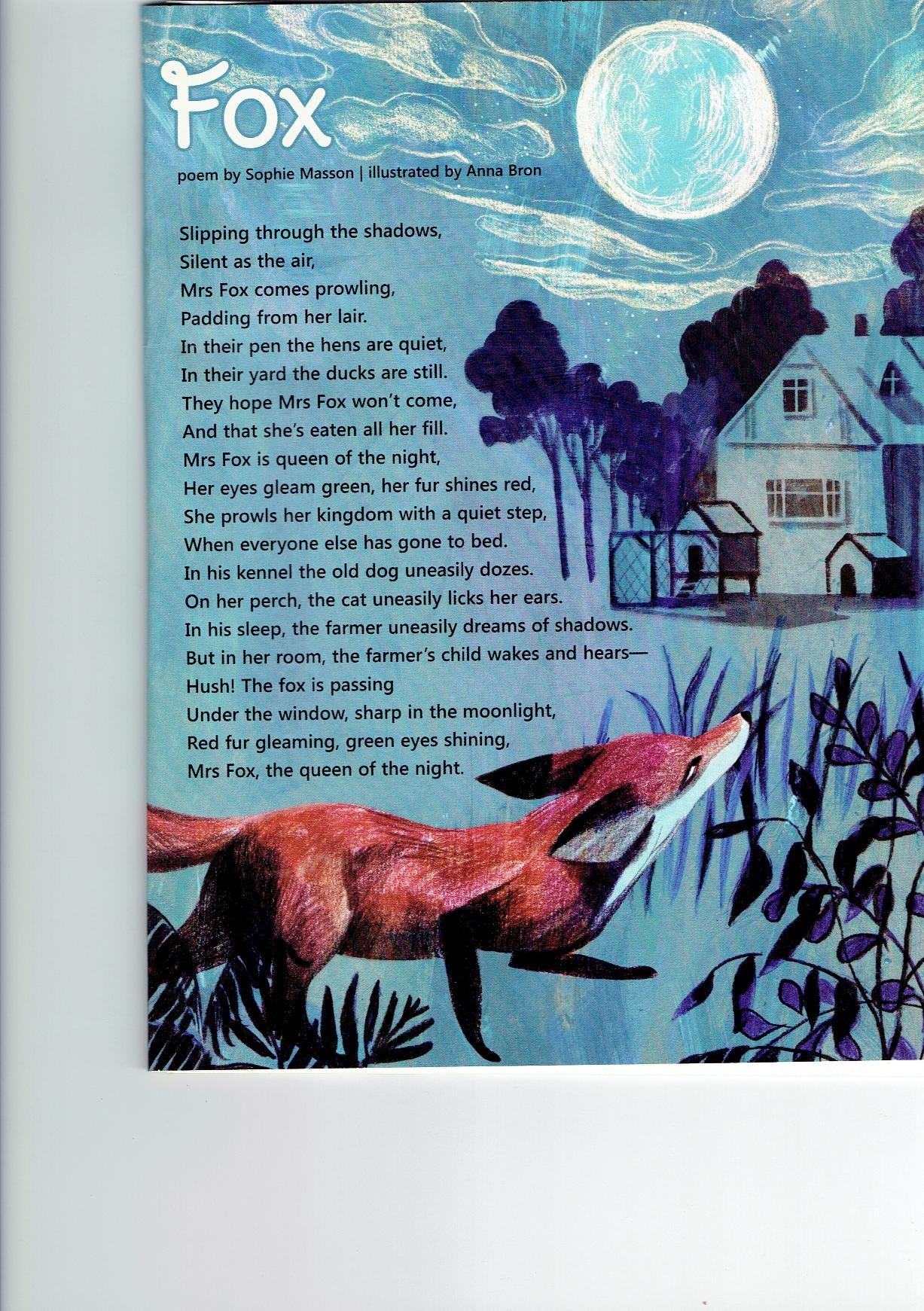
A few years ago I wrote a retelling of the classic Russian folktale, The Rooster with the Golden Crest, where the tables are turned on the crafty fox by the nice but stupid rooster’s resourceful friends, the cat and the thrush, which was published in my picture book with David Allan, Two Trickster Tales from Russia; and it’s certainly more than possible that one day some fiction of mine will come out of these recent personal foxy encounters experiences; but right now I’d like to finish with a poem I wrote a couple of years ago, after hearing a fox’s screaming call late one night whilst at my father’s place in France. The poem was published later in The School Magazine. In this poem, it’s a vixen, not a dog fox, that’s prowling…
 

Looking forward to Scone Literary Festival

I’m really looking forward to the Scone Literary Festival, which kicks off on Friday March 13 with a schools program and goes all through the weekend with a fabulous program of talks, readings, workshops and social events, with a great cast of speakers and presenters. There’s also a couple of writing comps, see here.

I’ll be presenting on the Friday at Scone schools and library with the fabulous illustrator Kathy Creamer, and on the Sunday, I’m giving a workshop called Journey of a Book, a practical and entertaining look at the whole writing and publishing process, based on my experience both as an author and a publisher. See the pic at left for all details of the workshop, and how to book.

You can check out the whole three-day program here. 


Link to Stories Connect film: and happy New Year!

I’ve put a new page on my blog for videos (of interviews and other things) and the first thing I’ve put up  is a link to the beautiful Stories Connect film, about a unique project which I was proud to have co-ordinated for the New England Writers’ Centre. Have a look at it here.

And while I’m here, I’d like to wish all my readers a very happy, healthy and inspiring new year!


The year’s favourite books: Susanne Gervay

Today I’m delighted to welcome author Susanne Gervay to my blog, to talk about her favourite book for the year.

Glass Walls, edited by Meenakshi Bharat and Sharon Rundle, 2019, published by Orient Black Swan ISBN 978 93 5287 679 2

The stories in this anthology  are hilarious at times, moving at other times, and make you reflect on who you are. It opens discussion on all sorts of prejudices, even when we think we don’t have any.  It’s those little prejudices that can develop into major prejudices impacting on us and the world.  Oscar Wilde wrote – ‘Most people are other people.’ We’re the other people. The writing is so good, from Australian and Indian authors. You just have to read the new story by Bruce Pascoe about fatherhood and identity. It was funny and real and emotionally powerful. There are stories by David Malouf, Roanna Gonsalves, Libby Sommer, Debra Adelaide. It’s a feast of stories.

Susanne Gervay lives and loves the author life of sharing story to adults and kids. Her latest books are Shadows of Olive Trees and a picture book The Boy in the Big Blue Glasses. Connect with her on social media – FB – sgervay; twitter – sgervay; Instagram – susanne gervay; website – www.sgervay.com

A serendipitous meeting and a discovery about a treasured manuscript

I was really delighted yesterday to meet the wonderful Dr Joko Susilo, world-renowned dhalang (master of traditional Javanese shadow-puppetry, the wayang kulit) , who’s been Artist in Residence at UNE  for the last few weeks. An eighth-generation dhalang from Cenral Java, Joko has been based in New Zealand for some time, and travels around the world to give performances, talks and other presentations.
I contacted Joko to show him one of my family treasures: a rare, handwritten Javanese-language ‘Boekoe Pedalangan’ or ‘Book of Puppetry’, which my French parents, who were very interested in the wayang kulit and Javanese culture generally, bought when they were living and working in Java in the late 50’s and early 60’s (and where I was born). I’ve always been in awe of this book, and was thrilled when my father gave it to me a couple of years ago, but I have  wanted for a while to ask someone who knew what they were looking at to let me know me more information about the book. Well, Joko was absolutely the perfect person, as he is not only a practitioner but also a respected scholar of the extraordinary and magical art of wayang kulit.
He was very interested indeed in the manuscript and I learned quite a bit about it from him as he leafed through it: that it came from the Central Javanese city of Solo(which like Yogya is at the heart of Javanese traditional culture), that it was written in High (literary) Javanese by a professional dhalang, someone well-educated and highly-literate–not very common at the time, Joko thought it might possibly have been someone who worked within the kraton, the palace, of Solo– and that it contains the full script, including narration, instructions to puppeteers and gamelan orchestra, as well as actual gamelan notation, for a famous epic wayang kulit play which goes on all night (at least 9 hours long).
As well as that, there is a shorter section at the back, which Joko revealed is actually an unusual collection of traditional Javanese magic charms and spells. The charms are for all sorts of purposes including one, Joko was amused to discover, against sleepiness (sleepiness being an occupational hazard of course for dhalangs who are performers of all-night plays!) He confirmed that this is indeed a very rare book, especially given its excellent state of preservation(my parents having very carefully looked after it for decades, ever since they first got it and of course I’ve done the same). So fantastic to learn more about this treasure–and Joko is keen to transcribe the book in its entirety at some stage, which is wonderful!

Cover reveal for A House of Mud!

I am absolutely delighted to be able today to reveal the gorgeous cover of A House of Mud, my picture book with the fabulous Katrina Fisher, to be published by Little Pink Dog Books in July 2020. Isn’t it just wonderful!

Here’s the blurb:

Building a mudbrick house is an adventure for everyone—Mum, Dad, kids and even Tess, the family dog! Heading out to the block to help make bricks, seeing their house take shape week by week, the children decide that Tess needs her own house too…

With warmth, sensitivity and liveliness in words and pictures, this book recreates the fun–and work!–of a special family experience, building your own unique house.

On the Little Pink Dog Books site, you can also see a few beautiful images from inside the book.

This is a very special book for me, as it’s inspired by our family’s real-life experience many years ago of building our own beautiful mudbrick house (which my husband David and I still live in), by hand, from scratch, and using clay from our own block. And our three lively young children and lively young dog Tess were very much involved at many stages of what was quite a long process (somewhat speeded up for the purposes of my text, of course! )

The book itself has had a long gestation–much longer than the house itself in fact 🙂 It first saw life in an earlier form as a short story in The School Magazine (which was illustrated by the lovely, sadly missed Kim Gamble) and which I then later rewrote and edited and tweaked several times till it was just right as a picture book text: or so, I am very happy to say, thought the wonderful Peter and Kathy Creamer from Little Pink Dog Books, who loved it as soon as they read it. And they found the perfect illustrator in Katrina, who has conjured a beautiful, touching and fun visual narrative–look forward to showing readers a couple of samples from the pages once they are ready!

Here below are a few photos from the actual family mudbrick building experience…including, of course, the children, Pippa, Xavier and Bevis, now of course all grown up–and Tess, who lived a happy long life but who passed on quite some years ago and is now immortalised in this book…

Guest post by Simon Groth on crowdfunding an innovative book project

Imagine… ‘a novel with twelve chapters that can be shuffled into any order, yet will always present as a cohesive story arc.’

Imagine… ‘a print run where each individual copy contains chapters that have been arranged at random, each one a unique version of the story, created just for you.’

Imagine…’a story with nearly half a billion possible combinations, with each copy being one of a kind, yet all of them telling the same story.’

Imagine…Ex Libris, an extraordinary, innovative book project which can be supported right now in a crowdfunding campaign. The brainchild of writer and publishing professional Simon Groth, Ex Libris promises to be both a fascinating literary/publishing experiment and an intriguing reading experience.

I’m delighted to be bringing readers today a guest post by Simon about the experience of crowdfunding this innovative project. Enjoy–and consider supporting the campaign!

Talking to an imagined audience

by Simon Groth

It was late. It had been a long day at work, but now all was quiet. My family slept or futzed around on phones upstairs. I had set up the microphone and my phone on a tripod. I was ready to start talking to myself.

Well, not myself exactly. Talking to an imagined audience is something I am familiar with, after all it’s what I’m doing right now writing these words. I just don’t normally do it out loud. I had prepared a script that ran for about three and a half minutes that I more or less memorised. I just had to deliver it. Emote. Make it sound casual. Shoot it straight down the lens.

This wasn’t my first attempt. I’m not a natural in front of the camera and, a couple of weeks prior to this, I enlisted a friend to help me. She had an SLR camera and put together a nicely framed and lit version of an almost identical speech. The experience was crucial in helping me find my feet, but I wasn’t satisfied with the performance. I looked uncomfortable, aware that I was using up someone else’s time with take after take. I also wanted to tweak the text, now I heard it back in my own voice. So I made the decision to try again in my own time and keep going until I had something closer to what I needed.

I have gained a whole new appreciation for what actors do. I had to take breaks every now and then. After a while, I stopped counting takes. I repeated the same phrases over and over, trying desperately to make it sound like I was just talking off the top of my head. I don’t know if I succeeded in this, but the video that resulted seems to be doing its job.

All of which is a long-winded introduction to the crowdfunding campaign I have just launched. Wait, what? I haven’t told you about it yet? Let me correct that for you.

Ex Libris is a book containing chapters that randomly change their order with every copy made. Yeah, very much my kind of novel, right? It’s a story that has nearly half a billion possible combinations and the campaign is looking to launch a small print run where every copy is a unique artefact. Check out the campaign here.

Though I’ve supported a few, I’ve never attempted my own crowdfunding campaign before. Partly this is because I correctly anticipated the gut-wrenching fear of failure that now pervades my every waking moment. But it’s also because, until now, I never had a project that had quite the right fit for it. The relationship between reader and writer is always intimate, but the knowledge that your copy is a text that exists for you alone paradoxically makes you want to find other readers to compare your experience with. It builds a community around its story. What better project to bring to a platform dedicated to raising community support?

Distilling a story with a complicated structure and a lot of interweaving characters and events into a three-minute video is difficult enough, but in this case the story has to also make way for an explanation of how the book itself will be made. It’s a lot of information to cram in while at the same time making the message as intriguing and compelling as possible, the linguistic equivalent of an acrobatic routine. But the response to the project so far has been wonderful and generous, so I’ll take that as a good sign that the pitch communicates well. To push the metaphor, we’ll see in the next few weeks if I stick the landing.

But all this was in future on that late Tuesday night as I adopted my most confident voice, stared down my phone, and repeated myself for hours. At one point, my son came downstairs.

‘Who are you talking to?’ he said.

‘No one,’ I said. ‘And everyone.’


The crowdfunding campaign for Ex Libris is underway until 25 November 2019.

https://www.pozible.com/project/ex-libris

Simon Groth is a writer with books, stories, and articles published in Australia and internationally. His most recent book is Infinite Blue (with Darren Groth, Orca 2018). He has also created a series of experimental publishing projects including the 24-Hour Book and stories publishing to billboards.

simongroth.com


Some photos from the 2019 HNSA conference

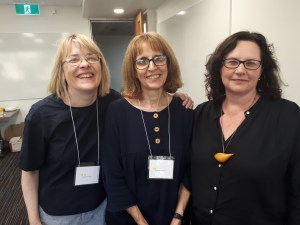
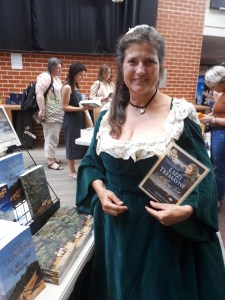
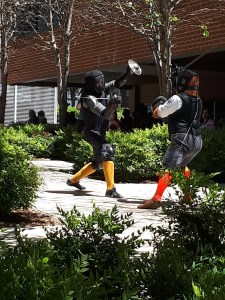
Over the weekend, I was at the biennial conference of the Historical Novel Society of Australasia(HNSA) which this year was held in the pleasant and spacious surroundings of the University of Western Sydney’s Parramatta South campus. It was a fabulous weekend, with a program filled to the brim with brilliant speakers and thought-provoking presentations, as well as excellent food and a collegial, convivial atmosphere, an excellent conference bookshop, great organisation, many catch-ups with friends, including fellow writers, meeting new people too–and witnessing some great demonstrations of armour and fencing! Here are some photos from the three days of the conference–and congratulations to all the HNSA team for a truly exceptional conference-I was proud to be involved.


A beautiful and astonishing example of serendipity

Sometimes, life can hand you a beautiful example of serendipity, a gift of simple grace and joy, which makes you feel connections across time and place that are just spine-tingling…Such a thing happened to me just recently, something which connected my childhood scribbling self with my present scribbling self, in the most unexpected of ways. It’s a whole story in itself, so in order to do it justice, I have to start with some context, with some scene-setting, before I move to what happened in the present day…

So, in an entry in my diary, written as a 12 year old (a diary I still have), there’s a mention of a book I was writing, titled The Twins’ Highlands Holiday. Everything in the entry except for that title is written in French (as indeed it is in the rest of the diary); but the English title clearly showed that I had ambitions for a fiction readership beyond my immediate family 🙂  And it also showed clearly the influence of one of my favourite writers at the time, Enid Blyton. I especially loved her mysteries series, the Famous Five and the Secret Seven, but also her story anthologies which could be consumed in bite size pieces(though being a voracious reader, I never stopped at one bite!) My parents rarely bought new English-language books for us(that was reserved for French-language titles, like Tintin, Asterix, Alexandre Dumas, Jules Verne etc); So most of those books I borrowed from the library or occasionally we might find some in second-hand shops, like the legendary White Elephant in Chatswood which my mother took us to during the holidays(we lived in Sydney’s North Shore area) and where we children might be allowed to select books to take home(she also loved rummaging amongst the shop’s astonishing mass of books, records, old china, curios, records, vintage clothes etc).

I had come across the entry in that old diary earlier this year, in preparation for an essay I was writing; and I thought then, I wish I still had that story! But it had vanished long ago, and all that remained was the title, a title straight out of Blyton, though maybe not the Highlands part, for that very English writer. As a twelve year old I had never been to the Highlands, though I loved stories set there(I’d also read and loved Robert Louis Stevenson’s Kidnapped, a very different kettle of fish to Blyton, of course!) So I’d combined twins and holiday–very Blyton–with a whiff of adventure in the heather, a la Robert Louis Stevenson. I don’t recall anything about the story or what happened in it..but seeing it mentioned there in the diary(mentioned in more than one entry actually, as I diligently reported progress on writing it) made me remember the sheer excitement of writing as a child, copying my favourite authors but doing it all in my own way.  And I thought, I know the Highlands bit came from Stevenson, but I wonder which Blyton it was which inspired the rest?  Oh well, probably a mix of several, I thought.

The Twins’ Holiday Holiday went into the essay. And that was it. Except it wasn’t. The astonishment, the serendipity, was still to come. A few weeks ago, I received a direct Facebook message from a fellow author, Pat Simmons. I hadn’t met Pat in person, but I did know her work: and had recently bought her latest lovely picture book, Ziggy’s Zoo(illustrated by Vicky Pratt) for some dear little people in my life. Anyway, Pat had messaged me about something she’d found, quite by chance. A book. An Enid Blyton anthology, called ‘The Holiday Book’, with a name, address, telephone number and date carefully written on the flyleaf, obviously by the proud owner. And here I’ll pass the story over to Pat herself, to explain:

My local ‘op shop’ sits close to the bus stop in Thirroul. A bus stop I frequently use when travelling home to Scarborough. As the buses almost always run late, I often have time to browse the ‘op shop’ and seek out treasures.

A few weeks ago, I spied a book of Enid Blyton short stories, sitting all by itself on a high shelf. Inside the book I read a name and address. Definitely not a local address and, seemingly, written some years ago. The name was ‘Sophie Masson.’

Could it be THE Sophie Masson I wondered? I took a photo of the inscription and messaged it to Sophie. She confirmed that the book had indeed belonged to her some years ago.

It was great to return the book to its original owner and to ponder on the book’s journey.

I could hardly believe it as I looked at the photos Pat had sent. It was definitely my handwriting as a 12 year old (just the same as in the diary!) and it carefully noted my name, address, phone number(which I still remembered by heart as we’d had it drummed into us by our parents, in case we ever got lost!) as well as the place and date we’d bought it–the W.E., Chatswood, the White Elephant of course, and in May, only a few days after my twelfth birthday. So it was already second-hand when we bought it, but I had clearly loved it and put my mark on it.

I was so excited! And even more so when Pat very kindly sent the book to me, and opening it, I was suddenly plunged back into the world of my childhood, not only because of the stories, the pictures, and my owner’s inscription–I was sure now that this was the book that had inspired the Blytonesque part of that story I’d written as a twelve year old–but also  because of something else written on the page facing the flyleaf. ‘Taken out By’ it read in my writing: and underneath a stamp somewhat shakily reading L M. I knew at once who LM was of course; my younger brother, Louis. And he, along with my other siblings, had been one of the visitors at the ‘library’ I ran with attempted firmness at home, acting the part of the librarian, complete with stamp (I just loved those stamps!). Very likely that my cheeky rebel of a brother broke every library rule I attempted to impose, but he had clearly meekly submitted to being stamped into Enid Blyton’s Holiday Book (I showed it to him next time I saw him of course, much to his amazed amusement!)

What a journey indeed that book must have gone on over the decades since I had first held it in my hands and officiously stamped it! It had not followed me from childhood into adolescence; my mother must have got rid of it, along with other books we had outgrown, when we left home, or when she and my father left Australia to go back to France. She would have given it to another secondhand shop, no doubt, but in northern Sydney somewhere–but how it had ended up on the South Coast, in Pat’s neighbourhood op shop in Thirroul, a little battered but still in remarkably good shape, considering, is a mystery. I presume other children along the way, maybe several other children, had enjoyed and loved it, or it would not have stayed intact. As to me, I had forgotten it, until that moment when I read Pat’s message. Yet I had written my name and contact in it so carefully, obviously fearing that I might lose it, and trying to ensure that it would find its way back to me.

Which of course, eventually, it did….

And I’m still feeling that rush of pure, simple pleasure about the lovely serendipity of it all.


Conferences, exhibitions, launches: a very busy few weeks coming up!

Later this month and into next month, I am going to be having a very busy and very interesting literary time!

First up is the wonderful Historical Novel Society of Australasia Conference, which this year is being held at the University of Western Sydney in Parramatta, Sydney, from October 25 to 27. The biennial HNSA conference is one of my favourite literary events: there’s always really interesting speakers, a fabulous program, and a warm, collegial atmosphere. This year’s certainly no exception, and I’m privileged to be involved with the Conference in several ways: as a speaker, a workshop presenter, judge of the HNSA short story contest, and, a great honour, being the Conference Patron as well. Looking forward so much to it! Tickets are still available for this fantastic event, so check out the program here.

Next up is the Artstate Festival, to be held in Tamworth, October 31 to November 3. I’m involved in this in several ways, as an author, a small-press publisher, and a contributor to an anthology and an exhibition, both of which will be launched in Tamworth during that time. On October 31, wearing my Christmas Press hat, I’ll be participating, with my Christmas Press partners as well as  fellow local publishing house Little Pink Dog Books, in the Creative Hot Spot Publisher Pitch Day, which will give children’s writers and illustrators an opportunity to pitch work to one or both publishing houses.

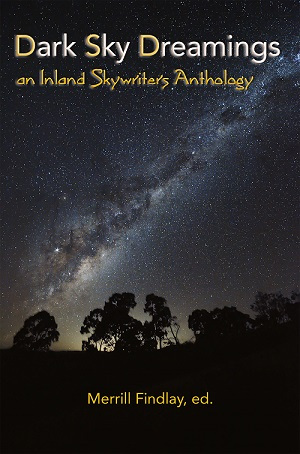
That evening, I’ll don my author hat again, as a contributor to the fabulous anthology Dark Sky Dreamings: An Inland Skywriters Anthology, which is themed around people’s relationship with the sky in all its aspects, and which will be launched at a great astronomy-themed event, in conjunction with the Tamworth Regional Astronomy Club, at Bicentennial Park in Tamworth at 8.30 pm: telescopes and stars will be a feature of this unusual launch!

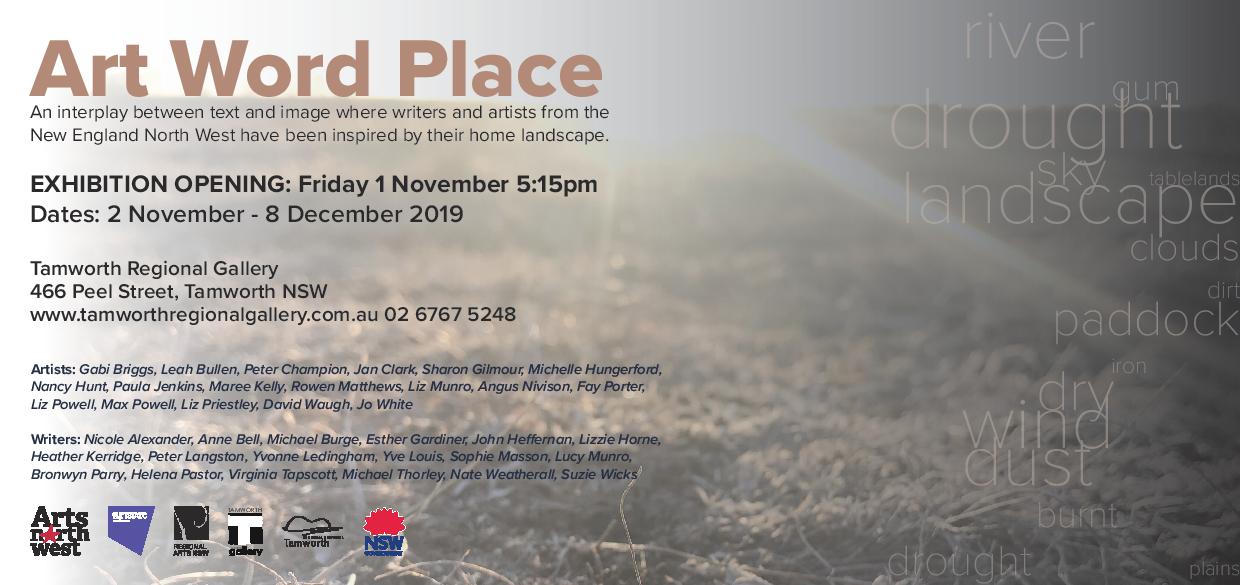
Then on November 1, I’m speaking at an Artstate/Arts North West event called Authors’ Cafe, where authors chat with readers and other interested people about their work. That the evening, I’ll be attending the opening of an exhibition called Art Word Place, which is an Arts North West project, where New England-based writers were paired with New England-based visual artists to create joint works. I’m one of the writers, and I had the good fortune to be paired with the fantastic painter Angus Nivison. His visual response to my poem is just extraordinary! If you’re in the region, come check it and all the other works out, the opening is on at the Tamworth Regional Art Gallery at 5.15 pm on November 1, but the exhibition itself is on till December 8.

There will be other events later in November that I’m a part of, in Armidale, Sydney and Melbourne, but I will write about them later, in a separate blog post. It is certainly a very busy time!