Anzac Stories: Behind the Pages Exhibition and my part in it

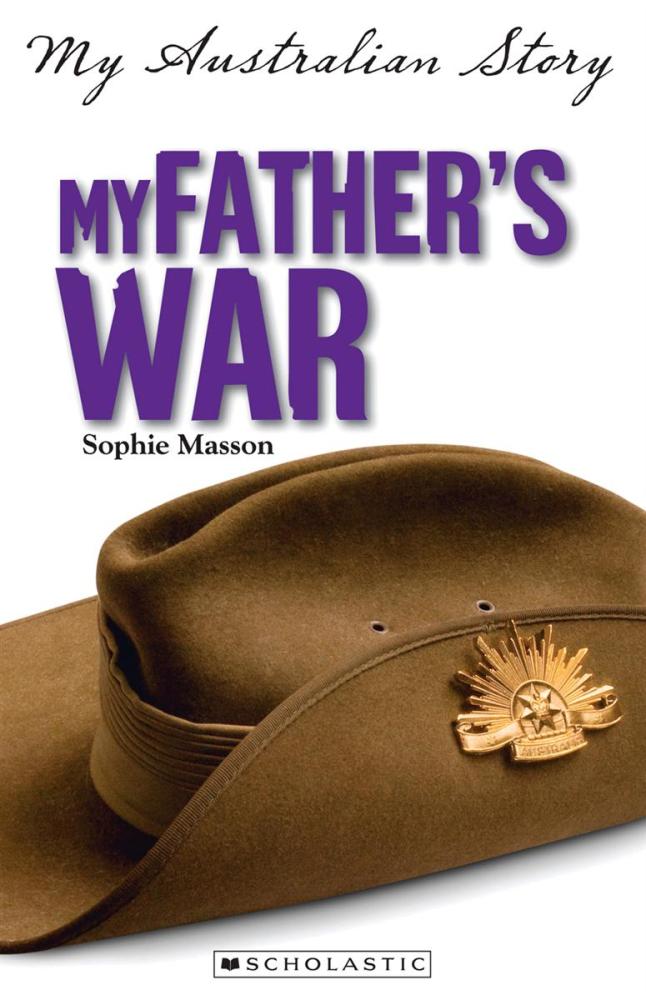
1914-coverI’m honoured to be part of the Anzac Stories: Behind the Pages exhibitions which will run throughout Australia in 2017 and 2018, and will showcase Australian and New Zealand contemporary children’s books set in wartime, and the stories behind the creation of those books. The exhibition is the brainchild of the fantastic New Zealand author Maria Gill, who initiated a similar exhibition in New Zealand earlier. Boards featuring individual books and writers will be exhibited in libraries across Australia. My two World War One novels, 1914 (Scholastic, 2014) and My Father’s War (Scholastic 2011) and the stories and research behind them, will be part of the exhibition. There’s also an Anzac Stories blog, with info about each book and a short interview with their writers. Here’s a little extract from minemy-father-s-war

Doing the research on the ground, in northern France especially, made it all become so real and so emotionally affecting. Both books blend my two main cultural influences: French and Australian, and that also felt like a very positive thing, especially as the ties between France and Australia forged during that terrible time are still very strong, particularly in the Somme region of northern France, where they have a saying, N’oublions jamais l’Australie : ‘Let us never forget Australia’

You can read the whole thing here.


Interview with Therese Walsh, editor of Author in Progress

12803300_10207051919154843_5638323324479667397_nSome years ago–I think it was back in 2008–I was invited to become a regular contributor to the international writing blog, Writer Unboxed, founded by US writers Therese Walsh and Kathleen Bolton two years previously. Their idea was to create a community of writers who would find guidance, support and encouragement in WU, as well as great advice and tips. That’s certainly proven to be the case, and Writer Unboxed is one of the most popular and respected writing blogs in the world today, garnering several awards as well as an ever-increasing list of followers, a very active Facebook and Twitter presence, and the hosting of a unique conference–or Unconference, as it’s titled!

And now comes the next step: a book which gathers together a great deal of individual and collective wisdom and advice from Writer Unboxed contributors and community. Author in Progress: A No-Holds Guide to What it Really Takes to Get Published (Writers’ Digest Books), is being released today, November 1 and will be available from online booksellers such as Amazon, Barnes and Noble, etc, as well as the Writers’ Digest shop. Edited by Therese Walsh, and with an introduction by respected author James Scott Bell, it features over 50 essays from novelists, editors, agents and contributors from the WU community. The book goes well beyond the usual run of how-to-get-published books: from discussing reasons why people want to write right up to post-publication issues, and much more in between. I’m delighted to say by the way that I have an essay in the book, which is called ‘Writer as Phoenix’, and is in the final section of the book.

And today, I’m delighted to celebrate the publication day of Author in Progress by featuring an interview with its initiator: writer and editor extraordinaire, Therese Walsh.

***************

Welcome to my blog, Therese! How did the idea for Author in Progress come about? What was your vision for the book, and how did that evolve as time went on?

Thanks for having me, Sophie, and for the opportunity to talk about Author in Progress.

The book came about after I met with Phil Sexton at the Writer’s Digest conference last summer (2015). He mentioned the idea of doing a book with them, and that took root with me over a month or so. I had a follow-up phone call with Phil, and he mentioned the freedom we’d have to do the type of book we wanted to do. After that, the idea for Author in Progress fell into place rather quickly, as I considered what I knew to be true about writing a book – because there are some things I always say when someone who is not yet published asks, ‘How did you get published? What did you do?’

The book is broken into parts, following the stages a writer will likely go through on the road to publication: Pre-writing considerations, the writing itself, critique-related topics, educational considerations, rewriting, perseverance, and releasing the project once you’ve served the work.

Author in Progress is a very different kind of how-to writing book, as it doesn’t assume that the journey ends when your book is published. And it offers the advice and experience of many different contributors. How did you go about gathering and editing contributions from so many people?

Assigning essays was much easier than it might have been, in part because Writer Unboxed contributors are exceptional to work with (I’m not at all biased!). I think the other reason it was relatively easy was because of the adaptability of the contributors, in that many could write to several stages of the book. That said, there was a certain magic to the match-ups and I’m particularly pleased with how that went; everyone delivered something about an issue that resonated with them personally.

In terms of gathering and editing, I created a deadline for essayists to turn in their work and that deadline was met almost without exception. I then read over each essay, and suggested revisions when I thought they might make the book stronger. I then did a final edit for clarity—adding headers—and correcting for typos. This is what was then submitted to Writer’s Digest and our in-house editor there, who took everything to the next level in terms of polish and readiness for publication.

Author in Progress is aimed not only at aspiring authors, but also authors who have already been published. What do you think authors at different stages of their careers could get from this book?

One of the things authors will be able to see is that the stages of story creation are cyclical, repeating with every book. Sure, you learn things early on that you apply to each book thereafter, but that doesn’t mean you don’t hit each stage in some way. We’ve included some articles under a header called ‘Eye on the Prize,’ which addresses how a topic (e.g. critique) becomes important in a different way when you’re a published author (e.g. accepting notes from an agent, editor, even readers). We also have boxes throughout the book marked as ‘Pro Tips,’ which, again, help to root the reader in the reality of why something is important if you’re to make a career of writing.

All that said, I think the larger reason published novelists might want a copy of Author in Progress is because when we’re in the middle of a project—or at the start of one—we sometimes forget that all of this is normal. The anxiety, the doubt, the block, the research pitfalls, the need to go deep with character (and how to do that), the need to continue to learn and grow (and what steps you might take to push to the next level). I think even published authors need to remember that we’re not alone, and that the angst is part of the process, too.

Is there any particular tip or bit of advice that you would offer an author starting out on the journey–and those a bit further along?

I would tell that author starting out and an author a bit further along something similar. Writing a book is tough at times. Many of us might say, ‘If I knew how long it would take, what it would ask of me, maybe I wouldn’t have finished… But I’m glad that I did.” Perseverance is one of the key ingredients for any author in progress, and so I’d tell both of those writers to keep going, and remind them that they are not on that road alone. Truly, they are not.

The book is closely associated with Writer Unboxed, the writing blog you founded some years ago with Kathleen Bolton, which has become prominent and respected in both the author community and the publishing industry. Can you tell us about the blog, and about the insights into authorship it has given you?

Writer Unboxed  is my writing family, and it’s my hope that we are other writers’ online family as well. We are dedicated to producing content daily about the craft and business of fiction on our website, but it goes beyond that with our Facebook community (5,000+ writers strong in a promo-free zone) and our Twitter feed (@WriterUnboxed). Our ultimate goal is to provide positive and empowering support for writers of any genre.

I’ve learned a tremendous amount about writing simply by being present for the day-to-day business of the site, but I think the most crucial lesson is that it is truly a cyclical process. You envision. You create. You revise. You learn the lessons the book is there to teach you. You serve the work. You release. Repeat. As someone who hasn’t always had an easy road myself, there’s a lot of power for me personally in seeing that this process is what it is. It’s the job of being an author. It’s not always easy. In fact, it can be grueling and draining and crazy making at times. But it is a wonderful and gratifying thing to be able to do this job—build stories, reach readers. Writer Unboxed has helped me persevere to do just that.

Thank you again, Sophie. Write on!

redo-of-cover-copy


Visual writing or the joys of calligraphy, by Peter Taylor

Today I’m featuring an absolutely fabulous guest post by writer Peter Taylor, who’s also well-known as a calligrapher and artist-book constructor on how we can encourage children to create multi-faceted and unusual word magic. Enjoy!

Visual writing or the joys of calligraphy

Picture books are written to provide young children with a roller-coaster ride of emotions. Similarly, we plot a journey for the older reader, leaving spaces in the text so that they can use their imagination to see themselves beside the characters, but it’s by the way we tell the stories that we cause each reader to feel the characters’ pain, doubts and passion. In music, a simple change in key, harmony, melody or rhythm can shift a listener’s joy to deep despair (or the reverse) in a second, but it’s not so easy for a writer.  Perhaps it really is true that writers, who agonise over choosing perfect words, all wish they were musicians able to express themselves directly through their playing.

Calligrapher Ann Hechle has described how verbal orchestration in poetry also manipulates the depth of our feeling so that our mind, imagination and almost every part of us is engaged. The flow of Latinate words like ‘consider’ and ‘recognise’ contrasting with the thump in the guts Anglo-Saxon ‘gripe’, ‘groan’ and ‘grunt’; long and short vowels; tempo and stress; volume and density; onomatopoeia where sound shades into meaning–these are felt as physical sensations, stirring our brain’s deeper interpretation.

In such a world of feeling, it’s therefore surprising to me that children of all ages are not encouraged more often to interpret words visually, un-restrained by a standard size of letters and a requirement of regimented rows of words. Isn’t it natural to want to write about crashing waves by using letters and words that heave and tumble on …well …wave shaped lines, and in appropriate colours? And why not sometimes use larger and bolder letters for those words emphasised most in speech, as pioneered by Hechle in the 1960s? Such freedom may foster creative writing by children and adults alike, or engender an artistic response to any favourite text.

taylor-1

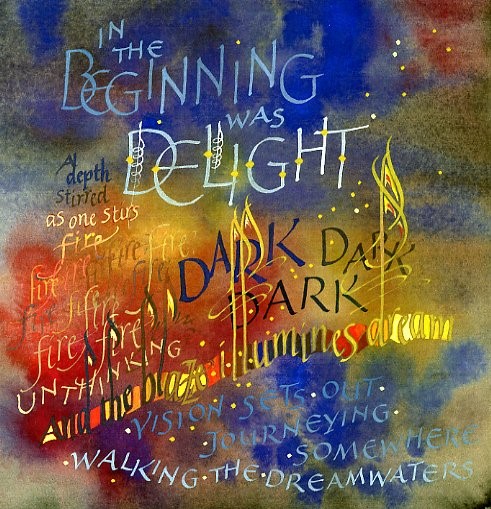
Text from Relearning the Alphabet by Denise Levertov

In the beginning was delight. A depth

stirred as one stirs fire unthinking.

Dark  dark  dark. And the blaze illumines dream.

Vision sets out

journeying somewhere,

walking the dreamwaters.

Designing the layout for words as an outward spiral may be appropriate for stories that unwind, such as: ‘Will you walk a little faster,’ said the whiting to a snail, ‘there’s a porpoise just behind us and he’s treading on my tail.’ Conversely, some stories wind up and can be written as an inward spiral, for example: ‘This is the cow with the crumpled horn that tossed the dog that worried the cat that killed the rat that lay in the house that Jack built.’ And as you will see, I have used this spiral technique and others in my combination of biblical passages.

taylor-2

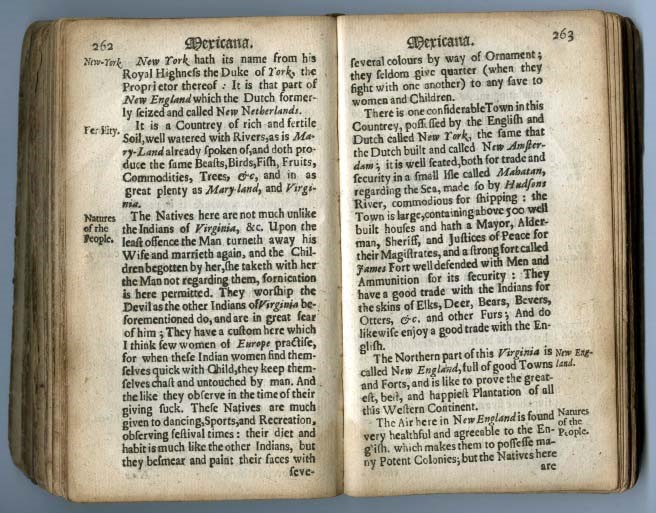
Not all children get hooked on reading and writing by initially listening to or reading stories. Some may arrive at the endpoint by predominantly first developing a love of words and of books as objects. When I stage a ‘Hands-on History of Books and Writing over 4000 Years’ experience in schools, even reluctant readers seem to enjoy handling a 2000 BC cuneiform clay sales docket, holding a hand-written vellum page from a 13th century medieval book without using white gloves, a page from one of the world’s first dictionaries printed in the 1480s, peeping inside Victorian picture books and deciphering a description of New York published in the 1679 that says that it has ‘…above 500 well-built houses’ amongst other treasures (and most then want to read more about early New York).


taylor-3-a


taylor-3


Some children may come to enjoy words and reading after calligraphic exploration. From playing with the word ‘rain’…taylor-4

…research could next find a poem that is fitting for similar presentation, with reading undertaken in the process enjoyed more than expected:

taylor-5

Poem: This Land by Ian Mudie

Designing calligraphic letter shapes can influence and add joy to creative writing, too. Letters with triangular serifs like webbed feet, for example, can give impetus to write about frogs, ducks or sea-gulls.

Verse by Peter Taylor, illustration by Anil Tortop

Verse by Peter Taylor, illustration by Anil Tortop

Sea fever, by John Masefield

Sea fever, by John Masefield

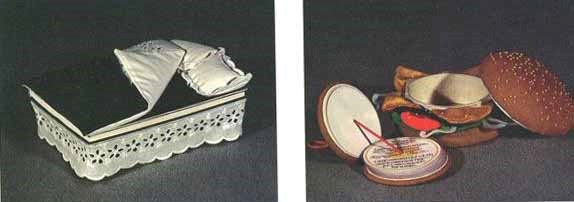
We can arouse young children’s interest in books with colour and quirkiness. But what sort of books are teens excited by? What kinds of bindings and book structures do they explore? I taught ‘Book Cover Design’ workshops to children aged 7 to 17 at the Queensland State Library. Participants used pens, scissors, paste and coloured and decorative papers to produce dust-jackets for Reference books of their choice (that were later re-shelved in their new covers). The children created the most eye-catching bold designs, but I wonder what they would have produced if they had been offered a wider range of materials and allowed more time, especially to read the books thoroughly. Would they have created a quilt cover for a book of poems titled On Going to Bed or placed hamburger recipes in a container shaped and covered to resemble a Big Mac?

taylor-8

Would they have modelled or sculpted mountain ranges to sit on top of the pages of Lord of the Rings, as famed designer-bookbinder Philip Smith has done?

taylor-10

Or designed a ‘Book Stack’, as Mike Stilkey does?

taylor-11

Maybe the children would have produced something even more original.

How many books do teens smell? Are they encouraged to write, design and bind their own books?

Is it possible that first creating a book with a special structure can provide the stimulus for writing a story to fit inside it? Or will a story provide ideas for a unique and satisfying way to display the text?

taylor-12


taylor-13


I hope children of all ages (and adults) are encouraged to explore the totality of the world of words, of language, writing, calligraphy, exciting layout designs and books of every form and structure until these become a rich, integral and important part of their lives. Sustenance for their creativity and creative thought. Let us give them experiences to savour and help them to respond with joy in their own way …to the extent that they want to bungee-jump into, read and devour our offerings of all genres with relish.

Peter Taylor’s first book was published in 1987 and he writes wacky verses, fiction and non-fiction for all ages. His picture book, ‘Once a Creepy Crocodile’ illustrated by Nina Rycroft and pub. The Five Mile Press was shortlisted for the 2015 Book of the Year award by Speech Pathology Australia. Peter is also an internationally respected calligrapher and artist’s book constructor, has been the Queensland Newsletter Editor for the Children’s Book Council of Australia, Co-ordinator of SCBWI Queensland and judge of the Dorothy Shaw Writing Competition for the deaf. He delights in sharing his extensive historical book and document collection and encouraging children and adults to love books, read, write and be creative. Peter offers workshops, talks and performances to libraries, schools and festivals. 


www.writing-for-children.com

http://brisbaneillustrators.com/peter-taylor.html

www.ptcalligraphy.com


2BR02B: the journey of a dystopian film–an interview with Leon Coward

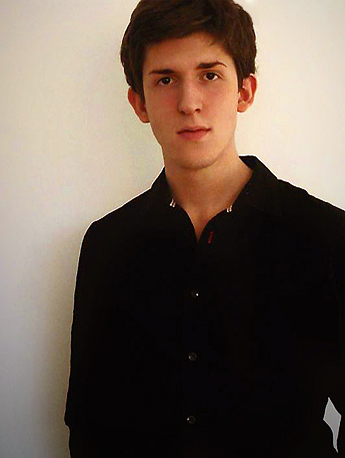
australian-artist-and-composer-leon-cowardI’ve known the extraordinarily talented young creator Leon Coward since he was a pre-teen reader/reviewer flatteringly enthusiastic about my books. Today, Leon’s love of creating art has  led him to work in many different fields–not only literature, but music, visual arts, and now film-making. Involved first as a concept artist for the short film 2BR02B–To Be or Naught to Be, a dystopian work based on one of Kurt Vonnegut’s short stories, Leon went on to take a much greater part in the creation of the film.

The Canadian production, which has already been selected for no less than 15 prestigious short film festivals, has its Australian premiere today, in Sydney. To mark this exciting occasion, I talked with Leon about the creative journey behind the film.

Leon, how did you become involved in the creation of  2BR02B: To be or Naught to Be? 

My background is in graphic design and traditional illustration. The producer Artin John is a childhood friend, and he began co-producing the film and asked for me to create a poster… then concept art… then the mural and other artwork. I had no idea how involved I would later become.

The film is based on a Kurt Vonnegut short story which imagines a dystopian world in which babies are only allowed to be born if another life is terminated. What were the particular challenges involved in adapting the story for film?

The tone was a challenge. It’s easy to show too little or be too graphic, be too nonchalant or be too sombre. You can try to be as true to Vonnegut’s material as possible, but at the end of the day also you’re working with the material that you as a team have generated, not just Vonnegut’s, and that’s what you’ve got to make work. There were a few things from the original story that confused our test audiences – in one instance it was putting jazz at the end of the film, and Vonnegut gets away with it because as a reader you don’t hear it, but we realised it just sounded like cinema lounge music and it spoiled the audience’s mulling over of events.
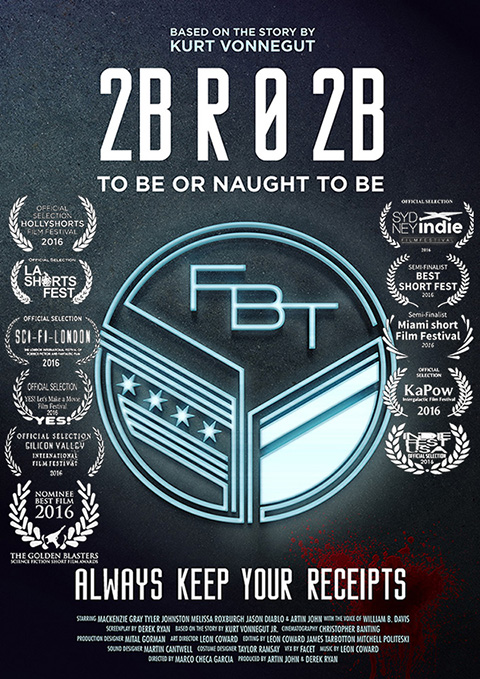
2br02b_federal-bureau-of-termination-poster2BR02B has an ensemble cast, so an editing challenge was working out the balance between them. We’d all thought the film would centre on Wehling and his internal conflict, because his dilemma motivates his actions which affect the other characters – the problem was that while we knew what he was thinking and what he’s gearing himself up to do, the audience didn’t. The first edit was melodramatic simply because the audience was asked to feel for a character they didn’t know. So I shook things up and this was hard because I took an edit to the team and, although the story itself hadn’t changed, what was emphasized had changed. For a long time we were also going for an emotional ending, but after test screenings it was clear the audience were frustrated. My grandmother suggested a twist, and I incorporated it and showed the team without warning them – that way they got to experience it as the audience would.

My own big challenges were creating the fictitious ‘Federal Bureau of Termination’ set in Chicago and the Painter’s 16-ft mural. The FBT is represented by Leora, a gas chamber hostess – but other than her and a brief shot of a gas chamber, the FBT doesn’t appear. So to convey the fact that this organization dominated the society, we gave them a brand identity that pervaded everything – corporate signage, posters, banners, badges, tags, earpieces and costume motifs. Vonnegut described a symbolic design for their logo (an ‘eagle perched on a turnstile’), but I approached it as a new branding commission and researched federal seals and local symbols for Chicago. There are a lot of references – the stars and stripes on the US and Chicago flags, the Chicago municipal device (which is a Y for their shaped river), even the wings of their state insect the Monarch butterfly. But there are also a lot of differences to real seals which make it very impersonal, very geometric, skeletal & circuit-like, and no natural symbols.

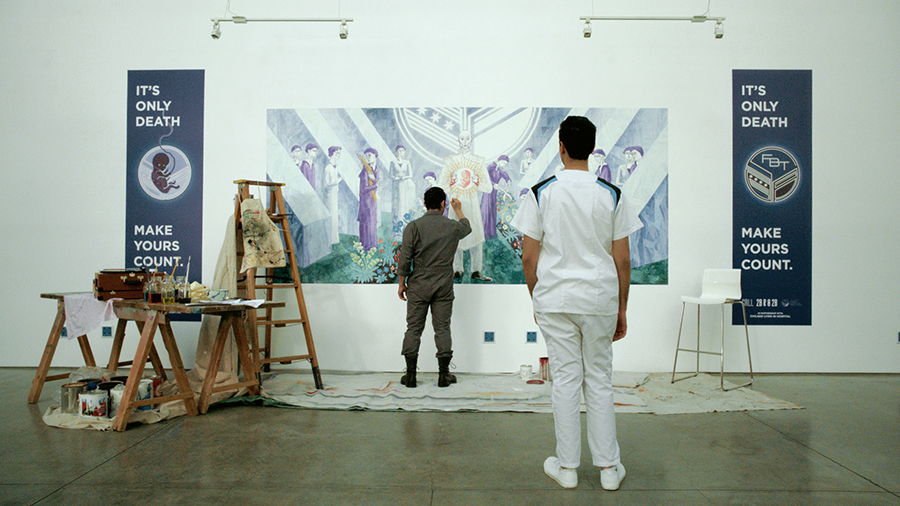
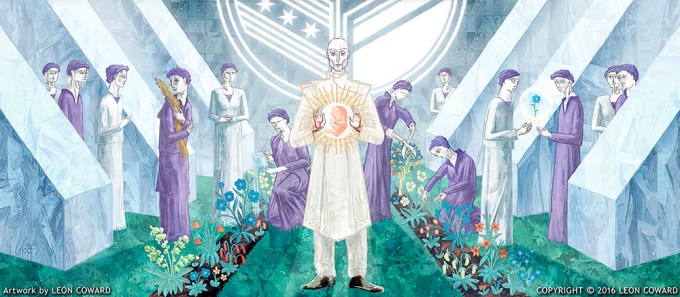
The mural took 6 months to design and finish. It was digitally painted in Sydney, then printed in Canada. All the characters discuss its symbolism and pose for it – if the mural didn’t come across as a genuine work of art, it’d devalue the acting. Its design was driven by story needs and Vonnegut’s prose. It shows a false utopian garden where nurses and FBT staff, dressed in white and purple, symbolically turn soil, plant seeds, and control life and death. Purple is traditional for sacrificial robes, and Dr. Hitz, who is the architect of population control, is painted as a ‘Zeus-like’ figure. The mural had to be recognizably propaganda and contemporary, so our director Marco instructed me to look at Russian war posters, Art Deco and Cubism. At the same time, I knew the mural had to have religious overtones. I’d experimented with a mix of Expressionism and William Blake-esque styles – trying to avoid the ‘communist cornfield worker’ interpretations I’ve seen in student versions of the film, or any specific garden-type, but I was going too far in that direction. My new layout was Art Deco-inspired, using diagonals and circles – essentially it’s an ‘X’ drawing your eyes to Hitz, and the FBT logo acts like a sun, framing Hitz’s head like a halo. I blended Cubism, Futurism and Brutalism with religious styles. The concrete flats, which also mimic the FBT logo, overpower the barest of gardens and help narrow the viewer’s focus, and the floating flower made it futuristic. The style of plants and their millefleur treatment came from The Lady and the Unicorn tapestry and the religiously-themed The Hunt of the Unicorn tapestry. Sir Edward Burne-Jones’ pilgrimage paintings, and especially his Wedding of Psyche, provided the inspiration for the figures, their poses, compositional distribution and costumes (I also referenced medical scrubs). Hitz needed a recognizable inference of himself as a messiah – so Byzantine iconography provided the inspiration for his hands (which are Christ’s) and the haloed foetus, as well as the mural’s forced perspective. For Hitz’s costume there was also a bit of SS uniform and Nehru jacket, dentist and Jedi, and a more contemporary influence from Gehn in Cyan’s Riven, a character who also sees himself as a god. Everywhere you look the message is there, and it was hard to make the mural function as a finished work of art yet still be visibly ‘in-progress’. The aim was to show a society where there is no respect for religious heritage – God is dead, and the FBT is filling the vacancy – and the mural needed to be created that way. It took months of digitally painting and scanning paint textures and brushstrokes, since the mural had to withstand close-ups. Halfway through, Paul Giamatti had scheduling conflicts, and I had to repaint the face for our Hitz replacement, Mackenzie Gray. The mural was printed in strips of paper which overlapped; clear hard-drying gel was applied to give it a texture, and Ferrero-Rocher wrappers (which have a great canvas texture) were used for the gold highlights.2br02b_mural-by-leon-coward-1
The project was an international collaboration over 3 years between crew in Australia, Canada, UK, Mexico and the Netherlands. What were the challenges and advantages involved in such a big undertaking over such distances and different time zones? What did you learn from the experience?

We had cast and crew in Vancouver, myself and other crew in Sydney, an artist in the Netherlands, and a VFX school in Mexico which did effects as part of their professional training. Footage was flown to me in Sydney and I began re-editing with James Tarbotton. Then Martin Cantwell, our brilliant sound designer in London, came onboard. The time differences were okay as calls were early morning or late night, so we’d avoid each others’ work hours – which was important since the film was not a paying project. The separation was a technical disadvantage, since exporting and transferring files adds a lot of time. It’s also important to be able to see, at least once, the person you’re communicating with, in person or Skype, because it makes email writing a lot easier. While there were disadvantages, I think the distance for me and my collaborators in Sydney allowed us to approach the project in a way we mightn’t have otherwise – especially in the editing, where we could respond as a fresh audience without preconceptions, or even knowing what the actors were like out of character.

You worked on many different aspects of the film, as art director, composer, film editor and associate producer. How did you navigate all these different roles? Was there one aspect you preferred above all?

2br02b_left-to-right_jason-diablo-and-australian-artin-johnIn a sense it hasn’t been hard to navigate between the roles because they were prepared for – I had this idea that the Painter would have a gramophone, and that he was listening to Schubert’s “Ave Maria”. When gun-shooting later ensues, the song could provide a macabre serenade. I stuck the gramophone in my concept art, and waited for the idea to take hold – it was influencing the film’s music to some extent without having to be the composer, but ironically I eventually found myself in the role and this wasn’t intentional! There is a some incidental music, but I pushed to have it that the only music was the ‘live’ gramophone so that the music was simply part of the world, and not an ‘invisible’ emotional narrator as film scores often are. The film and the Ave Maria recording were designed and edited around each other: while films are often edited to an existing temp track of unrelated music, this film was edited to a pre-existing recording of Ave Maria, which was later replaced with a tailor-made recording, post editing and sound design. It enabled us to go for a different interpretation too, which would greater contrast the action. We were fortunate to have my sister Imogen Coward, who is both a skilled soprano and conductor, record the version for us that appears in the finished film. We wanted to avoid any artificial stretching or splicing, so we had the unusual challenge of recording in one take, matching the timing of the temp version. We had 2 frames wriggle room, and the edit didn’t have any room to be changed for different timing. It was tiring, but it was worth it because it has a quality that is lost when music, especially singing, is heavily edited.

The film has so far received 5 nominations and 14 international festival selections, including for its Australian premiere at the Sydney Indie Film Festival on October 19. That’s quite an achievement! What do you think are the special qualities of the film which have made it attractive to festival selectors?

While Vonnegut created the story, it’s also the way the cast and crew have interpreted, realized and communicated the story. Derek Ryan, our screenwriter and co-producer, did a good job of cutting away story material that couldn’t be cinematic – so from the start we were all working with a document that concentrated our focus. 2BR02B really takes a cross-section of behaviours in a society where life and death are pushed to absurdities, but there’s no obvious political or moral position in its telling – just the drama of human action, and I think it allows the viewer in on their own terms. I think one of the things that’s helped is how the film feels when you watch it vs what is leaves you thinking about – cinematically it is very static up to a point, and then there’s this burst of drama and the music making it madness, and then just desolation, and that hits the audience. Vonnegut’s narrative was influenced by his experiences as a P.O.W. in Dresden, and even though his story is fiction, the themes are relevant and resonate because the wars have cast such a long shadow. It’s subtle in our film, but the hospital cross is actually a swastika, and the banners flanking the mural are inspired by Nazi banners –  Wehling’s cry “It’s only death” was used on our banners, so instead of his line being spontaneous, it becomes him quoting propaganda which the audience saw earlier.

2br02b_dystopian-chicago

What’s next for you, in terms of films, after this one?

I’m independently developing my own film project – an adaptation of Oscar Wilde’s “The Happy Prince”, and am shifting between generating its music and visual material.

You are also engaged in doing a PhD on aspects of film design. Can you tell us a bit about that?

It essentially provides an analytical process which teases apart a film’s design (if it has one) – whether the story, visuals, acting, music, sound or all their combination. The method is quite straightforward, but its theoretical justification and demonstration is very demanding. The method has had encouraging support from many industry practitioners.

As a multi-talented creator and performer, you are also involved in music, visual arts and literature. Tell us about some of your projects in those fields.

My sister Imogen is director of the chamber orchestra Camerata Academica of the Antipodes, which was founded by my siblings and a group of our young musician friends who we’ve played music together with since childhood. Our concert profits go towards helping support the Don Spencer’s Australian Children’s Music Foundation. Our orchestra has just celebrated its second anniversary and second regional tour in Australia. It’s been a very exciting time for the group. We love playing Baroque music – Vivaldi, Handel and Corelli – but our concerts also include music from a wide range of eras and styles, from the 1500s to today, and the orchestra has premiered some of my music that was written specially for the members. A lot of my own solo projects are on hold until after the PhD, including fine art prints and two picture books, written and illustrated by me, one which has been endorsed by Quentin Blake (Roald Dahl’s illustrator).

I know that you come from a family where the arts are highly valued, and your siblings are both also working in the arts. Can you tell us a bit about how you grew up, and what effect you feel it had on your adult career?

We’ve each ended up musicians – my sister  violin, viola, cello and voice, and she has her PhD in music. My brother has focused on violin, voice and guitar, and he’s also doing his PhD on music and magic performance (he’s been performing illusions for 10 years now). Our parents homeschooled us to university level, and were very keyed in to expanding our interests, skills and activities, but they didn’t try to turn us out as one thing or another and weren’t discouraging. My grandmother recently found some drawings from when I was 5, and I couldn’t draw for nuts. But I meet a lot of parents and kids who restrict activities because there’s no immediate interest or sign of potential. I think the effect it has had for my siblings and me is that we’re not afraid to venture beyond our immediate interests and skills, and that’s allowed us to develop the set of skills we have.

Leon Coward is a published artist and writer, and performed composer and choreographer. He performs on violin, viola, piano and voice with the chamber orchestra Camerata Academica of the Antipodes, and was recently art director, composer, editor and associate producer for the 2016 film adaptation of Kurt Vonnegut’s “2BR02B: To Be or Naught to Be”. He is undertaking a PhD at the University of New England, Australia, and has presented his creative work and research throughout Australasia and internationally, including for the TATE Liverpool UK. Since 2007 Leon has edited and designed the e-zine “The Online Book Group”. In 2009 Leon illustrated “Vietnam Reflections”, by award-winning author Libby Hathorn. In 2011 he was awarded a mentorship by the Australian Society of Authors.
 

Writers reviewing books–an interview with Linda Newbery, Celia Rees and Adele Geras

Book reviewing is a real art, and one that in the last ten years or so has undergone many changes. In the past, most book reviews were published in print—in newspapers and magazines, as well as, occasionally on radio and TV. But today, as space in newspapers and magazines has shrunk, most book reviews are published online, on specialised sites, online publications, and blogs.

Today I’m interviewing three distinguished UK authors, Linda Newbery, Celia Rees and Adele Geras, who together have created a great new book review blog, called WritersReview. I was asked to be a guest reviewer on the blog recently, was intrigued by the concept, and wanted to know more!

linda-celia-adele

Left to right: Linda, Celia and Adele

Can you tell me about how and why you started WritersReview?

Linda: Recently I added a blog to my own website. I’d never had a blog before but I liked the idea of using mine for reviews, with maybe a post of two about my own work in progress or backlist titles, and contributions from writer friends. When I mentioned this to Celia, she came up with the better idea of a joint review blog. This appealed at once, as I knew that a joint blog would reach more readers and attract more contributors than I’d achieve on my own. Next time Celia and I met, we talked about how to organise the blog and decided to invite Adele to join us, knowing that she reads widely and enjoys reviewing.

All three of us have published widely for children and young adults but are now writing adult fiction, and our reviewing here is a way of extending our range. Collectively we have a great many contacts, which should make it easy to keep things turning over.

Celia: Linda and I don’t live too far from each other and we meet up every now again for a writerly chat. During one of our talks.  We started talking about reviewing, specifically online reviewing.  We both agreed that good reviewing sites were few and far between and that much of the reviewing was poor and unfair. We were both taken with the possibility of setting up a review site where writers could review other writers. Writers tend to be keen readers and are often experienced reviewers and would offer fairer, more balanced and better informed reviews than many to be found online. Linda went away and came back with some ideas for the review site. She suggested we invite Adele to join us as she’s an avid and omnivorous reader and highly respected reviewer. We would each invite other authors to make guest posts, to add variety, keep the posts current and gradually build the site. Adele and I are both History Girls and are familiar with Blogger, so that was the site we chose to use. Linda did the hard work, designing and setting up the site, sorting out teething problems and posting the first reviews.

Adele: It was really Linda’s brainchild and when she asked me to join in, and mentioned that she was asking no Celia too, I was really delighted. I’ve long felt that there were too few outlets for people’s opinions about books. Newspaper reviews and much that’s online concentrates on the eye catching, the best-selling, the obvious. Linda made her offer seem attractive by telling us we can write about what enthuses us, whatever it might be.

Another of her good ideas was to give us a chance to invite other writers to contribute as well. She did all the heavy lifting, setting up the site and making sure it looks as good as it does.

What is your vision for the site? And how do you think it might develop?

Linda: I’d like it to be wide-ranging and friendly. We, and our guests, can choose anything we like to review – anything, that is, other than children’s books (not because we have anything against them but because there are plenty of other sites that specialise in children’s). I’d like to include biography, nature writing and other non-fiction, possibly poetry – whatever we or our guests want to write about. And the books don’t have to be newly-published – part of the point is for writers to share their own enthusiasms and draw attention to books that have inspired or influenced them, or deserve to be read more widely.

I hope, as we go on, that we’ll build up a list of regular guests and that maybe people will even approach us, wanting to contribute. I hope, too, that readers will comment on our reviews and add their own opinions.

I’d love it if our blog became known and respected and if we saw our reviews quoted in publicity releases!

Adele: I’m hoping it’s the sort of site readers might go to a) to see what we’d enjoyed b) to get ideas about what they might enjoy c) to be able to comment freely about what they saw there.

Celia: From the first, we decided to review books for adults, rather than children’s or YA. That was the only rule. I guess we hope that the site will attract people who are interested in what we have to say about the books we review and to counterbalance some of the ill-informed and occasionally malicious reviews to be found in other places online. I would like to see Writers Review become a site that readers can trust and use as a guide to books that they might want to read.

How do you choose books for review? Are there types or genres of books you particularly want to concentrate on?

Linda: Many of the books won’t be chosen by us, but by our guests. We won’t, on the whole, allocate titles to reviewers, though there may be some exceptions.  I hope contemporary fiction will be well to the fore, but we’ll see how things develop without our intervention.

Celia: Other than the books have to be for adults, we can review what we like, any genre, fiction or non-fiction. The books can be newly published or old favourites. There is no pressure to review current books. Our choices are made on our own preferences, what we might be reading at the time, work we admire, books that we have enjoyed and think other readers might like, too.

Adele: It’s about sharing enthusiasms. Fiction or non-fiction, but books for adults. We are known mainly as children’s or YA writers, but wanted to go outside our perceived boundaries.

What do you think of the current situation for book reviewing today, against the background of the contemporary publishing climate?

Celia: I think that there has been a marked falling away in the standard of reviewing. The broadsheet newspapers remain the gold standard but book review space continues to be squeezed. The plethora of online reviewing sites is patchy at best and can be downright destructive and malicious. Real reviewing appears to be a dying art. Too few reviewers understand that a good review is more than an exhaustive synopsis and a few subjective opinions, or arbitrary judgements based on personal preferences, or trivial concerns like print quality or length. We have all seen shocking examples of books condemned, their star rating brought down for the most irrelevant and trivial of reasons and behind that is always the lurking spectre of sock puppetry. I’m also uneasy about the possible influence of the big publishing houses through the blandishments of their publicity departments, particularly on book bloggers. We might be swimming against a tsunami but I don’t think readers like to feel manipulated (I certainly don’t) and I hope that a site like ours might be trusted and valued by readers and publishers alike.

Adele: I think it’s very patchy. I’m not 100% sure how much reviews contribute to the success of a given book, but am sorrowfully concluding: not very much! How otherwise to account for so many LOW LOW sales for extremely well-reviewed books?

Linda: It seems that publishers have come to value review blogs, with space for print reviews so much in demand, and that online reviewing can be quite influential in passing on word-of-mouth recommendations. In the press, some books are widely reviewed while others get no coverage at all, and might as well be invisible. The ‘blog tour’ for a new book is now quite common, even for high-profile authors. So a blog like ours is likely to be appreciated by authors as well as by publishers.

Across the Tasman 6: Sarah Davis

unnamedToday in my New Zealand series, I’m delighted to be publishing an interview with the wonderful illustrator Sarah Davis. Sarah began illustrating picture books in 2008, and is now, as she puts it,  ‘ruined for any other career.’ She has an honours degree in literature, and her love of language and narrative underpins her illustration work – as a self-taught artist, she is constantly experimenting with new ways to tell stories visually. She has illustrated more than 37 books with major publishers and been shortlisted for about the same number of awards in Australia and New Zealand. Sarah is an ambassador for Room to Read, and the Illustrator Coordinator for the Society of Children’s Book Writers and Illustrators (Australia East/NZ) Sarah is represented by the Gallt Zacker Agency in the USA and Frances Plumpton Literary Agency in New Zealand.

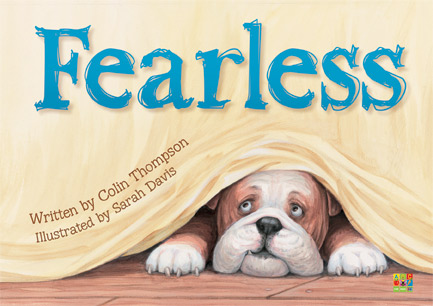
Sarah, you’ve said you are now spoiled for any other career other than illustration! Can you tell us about how that career started? What first drew you to illustration? And who were your main artistic influences?fearlesscover-copy

I think I’ve always been heading towards illustration, actually, but I got temporarily derailed by Life. I actually majored in English literature and creative writing at uni, and haven’t had much art training, and had my son when I was only 20, so went into teaching English at secondary school because it was something i felt passionate about and the hours were also good to fit around being a sole parent. I’d always drawn for fun and wanted to do more with it, but couldn’t really find the time.  I started dabbling in art a bit more seriously when I was about 26, but had our two lovely daughters in 2001 and 2003, and was still working part time, so it was hard to fit it in! When we moved to Sydney in 2004, I took time off work and that’s when illustration started to take off for me. I decided I’d go with the “fake it till you make it!’ philosophy, and set up a profile on some online freelancing sites, and got a bunch of jobs that way which taught me how it all worked and helped me start to build a portfolio. Then I decided to have a go at picture book illustration. I applied to the Stylefile with some truly horrible art samples, and they very sensibly and very kindly rejected me. Their rejection was accompanied by an A4 page of incredibly constructive criticism, and I took all their advice on board and built a much better portfolio, which i took to a critique at a SCBWI conference, and it all took off from there, thanks in a large part to my fairy godmother Susanne Gervay, who was incredibly kind and supportive and enthusiastically made connections and opportunities appear for me.soundsspooky_cover_hbk

What draws me to illustration is the opportunity it provides for narrative – I’m a sucker for story. My artistic influences are pretty varied, I think – I spend a lot of time online gazing at the awe-inspiring work of superior beings. I don’t think I really have a style, and seem to shift my approach based on the demands of the text, which I suppose is why the people whose work I admire also cover a broad spectrum of styles and periods.

You’ve become one of NZ’s busiest illustrators, with many books published, and lots more on the go. How do you manage your time with all the different projects?

Very badly! I call my system “surfing the tidal wave” – that feeling where you’re performing a very tricky balancing act, only just staying afloat, and there’s a weight of thundering chaos surging at your heels waiting to crash down on you. So far I haven’t totally wiped out and I’m still juuuust ahead of the wave. I’ve illustrated 37 trade picture and chapter books since 2008, as well as taking on commercial projects, books for educational publishers such as Cengage, and speaking at between 20-40 schools a year. Balancing that and family time has been very hectic – we’ve got three kids and 6 months ago we acquired a lovely extra teenager. There were quite a few occasions over the last few years when I had a deadline looming and I didn’t sleep at all for days in a row. I wouldn’t recommend it! I’m much better at achieving work/life balance now. I’m being very selective about what I take on, and trying to be much more disciplined with planning ahead. My son actually introduced me to bullet journalling this year, which is actually a wonderful way to be mindful and deliberate about how you spend your days. (http://bulletjournal.com/)

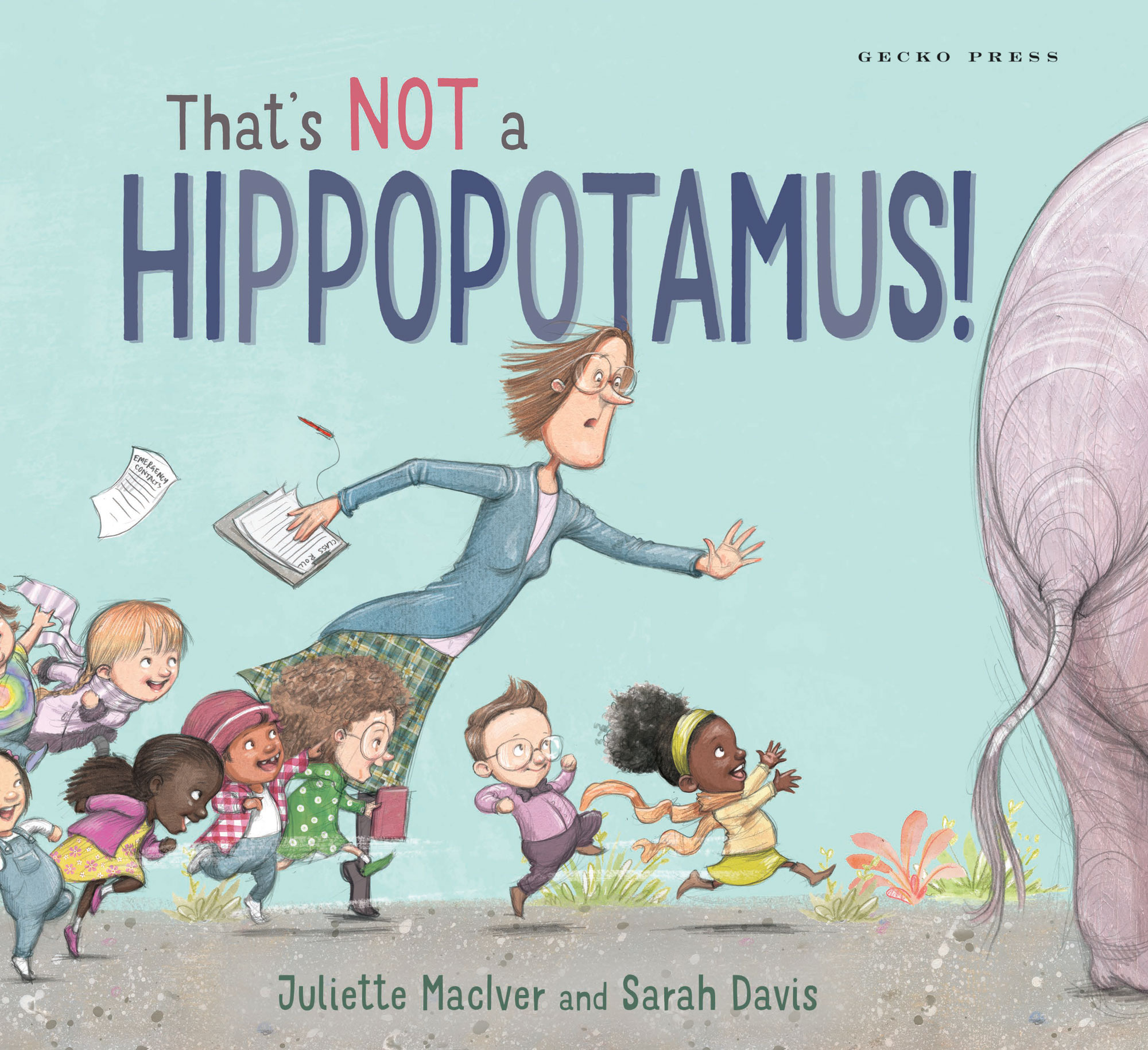
hippoWhat ‘sells’ you into agreeing to illustrating a text? What sorts of things do you look for? And do you have contact with authors at any stage during the process of creating the illustrations?

The text has to come to life in my head and make me feel something – it has to make me laugh or cry. I like texts that feel unusual and a little unhinged, or that feel as though they haven’t been done before. Vivid, evocative language and appealing characters. To be honest, a lot of the books I’ve done have been sequels – so I’ve initially signed on for one book, and then ended up locked in to doing 3 or 4, which is a brilliant problem to have, but also a little frustrating. I feel like it’s forced me to mark time a bit and cover old ground, when I really want to be moving on and trying something new. But I think I’m just coming to the end of that now!

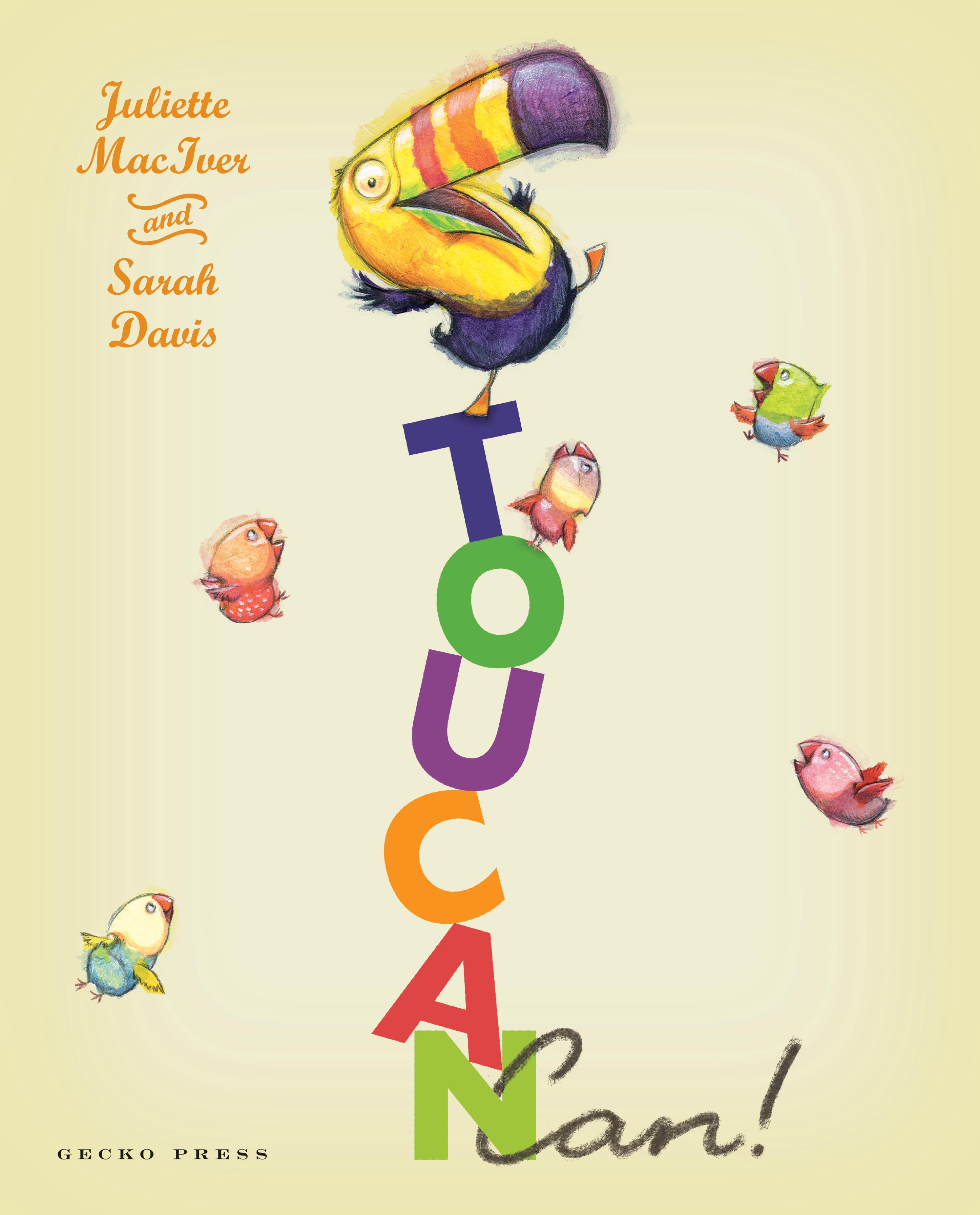
I usually don’t have a lot of contact with the authors through the process – the publisher usually liases with them, shows them the roughs, processes any feedback for me. It’s a bit odd, because that’s how it works even with authors I know quite well! Me and Juliette MacIver are a bit naughty though and we often have quite long consultations in which the publishers aren’t included, usually involving bottles of wine and ukeleles. (actually, we should include the publishers – they’re all great people and  good fun and can probably also drink wine and play the ukelele.)toucan-can-f-cvr-300dpi

You’ve illustrated both picture books and chapter books. What do you prefer doing? And how does the process differ between the two styles of books?

I much prefer picture books – there’s a lot more leeway for the illustrator to tell a story. Illustrating for chapter books is quite prescribed and proscribed – you basically get told what to draw and given a space in which to draw it on each page. It feels a lot more like  you’re just decorating the text. When you’re illustrating a picture book text you really have a huge interpretive role, and you have to bring the characters to life, draw out and enhance the themes of the text, work out how the action of the plot will play out visually. It’s much more challenging and fun. You can also subvert the text, add unexpected twists and turns and layers – then it becomes a wonderful sort of alchemy where the contributions of two creators meet and mix and create a new level of meaning.mdcc_hbk

You are published both in New Zealand and Australia, and your books have won awards in both countries. Do you see any differences between the two countries in terms of reception of books, and reader responses?

I’m not sure, really!  To be honest, I try not to think too much about how my books are being received, because it scares me! Best to keep my head down and just get on with it. Obviously, awards are always lovely – my favourite kind of award to get are the Children’s Choice awards. Kids are very wise and also really tough judges. As far as differences between the 2 countries go… um…. The Marmaduke Duck series became a really big hit in New Zealand and is a bit of a household name over there, but never really took off here. The quirky kiwi sense of humour might have something to do with that. I mean, it’s an entire 4 book series about a duck who makes jam! Doesn’t get much weirder than that…

mmd_wide-blue-seasDoes being a New Zealander impact on or influence your work? If so, in what way?

Well, I think it must, in the way that everyone’s childhood influences their work! I moved from England to Aotearoa when I was 6, and grew up mainly in Christchurch. The land had a huge effect on me. The mountains and bush and sea of Aotearoa have an really powerful presence – this brooding sense that the land is living, and aware of you.

I think for a little country it really punches above its weight creatively, and as a kid I remember there being a lot of emphasis in school on art and creative writing. I read voraciously, and a lot of my favourite authors were NZ writers. Gavin Bishop actually came to visit my school when I was about 9 or 10, and I remember he was working on Mrs McGinty’s Bizarre Plant, and showed us all his rough sketches – I was transfixed! (I actually wrote a blog post about it: http://sarah-davis.org/blog/2015/7/20/l0ef49s6lr8u1vcxogmnuqer1ommrd)

I should also mention my fabulous NZ publishers: Gecko Press and Scholastic NZ. Both extraordinary powerhouses of creativity and absolutely delightful to work with, and tireless in promoting their books and trying to get them out into the wider world, which is a necessity for NZ publishers since the local market is so small. An extra shout out must go to Julia Marshall at Gecko, who has built the company from the ground up and really does produce the most extraordinarily beautiful books.

What are you working on now?hoth

I’m working on a sequel to Be Brave Pink Piglet, published by Hachette, and a super-secret (and exciting!) project for Penguin, which is due in January. I also have a couple of educational titles on the go so that I can pay the bills. I’m working on a couple of series of paintings, too, and hoping to have an exhibition next year. But what I’m most excited about is that I’ve finally finished writing a picture book of my own, and am also going to be illustrating another that my son wrote. They’re both with a publisher now, going to acquisitions soon I hope!

Across the Tasman 4: Gavin Bishop

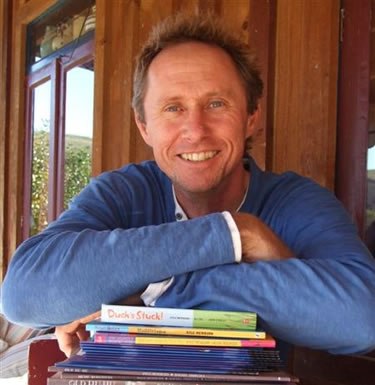
Photo of Gavin Bishop by Shar Devine.

Photo of Gavin Bishop by Shar Devine.

Author-illustrator Gavin Bishop’s long and very successful career has made him one of New Zealand’s most well-known creators of children’s books, both nationally and internationally. He has published more than 70 books, been translated into eight languages and won many awards. Yet he has also stayed close to his New Zealand roots, with a double Maori and European heritage which continues to inspire him. In this fascinating interview, he talks about how he started, his influences, process–and leaves us with an intriguing mystery about what he might be publishing next!

*********************

Gavin, you are one of New Zealand’s most prominent author-illustrators, winning many awards both in your home country and internationally.  Can you tell us something about how you started? Who were your influences, in terms of both illustration and writing?

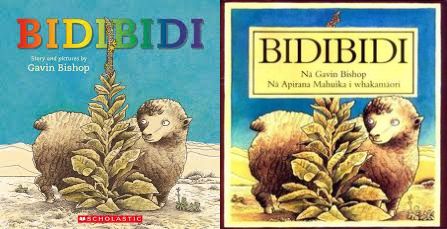
In 1978, I met someone who asked if I had ever thought of writing and illustrating a book for children. She had heard that Oxford University Press, in Wellington at that time, was intending to establish a children’s book list with a strong NZ flavour. A big bright light switched on in my head. It felt right. It was something I should do. So that very night I sat down and started to write BIDIBIDI a book about a South Island high country sheep who wanted more from life. I had no idea what I was doing. I thought I was writing a picture book but I ended up with far too much text. After quite a lot of time I sent my efforts to OUP and to cut a long story short, they liked it. It was in need of a lot of work and that is where Wendy Harrex came in. She had

Bidibidi in English and Maori editions

Bidibidi in English and Maori editions

recently returned from England and she became my editor. After a lot of rewriting and false starts the book was finally published in 1982 after another book of mine, MRS McGINTY AND THE BIZARRE PLANT had already been published.

What impact does being a New Zealander have on your work? Do you think there is a distinctively New Zealand literary/artistic atmosphere?

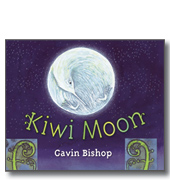
Being a New Zealander and living here is everything to me. It entirely shapes who I am and the work I produce. Knowing both my Maori and European whakapapa (Sophie’s note: this is a Maori term meaning genealogy, family history) and the attached family stories is a constant source of inspiration. I believe I have an obligation as a writer for children in this country, to kiwimoon_th-1mirror what I see and know of this place. NZ children reading a NZ book should be able to recognize landscapes, places and our stories that they can relate to and feel are important.

You have illustrated other authors’ texts as well as creating and illustrating your own. How do you go about each process? Which do you enjoy most?

Ultimately, writing your own story to illustrate is the most important thing you can do as a picture book creator. You are in complete control then; you can speak to your readers through the text as well as the pictures. It is a challenge to come up with original material more than it is to illustrate someone else’s text or to retell an existing story.

Many of your books have been based around traditional stories–Maori myths, European fairy tales, nursery rhymes. Why do you find them inspirational? And how important do you think they are in terms of children’s reading?

As a child I read a lot fairy stories and folk tales. As I grew older, as an adolescent, I graduated to horror stories and horror movies which are of course firmly rooted in fairy stories. I think it is very important for children to be familiar with nursery rhymes and fairy stories from an early age because they provide examples of traditional story structures and archetypal characters. I would include Bible stories here as well for no other reason than a knowledge of these is needed to understand and appreciate a huge amount of European literature, art and music throughout history. 

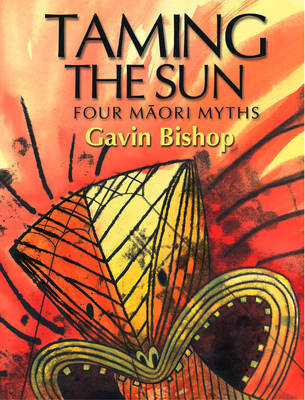
Nursery rhymes introduce us to language and ideas that can often be mysterious yet intriguing. I love the way a small child will often listen to a nursery rhyme with no idea of what it means. The rhythm and the succinctness of the words is enough, and they never forget them. A couple of hearings and a child has that rhyme for life. maori-myths-bishop

Our children should also be familiar with the stories told for centuries by Maori. Too few New Zealanders realise that the huge collection of Maori myths and legends are as complex, subtle and as encompassing as any of the Greek myths and legends that many of us were brought up on.  

I was fascinated to read that you’ve also been commissioned to write and design several successful ballets for the Royal New Zealand Ballet Company. Can you tell us more about that?

In 1985 I was commissioned by the Artistic Director, Harry Haythorne, of the Royal NZ Ballet Company to produce an original story and designs for a children’s ballet for their schools’ programme. They were interested in a story that reflected NZ. I thought about it, then remembered the time I ran away from home when I was two. I was going to a park to see an aviary of birds some blocks away from my grandmother’s house in Invercargill. I used this incident as the basis of the story of TERRIBLE TOM and later when the ballet was performed it was a great thrill to see dancers like Sir Jon Trimmer dancing out the story of my life. I learned a lot too. It was a bit of shock to realise that I couldn’t use any dialogue and the stage had to be empty so the dancers could dance. A second ballet was commissioned because the success of the first. I called it, TE MAIA AND THE SEA DEVIL. Set on the West Coast, it told of a brave young Maori girl who went to the bottom of the sea to save her mother who had been turned into a sea horse by Taipo, a sea devil.

These ballets were produced from scratch. While I did the libretto and designs, Philip Norman wrote the music and Russell Kerr did the choreography. They were the first original ballets produced for children in NZ.

You are also prominent in advancing the profile of New Zealand authors and illustrators for children, such as being involved in curating the marvellous exhibition of New Zealand illustration at the recent IBBY (International Board of Books for Young People) Conference in Auckland, which showcased NZ illustrators to an international audience. How important do you think it is for creators to be involved in the promotion of a literary culture? And how do you see the situation for authors and illustrators in New Zealand today?

I have been involved in the promotion of children’s literature from the early 1980s. I’ve attended hundreds of literary events here and overseas. Through the NZ Book Council’s Writers in Schools Scheme I have visited thousands of schools throughout NZ. It is an important part of being a children’s writer.

teddy-one-eyeChildren’s literature is misunderstood by many, and especially by other writers who write for adults. Writing for children is critically discriminated against. And illustration is, in particular, regarded with scorn. I come from a time when at the School of Fine Arts in the 1960s, the word “illustration” was used like a swear word. Again, I think it is through a big misunderstanding of the role of illustration. I see it as a storytelling process and in a way, a form of writing.

In 2006, a group of like-minded enthusiasts in Christchurch, and I was one of them, established the TE TAI TAMARIKI Charitable NZ Children’s Literature Preservation Trust. That was a bit of mouthful to say, so we now have a work-a-day name, PAINTED STORIES. Originally we set out to collect original illustrations and manuscripts of New Zealand children’s books to create a resource for research, exhibitions and events. The earthquakes of 2010 and 2011 demonstrated that this was not going to be easy. Our small gallery and display space in Victoria Street was demolished as a result of the 22nd February 2011 quake and on another occasion in another exhibition venue, a borrowed illustration fell from the wall and was damaged. So we decided to concentrate for the time being, on setting up national exhibitions of original art from NZ books. 

Bruiser, by Gavin Bishop: Taiwanese edition

Bruiser, by Gavin Bishop: Taiwanese edition

We have been doing that for 10 years. In the recent 3 shows we have used digital prints on watercolour paper instead of original art. This reduces insurance costs and lighting and conservation issues. It also helps us to emphasise that our main aim is to show how illustration is part of a story telling process and individual illustrations are part of a suite of images that all go together to help make a book. It takes away the expectation that an illustration needs to be considered as a serious piece of art.

Our trust is funded entirely by donations and goodwill and the generosity of the Original Children’s Bookshop in Christchurch and the Millennium Gallery in Blenheim. We have never charged illustrators to be part of our exhibitions. Once our current funds have been exhausted though, we will have to seriously look at fundraising. Follow us on Facebook.

What are you working on now?

I am working on a big project at the moment, one of the biggest things I have ever done. It will be published next year. That is all I can say.

Across the Tasman 3: Kyle Mewburn

kyle-mewburn-375I first met Kyle Mewburn, one of New Zealand’s most prominent writers for children, a few years ago in my capacity back then as Chair of the Australian Society of Authors, and Kyle’s as President of the New Zealand Society of Authors. Well, Kyle is still NZSA President, and very active in advancing the cause of writers and illustrators in NZ, against a not very positive background of change and difficulties in the industry there. And in this very interesting interview, he looks frankly at some of those issues, as well as his own literary work.

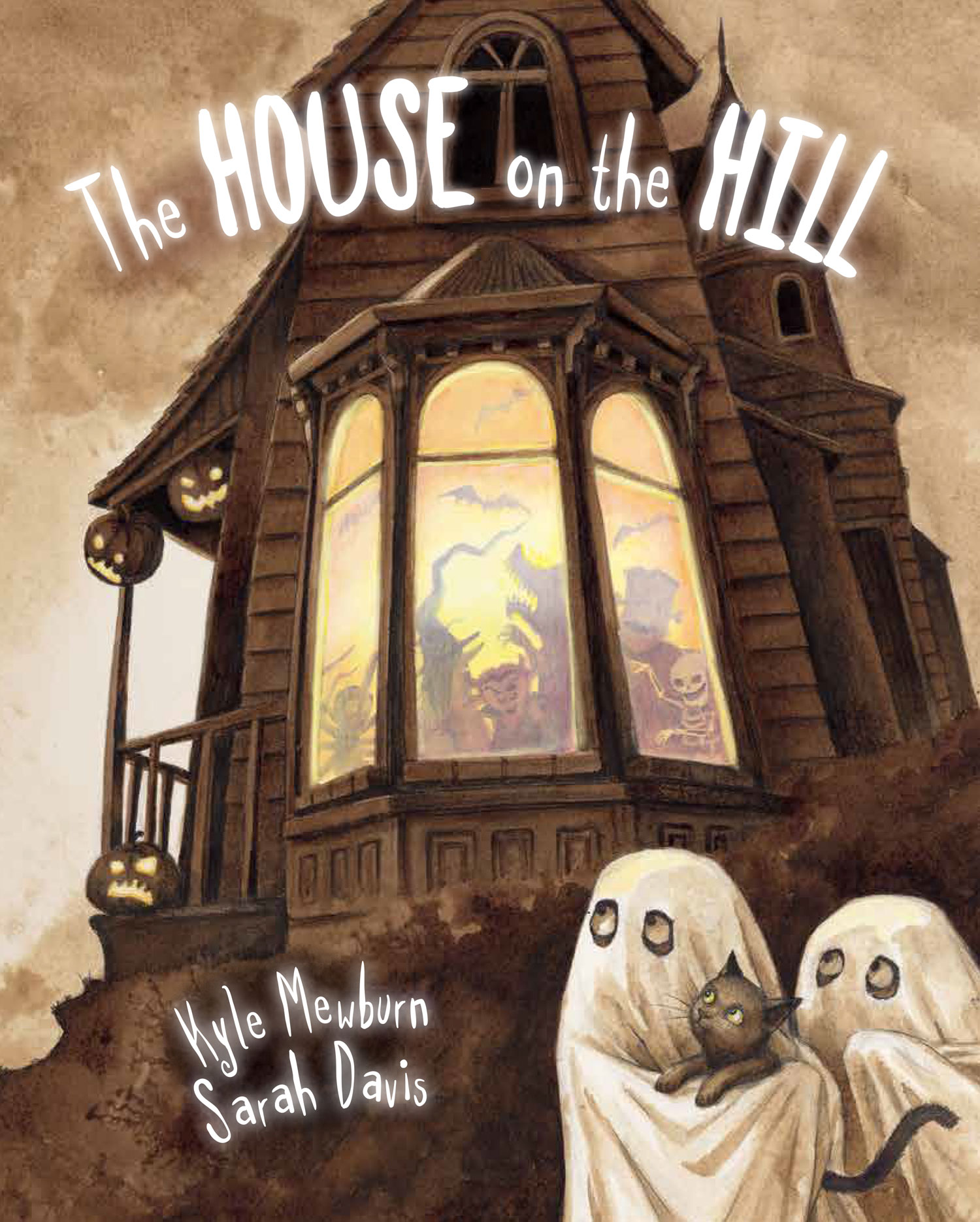
Kyle, your recent picture book, illustrated by Sarah Davis, The House on the Hill, recently won the Hell Children’s Choice Awards–love that award name by the way 🙂 in the New Zealand Book Awards for Children and Young Adults. Can you tell us something about the book, and how you and Sarah created it? And how have young readers responded to the book?

The idea for the story had been simmering away in the back of my mind for several years (as they do), though ‘idea’ is possibly too grandiose a term for what was, in effect, simply a refrain – “the house on the hill”. But that’s often how my stories start – with just a phrase that won’t go away. I knew there was going to be a journey of some sort, but had no idea who, or what, was going to make the journey. It wasn’t until I was Writer-in-residence at Otago University in 2011, that the story started coming to life, infused with an unexpected Edgar Allan Poe-ish vibe.

It took three weeks of solid, focussed writing for the story to come together. At the end of each day I’d go home exhausted, but satfisfied, despite having completed one stanza or less. I sent the story off to Scholastic and got a reply within an hour – “We love it.” Excellent, I thought. But over the next few months a sense of trepidation started filtering through, as the publishing team started second-guessing themselves. Was the story perhaps too scary? Fortunately, Diana Murray (publisher at the time) had a chat to the head buyer at a major bookstore chain whose verdict came as somewhat of a relief – “Embrace the darkness.” Having strived to make the story as scary as possible, having confidence in my young readers’ willingness, and enthusiasm, to have their pants scared off in a caring, controlled kind of way, I would have been hugely reluctant to water the scares down.

The next question was, of course, who should illustrate? I seldom get asked this question, but I jumped at the opportunity to put Sarah’s name forward. I’d always admired her work, not only for her undoubted technical ability, but also the fact she’s such an eclectic illustrator. Each work is unique with its own distinct style, and she was, I believed, the kind of illustrator who would push the boundaries and come up with a style to perfectly complement my story. Unfortunately, she was rather busy, so I was faced with a choice – wait 2+ years or choose house-hillsomeone else. I didn’t hesitate. Sarah it was.

One interesting, and unusual, aspect of working with Sarah was the unexpected rigour with which she addressed the text. Ultimately there were several stanzas which required re-writing and another which was dropped simply because it didn’t advance the story sufficiently. I really had no input into the illustrations, so can’t comment on that. Apart from saying they’re brilliant throughout and genius in numerous places, especially with their use of perspective. The art of illustration at its finest.

The response to the story has been phenomenal. Despite several parents, teachers and even reviewers initially worrying about the scariness level, the reality is that kids enjoy a good, safe scare and are happy to embrace the ‘game’. As one 6 year-old pointed out when his mum questioned whether or not he was scared – “No. I knew they weren’t real ghosts because there was a cat. Cats don’t like ghosts.” Winning the kids’ choice award is, I think, the ultimate accolade.

Though you are especially known for your picture books, you have also written chapter books and early readers. What are your favourite types of books to write, and what are the main differences between creating texts for all those different formats?

Picture books are my first passion. Almost a vice. My ideas are almost instinctively for picture books, and they seem to be the genre that most suits my thought processes and my writing voice. They’re also the biggest challenge and I get a lot of pleasure pursuing picture book ideas. (Also a lot of angst and anguish, but that’s another story…) Chapter books and junior fiction require a more measured approach. It’s more about building upon a concept than simply chasing an idea. For me, junior fiction (especially for so-called ‘reluctant readers’ or transitional readers) really has to begin with a strong character, ideally a child character. Once I have my hero sorted (whether that’s the first evolved boy in a Neanderthal tribe, or a shape-shifting dragon boy who wants to go to Knight School) I can view their world from their own unique perspective. It’s all about building relationships and interactions. Then, additionally, I add extra details and levels of meaning which encourage and reward re-reading.

dragon-knight

All my writing is child-centric. It’s all about creating stories which reflect their lives, or more specifically, some critical aspect of it. Generally my stories are about making or maintaining friendships. I guess the biggest difference between writing picture books and junior fiction is the former is a distillation process – reducing grand themes to its essence; while the latter is more a process of accretion – adding layers and details to a simple idea.

What are you working on now?

Currently I’m experiencing a bit of mid-career-itis, so not quite sure what I’m working on. The house on the hill was the last picture book I sold, so the drought has dragged on a bit. I’m not 100% sure why my picture books don’t seem to be hitting the mark any more. Possibly it’s me. Having never settled on a single style of story, I’ve generally always pursued whatever ideas tickled my fancy. And after writing over 25 picture books I’m reluctant to rework old ground. So I’ve been experimenting with different styles and approaches to writing, just to keep myself amused and challenged. Maybe that’s not what the market wants at the current time.

In the meantime I’m developing a new junior fiction series and tinkering with re-writing some of my early adult novels. A musical friend and I are also playing around with a script for a musical. It’s all good fun, but as the main breadwinner I can’t afford to spend too much time on non-profitable diversions, no matter how inspiring. So we’ll see what happens. 

Born and brought up in Australia but living in New Zealand for a long time now, you are one of New Zealand’s most prominent authors of children’s books, and you are also President of the New Zealand Society of Authors. In both capacities you’ve had a good deal of contact with the Australian literary world as well. How do you see the similarities and differences between literary New Zealand and literary Australia, both in terms of the kinds of books that get published, and also the literary scene–both in the children’s/YA and adult fields?dinosaur-rescue

There are enormous similarities between the two countries’ literary worlds and I’m rather perplexed by the fact there still seems to be a huge wall with respect to the sharing of books and writers. The key differences, I think, stem largely from the smallness of the local literary  community and market. Despite the size of the population (think Melbourne) there are very strong cliques and factions which are more based around protecting funding turf than  anything else. Which means local writers are very reluctant to criticise anyone or anything for fear of offending the wrong person. You could all-too-easily end up on the outer with no chance of funding or reviews. I’m sure every country has the same rivalries and divisions, but here, because of the population, it is much more distilled and rather potent.

The small market also makes it difficult to make a living. Print runs are often only 1500 and you can make the bestseller list by selling 100+ copies in a given week. I’ve been fortunate insofar as many of my stories have had some longevity (several are still being reprinted 10+ years later), and have had numerous titles published into international markets. Sadly New Zealand publishers are increasingly acting like imprints of their international parents, insofar as they have become much more focussed on publishing stories with local flavour. In the picture book market there has always been a demand for kiwi stories (literally stories about the bird) but this has become massively more so over recent years. No wonder when many bookshops report most people are buying picture books to send overseas to relatives or take away as souvenirs. There has also been a huge growth in stories translated into Te Reo (ie Maori language). While all this might be worthy and understandable from a business model point of view, it has not only made it that much harder to make a living as a writer, it has also created an unfortunate quandary – ie write for this market and accept your income is severely ring-fenced, or you don’t, and stack the odds against being published at all.

With respect to making a living as a CYA writer, I think Australia has massive advantages with respect to creating a secondary income stream from school visits and festival appearances. However it is a lot more cut-throat. In New Zealand school visits are arranged mostly through the Book Council, while in Australia it’s all done through agencies. So in Australia it’s much more a case of the more popular you are and the better your presentations, the more visits you get. Here it’s a bit more communal with visits shared around. On the negative side, we earn half as much for a visit as you do in Australia. It’s still very difficult to convince the majority of schools there is much value in author visits… as opposed to visits by sportspeople… or magicians… or the local fireman…

kisskissyuckyucklgeAs President of NZSA, you have been involved in helping to organise the first ever National Writers Forum in New Zealand, which has just been held. What are you expecting from the forum? And what are the issues that are most preoccupying authors and illustrators in New Zealand today?

The National Writers Forum was a huge success. The feedback has been extraordinary. The main goals were, firstly, to offer some serious professional development opportunities through masterclasses and expert panels. Secondly, it was about creating opportunities to discuss the business aspects of a writer’s life at every stage of their career. There’s plenty of information out there but seldom do writers get an opportunity to ask specific questions pertaining to their own, specific careers directly to a panel of experts. Finally, and for me most importantly, it was an opportunity for writers to assemble at the national level in a collegial and congenial environment. There are way too many divisions within the literary community, and this doesn’t help the literary cause in the wider context. The only way to break down barriers and cliques is to strengthen personal relationships by talking to each other directly rather than shouting at each other over the parapets.

As in most countries, the biggest issues preoccupying us in New Zealand centre on the increasing difficulties of making a living. New Zealand books are expensive in comparison to international titles available on-line, so there has been a concerted effort to exclude books from GST. Wishful thinking under the current government. We already have parallel importing, so have long ago come to terms with the long-term (all negative) consequences. As with writers everywhere we’re also concerned about the push to change (ie water down) copyright laws.

A very recent research report published by the New Zealand Book Council contained the rather disappointing finding that New Zealand readers were biased against NZ fiction, saying that they rarely read it–but also could not name any NZ authors–and that only 3-5 percent of fiction bought in the nation was by NZ authors. What are your thoughts on this? Is it a matter of cultural cringe? Do you think it could be turned around? If so, how?

Cultural cringe with two capital Cs. In many ways it reminds me of Australia in the 80s when I was at high school – nobody admitted to reading OzLit. When I arrived in New Zealand in 1990 there was a huge push to make NZ Music cool. The government pumped in $5million per year and introduced a radio quota. And (surprise!) within a generation NZ Music became cool. There was an attempt to do the same with books but with a budget of $100,000 and divisions within the industry, it gained little traction and soon disappeared. In the last 10 years, NZ has become a massively flag-waving country. Kiwis are enormously proud of their sportspeople, their music, their films (well, Peter Jackson and Weta Workshop, anyway), but there remains a total reluctance to wave the NZ flag when it comes to books and writers, despite local writers garnering increasing international awards and respect.

I suspect the cost of local books has something to do with it. It also doesn’t help that NZ “literature” is still discussed in such reverent tones while genre and/or popular fiction hardly gets a look in. It fosters the impression that local literature is rather intellectual and elitist. We have many world-class, internationally best-selling writers across all genres. It would help enormously if these were celebrated a bit more.     

Last year NZSA instigated a grassroots NZ Book Week with a very limited budget. Hopefully it will continue to grow and, over time, leach into the psyche. But generally I feel it requires a much greater level of government action and investment. It also is a long-term project. I’m constantly frustrated by the lack of commitment to involving local writers/titles in literacy programmes. The “as long as they’re reading something” approach does little to improve literacy, in my opinion. The only way to grow literacy is to promote local authors and stories and instill some pride in local literature. Imagine how few kids would be playing rugby if the All Blacks were considered also-rans, nobodies, rather than superstars. Pride – whether in rugby, music or literature – begins with aspirational role models. We need to start kids on NZLit from the get-go.


Kyle Mewburn is one of New Zealand’s finest, and most eclectic, picture book writers. His titles have been published in a dozen countries and won numerous awards including Children’s Book of the Year (Old Hu-hu), Picture book of the Year (Kiss!Kiss! Yuck!Yuck!),two Children’s Choice awards (Kiss!Kiss! Yuck!Yuck! andMelu) and a Flicker Tale award in North Dakota (Kiss!Kiss! Yuck!Yuck!). His stories are noted for being multi-layered, funny and linguistically creative.

He has been a frequent Finalist at the New Zealand Children’s Book Awards and many of his titles have been included on Notable Books Lists in both New Zealand and Australia.

As well as picture books, he has published numerous School Readers and junior fiction titles, including his popular Dinosaur Rescue series which has been published in over 20 countries. He was the Children’s Writer in Residence at Otago University in 2011 and is currently President of the New Zealand Society of Authors.

Originally from Brisbane, Kyle lives with his wife, Marion, a well-known potter, in a house with a grass roof in Millers Flat. When he’s not writing, Kyle’s free time is almost wholly consumed trying to maintain a semi-self-sufficient lifestyle … or watching the endlessly entertaining drama of chickens trying to get to bed under the watchful eyes of two teasing cats.

Across the Tasman 2: Sherryl Clark

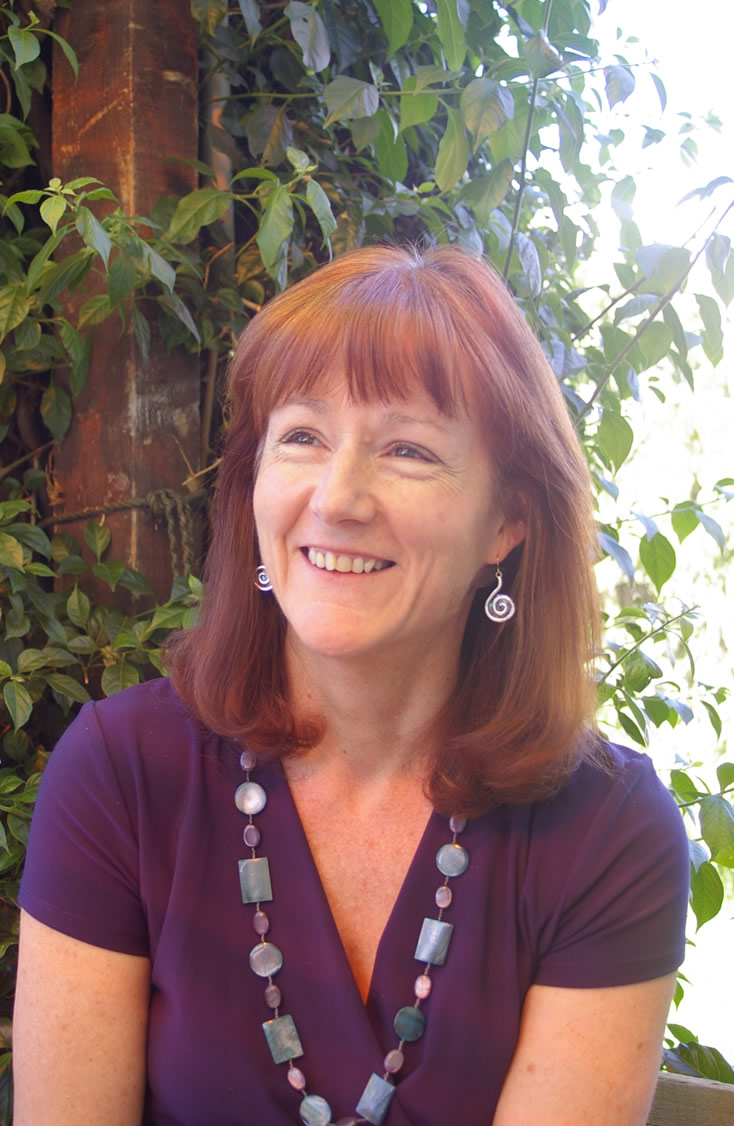
sherryl-1Sherryl Clark’s literary career is what might be called a trans-Tasman one; born and brought up in New Zealand, but living in Australia for many years, she is well-known in both Australia and New Zealand for the versatility and quality of her books, which range over many genres and age ranges. Today I talk to her about what it means to straddle those national cultures, and those different types of literature–as well as teaching literature, undertaking literary degrees, and lots more!

********************

Sherryl, you grew up in New Zealand but now live in Australia. Do you consider yourself an Australian or New Zealand writer, or both? And what similarities and differences do you think there are in terms of the literary world of each country?

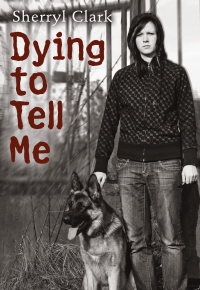
I’ve now lived in Australia for 37 years, but I think in my heart I am still a New Zealander, especially because I grew up on a farm and I think your first 18 years ‘imprint’ you. However I do think my stories are Australian, funnily enough, with some New Zealand elements. If I write about a farm (as in Farm Kid), it’s an Australian farm with drought and brown paddocks which you just don’t see in NZ like that. Not where I come from anyway. Dying to Tell Me is definitely Australian bush, and even my city stories, whether historical or contemporary, are very much set in Melbourne. I feel for NZ writers today – the publishing opportunities have narrowed so much. But at the same time I think many NZ writers are writing with real passion about their country, in very particular ways, and I don’t see that nearly so much in Australia.

You have written many children’s books in different genres, and for different age groups. Is there an age group/genre you most enjoy writing for, and why? Is there a book of yours that you think of particularly fondly? And how has what you write about changed over the years? (if indeed it has!)

jimmys-warI love picture books because of the process – the challenge of so few words – and the amazing work that illustrators do. I love verse novels because I love how poetry expresses things that prose struggles with. I think my favourite age group to write for is 11-14. To me it’s a time when you become aware of the outside world, of what people are like, the value of friends, the idea of adventure and exploration – the whole world opens up, but at the same time it’s when the whole world can make your life very hard. Anything can happen and bad things do. To me, writing about those things is a way to tell kids they’re not alone, and I think that’s important. I agree with Neil Gaiman – kids need to believe they can be brave and win against the dragons. I think that’s why I like Dying to Tell Me, my murder mystery for upper middle grade readers. Sasha has made some stupid choices without understanding why, but now she learns to be brave and to use her wits. I think my writing has become braver, too! I turned a corner about four years ago, during the MFA, when I realised that I just had to start writing what really stirred me and obsessed me, and stop worrying about what might come after.  dyingtotellme

What’s your latest book, and what are you working on now?

My latest book/s are a series based on Ellyse Perry (sportswoman). It was a commission, and I wanted to do it because I hated compulsory sport at high school, and so did lots of other girls. And I see someone like Ellyse being a huge influence on kids and getting them away from screens and participating in sports – and having fun. I wish that had been me! Plus adolescence and body changes have a lot to do with why girls stop playing sport and I wanted to explore that, too. I also have a picture book coming out next year with Allen & Unwin – The Night Tiger – which is being illustrated by Michael Camilleri. I’m very excited about that.
I’m always working on several things, so I can give manuscripts a ‘rest’ when they need some time out, so I’m able to able to look at them with a fresh eye. I’ve just finished a major revision of a SF novel (the ending still needs more work), and I’m doing another edit of a historical novel. I changed a large part of it into present tense and it’s still a bit clunky.

You’ve written poetry for both children and adults, and have edited a poetry magazine, Poetrix. Can you tell me something about both your poetry, and the magazine?

Poetry was the first thing I wrote when I realised what writing was. That probably sounds weird, but I’d been writing these dull short stories and an awful adult novel, and then I did a poetry workshop and thought – yes! I wrote this thing and the workshop leader said it was a nice metaphor and then I thought – what’s a metaphor? And since then (30 years ago, mind you!) I’ve been learning more and writing more, and it’s such an exploration of language and image. So much fun and so satisfying, and I just wish more schools would ask for poetry workshops. Truly. Most teachers have NO idea what poetry can open up for kids. And most importantly for those kids who don’t feel confident with language and prose. Poetry just excites them so much. They are the BEST poets!

We created Poetrix (Australia’s only magazine for women poets) back in 1993. I used to teach classes in self-publishing because it was a passion of mine, and I’d worked in community arts and for a printer. My writing group, Western Women Writers, were totally on board with creating a magazine, and we self-funded it with small catering jobs. We produced 40 issues of Poetrix, and we published a huge number of women who have gone on to have books published and won awards. But mostly we did it so women had a poetry voice. It was in reaction to some critic who’d said women only wrote poetry that was ‘domestic suburban vignettes’ and we thought – yes? So what’s wrong with that? It’s life as we know it and experience it, and of course you can write fabulous poems about it! So here are 40 issues of Poetrix and about 1400 poems about things that are important to us. To everyone, actually.

As well as writing books, over the years you’ve also run a lot of classes on writing and publishing. What kinds of things do you most enjoy helping people to learn? Do you teach mainly children, or adults, or a combination? And do you think that things have changed in terms of areas of interest–I mean, are people interested in learning about different things now than they were say 10 or 15 years ago?

I’ve been teaching in the Diploma and Cert IV of Professional Writing and Editing for nearly 20 years. But I did get to a point finally where I realised how much energy and focus teaching was sucking out of my writing. I went off to Hamline University in Minneapolis to do an MFA in writing for children and YA, and a very wise teacher there said, ‘It all comes from the same well. The more you teach, the less you have for your own writing.’ So in the past three years I have stopped teaching at TAFE, apart from substituting and helping out, and I think my own writing has received a huge boost because of that. It’s sad to say this, but it’s true. Teaching did detract from the energy I had for writing, and now with the whole onslaught of government paperwork requirements, more and more writing teachers are leaving TAFE because it’s overwhelming. Less time to teach and more time to fill out pointless forms. It makes me angry, to be honest.
Because I do love teaching and workshops. The people who come are so keen to write, and to learn. You can feel them soaking stuff up. I often see people start with an introductory class and five or ten years later, they’re getting published and doing so well. The one thing I love teaching is story structure. People get so mired in character and dialogue and just getting the words out, but structure (if you learn it and understand it) can fix just about everything. Mind you, it can’t fix voice, and in writing for children and YA, voice is so important. I think you only ‘get’ voice if you read a lot, read widely and read from a writer’s viewpoint. It astounds me when aspiring writers say they don’t read. There is so much to learn from astute reading. pocket-rocket

I teach mainly adults still – I do writing workshops in schools, yes, but a lot of schools want to spread their resources as widely as possible, of course, so I will do talks to 300+ students rather than workshops with 20. My dream is to create a portable poetry workshop I can take to school teachers and show them how to use poetry in the classroom, both reading and writing it. I have a website I started back in 2006 when I realised how little there was for schools – www.poetry4kids.net. I need to update it now and put a lot more material on it.

At the moment, you are undertaking a PHD themed around fairy tales, through an Australian university, after doing a Master of Fine Arts degree through an American university. What was your main focus in the MFA? What aspect of fairytales are you focussing on in the PHD? And how do the two university cultures compare?

When I chose to do the MFA in the US, it was because I knew it was the only way to do a Masters in the way I wanted. I didn’t want to be stuck doing one topic and one novel with one or two supervisors. Hamline meant I could do the things I really wanted: work with a different advisor every semester and learn from them (all published, experienced writers and teachers); work on a different project every semester to learn as much as possible (so I did a historical novel, picture books, a verse novel and a SF novel, plus a critical thesis on verse novels); go to intensive residencies in Minneapolis/St Paul where there were lectures, readings, workshops and a committed community of children’s writers; work at home via email in between and get detailed feedback on my writing; learn to write critical essays and a thesis that taught me more about the field from a critical viewpoint.

The PhD at Victoria University in Melbourne came from an essay I wrote during my picture book semester at Hamline. It was about picture books that are original, new fairy tales (Fox by Margaret Wild was my key text). Now my PhD asks that question – if I want to write new, original fairy tales myself, how do I achieve this? How do I write something that has the same resonance and unconscious signals that traditional tales like the Grimms’ do? So the creative writing (picture books and a novel) is informed by the research. Why have fairy tales endured? What is it that we respond to? How can I use this without being prescriptive or didactic or just plain boring?

Of course other aspects have come into it, especially the issue of publishers avoiding scary stories, and over-protective parenting that leads to a lack of resilience and coping skills in kids. I didn’t intend to venture into psychology, but then given that Bettelheim’s book, The uses of enchantment, was my starting point, I guess it was inevitable!

The two universities are poles apart, but that’s to be expected. Any Australian university would be entirely different to a US university that both specializes in children’s/YA writing and offers a low residency option. I think perhaps we’re not big enough here to be able to either specialize in that way or offer low residency on a wide scale. I’ve approached VU about running an MA similar to Hamline (indeed Hamline are keen to form a partnership), but with the government continually cutting tertiary funding and clearly having such an anti-arts agenda, I can’t see it happening anytime soon.

I think it’s so interesting that so many writers now are doing PhDs, because you can apply for a scholarship and it gives you an incredible amount of time to focus and create and innovate. Funded time that you don’t get hardly any other way. My bet is that in the next 10-15 years, Australian writing will see a huge growth in quality and innovation because of it. But if the government gets its scaly, arts-hating hands on the PhD program funding, they will kill it. Maybe I shouldn’t be telling them? Ssshhh.


Sherryl Clark’s first children’s book, The Too-Tight Tutu, was published in 1997, and she now has more than 65 published books. Her other titles include a number of Aussie Bites, Nibbles and Chomps, and novels. Her YA novels are Bone Song, published in the UK in 2009, and Dying to Tell Me (KaneMiller US 2011, Australia 2014).

Sherryl’s verse novel Farm Kid won the 2005 NSW Premier’s Literary Award for children’s books, and her second verse novel, Sixth Grade Style Queen (Not!) was an Honour Book in the 2008 CBCA Awards. Other recent titles include a picture book of poems, Now I Am Bigger, the middle grade novel Pirate X and the Rose series (Our Australian Girl). Her fourth verse novel, Runaways, was released March 2013.

Her latest books are the series featuring sportswoman Ellyse Perry. Pocket Rocket and Magic Feet are released in early October, with two more in January 2017.

Her books have been published in Australia and overseas, including the USA, UK, Spain, Mexico and China.

Her website is at www.sherrylclark.com

Facebook – https://www.facebook.com/Sherryl.Clark3

Twitter – @sherrylwriter

Instagram – sherrylwriter

An interview with Lisa Hayden, translator of Laurus

laurusThe greatest discovery of my reading life this year has been the extraordinary novel, Laurus, by Russian author Eugene Vodolazkin, beautifully translated by Lisa Hayden. Set in the Middle Ages, around the life of a Russian healer and mystic, it is bold, brilliant, spiritually profound and utterly absorbing. I’ve been raving about it to anyone who would listen ever since I read it–and thank you to my friend and fellow author, Natalie Jane Prior, for first drawing it to my attention!

And now I’m absolutely delighted to be bringing you an interview with Lisa Hayden, whose pitch-perfect English translation has so skilfully brought Laurus to readers all over the anglophone world( the book has of course collected many fantastic reviews). Fresh from a trip to Moscow where she won the prestigious Read Russia prize for translation, in the contemporary literature category, Lisa generously answered my questions with great insights and interesting observations. Enjoy!

Lisa(second from left) at ceremony for the Read Russia Prize, with winners of other categories. Photo by Anatoli Stepanenko, used with his kind permission.

Lisa(second from left) at ceremony for the Read Russia Prize, with winners of other categories, Joaquin Fernandez-Valdez, Claudia Scandura, and Selma Ancira. Photo by Anatoly Stepanenko, used with his kind permission.


*********************************************************************************************************

First of all, Lisa, congratulations on your wonderful translation of Laurus! It must have been an extraordinary undertaking. How did you prepare for it, before you even started the writing work? And how long did the whole process take?

Thank you! I’m glad you and so many other readers have been enjoying the translation. Laurus was tremendous fun to translate and it seems like that comes through for readers.

 I don’t generally do much before starting a translation other than reading the entire book before signing a contract. I don’t do a lot of advance research since I prefer to take each difficulty as it comes, though I often find that author interviews give helpful insights into an author’s intentions. All that said, when I was starting Laurus, I gathered lots of books about the Middle Ages. Though I can’t say I sat down and read any of them cover to cover, I enjoyed paging through lots of them, reading passages, and getting a feel for medieval prose, herbals, and life. An anthology of medieval literature that I read in college was helpful, too, for background information, ideas on vocabulary, and a look at translations of a text or two that Eugene borrowed for Laurus. As for timing, if I remember correctly, I had about eight months from start to finish to work on the translation, with editing taking more time later on.

Were you in touch with the author, Eugene Vodolazkin, during the translation process?

Eugene and I first met in Moscow, in September 2014, and have kept in touch ever since—he and his wife have become friends and I love spending time with them. Eugene answered questions for me and even read through my entire manuscript, which was extraordinarily helpful. He’s just wonderful to work with because his English is very good and he understands the role of the translator. We think of each other as the co-authors of Laurus.

Laurus is an absolutely superb, moving novel with a richly evocative style, truffled with piquant language and a complex narrative chronology. Yet though it’s so artistically accomplished, and the best evocation of the mystical experience I’ve ever come across, it is also very readable and accessible. I imagine that it must have been very difficult to recreate that balance between art and accessibility. How did you do it?

To be honest, I don’t really know! Of course I knew what awaited me because I’d read the book before I began translating. Really, though, for me translating any book is, most of all, a matter of sitting down each day, hearing the text in my head (this sometimes includes reading it out loud), and finding English words that can combine into phrases and sentences that feel like they capture the meaning, energy, style, and spirit of the Russian text. I’m pretty intuitive, so I follow my instincts. I usually go through about five or six full drafts before turning in a final draft. I read the entire book aloud to myself at least once, edit it on paper several times, and read it once on an electronic reader.

 Before Eugene saw my draft, I showed it to two Russian colleagues: Liza Prudovskaya checks a draft of all my translations and Olga Bukhina specifically looked at the old language in Laurus. They answered questions, corrected mistakes, and gave me further ideas. They’re both just wonderful to work with. So are my editors at Oneworld: publisher and editor Juliet Mabey is very no-nonsense, a quality I value highly in an editor and she has a fantastic feel for books that’s won Oneworld numerous awards. And copyeditor Will Atkins is just phenomenal. Beyond straightening out twisted syntax and correcting grammar and stylistic slips, he asks tough questions about usage and vocabulary that help me sharpen my texts. I enjoy working collaboratively, so all the feedback, queries, and ideas from Liza, Olga, Juliet, Will, and Eugene freed me up to take appropriate risks with the language in Laurus. In the end, I think what happened is that I had my intuitive feel for the text, translated the book, and then, thanks to all the drafts and comments, felt confident that my translation fit with the original in terms of meaning and style. Each book is different but that’s my general approach to all of them.

Lisa signing copies of Laurus with the author, Eugene Vodolazkin, at a book event in New York

Lisa signing copies of Laurus with the author, Eugene Vodolazkin, at a book event in New York

You are currently working on the translation of another book by the same author, The Aviator, which will be published in 2018. Can you tell us a bit about it?

I love The Aviator! The novel begins when a man wakes up in a hospital suffering from amnesia. He gradually begins remembering his past and his identity, and those memories are especially interesting because of how they fit with Russian history. I don’t want to say much more because what’s happened to him is so, hmm, unusual. It’s a book with a Petersburg setting that fits beautifully with Laurus and Solovyov and Larionov, which will also be published by Oneworld: all three books look at time, history, and identity, forming a beautiful triptych. I’m working on a first draft of The Aviator now and enjoying how it translates.

Russian-French writer Andrei Makine, in one of his novels, Le Testament français, has his narrator say, ‘The translator of poetry is the poet’s rival; the translator of prose is the novelist’s slave.’ What is your opinion? Do you have a philosophy of translation?

I can’t say that I have a philosophy of translation other than very basic things like “be flexible” and “get the work done,” something that applies to all levels of the process itself. Each book is different so I feel like I work under unique unwritten guidelines for each. Most of those guidelines are subconscious and sometimes I don’t realize what I’ve been doing until rather late in the process.

 The line you mentioned from Makine’s book comes from Vasily Zhukovsky, a nineteenth-century poet and translator. I’ve heard and read this before and I suppose it always irritates me a bit because I’m a prose translator and, despite knowing what he’s saying, I don’t feel like I’m any novelist’s slave on even a metaphorical level! Of course I’m very fortunate that my authors tend to see their translators as co-authors: they encourage me to approach their texts creatively and we often make changes together. Translating fiction is very creative work: even though I’m not restructuring a plot or rewiring character development, I’m a writer who’s supporting the author’s plot structure and character development by choosing words and putting them in an order that feels appropriate for capturing the language and literary devices in the Russian text by establishing a poetics for the translation. It’s very complex work and it’s a tremendously interesting and gratifying form of writing that requires a lot of thought about and feeling for the text.

What other literary works have you translated?

I haven’t been translating for a long time so this will be fairly quick to answer, particularly if I stick to recent and upcoming novels. I’ve translated another book for Oneworld, Vadim Levental’s Masha Regina, a novel about a young woman from a small city who goes to St. Petersburg and eventually becomes a filmmaker. Since I’m from a very small town, I particularly identify with Masha’s provincial roots. I translated Marina Stepnova’s The Woman of Lazarus, a rather edgy family saga, for World Editions and am finishing up her Italian Lessons now. I love Marina’s feel for history and pain, not to mention her humor. Then there are three other books for Oneworld that are in various stages: Eugene’s Solovyov and Larionov, about a historian and a general who live in different times; Eugene’s The Aviator, which feels so close to me right now; and Guzel Yakhina’s Zuleikha Opens Her Eyes, about a kulak Tatar woman who’s exiled in the 1930s. Guzel’s book is a historical novel that looks at Soviet-era difficulties but it’s also very lyrical in places, with imagery and descriptions of nature that are very moving. I like to translate books that have the power to make me cry. That’s why I like all these books: they’re very different but they all move me.

You are a Russian language specialist, and as well as translating literary works such as Laurus, you have taught the language. What drew you to Russian in the first place?

Literarily speaking, stories about Baba Yaga were the first thing to draw me in, when I was very small, then I read my first Chekhov story, “The Bet,” in the sixth grade. I went to college hoping to be a biochemist but nearly failed calculus: I signed up for first-year Russian after loving a Russian history course and went to Russia, which was then the Soviet Union, for the first time in 1983. After that came grad school in Russian literature, though I dropped out with just an MA because I couldn’t picture myself teaching and researching for the rest of my life. I love Russian and I love writing but don’t have it in me to construct plots and develop characters, so translation feels like ideal work for me.

 Thank you, Sophie, for inviting me to answer these questions for you. I appreciate your interest in Laurus, Eugene’s writing, and my work. Happy reading to everyone!