For whom the bell tolls–a memoir piece

Another of my memoir pieces that I’m republishing: this one’s about the house and the village in south-west France where we lived through parts of my childhood.

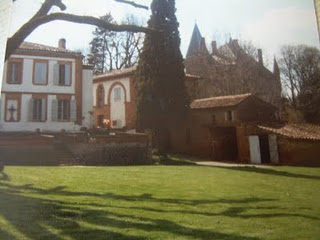
Back then: La Nouvelle Terrebonne from the back, with the castle and church seen in background

For whom the bell tolls

My childhood and adolescence were spent bouncing between Australia and France as my expatriate French parents never emigrated formally to Australia. My father worked for a big French building firm in Australia, after having worked previously in Indonesia and Africa, and a part of his contract entitlements was a regular paid trip back to France for the whole family. So every two or three years, we’d up Sydney sticks to spend two or three months in our French home, in the tiny village of Empeaux, in the Haute-Garonne departement of south-west France, thirty-five kilometres from Toulouse.

My parents had bought our beautiful eighteenth-century house in Empeaux, La Nouvelle Terrebonne, as a dilapidated shell in 1959 and proceeded to restore it to its former glory as the second finest house in the village(after the castle)through many years of huge builder’s bills.

The village was dominated by the castle, the church and, surprising in such a bucolic setting, the factory. Empeaux had been declining for many years when the new owner of the castle decided to open a ceramics factory. It was built at the far end of the village, right away from its main street, which was lined with thin, tall stone houses on one side, and on the other, our own large house, flanked by two much less imposing houses. Further down was the church with its pleasant, most unghostly little graveyard. Up on the hill at one end of the street, surrounded by a high fence and the barking of what we assumed were ferocious guard dogs, was the castle—not an ancient medieval fortress but a beautiful seventeenth-century building done up in the nineteenth century, all silvery-topped turrets and narrow windows.

The people who lived in the village’s main streets were old-time residents; the new ones who poured into the area, after the ceramics factory work, lived down the hill, away from the centre–Portuguese and North Africans, and young people from other villages.

On one side of our house lived the Vaccaronnes, peasant farmers; on the other, Remi Peres and his dog. Monsieur Vaccaronne had emigrated from Italy many, many years ago, so long ago that he often forgot he ever had. In fact, he was the epitome of the French peasant–canny, suspicious, pale blue eyes full of calculating hospitality, beret jammed tightly on his balding head. He and his wife had two grown up daughters who married quite late, and a great love of the variety singers in spangled suits who proliferated on French television screens. He would ask us into his kitchen, and, proferring a tiny finger of gnole, the fiery bootleg liquor that everyone made in defiance of the authorities, would point proudly at the television, where Claude Francois or Johnny Hallyday crooned or yelled. “Isn’t that beautiful?” he would say to my father.

Papa hated TV. We knew that. We didn’t have one at home, either in France or Australia. But he contented himself with an ambivalent  murmur, while old Monsieur Vaccarone hummed along with the singer on television. Then he turned to us with a wicked smile. “I want to show you something. Come and see!”

In the clean whitewashed wall of his kitchen there was a door, set well into the wall. He opened it. We knew what was beyond it, we’d been there before. But still, each time was a shock, like a passing from one time into another. Here the walls had been left plain, the smells were not of daube or saucisse de Toulouse, as in the kitchen, but a rich full, deep smell, both repellent and warm, the smell of familiar animals.

In one corner were the stalls for the Vaccarones’ two cows, which were driven off to pasture every day by Rose Vaccarone, calling out shrilly to her dog, “Euh! Mizette! Euh! Euh!” We’d walked to the pasture once or twice, and found Rose sitting there with her cows, her feet snuggled into the warm flowery grass.

But the cows weren’t there, this time, and the hens were out, scratching in the main street near the pump, squawking indignantly at birds landing near them. But the pig was there, an enormous, huge, nightmarish sow with evil eyes and an obscenely displayed belly, as several tiny shapes bustled and squealed at her teats.

“Beautiful,” said Monsieur Vaccarone, in the same admiring tone that he’d used for the singers. “She’s a wonder, that one. Always has so many piglets!” He looked at them in silence for a while, while I wrinkled my nose, thinking that it smelt of bacon and sausages in here, a thought that made me feel horrid. There was something disgusting about smelling the food on the living animal.

Monsieur Vaccaronne cackled, unexpectedly. “She’s a bit of a witch, though. I have to watch her. She’s as likely to eat her piglets as not. I’ve come in here sometimes and. . ” But Camille and I didn’t wait to hear any more. We raced outside, into the sunshine near the pump. “Yuck!” Camille said, and made retching noises. “How revolting!”

I could hardly answer. The idea of the cannibal sow eating her babies disgusted and terrified me. It reminded me of Hansel and Gretel, a story I’d always hated. I would see the sow’s small eyes in my dreams, I thought…


the Empeaux church today

Instructed by Maman, who wanted some peace, Papa often swept us along in his wake when he went to visit neighbours. To visit, for instance, the public telephone facility which was in Monsieur Martin’s house. Monsieur Martin lived over the street in one of those tall thin houses, and he was paid by the PTT to provide this service for the whole village. The PTT, like postal and telecommunications services the world over, had a probably undeserved reputation for casualness, a certain indolence and indifference to customers’ needs. Disgruntled customers maintained that its acronym stood for ‘Petits Travaux Tranquilles’ (Quiet Little Jobs’), maintaining that they’d once stood in a post office queue for ten minutes while staff discussed what they’d done on the weekend!

Be that as it may, Monsieur Martin was the representative of the PTT in Empeaux, and he took his job seriously. No PTT jokes in his presence!He was extremely well informed on the ins and outs of  everyone’s business in the village, and when we got our own telephone, Papa missed the snippets of gossip at the Martin house. Monsieur Martin, to my eyes, looked just like the other old men in the village, with his big flat beret, and soft speech full of succulent patois words, but he, too, wasn’t the storybook peasant we’d seen in books. He’d been a Communist in his youth, and had stood as a candidate for the Party in local elections, and he wasn’t married to the woman we all knew as Madame Martin, but lived with her in sin! I was amazed that a white-haired woman with a wispy bun and the traditional black floral pinafore of the region could possibly be a source of scandal. Like our other neighbour, Remi Peres, Monsieur Martin had little time for priests. “Oh—those ones!” he would say. “Those ones–like vultures, they are, waiting for you to be dying, so they can pounce, with their nonsense talk of heaven and hell!” I would watch Papa covertly, then, sure he’d be shocked, horrified, for religion means a good deal to him, but he would merely smile, shrug his shoulders. Yet if we’d said that. . .

Neighbours like champion gossip Monsieur Penain, who appeared on the dot, outside his door, every time any vehicle was heard in the village. He always came out with two buckets, as if he’d been just about to go and draw water, or scrub his step. You could see him, his eyes busy with speculation, suspicion, imagination, every time. Especially if it was a vehicle drawing up outside our house! At the time, my two older sisters, Dominique and Beatrice, respectively seven and five years older than me, kept a flock of admirers around them, and every time they came to visit, pop! Out would come Monsieur Penain and his buckets, just like one of those weather houses where the little man comes out if it rains. In fact, we had one of those weather houses, at home, and guess what the little man was called?

And the middle-aged woman who lived down one end of the village, Madame Lascours—she was a witch, from a long line of witches. People went to her for the curing of warts, of small ills, for counsel in love affairs and a spot of fortune-telling..

It seemed strange to me, as an adolescent: the village with its mixture of anticlericalism and piety, its acceptance of television singers and supernatural powers. It wasn’t consistent, I thought. And without consistency, how could you map the world, find your way around it?

You could listen to the stories of old Remi Peres, for instance, whom Papa called Remi but whom we had to call Monsieur Peres. He lived right next to the church, in an ancient, incredibly filthy hovel which looked as if it had survived from the Middle Ages. He’d been married, but his wife had taken off decades ago, with their child, grown-up now but who never came to see him. Now he lived with an old, blind dog, whom he treated alternately with extravagant affection and heedless cruelty. He drove a battered old 2CV, and lived on an army pension. Every week, he would drive to the nearby village of Saint Thomas and drink away a good portion of his pension in the cafe. And talk! How he could talk! Papa would invite him into the house, and he would sit there, firmly grasping a glass of some fiery spirit and talk, in a mixture of sardonic humour and menace. “When the Revolution comes, my dear sir,” he would say, “Ah, when it comes, all this will be ours!”

Papa wouldn’t bristle, his nostrils would stay pink, not pinch with white rage. He would say, softly, looking him in the eyes, “Ah, but then, Remi, I will be ready for you!”
Honour satisfied, Remi would start in on one of his stories. Scandalous stories, all, which he’d recount with a sly twinkle. Maman hated those stories. She would call out to us, curtly, “Come on! I’ve got some work for you to do!” and later, when he’d gone, she’d say to Papa, “Honestly, Georges, I don’t know why you encourage him. He is not a nice man, not a nice man at all. . ”

Most of the time, I saw him as a harmless teller of amazing stories, but we all knew there was another side to him. We’d seen him kicking his dog, and that gleam in his eyes when he talked about the Revolution wasn’t all make-believe. There was a harsh judgment, there, the pitiless resentment of the peasant. Once or twice, too, there had been another thing in his eyes, something as he looked at us, the girls, something creepy. But despite all this, his stories were amazing, evoking a bygone world, a world of folktale where the rich and powerful got their come-uppance, and the poor, but clever tricked them, easily!

Like the stories about the inhabitants of the castle. Remi said that the castle brought ruin and bad luck to whoever lived there–a fitting fate, in his opinion, for anyone who’d have the money to live in a castle. Before the present owners, there’d been an aristocratic young man who’d lived there–a pedale, as Remi called him, using the colloquial word for homosexual. ‘That one, he thought his crap didn’t stink,’ said Remi, ‘he lorded it over everyone. But then, well, you see, ‘ went on the old gossip, with a sly wink, ‘one of his servants, his cook, in fact, was also a pedale and he was in love with his boss and very jealous when the young chatelain would invite his other friends for their..er frolics. So, you see, one day, fed-up of it as he was, he poisoned the young chatelain’s dish, and the young man died, and then it all came out, all of it. . Such a to-do there was! ‘ And Remi would laugh, and we sat there, fascinated yet repelled, not only by the story but that someone should actually find it funny! He had lots of stories about priests, too, and what he said was their hypocrisy and how he himself, Remi Peres, had caught one in flagrante delicto with his housekeeper. It was Papa’s turn to frown at us, then, and say, “Haven’t you lot got something you should be doing?”

Because there were no shops in the village, mobile shops came once a week. There was a baker, an ordinary butcher and a horse butcher, and a grocery van. The vans would draw into the main streets, horns sounding, and people would pour out. All of them–the Vaccarones and the Penains, the Lascours and the Peres, and the other people who lived further down in the village.

But not the inhabitants of the castle. Occasionally, you’d see the son tearing out in his new sports car, doing wheelies down the street, and disappearing in a cloud of dust, but he never stopped to speak to anyone. His father, who owned the ceramics factory, was also a doctor, and Remi’s story of the Castle Curse seemed to be vindicated when several things happened to the castle family. The son, coming home late at night from a party, knocked down and killed a child on a bike. He was arrested, sent to gaol, and his mother declined visibly. And then his father was arrested for fraud and sent to prison himself. .

But that was several years in the future. Now, the village stands around the mobile shops, gossiping, passing traditional compliments and insults with the shopkeeper. “Call that a sausage?”

“Well, madame, that is the best sausage in the region, that’s all!”

“Navel oranges. . hmm. .  foreign, aren’t they?”

“Yes, of course, they’re from California! And look, madame, the best apples. Golden Delicious, no less!”

It seemed that everyone wanted the new, the strange, the foreign. I saw Remi Peres’ raised eyebrow when Maman said to the grocery man, “Golden Delicious? Horrible, floury things! Where are our good, traditional apples, the reinettes?”

She was several years too early, in her desire for the traditional, the old-fashioned, the crafted myriad varieties of apple as against the mass-produced EEC fluff. The others shook their heads.

“You have to move with the times, madame! These are modern times!” And Maman would give an angry, small laugh.

And then there was the glas, sounding out over the village. The glas, the ringing of the bells for the dead, the bells tolling, strange, portentous, somehow chilling. It rang several times when we were there, for the old, reaped by age, the young, felled by accident. Another grave in the cemetery, already filled with carefully-maintained graves and sepulchres. Everyone came to the burials, everyone, even those who hadn’t really known the dead, even those who despised priests and religion–for the burials were always attended by a priest–and for a long time I thought it was to show solidarity, the ancient togetherness of the peasant community. But then, one day, with the glas sounding, tolling, over the village, the procession wending its way down to the graveyard, we heard a conversation between two mourners. Remi Peres and Madame Lascours, or maybe it was someone else he was addressing.

“Who is it that the bell is tolling for?” she said. “Who has died?”

And he looked at her, the sly smile in his eyes. “I have no idea, madame, no idea! But if it is not for me, and it is not for you—why should we care, who it’s for?”

The language of astonishment: on being bilingual

I’m republishing here today a meditative essay of mine looking at how the experience of being bilingual, as well as my family history, has influenced my work.

(This essay was first published in Explorations, A Journal of French-Australian Connections, Number 50, June 2011, and subsequently republished at http://languageofastonishment.pressbooks.com/ )


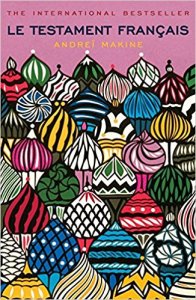
Towards the end of Russian-French writer Andrei Makine’s hauntingly beautiful novel of childhood, memory and divided loyalties, Le testament français(1995), the narrator Alyosha, who all his young life has been shuttling between the visceral reality of his Russian Siberian childhood and his French grandmother’s poetic evocations of her past and her old country, has a sudden slip of the tongue which for a moment puts him in a disorienting position: that of being literally between two languages, between French and Russian, and understood by neither. But it is that very moment which transforms his life and his understanding of himself and his literary ambitions. The gap between the two languages which as a dreamy child he simply accepted and as a rebellious teenager he reacted against, is not what he once thought it was—a frustrating barrier to understanding or a comforting bulwark against reality, depending on his mood at the time. No, it is something far stranger and much more exhilerating: a prism through which everything can be seen and felt even more clearly, sensually and intensely, and not only because with two languages at your disposal, you have even more opportunity to ‘nail’ the world, as it were. It is because that between-two-languages phenomenon common to all bilingual people is actually a striking metaphor for the gap that exists between language per se and lived, sensual reality for all human beings. And it is in that gap that literature itself is born: literature, which in Makine’s beautiful words is un étonnement permanent devant cette coulée verbale dans laquelle fondait le monde: a never-ending astonishment in the face of the flow of words in which the world dissolved. (Le testament français, Mercure de France 1995, page 244.) And it is that very ‘in-between’ that universal ‘language of astonishment’ which will turn Alyosha into a writer, and by extension Makine himself, who included many autobiographical elements in the novel.

When I first read Le testament français, in the year in which it first appeared, and the language in which it was written—French–(the English translation, with the same title, appeared in 1997) I had already been published in Australia for five years, with several novels already in print. I was already aware subconsciously of many of the things Makine writes about. But I was immediately and viscerally struck by Le testament français. Makine had put his finger unerringly on the pulse of the bilingual writer; he had expressed perfectly something most of us knew and struggled with but I for one had never expressed quite so clearly, though I knew that my background and divided loyalties informed practically everything I had written, even those works which had nothing whatever to do with bilingualism in content, style or theme.

I write very differently to Makine, and in a very different field to his adult literary fiction. Though I have written three adult novels, the vast majority of my work is fiction for young people: children and adolescents. It is an area I much prefer, for all kinds of reasons, but principally because it is the area in which I can most express myself, in which I feel most free, whose very constraints in terms of what may or may not be permissible due to readers’ ages mysteriously allows my imagination a great deal more latitude, invention, freshness and subtlety than would be the case in adult fiction. Within young people’s fiction, I have written in all kinds of genres, from mystery novels to fantasy novels, family sagas to ghost stories, thrillers to love stories, historical novels to graphic novels. But the element of the fantastic, in one way or another, has been an abiding feature of my work. And now, after reading that book and thinking deeply about what it raised,  I began to see that my own abiding interest in the fantastical, ever since my earliest childhood: in fairytales, legends, myth, as well as modern fantasy, was in itself  not only a personal choice, because I was that way inclined and always had been. But also because the journey between worlds, the sojourn in strange places, and the sudden irruption of a different, disturbing reality into the everyday which is at the heart of fantasy was actually also at the heart of my own lived experience.
 

I was born into a long, tumultuous family history. A history which at least on my father’s side we knew very well, stretching back through the centuries, from the peasant villages of western France to emigration to Quebec as some of the first people to settle in ‘New France’, through centuries of Quebec life to the spectacular return to France in the early twentieth century as very rich and reckless dual nationals of the haute bourgeoisie. It was a history that was a mixture of grand tragedy, thrilling romance, Grand Guignol horror and high farce, and it was  always more than a bit player in all of our lives. The dead jostled the living, in our understanding of the world; the mad, the bad, the sad, the brave, the good, the cruel, the powerful, the poor wore our features, and answered to our names. Passionate love and murder and suicide and treachery and madness and  acts of courage and of cunning were all common currency in this history of ours, which crossed over often into the history of the countries my various ancestors lived in. And throughout the twentieth century (and beyond!)it has continued to unfold in instalments action-packed, terrifying, ridiculous, disturbing and exciting by turns.

We were always in the midst of drama, some a direct result of the past, others new episodes that would in turn generate their own echoes. People to whom I’ve told even a fraction of the extraordinary stories engendered by my family have said to me that one day, I must write them  down. They’re thrilled by it all; they say, No wonder you became a writer! But what often people fail to understand is that , for a child, and especially a child who tends to be more of an observer, such as young writers en herbe tend to be, such tumult can be fatal to peace of mind and even to the growing of separate identity. It can actually paralyse your faculties of observation and clarity, which you need in order to transform powerful emotions into good writing. In order to escape, to protect yourself,  you can only retreat, at the risk of being labelled a selfish dreamer, an emotionless blank, a weird changeling in the warm human world…

Perhaps I was just such a changeling. Perhaps my own destiny, as a child born to carry straight on with the quarrels and loves of a self-absorbed French family was irrevocably changed when first, I was born on the other side of the world, in Indonesia, where my parents were working; then, second, because of ill health, I was left as a baby with my paternal grandmother in France for four years, and did not see my parents or sisters in all that time. My grandmother, a great beauty with a turbulent past, was from a world that to me seems as mythically poetic as the past of Alyosha’s grandmother Charlotte Lemonnier seems to him. She had a fund of stories of that world, suitably glossed for a child’s ears, and one of my greatest delights was to listen to her or my aunts, her daughters, tell stories about the glamorous people in the elegant photo albums that filled one of the family heirloom cabinets in her bedroom. The Toulouse apartment where they lived, filled with the gracious and gorgeous relics of the past, its wardrobes crammed with evening dresses and furs and hat-boxes, was like a memory capsule of the vanished family fortune and long-ago histories of its more celebrated members, a place where a child could dream and dress up and imagine fairytale destinies. But it was also a space where I was the only and very cossetted and petted child in the house, the embodiment of the future, and with my grandmother, one of the twin centres of this very feminine world.

My grandfather was still on and off a part of my grandmother’s life; but their differences and a difficult history had made them drift apart so that he was away for long periods in his other world, one I never knew and still know of now only in very small hints. A world where he did not have to live up to the protocols and constraints of the gilded class into which he had been born, where his own troubled past could be forgotten, a world in which he felt more himself, though he was not the kind of man who would ever have put it like that. Elegant, impulsive and with a not-so-hidden streak of violence, he was not an analytical type, and was also no worshipper of the past; indeed, quite the contrary. On his infrequent visits back to the apartment, he brought a disturbing breath of masculine havoc with him, and a reminder that the past had also contained much darker things than the golden memories evoked by my grandmother in her stories. I was afraid of him; and also fascinated by him. I’d been so young when I left Indonesia that I didn’t remember my father at all, but I knew, from looking at photographs, that he looked very like his father, my grandfather, though I also knew that they didn’t get on.

All this vanished almost overnight when my parents came back from Indonesia, and the next stage of my border-crossing, changeling existence began. Suddenly I was no longer the only child, but the third of four children; suddenly I had to adapt to the rediscovery of my father and mother. We were not together long in France though; my father had been offered a new contract to work overseas again, this time in Australia. And this time, I would go along with them, with my second older sister Beatrice and my little sister Camille, while my oldest sister Dominique, who was on the cusp of high school, would take my place in my grandmother’s and aunts’ lives as the young centre of their lives.

I knew no English at all when we arrived in Sydney. I was five, ready to start school, and with Beatrice, who did know English, I dutifully trotted off. I don’t remember much at all about that first year in Australia. And I don’t think it’s because I was traumatised—from what my mother tells me, though she was worried I’d be upset, in fact I took to school very happily and babbled away in French and broken English to anyone who would listen, seemingly unconcerned with the strangeness of it all, and soon had several friends. Rather, I don’t remember that time because I didn’t have the words in which to ‘dissolve the world’ and fix my memories. Memory itself is dependent on language, and it is why we do not remember, as a general rule, our pre-verbal babyhood.

But I do very clearly remember that first English-language book I read by myself, as I mentioned; the Little Golden Book which recreated for me, in this new language, fairy stories I’d already heard and read, in my own mother tongue. For me, it was like a version of the feelings Alyosha has when he realises that the stories his grandmother tells him could be told in French, or in Russian, equally, because they are at the junction of the two, told in that ‘language of astonishment.’ And the fantastic is par excellence the discovery of astonishment, of surprise, of the strange, dislocating everyday reality in an unexpected way. Little wonder then that it was that element that spoke so deeply to me, why I took so to the whole idea of fairyland, of the otherworld in my reading. And the discovery of the extraordinary range of fantastical children’s fiction in English was one I made by myself; for as my parents had come to English as adults, they were not familiar with English-language children’s books. We had many books at home in French: rows of Tintin and Asterix and Babar and Bibliothèque Rose editions of the Comtesse de Ségur and Bibiliothèque Verte editions of Paul Berna and lots of 19th century adventure novels, like those of Dumas, Féval, Gautier, Hugo. I read them all, some of them many times over; but the English-language books I found for myself in the public library or the school library were very special to me because I came across them by myself. I was always attracted to titles that breathed of magical possibilities. The world beyond the wardrobe, in the cracks of the floor,  through a river, across the sea, in the hollow tree, through the looking-glass: it beckoned me. It offered space and time. Possibility. More than that, it offered the chance of transformation, so that one could re-emerge into the everyday world re-invigorated, newly ready to cope, understand, and overcome.

My parents never intended to stay more than two or three years in Australia; Dad always had it in his mind to get a job back home. But that didn’t happen; the contracts kept being signed, and we settled into a shuttle of Australia for the two or three year period of each contract, with a stay of several months back in France at the end of each. It became our way of life, this moving between countries, continents, and languages; and though Beatrice soon rejoined Dominique back in France for high school, the rest of us(including the three youngest born in Australia, Louis-Xavier, Gabrielle and Bertrand)stayed here. English-speaking at school, we were not supposed to use it at home, and didn’t, with our parents; but soon evolved, between siblings, a kind of private language, a franglais, or rather frangarou, as I’ve coined it now to evoke Australian English: an in-between patois that twisted and melded and that no-one else would understand. That too now I see fed into my apprehension of the world as a multi-dimensional thing, a reality that could be disturbed, whose known layers could be peeled back to reveal something else, something unexpected, familiar and foreign all at once. The languages coined by fantasy writers are no more strange than the weird mixtures spoken between children who are growing up with more than one language deeply embedded in them..

I was soon writing as well as reading stories. Head down in a book, or nose up in the air, dreaming; or bottom up, scribbling interminably: for me, stories were literally indispensable, as absolutely necessary as breathing. Away with the fairies, I could hold and control and understand and know. Outside it, I was just a child, at the mercy of forces, both personal and impersonal, which swept me into constant, yet unpredictable turmoil. But right from the start, the stories weren’t just private, not just written for myself; I had an audience in mind, the audience of my siblings. We younger five especially were very close; our parents’ fears about the cultural difference of Australia, and their own difficult war childhoods, meant that they did not allow us to do the kinds of things our Australian school friends could do as a matter of course. I’ve often read in the reminiscences of fellow Australian writers that they had a freedom in their childhoods that children today lack, hovered over as they are by anxious ‘helicopter’ parents. Well, in our case, we had more that ‘hovered-over’ experience; not for us bike rides down the creek or jaunts by yourself into the city. During the week, we trod familiar paths to school and back again; after school and on weekends,  we stayed generally within the—quite extensive–confines of the garden and the house. However, our parents did not attempt to program our days. We were thrown very much on our own resources, especially as there was no TV allowed in the house. And entertaining yourself often meant having to entertain the bored younger ones as well; you couldn’t just bookworm all day or you’d run the risk of armed revolt, both from siblings and parents. Telling stories—or rather writing them—was a good compromise. I’d be doing what I wanted, and still escape into other worlds; but also keep the family peace. More exciting, I could actually take other travellers into those strange and magical worlds of the imagination.

Sometimes, we children would sit under a big table in the living-room that we’d covered with a large dark pink velvet curtain that hung all the way down, making the space beneath like a kind of dimly-lit tent. In this space my younger brothers and sisters sat while I played Scheherazade, spinning as many stories as I could. Though I didn’t know it, I was learning not only the storyteller’s vocation, but also the craft of the writer, because there were times when my stories fell flat and I had to quickly change them, and build up suspense and a sense of style. I couldn’t just go, And then this happened and then this.. because the audience would rapidly get bored and one brother would start pinching one sister or vice versa and the resulting brawl would make our parents come running.

Sometimes, though, it wasn’t a shared experience. One of my ways of coping with boring or uncomfortable situations was to imagine myself elsewhere. I could look at a stone, or a piece of wood, or anything really, focus on it till I felt as if I could crack its essence, and emerge into that parallel reality I’d grown to love deeply. It was an actual physical reaction, this sensation of being in another world: a kind of dreamy dissolving of the limbs, a swimming of the head, and yet a great clarity of mind, and a delight that was piercingly sweet.

This was possible anywhere; but even more so when on holidays we were back at our house in the rural south-west of France, west of Toulouse. The house, that had been renamed by our father La Nouvelle Terrebonne, after the original Terrebonne, the long-lost family mansion in Montreal, was a centuries-old place that with its nooks and crannies and secret places seemed to me to hide many different passages to the otherworld.  In that enchanted Narnia-like space, everything was extraordinary. It was a house my parents were happy in and relaxed, and from where we children could roam into the countryside, free of the anxious worrying which  in Australia kept us to our immediate surroundings. It was a good-fairy kind of house, the sort that is deeply loved by all who live in it, but that nevertheless had many strange, mysterious and even frightening stories associated with it. Stories of the haunted red room, where a young man had hung himself, a hundred years before; of the well, where a witch had been thrown, centuries ago; of the enormous elm tree outside my parents’ bedroom window, planted by one of Louis XIV’s ministers. The stairs creaked, the attic was spooky, the cellar dim and creepy; there were storage antechambers to every room. Each of these storage rooms had its own strange cargo: a huge oak wardrobe full of old fur coats, including my great-grandmother’s Canadian wolf-skin coat; pottery jars full of goose and duck confit in the winter; an old wicker doll’s pram with my aunt’s doll in it, sporting a wig made of her own, blond childhood hair; and in another, the baskets brought back by my parents from Indonesia, full of red and gold and green and gold costumes, filigree jewellery, and two sinuous plaits of black hair, wigs made, so my mother told us in a thrillingly bloodcurdling tone, by cutting off the hair of corpses.

In Australia, I’d scribbled and told stories of fairies and knights and monsters. But  in La Nouvelle Terrebonne, and the rural world beyond it, we discovered the actual homes of those fairies and knights and monsters. We headed out on our bikes to neighbouring villages, past deep rustling woods, fountains and castles and ancient churches; we went to school in the little village school across the road where they still had ink bottles and slates; we found eighteenth-century books on the rubbish tip and picked cherries and apricots and greengages and figs in our own parkland. Looking back on it, and now that the house has long been sold on, there is a golden Le Grand Meaulnes nostalgia about it, an enchanted space which stayed forever not only in my own heart, but those of all of my family. We sometimes visit the village just to look at the house; and my mother told me recently, that of all the many houses she’d lived in in her life, all over the world, La Nouvelle Terrebonne was the only one she ever had dreams about.

Of course, for a budding writer, an enchanted space like that is very important. Stories don’t need to be looked for; they are thick on the ground, in the air. But if that space is only chronologically a small part of your childhood, then you must also find stories wherever you are. And that’s how a writer’s mind works—you see stories everywhere. Back in Sydney, we might be more restricted than in the village, but there were still lots of magical stories to be found, even in our small radius. Coming home from school, we passed a house on the corner that was covered in vines and creepers, its garden full of roses. A couple of elderly sisters owned it, and often in the afternoons they were out in the garden in flowery flowing dresses and girlish hats. One had dyed her hair lilac, the other pale blue; to me they looked just like the good fairies in Disney’s Sleeping Beauty film, and we used to call their place the ‘Sleeping Beauty house’. Or there was the old lady who lived in the block of flats next to our house. Her late husband had been something important in India and her beautiful apartment was crammed with such things as a jewelled sword and a whole family of carved ivory elephants, arranged in a row from the large to the tiny. Once she took us for a ride in her ancient, magnificent Rolls Royce which scarcely ever poked its nose out of the garage. Though she was a tiny woman, she navigated the roads with great aplomb, sitting on a cushion at the wheel of the vast car that to me felt like a royal carriage in a picturebook.

I was always doing that as a child—transforming the world with the ‘language of astonishment.’ It didn’t even need to be as glamorous as a Rolls Royce or a fairytale garden to be turned into something magical. That technique I’d learned, about abstracting myself into imagination, came in very handy indeed-in maths lessons, long sermons, school assemblies, on unwilling bushwalks at the Blue Mountains block my parents bought; and just hanging around at home on a rainy day. My sister Camille said to me once that what she most remembers of her childhood is being bored; and that amazed me. Because boredom was something that I don’t associate in the least with my childhood; many other emotions, yes. But boredom, never. I was on journeys all the time, in my mind; whether in books written by other people, my own stories, or daydreams. Always escaping into other worlds…

As a child, though, the fact that even in reality I lived in two worlds—a French one at home, an Australian one at school—did not strike me as unusual, intriguing, or weird. It was just what life was like. I spoke in French to my parents, frangarou to my siblings and my diary, and English to my classmates and the exercise book I kept for my stories. I didn’t wonder at it, back then. I just switched effortlessly without thinking about it, just like the child Alyosha in Le testament francais. Yes, there were certain things I didn’t like, about times when the worlds collided, like the fact our sandwiches were different to our classmates’ or the truly cringe-making experience of the teacher picking me out of the class, saying to the rest of them, ‘Sophie’s native language isn’t even English and she writes it better than any of you!’ Yes, I might dream of having blond hair as well as magic powers(one of the characters I created as a child, Princess Alicia, had both!) But mostly, the differences didn’t worry me. I was simply hardly even aware I was different. Was I French? Was I Australian? I didn’t know and didn’t care. At home, my parents were always enjoining us never to forget we were French; at school we were always having it reinforced that this was Australia. At home, my parents sometimes talked about ‘Anglo-Saxons’ in disparaging terms; outside of home you sometimes heard disparaging—or conversely—adoring– remarks on the French, both of which surprised and confused me. But it didn’t really cause any conflict in me, as a child, it just seemed like one of those boring things that adults thought about but I didn’t. My mother would sometimes say, ‘Why are you always writing make-believe stuff? Why not write about what you know?’ but I had no interest at all in writing about my actual experiences, which to me were much too humdrum. Even if I was writing about the ‘real’ world it was always set in places I’d read about. Never places where I’d actually lived.

That all changed in my teens. I still loved fantasy but went from wanting to write dashing adventurous tales to dreamy meditations and mystical poetry which tried to express everything I felt about the mysteries of life. But I also became intensely self-conscious about the two worlds I lived in every day. Became aware that it wasn’t ‘usual’. I started questioning. Rebelling. And that meant challenging my parents, because it was the school culture—the cool Aussie teen culture I really wanted to belong to in those years. Like Alyosha in Le testament français, I really wanted to ‘expiate my marginality’ in the merciless ‘mini-society’ of adolescence. So I read mostly in English, at least where I could be seen, and my diary and my stories were always written in English, though I didn’t quite dare speak to my parents in anything other than French. When we went back to France on holidays, I took to calling myself ‘Australian’, to the sardonic jokes of my relatives who took all this teenage hoity-toitying much less seriously than my parents did.

And I laboured incessantly to keep my worlds strictly apart, impermeable to each other, an effort constantly frustrated by my father’s mischievous antics: for instance, I remember mortifying expeditions to the beach in the early morning—avoiding the very hot sun–and Dad, wearing on his head a clean but very shabby handkerchief knotted at the corners,  speaking loudly to us in front of the surfies I’d hoped to impress, and who would then, I just knew, dismiss us as a bunch of ridiculous wogs.  And neither of my parents always refused to bow to our pressures to hide, or reinvent themselves as Australians, New or otherwise. Stiff-necked in their pride, and determined to teach us a lesson in identity, they made us, instead, toe the line, and refused to change.

But at school it wasn’t always plain sailing either. Occasionally my wish to belong ran up smack bang against visceral feelings, such as in the mid-70’s when there was one of those periodic anti-French-nuclear-testing episodes which pepper the memories of many French Australians. Just as in the 90’s, the whole issue was personalised in a quite inappropriate way, with local French people targetted with things such as mail bans, and rude comments in the papers that appeared to make no distinction between an attack on French Government policy and the French themselves. My parents were up in arms: and though I shared my school friends’ anti-nuclear stand, it stuck sharply in my throat that we should be targetted in this way, and that even people I liked thought it OK to make sweeping generalisations about French people. But that was a rare if uncomfortable episode. Mostly, it wasn’t the fact of being French that caused me any angst; it was more a case of not being ‘mainstream’. Being a ‘frog’ was rather better than being a ‘wog’–there were many more romantic cliches attached to it–but most people outside those who knew us personally thought we were ‘wogs’ anyway, because of our olive skin and dark hair; so that made no difference.

But though I tried so hard to be a real Aussie, I began to see after a while that there were advantages in my unusual situation. Adolescence is often the time when budding writers, bilingual or not,  first learn that the storyteller has a special place, even amongst the cool groups, even amongst the scary types. And the skills they learn in the jungle of adolescent society not only help them to survive it, but can be carried right through into adult life and the honing of the writer’s craft. And so I soon realised that quite a lot of my schoolmates were actually interested in France, and Frenchness. To them, it was a glamorous other world, and they never tired of hearing stories about it and our periodic disappearances there. I began by recounting fairly straightforward stories of our holidays, of people we knew, of the family; and then expanded, embroidered, taking in stories I’d read, and ‘remembering all kinds of things that hadn’t happened,’ as my husband calls it. I wrote a good deal of it down, too. And as it does for Alyosha, France became for me material for storytelling, and gave me an unexpected cachet amongst my peers, especially in the last two or three years of high school, when peer-group pressure is towards individualism and not melting into the mass as it is in early adolescence.

But it also led me on to write not only about France, but about my life in Australia too. And not only focussed on me, either. I started keeping voluminous notebooks of observations of people I knew or had briefly come across or seen from the windows of the train on my way to school. I imagined how their lives might proceed in the future. I wrote down columns of descriptions of places and objects, for the sensual world, which I’d observed so closely in childhood through a fantastical prism, became ever more sharply important to me as a teenager. Going on several holidays to northern NSW—my first real contact with rural Australia outside of the books I’d read set there—I was utterly fascinated by its village life. At sixteen, I wrote an impressionistic short story called ‘Sketches’, about the lives of people in one small timber-milling village. To me, that place was as exotic as something I’d read about in John Steinbeck’s novels or Chekhov’s plays; but it also had an odd familiarity, not only because it was Australia but also because of its occasional, unexpected similarities with rural France and the village we’d known. Yet there wasn’t a single mention of France in this story, and I didn’t bring in my own experience at all. It was rich material for the ‘language of astonishment’, and it’s one of the things I wrote at that age which still remains with me. Indeed, Sketches eventually morphed into my very first novel, The House in the Rainforest. (UQP 1990).

Was I French? Was I Australian? I still wasn’t entirely sure, despite my efforts to fit in. But I wouldn’t have answered at that point as I might have done in childhood, ‘Who cares?’ I did care. Part of me wanted to reject France, to pretend I could only speak English. But another part refused point-blank. It was all part of the painful chrysalis process of adolescence. Every teenager asks ‘who am I?’  In my case, like that of so many others, it was complicated by the fact of those two worlds, that’s all. And as I wrote my way through mystical Celtic-flavoured poetry and Steinbeckian realism and French fancies and Russian-inspired sagas, I was also making my way through those questions without even knowing it. When I left home soon after leaving school—the strains between my two worlds had become too much—I took the big step of becoming an Australian citizen, something that my parents, who never came as migrants but on work contracts, had never encouraged. It caused a stir in the family. I was deemed to have chosen, to have turned my back on France(though I still had my French citizenship.) I knew they’d see it that way, though consciously I’d never intended it. But unconsciously? I don’t know. It was confusing, and all mixed up with the fights I’d had with my parents, or more particularly, my father, over our very different expectations about my post-school life. But leaving home actually meant moving in with my eldest sister Dominique who had come to Australia after she’d finished university. And she was much more French than I was, because she had spent her entire adolescence and early adulthood in France. Living with her, I couldn’t have escaped from the French side of me even if I’d tried! Not only that but I’d become very interested in languages generally—not only did I enrol in French at university, but also a range of ‘English literature’ subjects which in fact weren’t English at all—Middle Welsh, Old Norse sagas, and Anglo-Saxon. All, as you note, fodder for the ‘fantasy’ side of me, the side that also sent me to weekly Irish classes at the Gaelic Club in Surry Hills. But also fodder for that ‘language of astonishment’–the writing voice I was groping towards.

So I went to uni, patchily, and to work, patchily too, and wrote and wrote, very assiduously. At school, I’d never really tried to send anything out. Now I began blizzarding magazines and newspapers with ideas, outlines, finished pieces. I pestered my sister and her friends to read my work and offer advice. I borrowed umpteen books on how to get published and sent my verse to poets whom I’d read at school and admired—AD Hope, Judith Wright, and later, Les Murray. I will always be grateful for the generosity with which they responded to the naïve young enthusiast with her palimpset poetry modelled on ancient forms. AD Hope in particular went way beyond the call of duty, critiquing lines and giving advice, not just once, but three times. That was an important experience—my first exposure to the idea of a community of writers, and of the continuity of literature, too, as older, more experienced and sophisticated writers pass on hints and encouragement to a new generation. It’s something I’ve been mindful of myself, passing on those things, as my status has changed over the decades from ’emerging’ to ‘established’, and I get letters—or rather, emails, these days!–from naïve newbies myself.

But it took years, many more years than I’d have cared to imagine, as an impatient eighteen year old, to go from the occasional short piece in a student newspaper or the occasional poem in a local magazine, through short stories accepted for magazines, newspapers and anthologies, and through many rejections of the first two novels I wrote, to that magic moment when I got the letter which told me that an editor actually wanted my book. Lightning struck twice for me that year; for only a few months after getting that letter, I got another, from a different publisher, accepting another novel of mine. Both were published the same year, in 1990.

The first was The House in the Rainforest, that very realistic Australian drama with not a skerrick of Frenchness  in it; the other was Fire in the Sky, my first children’s novel which combined my love of the fantastic, of history, and which from the start melded France and Australia, past and present, as a modern French-Australian family is confronted through a time-slip with events in medieval south-west France. Domi and Tad in that novel have elements of myself at their respective ages—pre-pubertal, enthusiastic Domi, who doesn’t think or care about questions of belonging; and surly, frustrated teenage Tad, who’s uneasy in his own skin. But Kate in the first novel, though her background is nothing like mine, does carry elements of  my life, especially that after leaving home. By the time I wrote those books, in my late 20’s, I had still not answered that abiding question: Was I French? Was I Australian? But it no longer preoccupied me as it had done in adolescence. It wasn’t that I didn’t care, as it had been the case back in childhood. It was just that I’d decided it was a lesser question than the ones that had become much more important to me: was I really a writer? Did I really have an original voice that people would want to listen to? Or was I just kidding myself and day-dreaming again?

Being published, especially with two such different books in the very first year, settled those questions very satisfactorily indeed! But some of the reaction to those first books also re-opened those old questions of identity. My background was mentioned in reviews, and as time went on and more of my books for young people were published, they started appearing on lists of multicultural children’s literature. I was asked to speak at conferences on ‘writing from another culture’ and asked questions about what it was like to write in a language that wasn’t your mother tongue. And I found myself both welcoming and resenting these things. Just as in those long-ago primary school classrooms, I hated to be hauled out in front of everyone as some kind of demonstrative specimen. I squirmed at awards ceremonies focussing on ‘multiculturalism’, feeling I was getting stuck in a ghetto. But equally I didn’t want to pretend that it didn’t matter at all, that I’d come to this country without any English. Meanwhile, going back to France periodically, as I continued to do as an adult, meant that I could not clothe that part of my identity in either a rosy glow or a black veil, but had to deal with its reality.

Slowly, I came to grips with the idea that I was simply a hybrid. The answer to the question, was I French, was I Australian? was: both. And neither. I was in an in-between stage, unlike my parents,or my children. And I probably always would be. My parents never thought of being Australian; my children were, naturally. Though they acknowledged their heritage, it did not trouble them at all. It still did trouble me, a little. I was glad of my acceptance in Australia—as time went on and my books grew ever more varied in scope and genre, the ‘multicultural’ tag was no longer automatically attached to them—but I longed for my books to be published in French, in France. But that did not happen for many, many years: it appeared that though French publishers were mildly interested in Australian fiction, it was only of the kind that was ‘exotic’, i.e recognisably Aussie. An author with a French name writing in English about frangarous like Domi and Tad, or even true blues like Kate in The House in the Rainforest, was clearly not high on the agenda. Perhaps it was confusing. Perhaps it was deemed not exotic enough. In any case it wasn’t until 2010 that a book of mine appeared in French. And even then it was one I’d written under the pseudonym of Isabelle Merlin! But by then things had changed for me, and instead of being troubled by this as I might once have been, I found it amusing, for the last trace of that self-consciousness has quite gone.

For it’s one thing to feel you’ve answered a question. It’s quite another to feel comfortable with the answer. When I first read Le testament français, back in 1995, I had already accepted the fact of my hybridity, but I still wanted somehow to pin it down, analyse it, worry at it. Makine’s novel, with its extraordinary evocation of the essence of bilingualism and how it affects a budding writer, struck deep echoes in me. Because it linked those questions—the bilingual identity, the writer’s identity—and answered them with great simplicity and yet great depth. At the very end of the novel, in a spine-tingling and pitch-perfect twist, Aloysha discovers something about his mother which will not only show the past in a new light, but also propel him into the real discovery and mastery of the ‘language of astonishment’ by exploring that past and making it live again. The novel ends with the words: Seuls me manquaient encore les mots qui pouvaient le dire (Le testament français, page 309): Only the words with which I could express it were missing… And as the young man, on the cusp of becoming a writer, walked out of the pages and into this reader’s memory, I knew that was precisely what had happened to me, as a young writer. I had gone looking for those words; and I had found them. And ever since then, that knowledge has been with me. I don’t need to labour those questions of identity any more. The language of astonishment has become my native tongue.
A Feather of Fenist the Falcon–my modern fairy tale in TEXT

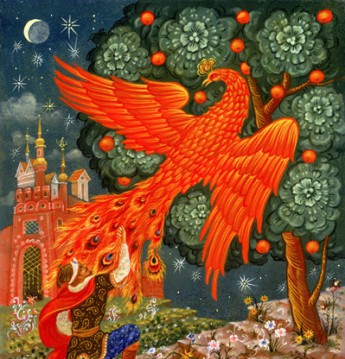
Illustration by Ivan Bilibin for Fenist the Falcon.

I’m delighted to announce that my modern fairy tale, A Feather of Fenist the Falcon has just been published, with its accompanying research statement, in a special issue of the prestigious journal TEXT(Special Issues series, Vol 43). Titled Into the Bush: Australasian Fairy Tales, the special issue focusses on the particular take of Australian writers on fairy tales and features both creative and analytical pieces.

A Feather of Fenist the Falcon is inspired of course by the wonderful Russian fairy tale, Fenist(or Finist) the Falcon, which I’ve loved ever since I first read it as a teenager, in a Soviet-era reprint of a classic version superbly illustrated by the great Ivan Bilibin. With its echoes of Beauty and the Beast and Psyche and Cupid, the tale has a haunting beauty, romantic power and great storytelling verve. My story transposes the setting to contemporary Australia, within a wealthy Russian immigrant family, but also keeps within the timeless dimensions of the original tale by not overtly stating place or time, It’s told from the point of view of the youngest daughter, focussing on the very beginning of the tale, up till the moment when the feather brings the shapeshifter, Fenist to her window. I loved creating this rich, disorienting and resonant contemporary fairy tale world.

My story is here, and you can also read a version of the original fairy tale from which it’s inspired, here. (Note by the way there are several versions of this tale!)

And have a read of all the other wonderful stories and articles in the special issue, here.


A ghost story for Halloween

Today, as it’s Halloween, I thought I’d republish one of my ghost stories, Restless. Inspired by a creepy dream, it was first published in Aurealis magazine in June 2013.  As it’s quite long, there’s a ‘Read More’ for you to read beyond the line. Enjoy!

Restless

by Sophie Masson

The worst nightmares aren’t of blood and monsters and darkness. The worst are the ones that creep up on you, that start so quietly and lull you into a false sense of security, and then..

It was that kind of a dream. Oh, I’d had it only once, and months ago at that. And you could say nothing really had happened to account for the chilling sense of dread I’d woken up with. It went like this: I was in a house I did not recognise. A smallish house, a cottage, really. It was quiet. Sunny. Sparsely furnished with rather shabby furniture. But there seemed to be no one there. I walked into the next room. There were dishes on a table, untouched. Chairs pushed back, as if the people had just left. But still no sign of anyone. And then I came to the back room. It was dim in there. But I could see someone, sitting facing away from me, in a high-backed armchair. Male or female, I couldn’t tell, for all that could be seen above the chair back was a gleam of blond hair under a dark-coloured beret. The person didn’t move. He or she just sat, silently staring at the opposite wall.

That was it. But somehow I knew that I must not make a sound or move a muscle or else the figure would turn around. And if they did, then I was lost.

I had no idea why. I just knew deep in my dream-self that it was so. That the person sitting there so quietly was pure evil. And that if they discovered I was there, I was done for. I had to get away. But how?

I managed to wake myself up then. Switching on the light, I lay there while my heartbeat returned to normal and my skin no longer puckered with gooseflesh. Sometimes, after waking from a really bad dream, I’ve tried to think up a happy ending for it, so that its power to scare me is taken away. Sometimes, I’ve tried to understand what it was trying to tell me. And sometimes, I’ve just tried to airbrush it from my mind.

That’s what I did with this one. Airbrush it away, I mean, because the other options meant that somehow or other that figure in the chair had to turn around and that was just unthinkable. And though that first day I felt as though the nagging memory would never leave me, and hardly dared to close my eyes that night in case the dream returned, little by little the dread left me. Partly of course that was because the dream never returned. Partly because I told no-one about it. Not my parents, not my twin brother Jamie, and not my friends. Not even my diary.

But whatever the reason, soon I had just about forgotten about it. Until that Saturday three weeks ago..


When Jamie and I were little, we used to be very close. We aren’t identical twins, because I’m a girl and he’s a boy, and when we went to school we still hung around together a lot. It wasn’t until mid-primary that being a twin became less important than being girl or boy. We began to move in different circles and to like very different sorts of things. I read a lot, Jamie never. Jamie’s brilliant at art, I’m hopeless. I had lots of on-and-off friends, Jamie only a couple of long-standing close ones. In high school it was even more that way. It was only this last year, our last year of school, that we were slowly drifting back to our old closeness, and to enjoy being in each other’s company again.

That was why that rainy Saturday morning, Jamie had persuaded me to go with him to the big art museum in the city. He couldn’t spend the morning painting in his studio as he usually did, for he had an important assignment to do, about how and why people react to art. I was to be an interview subject. Now, normally art galleries aren’t my thing. It’s not that I don’t like art: it’s just that when there’s a lot of it together and you have to trudge kilometres across hard floors and you can’t talk except under your breath because if you do people frown at you as though you were chatting through a film, it gets to be a bit of an ordeal. And I hate how you’re meant to stand in front of the artworks, especially those by famous artists, and pretend you’re thinking deep thoughts about the meaning of it all. Plus normally the kinds of paintings I like—the kind with people in them, the sort that tell a story—are not Jamie’s thing. He prefers abstracts and landscapes, which I find mostly boring.

However, to my pleased surprise, Jamie took me not to the modern art section but to a dimly-lit exhibition hall full of ancient African and Central American sculptures. They were actually pretty cool: weird and even sinister at times but powerful and interesting. We sat on a padded bench in front of one of the display cases, where spooky masks with wide open mouths and blank eyes stared sightlessly at us, and Jamie asked me questions, and typed what I said into his Ipad.

After a while I ran out of things to say and left Jamie to finish entering it all in while I went in search of the toilet. It was a bit of a trek. Then I had to find my way back. I must have taken a wrong turn or something because suddenly I had no idea where I was, and I couldn’t even call Jamie because I’d left my phone at home.

I couldn’t see any maps. Still I kept going. Down one corridor, up another, round a corner into another. That’s how I found myself in an annexe which was a rather newer part of the gallery than the grand exhibition halls. Here it was all white plasterboard walls and recessed ceiling lights and impersonal corridors like those in hospitals. There were doors up and down them but they were  locked, with ‘No Access to Public’ written on them. It struck me how empty this annexe was. No guards. No guides. No art lovers. No tourist groups. No bored kids trailing behind parents. No random people sheltering from the weather.

Nobody at all. Except me.

Even then, I wasn’t scared. Not even uneasy. Only a bit puzzled and fed-up. But then I saw an open door down the end of the corridor, and light coming from it. And so I headed for it and straight into my nightmare.. Continue reading

Artichoke Fields–a memoir piece

Following on from last week’s family history piece, The Crystal Necklace, here’s another republished and slightly revised memoir piece, Artichoke Fields, coming from certain episodes in childhood, when I was around 12-13.

Around the time this piece is set: my father with me(at back, next to him) and four of my siblings, Camille, Gabrielle, Louis and Bertrand. Photo taken by my mother.

Artichoke Fields

It is a hot day in the seventies, and we kids are fighting quietly in the back of the car. Maman occasionally shoots glares at us in the rear-vision mirror, silently warning us to behave. Meanwhile Dad drives steadily, carefully, as if he is anticipating all kinds of possible dangers, as if years and years of driving have not cushioned him against the myriad possibilities of danger and catastrophe. When I am older, it comes to me that this is how he has lived his whole life, on the brink, never taking it for granted, trying to keep control of it yet jumpily aware of the knife-edge of life, of the unpredictable way in which, in a second, things can change forever. But at the time, his careful driving is merely another of the mix of traits, the shorthand of experience, which, together, make up “Dad”—this person who you accept naturally, as you accept your mother, or your brothers and sisters. As a child, you rely on signs, on the known, and somehow accommodate contradictions and complexities without really thinking about them.

But here we are, driving. The vinyl of the seats sticks to our flesh, so the too-close warmth of a brotherly or sisterly leg in the backseat of the Holden leads to under-the-breath quarrels about the most ridiculous things possible. It’s summer, and we are driving from our northern suburb into the semi-rural west of Sydney, near Blacktown. As we approach, Dad sits up more in his seat. Even though–or maybe because–he is city born and bred, he loves the country with a fervour born of happy memories of his great-grandparents’ place in the Aveyron. When he was a small child, he would go there for holidays, and he has told us many stories of it, his eyes misting with a regret which I didn’t quite understand at the time. Later, I see it is not only nostalgia, but something more powerful–a need to hold on to a good, simple thing within a wartime childhood booby-trapped with painful memories.

The good memories connected with this kind of place have transformed Dad, at the moment. He does not look anxious, or harried; his even, smoothly pale olive skin is unmarked by frowns. He says, “It’s astonishing, isn’t it, to see how hard these people work, ” and his tone is gentle,  wondering,  filled with the pleasure of contemplating the simplicity of work on the land. It is traditional for him to say this, here; yet always Maman nods, patiently, always we hear him without wondering at its repetition.

We stop in front of the house. It is a very simple fibro construction and we have only been further than the kitchen once or twice. But the house is unimportant. What is important is beyond it, in the flat fertile acres that surround the house, making it an island out of time, its plain Australianess an incongruity in the lavish Europeaness of cultivated fields. For here are not acres of wheat, or of the other large, full-scale crops we associate with this vast land; but the smaller, denser patches of hand-grown vegetables, in different seasons: lettuce and spinach in serried rows, tomatoes and capsicums and eggplants ripening in sunrise colours, and especially,  most especially,  the artichoke fields. There the artichokes stand, tall and fierce in their greens and purples, acres of them, their tightly-packed heads swaying on their strong stems. Some of them are already going to flower; and their perfume–a strong, sweet smell, like wild honey–fills the air. They are extraordinary, beautiful and wild as a Van Gogh painting. The sight of them always catches at my throat, so that even now,  years later,  I can see them,  smell them,  and wonder at the selectiveness of memory that will keep such pictures and not others. And, like a Van Gogh painting, if you don’t simply stand on the sidelines, admiring, but venture inside them,  the artichoke fields will reveal all kinds of unexpected things.

Here, in that childhood time, the farmers come to greet us, their sun-brown, wrinkled faces split by their smiles into a hundred tiny rivulets. I never learnt their names, and to me, at that age, they look agelessly ancient, like peasants in an old picture. They are small, both of them, both dressed in black: but he is lean and wiry, with crew-cut greying brown hair and sharp pale eyes, while she is round as she is high, her breasts like soft pillows under her shabby dress, her silver-and-black hair done up in a floppy bun, her eyes like lively brown birds in their nest of wrinkles. She is Maltese, he is Yugoslav. Dad, accustomed, at the building sites he supervises, to working with Balkan men insisting on their Croatianess,  or Serbianess,  or Bosnianness,  wonders at the farmer’s calm avowal of being ‘Yugoslav’–what does this show about his politics?–but does not press the point. But on the way home, he will say, “Hmm, say what you like, I’ve always found Yugoslavs difficult people to fathom. It’s really the extremity of Europe, you know. .” And I wonder at the need of adults, too,  for shorthand,  for second hand wisdoms.

But he finds the female farmer, the Maltese, very sympathetic. “Eh, paysan!” she says (‘Hey, countryman!’), or that’s what it sounds like to my delighted father. Her voice, high, distinctive and confident, is ageless, too; we have heard, on a record at home, Portuguese peasant girls singing in exactly the same kind of shrill yet in-key voices. Dad is immensely proud of it, preening under the accolade which she shrewdly–but not insincerely–gives him. Maman is rather more circumspect; not only is she a more detached observer of people, but she is also closer–only one generation removed–from peasant origins, and she has few illusions about it. “She’s a good saleswoman, ” is all she will say, later, when Dad, talking nineteen to the dozen about these wonderful salt-of-the-earth people, drives us back to our somnolent, rich suburb where the quiet he both craves and resists attacks his restless spirit like a physical pain.

Dad addresses the farmers in a mixture of languages: a bit of English, mixed with a little French, fragments of Italian he’s learned on building sites, and even a bit of patois, the Occitan-derived dialect of the Toulouse area, where he comes from. The farmers answer back in a linguistic mosaic too, and Dad is always particularly thrilled if they appear to understand some of the patois; he sees a connection between all kinds of European languages and to hear this confirmed, especially here, the homely patois under the alien sky, is a source of joy.

We walk with the farmers down the paths that lead away from the incongruous Australian house (where their only child, a daughter, sits eating biscuits in front of the television) and into the European preserves of the farm. Here, before you reach the hand-cultivated fields of vegetables, are neatly-arranged poultry runs, with chickens running about, and rows of hutches, where blink fat rabbits. There are no pets or superfluous things; in this setting, away from the house which diminishes them, the farmers are tough, witty, their tenacity written in their faces, with none of the irritated bewilderment which must surely seize them sometimes. I think of their daughter and how it must be for them all when they have to come up to the school. I think of it because it’s how I feel. When my parents come to my school, I am in shameful agony, hoping they won’t say the ‘wrong’ thing in the ‘wrong’ sort of accent. There are other people we know, Sicilians from rural backgrounds, whose attitude towards their educated children is humble, frighteningly so in fact. My parents aren’t like that, at all, they are better educated than I am and would soon cut me down if I tried to patronise them; yet still I cannot help fearing that they’ll say the wrong thing. So I wonder how these two, these farmers, and their daughter, must feel like, when they have to leave the artichoke fields and go to the school, or the supermarket,  or the myriad things one must do in this society. It makes me squirm, this thought, and so I turn away from it, and towards the fields. It never occurs to me back then, of course, that maybe it did not touch them, that the shame may only be in the minds of self-conscious children.

At first, we look in the hutches, say,  “Isn’t that one sweet?” and the farmer grins at us, showing crooked teeth,  and says,  in her strongly-accented English,  “Good eating,  that one!” We are at the age, in the place and time where such statements appear callous; so we are silent, and ignore Dad’s I-told-you-so-smirk. He has often said we are becoming too soft, sentimental, Australian; Europeans are tough people who look reality in the face. You like lapin a la moutarde? Right, well then you must be ready to first catch your rabbit and kill it. Or to plunge your hands without disgust into the freshly-killed carcase of a chicken and make it into a dish. We are tenderhearted; but our feelings never extend to the nicely trussed, carefully jointed roast that appears on the table. . .

Now the farmer is walking in the artichoke fields, talking shrilly,  a mixture of salty comment on current events,  and wild praise of her vegetables. Her husband is silent (“Taciturn,  like all Yugoslavs, ” Dad is delighted to say) . But he smiles quite a bit, and touches the plants, gently,  as if he is greeting each. That, surely, is only my fancy. He and his wife are unsentimental, without frills or falsity, honest, as the French saying has it,  as ‘du bon pain’, good bread. But that,  surely,  is a sentimentality,  too; for I have heard Maman saying that these two never lose ‘le nord’,  always stick to what they know they want,  and are not above using cajoling or even a judiciously-placed marketing ploy to sell their vegetables. They are not doing this for fun, for ‘du folklore’: that is the mistake of urban people, throughout the ages. Simplicity is in the eye of the beholder.

Every so often, the farmer stops. She throws an arm out to her husband: yes, this one. He stoops, cuts the stem, throws the vegetable into the basket he is carrying. Dad keeps pace, asking the woman all kinds of questions. She answers with aplomb and humour, in her shrill voice, while her husband fills the basket and smiles what my mother would call a ‘corner’ smile; amused but enigmatic. We children follow behind with Maman, the smell of the big vegetables filling our nostrils with a heady odour.

We all love artichokes; some Sunday nights, that’s all we’ve eaten, an enormous tureen filled to the top with the boiled vegetables, served with vinaigrette on each person’s plate. The table would fill up with mountains of discarded leaves, plundered for their bit of sweet flesh, then put aside for the next one. There is something addictively wonderful about artichokes; the more and more frenetic peeling-back of leaves, till you get to the ‘straw’ inside, and peel that off as cleanly as a bandage, to reveal the succulent flesh of the heart. We ate the stems, too; the Blacktown farmers always sold us young, fresh artichokes, so that their stems were as tender as asparagus. Occasionally, we’d eat them with butter and garlic, or tomatoes. But the simple one, the boiled-and-vinaigrette ones was what we preferred.

We always lingered in those fields, dodging prickles, and in areas where the purple flowers were really out, the bees as well, maddened, as we were, by the heavy smell of the artichokes. Once, I remember, the farmer picked one of the flowers and gave it to me. The unexpectedness of the gesture surprised me, and for the rest of our time there, I couldn’t resist putting my nose as close as possible to the flower. I’ve always been sensitive to smells, finding them powerful evokers of emotion and place, and now, I try to think what it was that made this smell so heady. Roses smelt sweeter, muskier; vanilla smelt more homely and tender; the rich dark smell of roasting meat made me feel hungrier. This was a smell of almost-wildness, of something only just tamed, and only dimly understood, something whose discovery was concealed under layers of half-meanings. It was not the smell of careful, cultivated Europe, neatly arranged,  tamed and civilised,  the Europe of the mythologisers or the nostalgic. Rather, it was the smell of the Europe whose inheritance was mine, which seeped into me like instinct. A Europe–a France– not only of the mind or of the comfortable senses; but also one of the blood’s leap, of the pain of rejection. The France my father felt in exile from, the France my mother followed him from, despite her own rather less ambivalent feelings. A corner of Europe forever elusive, never quite pinned down, half-wild, half-tame, of heady,  unforgotten smell,  uncomfortable at times,  maybe never to be fully understood.


The creation of Building Site Zoo, part one: the text

This month, Building Site Zoo, my picture book with the wonderful illustrator Laura Wood, is published by Hachette Australia, and to celebrate we thought we’d tell you about how the book came about and what the process was like for both the text and visual narratives. In Part One, I talk about the genesis of the text and how it developed, and in Part Two Laura will describe her process, in both words and pictures of course! Hope you enjoy reading both!

The text, by Sophie Masson

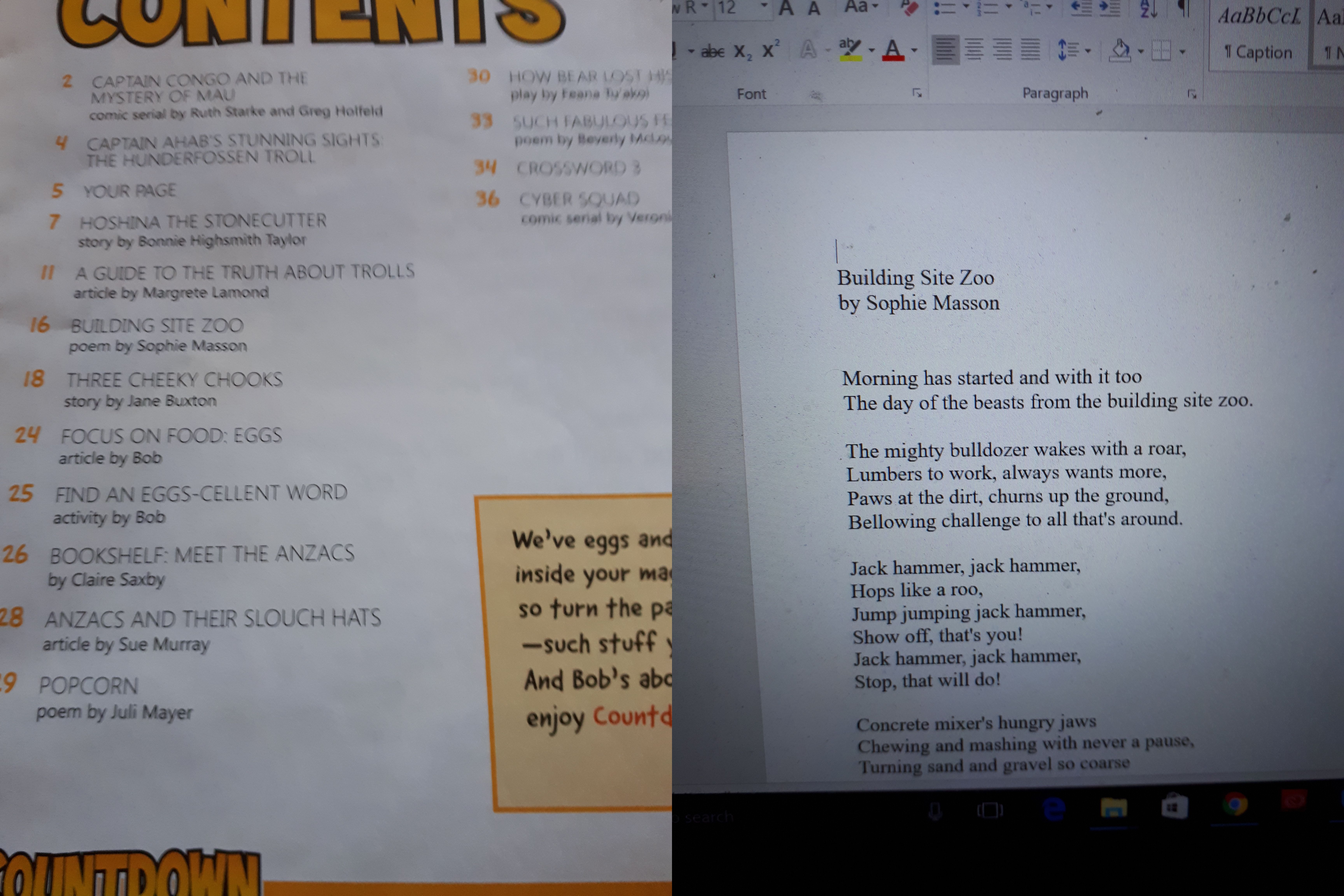
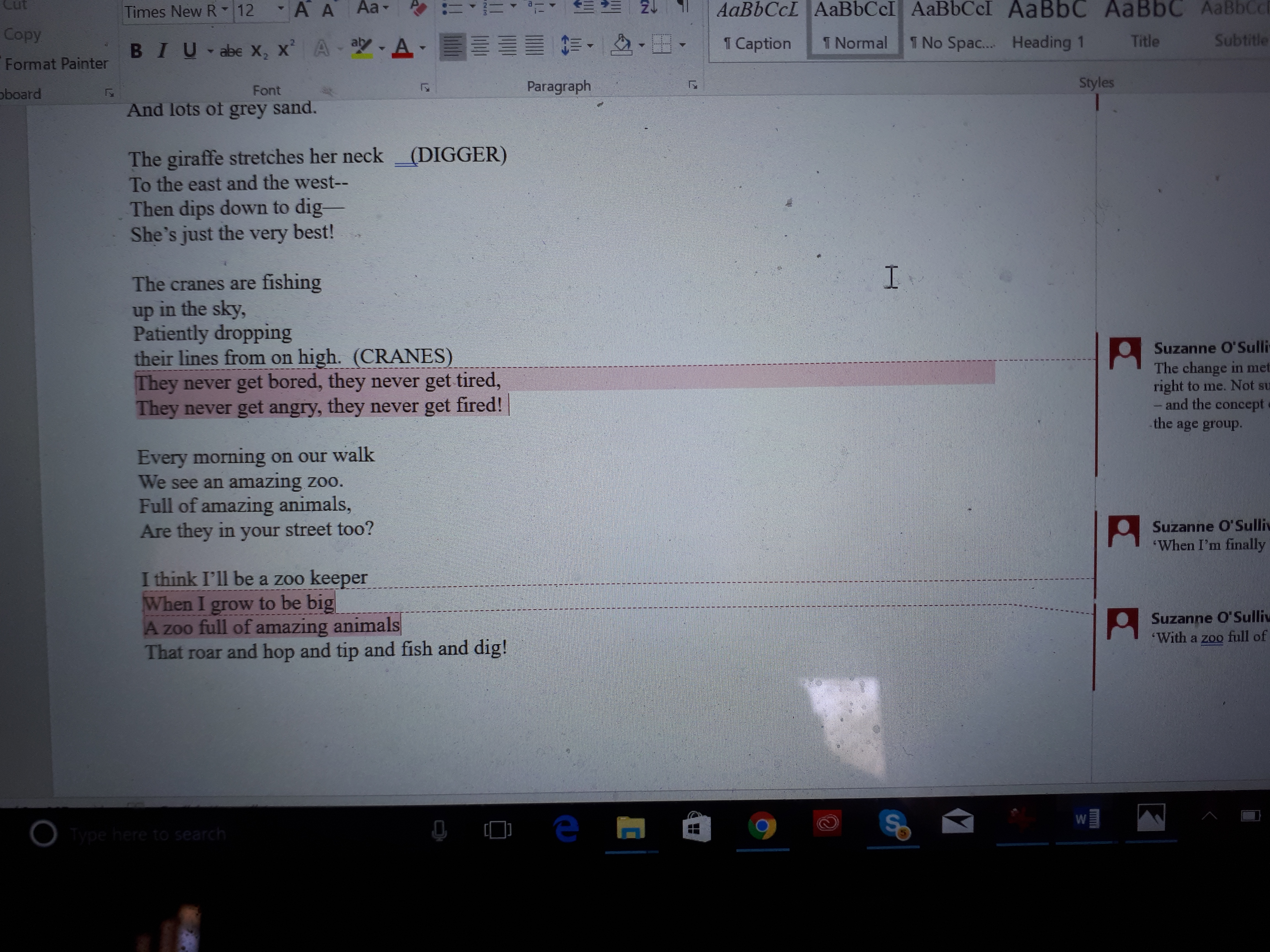
It so happened that one day in late 2014, I was in Sydney, in Ultimo, in fact, having just gone to an ASA meeting. I was sitting by myself having a cup of coffee in a quadrangle near the ASA office, and happened to look up at the cranes high above: that spot is very close to UTS where new buildings were under construction at the time. A line suddenly popped into my head: The cranes are fishing up in the sky…As soon as it did, I knew I had something. Cranes could be birds as well as machines, so in that vein I started to think about other machines that could also be seen as animals. So I pulled out the latest incarnation of the cheap little notebook I always carry in my bag, and started scribbling lines down. ‘Building site zoo,’ the title, came almost straight away, but the full lines took quite a lot of to-ing and fro-ing and crossing-out and rewriting.

My initial thought with Building Site Zoo was that it would make a great poem, so that’s what I worked on, when I was back home. I then sent it off to The School Magazine–to my delight it was accepted and published in the April 2015 Countdown issue.

By then, I’d started getting picture book texts accepted–Once Upon An ABC and Two Rainbows--both of whom had started as poems(in the case of Two Rainbows, two poems!) so I began to think about Building Site Zoo and how it might work as a picture book text. I spoke to my wonderful agent Margaret Connolly about it, whose ideas and suggestions are always incredibly helpful no matter what the literary project, AND who really understands picture books. We discussed how the text could be tweaked to make it more like a story and less like an impressionistic piece, which works well for a poem but not for a picture book–and yet leave the poetic central concept of the machine-animals intact. I went away and thought about it and worked on first the beginning, to introduce some characters–the child’s point of view was very important, because in fact that’s how I’d seen the whole thing from the beginning. I didn’t want to make the characters fixed: there would be a first-person point of view, but it would also encompass other family members, so it wasn’t just ‘I’ but ‘we’.  So the new opening would start:

Every morning on our walk/ We see an amazing zoo/Full of the most amazing animals/Come and see them too!

I would also identify each machine-animal, not as part of the text, but as indicators for editor and illustrator: so the bulldozer’s a bull, the jackhammer a kangaroo, the concrete mixer a hippo, etc.

Margaret loved the new revised text and sent it off on its rounds to publishers in late 2015. And in April 2016, she emailed me to say Suzanne O’Sullivan at Hachette Australia really liked the text but had a few suggestions for minor changes. These related mainly to tweaking a word or two, but the biggest change was in dropping some lines from that stanza that had started everything off, about the cranes fishing! She felt there was a change in metre which didn’t work, and that the concept of ‘firing’ also didn’t work for the age group. Looking at it, I could see just what she meant, so I dropped those two lines.

After revising the text, I sent it back–and in June 2016, it was accepted for publication. I was of course thrilled!  And even more delighted when Suzanne confirmed that the illustrator would be the wonderful Laura Wood! It was so exciting to see her roughs, and the progress on the visual narrative as it went on, and she added all kinds of fabulous details and so beautifully fleshed out the characters whom I had deliberately left undescribed. I never get over that extraordinary pleasure, of seeing my text expanded and transformed by the illustrations, producing a true creative collaboration which is immensely exciting and satisfying.

The editing of the text didn’t end there of course–with great suggestions from Hachette editor Tom Bailey-Smith and Suzanne, more words were tweaked, an extra stanza was added at the beginning, and the ending you see above was dropped in favour of a simpler and more satisfyingly cyclical one, bringing it nicely back to the beginning.

Every morning on our walk/we see an amazing zoo/full of astonishing animals/Are they in your street too?

And here too, before inviting you to turn to Part Two in which Laura talks about her creation of the illustrations, I’d like to thank and pay tribute to the publishing team at Hachette and the fabulous designer Ingrid Kwong. What a beautiful book we have all produced!

Read on!


Crossing the Lines: interview with Sulari Gentill

Last Friday, I published my interview with Anthony Horowitz about his brilliant crime novel/metafiction, The Word is Murder. Today I’m interviewing Sulari Gentill about her equally brilliant crime novel/metafiction, Crossing the Lines. Well-known for her popular Rowland Sinclair series of detective mysteries set in the 1930’s, Sulari has broken new ground with this novel. It feels like wonderful serendipity to me, that two such gifted authors should have created these bold new explorations of the writing experience and creative process, within the tight, gripping framework of a great crime story.

First of all, Sulari, congratulations on Crossing the Lines, a brilliant and inventive work which works really well both as a gripping crime novel and as highly effective metafiction. How did the idea first come to you?

Thank you, so much Sophie.

This was one those ideas that grew out of idle speculation.

I’ve always allowed myself the indulgence of believing in my characters when it suited me.  It makes the act of writing less lonely in a way.  I’ve always known that I played close to the line between imagination and delusion.  Interestingly, it’s this aspect of my process (if you can call it a process) that I am most asked about at festivals etc. I’ve found myself speaking often about the “the line” between imagination and delusion, confessing to those times I’ve ventured a toe across it.  I suspect it’s a game that both writers and readers play to greater and lesser extents.

I do wonder what Rowland Sinclair thinks of me.  Does he like me?  Would he read my books?  Does he find me unnecessarily sadistic?  I do, after all, visit all sorts of pain and trouble upon the poor man… and yet I feel he trusts me; that we’re working together.  I can help but think about what it would be like to be him, to have the circumstances of my existence controlled by someone else’s narrative.

Of course it’s a writer’s practice to extrapolate, to take things to their natural end, and so I have on occasion found myself pondering what would happen if I crossed the line completely, if I allowed the people I made up to take over, if I permitted them to control my life as much as I do theirs.

And somewhere from the midst these muddled musings came the story of Madeleine and Ned, who write each other and entwine the lines of their stories and their lives.

You use a very interesting and unusual narrative process, by switching back and forth between Madeleine and Edward, sometimes even within the same paragraph, which further blurs the boundaries between them–crosses the lines, in fact!–yet never becomes confusing. How did you go about doing that?

I wanted to echo the way my mind works when I write, the way in which the novel’s voice both merges with and takes over from mine—sometimes in the midst of a sentence or a thought.  I wanted to reflect that fluidity but also maintain the individuality of both voices.  To be honest, I thought it would be a great deal more difficult that it was.  I wrote this novel as I do all my novels, without a plot or plan of any sort and I wasn’t really consciously doing anything in particular.

The novel is written in third person, and the voice tends to change at a point when Maddie and Ned have the same thought or disagree, which is, I think, why the transition is smooth and not confusing.  Again, I didn’t do this consciously when I was writing – the changes were instinctive and responsive to the narrative rhythm, but, in hindsight, I see that those pivot points occurred when Ned and Maddie engage directly with each other. For a moment, at these places in the narrative, the reader’s mind is in the head of both Ned and Maddie, allowing them to move seamlessly from one point of view to the other without jarring.

You play with literary concepts and conceits–such as the ‘lines’ between genre fiction and literary fiction–with great deftness, and Crossing the Lines can be seen as a riposte to that artificial boundary-setting. Can you expand a little on that?

My reputation in Australia is primarily as a crime writer.  It’s a genre I love and respect, not just because it engages the reader in a tale of peril and intrigue, but also for its ability to hold a mirror up to society, to make social commentary in a way that is subtle and incidental but, for that, no less insightful.  The crime novel, at its finest, has many layers; it talks about the worst and best of humanity, about fear and courage, discrimination and justice.  And yet there seems to be a line, in this country particularly, that arbitrarily divides genre from literary fiction with the implication that literary fiction is somehow inherently worthy and, conversely, genre is not. To me, the line is an artificial prejudice and whether or not a novel has worth has scant to do with its genre.  With Madeleine being a crime writer and Ned a literary novelist, it seemed natural that they would have this conversation.

In the novel, you have mixed aspects of your own lived and literary experience with cameo appearances by other literary figures–such as respected author and director of Writers Victoria Angela Savage–and completely fictional elements to create a disconcerting–and fun!–hybrid narrative. Can you tell us about how you juggled all those different elements?

Whilst her circumstances sound familiar, Madeleine is not me and Crossing the Lines is a novel, not a memoir. In writing this book, I wanted to concentrate on Madeleine’s inner world and so I gave her an outer world that I knew—one that’s very similar to my own.  A familiar baseline from which I could extrapolate. It’s not something I’ve ever done before, but for this book which is all about crossing those lines between reality and imagination, it was right.

It also seemed right for a novel about crossing existential lines to allow real people from my own life to play a part in the novel (also not something I’ve really done before).  Angela Savage, the character, is Madeleine’s dear friend and trusted colleague—the real Angela is that to me.  My old friend and confidant, Leith Henry is cast as both Ned’s and Maddie’s agent.  I felt like she anchored the three of our worlds (Ned’s, Maddie’s and mine) together.

To be honest, it felt more like weaving than juggling.

Crossing the Lines is a very different kind of book to your other crime fiction, the very popular Rowland Sinclair detective series, set in 1930’s Sydney. What was the experience of writing it like, compared to those?

In many ways the experience was similar—intense and immersive.  But for the first time I was writing without a scaffolding of history, and I was writing a story that was quite internal.  It didn’t deal with larger issues of political movements and social justice.  Everything in this novel looked in rather than out.  I do remember feeling quite lonely when I wrote this book in a way that I’m not when I write Rowland.  I suspect it’s because I didn’t have as direct a link to Ned and Maddie as I do Rowland.  I am Rowland’s writer, so he speaks to me.  Ned and Maddie were each other’s writers—I just eavesdropped on what they said to and felt about each other.  I do realise I sound quite mad.  Sorry.  Sometimes it’s difficult to explain the way my mind works without sounding at least a little insane.

I’ve heard you speak at events where you have said you don’t like to look too closely at your own creative process in case it withers the magic. Yet in Crossing the Lines you have performed another act of magic: incarnating the creative process in the story of Madeleine and Edward. I can imagine it must have felt spooky at times! How did you focus on that aspect of the novel without becoming too self-conscious?

I just tried to be as honest as I could about the experience of writing as I understand it.  I think Crossing the Lines works because it doesn’t try to forensically analyse and explain the magic, simply to recreate it.  I did get self-conscious once the novel was written…I panicked that it would be read as a memoir rather than a fiction.   I even tried to talk Pantera out of wanting to publish it because it made me feel exposed and awkward.  I think I might to the only writer ever to tell a publisher, “All right, you can read it if you really insist, but I promise you’ll hate it…”  Fortunately, despite my best efforts, I didn’t manage to dissuade them.

While I was actually writing though, self-consciousness was not a problem.  I tend to lose myself when I write, I stop being so aware of me.  It’s just all about the story.  I don’t get embarrassed till later.

How have readers responded to the book? 

Pantera tells me CTL is selling much better than they had expected (but I’m not sure what that really means – maybe their expectations were low  😮 ).  I’ve had some lovely  messages from readers, especially readers who are writers, and it’s received some glowing reviews.  It’s doing well on Goodreads, but while some people really love it, there are a few who don’t get it at all  (which I did expect – it’s not your standard crime novel)  My US Publishers tell me they have very high hopes for this book… but again I’m not really sure what that means.  People (including you) whose opinion I have come to really respect, have liked it.  So I’m happy.  I know that’s really vague but it’s really hard to know as a writer… at this early stage anyway.

Yours is the second new metafiction/crime fiction novel I’ve read this year–Anthony Horowitz’ The Word is Murder is the other–which brilliantly illuminates the creative process in a highly original way. There have been other earlier works which play with those elements, such as French author Guillaume Musso’s La fille de papier (Girl on Paper) and Stephen King’s novella Secret Window, Secret Garden(which was made into the film Secret Window) but though they are gripping mysteries, they both ultimately ‘explain’ the apparent boundary-crossing in a way that disappointed me as a reader(and writer). Not so with your book, and Anthony’s, which stay most satisfyingly within that narrative world. Can you expand on that, and why you decided not to explain?

As a historical fiction writer and a lawyer I’ve learned that what people think happened is as important to consequences as what may actually have happened.  To me, what Ned and Madeleine believe is enough.  The story is about them, their reality.  I didn’t feel the need to rationalise it with any conspiracy or plot or illness etc.  The story is purely about the lines that writers may be tempted to cross, and why doing so is both seductive and dangerous.

The Word is Murder: interview with Anthony Horowitz

Today, I am delighted to bring you my interview with the fantastic author Anthony Horowitz, about his latest novel, The Word is Murder. Anthony’s books, whether for adults or kids, are always gripping and elegantly written, but this one is particularly accomplished, a bold and brilliant tour de force that takes big risks with literary conventions and reader expectations, and pulls it all off triumphantly. It’s one of the most interesting and memorable novels I’ve read all year.

First of all, Anthony, congratulations on The Word is Murder, a daring and playful blend of metafiction and crime fiction.  In Magpie Murders, your novel published last year, you use metafiction elements–such as a book within a book–but The Word is Murder goes a lot further. How did the idea first come to you?

Thank you for your kind words! TWIM (as we all know it) began when I met my new publisher, Random House, and they asked me to concentrate on a series of murder mysteries. My first thought was that I wanted to do something that would completely shake up the format. It wasn’t enough just to have a fat detective, a drunk detective, a Russian detective or whatever. I wondered if could alter the entire template so that we would look at the crime and the solution in a new way.

 To be honest, the idea sort of fell into my lap as I was walking home from that initial meeting. Drop the author into the action. Take him off the mountain, as it were, and into the valley. Turn him into the sidekick. I knew at once it was what I wanted to write.

There are other novels in which the author has a walk-on part–such as for instance, Michel Houellebecq’s The Map and the Territory and Paul Auster’s A City of Glass–but yours is I think the first one I’ve read in which the author is both one of the main characters and the narrator, being bossed around by the other main (fictional) character! And yet, despite the extraordinary literary conceit and dazzling sleight of hand, the story never loses its narrative power and drive. What is it like to imagine yourself as a fictional character? How did you manage to juggle all the different elements, and what were the challenges along the way?

Again, you are very kind. I was quite nervous about putting myself center stage – and so, actually, were the publishers. I didn’t want the book to turn into an ego trip. But although I appear rather more than I would really like (I’ll take more of a back seat in future adventures) the book is more about my writing life rather than me personally – the focus is on Hawthorne!

 When I was writing TWIM, I simply had to imagine that it was all really happening. Writers do this anyway, of course – but I had to consciously ignore the fact that I was making it up. The AH character is seldom named…and this helps me distance myself from him. You might think of him as an avatar. Yes he is me but he’s also my creation and what I think makes it fun is that Hawthorne is as much in control of him as I am!

In The Word is Murder, you incarnate the creative process through literal dialogue and interaction between the author and his characters, brilliantly illuminating the way in which writers conjure characters that feel not only real to them, but also the reader. The novel is deftly ironic yet never falls into the trap of over-signalling. How did you go about it without becoming too self-conscious?

I think I’ve answered this above. I’ve often said that writing is about immersion. I can only write Alex Rider if I totally believe in him…even when some of the action is quite fantastical. The same was absolutely true of TWIM. I had to imagine myself into it but then wrote with 100% belief.

 How have readers been responding to TWIM? Do most people enter into the spirit of it, or are some people confused and think you are writing true crime(as the lady in Hay on Wye suggested in the book)?

I think it’s true to say that audiences have received TWIM more warmly than anything I’ve ever done. This is particularly true of the book blogs and the Amazon reviews. I’m really happy. People tell me that they’ve been Googling to find out what’s true and what isn’t (not that Google necessarily helps). And everyone seems to have grasped the concept.

Will there be more ‘true crime’ novels featuring the ‘real fictional’ Anthony Horowitz as the sidekick to detective Hawthorne?

Absolutely. One of the most enjoyable parts of the book (to write) was the realization that something had happened to Hawthorne when he was young. To some extent, I turn into a detective as I try to find out more. The idea is to write about nine or ten books in the series and gradually to work out the mystery of Hawthorne’s past. As I sit here now, I have a fairly good idea what that might be but I won’t know for sure until I get to the end.

Yours is the second new metafiction/crime fiction novel I’ve read this year–Sulari Gentill’s Crossing the Lines is the other–which brilliantly illuminates the creative process in a highly original way. There have been other earlier works which play with those elements, such as French author Guillaume Musso’s La fille de papier (Girl on Paper) and Stephen King’s novella Secret Window, Secret Garden(which was made into the film Secret Window) but though they are gripping psychological mysteries, they both ultimately ‘explain’ the apparent boundary-crossing in a way that disappointed me as a reader(and writer). Not so with your book, and Sulari’s, which stay most satisfyingly within that narrative world. Can you expand on that, and whether you think the crime fiction lens helps to make that more effective?

I don’t know these books and must check them out. I think the short answer to your question is that I don’t really perceive any boundaries between truth and fiction. In Magpie Murders there were three distinct worlds which related to each other like Russian dolls. There was the fake world of Saxby-on-Avon where the murders took place. There was the “real” (but actually fake) world of Alan Conway, the author of the murders. And although it was only hinted at, there was my own real world – with references to Crete, Orford, the Ivy Club and real people including the radio DJ, Simon Mayo and Agatha Christie’s grandson, Mathew Prichard. TWIM simply blends them all together so there is no distinction between me working on Foyle’s War, for example, and me being attacked by a psychotic killer. So the crime fiction is not so much a lens as a landscape!

 Thank you for these extremely interesting and generous questions.

Thank you very much, Anthony!


Thrilled to be included in A Boat of Stars!

Delighted to announce that I’m one of the authors included in a gorgeous new poetry anthology for children, A Boat of Stars, edited by Margaret Connolly and Natalie Jane Prior, which is coming out with Harper Collins in February 2018. At left is the gorgeous cover, with illustration by Stephen Michael King. I am thrilled that no less than seven of my poems were accepted for the anthology! And I am doubly thrilled that my poems will be illustrated by some of Australia’s most fantastic illustrators. Very exciting indeed! You can read more about the book on the Harper Collins website. 

Another lovely review for Two Rainbows

I was delighted to read another lovely and perceptive review of Two Rainbows this morning. It’s on The Bottom Shelf blog.

Here’s an extract:

This story is a marriage of text and illustration, each interdependent as they should be in quality picture books.  At first the little girl sees only the rainbow, even though there are other spots of colour around her, as she thinks nostalgically of the colours of the country but as she starts to see more of her environment, so too the colours in the pictures increase although the city remains grey and the country bathed in light. And as her thoughts slowly attune to the city environment she begins to see more objects, different from the farm but perhaps with something to offer as she peers over the blue fence and sees a treehouse with a rope ladder and maybe a friend.

You can read the whole review here.