I’m really delighted to reveal the fantastic cover of Four All at Sea, my forthcoming chapterbook with the fabulous illustrator Cheryl Orsini, to be published by Christmas Press in September. It’s a sequel to our 2020 chapterbook, Four on the Run. Isn’t it the most gorgeous cover! Four all at Sea was such a fun book to write, like Four on the Run–I just love writing about these four friends who just happen to be machines, and their crazy adventures!
To give you a little taste of what the book’s about, here’s a short outline:
After the adventures of Four on the Run, Maxie, Lady, Flash and Fergie are set for a new life as film stars and a luxury cruise overseas. But when they are washed overboard in a storm and land on a desert island, it seems their troubles are only just beginning! Because somebody else is there–someone who is not very friendly—a rusty old tank that thinks there’s still a war on! They need to escape from the island and get back to their ship and very worried Mrs Brown. …but how?
I’m delighted to announce that I’ve signed an audio production contract for A Hundred Words for Butterfly, with the fabulous independent publisher, Spineless Wonders Audio.
Spineless Wonders Audio, which was launched in late 2020, is an enterprise of the innovative, award-winning digital publisher Spineless Wonders who, with founder Bronwyn Mehan at the helm, for the last ten years have not only consistently supported and promoted great short fiction, poetry, memoir and creative non-fiction, but found new and interesting ways to publish and showcase them. And Spineless Wonders Audio grew naturally out of that experience.
I am absolutely delighted to be working with Bronwyn and her fantastic team, and in the next few weeks will be telling you more about the novel’s journey to becoming an audio book. In the meantime, I’d better finish that last chapter 🙂
I’m two-thirds of the way through writing my audio novel now and it’s going really well. I’m also exploring next steps to make the actual audio book a reality(more on that another time, when plans have firmed up) but something that’s happened recently is a pretty important change: the title of the novel.
A Turn off the Path was a good working title to begin with. It conjured up for me quite a few things: the path literal(ie the Camino) and the path metaphorical(ie the different turns we take as we go along our life’s path). But after discussion with other people who suggested it might perhaps not quite be the right final title for it–not strong enough or memorable enough or unusual enough–I decided it was time to think of something else. For a while, it foxed me–titles can be tricky beasts to catch!–and then quite suddenly it came. It was there all along, hiding in plain sight, in a text message conversation between two of my main characters, Helen and Tony, and Tony tells Helen that there are a hundred words for butterfly, in Basque…
I’d written that quite a while back, and just seen it as part of a conversation, though one that Helen really responds to, as an imaginative artist. But suddenly, I knew that’s what it had to be, the new title: A Hundred Words for Butterfly. It felt right, at once. It was simple yet enigmatic. Memorable yet not overdone. It could conjure up so many images in so many cultures yet was distinctively expressive of something from that place, that setting. I tried it out on other people, especially those who had expressed a certain dissatisfaction with the original title, and they confirmed their immediate affinity for this new one, too.
So that’s what it’s going to be. A Hundred Words for Butterfly…
My latest post on Writer Unboxed is about writing my audio novel, and it’s attracted some interesting comments. Have a look at the post, and the comments, here.
I’ve created a new playlist on my You Tube channel, which presents video readings I’ve done of several of my published poems for kids. I created it to help support my presentation in the fabulous CBCA NSW online conference focussed around Poetry(which you can still book in for, as it’s pre-recorded and available till the end of May for delegates). I also thought it could be an ongoing resource for parents and schools, and in fact anyone who might be interested. Hope you enjoy!
I am absolutely delighted to be heading off in a few weeks, in early May, to Bendigo for the fabulous Writers’ Festival. Over the three days of the Festival, I’m going to be contributing on three fantastic panels with some wonderful fellow creators! On the Friday, I’ll be talking about fairy tales; on the Saturday, on historical fiction; on the Sunday, on children’s and YA books. I’ll also much enjoy catching up with old friends and meeting new ones and finally connecting, in person, face to face, with my wonderful French Fairy Tales co-creator, Lorena Carrington.
I loved the last BWF I attended, and being in Bendigo too was a real pleasure: and this time promises to be even better. Can’t wait!
Check out the full program of the 2021 Bendigo Writers’ Festival here.
When I originally wrote The Ghost Squad, as part of my creative practice PhD, I also wrote a very short story called ‘The Ghost Ship’, which is mentioned in the novel as having been written in pre-Pulse days by Link, one of the devoted followers of ‘Hermes’, whose unpublished manuscript about the Hermes group appears as extracts throughout the book. Though it wasn’t included in the published novel (unlike in the PhD, where it appears as an appendix only) I thought readers might be interested to see it here. ‘The Ghost Ship’ is a story nested within a story nested within another story: because not only is it purportedly written by a fictional character in my novel, but also it is about another fictional writer creating a story while on an overnight stay in what may be a haunted house, the manor house of Fitton Howe.
You may also be interested to know that the ‘Fitton Howe’ of the short story is inspired by the famous, evocative archaeological site of Sutton Hoo, in Suffolk in the UK, which I visited back in 2017 when I was in Cambridge on a month-long stay as a visiting scholar, during my PhD. (The site has recently also been the setting for a recent film called The Dig, which appeared on Netflix, but which does not mention the story of the spooky aspect of the extraordinary discovery of the buried ship, which you can read about here.)
Photo by Sophie Masson of replica of Sutton Hoo helmet at Sutton Hoo museum, 2017(original helmet held in British Museum)
The Ghost Ship
By ‘Link’
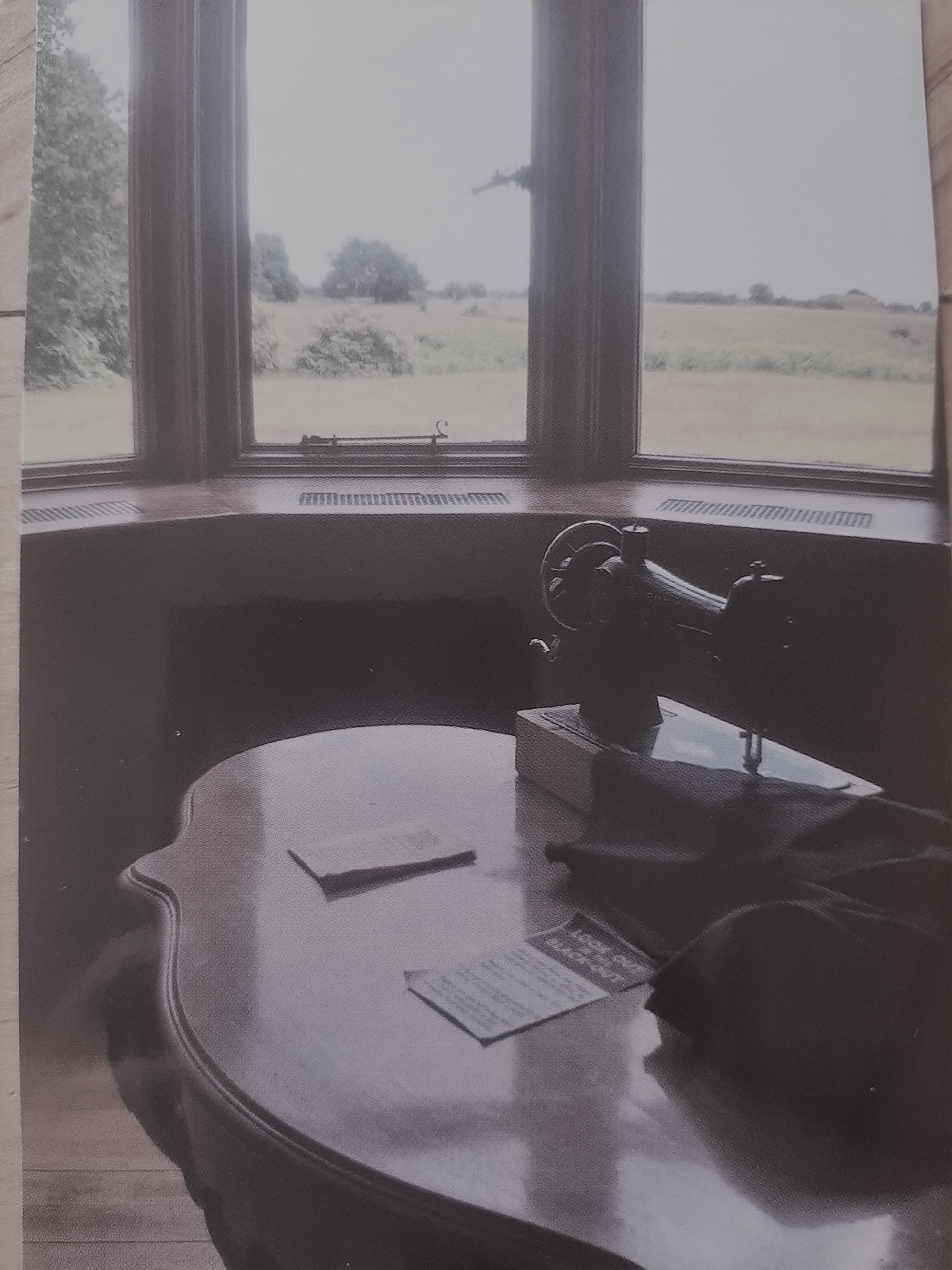
She’d often sat at that window, looking out at the ancient burial mounds, twenty of them or more, some mere shrugs of the ground, others like humped backs, that dotted the green fields in front of Fitton Howe Hall. She was missing her husband, dead these several years, his body not placed in a mound like his distant ancestors might have been, with all their worldly goods beside them, ready for their journey into the afterlife, but instead resting in a quiet churchyard. His spirit however was still here; and she spoke to it, frequently, alone or in the company of the medium who had become her closest friend. She had never seen his shade, though she longed to; but if ever he came back to her, it would be here, in this place he’d loved so much…
She stiffened. Someone was walking around the mounds. Yet her view of the fields commanded entry and exit and she had seen no-one coming. She couldn’t make out the figure well, only that it was a man, tall, with longer hair than was surely normal, dressed in a smock or tunic and leggings. It could be a local farm labourer or a gypsy perhaps, with that hair—but then he turned and she saw a flash of gold at his throat and a glint of silver at his waist and she knew instantly that she was looking at someone else. He stood there, outlined in the sunlight, not ghostly, but somehow not quite solid either and then he looked straight at her and made a strange gesture, a gesture that afterwards she could hardly describe but which she understood to mean, Do not be afraid.
And that’s how it started. That’s how Mrs Violet Manning, bereaved widow of a dearly beloved man whose passionate nature had given her too few years of delirious happiness before his untimely death, a man she could not bring herself to acknowledge was lost to her for ever, became the chosen vessel for the return of a long-dead king, a king so wealthy and honoured he had been buried not only with all his gold and silver and precious objects, but held in the embrace of his favourite ship, a massive vessel that had been dragged from its mooring place in the tidal river to here, miles inland.
The ghost ship. That’s what the press called it, when the archaeologists uncovered it after centuries in the sandy soil. Its imprint was still there, fixed in the sand like an ancient X-ray, dotted here and there with rusted rivets, the ghostly ribs suggesting the vessel whose material substance had sailed into the afterlife with its kingly captain at the helm. The king who had vanished into the misty lands beyond death but who had left behind, as a marker, the trove of treasure and a powerful mask of gold and silver that was to become famous the world over as a mysterious image of his vanished people. His people’s vision of the afterlife was reassuringly secure. Beyond death was a calm harbour where the great burial ship, with its kingly captain steering, would have moored, to be received with honour. In that world were meadows and woods and rivers and villages and great halls, just as in this one. His departed family would have met him, his ancestors, his vanished warriors and friends. Here he would have been happy and honoured as in life but freed of life’s cares. Some say this king kept to the old faith of his ancestors; others that he had taken the faith of Christ, others that he mixed the two. Whatever the truth, he was at peace, in the world beyond, even if the living world he had left behind had forgotten him. So why had he come back? Violet always said it wasn’t in fact the king who had stood on the mound that morning but one of his trusted warriors, sent by his lord from the afterlife with a message to a country teetering on the brink of war. Do not be afraid; wars have come and gone in this land. Be steadfast; your ancestors stand with you. Or that’s what she believed. Whatever the truth, she had certainly done what no-one else had: she had triggered a discovery so stupendous that for a few days it distracted the entire country from the sinister drums beating in the distance over the sea and getting closer, closer…As the archaeologists raced to secure the site and its treasures so it would be safe from harm, Violet watched from her seat by the window, and never had she felt her husband’s presence so close.
The countryside here is green, flat, peaceful, secretive. Though it’s known as a valley of kings, it’s not in truth a valley, though it lies by a river. It’s a place of contrasts: there are fertile crop fields and pig farms ressembling villages of free-ranging swine; there are quiet corners in little woods where you can pick up stone axeheads and shards of ancient pottery, the detritus of the Stone Age, Bronze Age, Iron Age, imperial ages, tribal kingdoms, settled societies, industrial ages—and further back, much further back, fossils from the time when humans did not rule the earth, and were not even a twinkle in God’s eye, and…
Thornley put his pen down, startled by a sudden noise. A creak, above his head. But he was alone in this house. He knew he was. He’d paid enough for the privilege. The trust which ran this place made sure of that. They might say that Mrs Violet Manning’s memory might live on in her house, even hint that it was haunted, but they made sure that writers after ambience and ghost hunters after sensation did more than pay lip service to it. Thornley had spent one night here. So far there had been nothing special to disturb his work. And today was a bright sunny day. Not a day for any self-respecting ghost, he thought, lip curling, as he gazed at the photograph of Violet Manning, over the mantelpiece, looking somewhere into the distance. Neither she nor anyone else haunted this place. Fitton Howe House was like any other old museum house where nobody lives any more. But it was his stock in trade, to build up atmosphere, tension, so that his readers would feel something was about to happen. Yes, that was it. He’d use the creak, and his own startlement, to add the right touch.
…and people who come to Fitton Howe House still report seeing things. Hearing things. The flash of a sword, in the morning mist. The muffled shouts of men, the gleam of gold, the creak of oars, as the ghost ship begins its journey to the afterlife laden with treasure. In her book Violet Manning says that….
The creak came again. A creak, followed by a squeak. Thornley half-rose from his seat, heart beating a little faster, till he realised what it must be. Mice! The trust might keep the place neat and tidy but it couldn’t shut out all life. Little, secret life, darting insects and scuttling spiders and nesting mice. How many of those so-called reports were down to the creatures who lived in the holes and nooks and crannies of the house?
This piece was due tomorrow. That’s why he’d shut himself away here. No distractions. He’d already missed one deadline. His editor would not let him miss another.
…says that the old king was full of sorrow when his favourite son died at sea and that it broke his heart so that he died and sailed off in the ghost ship to meet him. This what her medium friend had told her, claiming he’d spoken to the king’s shade. It’s a nice story, with the ring of poetry but sadly not a shred of evidence to….
Creak. Creak. Squeak. Thump. Not mice, with that noise. Rats. Thornley had never liked rats. He got up and closed all the doors that led into the room. They couldn’t get in, then. Then he banged on the walls. Just to make sure they knew he was there. He’d been so quiet, writing, that the rodents probably thought no-one was in and they could have a party. A rat party. Imagine that! He shuddered as an image came into his mind. Rats on a sinking ship, clinging to the wreckage–or cosying up to the dead in a buried ship, coming closer and closer and closer…
Stop it, he told himself. You’ll be seeing ghosts next. Like Mrs Violet Manning. Who only saw what she wanted to see. The pictures in her mind, a product of grief and suggestion. After all, everyone knew Fitton Howe had once been a burial place, long, long ago. Finding the ghost ship—that had been a happy accident, a fluke of history.
Yes. He felt calmer. He took up the pen again.
…not a shred of evidence to prove why or how the old king died. Or even if he was the one who had been buried there, in his ship, setting sail into the afterlife sunset, crewed by a ghostly band who had been sent for him from beyond death itself.
The creaks were louder now. The thumps. The squeaks. And now voices. He couldn’t hear what they said. Or at least understand. The language they spoke, it wasn’t English. Not quite. The sound was stranger, older. There was a smell now, too. Not a rodent smell, but something made up of wood, pitch, iron. And dust. The dust of ages. Of centuries. Of millennia. It filled his nostrils. Clogged his throat. The door handles rattled. The lights went out. He could not see anything but he knew they were coming. Coming for him, in their ghost ship. His breath rattled. His chest tightened. He groped for the lifesaver on his desk. It wasn’t there. They would…
Fitton Howe, Monday
Bestselling author Thornley Gordon was found dead this morning at Fitton Howe House, where he had been working on his latest publication. It is believed he died of an acute asthma attack. Tragically, the inhaler that might have saved his life was just out of reach, having rolled under his desk. Though there is no suggestion that anyone else was in the house at the time, police are puzzled as to why Mr Gordon’s unfinished manuscript was stained with what appeared to be salt water.
Photo taken by Sophie Masson at Sutton Hoo house, 2017
Tomorrow, together with renowned artist Angus Nivison, I will be leading a workshop for Arts North West called ‘Looking Both Ways’ which will be pairing artists and writers to produce jointly-inspired works: image to text, and text to image.
It’s come out of a fabulous Arts North West project in 2019 called Art Word Place, which similarly paired artists and writers. That though was about artists creating works inspired by writers’ words: in my and Angus’ case, I wrote a poem called Sky Dramas, New England, and Angus created a painting inspired by it called But in the Dry (based on the second stanza of the poem, which was fuelled by the terrible drought we were in the midst of at the time. )
This new project however is indeed ‘looking both ways’ as writers will create writing based on artists’ work and artists will create works based on writers’ words. Aside from Angus and I, eleven professional local writers and eleven professional local artists will be taking part in it. It’s a two-part workshop, with tomorrow’s concentrating on setting everything up and beginning paired projects and a final one on April 17 where completed works will be presented to the group. It’s going to be an amazing experience!
Photos below are of me and Angus at Art Word Place; my poem from that project; and Angus’ painting inspired by it.
It’s always wonderful when fellow creators working in other art forms are inspired by your work, so I was delighted when French Fairy Tales, my book with the wonderful illustrator Lorena Carrington (Serenity Press 2020), became the inspiration for talented musician and composer Reilly McCarron’s new album, Il était une fois (once upon a time in French). The album will be released in April by Serenity Press, and it features Reilly’s haunting compositions and soundscapes, brief readings in French translation by Cathy Abadie of snippets from my own retellings of the stories, and evocative singing by Cathy of the beautiful old song, A la claire fontaine. It’s amazing, actually, to hear Cathy’s translation of my retellings of the tales, because I created the English translations directly from the French originals, and now they’ve cycled back into French, but using my words!
You can read more about the album in this post by fellow fairy tale aficionado Louisa John-Krol, and watch a gorgeous trailer for the album below.
My audio novel, A Turn off the Path, is set in the Pays Basque, the French Basque country, in the beautiful Pyrenean hill town of Saint Jean Pied de Port, or Donibane Garazi in Basque. I wanted to set it there not only because it is at the beginning of the famous Camino Frances, or French Way, to Compostella, but also for family reasons. On my mother’s family’s side, we have Basque heritage and though they’re not from Saint Jean, but rather from Biarritz (where my uncles, aunts, cousins and extended family still live) and also, further back, from the Spanish Basque side, from childhood onwards we have roamed across the beautiful Pays Basque, including several visits to Saint Jean, like this one to the markets there. As well, my sister Camille, who’s an artist, lives and works in Hasparren, and is a proud member of the Institut Culturel Basque.
Though we were not brought up speaking Basque ourselves, and we had other very important ethnic heritages–French (which dominated), French-Canadian, Spanish and Portuguese–our Basque heritage strand was always a rich and valued part of our family tapestry. It lived not only in our DNA but in our cultural references and lived experience. All of it fascinated me: the gorgeous landscape, the tumultuous history reaching way back into the millenia, the ancient culture whose ancient, non-Indo-European language still flourishes, and people both clannish and dynamic, tenacious and adaptable, traditional and innovative, fierce and businesslike, imaginative and reserved. And it influenced my writing: my first ever published piece was an article in Vogue Living on Basque cooking, which combined glimpses of Basque culture and places with delicious recipes. Over the years, I’ve sprinkled Basque references and characters in several of my novels, but in my alternative history YA novel The Hand of Glory, a Basque character is at central stage: a young undercover detective called Anje Otsoa. Through him, I was able to explore some aspects of Basque folklore, history and mythology. And now, in A Turn off the Path, I am exploring that Basque heritage again, not only through my main character Helen getting to know the region, its history and culture, but also through another character, another Australian, who’s come to investigate his family history and his Basque ancestors.
It’s an interesting challenge, both to include those elements yet not make it into some kind of Basque tourist guide or explanation of Basque culture. And in a novel like this one, where you always have to think of the auditory aspect as well, I have to think carefully about how I can present those important strands without overwhelming dialogue with information or having too much description. It’s very much about glimpses, and also emotion. For example, one of the scenes I’ve written recently has Helen walking through the streets one evening and suddenly hearing music floating from an open window: it’s a local Basque male choir practising. For like the Russians, the Welsh, Corsicans and others around the world, the Basques have a long-standing tradition of male choirs, and hearing a really good one is absolutely spine-tingling. That scene is only brief, but it anchors the action in something that is both concrete yet elusive, and emotional all the way through. (If you’re interested in hearing what such a choir sounds like, here’s the website of one, Gogotik, from Saint Jean Pied de Port itself)
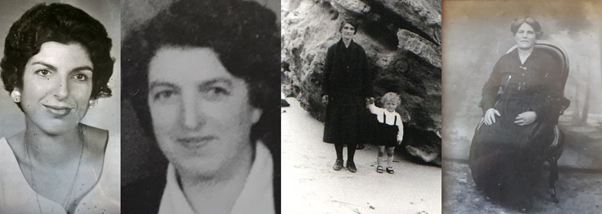
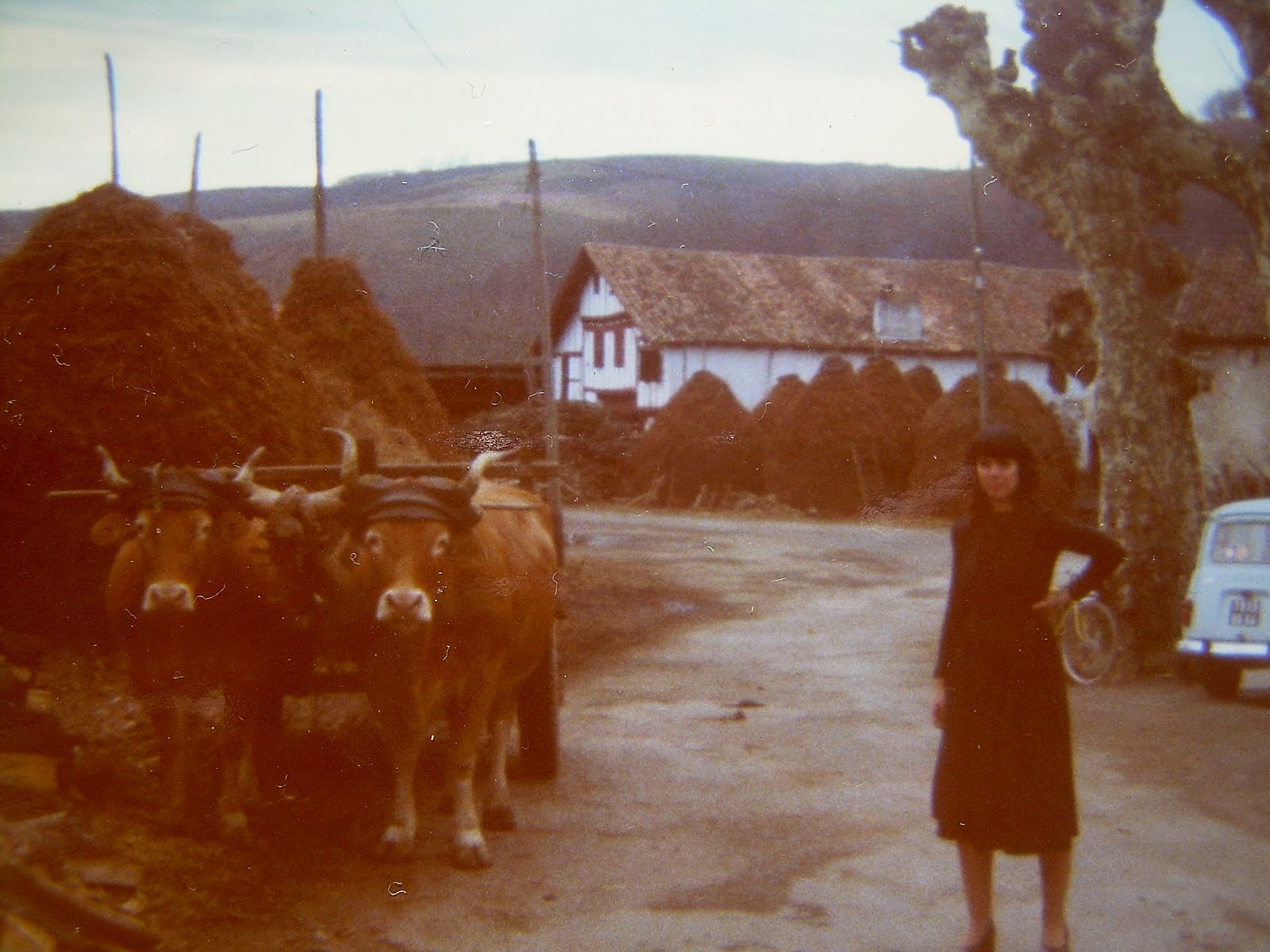
Below is a composite photo of my mother’s maternal side, on the Basque lineage. Going left to right, far left is my mother, Gisele; then her mother, Anna (both born in the French Basque country); her mother Antonina, and her mother Ama (both born in the Spanish Basque country, though Antonina came to live in the French Basque country as a young woman). And below that is me, as a teenager in the late 1970’s in the French Basque country, near the village of Ainhoa. Yes, you could still see the occasional ox cart there, back then!






 Feathers of the Firebird