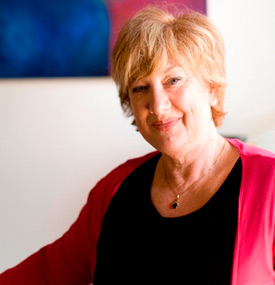
Fiction, prediction and diversity: an interview with Hazel Edwards

Today I’m very pleased to interview popular author Hazel Edwards about her new book for adult readers, Celebrant Sleuth, set in a country town and centred around the character of Quinn, an unusual woman who lives in a romantic but non-sexual relationship with her partner Art, and who as well as being a celebrant in great demand at weddings, funerals and other life rituals, also has a knack for solving mysteries of all sorts.

Hazel, how did the idea for ‘Celebrant Sleuth’ first come about? 

I’d observed celebrants in action at Australian weddings, name-days and funerals. Most are very personable.

They are problem-solvers. They have to handle dramatic situations with difficult people and heightened tension. Apt words in emotive ceremonies are their business.

The role seemed versatile enough for a sleuth character who needed to move into different settings and cultures to solve mysteries. For diverse age groups too.

Like many others, our family is spread across generations and cultures and friends are re-committing, divorcing or blending.

So I’d been to a few celebrations, commitments and an increasing number of funerals.

That seemed like a good starting point to research the role of celebrant. As a believer in participant-observation, I considered qualifying as a celebrant by doing the course, but then decided it was more effective to interview the experts.

In early 2016, well before the Same Sex Marriage law debates, I moved into serious interviewing.  More than twenty-five celebrants on phone or Skype or in person. But it wasn’t all serious, most celebrants had a sense of humour, which was vital because I was collecting anecdotes for my mystery plots.  I needed the absurd inbetween the tragic and the romantic.

Most fictional detectives have a ‘backstory’ but Quinn, the celebrant/detective in Celebrant Sleuth, has a most unusual one. Can you tell us how you came to create her, including any research you had to do? 

 Usually I create a detailed dossier for each of my characters. Quinn required a bit more research because I needed to get the gender vocabulary right as well as find out about the job of celebrant.

Earlier, I’d been invited to various literary festivals in connection with our co-written trans YA novel ‘f2m;the boy within’ (2010).

On a panel, I met an extremely articulate and thoughtful asexual in her early thirties, who challenged me to write about her gender circumstances. She was NOT a celebrant.  She was a park ranger. But the idea of juxtaposing a romantic personality in a longterm relationship within the character of a celebrant who had a job involving romance interested me.  ‘I prefer icecream to sex’ was one of her very quotable comments to me, as she explained the differences between being asexual  (feeling no sexual attraction to any gender) and being a ‘romantic’ desiring and giving affection which is different from being aromantic.

She became one of my ‘expert’ readers.  Along with the celebrants, actors, caterers, lawyers, mothers-in-law, actors and photographers I interviewed. And the multiple florists in fabulously perfumed shops.  The only problem was fictional time. Everything needed to happen in under an hour, just like in a wedding or funeral.

But it’s taken about 2 years to write in ‘real time’, between 6 am and 8 am daily. My brain was clear then and could cope with plotting clues. The mysteries are episodic, with celebrant Quinn solving problems in settings including the football hall of fame, retirement village chapel and a few inter-relationships of florist, caterer and media in the country township during an economic downturn. Millionaire retirement village owner, eighty-something Flora is feisty and falls for a younger man. I had to create a whole ‘fictitious’ township of intersecting roles. And get the street geography right.

There are several stories in Celebrant Sleuth: cases ranging from murder to theft to missing wills. Did you write them in sequence or not?

 No. I didn’t write in sequence.

The tight opening, Introducing Quinn, was written last as the viewpoint was always a challenge.  Initially I imagined a kind of voice- over which could adapt for television, but also the issue of asexual gender had to be explained indirectly for a mainstream audience but was not the central theme of the book. First person enabled less use of pronouns

I wrote each chapter as a separate ceremony with a problem or crime solved by Quinn the sleuth. But I didn’t want a murder per chapter. That seemed Agatha-Christie-ish, depopulating one small country town. The settings were a challenge because I needed to create a country town, small enough for the characters to bump into each other via their other roles like caterer or florist.

I tried to vary the mood and pace of the chapters and the type of ceremony, not all were weddings. And I had to check the facts about types of death… and set up the circumstances and motives. After trialling them with my test readers.

‘Celebrant’ is an Australian term and often confused with ‘celibate’ or ‘psyche’ or ‘Celebrity’ so I had qualms using it for the title.

Amused that my publisher BookPOD has used the meta tag Clean crime to describe ‘Celebrant Sleuth’.

‘I do…or die’…was the last minute subtitle to include all circumstances.

What has been the reaction of readers?

Really positive.  Celebrants are thrilled with their job being featured.  Diverse gender groups are delighted to have an asexual hero. Others like the small town mystery.

My expert test readers picked me up on a few technicalities. ACE as the name of Quinn’s partner was inappropriate as it is a term used by asexual groups. Pure coincidence I used that name as I was trying to give alphabetical and simple names to characters.  Ace became Art. Coronial and forensic pathology procedures.  Legal stuff.  Uniformity of retirement village streetfronts and use of ramps.  Youngest legal age of bride.

But the greatest legal challenge has been the Same Sex Marriage laws changing the terminology in my commitment chapter. Last minute updates.  So far I haven’t been accused of being politically opportunistic in using such a topical gender situation. The reality is I started writing two years ago. It was serendipitous topicality which had the law being changed on the day I was checking the galleys and had to change clues since wedding services differ from commitment in the legal wording and papers, but there will still be people who choose to commit rather than marry.

The cover has ambiguous and symbolic silhouettes and that was deliberate. Designer Lee Burgemeestre is multi talented and is also a celebrant so she brought an experienced eye.

My favourite anecdote relates to lost rings and metal detectors on the beach. Closely followed by dogs as Best Man.  And the professional afternoon- tea eaters who turn up as rent-a-crowd for the scones, raspberry jam and clotted cream provided by one funeral parlour, even if they didn’t know the deceased.

Some readers are intrigued by the blurb.

‘I buried my father, married my sister and sorted the missing will.’

Quinn, a celebrant with style and a few obsessions but a good heart, solves quirky problems, mysteries and the occasional murder at weddings, funerals and naming ceremonies in her country town.

Ex-actor with a great voice who writes eulogies to die for! Not forgetting a few quotable ‘Quinn’s Laws of Relativity’. A romantic, but asexual, Quinn lives with her long term partner Art who runs community Channel Zero.

The workstyle of a celebrant is never routine. Fake I.D. Fraud. Fights, even to the death, over wills and inheritance … Mislaid rings. Lost bride. Food poisoning.   Clients of varied ages and cultures are well looked after. Even vintage millionairess Flora with the much younger lover who might be a con-artist.

Quinn solves most problems but not always in the expected way

Why have you included Quinn’s Theories of Relativity at the end?

To characterize Quinn as many celebrants do write their original material.

Most people only know Albert Einstein from t-shirt quotes, but …

I admit I occasionally adapt his ‘Theory of….’quotes for funerals or weddings. Not really plagiarism because I always mention Einstein, just an updated tribute to the most significant science philosopher (in my opinion). One of my heroes and gives a bit of gravitas to a service.

Quinn’s Theory of Relativity

The likelihood of the relationship ending in divorce is directly related to the number of arguments during rehearsals, obsessive preparation and the bride’s budget on self.

My favourite is: Quinn’s Theory of Funeral Secrets

‘At a funeral, we acknowledge the life of the person and maybe the many identities, actions and secret lives of which the family and friends were unaware. For some a shock, for others a relief.’

 Are you planning any more ‘Celebrant Sleuth’ stories?

Yes.  But only if optioned for television. I’m realistic about the number of options which are never made.

Currently there is a great demand for celebrants to perform weddings for same-sex couples who previously had commitment services or who had married under the laws of elsewhere.  But the demand for commitments, re-commitments, funerals and naming ceremonies will continue.


Celebrant Sleuth by Hazel Edwards is published by Bookpod and is available through all good bookstores. Formats: paperback and ebook.


The creation of Building Site zoo, part two: the illustrations

In Part Two, here’s Laura Wood’s great post about how she went about creating the visual world of Building Site Zoo. And  it includes samples of her roughs, storyboard, and work as it developed–thanks so much for sharing them with us, Laura!

Creating the illustrations for Building Site Zoo, by Laura Wood

The first time I read Sophie’s manuscript, I thought it was one of the most original picture books I was ever asked to illustrate.

I knew it would have been a fun text to bring to life but also quite challenging… which is always a good thing! I knew it would be hard for me to draw all those buildings and machines, since it’s not something I’m very used to!

Anyway, it didn’t take me long to decide to accept the challenge.

The first things publishers want to see are always the main characters of the story, so I started from there. The story doesn’t say explicitly who the characters are, which I personally love, since it gives me a lot of freedom to play around. I decided to go for brother, sister and grandpa.

After that, I started doing lot of research about cityscapes, buildings and machines before sketching ideas for the storyboard. I knew I needed to becoming familiar with the shapes of the machinery before getting the ideas out.

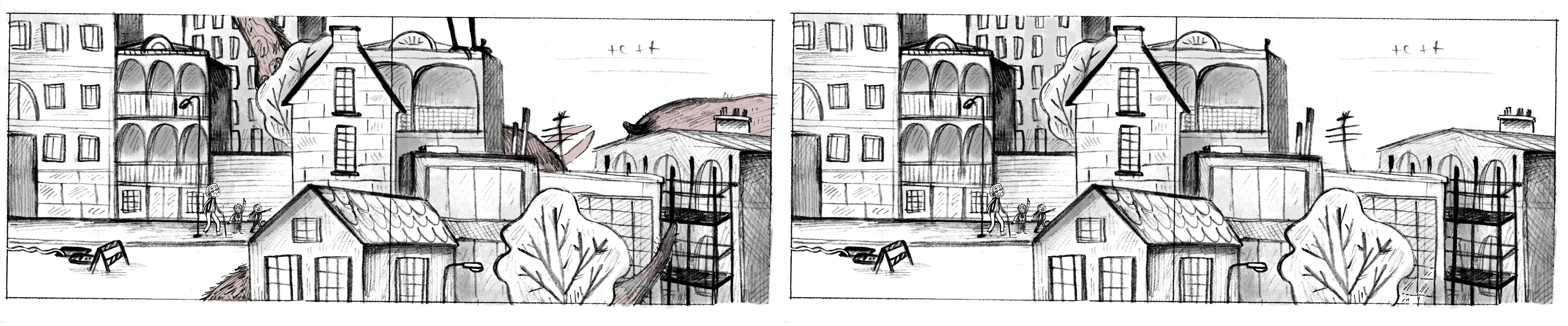
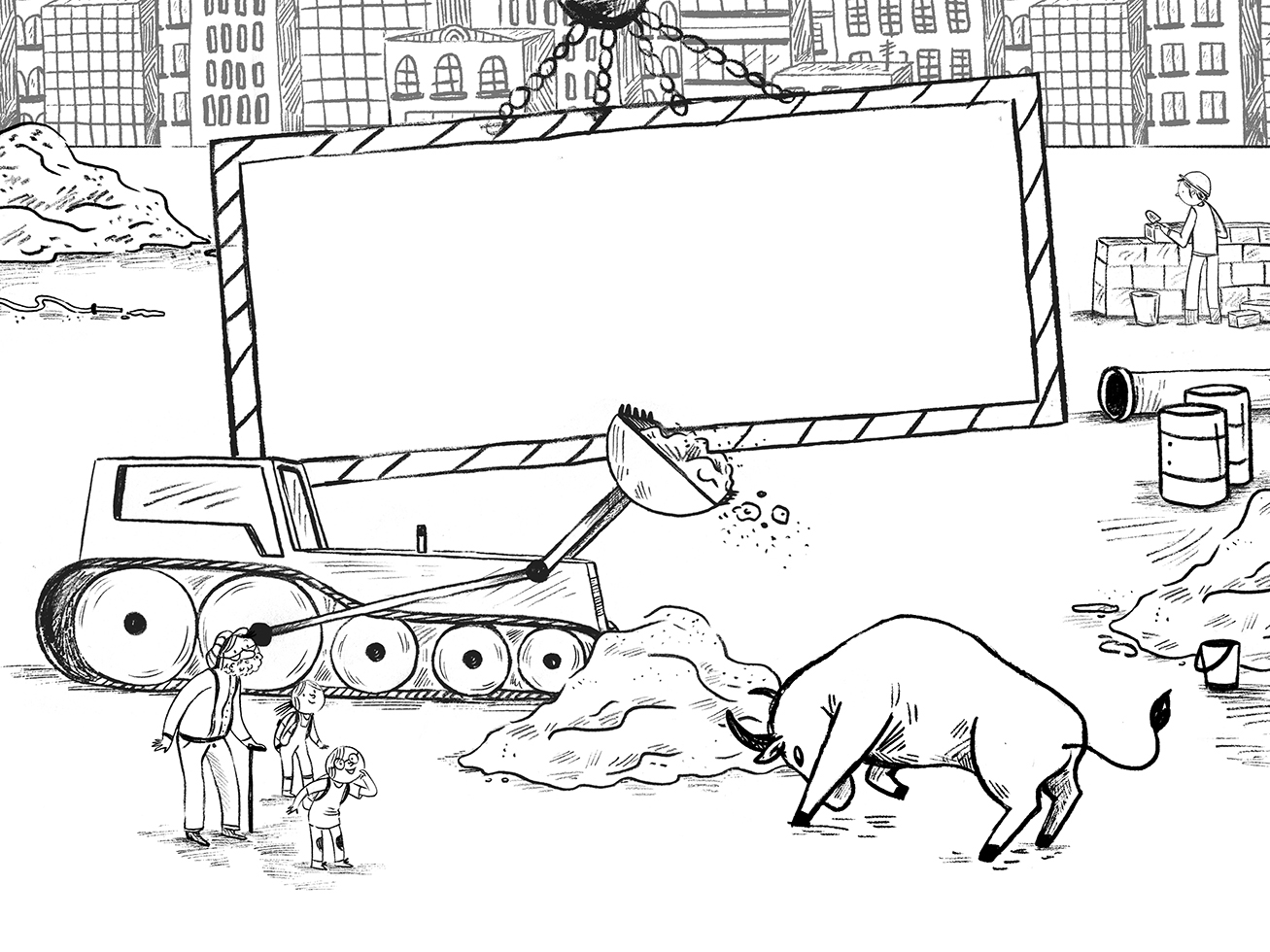
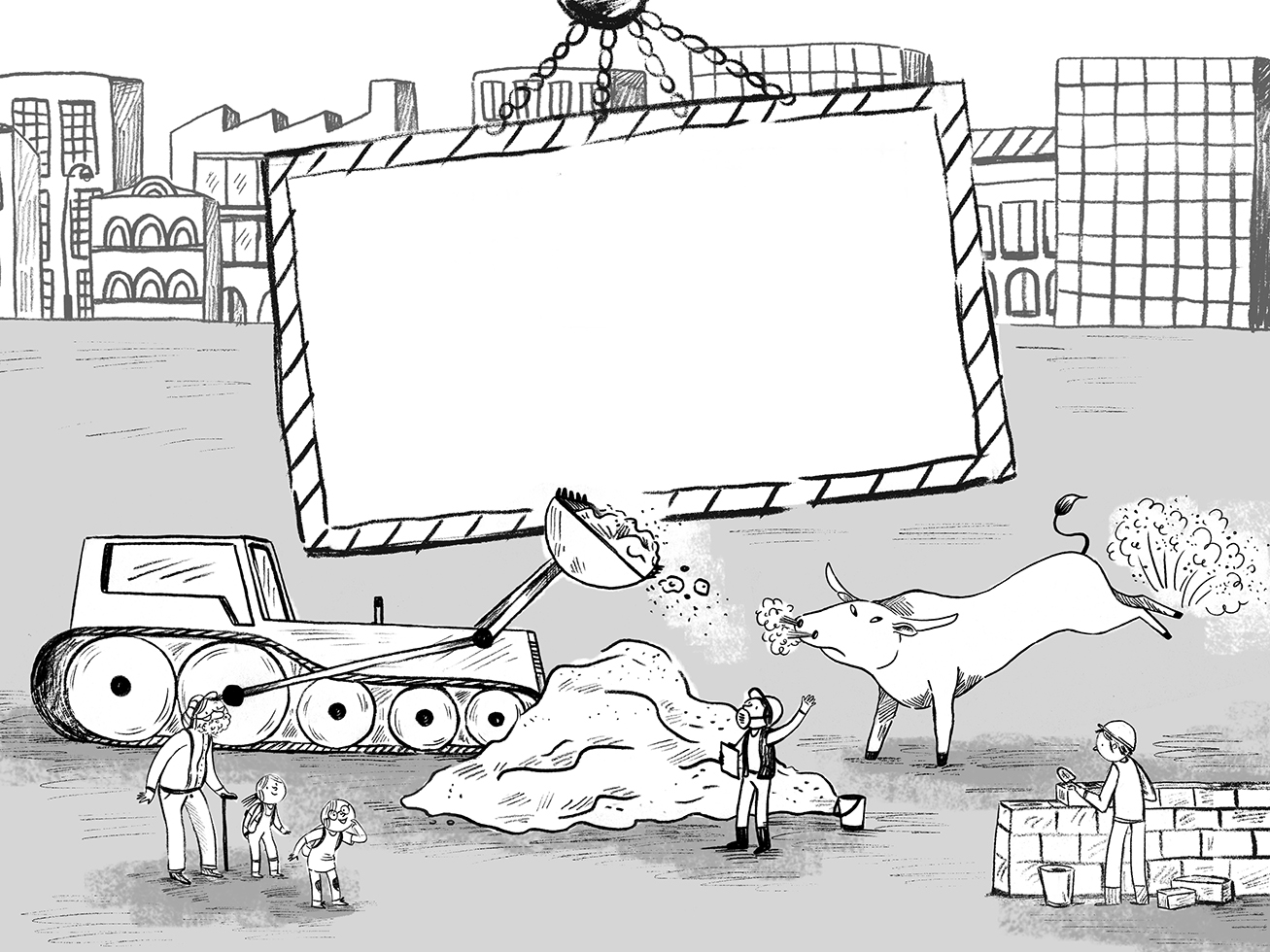
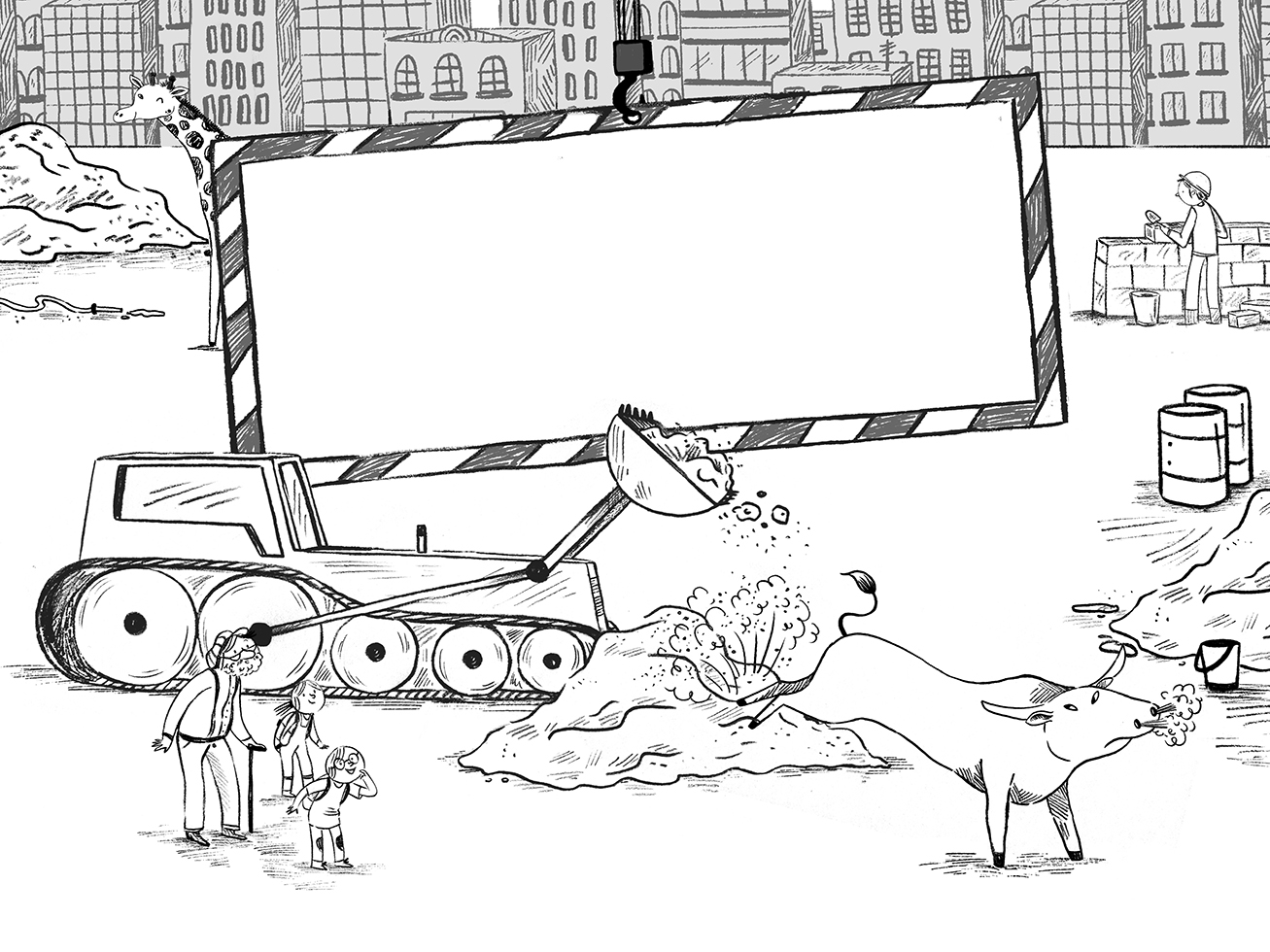
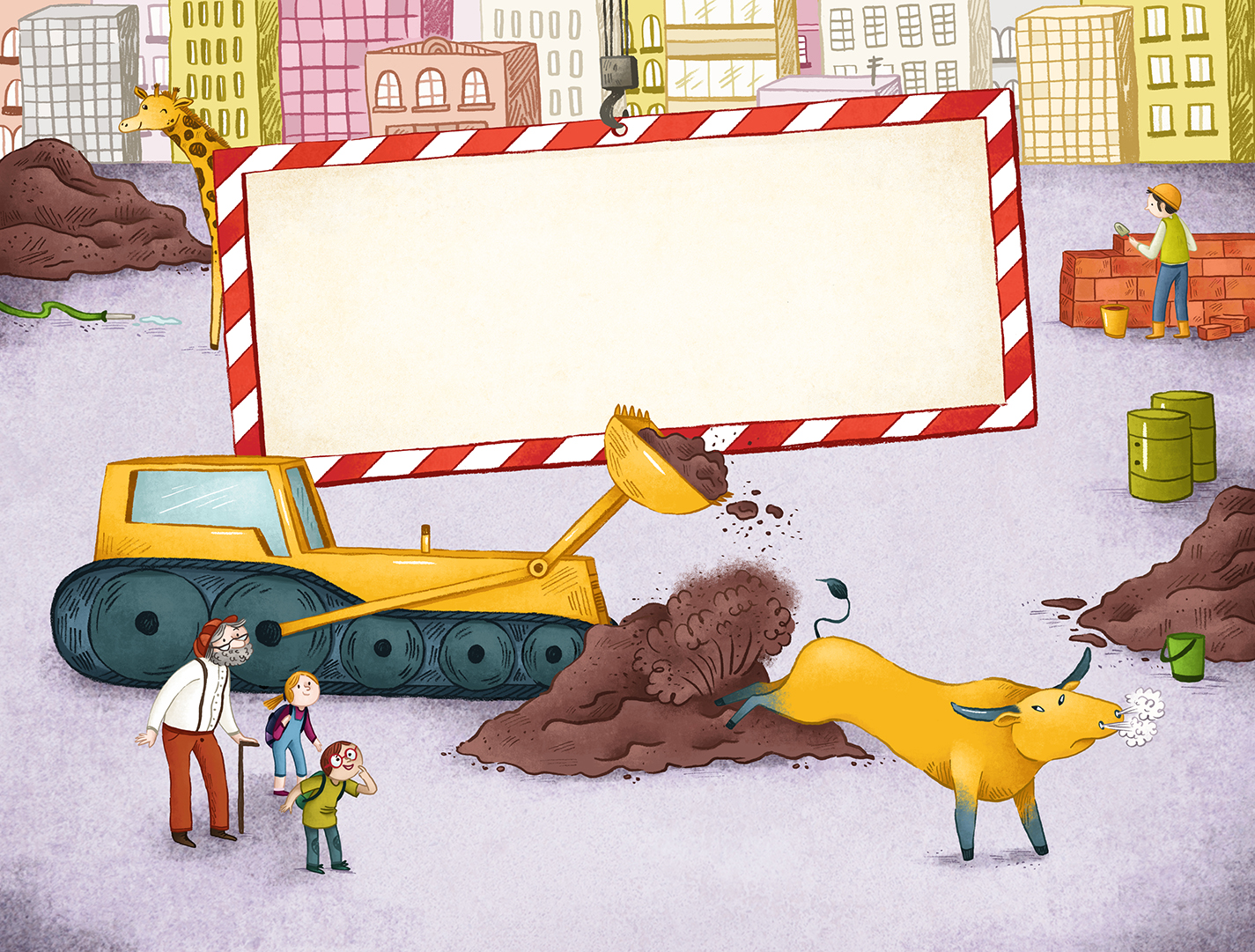
The idea I finally came out with was to approach the whole book, as a dual reality kind of thing: basically having two very similar spreads, the first one with the animal – the world made up by the kids – and the second one with the corresponding machine – the real world. This way, I thought the reader could make a connection easily between the text, the animals and the machinery in action. Mmm… I think written down sounds more complicated than it is, anyway here are some early storyboard sketches.


Some more storyboard sketches. As you can see, spreads developed and changed.


Once all the spreads have been approved by the publisher, I work on the final lines. For this book in particular, since there were a lot of overlapping elements on each spread, I preferred to draw some of the elements separately (background, animals, machines, characters, etc…) and put everything together in the computer.

I then proceed to colour everything. Once the internal spreads are coloured, the cover is always the last thing that gets done.

There were lots of different elements I wanted to fit in this particular cover, so I tried a few ideas but it took me quite a while to get the composition working…


The creation of Building Site Zoo, part one: the text

This month, Building Site Zoo, my picture book with the wonderful illustrator Laura Wood, is published by Hachette Australia, and to celebrate we thought we’d tell you about how the book came about and what the process was like for both the text and visual narratives. In Part One, I talk about the genesis of the text and how it developed, and in Part Two Laura will describe her process, in both words and pictures of course! Hope you enjoy reading both!

The text, by Sophie Masson

It so happened that one day in late 2014, I was in Sydney, in Ultimo, in fact, having just gone to an ASA meeting. I was sitting by myself having a cup of coffee in a quadrangle near the ASA office, and happened to look up at the cranes high above: that spot is very close to UTS where new buildings were under construction at the time. A line suddenly popped into my head: The cranes are fishing up in the sky…As soon as it did, I knew I had something. Cranes could be birds as well as machines, so in that vein I started to think about other machines that could also be seen as animals. So I pulled out the latest incarnation of the cheap little notebook I always carry in my bag, and started scribbling lines down. ‘Building site zoo,’ the title, came almost straight away, but the full lines took quite a lot of to-ing and fro-ing and crossing-out and rewriting.

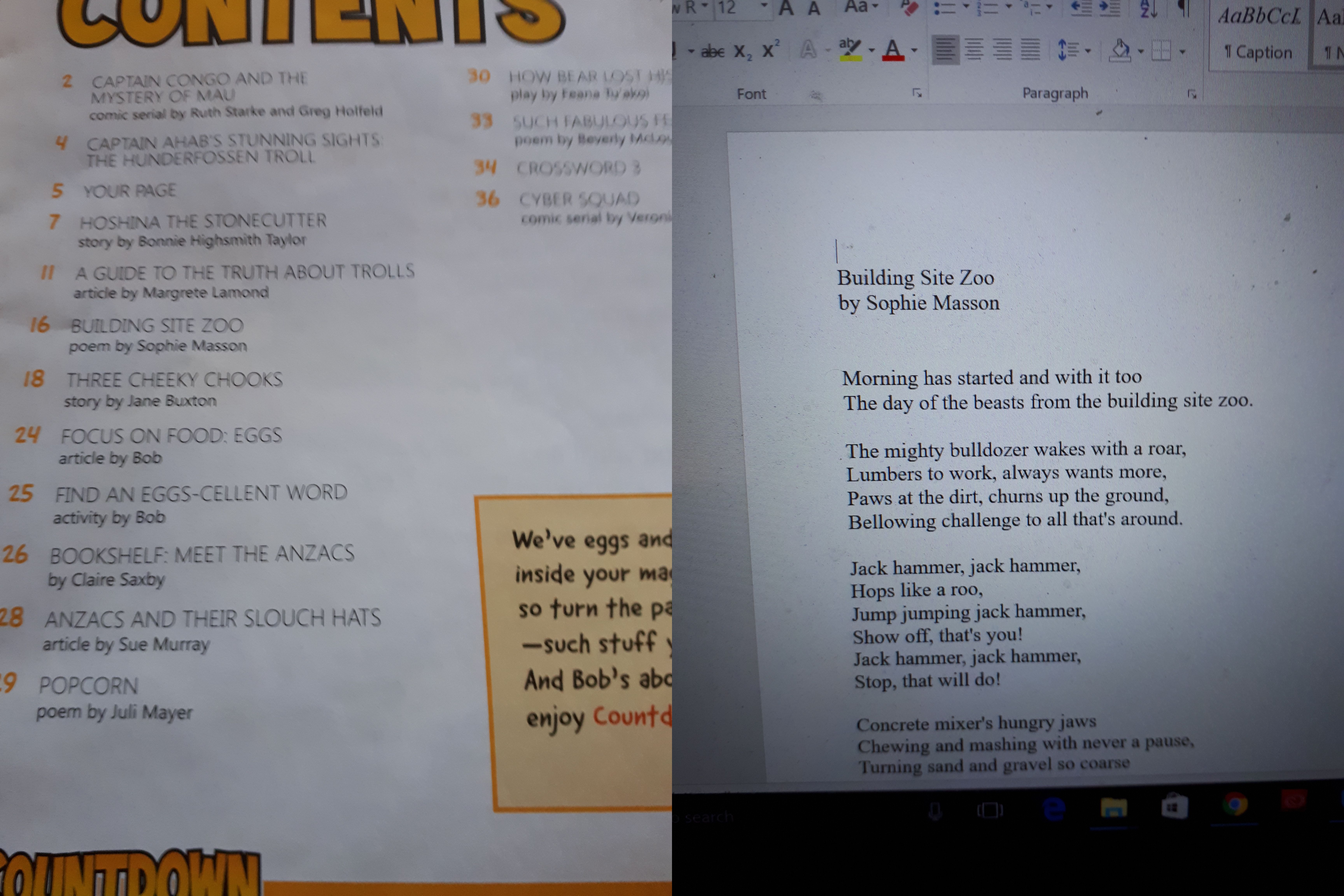
My initial thought with Building Site Zoo was that it would make a great poem, so that’s what I worked on, when I was back home. I then sent it off to The School Magazine–to my delight it was accepted and published in the April 2015 Countdown issue.

By then, I’d started getting picture book texts accepted–Once Upon An ABC and Two Rainbows--both of whom had started as poems(in the case of Two Rainbows, two poems!) so I began to think about Building Site Zoo and how it might work as a picture book text. I spoke to my wonderful agent Margaret Connolly about it, whose ideas and suggestions are always incredibly helpful no matter what the literary project, AND who really understands picture books. We discussed how the text could be tweaked to make it more like a story and less like an impressionistic piece, which works well for a poem but not for a picture book–and yet leave the poetic central concept of the machine-animals intact. I went away and thought about it and worked on first the beginning, to introduce some characters–the child’s point of view was very important, because in fact that’s how I’d seen the whole thing from the beginning. I didn’t want to make the characters fixed: there would be a first-person point of view, but it would also encompass other family members, so it wasn’t just ‘I’ but ‘we’.  So the new opening would start:

Every morning on our walk/ We see an amazing zoo/Full of the most amazing animals/Come and see them too!

I would also identify each machine-animal, not as part of the text, but as indicators for editor and illustrator: so the bulldozer’s a bull, the jackhammer a kangaroo, the concrete mixer a hippo, etc.

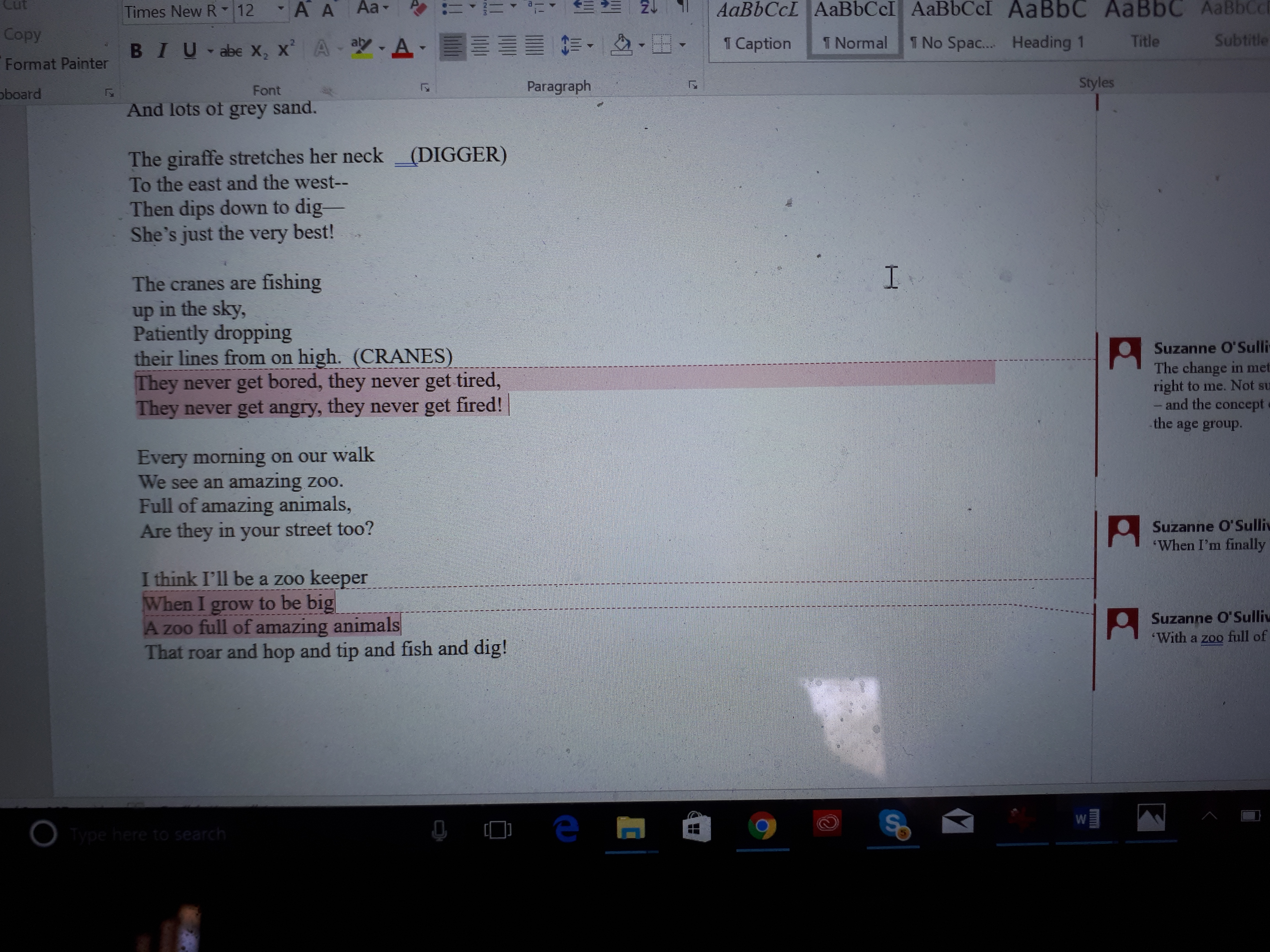
Margaret loved the new revised text and sent it off on its rounds to publishers in late 2015. And in April 2016, she emailed me to say Suzanne O’Sullivan at Hachette Australia really liked the text but had a few suggestions for minor changes. These related mainly to tweaking a word or two, but the biggest change was in dropping some lines from that stanza that had started everything off, about the cranes fishing! She felt there was a change in metre which didn’t work, and that the concept of ‘firing’ also didn’t work for the age group. Looking at it, I could see just what she meant, so I dropped those two lines.

After revising the text, I sent it back–and in June 2016, it was accepted for publication. I was of course thrilled!  And even more delighted when Suzanne confirmed that the illustrator would be the wonderful Laura Wood! It was so exciting to see her roughs, and the progress on the visual narrative as it went on, and she added all kinds of fabulous details and so beautifully fleshed out the characters whom I had deliberately left undescribed. I never get over that extraordinary pleasure, of seeing my text expanded and transformed by the illustrations, producing a true creative collaboration which is immensely exciting and satisfying.

The editing of the text didn’t end there of course–with great suggestions from Hachette editor Tom Bailey-Smith and Suzanne, more words were tweaked, an extra stanza was added at the beginning, and the ending you see above was dropped in favour of a simpler and more satisfyingly cyclical one, bringing it nicely back to the beginning.

Every morning on our walk/we see an amazing zoo/full of astonishing animals/Are they in your street too?

And here too, before inviting you to turn to Part Two in which Laura talks about her creation of the illustrations, I’d like to thank and pay tribute to the publishing team at Hachette and the fabulous designer Ingrid Kwong. What a beautiful book we have all produced!

Read on!


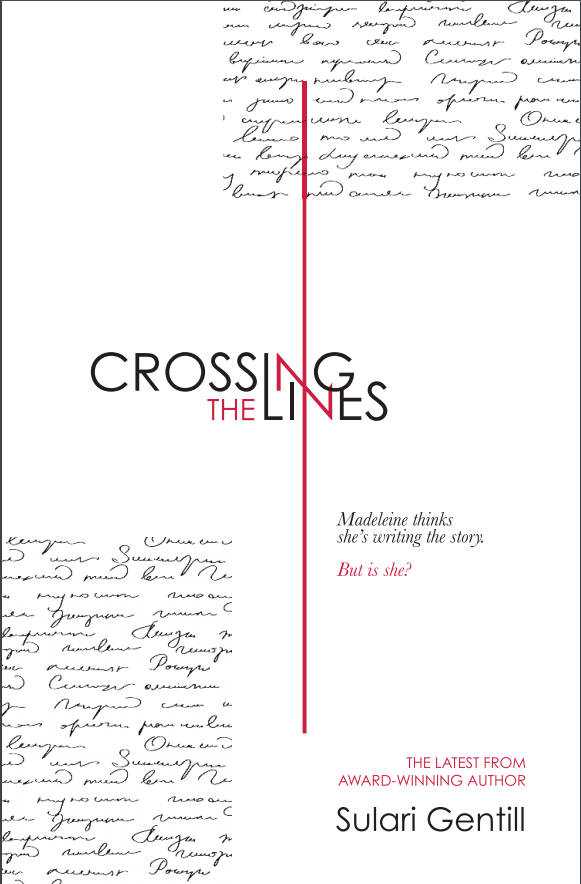
Crossing the Lines: interview with Sulari Gentill

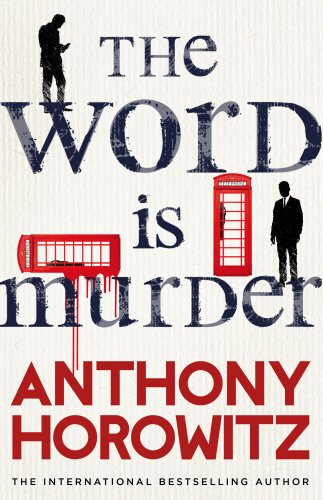
Last Friday, I published my interview with Anthony Horowitz about his brilliant crime novel/metafiction, The Word is Murder. Today I’m interviewing Sulari Gentill about her equally brilliant crime novel/metafiction, Crossing the Lines. Well-known for her popular Rowland Sinclair series of detective mysteries set in the 1930’s, Sulari has broken new ground with this novel. It feels like wonderful serendipity to me, that two such gifted authors should have created these bold new explorations of the writing experience and creative process, within the tight, gripping framework of a great crime story.

First of all, Sulari, congratulations on Crossing the Lines, a brilliant and inventive work which works really well both as a gripping crime novel and as highly effective metafiction. How did the idea first come to you?

Thank you, so much Sophie.

This was one those ideas that grew out of idle speculation.

I’ve always allowed myself the indulgence of believing in my characters when it suited me.  It makes the act of writing less lonely in a way.  I’ve always known that I played close to the line between imagination and delusion.  Interestingly, it’s this aspect of my process (if you can call it a process) that I am most asked about at festivals etc. I’ve found myself speaking often about the “the line” between imagination and delusion, confessing to those times I’ve ventured a toe across it.  I suspect it’s a game that both writers and readers play to greater and lesser extents.

I do wonder what Rowland Sinclair thinks of me.  Does he like me?  Would he read my books?  Does he find me unnecessarily sadistic?  I do, after all, visit all sorts of pain and trouble upon the poor man… and yet I feel he trusts me; that we’re working together.  I can help but think about what it would be like to be him, to have the circumstances of my existence controlled by someone else’s narrative.

Of course it’s a writer’s practice to extrapolate, to take things to their natural end, and so I have on occasion found myself pondering what would happen if I crossed the line completely, if I allowed the people I made up to take over, if I permitted them to control my life as much as I do theirs.

And somewhere from the midst these muddled musings came the story of Madeleine and Ned, who write each other and entwine the lines of their stories and their lives.

You use a very interesting and unusual narrative process, by switching back and forth between Madeleine and Edward, sometimes even within the same paragraph, which further blurs the boundaries between them–crosses the lines, in fact!–yet never becomes confusing. How did you go about doing that?

I wanted to echo the way my mind works when I write, the way in which the novel’s voice both merges with and takes over from mine—sometimes in the midst of a sentence or a thought.  I wanted to reflect that fluidity but also maintain the individuality of both voices.  To be honest, I thought it would be a great deal more difficult that it was.  I wrote this novel as I do all my novels, without a plot or plan of any sort and I wasn’t really consciously doing anything in particular.

The novel is written in third person, and the voice tends to change at a point when Maddie and Ned have the same thought or disagree, which is, I think, why the transition is smooth and not confusing.  Again, I didn’t do this consciously when I was writing – the changes were instinctive and responsive to the narrative rhythm, but, in hindsight, I see that those pivot points occurred when Ned and Maddie engage directly with each other. For a moment, at these places in the narrative, the reader’s mind is in the head of both Ned and Maddie, allowing them to move seamlessly from one point of view to the other without jarring.

You play with literary concepts and conceits–such as the ‘lines’ between genre fiction and literary fiction–with great deftness, and Crossing the Lines can be seen as a riposte to that artificial boundary-setting. Can you expand a little on that?

My reputation in Australia is primarily as a crime writer.  It’s a genre I love and respect, not just because it engages the reader in a tale of peril and intrigue, but also for its ability to hold a mirror up to society, to make social commentary in a way that is subtle and incidental but, for that, no less insightful.  The crime novel, at its finest, has many layers; it talks about the worst and best of humanity, about fear and courage, discrimination and justice.  And yet there seems to be a line, in this country particularly, that arbitrarily divides genre from literary fiction with the implication that literary fiction is somehow inherently worthy and, conversely, genre is not. To me, the line is an artificial prejudice and whether or not a novel has worth has scant to do with its genre.  With Madeleine being a crime writer and Ned a literary novelist, it seemed natural that they would have this conversation.

In the novel, you have mixed aspects of your own lived and literary experience with cameo appearances by other literary figures–such as respected author and director of Writers Victoria Angela Savage–and completely fictional elements to create a disconcerting–and fun!–hybrid narrative. Can you tell us about how you juggled all those different elements?

Whilst her circumstances sound familiar, Madeleine is not me and Crossing the Lines is a novel, not a memoir. In writing this book, I wanted to concentrate on Madeleine’s inner world and so I gave her an outer world that I knew—one that’s very similar to my own.  A familiar baseline from which I could extrapolate. It’s not something I’ve ever done before, but for this book which is all about crossing those lines between reality and imagination, it was right.

It also seemed right for a novel about crossing existential lines to allow real people from my own life to play a part in the novel (also not something I’ve really done before).  Angela Savage, the character, is Madeleine’s dear friend and trusted colleague—the real Angela is that to me.  My old friend and confidant, Leith Henry is cast as both Ned’s and Maddie’s agent.  I felt like she anchored the three of our worlds (Ned’s, Maddie’s and mine) together.

To be honest, it felt more like weaving than juggling.

Crossing the Lines is a very different kind of book to your other crime fiction, the very popular Rowland Sinclair detective series, set in 1930’s Sydney. What was the experience of writing it like, compared to those?

In many ways the experience was similar—intense and immersive.  But for the first time I was writing without a scaffolding of history, and I was writing a story that was quite internal.  It didn’t deal with larger issues of political movements and social justice.  Everything in this novel looked in rather than out.  I do remember feeling quite lonely when I wrote this book in a way that I’m not when I write Rowland.  I suspect it’s because I didn’t have as direct a link to Ned and Maddie as I do Rowland.  I am Rowland’s writer, so he speaks to me.  Ned and Maddie were each other’s writers—I just eavesdropped on what they said to and felt about each other.  I do realise I sound quite mad.  Sorry.  Sometimes it’s difficult to explain the way my mind works without sounding at least a little insane.

I’ve heard you speak at events where you have said you don’t like to look too closely at your own creative process in case it withers the magic. Yet in Crossing the Lines you have performed another act of magic: incarnating the creative process in the story of Madeleine and Edward. I can imagine it must have felt spooky at times! How did you focus on that aspect of the novel without becoming too self-conscious?

I just tried to be as honest as I could about the experience of writing as I understand it.  I think Crossing the Lines works because it doesn’t try to forensically analyse and explain the magic, simply to recreate it.  I did get self-conscious once the novel was written…I panicked that it would be read as a memoir rather than a fiction.   I even tried to talk Pantera out of wanting to publish it because it made me feel exposed and awkward.  I think I might to the only writer ever to tell a publisher, “All right, you can read it if you really insist, but I promise you’ll hate it…”  Fortunately, despite my best efforts, I didn’t manage to dissuade them.

While I was actually writing though, self-consciousness was not a problem.  I tend to lose myself when I write, I stop being so aware of me.  It’s just all about the story.  I don’t get embarrassed till later.

How have readers responded to the book? 

Pantera tells me CTL is selling much better than they had expected (but I’m not sure what that really means – maybe their expectations were low  😮 ).  I’ve had some lovely  messages from readers, especially readers who are writers, and it’s received some glowing reviews.  It’s doing well on Goodreads, but while some people really love it, there are a few who don’t get it at all  (which I did expect – it’s not your standard crime novel)  My US Publishers tell me they have very high hopes for this book… but again I’m not really sure what that means.  People (including you) whose opinion I have come to really respect, have liked it.  So I’m happy.  I know that’s really vague but it’s really hard to know as a writer… at this early stage anyway.

Yours is the second new metafiction/crime fiction novel I’ve read this year–Anthony Horowitz’ The Word is Murder is the other–which brilliantly illuminates the creative process in a highly original way. There have been other earlier works which play with those elements, such as French author Guillaume Musso’s La fille de papier (Girl on Paper) and Stephen King’s novella Secret Window, Secret Garden(which was made into the film Secret Window) but though they are gripping mysteries, they both ultimately ‘explain’ the apparent boundary-crossing in a way that disappointed me as a reader(and writer). Not so with your book, and Anthony’s, which stay most satisfyingly within that narrative world. Can you expand on that, and why you decided not to explain?

As a historical fiction writer and a lawyer I’ve learned that what people think happened is as important to consequences as what may actually have happened.  To me, what Ned and Madeleine believe is enough.  The story is about them, their reality.  I didn’t feel the need to rationalise it with any conspiracy or plot or illness etc.  The story is purely about the lines that writers may be tempted to cross, and why doing so is both seductive and dangerous.

The Word is Murder: interview with Anthony Horowitz

Today, I am delighted to bring you my interview with the fantastic author Anthony Horowitz, about his latest novel, The Word is Murder. Anthony’s books, whether for adults or kids, are always gripping and elegantly written, but this one is particularly accomplished, a bold and brilliant tour de force that takes big risks with literary conventions and reader expectations, and pulls it all off triumphantly. It’s one of the most interesting and memorable novels I’ve read all year.

First of all, Anthony, congratulations on The Word is Murder, a daring and playful blend of metafiction and crime fiction.  In Magpie Murders, your novel published last year, you use metafiction elements–such as a book within a book–but The Word is Murder goes a lot further. How did the idea first come to you?

Thank you for your kind words! TWIM (as we all know it) began when I met my new publisher, Random House, and they asked me to concentrate on a series of murder mysteries. My first thought was that I wanted to do something that would completely shake up the format. It wasn’t enough just to have a fat detective, a drunk detective, a Russian detective or whatever. I wondered if could alter the entire template so that we would look at the crime and the solution in a new way.

 To be honest, the idea sort of fell into my lap as I was walking home from that initial meeting. Drop the author into the action. Take him off the mountain, as it were, and into the valley. Turn him into the sidekick. I knew at once it was what I wanted to write.

There are other novels in which the author has a walk-on part–such as for instance, Michel Houellebecq’s The Map and the Territory and Paul Auster’s A City of Glass–but yours is I think the first one I’ve read in which the author is both one of the main characters and the narrator, being bossed around by the other main (fictional) character! And yet, despite the extraordinary literary conceit and dazzling sleight of hand, the story never loses its narrative power and drive. What is it like to imagine yourself as a fictional character? How did you manage to juggle all the different elements, and what were the challenges along the way?

Again, you are very kind. I was quite nervous about putting myself center stage – and so, actually, were the publishers. I didn’t want the book to turn into an ego trip. But although I appear rather more than I would really like (I’ll take more of a back seat in future adventures) the book is more about my writing life rather than me personally – the focus is on Hawthorne!

 When I was writing TWIM, I simply had to imagine that it was all really happening. Writers do this anyway, of course – but I had to consciously ignore the fact that I was making it up. The AH character is seldom named…and this helps me distance myself from him. You might think of him as an avatar. Yes he is me but he’s also my creation and what I think makes it fun is that Hawthorne is as much in control of him as I am!

In The Word is Murder, you incarnate the creative process through literal dialogue and interaction between the author and his characters, brilliantly illuminating the way in which writers conjure characters that feel not only real to them, but also the reader. The novel is deftly ironic yet never falls into the trap of over-signalling. How did you go about it without becoming too self-conscious?

I think I’ve answered this above. I’ve often said that writing is about immersion. I can only write Alex Rider if I totally believe in him…even when some of the action is quite fantastical. The same was absolutely true of TWIM. I had to imagine myself into it but then wrote with 100% belief.

 How have readers been responding to TWIM? Do most people enter into the spirit of it, or are some people confused and think you are writing true crime(as the lady in Hay on Wye suggested in the book)?

I think it’s true to say that audiences have received TWIM more warmly than anything I’ve ever done. This is particularly true of the book blogs and the Amazon reviews. I’m really happy. People tell me that they’ve been Googling to find out what’s true and what isn’t (not that Google necessarily helps). And everyone seems to have grasped the concept.

Will there be more ‘true crime’ novels featuring the ‘real fictional’ Anthony Horowitz as the sidekick to detective Hawthorne?

Absolutely. One of the most enjoyable parts of the book (to write) was the realization that something had happened to Hawthorne when he was young. To some extent, I turn into a detective as I try to find out more. The idea is to write about nine or ten books in the series and gradually to work out the mystery of Hawthorne’s past. As I sit here now, I have a fairly good idea what that might be but I won’t know for sure until I get to the end.

Yours is the second new metafiction/crime fiction novel I’ve read this year–Sulari Gentill’s Crossing the Lines is the other–which brilliantly illuminates the creative process in a highly original way. There have been other earlier works which play with those elements, such as French author Guillaume Musso’s La fille de papier (Girl on Paper) and Stephen King’s novella Secret Window, Secret Garden(which was made into the film Secret Window) but though they are gripping psychological mysteries, they both ultimately ‘explain’ the apparent boundary-crossing in a way that disappointed me as a reader(and writer). Not so with your book, and Sulari’s, which stay most satisfyingly within that narrative world. Can you expand on that, and whether you think the crime fiction lens helps to make that more effective?

I don’t know these books and must check them out. I think the short answer to your question is that I don’t really perceive any boundaries between truth and fiction. In Magpie Murders there were three distinct worlds which related to each other like Russian dolls. There was the fake world of Saxby-on-Avon where the murders took place. There was the “real” (but actually fake) world of Alan Conway, the author of the murders. And although it was only hinted at, there was my own real world – with references to Crete, Orford, the Ivy Club and real people including the radio DJ, Simon Mayo and Agatha Christie’s grandson, Mathew Prichard. TWIM simply blends them all together so there is no distinction between me working on Foyle’s War, for example, and me being attacked by a psychotic killer. So the crime fiction is not so much a lens as a landscape!

 Thank you for these extremely interesting and generous questions.

Thank you very much, Anthony!


Thrilled to be included in A Boat of Stars!

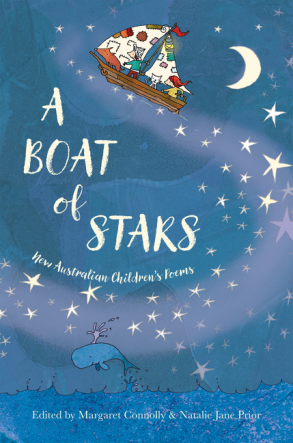
Delighted to announce that I’m one of the authors included in a gorgeous new poetry anthology for children, A Boat of Stars, edited by Margaret Connolly and Natalie Jane Prior, which is coming out with Harper Collins in February 2018. At left is the gorgeous cover, with illustration by Stephen Michael King. I am thrilled that no less than seven of my poems were accepted for the anthology! And I am doubly thrilled that my poems will be illustrated by some of Australia’s most fantastic illustrators. Very exciting indeed! You can read more about the book on the Harper Collins website. 

A unique book contract signing

L to R: Michelle, me, Peter

L to R: Michelle, me, Kathy


Yesterday I had the great pleasure of signing a new picture book contract in a lovely, unique and totally relevant venue: our fabulous local independent bookshop, Reader’s Companion. Kathy and Peter Creamer of locally-based children’s publisher Little Pink Dog Books suggested the venue for signing the contract for A House of Mud, a text inspired by our family experience of building our mudbrick house years ago, and which I have long dreamed might become a picture book one day: a dream which will become a reality next year! The book will be illustrated by Kathy herself, who is also illustrating another of my texts, See Monkey. It was a great occasion, with Michelle Wheatley of Reader’s Companion there as delighted witness to what is the first step in a process which will eventually see the book arrive on her shelves!

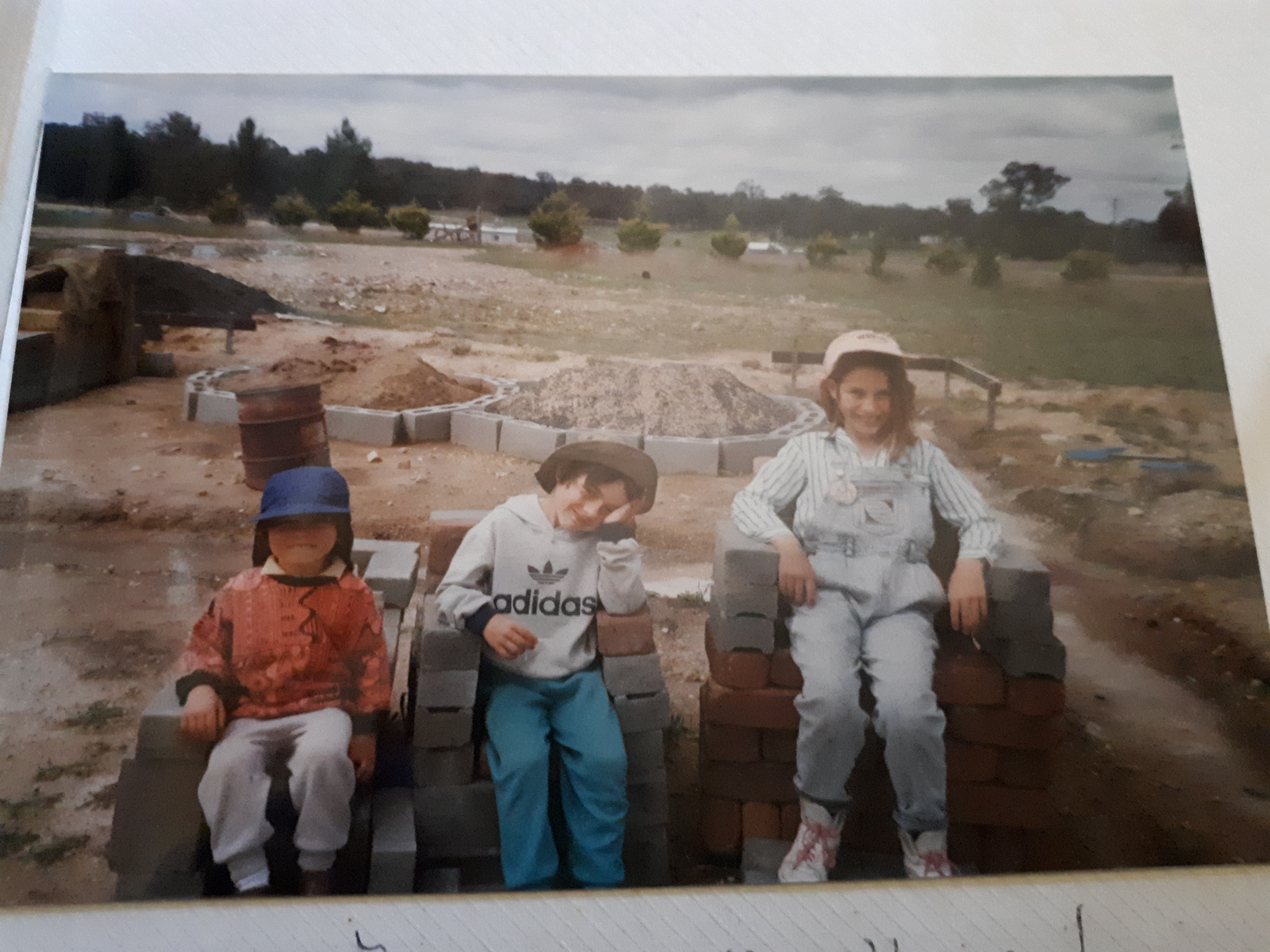
A House of Mud is told from a child’s perspective, based very much on the fact that our three children, Pippa, Xavier and Bevis, enthusiastically took part in the experience of building, paddling in the mud and making small bricks themselves!


Lisa Bigelow on her debut novel, We That Are Left

Today it is my great pleasure to welcome writer Lisa Bigelow to Feathers of the Firebird as part of her blog tour for her debut novel, We That are Left. Set in World War Two, and inspired by family history, it is a moving portrayal of the impact of war beyond the armed forces. In this guest post, Lisa writes about the lived reality of history.

Keeping history alive

by Lisa Bigelow

Blue willow china, lemon delicious and floral carpet; history isn’t just about war and famous people in funny costumes. History is in the great aunt’s lounge room that you visited as a child, that time capsule of tin toys and steamed puddings and jewellery that held memories of lost loves and departed siblings. Reaching back into those memories brings a treasure trove of detail to a writer’s storytelling.

As a child of the seventies, I was becoming aware of my surroundings just thirty years after the end of the second world war. When you think of thirty years back from now, you land in the mid-nineteen eighties era of shoulder pads and Michael Jackson’s Thriller album. It doesn’t seem so long ago, does it? So it was surprisingly easy to imagine some aspects of houses and shops and streets in Melbourne and out in the country, during the war.

Having lost my grandfather on the HMAS Sydney II in 1941, I personally felt the weight of responsibility to accurately portray events in the story of this tragedy. Only a few facts were blurred such as the timing of Harry’s final shore leave and sighting of the decoy target off WA. Rather than adopting the old journalism maxim, “never let the truth stand in the way of a good story”, I feel that the truth enhanced this story, along with a dusting of period detail to transport readers to their not so distant past.

We That Are Left by Lisa Bigelow is published by Allen & Unwin, RRP $29.99, available now.

More about the book:

Melbourne, 1941. Headstrong young Mae meets and falls head over heels in love with Harry Parker, a dashing naval engineer. After a whirlwind courtship they marry and Mae is heavily pregnant when she hears that Harry has just received his dream posting to HMAS Sydney. Just after Mae becomes a mother, she learns Harry’s ship is missing.

Meanwhile, Grace Fowler is battling prejudice to become a reporter on the afternoon daily newspaper, The Tribune, while waiting for word on whether her journalist boyfriend Phil Taylor, captured during the fall of Singapore, is still alive.

Surrounded by their friends and families, Mae and Grace struggle to keep hope alive in the face of hardship and despair. Then Mae’s neighbour and Grace’s boss Sam Barton tells Mae about a rumour that the Japanese have towed the damaged ship to Singapore and taken the crew prisoner. Mae’s life is changed forever as she focuses her efforts on willing her husband home.

Set in inner Melbourne and rural Victoria, We That Are Left is a moving and haunting novel about love and war, the terrifyingly thin line between happiness and tragedy, and how servicemen and women are not the only lives lost when tragedy strikes during war.

More about the author:

Lisa Bigelow’s life revolves around story-telling. An avid reader from age five, her career as a journalist and communicator has been all building and delivering compelling stories about water resources, climate change and any issue that interests her audiences. She recently completed a Masters Degree in Communication and aims to use her writing to illuminate ongoing issues and make them accessible to a wide readership. We That Are Left is her first novel.

Get in touch with Lisa!


Rachel Nightingale on Harlequin’s Riddle

Today I’m delighted to welcome to the blog Rachel le Rossignol, who under her writing name of Rachel Nightingale (‘Nightingale’ being the direct translation of ‘Rossignol’) is launching her first novel, Harlequin’s Riddle, an intriguing and memorable fantasy set against the background of the Commedia dell’ Arte. In this guest post, Rachel writes about the inspirations that came together in the novel’s creation.

Being a Bower Bird

by Rachel Nightingale

When I was in grade 2, we did a project on Australian fauna. I chose the Satin Bowerbird. These birds are well known because the male of the species builds a bower then fills it with bright blue objects to attract a mate. I drew the bird and its nest collection, using every shade of blue available in my pencil case. The idea fascinated me. Why only blue objects? Where did it find them? What did it feel when it spotted a perfect piece of sapphire glass, or a shiny azure ribbon? Now, with my first book coming out, I’ve seen the same pattern in how I gathered similar images and ideas to write Harlequin’s Riddle, a fantasy about the Commedia dell’Arte, the travelling players of the Italian Renaissance.

On the surface, Harlequin’s Riddle was inspired by a comment in an article about the Broadway revival of Cabaret. Alan Cumming, starring as the MC, mentioned the moment before you step onstage, when a whole world opens to you. I asked the inevitable question fantasy writers ask: what if? What if that world was real? What if actors and other artists could reach it? What would they find? What would they be able to do? The idea of Tarya, a realm where creativity can literally change the world, was born. I had a premise for my book. But that premise needed a home – a bower. And I had already filled it with a cast of characters, a collection of archetypes and dreams.

Looking back, I’ve been fascinated by the trickster Harlequin, beautiful Columbine and tragic Pierrot, for a very long time. Masks are a recurrent theme in my life – I have made, decorated, collected and been gifted them. The Commedia dell’Arte used different masks, along with their distinctive costumes, to signify the various characters. In Harlequin’s Riddle masks play a key role in enabling actors to reach Tarya. They confuse identity and ultimately are a tool of misdirection.

But foraging in my bower I found other Commedia memories. Although long ago left behind, I used to have a collection of porcelain Pierrot dolls. I had the inevitable feminine anime Pierrot poster by Mira Fujita. Pierrot evoked such sadness and longing in me – here was a character whose love was so pure and true, but who could never have what he longed for, for that was the way of the story.  I adored the musical The Venetian Twins, which is based on the Commedia. One of my favourite books, Chase the Moon, by Catherine Nicolson, is an unashamedly romantic tale of a pair of lovers who can only reveal their true selves to each other in letters that they sign Harlequin and Columbine. I had an art deco poster book with different depictions of Harlequin, in his diamond patched suit, and Columbine, in gauzy ballet dresses. I imagined the stories they lived in, the twists and turns and tricks.

Recently I found something I’d forgotten I owned – a tin gifted to me by my great aunt, with Pierrot on the lid. The tin contained a face washer and 2 soaps, long since washed away into memory. It’s likely this image was the first that opened the door to the Commedia dell’Arte.

Yet it is not the collection of items and images that I gathered over the years that triggered my writer’s imagination and led to the creation of Harlequin’s Riddle – it was what they represented. The trickster, the beauty and the sad clown promise mystery, deception, romance, laughter and song. This is what I wanted to capture in my story.

Researching the Satin bowerbird for this article, I discovered that these birds have unusual blue-violet eyes. Perhaps these hopeful birds gather all things blue because this colour represents the promise that they will share their bower with another like them. Sharing my story now, I hope I am sharing the mystery and magic that I found in writing Harlequin’s Riddle.

More about Harlequin’s Riddle

The Gazini Players are proud to present

For your Edification and Enjoyment

Tales of great Joy, and of great Woe

Ten years ago, Mina’s beloved older brother disappeared with a troupe of Travelling Players, and was never heard from again.

On the eve of Mina’s own departure with a troupe, her father tells her she has a special gift for Storytelling, a gift he silenced years before because he was afraid of her ability to call visions into being with her stories.

Mina soon discovers that the Travelling Players draw their powers from a mysterious place called Tarya, where dreams are transformed into reality.  While trying to solve the mystery of her brother’s disappearance, she discovers a dark cost to the Players’ onstage antics. Torn between saving her brother or exposing the truth about the Players, could her gifts as a storyteller offer a way to solve Harlequin’s riddle?

More about Rachel le Rossignol(Nightingale)

Rachel Le Rossignol has been writing since the age of 8 (early works are safely hidden away). She holds a Masters degree and PhD in Creative Writing. Winning the Mercury Short Story competition (junior section) at the age of 16 fueled her desire to share her stories with the world. Subsequent short stories have been shortlisted in a number of competitions and a play, No Sequel, won the People’s Choice Award and First Prize at the Eltham Little Theatre’s 10 Minute Play competition. Another, Crime Fiction, was performed at Short and Sweet Manila and Sydney.

Rachel’s second passion after writing is the theatre, and she has been performing in shows and working backstage for a rather long time. She co-wrote and performed in the 2013-2015 version of the hugely popular Murder on the Puffing Billy Express, a 1920s murder mystery set on the iconic Dandenong Ranges train. The inspiration for the Tarya trilogy, which begins with Harlequin’s Riddle, began when she read a quote by Broadway actor Alan Cumming about that in-between moment just before you step onstage, and began to wonder might be found in that place between worlds.

Published by Odyssey Books in June 2017.

www.odysseybooks.com.au

www.rachel-nightingale.info

@OdysseyBooks

@NightingaleRA


Anna Daniels on her book Girl in Between

Today I’m very pleased to be hosting debut novelist and experienced comedic screenwriter and presenter Anna Daniels in a guest post as part of her blog tour for Girl in Between, her first novel, which she describes as ‘a rom-com set in Rocky’ . Read on to know more!

Girl in Between…the rom-com set in Rocky!

by Anna Daniels

It’s wonderful to be with you, Sophie, and your Feathers of the Firebird followers!

My debut novel, Girl in Between, is a rom-com largely set in my hometown, Rockhampton…the Beef Capital of Australia!

For anyone who hasn’t been to Rocky, it’s a tropical city of about 70,000 people, situated on the Tropic of Capricorn in Central Queensland. There’s a wonderful larrikin element to Rocky, heightened by the bull statues astride the roundabouts, and the sense that everyone knows everyone

Jerry Seinfeld has a theory there are some cities in the world, like New York, which are just funny. For me, Rocky fits that bill…it’s just funny!

In deciding to set Girl in Between in Rocky, I wanted to capture the town, with all its quirks and landmarks, so that it was easily identifiable, but I also wanted to make the setting accessible to anyone who’s spent time in any regional Australian city.

I had great fun conjuring up characters and names for the places they work. Ruth, for example, runs a one-woman car wash on the corner of Fitzroy and Albert Streets, and hosts an annual Suds ‘n Thuds disco; Colleen, Ruth’s best friend, works at the popular Rocky café, ‘Bits n Pizzas’, and the central characters, Lucy and Rosie, often have wild nights out at their local, The Whipcrack Hotel.

I remember Gina Riley and Jane Turner, the creators of Kath n Kim, once saying their series was an affectionate look at suburbia, and I like to think that’s how my portrayal of regional Australia in Girl in Between will be viewed….as one of great affection!

Best wishes!

Anna x

Girl in Between by Anna Daniels is published by Allen & Unwin, RRP $29.99, available now.

More about Girl in Between:

Life can be tricky when you’re a girl in between relationships, careers and cities… and sometimes you have to face some uncomfortable truths. The sparkling debut from comic TV and radio presenter, Anna Daniels.

Lucy Crighton has just moved in with some gregarious housemates called Brian and Denise… who are her parents. She’s also the proud mother of Glenda, her beloved 10-year-old… kelpie. And she has absolutely no interest in the dashing son of her parents’ new next-door neighbour… well, maybe just a little.

When you’re the girl in between relationships, careers and cities, you sometimes have to face some uncomfortable truths… like your Mum’s obsession with Cher, your father’s unsolicited advice, and the fact there’s probably more cash on the floor of your parents’ car than in your own bank account.

Thank goodness Lucy’s crazy but wonderful best friend, Rosie, is around to cushion reality, with wild nights at the local Whipcrack hotel, escapades in Japanese mud baths, and double dating under the Christmas lights in London.

But will Lucy work out what she really wants to do in life and who she wants to share it with?

Anna Daniels is a natural-born comedian. She originally set out to write a screenplay that was part Muriel’s Wedding, part The Castle. Instead, she wrote Girl In Between, which was shortlisted for the 2016 Vogel’s Award. She says ‘I’ve always loved comedy which not only makes you laugh but also pulls at your heartstrings. I think a lot of people may be able to relate to Lucy’s story!’

Girl in Between is a warm, upbeat and often hilarious story about life at the crossroads. Featuring an endearing and irrepressible cast of characters, it will have you chuckling from start to finish.

More about Anna Daniels:

Anna Daniels has enjoyed great success as a comedic storyteller since kicking off her career by winning the ABC’s ‘Comedy Segment of the Year Award’ for an interview with Russell Crowe. She then went on to co-create the ABC’s first online sketch comedy series ‘Tough at the Top’ with Melbourne comedian, Anne Edmonds. For several years Anna wrote and presented funny upbeat stories for The Project, winning over viewers with her warm, silly, endearing style.

Having grown up in Rockhampton, she particularly championed the stories and characters of rural and regional Australia with affection and humour. As well as The Project, Anna has written, presented and/or produced radio, TV and online content for Queensland Weekender, Red Symons’ Breakfast Show, and the BBC One series, ‘John Bishop’s Australia’. Anna continues to report for The Project and often presents on ABC Radio Brisbane.

  • Twitter: @annadtweets
  • Insta: @annamdaniels
  • Website:annamdaniels.com


//cdn.thinglink.me/jse/embed.js