Interview at #LoveOzYA

Alex Patrikios of the wonderful literary group #LoveOzYA interviewed me via Zoom the other day, to talk about The Ghost Squad–she had great questions, and I really enjoyed our chat! The interview is now up as a transcript on the #LOveOzYA website, and you can also see clips of the video, exploring such things as research, speculative fiction tropes, and the writing life, at their You Tube channel. Here’s an extract from the interview, about the inspiration and research behind the book:

Was there a particular moment of inspiration that sparked the idea for THE GHOST SQUAD?

A while back, I went to this little museum in Rome, which is called the Museum of Purgatory. Of course in Catholic doctrine, purgatory is a sort of halfway house between heaven and hell. This particular museum was quite a weird little place, and (I learned) this priest in the 19th Century had tried to show proof that purgatory existed and he did with burned handprints on a piece of fabric, supposedly of people who had tried to send messages from purgatory.

But this is now: people don’t believe a burned handprint on a piece of fabric is proof. So I thought, okay, what would cause a disturbance in the electronic systems — monitoring machines and other things like that in hospitals — so I had a look, and found out about electronic magnetic pulses(note: caused by solar storms). I found out about the Carrington Event, and also that a lot of governments actually have contingency plans for when the next one hits. I read stuff from both NASA and the British Government, about what they plan to do in the event of an electromagnetic pulse.

When I saw the Carrington Event had happened around the same time you saw this big interest in seances and spiritualism, in the Victorian times, I thought, okay, this is kind of ‘ghosty’ stuff — and maybe in my lifetime, it would trigger something similar.

Everything sort of fell into place after that.

Apart from that kind of research — NASA, government documents — did you also look at popular movies or shows that have that speculative flavour, and try to examine the genre itself?

Absolutely! Also the novel came out of a creative practice Phd, so that was the creative part of it, but the academic part of it was all about afterlife fiction for young adults. Really fantastic books, like Neal Shusterman’s Everlost trilogy, Yangsze Choo’s The Ghost Bride, and Lynette Lounsbury’s Afterworld.

I watched a lot of films and TV series — things like The Glitch, and the French series The Returned, and even Lost have examples of (afterlife fiction). That was fun! I had so much fun doing ‘research’, reading all these great books and watching all these terrific TV series and films.

I also read a lot of folklore and (material) from religious and spiritual traditions. I had three years to do the Phd, which was fantastic, because it meant I could really develop the book in the very rich and complex way that I wanted to do.

You can read the whole interview here.

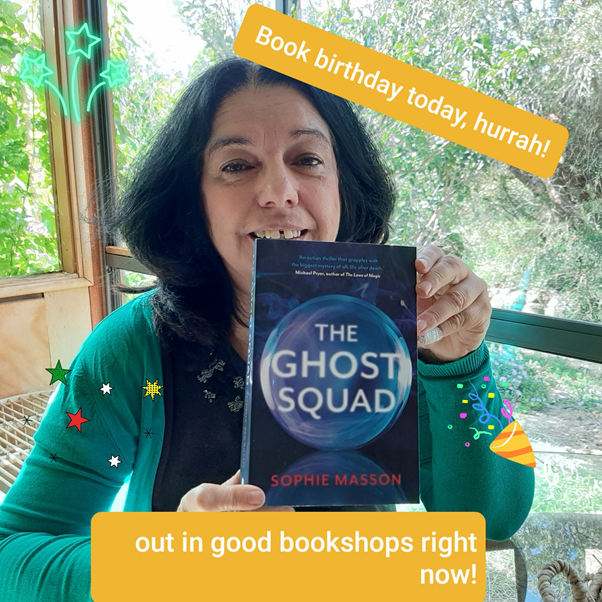
The Ghost Squad is out today!

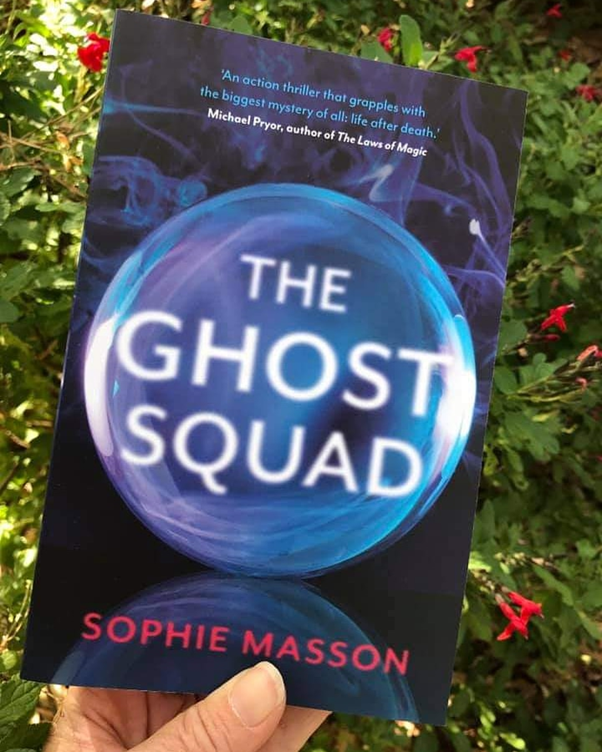
I am thrilled to announce that today is the official release of my new book, The Ghost Squad, published by MidnightSun Publishing and now available in bookshops all over Australia. Hurrah!

As readers of this blog know, the novel, a young adult speculative fiction thriller set in a disconcerting world, was first written as the creative part of my PhD at the University of New England (I was awarded the PhD in 2019) and subsequently acquired by MidnightSun Publishing.  It is immensely exciting to see the novel out there in beautiful book form and for that I wish to greatly thank Anna Solding of MidnightSun Publishing, who so warmly and thoughtfully responded to The Ghost Squad from the start, and many thanks to all her great team as well. I am absolutely delighted that the novel has found its perfect home with such a wonderful publisher. Many thanks to my fantastic agent Margaret Connolly, who always sees the potential in my work, no matter how ‘left-field’, and without whose unfailing support my career would never have been as fortunate and enduring as it has been. And thank you to UNE and my supervisors, especially Dr Yvonne Griggs, whose unfailing support, encouragement and thoughtful readings throughout the PhD helped so much in the development of the novel.

I hope many, many readers will enjoy The Ghost Squad, as this lovely early reader did in a wonderful advance review in Books+Publishing. If you’d like to know more about the book, have a look at the dedicated page to it on this blog. You can also read a short interview with me about the book on the international writing blog, Writer Unboxed. And if you’d like to get a taste of the novel’s atmosphere, do check out the fabulous trailer here.

A bit about the world of The Ghost Squad…

What if there was scientific proof not only that the afterlife existed, but that everyone had an afterlife marker, similar to a genetic marker, that coded them irrevocably for their existence post-life? What if that explosive proof had been hidden from the general public by a worldwide conspiracy of silence, supposedly in order to protect the population from panic, but actually to facilitate secret experiments being conducted to push the boundaries of government surveillance and control, even beyond death itself? 

In the world of The Ghost Squad, everything seems normal to most people, the new normal that is, with all electronic communication strictly controlled and social media banned. Twenty years previously, a major solar storm had caused a massive electro-magnetic pulse which not only knocked out all computer-controlled technology and power around the world for quite some time, but triggered what became known as the Anomaly, the first indication of the afterlife markers of human beings. Since then, the followers of Hermes, a secretive whistle-blower, who operate out of an underground network, the Base, have been attempting to bring knowledge of the secret to the population in general. They are locked in a constant clandestine struggle with the forces of the Ghost Squad, who work for secret government research centres known as PLEIFs (short for Post-Life Entity Index Facility) , who are known to abduct people whose unusual afterlife markers show them to be of particular experimental interest.

The Ghost Squad is set in a contemporary/near-future time, in places which have deliberately not been tethered to real-world geography, though several settings are inspired by real-world places, including in Australia, New Zealand, Japan, the UK, and Russia.

Something about The Ghost Squad…

In the next few weeks, leading up to the release of The Ghost Squad, I’ll be posting snippets about the book, its background and inspirations, but I thought I’d start today with a short outline of the story, which includes the back cover blurb but expands a bit on it…

Imagine a world where all seems normal and yet nothing is – a world very much like our own, yet jarringly unlike. A world where two clandestine organisations, the Ghost Squad and the Base, are engaged in a secret battle for control of information so dangerous it could literally change life as humans have always known it…

Sixteen-year old Polly Sikorski lives an ordinary life in an ordinary small town with her mother, a homicide detective. But when her mother goes missing while investigating a case, Polly is catapulted into a very different life, where nothing will ever be the same again. Running from the police, she encounters seventeen-year old Swan, a tough young Base operative. On their way to shelter, they come across a little boy, Kel, who’s on the run, and take him under their wing. It is a momentous decision that will take them into the dark heart of the shattering secrets that lie behind the apparent normality of the world. Battling to find answers and protect Kel from his pursuers, they run into greater and greater danger.  As the Ghost Squad and the Base close in on them and the story races to its thrilling conclusion in the eerie, steam-wreathed town of Hot Springs, Polly and Swan must face the most stunning discovery of all.

A bold, exciting YA novel with thrilling twists and turns, The Ghost Squad is a novel that will keep readers guessing – and keep them awake at night!

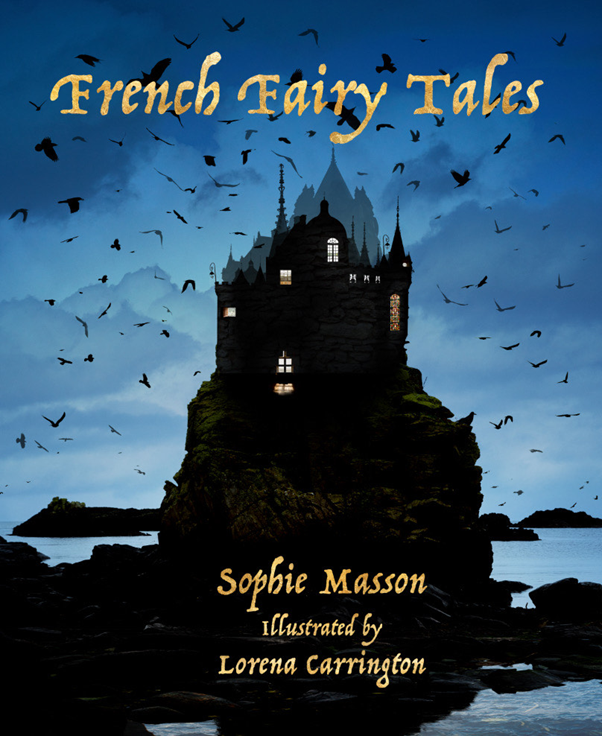
Podcast interview about French Fairy Tales

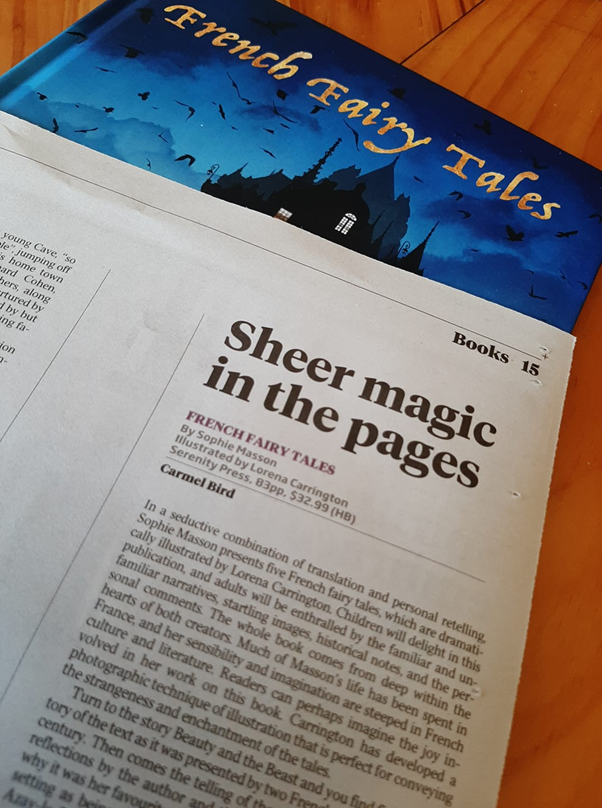
Delighted to announce the release of my interview with Claudine Tinellis’ fabulous podcast, Talking Aussie Books, which has gone live today. It’s very much a discussion focussed around French Fairy Tales and the stories I retold within it. I really enjoyed chatting with Claudine about it all! Also talked about some of my other 2020 books later in the interview.

You can listen to the full podcast interview here.

Delighted to be featured on Story Scoop!

Delighted to be one of the featured creators in the latest episode of Story Scoop, the fabulous joint initiative between the Children’s Book Council of Australia, NSW branch and the Society of Children’s Book Writers and Illustrators ANZ. Story Scoop episodes are in three parts, and in this one, it features author Oliver Phommavanh talking about his humorous middle-grade books in Middle Grade Magic, illustrator Serena Geddes talking about her creative process in Illustrator Corner, and myself, in Picture Book Nook, talking about the inspiration and creation of my latest, very seasonal picture book, Santagram (illustrated by Shiloh Gordon and published by Little Hare). Lots of fun to make the clip and lots of fun to be part of this project–thank you so much, CBCA NSW and SCBWI ANZ, for the opportunity.

Watch the video here:

Happy publication day to Santagram!

Today is the official publication day of my latest picture book, Santagram, which is illustrated by the fabulous Shiloh Gordon and published by Little Hare. It was such a fun text to write, the idea coming to me out of the blue one day when I thought about how letters to Santa are such a big thing, still: so what would happen if more ‘modern’ methods were suggested to him? I was so delighted when Ana Vivas and her team at Little Hare loved the book and took it on for their big Christmas title this year!

And I just love the wonderful, warm and funny visual world Shiloh has created for my text, full of great detail and so appealing! Plus there is even a real (blank) letter and envelope that children can write to Santa. Hope lots of children and families enjoy!

Here’s a bit about the story:

Santa’s mailbox is overflowing.
 
Santa loves getting letters, but the elves are FED UP with sorting through the huge piles of mail.
Surely an app would be better – quick, easy and heaps of fun! They’ll call it ‘Santagram’.
 
But once the letters stop arriving, will they be missed?
 
Can Santa use social media? And should he? This is a Christmas story with a twist that will have the whole family laughing out loud.
Includes special Christmas notepaper so you can send your very own letter to Santa!

Complete Your Book in a Year: an interview with Hazel Edwards

Today, I’m delighted to bring you an interview with fabulous, dynamic author Hazel Edwards, talking about her new projects, especially her new book, Complete Your Book in a Year, which has come out of her very successful and popular writing workshops. Of course, due to the COVID19 situation, these in person workshops had to shift online, but nothing daunted, Hazel found ways of still engaging her audience, dubbing her approach ‘strategies for writing in a pandemic’.

Welcome, Hazel! Your unique how-to writing and publishing manual for family historians, Complete your Book in a Year, has just been published. Can you give us some background on how the book came about?

The Pandemic has given a sense of the need to act NOW on writing projects.

The inspirational ‘Hazelnuts’ and the Pandemic Lockdown of my f2f (face to face) writing workshops led to this manual.

The term ‘Hazelnuts’ was affectionately started by some of my former writing students who HAD been procrastinators. To qualify as a ‘Hazelnut’, you have been mentored in my courses, finished AND published your writing project. Across decades, it’s satisfying to see so many non-fiction books on diverse subjects gained from crafting and workshopping across a year.

Then came the pandemic postponement of face-to-face classes like monthly sessions at (Public Records Office) PRO’s Victorian Archives Centre. Apart from Zooming, a 12 part manual was an attempt to keep people writing to finish their book projects by December deadline.

During Lockdown, others de-cluttering became interested in writing memoirs, organising family memorabilia and evaluating their lives for their families and themselves.  So there was a wider demand than my adult students.

Requests came for a manual of strategies to help with writing in Lockdown.   So I converted my notes and ‘Your Turn’ exercises.

Why?

Telling the stories of ‘extra-ordinary-ordinary heroes’ is worthwhile. So are ‘How To…’ books. And then there is the mutual help Hazelnuts offer each other by reading drafts or attending launches. And the research skills from visiting archives, historic locations, interviewing via digital devices or sleuthing family secrets.

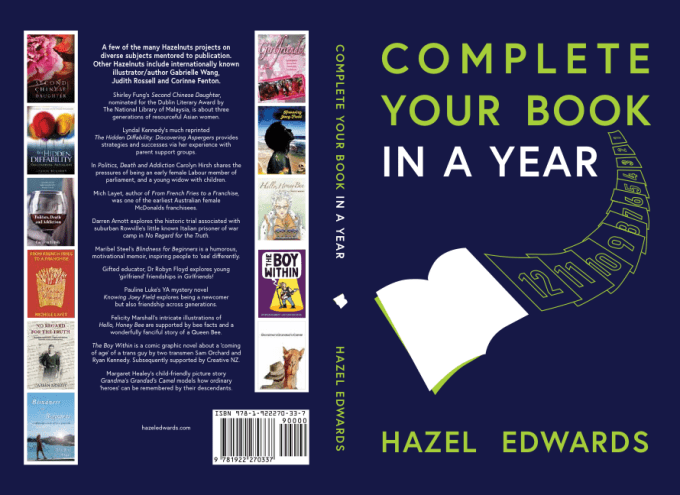
So I put the Hazelnuts’ books on the back cover, as inspiration.  They did it, so could others.
 

‘Complete a book in a year’ is quite a challenge to throw down to authors! Tell us about something how the book works and what it covers. How did you decide what to include in it?

Based on the strategies, activities and notes I’d normally share in my face to face workshops but MINUS the companionship of learning from others and their WIP (Work in Progress). Often workshoppers become ‘step-parents to another’s bookchild and help craft it. Or they suggest titles.  And they work through the various drafts, reading aloud, celebrating and finding relevant resources to share.  Working alone, writers miss that. So the personal and quirky tone of the manual is as if I’m sharing anecdotes and hints with the reader. Zooming, the students can also use the manual.

Mid-project I woke up with the idea of having a cover which was a compilation of Hazelnut covers. To inspire. The publisher suggested including a Schedule for the Year’s Writing Needed to Complete a Book. I wrote a realistic timetable and scared even myself. But it works based on averaging 200 words per day. And the timetable has been renamed ‘You Can Do It.’

Others can use the manual as a substitute for Hazelnut style workshopping in these surreal times.

There are twelve main segments which match the monthly workshops. Projects include memoir, autobiography, non-fiction, biography, fiction, graphic novels, young adult and children’s books.

What is the manual about?

Strategies to overcome ‘Procrastination’ and get your book finished.

Includes: Choosing titles, writing Conversational Table of Contents, ways to structure, characterisation (Your Turn exercises), Common Q and A, making it non-boring, use of anecdotes, mini launches and publication options.

The ‘Your Turn’ exercises are very practical.

Participants voted The Ancestor Interview  (see below) as the most valuable exercise. But you’ll need an in-house or online ‘helper’ for this one.

YOUR TURN

Interview Your Ancestor (in pairs, 8 minutes each).

Become your selected ancestor and answer the interviewer’s questions as honestly as you can, even admitting to crimes. Use ‘I’ not ‘he’ or ‘she’ and get into the perspective of your character and their times.

You’ll also find out what you don’t know and need to research.

How does this book differ from your earlier popular title, Writing a Non-Boring Family History?

It’s for procrastinators, so they can finish in a year. Not all projects are histories or memoirs.  More emphasis on the strategies to finish to deadline.

I deliberately didn’t repeat myself so the books could be complementary. Plus the Non-Boring one was written over 20 years ago and much reprinted, so it was time for an online approach. At first I was going to have an e-book only, but the publisher convinced me to have print too.

You’ve also got a great fiction project on the go, writing a podcast for the ABC. Can you tell us about it, and how it came about?

Adult mystery ‘Celebrant Sleuth; I do or Die’ (BookPod) was inspired by a diverse gender woman who said, ‘How come nobody writes about a woman like me? Why don’t you?’ I’d been playing with the concept of a celebrant who conducted weddings and funerals, for a mystery series, so I did.  She acted as my expert reader. I changed the terms she suggested. Chapters were written with future TV episodes in mind. E and print book and then I ‘voiced’ the audio, a challenging experience for a non actor but important to have an Australian voice on AUDIBLE.  Then I wrote ‘ Wed, then Dead on The Ghan’ intending it as the first chapter of the sequel but now Geoffrey Wright and I have been commissioned to adapt it for the ABC as a podcast. I knew it had the ingredients of an iconic train, literary tourism role-play of Agatha Christie and a diverse sleuth, but….

Hijabi Girl Plays Footy Too” is a sequel which may be a bindup around the time the ‘Hijabi Girl’ puppet musical is performed post-Pandemic by Larrikin Puppeteers and tours regionally. We even have an Aussie Rules football puppet.

The Future?

I’d love more of my books to be adapted for TV, audio or theatre.  And to be translated into languages like Spanish and Turkish.

The Lockdown has forced me to evaluate. Although traditionally published by Penguin, my ‘riskier’ projects have been author-published in recent years.

I persisted with these ‘soul’ projects (of value for themselves and ironically later commercially viable). It has been the right decision. I also control the rights which enables faster decisions when new media offers are available.

Ironically in 2006 I wrote ‘Outback Ferals’ set in Darwin about a feral pig pandemic threat. Writers ask ‘What if?’ and then things happen. It’s called fiction prediction!

LINKS:

https://hazeledwards.com/complete-your-book-in-a-year.html

Free downloadable Schedule to Finish Your Book in a Year

Available: BookPod http://www.bookstore.bookpod.com.au/p/9426321/complete-your-book-in-a-year—pbk.html


More about Hazel and her work:

Hazel Edwards writes quirky, thought-provoking fiction and fact for adults and children. Coping successfully with being different is a common theme. Co-written ‘junior novel ‘Hijabi Girl’ soon to be a ‘Larrikin Puppets’ musical post Pandemic and YA novel ‘f2m;the boy within’ which has inspired a graphic novel , explore cultural diversity.

Best known for ‘There’s a Hippopotamus on Our Roof Eating Cake’ series, recently touring as a musical, Hazel has grandkids for whom she writes a story each birthday. ‘Outback Ferals’ her YA novel set in Darwin, is a sequel to ‘Antarctica’s Frozen Chosen’, researched during her 2001 Antarctic expedition.

Hazel runs book-linked workshops on ‘Authorpreneurship’ and ‘Writing a Non Boring Family History’. ‘Complete Your Book in a Year’ is a yearlong master class at PROV (Public Records Office) and all her mentored ‘Hazelnuts’ finish their projects.

’Trail Magic; Going Walkabout for 2184 Miles on the Appalachian Trail ’ with her son Trevelyan is an adventure memoir. He did ALL the walking.

A National Reading Ambassador, in 2013 Hazel was awarded an OAM for Literature. Her memoir ‘Not Just a Piece of Cake-Being an Author’ explores longterm creativity.

Interested in stories crossing mediums, ‘Celebrant Sleuth;I do or die’ an adult mystery with an asexual sleuth is her latest AUDIBLE fiction, plus the sequel ‘Wed Then Dead on The Ghan’ available on Kindle and being adapted as a screenplay for ABC.

Hazel served on the board of The Australian Society of Authors’ for 20 years and is the current patron of the Society of Women’s Writers (Victoria)

Husband Garnet does her BAS, daughter Kim advises on marketing and three grandsons act as readers, so writing is an Edwards’ family trade.

She also reads in the bath.