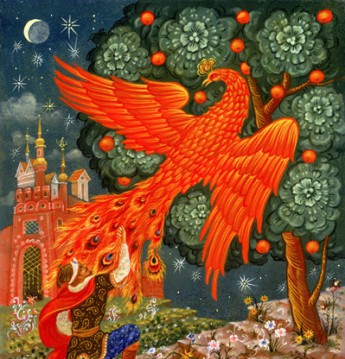
 Last year, I had the very good fortune to be commissioned by the New England Conservatorium of Music in Armidale, Australia, to write three poems for children, which would be then set to music and performed by choirs of school children at the tenth anniversary celebratory concerts of New England Sings. As those who’ve followed this blog know, the event was a big success and right now it’s attracted attention again because NECOM has just won a prestigious award at the annual APRA/AMCOS Art Music gala. I am so chuffed to think that my work–the three poems, Frosty School Morning; Midday at the Waterhole; and Lyrebird Sunset, all set to music by Harley Mead–was part of it!
Celebrations
In praise of Tintin
 A piece of mine I’m republishing, having just been reading some Tintins again!
Tintin of the ageless quiff and boundless enthusiasm, from the gorgeous comic books by the Belgian author and illustrator Herge has turned eighty-six this year ! Of course I have every single volume of his adventures, some in French, some in English, as well as quite a few associated books, including a gorgeous book of travel narratives and photographs retracing the steps of Tintin and his friends in such countries as Tibet, Scotland, the Congo and ‘Syldavia’, compiled by the French magazine Geo. This curiosity, along with Tintin encyclopedias, dictionaries, diaries and several figurines of Tintin and his friends, action figures, bookend the scruffiest, most loved-to-death collection of the Tintin adventures, which we never get tired of rereading.
The Tintin adventures are the books most often pulled out of the groaning family shelves when any of my kids come home to visit. When anyone’s feeling tired, discouraged, or simply at a loose end, Tintin is the prescribed remedy—a remedy of freshness, fun and escape that never fails to work. And when I canvass many of my writer friends as to favourite childhood reading, Tintin comes up again and again.
Translated into the world’s languages, over the four generations and more since his birth in the pages of an obscure children’s journal, Le Petit Vingtième, the immortal little reporter has proved remarkably adept at transcending all kinds of barriers of nationality, culture, religion, class, race, sex, ethnicity, age, whatever you will. The brainchild of the renowned Belgian cartoonist Hergé(his real name was Georges Rémi—and his pen-name comes from the phonetic French rendition of RG, his initials spelt backwards), Tintin’s now reached an iconic status. You rarely hear anymore the snobby, narrow-minded assertion that it’s not right for kids, because it’s—shock, horror!– a comic. Yes, some of the early work is very dated and patronising (my least favourites, for this reason, as well as incoherent story, are the early Tintin in the Congo and Tintin in America). But mostly, the Tintin corpus has aged remarkably well, because at the heart of Herge’s work is a realistic, amused but compassionate view of human nature, and a strong feeling for justice. Along with the social comedy and the crisp dialogue, there is also a horror of cruelty and bullying, and a tenderness for the ‘ordinary’ aspects of human life, as opposed to those who would have us valuing ideas over people.
Hergé very much kept up with what was going on in his times, something that is clear in the Tintin adventures. Yet it’s a curious fact about the Tintin stories that they’re both timeless and very much of their time. With consummate artistry, in both gorgeous pictures and crisp words, Herge managed to both document the realities of the twentieth century, and create his own world. The archetypal characters, social comedy, jaunty pace, inventive language, extraordinary command of line and colour, exciting, suspenseful plots, and clever dialogue of the books are all handled with the lightest of touches that belied the author/illustrator’s painstaking care with his work, both visual and written, and the immense amount of research he did to create such a seemingly effortless, pleasurable result. He combed dictionaries for words that could be used for the ever more colourful and bizarre invective of Captain Haddock; read umpteen atlases, books of science, folklore, geography and history to get exactly the nuances of the various places Tintin explores. Like Shakespeare, he did not visit the places he set the stories in, preferring to document himself in libraries and museums, but his own city of Brussels features anonymously many times at the beginnings of Tintin adventures.
The Tintin books have been highly influential in pop culture. Writers and film-makers have been greatly inspired by them. When I was compiling a series of columns for a book magazine a few years ago, on the favourite childhood books of several prominent children’s writers, Tintin came up many, many times as a major influence. Tintin has also helped to make the extraordinary art of comic books acceptable to a wide range of people(incidentally the massive success of such European books clearly shows that it’s certainly not just the US that calls the cultural tune).
But the Tintin alchemy has not yet been totally successfully distilled into decent film versions—of the abortive 1970’s cartoon series, the less said the better(indeed Herge himself, who had had no control over them, hated and despised them). The recent Steven Spielberg film was okay, but no more. It doesn’t matter We Tintinophiles have all those gorgeous stories to read again and again; a mixture of cinema and storytelling right there in front of our eyes, in a perfect blend of word and image.
The inspiration behind Hunter’s Moon
 As this week saw the official release of my new novel, Hunter’s Moon, and next week sees the first of the launches celebrating the book, I thought I’d feature a piece I wrote about the inspirations behind Hunter’s Moon. I first wrote this for the excellent Teachers’ Notes my publisher, Random House Australia, have created for the book, which feature discussion points, ideas for activities etc. If you’re interested, you can download the full set of notes from the Random House website, here.
Inspirations of Hunter’s Moon
by Sophie Masson
The main inspiration behind Hunter’s Moon is of course the classic fairy tale of Snow White. This Germanic fairy tale is one of my favourites, with its blend of suspense, drama, romance, dark magic and dark secrets. It’s also become one of the world’s favourite stories, and has been told and retold many times over in novels, poems, films and even TV series.
First written down in the form we know it by Jakob and Wilhelm Grimm in 1812, the story was told to them by people who had passed it down throughout the ages. Some people think it may possibly have been partly inspired by the real-life story of the 16th century beauty Margaretha von Waldeck, whose jealous stepmother forced her out of her home to live abroad, only to die poisoned at the age of 21. It’s said that the dwarves could be inspired by the fact that Margaretha’s father Count Philip owned
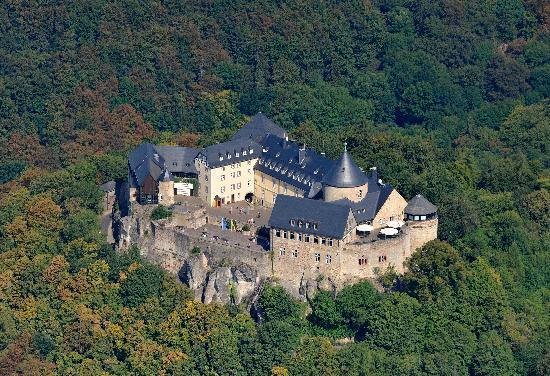
Schloss Waldeck, home of the Waldeck family
several copper mines, where miners worked from an early age, becoming hunched from working in such confined quarters. Others say that the story derived from sources much earlier than that, and point to variations of the Snow White story to be found in many other traditions, such as in France, Albania, Armenia, Russia and as far afield as Malaysia. Like most fairy tales, in fact, the inspiration for the story probably derived from a whole mix of things, leading to the form we know and love today.
As with most fairy tales, there are many things behind the surface of the magical action and extraordinary characters in Snow White: intriguing motifs such as a magic mirror, a poisoned apple, a glass coffin, a huntsman who takes pity on the girl he’s supposed to kill. And there are many contrasting themes, too: betrayal and friendship; beauty and cruelty; appearance and reality. When as a novelist you are working with traditional stories, it’s important to find ways in which you can mine this rich material in an original way yet also respect the themes at its heart. And for me that lay principally in reinventing Snow White herself, to make her a more complex and interesting character.
In the fairy tale, poor Snow White has to learn the hard way that nothing is what it seems and that it is a grave mistake to trust to a fair face and honeyed words. And yet she is still trusting enough to blunder into the home of strangers in the shape of dwarves, and later accepting apples from someone who just turns up at the door; her essential innocence is untouched by the painful revelation of her stepmother’s treachery and cruelty. She is also quite passive: aside from her flight into the woods when the huntsman spares her life, she doesn’t do a great deal for herself.
My Snow White character, Bianca Dalmatin, isn’t like that though she certainly starts in a similar way. Just like Snow White, Bianca has been lulled into a sense of false security by the apparent kindness of her beautiful stepmother Belladonna; like Snow White, she learns the hard way that appearances aren’t reality. Her heart is broken by the revelation; but instead of just hiding and accepting her fate, she wants to kick against it, to change things, even if it is very dangerous. And she is full of hatred for the woman who has destroyed her world. And yet like Snow White in the fairy tale, she doesn’t altogether lose her trust in others. It leads her to make mistakes—but also means that she will not turn into someone like Belladonna. Similarly, I worked with other aspects of the Snow White story, such as the seven dwarves, the truth-telling mirror, the huntsman and the glass coffin, to transform the original material whilst keeping its powerful impact.
As with my other fairy tale novels (Moonlight and Ashes; Scarlet in the Snow; The Crystal Heart) Hunter’s Moon is set in a magical alternative world, a world inspired by Europe in the late 19th century, but where ancient magic exists side by side with modern technology. In terms of specific setting, Hunter’s Moon takes the reader back to the Faustine Empire, which first appeared in Moonlight and Ashes. However Hunter’s Moon is set in a different province of the Empire: in Noricia, rather than Ashberg. Just as Ashberg in the earlier novel was based on Prague and the Czech countryside beyond, so Noricia in Hunter’s Moon is based on Austria, and its main city, Lepmest, is based on Vienna. And the inspiration for the Ladies’ Fair department store empire owned by Bianca’s father came from the gorgeous 19th century department stores that you can still find in cities such as Vienna, Paris, Moscow and London—glittering palaces of fashion and beauty housed in elegant old buildings.
And finally, Hunter’s Moon also has influences and elements from those earlier fairy tale novels of mine, including a recurring minor character who in this book takes on a bit more of a role!

Northern Russian splendours: an interview with photographer Richard Davies
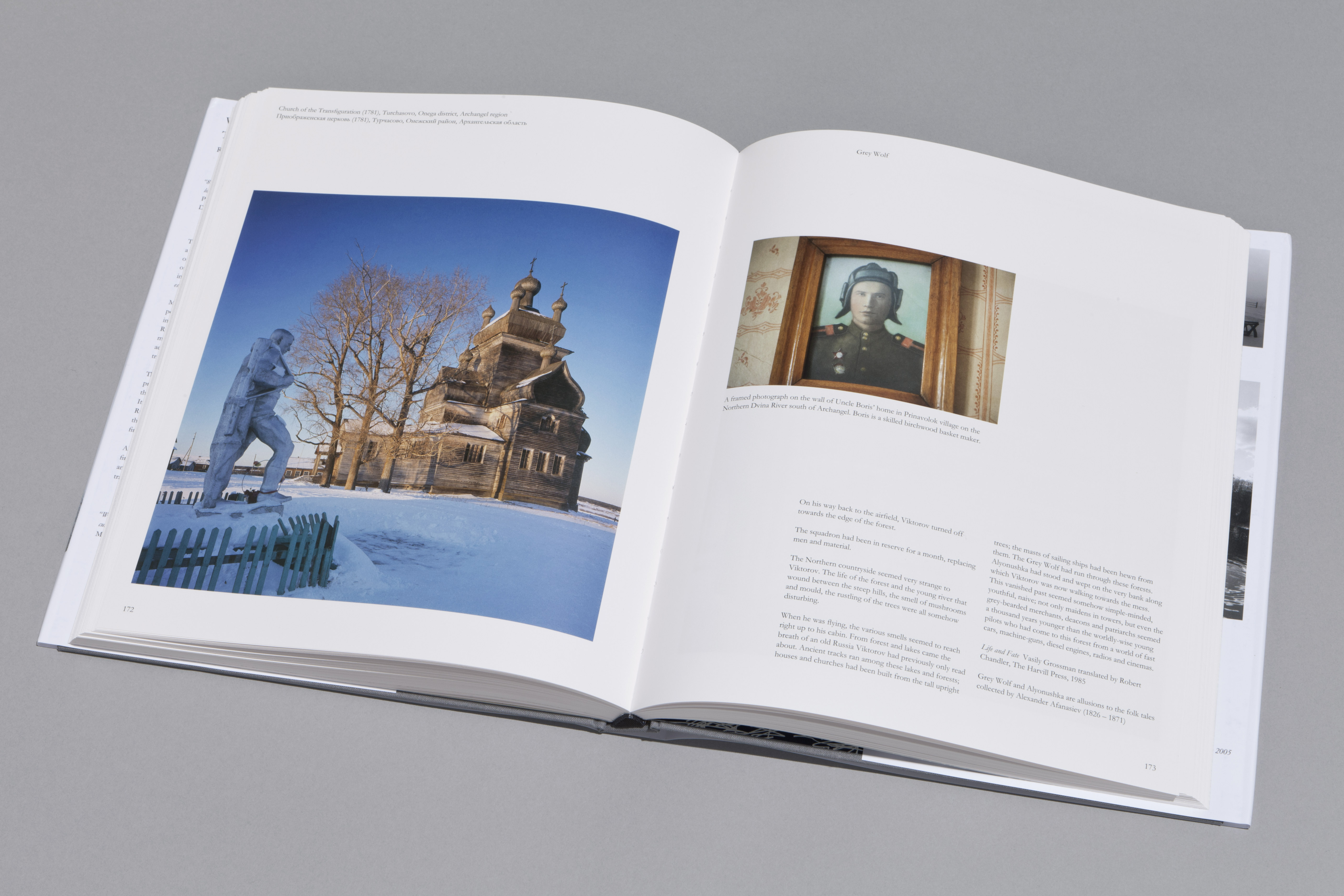 Recently I became aware of the magnificent work of British photographer Richard Davies, who over several periods of travel in Northern Russia, has been documenting the everyday and extraordinary splendours and colours of the region, and especially its glorious wooden churches and colourful characters. Richard has published two beautiful books: Wooden Churches: Travelling in the Russian North 100 years after Bilibin(sadly out of print at the moment) and the recent Russian Types and Scenes, which you can get on Amazon (and which I can very highly recommend!). Inspired by the gorgeous work of this fellow Russophile, I got in touch with Richard, and this fascinating interview is the result. Enjoy!
![207RT_mod2[1]](https://firebirdfeathers.com/wp-content/uploads/2015/05/207rt_mod21.jpg)
Richard, can you tell us first about Northern Russia, which has inspired your work? How long have you been visiting the area? And what drew you to it?
I’m a Russophile! My standard story for explaining this is that one-day, my mother came home with an LP (long playing record) of Jascha Heifetz playing Mendelssohn’s violin concerto. On the flip side he was playing Prokofiev’s 2nd violin concerto. It was the most exciting thing I had ever heard and I played it continuously, day and night for weeks. It drove my father crazy, my mother was happy that I was happy. I was head banging to Prokofiev while my friends head banged to the Rolling Stones – very sad. The other influence, I remembered this recently, was our local dentist. He was an out and out Communist and a great dentist. The waiting room was strewn with copies of Soviet magazines and the patients were left to quietly soak up the propaganda. Danny Stalford, Red dentist, and local Communist Councillor obviously had some success with me – I fell in love with the country if not the system.
In the late 70’s and 80’s I took Intourist trips to Leningrad and Moscow to satisfy my Russophile needs. Concerts at the Philharmonia, opera at the Kirov, Maly and Bolshoi, art at the Hermitage, Russian, Pushkin and Tretyakov museums, day trips to Novgorod and the Golden Ring etc etc – but the countryside of Turgenev and Tolstoy was out of bounds
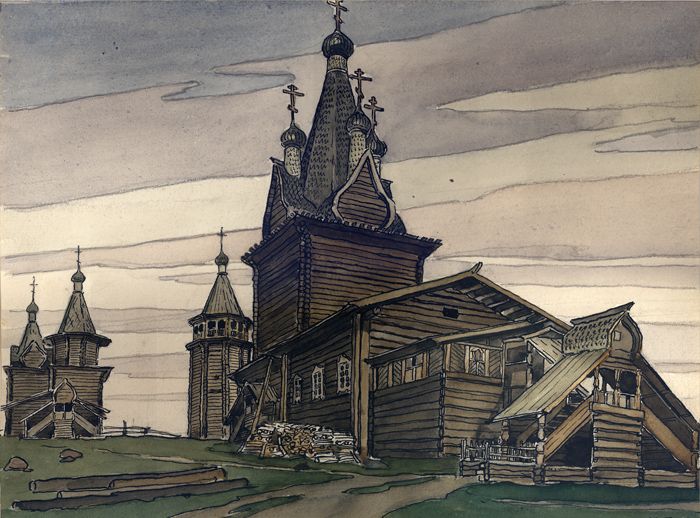
Illustration by Ivan Bilibin

Photograph by Ivan Bilibin
With the break of the Soviet Union, that changed. In 2001 I came across some postcards published at the beginning the 20th century of watercolours and photographs of wooden churches by the artist Ivan Bilibin. Bilibin had travelled to the Russian North in 1902, 1903 and 1904. Friends in St Petersburg found me a driver, Alex Popov the Professor of Atmospheric Physics at St Petersburg University, and in 2002 we set off in Bilibin’s coach tracks.
 Wooden Churches was published ten years later.
The wooden churches of northern Russia, which you have documented in your first book, are unique and fragile works of art as well as testaments of faith. What is being done both to preserve them as monuments and keep them alive as part of the distinctive religious life of the region? And what do you think might further be done?
Many of the churches that Bilibin had recorded were no more and those that had survived were in a perilous state.
During the war a wonderful book had been published in Russia celebrating the wooden architecture of the north – it was recognized as a facet of Russian culture that the armed forces where fighting to preserve. After the war, Stalin was able to blame the destruction of these cultural artifacts on the enemy and great efforts where made to restore those that had survived the revolution and the war. But with the break up of the Soviet Union funds disappeared and the churches where again left to rot, with rusting signs attached proclaiming that such and such a church was an ‘Historic Monument under the Protection of the State’.
![47RTprint[1]](https://firebirdfeathers.com/wp-content/uploads/2015/05/47rtprint1.jpg) Many churches are being re-inhabited by their local communities, roofs are being patched and plastic bagged cardboard icons are being pinned to walls but many churches, because of collectivisation, have been left with nobody to care for them.
Many churches are being re-inhabited by their local communities, roofs are being patched and plastic bagged cardboard icons are being pinned to walls but many churches, because of collectivisation, have been left with nobody to care for them.
In the summer volunteers now flock to the north, many under the flag of Obscheye Delo, an organization founded by the Moscow priest, Father Alexei, to do what they can to save the churches. There are very good professional restorers on hand but sadly the funds aren’t. The feeling is that the Church is more interested in building spanking new buildings than preserving archaic old wooden ones. And for the moment the State seems to be more interested in building up its nuclear arsenal than preserving historic churches in the far north.![183RT_mod2[1]](https://firebirdfeathers.com/wp-content/uploads/2015/05/183rt_mod21.jpg)
The ‘Wooden Churches’ book has sold out – do you have plans to reprint?
I had a publisher for ‘Wooden Churches’ but they came back to me with terrible layouts– can you believe it they cropped my photographs!! So I ended up publishing the book myself. It was great fun but not a great money making venture (I did in fact get my money back) so I’m thinking hard before reprinting. I’m sure it would sell (the churches are so beautiful), but it would be good to reprint it on the back of an exhibition.
How have local people reacted to your work?
The local people in the Russian North are naturally very kind and generous and I’m pleased to say that they have been very kind and generous to ‘Wooden Churches’. I’ve done my best to make sure that it is sitting on a good few shelves in Northern Russia. I haven’t yet had the chance to show ‘Russian Types’ to many people in Russia although I have had two reactions. 1/ The wife of the restorer Alexander Popov complained that the photograph of her husband showed his bottom and not his face. 2/Our translator on the last trip to Russia in April this year laughed out loud almost every time she turned a page – I took this as a compliment.
![87RT_mod1(1)[1]](https://firebirdfeathers.com/wp-content/uploads/2015/05/87rt_mod111.jpg) What anecdotes or encounters particularly stand out for you in your travels throughout northern Russia?
What anecdotes or encounters particularly stand out for you in your travels throughout northern Russia?
Everyday, travelling in Russia is an adventure – I’ve yet to encounter a bear although I’ve heard many encountering-bear stories! I have been towed by snowmobile across a frozen lake horizontally on a sledge and arrived at our destination iced up like a frozen corpse. I’ve flown in a flimsy aircraft to land in a field next to a wooden terminal. I’ve been hauled in for questioning by the authorities at a town with an intercontinental ballistic missile site attached. I’ve venture across the White Sea to uninhabited islands and crumbling churches with twenty beautiful art history students from St Petersburg University. I’ve drunk more vodka than I should on occasions and eaten piles of bliny with honey and cream – my liver is shot and my cholesterol levels are sky high – I could go on…
In your second book, Russian Types and Scenes, you and your co-creator Alexander Mozhaev profile the everyday life and colourful characters of northern Russia in a wonderfully vivid way, through both photographs and texts. Can you tell us a bit about how the book came to be, and how you worked on it together?
Having published one book myself, the only thing I could do was to publish another. I’d continued to travel to the North, with the students, filmmakers and friends. I had been taking photographs of people while photographing the churches and continued to do so on these trips. I love pure photographic books but I also love words so I wanted to put a book together gelling the two. Alexander Moshaev, a Moscow writer and architectural historian, was one of the friends who joined me on some of these trips. Sasha is very lively and I soon understood that he had insights into what we were seeing that I, as an Englishman, would never have (needless to say, many of the things I enjoyed he found rather banal). He would also interpret the content of my photographs in ways that I couldn’t. I read a lot of Russian stories in English, sadly I don’t speak Russian, and tracked down quotations that would fit into my photographic narrative. And as the book was coming together I would ask Sasha for suggestions and  stories.
I was also very lucky that one of the students from St Petersburg, Natasha Shalina, was studying in London while I was putting the book together. With a few deft taps on her iphone she would come up with wonderful things from Russian web sites that would inevitably lead to other wonderful things. She also helped with translating Sasha’s particular style.![219ART_mod2[1]](https://firebirdfeathers.com/wp-content/uploads/2015/05/219art_mod21.jpg)
Do you have any anecdotes about the people or occasions you’ve featured in that book?
The fun about putting these books together, ‘Wooden Churches’ over 9 years and ‘Russian Types’ over two years, is obviously that what you have at the end is the result of a great adventure. As a photographer you never know who or what will come in front of your camera each day. Matilda Moreton, the writer of Wooden Churches never knew who she would meet each day and what they would tell her. Researching the texts was equally exhilarating. I bought a copy of the New Yorker once on a whim and inside was a great story about Russian bells. I was reading the biography of a Russian children’s writer and suddenly he’s talking about wooden churches. It’s as though all these things are given to you if you loiter long enough. But then again there are the photos you missed, the people you didn’t talk to and the books you didn’t open.
Are you working on a new book at the moment?
I am. I will publish a book with a photograph I took in 1967 – by rights the book should appear in 2017. The book will have photographs and stories about seaside ‘Pleasure Piers’ – like Russian Churches they are often decorated with onion domes and they also attracts great writing and yarns!
Note: All photos aside from those by Ivan Bilibin pic are copyright to and courtesy of Richard Davies.
On comics and graphic novels: an interview with Bruce Mutard
Ever since I was a Tintin-devouring child, I’ve loved comics and graphic novels, so it’s a great pleasure today to be featuring a really interesting interview I did recently with Bruce Mutard, one of Australia’s most prominent creators in these genres.
Bruce has been writing and drawing comics for 25 years, producing 4 graphic novels: The Sacrifice (Allen & Unwin, 2008), The Silence (Allen & Unwin, 2009), A Mind of Love (Black House Comics, 2011), The Bunker (Image Comics, 2003) and a collection of short stories, Stripshow (Milk Shadow Books, 2012). He also has had short comics stories in Overland, Meanjin, The Australian Book  Review and Tango among others, and has illustrated several books for Macmillan Education’s Stories From Australia’s History, series. He has just completed a Master of Design in comics studies on the interaction of words and pictures at Monash University. He has conducted many comic workshops, and given talks at Melbourne Writers Festival, NMIT, RMIT, Edith Cowan University, University of Melbourne, Monash University, and presented papers on comic theory at Oxford University, Loughborough University and University of Arts, London among others.
Bruce is an eloquent and knowledgeable advocate for comics and graphic novels generally, and holds the comics and graphic novels portfolio within the Australian Society of Authors. Recently, his passion has led him to a new direction. Read on!
Bruce, you’re about to launch a new imprint, Fabliaux. Can you tell us about it? What motivated you to start it? What has the journey been like so far? And what kinds of books will you be publishing?
The idea for Fabliaux started a few years ago when I was still thinking of self-publishing some of my own work that wasn’t suited or wanted by my existing publishers. This was primarily my short comics collection: Sex, Politics and Religion: Stories To Break Up Families By and Alice In Nomansland – a still unpublished graphic novel that is predominately naughty humour, and unlike any other I’ve done. Those books are still floating about, though I’d much rather other  publishers took them on. Anyhow, I’d always nursed the possibility of publishing other people’s work if I thought it needed to take print form, and that there might be enough of a market to make the investment back. I chose the name Fabliaux because it has a literary pedigree and doesn’t have ‘comics’ in it, limiting the sorts of books I might be able to publish. I may one day do prose, poetry, artists books, art books or kids books. Anyhow, Fabliaux is a term given to a genre of ribald and comic tales told by jongleurs in France in the 12th and 13th Centuries; the precursors to similar bawdy tales in the Decameron and The Canterbury Tales.

from Roman de Renart, medieval French fabliau
So far the journey has been ‘artistic’, which is to say that I’ve blundered into publishing with the eye on the creative end-goal, satisfying my authors, but less concerned about the costs and how to market the work! To that end, my aim is to publish books that have a niche readership, but nevertheless one that is proven to exist, and to make sure the print quality is the best for the work. I’m an author first and foremost, so that is my main role, but since that often takes me to markets, fairs, conventions and the like, I might have an opportunity to sell some of these books. I won’t do mass-market books, as I have neither resources nor time to put into the marketing and administration of such an enterprise. I give my author’s contracts and generous terms, though no advances. I make no promises other than to publish and do my best to take the authors work to the world in my stumbling fashion. Don’t laugh, please.
The launch title of Fabliaux is the provocatively-titled Art is a Lie, by Carol Wood and Susan Butcher–a unique work indeed. Tell us about it–how did you discover it? What drew you to it so much that you chose it as the launch title of Fabliaux?
I’m pretty certain Art Is A Lie is unique. In short, it’s a collection of 1-3 page comics strips mostly first printed in a US art magazine, Artillery, over the past 9 years under the title, Dead or Alive. Essentially they are spoof biographies of famous artists, done in myriad of styles so no two 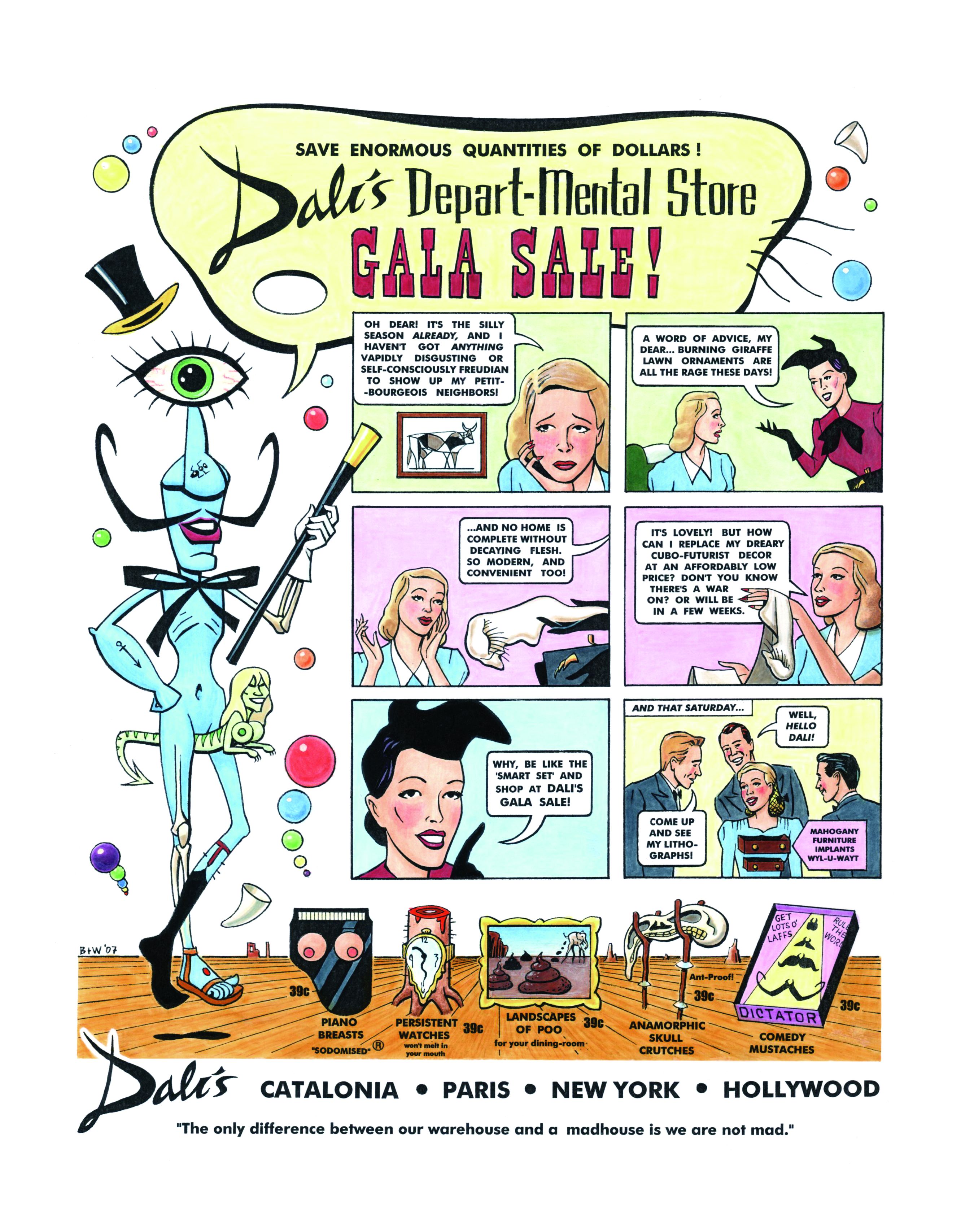 stories look the same. Imagine Picasso as done by EC Segar (Popeye), Duchamp as a Dick Tracy story, Hieronymous Bosch as done by Don Martin (MAD), or the 5000 Fakes of Dr Seuss. Imagine Frida Kahlo as a Betty Boop cartoon, or if you can, Tom of Finland as done by George Herriman. You probably can’t imagine such things, but they do exist in this book. There’s fumetti of which a couple all the characters and backgrounds are intricately constructed models that Carol in particular, makes. The level of detail in these is astonishing. In short, they are brilliant and I think the world needs to know about it! As for discovering it, I’ve known Carol and Sue for perhaps 20 odd years on and off, so when they showed me the work they’d
 been doing for Artillery, I was blown away – laughing. Since the magazine was not available in Australia, I wondered if there would ever be a collection of the strips so I could have a well thumbed, cup ring stained, annotated copy on my bookshelf. The magazine’s publisher was in no position to produce such a book, nor were the Pox Girls. For many years, nor was I, but as the old saying goes: ‘good things happen to people who wait.’
The rise of self-publishing has been talked about a lot in recent times, but not so much another phenomenon–the rise of small presses founded by creators: authors, illustrators, graphic novelists, who are publishing other people’s work. Why do you think this is happening? And do you have any thoughts on what it means for the literary landscape and the publishing industry?
It is probably a confluence of factors. Firstly, there is the general contraction of sales across the industry that has lead to a reluctance on the part of established publishers large and small to take on new projects, even from authors they’ve published. Unless an author has earned out their advances (assuming they got one), it’s hard to place a new work, especially something that is a challenging literary work. The old template publishers worked from by having commercially successful works subsidise the publication of works of merit has diminished. But those authors who have been fortunate enough to do well out of their literary career, generally love writers, good writing, good books and having been through the mill of building a career in writing, also know how much more difficult it is to get published today. So, I think their passion for literature means they are willing to set up imprints and publish those works that the established publishers have forgone, not to prove the latter wrong, but simply to ensure good work gets published, be it in print or digital. Some may have a better business head than others (like me), but I’m sure it’s passion for the art, craft and life of words and pictures, that drives them.
The comics/graphic novels scene has both expanded and contracted in recent years in Australia. There seems to be more creators than ever yet less opportunity for them to be exposed at the traditional showcase events, such as Comicon, Supanova etc. Can you comment on that?
I would agree there has been a huge expansion in the number of creators and works being produced in recent years. The Ledgers committee (The Ledgers are the recently reinstituted annual Australian comics awards) had a long list of more than 250 to sift through last year, whittling that down to about 40 for the shortlist. There are so many more people considering comics as a medium with which to tell their stories or non-fiction. I would disagree that there are less opportunities to showcase their work; if anything, it’s the opposite. True, showcasing comics work is not overly rewarding at the pop culture expos like Supanova and Ozcomicon for the simple reason that they are nowhere near as popular as the other stuff on show. The main reason people to go to those is to dress up in cosplay, get photos and stuff signed by the stars, attend their speaking sessions, play some games, buy copslay merchandise, get prints, toys, books and dvds. It’s very rare that there is a comic guest that requires one to buy tokens in advance and line up for an hour or more to get something signed (Stan Lee is one such).  Although comicons began with all comics, they have evolved with time to embrace all the pop culture that was largely born in comics, or spec fiction. It’s a case where the children of comics have gone and built a world that left its parents and grandparents long behind. Occasionally, these elders are known to express a little pique at being marginalised or forgotten. But there’s nothing wrong with that; evolution is healthy and the events bring joy to tens of thousands of people every time they are put on.
But in the last few years, a good number of comics only events have sprouted up which probably resemble the comicons of old in their early days. There’s Comic Gong in Wollongong (which may evolve to be more pop culture); Comic Con-Versation in Sydney in September, run across several library services; the Homecooked Comics Festival in Melbourne, put on by the City of Darebin; The Central West Comics Festival in Parkes; the Zine and Indy Comics  Symposium in Brisbane, the Sticky Zine Fair in Melbourne and numerous zine fairs that are also very good places for comics creators to sell their work direct to the public. I suppose the biggest problem in Australia is that these forums are almost the only way most creators reach their public, for aside from those few of us whose work is published by mainstream book publishers, most are sold through a few local comic shops and/or online. There is no national comics distributor that reaches all the local comics shops, let alone high street bookshops that sell graphic novels. Most of the latter do not sell ‘floppies’ or mini-comics. The Australian comic shops buy 90-100% of their stock from Diamond Comics Distributors – a near monopoly comic distributor in the USA, where all the Marvel, DC, Image, Dark Horse, IDW and other popular titles come from. These stores very rarely set up accounts with anyone else, unless it’s manga, Anime, Dvds, figurines and other stuff they might sell. I know that you can’t find my books from Allen & Unwin in most Australian comic shops because they won’t set up accounts with Allied Distribution for a few local graphic novels. So, if you go to your local comics shop in your capital city (there’s a handful in major regional centres), then you’re most likely to find what is produced by creators who reside in that city, as they have personally taken their work to be sold there – usually on consignment. There have been a few attempts over the past couple of decades to create a national comics distribution system, but aside from one who failed at the first hurdle, the others foundered on the lack of support and interest from the comic shops. Australian comics are by and large marginal sellers compared to the American comics and Manga. The reasons for this are the simple fact that we don’t produce comics that compare with the slick overseas products (see question 6, below).
Tell us about your own books–and whether you’re working on something new.
 My own books to this point, have been very specifically set in Australia and dealing with Australian themes, which has been at times appreciated for that fact because it’s uncommon. For instance, my novel, The Sacrifice, is set very specifically in Melbourne, during the years 1939-1942, following the travails, loves and life of a dedicated pacifist, whose unwillingness to enlist is corroded by a rapidly changing cultural and societal matrix as a consequence of war, and of course, the influx of American troops. The Australia of that period: ‘white’, xenophobic, English, colonial and still a bit cocky even after the bruising taken by participating in WW1, is evoked with considerable detail, to the point where due to the presence of the juxtaposed narrative images, it is a major character in the story. My next book, follows the daughter of the principal in The Sacrifice as she serves as an army nurse in Vietnam during 1970 to 1975. But there are plenty of extended parts set in Melbourne during this period, which will show the changes from the previous era, but also how much it’s changing for the better, even if it was barely perceptible during that period. I have been working on this book for the better part of 8 years and there is a considerable way to go, due to having completely revamped the story twice. On the side, I on occasion do smaller projects by commission, usually
  if they offer me a challenge to do something that I’ve never drawn before, or it’ll mean comics appearing in a place where they’ve rarely, if ever appeared. So for that reason, it is not the money that motivates me, but what I might learn by doing the work. Examples are the all-comics issue of Cordite, where artists adapted contemporary poems into comics. For me, the challenge was to take words that are usually so visually evocative and allusive, into something actually visible, but without simply illustrating them. I adapted A Frances Johnson’s poem, Microaviary (about drone warfare of all things) because when I read it, all these images by association flooded into my consciousness from my unconscious, and it was immediately apparent to me that I should simply put those images down. To that end, about half the actual words disappeared into the
  images, and where they remained, the images added new contexts and layers, so that in a sense, it was a new work. I would love to do more such ‘collaborations’ and there is talk of such.
Aside from that, I have also recently completed my Masters degree, researching what it means to ‘write with pictures’ which is how I actually think of my craft. It is another way of saying that in comics, the pictures need to do the bulk of the work of conveying the story. In cinema, they call it ‘show don’t tell’. It’s about the most sagely three words of advice I could give any budding comics artist, only it’s also one of the hardest balances to achieve. Words are easy to put down, cut and paste and have a sort of precision about them, especially compared to the polysemous nature of images. What I really learnt from my research was how little study had been made into the formal properties of what I called juxtaposed narrative images. Much ink and pixels have been devoted to the content via all sorts of prisms (feminist, Marxist, deconstructionist, structuralist, sociological, medical, Freudian, Friedman, etc.), but strangely, little has been done to place it within art theory or as a visual art. Rather than produce a new work for print, I took it into space as an exhibition, where there was no page one, no need for the meta boundaries of the page – just walls, doors and of course, the space 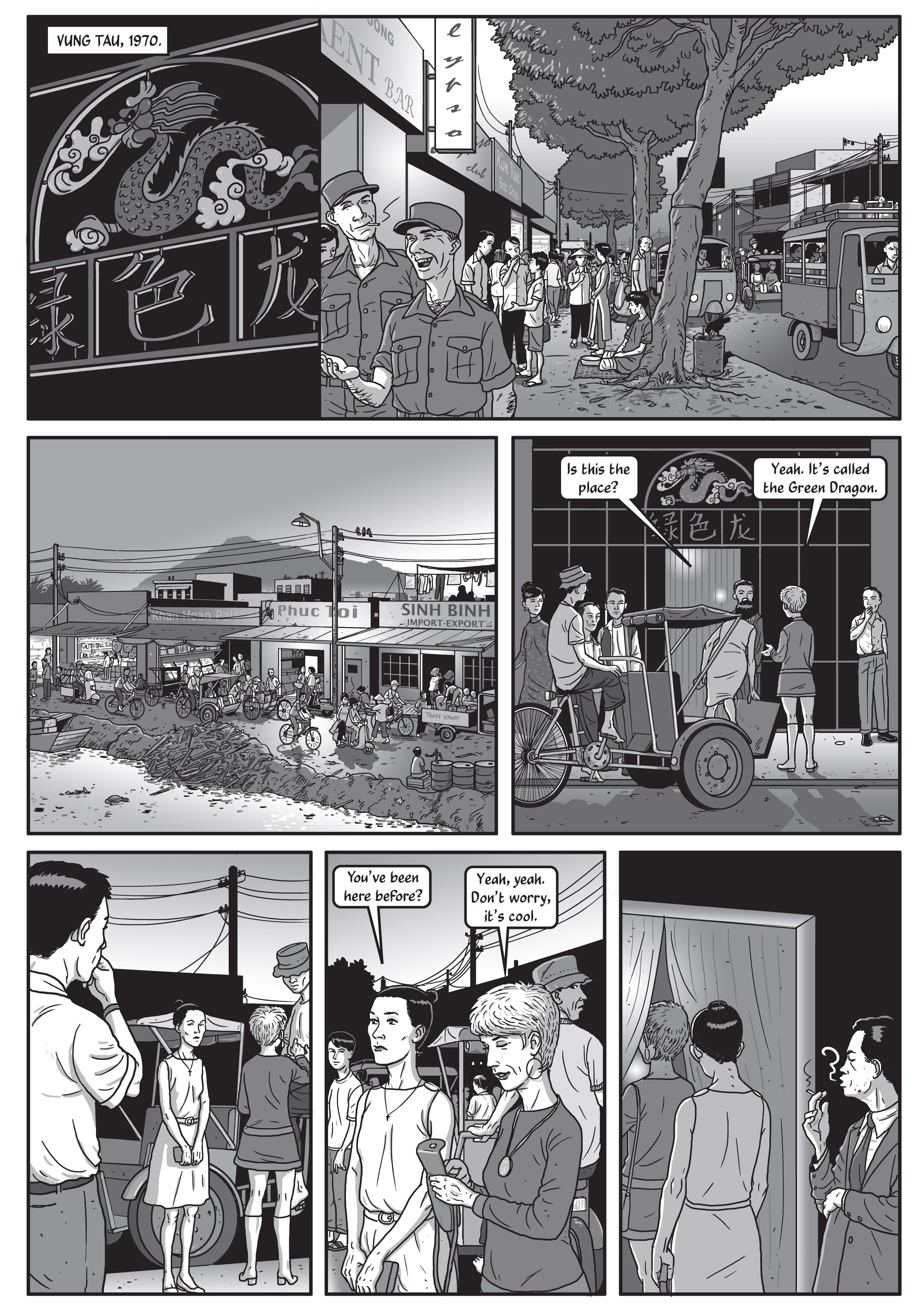 within the room itself. I really want to do a PhD and take this much further and develop a new theory of comics that starts with the proposition that it is a medium, not a genre of literature. So, this means technically, the answer to the question ‘Are comics literature?’ is actually, no. But I
  try not to say that in polite company.
Is there a distinctive ‘Australian’ style and approach to comics and graphic novels? Do you see your own books as fitting within that?
While I wouldn’t say there was any overarching style in terms of appearance, such as manga has, or the ‘ligne claire’ (clear line) school of BD, or the sort weightless dynamism pioneered by Jack Kirby that signifies the superhero genre, I would say there is a characteristic idiosyncrasy in Australian comics. It may sound strange to say, but comics might be one area where the ‘tyranny of distance’ is still at play. By that I mean few creators here really think they have a chance of ever being able to make a living from comics, or getting hired to work for the big comics publishers in the USA, Europe or Japan. There are a number of writers and artists who 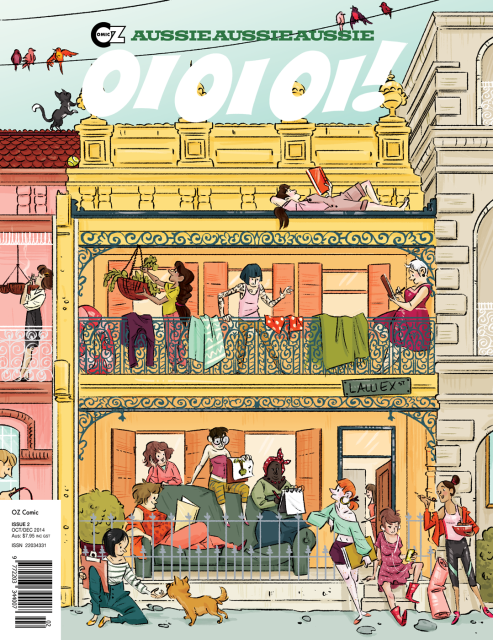 have succeeded, particularly with the US comic publishers (speaking English helps). But since the Australian market is so small, and therefore the prospect of sales is limited to local readers, Australian creators tend to produce work that is not obviously aimed at readers in those other markets. They tend to produce comics for the sheer joy and pleasure of it, and garnering a few readers tends to satisfy them. Some might say that this
  displays a lack of ambition or professionalism, but it’s not. Those who really do want to make a living in comics doing work for hire, put in the long, hard yards at improving their skills, getting the feedback from industry professionals as they hawk their portfolios at the US shows (or European ones). As for selling ones own creator owned graphic novels to compare with say, Dan Clowes, Chris Ware, David B, Rutu Modan, Art Spiegelman and so on, have a harder row to plough. Even in the US market, few creators make a living exclusively from their comics, but at least there are substantially more and much larger comic’s shows with which to showcase and sell their work. In the last few years, some Australian creators (including myself) have made the trek to North America to sell work at shows like Toronto Comic Arts Festival, the Small Press Expo, CAKE and the like. It’s an expensive way to showcase ones work, and I’m not convinced it’s worth it given that any follow up sales have to be made via ones social media or site, necessitating shipping hard copies overseas, which has a frightful cost, (normally more than the margin between retail price and cost of production). There is no question that building a big reputation in comics would be easier if based in the USA, Canada or perhaps in Europe.
That said, not too many local works are specifically Australian in content or character either, often being set in imaginary worlds, mining the tropes of spec fiction genres. There is a strong trend to autobio comics, which depict the prosaic and quotidian with some reflective humour. I find autobio comics to be interesting in that with the presence of the image, the authors often depict themselves quite unfavourably and viscerally – a trend set by Robert Crumb. For some reason self-loathing almost seems to be a requirement for autobio comics, where the body and its liquids seem to feature prominently. I guess there is a safety in ink, where it is not possible to  transmit physical infectious agents, though it is very prone to spreading infectious memes!
I was brought up reading within the strong French tradition of ‘bandes dessinées‘,or BD, as comics and graphic novels are known there. That whole area of publishing is mainstream in France, the books are sold in every bookshop, creators are routinely invited to general literary festivals as well as the BD-oriented ones, and the books cover many different genres and age ranges .In America and Japan, the other two great traditional centres of comics and graphic novels, the art form is similarly respected and accepted in the mainstream of publishing. But not in Britain or Australia, where the mainstream either ignores it, or looks down on it. Or both! What’s your take on this?
Long have some of us looked to France and wished the cultural acceptance of comics there, was replicated here. In Japan, it is certainly a similar case, although I believe it is not a career too many parents would hope their sons and (few) daughters would take up, as it’s punishing work and pays badly. I would disagree that comics are a respected art form in the USA. The same pejorative connotations that have tarred and feathered comics here and in the UK, applies to the Anglophone speaking world in general. This view generally runs along the lines that  comics are mostly for kids, are superficial, sub-literate, containing very little content worthy of literary merit, nor give cause for and reward consideration by academia, literature festivals and arts grants bodies. And for much of the history of Anglophone comics, including a fair proportion of what is produced today as ‘mainstream’ or superhero/action/spec fic comics, you would not find much to convince you otherwise. Despite revisionist historical appreciation of the skills of George Herriman, Winsor McCay, EC Segar, Walt Kelly, Jack Kirby, Bill Gaines (as publisher), Harvey Kurtzman, Will Eisner and so on, very few people appreciated what they did at the time they produced their work, such that Roy Lichenstein could blatantly plagiarise comics artists work without attribution or reward.
It has only been since the revisionary comics of Alan Moore, Neil Gaiman, Grant Morrison, Bill Sienkewicz, Frank Miller and Art Spiegelman in the mid 1980s, did a wider appreciation of comics as a form of literature to be taken seriously, take root and found fertile soil in which to grow. Now there’s an abundance of academic studies mining a new field of comics studies (why not; it was a new field with ground to stake like a new unfarmed fertile valley), mainstream book publishers suddenly taking an interest in a genre they hitherto ignored and republishing collections of comics, graphic novels and studies (but mostly only those creators who had  achieved considerable acclaim and attention within the comics market first). Literary festivals started to invite a few of the leading lights of comics to participate, though I think still in a way that shows they don’t get comics in the same way they don’t understand spec fiction; they are generally programmed as a separate stream, not integrated into the main program. Most importantly for me, is the sudden appearance of often substantial comics collections in public libraries (and some school libraries, though there is still an inconsistency in how to shelve it: ideally as it’s own section, not within general fiction or non-fiction). All of this points to the steady progress comics have made to enter the arts mainstream in the Anglophone world. There is still a long way to go to attain a mass readership like the Franco-Belgian world has, and it will probably never get there given the plethora of new competing forms of content (and their delivery) for the public’s attention, but it’s no longer considered a juvenile activity. There’s a level of immediate
  respect for the medium and its makers now that was largely absent as recently as 15 years ago. There is no better time to be making comics than now – even if it’s almost impossible to make a living at it. But that’s the same as being an author in general!
Recently, a librarian told me something that astonished me–she said that she had no idea how to read comics and graphic novels. It seemed to me to encapsulate a major problem: that unlike in the strong European tradition of comics and graphic novels specifically directed at children, young Australians rarely get a chance to ‘learn to read’ in those genres. And there is in fact very little for children published in those areas in Australia. Yet at the same time it seems a very natural art/literary form for children to respond to. Why do you think so few Australian comics creators write for kids?
There could be a number of explanations to the librarian’s difficulty: a structural cognitive deficit where her mind simply couldn’t interpret the iconic recurrence, and therefore ‘sculpt’ space and time within her mind in the additive way that comics requires; a kind of visual dyslexia if you will. Or, she can read words, but not ‘read’ images. It may be that she has grown up having absorbed the pejorative tag on comics and therefore, unconsciously resistant to them (when I appeared on the First Tuesday Book Club with Jennifer Byrne, she told me she didn’t ‘get’ graphic novels, either).
But you’re right, it seems in the great effort of comics to persuade the Anglophone world that comics are NOT just for kids, we’ve forgotten to keep them. Once upon a time superhero comics were all suitable for kids thanks to the requirement to receive the imprimatur of the Comics Code Authority seal (and therefore, appear on American newsstands). In the mid 1980s, the revisionism of the genre allied with the bulk of American comics being sold in specialty comics shops patronized mostly by adolescent males of all ages, meant the arrival of mature readers labels on comics, which very soon grew to encompass all genre comics, as almost all the readers were adult males. Naturally, their interests are somewhat narrow, meaning the content was (and continues to be) largely a mix of violence, gore, swearing and  badly drawn sexy women in contortionist poses to satisfy the male gaze. But that is modifying as the readership of comics expands to embrace women and a plurality of voices, there are now comics for everyone. Thank heavens!
Since most comic creators tend to love comics, there is no surprise that they write and draw the kind of material they like to read (for good or ill), which tends to the adult. I am one such creator; almost all the work I create is aimed at 15+ readers of all genders. Given what I said above regarding Australian comics and the book market here, there isn’t a lot of incentive to produce comics for kids in the way there is for picture books. But this is changing as there are few comics aimed at kids coming onto the market, like Gregory Mackay’s delightful Anders and the Comet , Sorab Del Rio’s Rudy Cool, Sarah Ellerton’s Finding Gossamyr, Ruth Starke and Greg Holfeld’s Captain Congo, (an adventure in the ‘Tin Tin’ mold).
 There has been a slowly building countervailing trend to produce comics for kids (like Toon Books, run by Francoise Mouly), especially in a pedagogical context, since many teachers I’ve spoken to are happy to find anything that kids will read. At long last the educational world has accepted that reading comics is still reading, and moreover, helps with reading by having words constantly associated with what they stand for, even emotions, smells, sounds, the sense of touch and the like. In that respect, the arguments put forward for picture books can be applied to comics as well. I hope this will lead to the presence of comics available to readers at all age groups in a manner found in Japan and Europe.
Guest post: Adèle Geras on retelling fairy tales
 Today I’m delighted to feature the wonderful Adèle Geras on my blog. Adèle is a renowned British author who has written more than 95 books for children, young adults, and adults. Her best-known works for young people are Troy(shortlisted for the Whitbread Prize and Highly Commended for the Carnegie Medal); Ithaka; Happy Ever After(previously published as the Egerton Hall trilogy) Silent Snow, Secret Snow, and A Candle in the Dark. Her novels for adults include Made in Heaven, Cover Your Eyes, and A Hidden Life.
This week, her latest book, Two Fearsome Fairy Tales from France, with gorgeous illustrations by Fiona McDonald, comes out with Christmas Press, and to mark it Adèle has written about why she loves retelling fairy tales.
Retelling Fairy Tales
by Adèle Geras
This week, two fairy tales, retold by me, are going to be published by Christmas Press in Australia. The book is called Two Fearsome Fairy Tales from France. They have been beautifully illustrated by 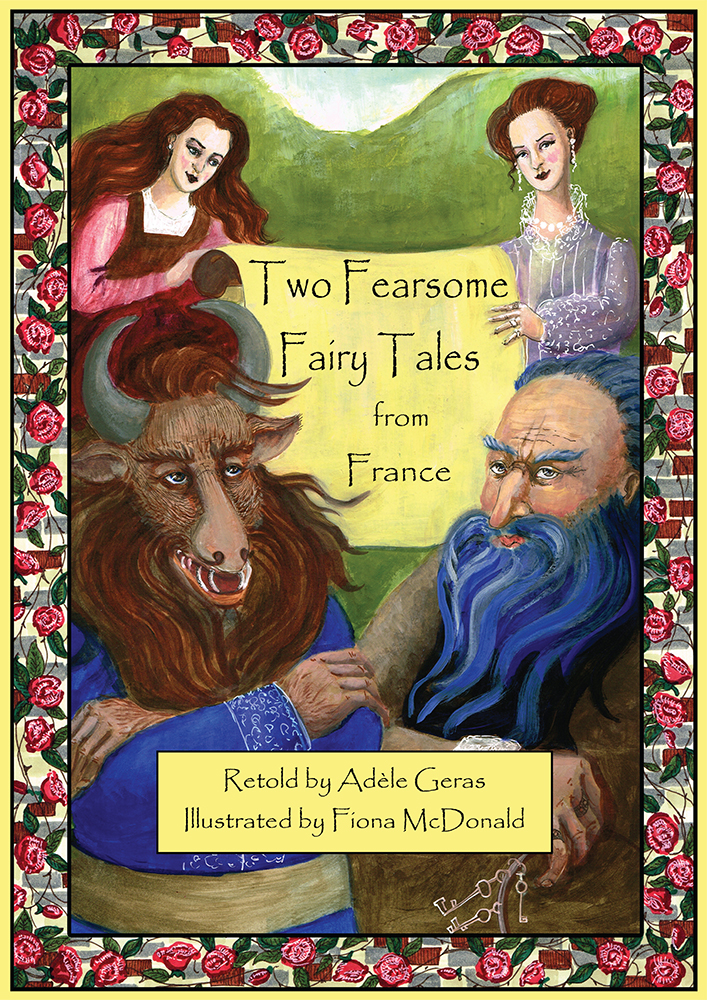 Fiona McDonald. I love the look of this book. The designers have found a fairytale font that I’d never seen before and the whole production is gorgeous. I can’t wait for it to appear.
I’m a bit evangelical about fairy tales. I was brought up on them. Almost the first thing I can remember reading for myself was a version of Rapunzel. I can bring to mind even now, decades later, the look of my edition of Andersen’s stories ( which are not all traditional, of course) with Rex Whistler’s illustrations. I think it is important that children can still read the story, and not just look at Hollywood versions of these tales.
Retelling fairy tales is one of the things I like doing most as a writer. The reason I’m often asked to do this is, I think, because back in the 90s, I wrote a trilogy of novels based on fairytales, set in my old boarding school, Roedean. They are now published together as a book called Happy Ever After. Shortly after they came out I was commissioned to retell some fairytales and that book (Beauty and the Beast and Other Stories) is the one from which my Two Fearsome Fairy Tales from France are taken. I’ve also retold The Six Swan Brothers as well as Cinderella and Sleeping Beauty.
For a lazy writer like me, it’s a real pleasure not to have to think of a plot. I always find working out the plot the hardest thing of all. I always have to scratch about a bit when I’m writing something original. This is never a problem with fairy tales. They are there, and the reason they have lasted for so long and have been passed down over the centuries is because they are very good stories, dealing as they do with the most basic aspects of human existence: love, death, ambition, jealousy, fear, etc. They teach us that good will triumph, that the wicked will be punished and that it never hurts to be polite….look what happened to the unfortunate sister who was rude to an old woman by a well and ended up spewing toads and vipers from between her rosy lips.
Wonderful characters abound in fairy tales. Princes, monsters, ogres, dwarves, dragons, beautiful damsels who turn out to be braver and cleverer than they know, dreadful mothers, wonderful nurturing mothers, horrible husbands (Bluebeard is a lulu!) and envious siblings. The writer has nothing to do but let the narrative unfold and all is well.
This might be thought boring but it’s not. Just as having a fourteen – line limit for a sonnet is liberating rather than restricting, so the fact that you can’t change things too much makes you concentrate on the language. And that’s where the fun starts. I strive to make the words themselves as resonant and beautiful; as suitable to the tale I’m telling as I possibly can.
I hope very much that everyone who reads my versions of Beauty and The Beast and Bluebeard goes on to read lots more fairy tales told by lots of other people. And I hope that someone asks me to retell another fairy tale, one of these days….
Adèle’s website: www.adelegeras.com
Follow Adèle on Twitter: https://twitter.com/adelegeras
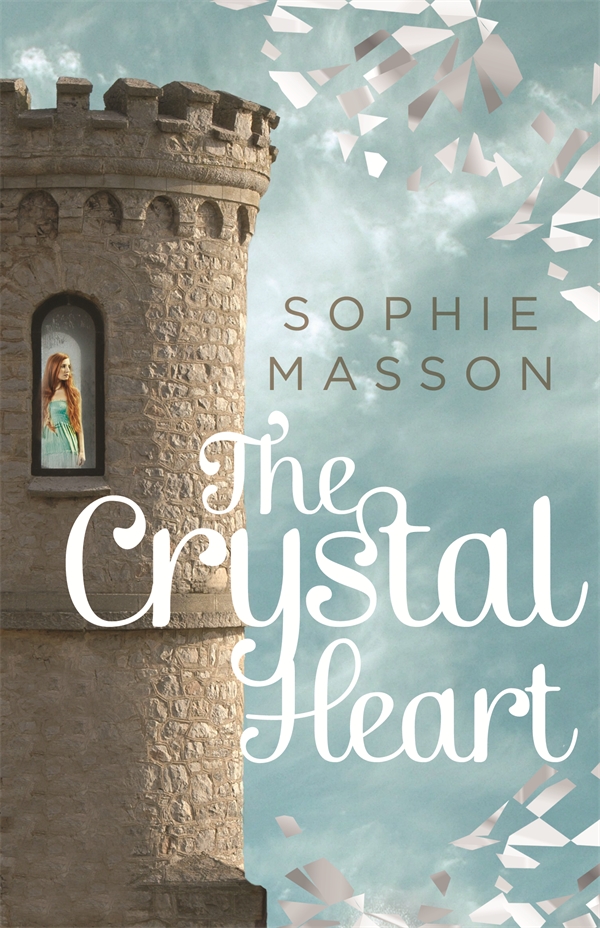
Creating the world of The Crystal Heart
 For anyone interested in knowing more about my novel The Crystal Heart (named as a CBCA Notable Book this year) I have a guest post on creating the world of the book, on Goldie Alexander’s blog. Following is a short extract. You can read the full thing here.
The Crystal Heart is set in the military state of Krainos, a small country which is on a constant war footing due to its enmity with the underground, magical realm of Night. But it’s also partly set in Night itself, an amazing realm which is much more advanced than Krainos. Some of the elements of the kingdom of Night owe their inspiration to two things: first, a magical, extraordinary place in the real world, the Wieliczka Salt Mines near Krakow in Poland, http://en.wikipedia.org/wiki/Wieliczka_Salt_Mine , which I visited in 2012.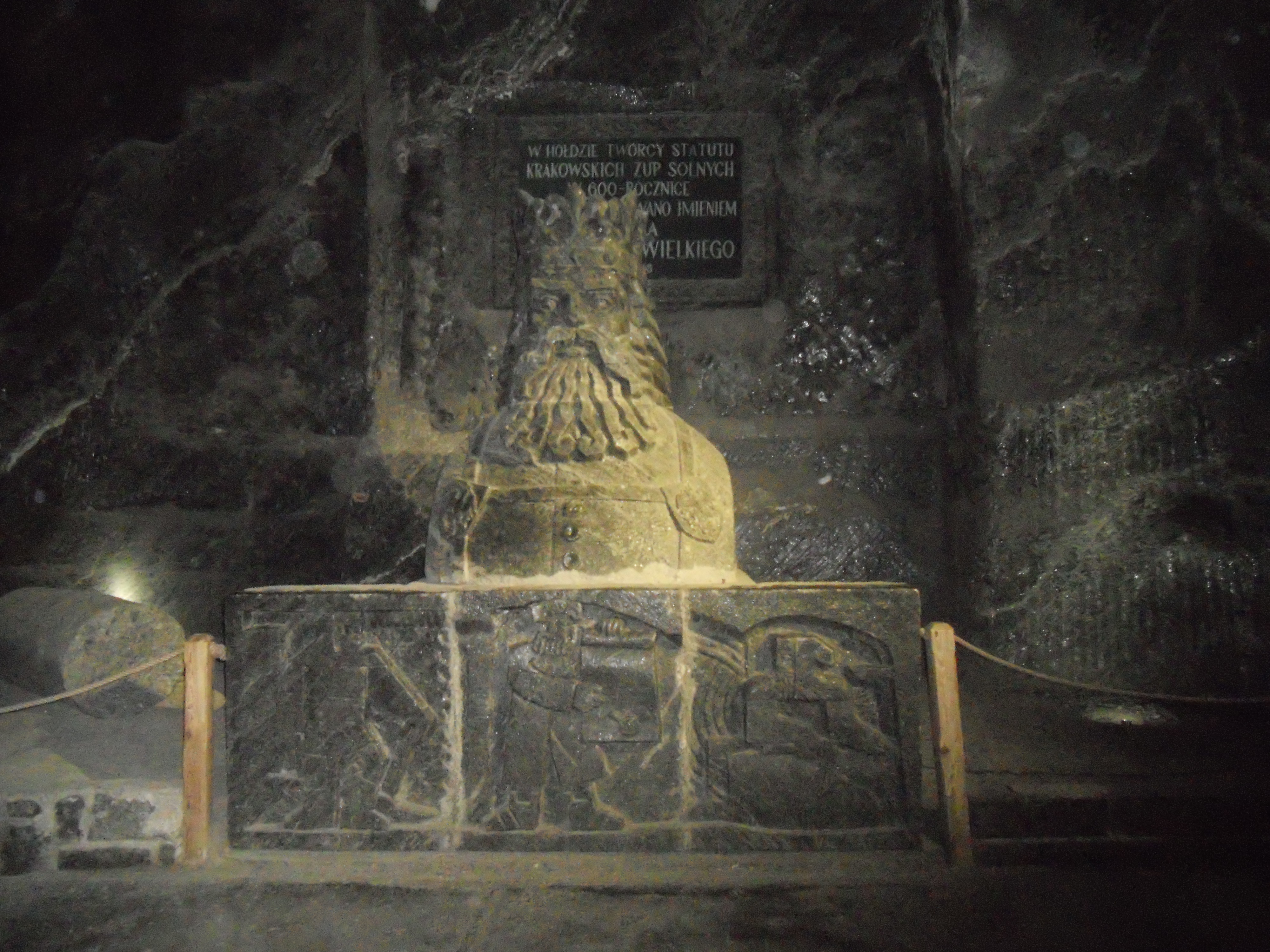
As soon as I set foot in this amazing underground world, with its huge caves, shining salt walls, fantastical statues carved out of grey and white rock salt, and its fairytale cathedral entirely carved out of salt, with glittering chandeliers made of salt crystals, I knew I had to use it in a book! By the time I had emerged from our extraordinary journey underground, the characters of Izolda and Kasper were already whispering in my ear…
The other inspiration for the underground setting was one of my favourite childhood books, George MacDonald’s classic fantasy novel for children, The Princess and the Goblin. I disliked the goblins but was fascinated by their underground kingdom! And when I saw the Wieliczka Salt Mines, those nasty goblins from George MacDonald’s book morphed into even nastier ones in my world!
Guest post about Jules Verne’s Mikhail Strogoff, on Great Raven blog

Photo of Russian riverboat by Sergei Prokudin-Gorsky, circa 1910.
I have a guest post on fellow author Sue Bursztynski’s Great Raven blog, about the impact on me of Jules Verne’s Mikhail Strogoff, and about being involved in bringing it back to English-speaking readers. Here’s a short extract:
I read the novel I don’t know how many times, swept away by the grandeur of the story, the fantastic adventure, with its wolves, bears, mountain storms, bandits, iced-up rivers, cruel torturers and traitors. I thoroughly enjoyed the funny rivalry and repartee between Alcide Jolivet and Harry Blount, I thrilled to the love I could see developing between Nadia and Michel, both equally tough and brave. And I was swept away too by the description of the journey, which starts in Moscow and ends in Siberia — a journey over water, through forest and mountain and cities and villages: you get a real sense of the vastness and amazing diversity, both human and environmental, of Russia. Basically, it’s a chase novel, and it has the breakneck pace of that, and lots of twists and turns, culminating in an especially unexpected and satisfyingly resolved one. But it is also beautifully written, as tight and clever and witty as Around the World in Eighty Days, and much more passionate and exciting.
You can read the whole post here.
On writers 4: in loving memory and celebration of Lloyd Alexander
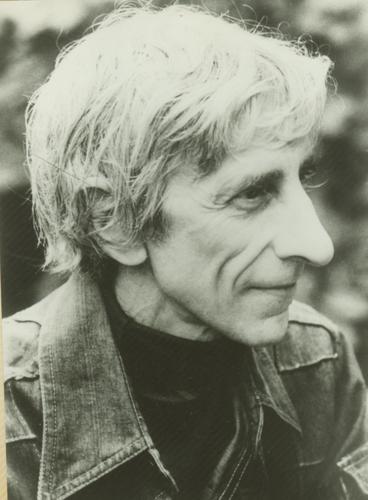 This fourth republished article about writers I’ve been inspired by is a very personal one, because not only did I love the work of the great American children’s writer Lloyd Alexander, but I also knew him personally, at least by letter, as we corresponded over many years. This article was written after he died in 2007, and was originally published in Magpies magazine.
Vale Lloyd Alexander, 1924-2007
The world of children’s literature has lost a great light. On May 17, 2007, the American writer of many classic children’s novels, Lloyd Alexander, died of cancer at his home in Philadelphia, only two weeks after the death of his beloved wife Janine, with whom he’d shared sixty years. Beloved of readers and critics alike, his work spanned more than forty years, and more than forty books, and as a fantasy writer, he is reckoned to be in the ranks of such as JRR Tolkien, CS Lewis, TH White, and JK Rowling.
In fact, I’d go so far as to call him the greatest American writer of children’s fantasy of modern times. Many people would agree with me. He has a huge, devoted worldwide audience. His six-volume Chronicles of Prydain have been continuously in print since 1963, with the first two, The Book of Three and The Black Cauldron, made into the 1985 Disney movie, The Black Cauldron, which has always had a mixed reputation—many readers being disappointed by the fact that too many of the events of the books were shortened, and too many characters dropped. 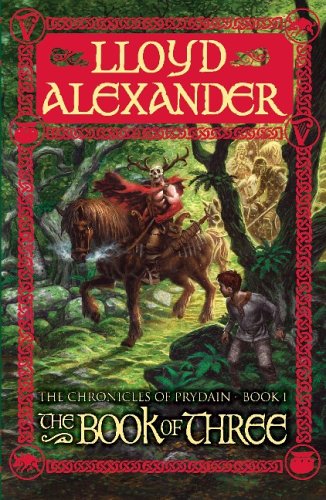
The books themselves however have had no such mixed reviews. Who can resist Taran, assistant pig-keeper’, and his oracular pig, Hen Wen? The feisty Princess Eilonwy? The bard Fflewdur Fflam? And the noisy, messy creature, Gurgi? It’s not only the characters, though, or the action of the books—which is considerable—or the exciting plots, or the scary villains and mythological richness of the background that readers take to their hearts: it’s a warmth, a humour, a wit, a love of language, a lightness of touch and a playfulness, which is all too often lacking in fantasy. Yet he also doesn’t shirk the darker side of life, and of people. There’s an extraordinary honesty, yet a compassion, in all his work, which is immensely attractive. Readers love the Prydain books, and dearly: to the extent that I know of at least two people who so loved them as children that they were inspired to name their children after them. One friend named her first-born son Lloyd Alexander; another named her youngest son Taran, after the hero of the Chronicles.
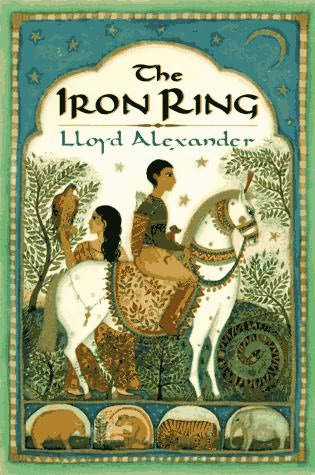 But it’s not just the Chronicles of Prydain, with their earthy yet mystical Celtic mythological background, that Alexander is famous for. He wrote a large number of wonderful, versatile fantasy adventure novels, set against all kinds of backgrounds and inspired by all kinds of fairytale and mythological sources.
Long before it was fashionable, Lloyd Alexander delved into all sorts of multicultural influences. There’s The Iron Ring, for instance, inspired by Indian myth; The Remarkable Journey of Prince Jen, based on Chinese sources; The Marvellous Misadventures of Sebastian, with its Central European flavour; The First Two Lives of Lukas-Kasha, with its roots in the Arabian Nights; The Arkadians, with its source in Greek myth. And many, many more. There are certain recurring motifs in his books: cats, music, the quest for true courage and love. And fun. Pure, unadulterated fun. He is such a fun writer, in all sorts of ways: pure pleasure to read, beautiful to read, because everything is so well put together, so deft and exciting and funny and warm and moving and intelligent. And his considerable learning and experience are worn lightly. A man who had travelled very widely and was interested in all kinds of cultures and always curious and intrigued by the amazing richness of the human experience throughout the world, he was also very much a homebody, who dearly loved his city of Philadelphia, where he was born and bred, and where he lived with his family for most of his life, apart from a few years away in Europe.
That deep knowledge of ‘Philly’ as well as of other places shows up very strongly in his marvellous comic adventure series, set around determined 19th century Philadelphia schoolgirl detective Vesper Holly, and told in the rather flustered, fussy tones of her guardian Professor Brinton Garrett, known as  ‘Brinnie’: these include The Illyrian Adventure, The El Dorado Adventure, The Drackenberg Adventure, and more. He also wrote a historical adventure series, The Westmark Trilogy, set in a world that rather ressembles Revolutionary France. He wrote several books that weren’t strictly speaking fantasy, including the delightful semi-autobiographical The Boy and the Gawgon. And he also wrote for adults, for the first few years of his career, until he switched to children’s books in 1963.
His first book, an autobiographical novel called And Let The Credit Go, was published in 1955. A fluent French speaker (his wife Janine, whom he met at university in Paris after World War Two, after a stint in the Army and in counterintelligence, was French) he is also the author of several translations of important French philosophical and poetic works, including Nausea, by Jean-Paul Sartre, Uninterrupted Poetry, by Paul Eluard, The Sea Rose by Paul Vialar.
 Yes, the world of children’s literature has lost a great light. Readers everywhere have lost a great writer, though there is that wonderful backlist to enjoy. And his last book, The Golden Dream of Carlo Chuchio, will be published in August. But it’s more than that for me. I feel like I’ve lost a real friend, as well, because for the last ten years, I’ve been corresponding frequently with Lloyd, exchanging letters and cards(he didn’t like computers, and never used email)and swapping books with him. The bright row of Lloyd Alexander books on my bookshelf, all inscribed by him in his characteristically warm and friendly style, will be doubly precious to me now.
It’s not always true that a great writer is a great person, but when the two coincide, it’s pure magic. That was certainly the case with Lloyd. From the very first letter he sent me, in January 1997, in response to the enthusiastic missive I’d sent via Cricket magazine(with whom he was associated), after my children and I had finished reading The Chronicles of Prydain, you could tell that here was a generous, warm, intelligent and modest person, a real gentleman in the very best sense of the term. Finding we had a good deal in common—writing, France, music, Celtic myth, travel, and much more—we continued to correspond fairly often over the years, and sent each other signed copies of our recently-published books. Lloyd always replied to letters promptly, typing or handwriting on his own distinctive pale yellow letter-paper, with the drawing of a cat playing the violin(thereby combining two of his great loves, as well as indulging his sense of humour). The elegant envelopes postmarked ‘Drexel Hill, Pennsylvania’ were always welcome arrivals in our mailbox!
Lloyd was always ready with a kind word and a friendly remark, and his generous and perceptive understanding of my own books heartened me enormously, and meant a huge amount to me, as did the warm and intelligent quotes he provided for my publishers when my books started to be published in the USA. Over the years, we shared snippets of information, and exchanged news of family and of friends(he was tickled pink by the knowledge that two of our friends had been inspired to name their kids after him and his characters!) And we exchanged Christmas cards—his featured his own delightful coloured drawings of a fantasy cat world, from the poshest drawing-rooms to the rumbustious tavern, with each year a new scene.. ![WP_20150327_001[1]](https://firebirdfeathers.com/wp-content/uploads/2015/03/wp_20150327_0011.jpg)
It may surprise non-writers(or perhaps not!), but not all writers are as supportive or as friendly and generous towards other writers as Lloyd was. In a competitive industry where egos can be as big as houses, there is all too often an urge to ‘do down’ or at least ignore other writers. Even when it’s not as bad as that, there can be a sense that really, what do you have in common except that you both write books? But when you do connect on a real level—the personal as well as the artistic—it is a very special friendship, even if that is conducted long-distance, as ours was, for we never met in person. And so I grieve for a good friend and a good writer, a good man and one who will be sorely missed, but whose books will live for ever.
The years have passed, but we still miss you very much, Lloyd.
Interview with Jane Routley
 Today it is my great pleasure to feature a really interesting interview I did recently with Jane Routley, multi-award-winning author of haunting and gripping fantasy novels, whose earlier books, I’m delighted to see, are enjoying a deserved comeback through ClanDestine Press, but who’s also hard at work on several new fantasy novel projects. And she’s also continuing with another wonderful side to her writing–Station Stories, intriguing non-fiction vignettes inspired by her day job. Read on!
Your new ebook, The Three Sisters, has just been released by ClanDestine Press. It was first published in 2004 under the pseudonym of Rebecca Locksley, and received fantastic reviews, including one from the great fantasy author Sara Douglass, who deemed it a ‘captivating read’. Can you tell us a bit about the book’s journey from its initial publication to its new release now? Did you make any changes to the original book, and how did you approach the question of pseudonyms for this new release?
The pseudonym Rebecca Locksley was an attempt to re-launch me for marketing reasons. At that time big bookshops like Borders were only ordering numbers of books on the strength of previous sales. Harper Collins had enough faith in me to think it might be worth re-launching me and making a big marketing push with posters and dump bins etc… In The Three Sisters I had wanted to write a  prequel to my Dion Chronicles, to deal with the history of the Klementari and their contact with the Aramayans. The name change came when I was too deep in the book to change the story. To be honest even though I understood the reasoning, I wasn’t very happy about it. I changed the names and some of the geography, but the magic system and the characters – everything that mattered -remained the same.
Since the name change didn’t achieve what Harper Collins had hoped and publishing has changed enormously with the advent of ebooks, I thought I might as well consolidate and change my name back for the re-issue.
Oddly enough when Clan Destine offered to re-releaseThe Three Sisters under my own name,I started out changing the world back to that of the Dion Chronicles. Somehow it just felt wrong so I must have changed more than it seemed at the time. Also I was worried people would think I was setting out to deceive.
The Three Sisters has been re-copy edited and I’ve smoothed out some stylistic edges that seem rough to me now but otherwise it’s much the same book that was released in print.
There is a sequel to The Three Sisters which has never been in print, which I spent a lot of time writing and which people still write and ask me about. Fingers crossed Clan Destine will bring it out some time next year.
In both your earlier Dion Chronicles and this book, you have created vivid and intriguing characters, acting in richly-depicted fantasy settings. How do you go about creating the world of your books?
I usually start out with an idea or a character. I’ve always loved the vividness of Angela Carter and Vernon Lee and I’ve tried to emulate it. Fairy tale and history fuel my world building. I tend to imagine my self living in my worlds. I imagine daily life, the smell of fresh bread and the feel of velvet robes. Hence there must always be the sense that there are bakers and seamstresses in the back ground even if they are not described. You need to make sure that everything follows logically.
For instance, your characters need ways to earn livings, which leads to ideas about social structure and economies.
The Three Sisters is set in a kind of medieval world but one in which a country is being colonized. I’ve plundered a lot of my history reading for that. For instance the local women are regarded as valuable slaves because of their skill at weaving. The women captured after the fall of Troy were used in just such a way. Later in Medieval times the work of weavers was the basis of much of the wealth of the Medici’s and the English Monarchy. Hence my history reading fuelled that piece of world building.
On the other hand fairytales are the back ground for a lot of my writing about the Tari. But even though they are magical they still have to eat! And they are human enough to need something to do during the day. I always notice in fantasy books when someone is just sitting round in their castle/cottage/flat waiting for the plot to catch up with them and it always irritates me. Real people,even magical real people, get bored with nothing to do. Even if you never mention it, at least have an idea in your head for what they do every day.
As a writer, are you a plotter or a gambler’? Do you plan your journey into a book, or do you just set out and see what happens?
As a writer I’m more of a gambler than a plotter. I know what I’m interested in writing about and I usually have some idea of where I want to go, but I never have much idea of how I’m going to get there. Every book I start I try to be more of a plotter. It must save so much time and angst. I always get to a point where the book goes dead and I’ve learned that that’s because I’m trying to make the characters do something that doesn’t work. Gee it’s miserable when it happens! I wish I didn’t have to go through it. On the other hand I get bored easily, so perhaps it’s best if I don’t know how things are going to go.
As a gambler, I know I write stories and books to see what’s going to happen if… For instance I’m interested in female roles in fantasy. In The Three Sisters I wanted to subvert the idea of the beautiful woman everyone desires. My suspicion would be that it would be horrible to be so desired. Sort of like that famous photo by Ruth Orkin of an American girl in Italy 1951 running the gauntlet of leering men. Elena’s quality of fatal beauty deprives her of much of her chance for agency and forces her to make a horrible sacrifice that many women in history have had to make. And I wanted to portray what it 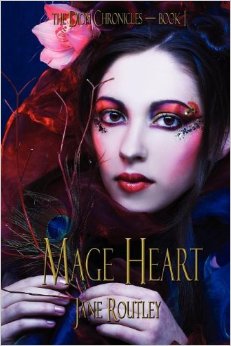 would be like to occupied by a colonizing force, which is an important theme in Australian History. So I keep asking what happens next when these conditions apply and over time I dig into the story and get closer and closer to the story that feels right for me. It’s a bit like being an archaeologist or painting an oil painting.
Are you working on a new novel now? If so, can you tell us about it?
My current project Shadow in the Empire of Light, is an example of the way I work. I was tired of reading traditional patriarchal gender roles and especially tired of the nice girls don’t have love affairs trope that is so much a part of traditional fantasy. It’s Fantasy for heaven’s sake!! Let’s live a little!! So I tried to design a world in which women are men’s equal and gender is less of an issue. At first it came out a bit dull. I hadn’t realized how much the sex war supplied tensions.
So I added the element of class. In the Empire of Light wealth is passed down the female line and all mages become nobles. Those without magic are peasants.
My heroine Shine Lucheyart is well born but she has no magic and no mother to leave her an inheritance. She works as a poor relation in the house of powerful sorcerer relatives. But she’s smart and feisty and in the first book she spends a lot of time getting sorcerer cousins out of trouble.
Her main aim is the cut loose from her family and, with her telepathic cat for company, make her fortune. I had a lot of fun with gendered language and also fun making it a sexy silky kind of book. I’m looking for a publisher now.
You are a multi-award winning, internationally-published author. How do you think the genre of fantasy fiction has changed over the years since you were first published?
The introduction of sparkly vampires and the growth of urban fantasy is one major new part of the genre. Fairy tales seems to have left nature and have become more and more entwined with our grungy urban settings. I’m not sure the type of historical fantasy I write has changed all that much. A lot of it seems just as sexist and humourless as it was when I started out. There are a lot of women centred fantasy novels nibbling away at the edges, but the mainstream….? Women are still being married off to save their brothers from ruination or in constant danger of being ravished by every man they meet. On the other hand there is the Game of Thrones phenomenon which can only be good for all fantasy writers simply because it’s gone so mainstream. Looking at G o T is a great way of looking at gender roles in Fantasy. A lot of women say that G o T is too rapey. That’s true. It’s set in a war and that’s what happens in the chaos of war. But there are a lot of strong women in the book. You have Aya, Danerys and even the appalling Cerci just to name the main ones. On the other hand you could accuse it of exceptionalism since all these ladies are exceptional and not the norm and the rapeiness is a drag to read if you’re a woman. Still compared with Tolkien we are definitely making progress. I guess one should be happy for small steps.
Separately to your fiction, you have created a wonderful compendium of non-fiction ‘Station Stories’ of vignettes and micro-stories inspired by your work as a station host at a Melbourne station host. How did ‘Station Stories’ start, and how do you see it as developing? Can you share with us one or two stories that stand out?
As a writer I’ve always wanted to celebrate everyday life – to make little photographs of it but with scents and sounds. Because everyday life is full of tiny transcendent jewel-like moments of delight and sorrow and interest. Fantasy writing doesn’t give you much scope for this. When I first started to work at a railway station (unfortunately my writing doesn’t pay the bills)I was delighted by all the little stories that played out on station platforms and kept a diary so that they wouldn’t be lost. Over time and with my discovery of social media these have metamorphosed into ‘Station Stories’. I really wrote them for my own pleasure. People tell me to look for a publisher for them and perhaps I will. But I already think of it as a small weekly column and I try to post one every weekend. I’d love to build up a following for them so that lots of people get this little story maybe on their mobiles maybe on Monday mornings as a bit of a sweetener. Without really planning it that seems to be what I’m working towards.
Here are two of my favourites.
A regular
G, one of our regulars is extremely disabled. He drives his wheelchair with a stick mounted on his head and communicates by tapping out words on a communicator. Were I so disabled, I think I’d be scared to leave the house, but G goes out to his job most days and has a busy social life. Recently I was tasteless enough to tease him about checking out the pretty girls. The way he tapped out “I’m engaged” and the dignified way he looked at me as it sounded out, made me feel rather small. Serves me right!
Yesterday he was waiting for a friend at the barriers and we got chatting. Hundreds of people headed for the Soundwave festival were going past and my task was to call out “Soundwave passengers – buses to the left!” at regular intervals.
I was startled to hear a little mechanical voice repeating my words. G had typed the words into his communicator and helpfully kept pressing the button at regular intervals until his friend arrived and he shot off in his wheel chair to greet him.
Station Heroics
Today the Crystal lady was in great distress (although not willing to miss her train) because she had dropped a container of freshly made organic peanut butter on the train tracks. I leapt in to help like the hero station host I am. Although these days railway employees are forbidden to enter the Pit (this is the evocative name we rail types use for the area of train track between the platforms) I do have a Scoopy Thing. This thing, created by some great hero station officer of times past,is a plastic milk bottle cut in half and attached to a pole. It enables me to fish all kinds of things – mostly mobile phones safely out of the Pit.
The ST performed admirably but to be honest, I’m not sure the Crystal Lady will want the peanut butter as the jar has a big germ emitting crack in it. Still that’s her decision for tomorrow.
Station Stories can be followed at www.janeroutley.com
https://janeroutley.wordpress.com/
https://www.goodreads.com/author/show/333390.Jane_Routley
http://www.linkedin.com/today/post/author/posts#published
https://www.facebook.com/jane.routley.5
 Feathers of the Firebird