Looking forward to the HNSA Conference: interview with Elisabeth Storrs

In just over a month–on September 8–the 2017 Conference of the Historical Novel Society Australasia will be kicking off in Melbourne. And not only do I have the privilege of speaking at the Conference, I also have the honour of being Conference Patron! It’s going to be a great conference, filled with interesting speakers, panels and events, and today I caught up with author Elisabeth Storrs, the program convenor, to tell readers more about it. And, by the way, once you’ve learned what a treat us in store, you can book tickets for the conference here 🙂 

The 2017 HNSA conference is on next month in Melbourne, and there are lots of people–including me!–excitedly waiting for the big day! Elisabeth, can you give a bit of an overview of what to expect at the conference?

Elisabeth Storrs

Over 60 fabulous speakers will celebrate the historical fiction genre, covering eras and events from the Ancient World through to WW2, at the HNSA 2017 Melbourne conference. The programme is divided into three streams. The first will explore the conference theme of Identity: Origins and Diaspora, and also includes interviews with numerous talented authors such as Kerry Greenwood, Kate Forsyth, Deborah Challinor, Lucy Treloar and you! We’re confident that attendees will find inspiration from such ‘personal histories’. For emerging and aspiring writers, the second stream looks at various aspects of the genre together with the craft of researching and writing. The third stream comprises an academic programme discussing Bio-Fiction and ‘The Lie of History’ that is open for general admission.

Hanifa Deen

We are also conducting an extensive suite of workshops with wonderful tutors including Anne Gracie, Isolde Martyn, Lisa Chaplin, Hazel Edwards, Elizabeth Lhuede and Sherryl Clark giving insights into historical romance, pitching, the business of writing, social media and CYA. Kelly Gardiner and Rachel Franks provide practical tuition on tools such as Scrivener and Trove. Sulari Gentill offers tips on historical mystery, and Rachel Nightingale will demonstrate historical costumes. Greg Johnston gives the lowdown on self-publishing – and who can resist Leif the Viking displaying his array of armour? Additionally, Alison Arnold and Irina Dunn are available for 1:1 manuscript assessments while Gillian Polack is conducting 2 masterclasses on making history come to life through research and writing.

Back by popular demand, we’re running the First Pages Pitch Contest again in which ‘first page’ pitches of aspiring authors will be read anonymously by a narrator (Rachel Nightingale) to industry experts (Alison Green, Mandy Brett and you) who will provide a critique of chosen submissions. The session will provide the audience with a chance to learn what attracts the attention of agents and publishers when seeking new historical fiction. And many thanks to Eagle Books for providing the prize of a limited edition of Mikhail Strogoff by Jules Verne and an original 19th century print of Russian life! The ASA is also kindly offering a free associate membership to the winner.

The theme, Identity: Origins and Diaspora, goes right to the heart of many modern as well as historical discussions and controversies. How did the HNSA committee come up with the theme, and how do you think it will be interpreted?

The committee wanted to explore the theme of Identity: Origins and Diaspora as we believe historical fiction plays an important role in informing current generations as to how national identities have been forged by past struggles, injustices, sacrifice, survival, and clash of cultures. Both Australia and New Zealand are multi-cultural societies with a rich history of migrant stories but both countries have also faced the pain of first encounters between first peoples and colonial settlers which require illumination and interrogation. How historical novelists grapple with portraying these meetings provides fertile ground for exploration. The issue of cultural appropriation will also be up for discussion. As such it was important to secure the appearance of speakers who represented a range of perspectives to reflect this. Our round table discussion at our opening reception on 9th September (after our History with a Twist cocktail party!)
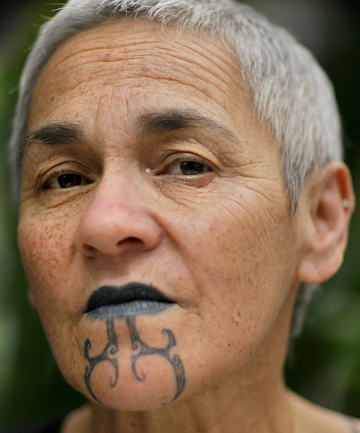
Ngahuia te Awekotuku

features Arnold Zable, Hanifa Deen, Ngahuia te Awekotuku and Gary Crew who will discuss the role of the historical novelist in exploring first encounters in Australasian colonial pasts, the migrant experience underlying multicultural identity, and whether an author’s origins are relevant to the story telling.

There’s a packed conference program, and counting tutors and panel chairs as well as speakers, there are more than 70 presenters. How do you go about sourcing people to be presenters?

Our desire was to provide diversity in the conference line-up by including authors from a variety of backgrounds, particularly indigenous speakers. Fortunately, the success of

the inaugural conference in 2015 placed us in a happy position to be able to run two concurrent streams in 2017 to achieve this vision.

Lesley and Tammy Williams

The first stream of the Saturday programme will continue to highlight the theme with keynote addresses from Lesley and Tammy Williams, authors of Not Just Black and White, followed by panels that will discuss the challenges faced in portraying the meeting of First Peoples with Europeans, and how historical novelists can breathe life into immigrant tales. I chose authors who had produced books that directly addressed one or more aspects of the conference theme such as Nicole Alexander, Maxine Alterio and Kim Kelly.

The remainder of the first stream concentrates on introducing readers and writers to the personal histories of the high profile authors I’ve already mentioned. Insights into the secrets of ‘the long haul’ of producing multiple books or series will be provided by Juliet Marillier, Libby Hathorn and Anne Gracie.

Sulari Gentill

The second stream required further difficult decision making. I chose to separate the sessions into three areas: research and technique, sub-genres, and trends in publishing. I matched authors to the topics using criteria such as prominent reputation, favourable reviews, recommendations from HNSA patrons and committee members, and from among members of our HNSA Facebook group. Again, I hoped to achieve diversity in the panels. And my aim was to present authors who wrote across a range of eras and cultures while also including a few self-published writers with proven reputations. I was pleased to include more Kiwi authors to ensure a greater representation from New Zealand than in our 2015 conference. The result is a wonderful array of panels covering Historical Mystery (Sulari Gentill, Robert Gott, Meg Keneally, Gary Corby), Historical Romance (Isolde Martyn, Alison Stuart), CYA (Alan Tucker, Pamela Rushby, Gabrielle Wang, Wendy Orr), World War Fiction (Julian Leatherdale, Elise
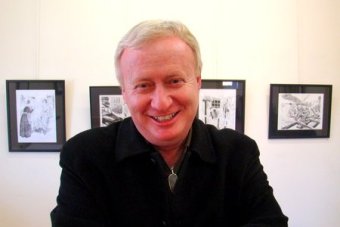
Robert Gott

McCune, Paddy Richardson, Justin Sheedy), ‘The Outlander Effect’ (Belinda Murrell, Felicity Pulman, Ella Carey) The Modern Voice in Historical Fiction (Kate Mildenhall, Melissa Ashley, Greg Pyers), International Fiction (Robyn Cadwallader, Natasha Lester, Prue Batten), Transmuting Research into Compelling Fiction (Barbara Gaskell Denvil, Wendy J Dunn, Stephanie Smee) and Authenticity vs Truth (Pamela Hart, GS Johnston, Tim Griffiths, Kathryn Gauci). And, of course, the weekend finishes with ‘Outside Your Comfort Zone – Writing Sex and Violence’ with less bashful authors Kate Forsyth, Luke Devenish and Anna Campbell.
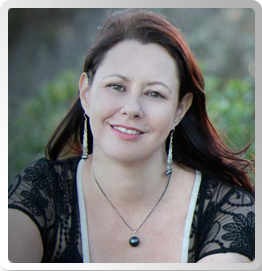
Kate Forsyth

I thoroughly enjoyed the first HNSA conference, back in 2015, and so did everyone I’ve spoken to who went there. And and I’m sure this one will be even better! But I know that behind the scenes there is a lot of frantic work. Can you tell us a bit about just what it takes to organise a conference of this size and scope, and how has it changed(if it has!) from 2015 to 2017?

Kelly Gardiner

Organising HNSA 2017 is a labour of love for all the committee members who have volunteered 18 months of their lives to bring the event to fruition. In 2015 we only ran one stream and a couple of workshops. 2017 presents two concurrent streams, 10 workshops, 2 masterclasses, 20 manuscript assessment sessions and our inaugural short story contest (with a prize of $500). In other words, the workload has more than doubled. The six committee members have wrestled with website development (our previous website was hacked!), content writing, programming, budgeting, sponsorship drives, marketing, social media streaming, and booking systems to name just a few major tasks. We also have boosted our HNSA blog content to bi-weekly postings and have produced a monthly newsletter. We are also proud to have produced our Imagining the Past podcast series hosted by newly recruited committee member, Kelly Gardiner. On top of all this, we have conducted satellite events in Sydney, Melbourne and Brisbane to help spread the word and also feature aspiring, emerging and established authors who may not have been included on the main conference bill. Frantic is definitely the right adjective!

What are you hoping will come out of the conference?

The last conference gave an opportunity for writers from various stages of their careers to mingle and feel a sense of community. I feel that was one of the major successes of 2015. Our aim is to widen the scope to include readers as well as writers. By presenting a broad programme that hopefully offers something for every historical fiction fan, we hope to build on connections and establish Australasian local chapters as is the case in the UK and USA.
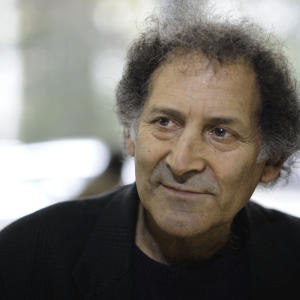
Arnold Zable

Thanks for giving me the opportunity to tell your readers about HNSA 2017. We are super excited that you are our conference patron. I look forward to seeing you in Melbourne. You’ve supported us so well!

More about the Conference:

The HNSA 2017 Melbourne Conference is being held on 8-10 September 2017 at Swinburne University, Melbourne. This celebration of the historical fiction genre will showcase over 60 speakers discussing inspiration, writing craft, research, publishing pathways and personal histories in our weekend programme. Among the many acclaimed historical novelists participating are Kerry Greenwood, Kate Forsyth, Deborah Challinor, Libby Hathorn, Lucy Treloar, Sophie Masson, Sulari Gentill, Robert Gott and Arnold Zable. The HNSA’s speakers’ list is available on the HNSA website.

In addition to the two stream weekend programme, there will be ten craft based super sessions and two research masterclasses.You won’t want to miss our interactive sessions on armour and historical costumes either! Purchase a ticket and you will be entered in the draw to win a $100 Dymocks Gift Card.

Lucy Treloar

Manuscript assessments will be conducted by industry experts, Alison Arnold and Irina Dunn. Our free extended academic programme is open for general admission but bookings are essential.

Our First Pages Pitch Contest offers an opportunity for submissions to be read aloud to a panel of publishers. And we are delighted to announce the introduction of our inaugural HNSA Short Story Contest with a $500 prize!

Visit the HNSA website to purchase your tickets now!
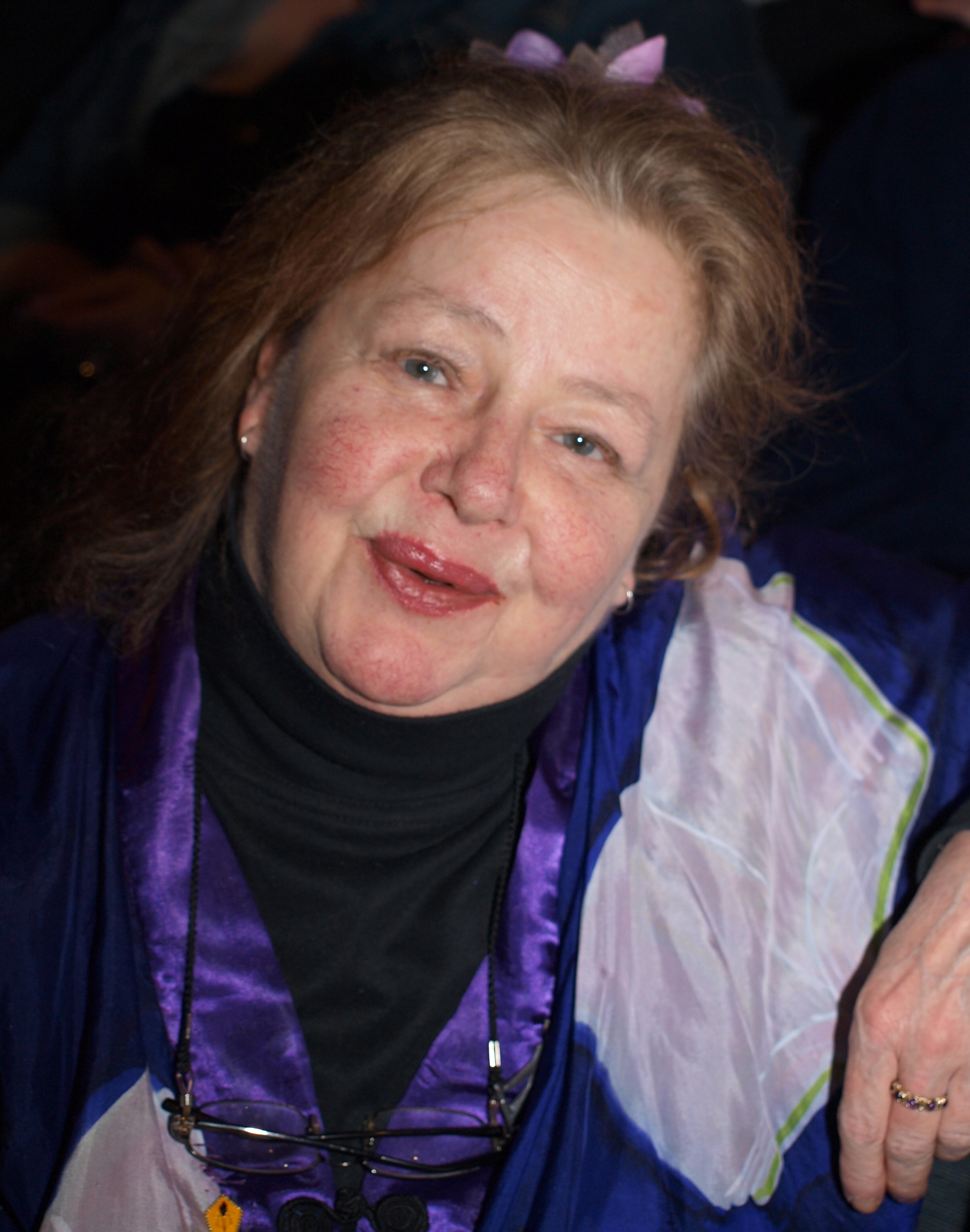
 

Kerry Greenwood

Subscribe to the HNSA newsletter for interviews, reviews and news.

Learn about sponsorship opportunities.

Let’s make a noise about historical fiction!
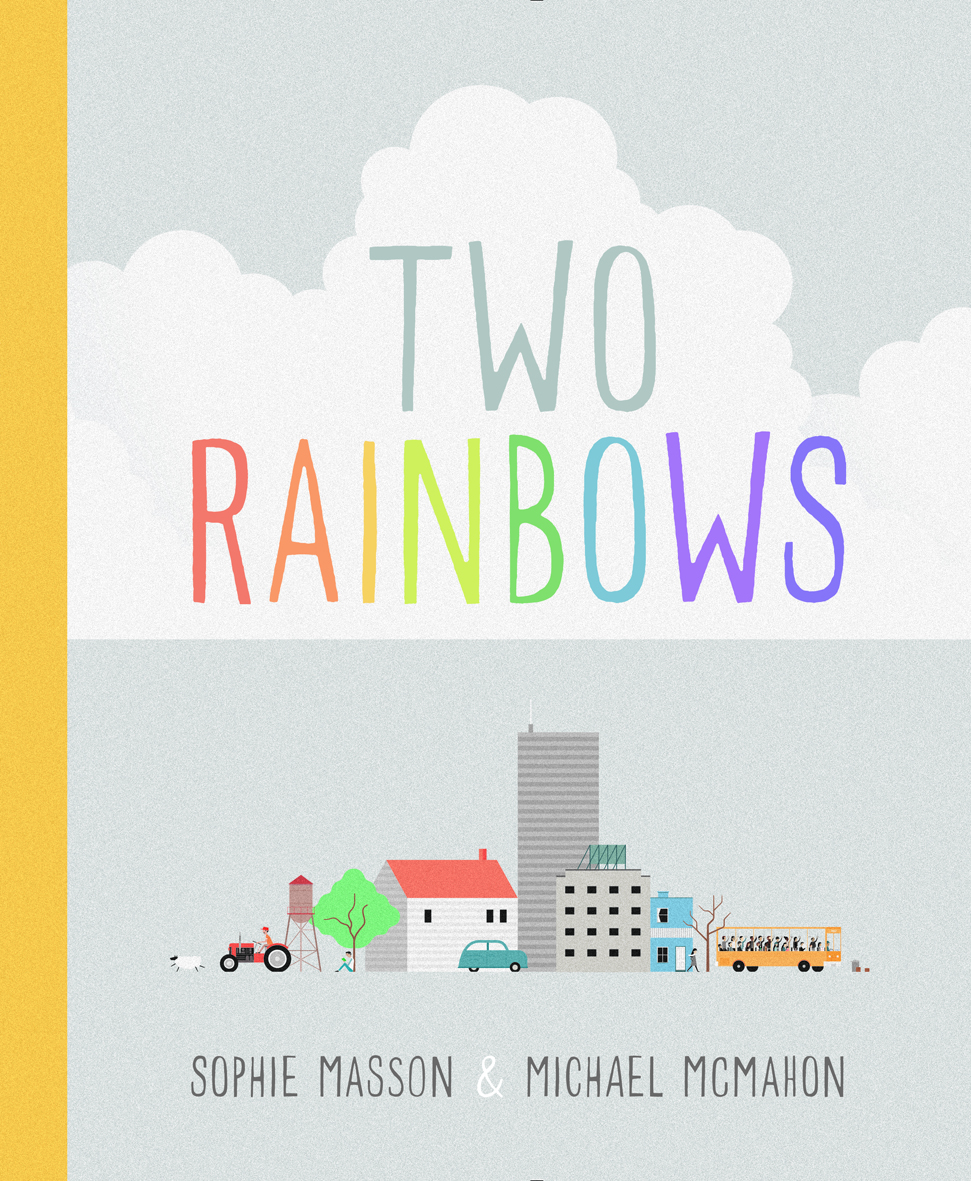


Michael McMahon on creating illustrations for Two Rainbows

My latest picture book, Two Rainbows, illustrated by the wonderful Michael McMahon, came out this month with Little Hare and to celebrate I asked Michael to share his creation process for the book, which he’s done in this very interesting post. Enjoy!

I was first given a draft of Sophie’s Two Rainbows by my publisher Little Hare and was asked to imagine this little world of words becoming illustrations. When reading the story for the first time there were two things that I was struck by. One was the stories unique look at colour, and the other was Sophie’s original choice of words.

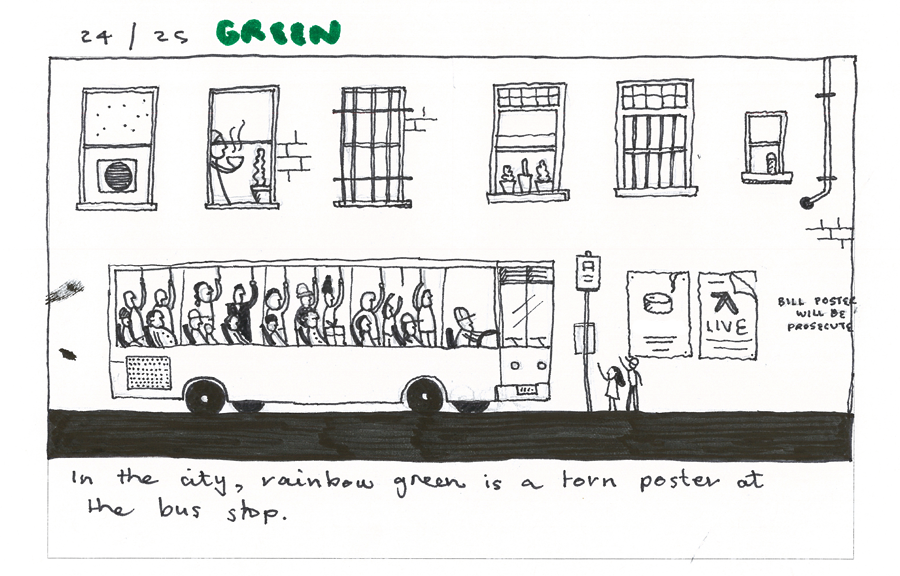
Stepping through the colours of a rainbow the reader follows a little girl as she begins to notice all of the colourful differences between the city where she lives and the memories of her home in the countryside. Sophie’s words give life to a simple story that highlights both the obvious and the subtle. Comparing the vibrance of the farm meadows to a muted bus-stop poster gives the story both a realistic and idealistic twist.

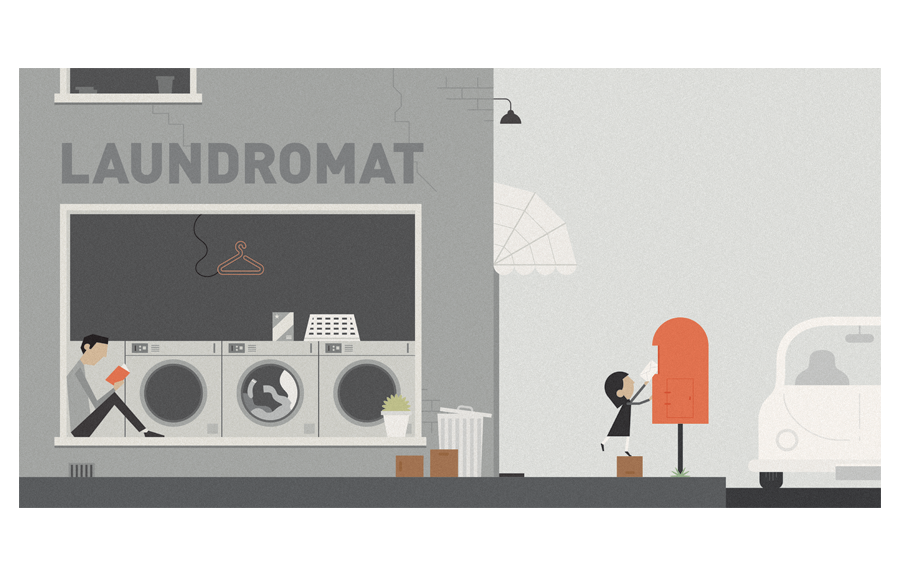
Illustrations are often simply coloured in, either to express emotion or create emphasis, but it’s rare for colour to sit at the forefront of a narrative. In that sense it was a nice change of pace to wonder how colour could be used in each scene. I often sketch and then start to put together each illustration, with colour naturally following on from this somewhere near to the end of the process. However, it was interesting that colour was now going to be considered first before touching pen to paper.


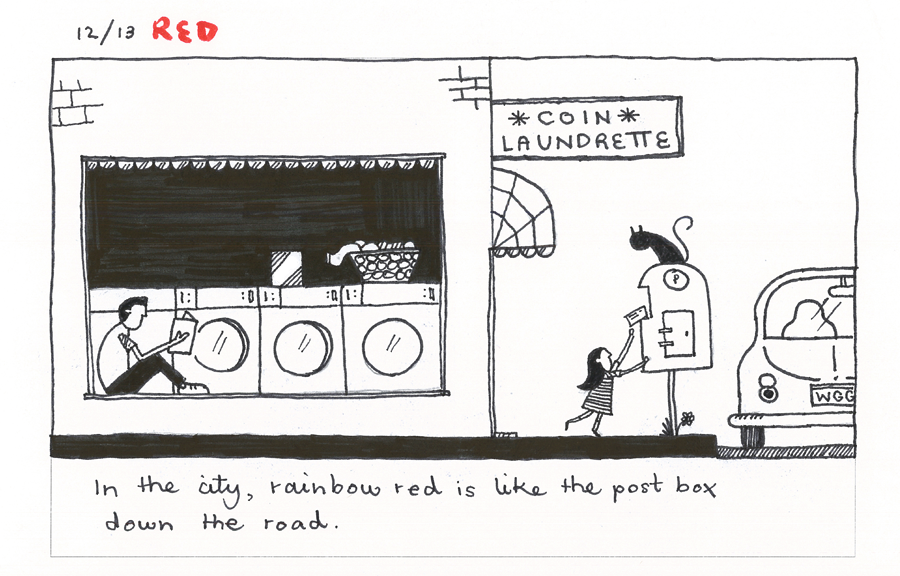
After reading each page, I would very quickly draw the first things that came to my mind, not thinking it through too much. I would then read the next part of the story and do the same. I like the spontaneity of this. After considering each page separately, I’d then start to sketch the story again and consider it as a whole – crossing things out and moving things around until it starts to form something I feel is working well.

This is how the messy sketches begin…


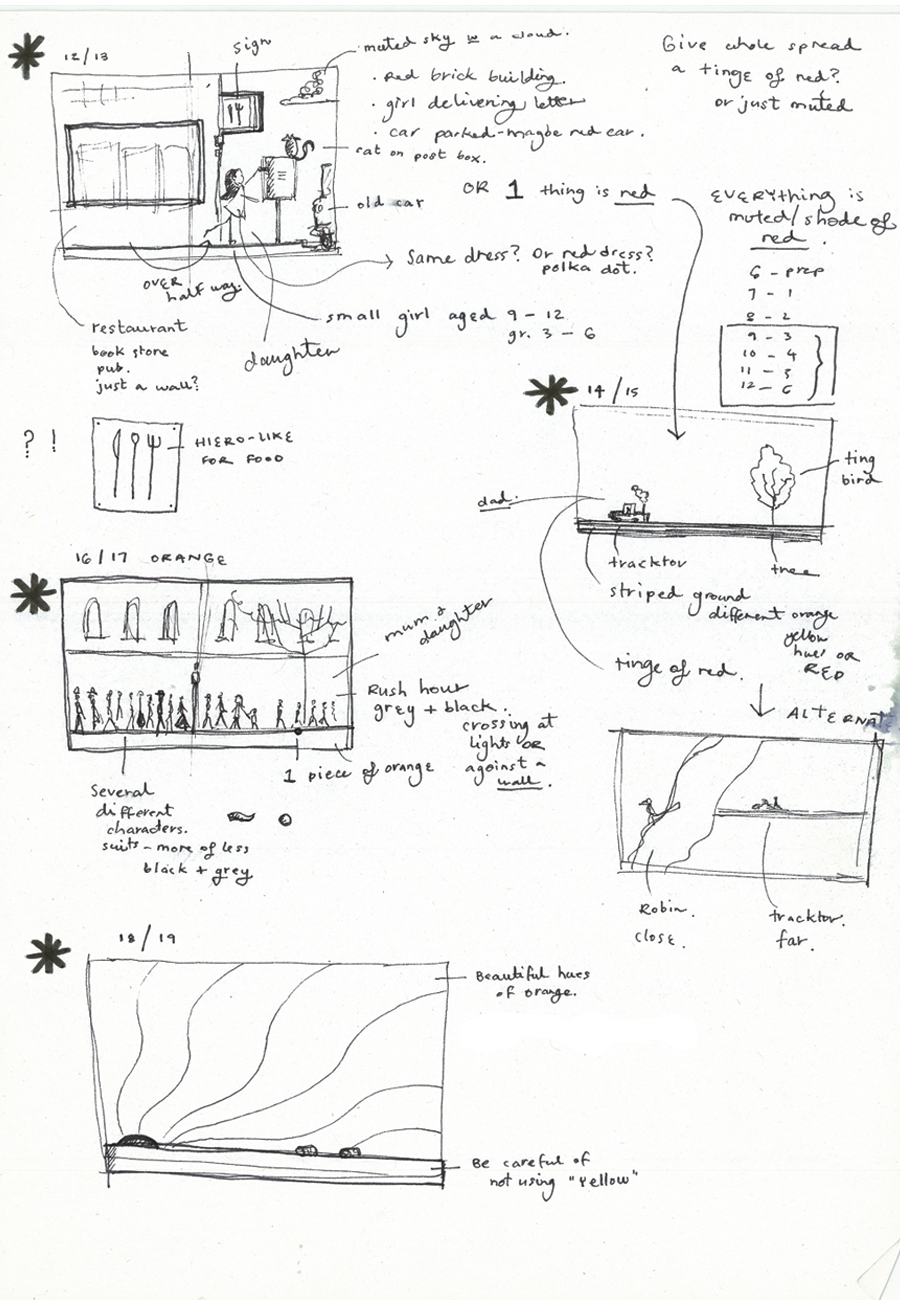
After the initial sketches, I find it important to start each book with a little bit of research. In a way, I feel it’s good for storytellers to know and imagine the world of their characters, a sort of ‘reading-before-the-lines’ not just between them. I imagined the little girl in the book growing up and spending her childhood in the countryside and then suddenly having to pick up everything and shift into the heart of a very far away city. I took my time photographing the inner suburbs of my own city to get a sense of where the little girl might live. I also went through troves of old photos of famous cities to create a kind of made up metropolis. I took inspiration from a lot of different places.

This is how the sketches start to take on a little more shape…


When the sketches are finished and placed alongside the text, I then start to put together the illustrations by adding more details and slowly refining each one until we have the finished book.


Does writers’ creative process change if they’re working on a PHD?

It’s been a bit of a trend in recent years: established writers undertaking PHDs within their own creative field, and in 2015, I joined their ranks, starting a PHD in Creative Practice at the University of New England(Armidale, NSW, Australia). This means I’m writing a novel, The Ghost Squad, plus an associated exegesis, or mini-thesis. Last year, I published a paper in TEXT about the motivations and experiences of established writers undertaking PHDs/doctorates, which was based on interviews with authors and academics. (You can read the paper here) And an issue arose during it: whether a writer’s way of working, their creative process, changes as a a result of undertaking the PHD. It was an issue which I found fascinating and which I decided to expand into another paper, by interviewing a different set of authors and academics on that precise point. My research came up with some interesting results, and great insights into how writers work.

This month, the paper was published in New Writing, the International Journal for the Practice and Theory of Creative Writing. And the full text of the article is available here: http://www.tandfonline.com/eprint/maXQXJny9PXPBkQgRGiB/full

Do feel free to comment!


Rachel Nightingale on Harlequin’s Riddle

Today I’m delighted to welcome to the blog Rachel le Rossignol, who under her writing name of Rachel Nightingale (‘Nightingale’ being the direct translation of ‘Rossignol’) is launching her first novel, Harlequin’s Riddle, an intriguing and memorable fantasy set against the background of the Commedia dell’ Arte. In this guest post, Rachel writes about the inspirations that came together in the novel’s creation.

Being a Bower Bird

by Rachel Nightingale

When I was in grade 2, we did a project on Australian fauna. I chose the Satin Bowerbird. These birds are well known because the male of the species builds a bower then fills it with bright blue objects to attract a mate. I drew the bird and its nest collection, using every shade of blue available in my pencil case. The idea fascinated me. Why only blue objects? Where did it find them? What did it feel when it spotted a perfect piece of sapphire glass, or a shiny azure ribbon? Now, with my first book coming out, I’ve seen the same pattern in how I gathered similar images and ideas to write Harlequin’s Riddle, a fantasy about the Commedia dell’Arte, the travelling players of the Italian Renaissance.

On the surface, Harlequin’s Riddle was inspired by a comment in an article about the Broadway revival of Cabaret. Alan Cumming, starring as the MC, mentioned the moment before you step onstage, when a whole world opens to you. I asked the inevitable question fantasy writers ask: what if? What if that world was real? What if actors and other artists could reach it? What would they find? What would they be able to do? The idea of Tarya, a realm where creativity can literally change the world, was born. I had a premise for my book. But that premise needed a home – a bower. And I had already filled it with a cast of characters, a collection of archetypes and dreams.

Looking back, I’ve been fascinated by the trickster Harlequin, beautiful Columbine and tragic Pierrot, for a very long time. Masks are a recurrent theme in my life – I have made, decorated, collected and been gifted them. The Commedia dell’Arte used different masks, along with their distinctive costumes, to signify the various characters. In Harlequin’s Riddle masks play a key role in enabling actors to reach Tarya. They confuse identity and ultimately are a tool of misdirection.

But foraging in my bower I found other Commedia memories. Although long ago left behind, I used to have a collection of porcelain Pierrot dolls. I had the inevitable feminine anime Pierrot poster by Mira Fujita. Pierrot evoked such sadness and longing in me – here was a character whose love was so pure and true, but who could never have what he longed for, for that was the way of the story.  I adored the musical The Venetian Twins, which is based on the Commedia. One of my favourite books, Chase the Moon, by Catherine Nicolson, is an unashamedly romantic tale of a pair of lovers who can only reveal their true selves to each other in letters that they sign Harlequin and Columbine. I had an art deco poster book with different depictions of Harlequin, in his diamond patched suit, and Columbine, in gauzy ballet dresses. I imagined the stories they lived in, the twists and turns and tricks.

Recently I found something I’d forgotten I owned – a tin gifted to me by my great aunt, with Pierrot on the lid. The tin contained a face washer and 2 soaps, long since washed away into memory. It’s likely this image was the first that opened the door to the Commedia dell’Arte.

Yet it is not the collection of items and images that I gathered over the years that triggered my writer’s imagination and led to the creation of Harlequin’s Riddle – it was what they represented. The trickster, the beauty and the sad clown promise mystery, deception, romance, laughter and song. This is what I wanted to capture in my story.

Researching the Satin bowerbird for this article, I discovered that these birds have unusual blue-violet eyes. Perhaps these hopeful birds gather all things blue because this colour represents the promise that they will share their bower with another like them. Sharing my story now, I hope I am sharing the mystery and magic that I found in writing Harlequin’s Riddle.

More about Harlequin’s Riddle

The Gazini Players are proud to present

For your Edification and Enjoyment

Tales of great Joy, and of great Woe

Ten years ago, Mina’s beloved older brother disappeared with a troupe of Travelling Players, and was never heard from again.

On the eve of Mina’s own departure with a troupe, her father tells her she has a special gift for Storytelling, a gift he silenced years before because he was afraid of her ability to call visions into being with her stories.

Mina soon discovers that the Travelling Players draw their powers from a mysterious place called Tarya, where dreams are transformed into reality.  While trying to solve the mystery of her brother’s disappearance, she discovers a dark cost to the Players’ onstage antics. Torn between saving her brother or exposing the truth about the Players, could her gifts as a storyteller offer a way to solve Harlequin’s riddle?

More about Rachel le Rossignol(Nightingale)

Rachel Le Rossignol has been writing since the age of 8 (early works are safely hidden away). She holds a Masters degree and PhD in Creative Writing. Winning the Mercury Short Story competition (junior section) at the age of 16 fueled her desire to share her stories with the world. Subsequent short stories have been shortlisted in a number of competitions and a play, No Sequel, won the People’s Choice Award and First Prize at the Eltham Little Theatre’s 10 Minute Play competition. Another, Crime Fiction, was performed at Short and Sweet Manila and Sydney.

Rachel’s second passion after writing is the theatre, and she has been performing in shows and working backstage for a rather long time. She co-wrote and performed in the 2013-2015 version of the hugely popular Murder on the Puffing Billy Express, a 1920s murder mystery set on the iconic Dandenong Ranges train. The inspiration for the Tarya trilogy, which begins with Harlequin’s Riddle, began when she read a quote by Broadway actor Alan Cumming about that in-between moment just before you step onstage, and began to wonder might be found in that place between worlds.

Published by Odyssey Books in June 2017.

www.odysseybooks.com.au

www.rachel-nightingale.info

@OdysseyBooks

@NightingaleRA


Five Favourites 24: Kate Forsyth

Today, it’s the turn of Kate Forsyth to select her five favourites.


It was so hard to choose only five favourites from my childhood, when I read so many wonderful books. But I have finally – after much agony – chosen only a handful for you.


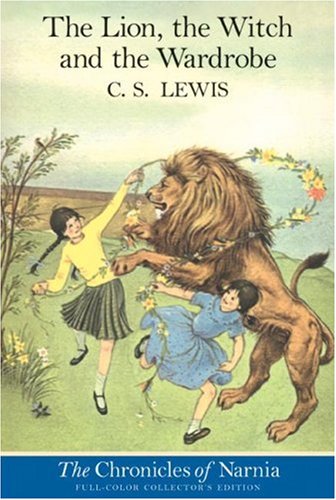
The Lion, the Witch & the Wardrobe – C.S Lewis


This was the first book I ever read all by myself and it was, for many years, the benchmark by which I judged other books. Was it as thrilling and magical as Narnia? I love the other books too (except for The Last Battle), but this one will always occupy a very special place in my heart. There is something so wonderful about the land at the back of the wardrobe, the lamp-post in the silent snowy forest, the faun carrying an umbrella, the menace of the White Witch, the beavers with their cosy house and sewing machine, Edmund’s betrayal and eventual redemption, the lion who can play like a kitten … just writing about it makes me want to go and read it again!
The Little White Horse– Elizabeth Goudge

 I absolutely adored The Little White Horse by Elizabeth Goudge, which I read as a little girl sick in hospital. I read it over and over again, and longed with all my heart for a house like Moonacre Manor.  It is filled with wonderful descriptions of the house, the garden, the woods and meadows, and of food (which was very important to me at the time, as I was living on hospital fare.) It tells the story of Maria Merryweather, who goes to live at the manor with her governess and her dog, and finds mystery, magic and romance. I still wish for a house just like Moonacre Manor – if I ever sell five hundred million books, that will be what I will buy. I also love Elizabeth Goudge’s other books, particularly Linnets and Valerians, but The Little White Horse was the first of hers I ever read and so closest to my heart.

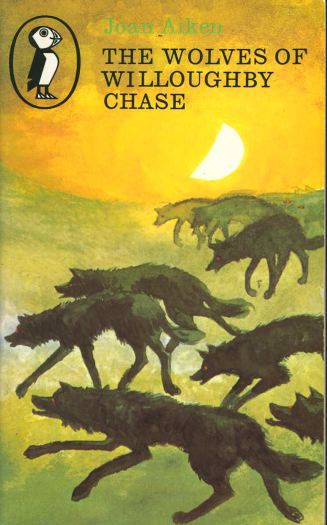
The Wolves of Willoughby Chase – Joan Aiken

 I cannot understand why Joan Aiken is not much more widely celebrated than she is. Her books are so funny, so surprising, so thrilling, and so beautifully written. They are set ‘at a time in English history that never happened,’ when Good King James III was on the throne and the wicked Hanoverians kept plotting to take over the country. My copy was given to me by my brother, and cost $1.15 … sigh! Wishing books were that cheap now. The Wolves of Willoughby Chase tells the story of two cousins, Bonnie and Sylvia. The first is rich and beloved and lives at Willoughby Chase, a grand manor house. The second is poor and orphaned, and sent to stay with her. However, Bonnie’s parents must go away for her mother’s health, and a cruel and devious governess comes to take care of them, precipitating the two girls into the adventure of a lifetime.
The Glass Slipper – Eleanor Farjeon

A delightful retelling of ‘Cinderella’, The Glass Slipper is full of dancing rhythms and warm-hearted humour. I remember the day I borrowed it from the library, and began to read it on my walk home from school. I became so engrossed I walked straight past my street and only realised where I was when a passing neighbour tooted me and called out to me that I’d missed my turn-off. I simply turned around and kept on reading as I walked back towards home. I loved the book so much I spent years trying to find it again, and was so delighted when I discovered a copy in an old second-hand store. I now collect Eleanor Farjeon books, and have a copy of her book Kaleidoscope (signed to someone called Kate!) which is one of my absolute treasures.


The Stone Cage – Nicholas Stuart Gray

A retelling of ‘Rapunzel’ from the point of view of the witch’s cat, The Stone Cage is one of my all-time absolute favourites (as you know, Sophie!) I have re-read it many times and it never fails to enchant me. The voice of Tomlyn the cat is pitch-perfect, and the mix of humour, pathos and danger so adroitly managed. I think of it as one of my touchstone books, and know that anyone who lives it (or any other books by this author) is a true kindred spirit.


Five Favourites 23: Katherine Langrish

Today Katherine Langrish is writing about her five favourites.

My five top books? Of course it’s really almost impossible to choose, but here are some which spring to mind

Susan Price’s The Ghost Drum (1987) is set in a far-distant Northern Czardom where half the year is summer and light and half the year is winter darkness. It’s the tale of young Chingis, daughter of a serf but raised by a shaman woman to inherit her magical powers and her hut that runs on chicken legs across the snow. And it’s also the story of Safa, son of the cruel Czar who has kept him imprisoned since birth in a single room with no windows.  “Every moment, day and night, waking and dreaming, his spirit cried; and circled and circled the dome room, seeking a way out.” One night Chingis hears his spirit crying from far away, and she sets out across the steppes to rescue him. I have read this starkly beautiful and unsparing story over and over again.

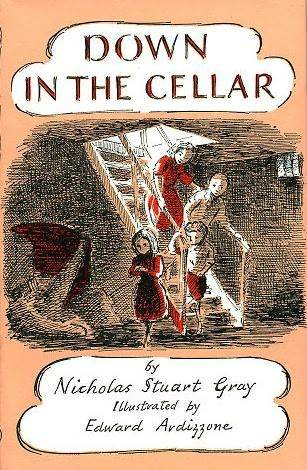
The wonderful Nicholas Stuart Gray is undeservedly neglected; I can’t think why he’s not still in print. He wrote many books and plays for children: perhaps the very best is Down In The Cellar (1961).  A family of four lively and eccentric children rescue a mysterious young man called Stephen whom they discover lying wounded and ill in a deserted quarry they were told not to visit. They smuggle him into the cellar of the rambling old house in which they are staying, and attempt to look after him.  But sinister forces are in pursuit of Stephen, and five-year-old Deirdre keeps seeing things the other children can’t – weird green lanterns shining in the dark, and a mysterious golden gate in the cellar wall. Are half the villagers really warlocks?  Where do the cats go, when they go missing? And who or what are the Spoilers? This is a very scary, very exciting and very funny book.

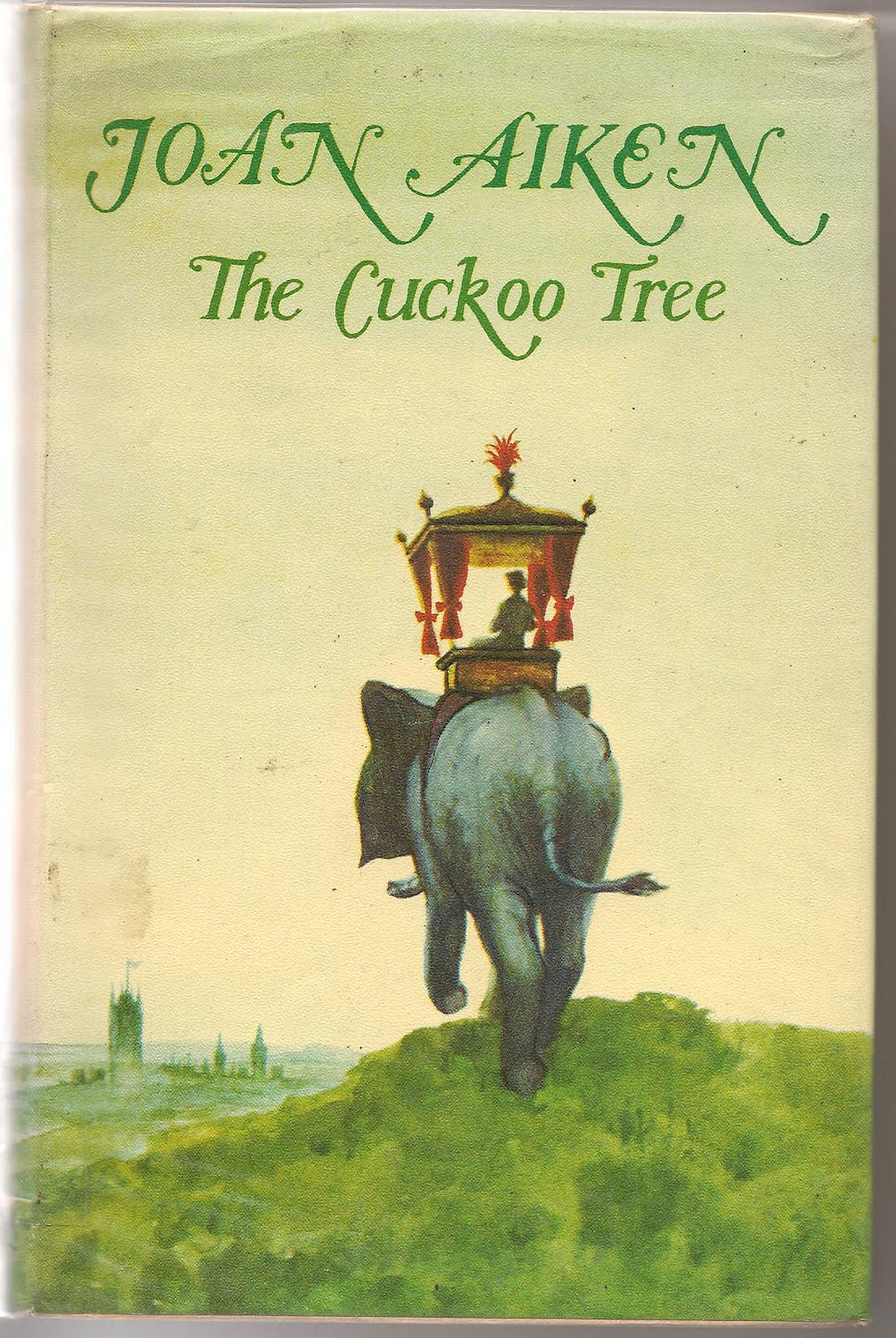
So is The Cuckoo Tree (1971) by Joan Aiken. On a wild November night some time in the middle of Aiken’s alternative 19th century, her gamine Cockney heroine the redoubtable Dido Twite is travelling from Bristol to London by coach, with her friend Captain Hughes of the Royal Navy. Shortly after singing this raucous little ditty:

Captain Hughes and young Miss Twite

Went for a drive – hic! – one shiny night,

If they don’t end in the Cuckoo Tree

Pickle my brains in eau d vie!

– the drunken driver overturns the coach; Captain Hughes is injured and Dido is compelled to seek shelter for them both in sleazy Dogkennel Cottages, just down the road from neglected Tegleaze Manor. She is soon up to her neck in a plot involving smugglers, missing heirs, voodoo, witchcraft, and a scheme to send St Paul’s Cathedral crashing into the Thames with a full coronation ceremony going on inside.  Joan Aiken at her wildly imaginative, quirky best. Unbeatable!

Linnets and Valerians (1964) is Elizabeth Goudge’s best book for children, better than ‘The Little White Horse’, though I love that too.  But this book is deeper, full of the harm human beings can do to one another, of darkness and loss and the waste of lives: but ultimately also of the strength of goodness to drive out evil.  Like ‘Down In the Cellar’ it features a large family of children. These – two boys and two girls – run away in a stolen pony-trap and end up living with stern but upright Uncle Ambrose high on Dartmoor, in a village reminiscent of Widdecombe.  They soon find the village is divided by old tragedy and hatreds. Is Emma Cobley, the postmistress, really the sweet old lady she seems? Who is the strange, dumb wild man who lives in a cave up on Shining Tor?  And what is the secret of the wonderful tapestry in the Manor house, and the book of black spells hidden away in a secret cupboard in the Vicarage? This hauntingly lovely book is one of my all-time favourites.

Finally I have to choose Alan Garner’s The Moon of Gomrath (1963): it made such a huge impression on me as a child. The sequel to ‘The Weirdstone of Brisingamen’, for me it’s an even richer and more exciting blend of Norse and Celtic mythology in (what was then) a contemporary setting.  So many wonderful moments – the shapeless Brollachan which flows into Susan’s body and begins to warp it, the old straight track that turns to moonsilver or curling flame, the mad, exhilarating ride of the Wild Hunt with their thrilling cry “Ride, Einheriar of the Herlathing!” and the long vigil of the elves outside the ruined manor house which is, creepily, only there when the full moon shines…  If I may add as an aside to modern publishers, the fact that aged ten I had no idea how to pronounce the Wild Hunt’s thrilling cry, “Ride, Einheriar of the Herlathing!” made not the slightest difference to my delight in the story.


Charity Norman on See You in September

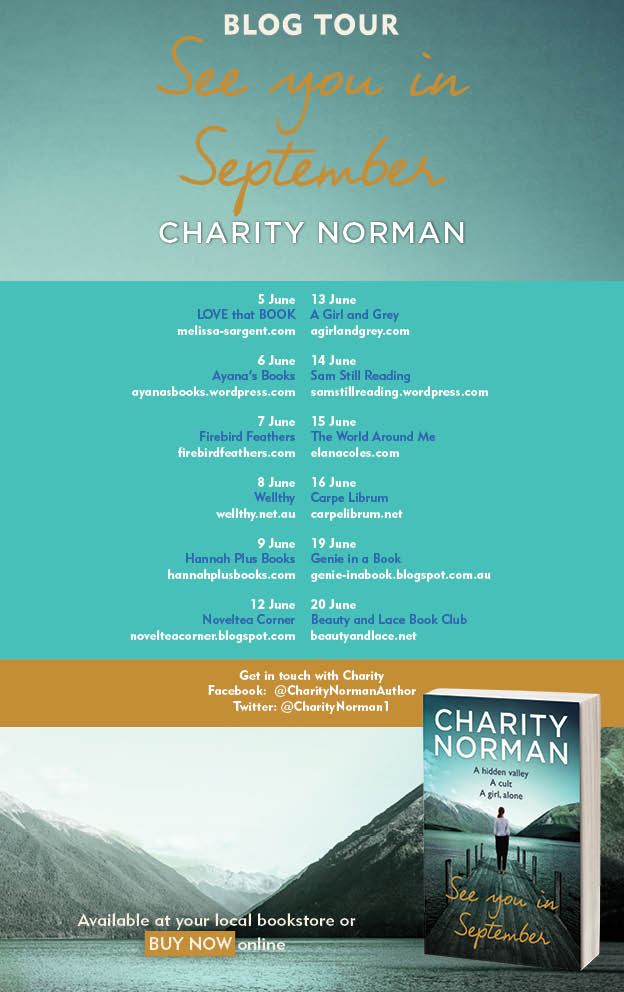
Today I’m very pleased that Feathers of the Firebird is part of the blog tour for Charity Norman and her gripping new novel, See You in September. In this guest post, Charity writes about the hard editing work behind the polished surface of a new work.

The devil’s in the detail

By Charity Norman

I used to think that, once a book was ‘at the publishers’, the writer’s work was done. It was like making a cake: the writer would deliver a typescript, and a novel would emerge a few months later, shiny and beautifully jacketed.

Boy, do I know better now. It’s wonderful to finish the first draft of a novel (which in itself is probably the tenth draft!) and be ready for a publisher to see it – but even if they like it, there’s a lot of work still to be done.

First, there may be a structural edit, perhaps even a major rewrite. This was the case with See You in September. And when that’s done, there’s copy-editing: a line-by–line check. Some writers hate this part of the process, but I love it. I’m so grateful that a sharp-eyed professional has given their time to combing through every word, every comma, checking that I haven’t used the same adjective twice in two pages, or a malapropism, or some grammatical howler. We all have little tics, expressions we use too often – they are there to spot those. They save a writer from themselves.

Often there’s a short time frame for checking all the suggestions. And although I enjoy it, eventually my head begins to spin. Thousands of small decisions: should this be a semicolon? Is this word quite right? Is it fish-and-chips or fish and chips? It’s easy for the whole thing to grow out of perspective. Nothing in the world matters as much as that darned comma! My whole career is riding on it! There will be thousands of Amazon reviews sneering at that adverb!

That’s when my family gently steer me away, and suggest it’s time I went for a walk.

See you in September by Charity Norman is published by Allen & Unwin, RRP $29.99, available now.

More about See You in September:

It was supposed to be just a short holiday… but when Cassy is lured to an idyllic valley called Gethsemane it’s years before her friends and family see her again. Can her family rescue her before it’s too late? A dazzling, gripping new novel about a young woman lured into a clutches of a doomsday cult by its charismatic leader, Justin.

Cassy smiled, blew them a kiss. ‘See you in September,’ she said. It was a throwaway line. Just words uttered casually by a young woman in a hurry. And then she’d gone.

It was supposed to be a short trip-a break in New Zealand before her best friend’s wedding. But when Cassy waved goodbye to her parents, they never dreamed that it would be years before they’d see her again.

Having broken up with her boyfriend, Cassy accepts an invitation to stay in an idyllic farming collective. Overcome by the peace and beauty of the valley and swept up in the charisma of Justin, the community’s leader, Cassy becomes convinced that she has to stay.

As Cassy becomes more and more entrenched in the group’s rituals and beliefs, her frantic parents fight to bring her home-before Justin’s prophesied Last Day can come to pass.

A powerful story of family, faith and finding yourself, See You in September is an unputdownable new novel from this hugely compelling author.

More about Charity Norman:
Charity Norman was born in Uganda and brought up in successive draughty vicarages in Yorkshire and Birmingham. After several years’ travel she became a barrister, specialising in crime and family law in the northeast of England. Also a mediator, she is passionate about the power of communication to slice through the knots. In 2002, realising that her three children had barely met her, she took a break from the law and moved with her family to New Zealand. Her first novel, Freeing Grace, was published in 2010 and her second, Second Chances, in 2012 (published in the UK as After the Fall). The Son-in- Law, her third novel, was published in 2013. Her fourth novel, The Secret Life of Luke Livingstone (published in the U.K. as The New Woman) was published in 2015.

Five Favourites 22: Meredith Costain

Today’s five favourites have been chosen by Meredith Costain.

Ballet Shoes by Noel Streatfeild, with illustrations by Ruth Gervis

I have read this book so many times over the years it is falling apart. It made me long for a life in a genteel inner-city London, one of the three little ‘Fossil sisters’ tenderly cared for by a guardian and a no-nonsense and very proper English nanny, and earning their keep on the stage. The scene where they vow to get their names in history books has stayed with me forever (and set me on the path to becoming a writer). I devoured the rest of her books one after the other.

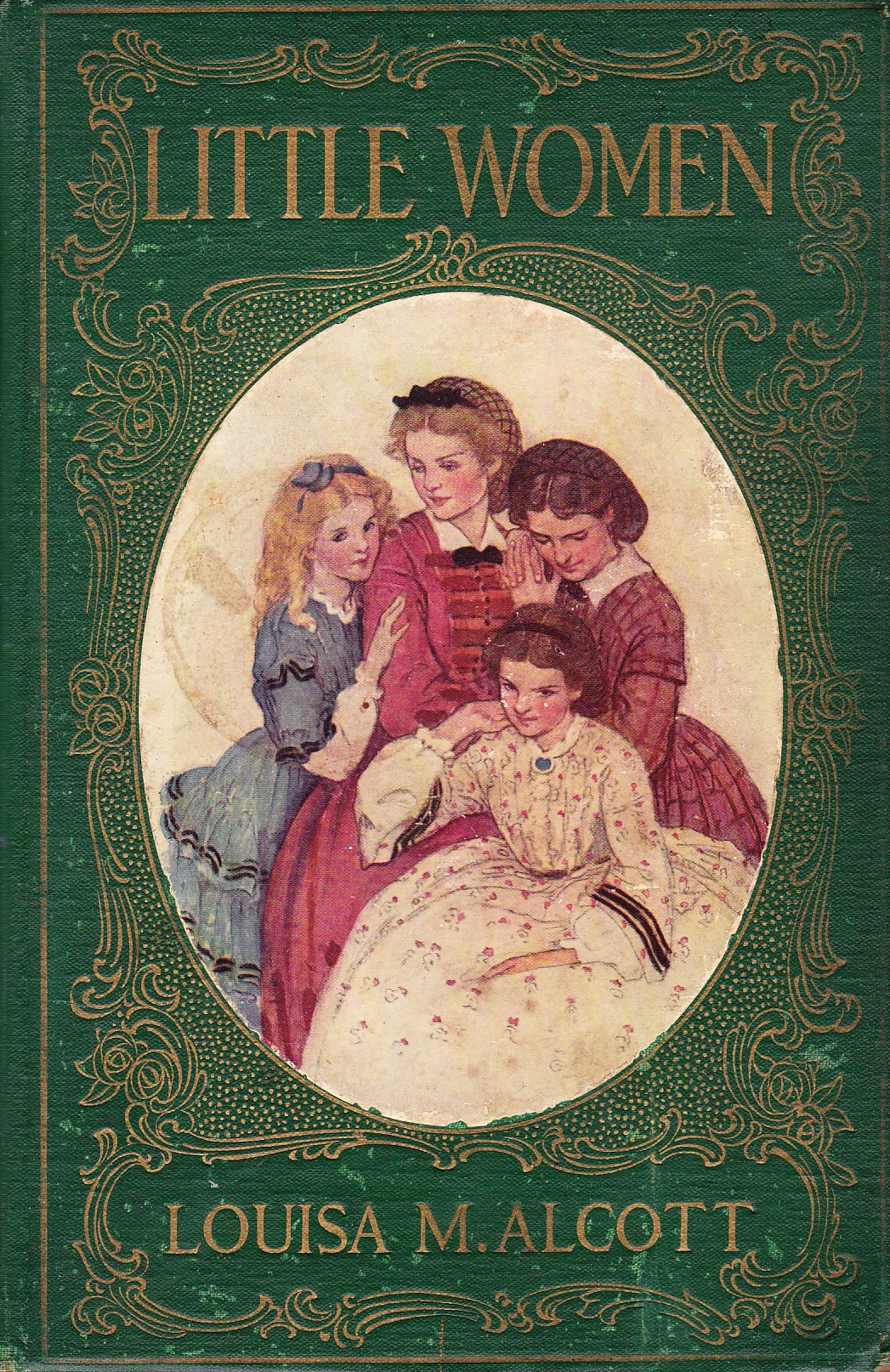
Little Women by Louisa May Alcott

I suspect I loved this book so much because I identified so strongly with Jo. She spent every spare moment she could reading, writing, crunching apples up a tree or acting out plays with her sisters. I also admired the family’s dogged insistence on making the best out of every situation: the scene where the four sisters are hand-hemming a bed sheet (hemming being something I hated doing myself) and imagining each seam was a new continent to be explored is wonderful.

When We Were Very Young by A A Milne, with illustrations by E H Shepard

We recited a lot of poetry in our house when I was growing up – and this book (along with Now We Are Six) contained some of my favourites: ‘Disobedience’, ‘The King’s Breakfast’, ‘Happiness’ and ‘At the Zoo’. All his writing had such wonderful, matter-of-fact rhythm that went marching through your head. The perfect companion to the perfect Winnie-the-Pooh.

A Book For Kids by C J Dennis

I went to a tiny two-roomed country primary school where our wonderful teacher shared his love of rhythm and rhyme (and the new kids on the block – The Beatles!) with us every day. He introduced us to the poetry of C J Dennis and I still know most of the poems off by heart, particularly ‘Hist!’, ‘The Ant Explorer’, and ‘Triantiwontigongolope’.


The How and Why Wonder Book of Dinosaurs by Darlene Geis, with illustrations by Kenyon Shannon

My brother and I fought for ownership over this book (I’m happy to say I won – it’s currently sitting on my ‘beloved books’ shelf). We spent hours poring over the words and images and had fun trying to pronounce their unpronounceable names (so different to the names of animals we had first-hand knowledge of: cow, dog, chook, rabbit, horse). The blend of hard facts and narrative and its conversational tone made it perfect for young readers desperate to find out more about these fabulous beasts from another world and time.

Finally, just want to add some ‘near misses’: I feel like I will have betrayed these lovely books if I don’t give them a mention as well!

Near misses: A Girl of the Limberlost by Gene Stratton-Porter, Ash Road and Hills End by Ivan Southall, What Katy Did and What Katy Did Next by Susan Coolidge, Emil and the Detectives by Erich Kästner, Warrior Scarlet by Rosemary Sutcliff.

http://www.meredithcostain.com

Five Favourites 21: Claire Corbett

Today Claire Corbett is presenting her five favourites.

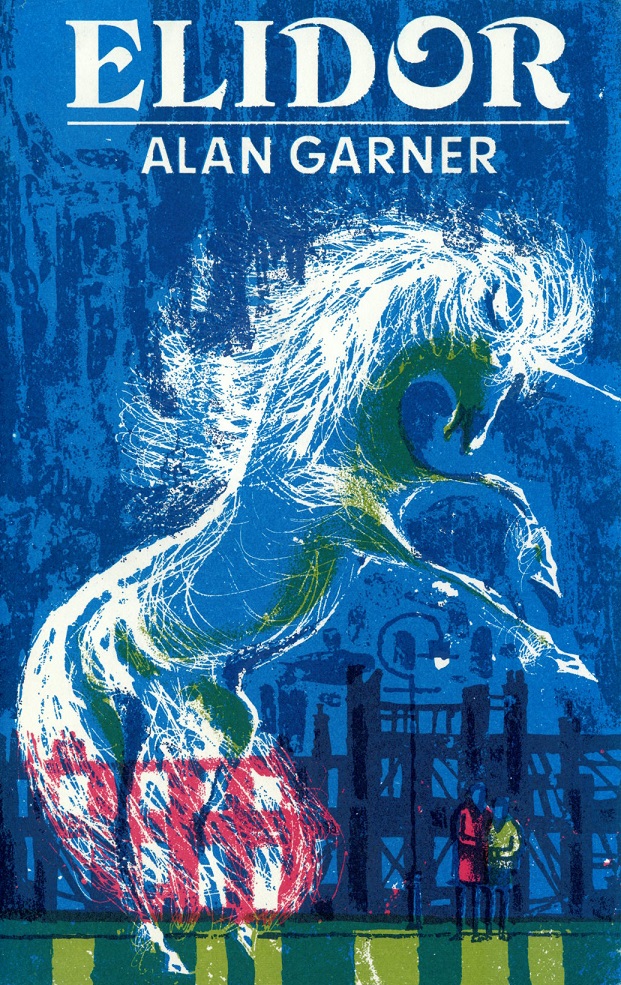
Elidor–Alan Garner–the anti-Narnia

This novel introduced my child self to the grown-up pleasures of having your heart broken by a book. Elidor, a slim novel published in 1965, is one of the greatest fantasy novels ever written. It lures you in by beginning as a classic portal fantasy: that is, the main characters enter Elidor, ‘Green Isle of the Shadow of the Stars’, through a ruined church in the bombed-out suburbs of post-war Manchester. The four children find themselves in an eerie, dying land and encounter trials of evil magic before being entrusted with four relics they must guard back in Manchester to keep the last of the light alive in Elidor. But the darkness of Elidor follows them into their seemingly dull everyday world. Here the book becomes more SF horror than high fantasy (its moments of suburban satire intensifying the terror), with its ending modulating to tragedy in the key of Celtic Twilight.

This perfect book is described by Garner himself as the ‘anti-Narnia’. It is scary and sad and refuses the child reader the pleasure of exploring its fantasy world. Instead its terrors erupting onto the streets of Manchester are gripping; only as adults do we see how Elidor not only  parallels postwar England, but is of course itself England, with the adults in that fantasy land having no more idea of how to hold back the darkness than did the adults during World War Two. Garner has talked about how he used scientific parallels for magic in the book with static electricity being one form that Elidor’s magic takes in Manchester. This is how Garner weaves SF into his fantasy, and it’s a very powerful device, making the magic feel real in his modern setting and denying the reader the comfort that scientific rationality will defeat the darkness.

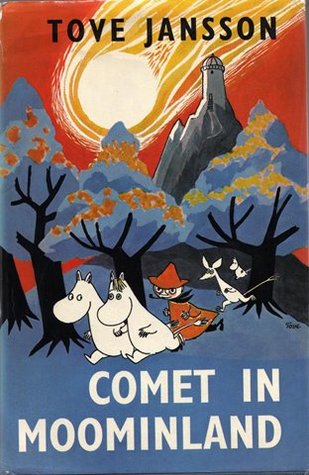
Comet in Moominland – Tove Jansson – the Romantic Sublime

All of the Moomintroll books are enchanting but this book deals in the Romantic sublime. This captivated my child’s imagination before I ever heard of the concept of the sublime – the shiver of awe we feel at the beauty and terror of that which is great beyond human understanding: sheer mountains, vast Deeps, the infinite reach and darkness of space. This book delivers all of that as Moomintroll and his friends go on a quest to the Lonely Mountains to ask the astronomers what to do about the Comet threatening Earth. This book even has a kickass heroine in the form of the vain Snork Maiden, who saves Moomintroll from a giant octopus.

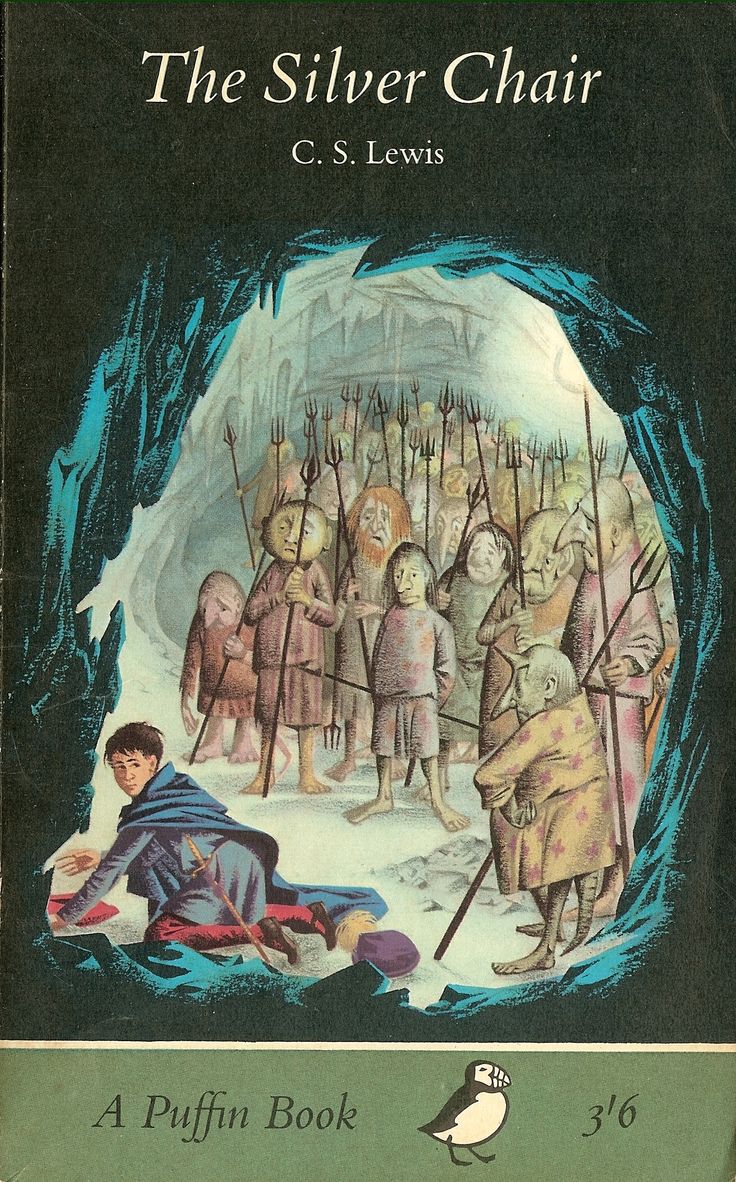
The Silver Chair – CS Lewis – Plato’s cave

The darkest, most Gothic and most convincing Narnia tale. I loved it for its epic quest through terrifying settings and its philosophical meditations on the nature of reality. Its pivotal scene is a gripping retelling of the parable of Plato’s cave (of course as a child I didn’t know this). As always with Lewis, the villain, challenging male authority, is a beautiful powerful woman, in this case a witch who kidnaps Prince Rilian, son of King Caspian. Using her engine of enslavement, the Silver Chair, she plans to turn the Prince into her puppet to allow her to rule Narnia.

Two children, Eustace Scrubb (the reformed brat from The Voyage of the Dawn Treader) and fellow victim of bullying Jill Pole, are sent on the quest to rescue Rilian by teaming up with one of Lewis’ most charming creations: the hilarious Marshwiggle Puddleglum, whose idea of looking on the bright side results in ghastly statements worthy of Eeyore such as: Now a job like this–a journey up north just as winter’s beginning, looking for a Prince that probably isn’t there, by way of a ruined city that no one has ever seen–will be just the thing. Puddleglum, one of the great pessimists of English literature, turns out to be the bravest and most stalwart friend any frightened child, or Prince, could ever wish for.

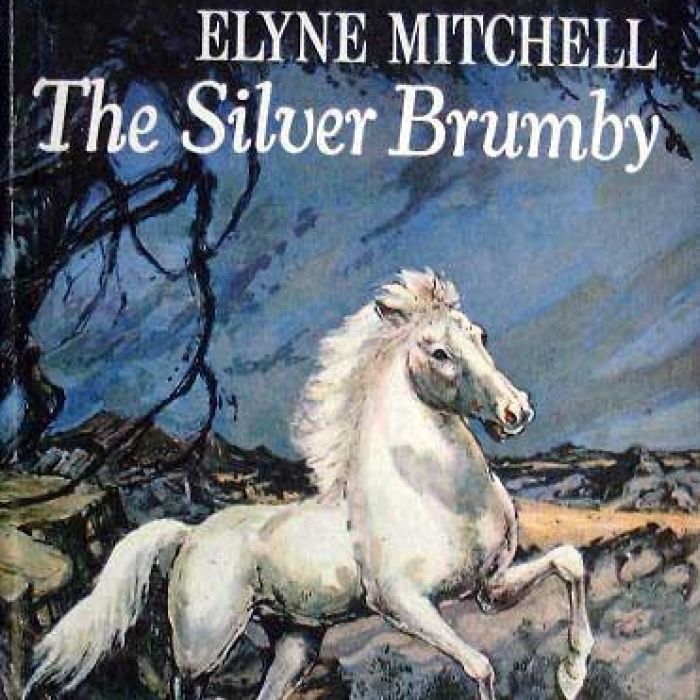
The Silver Brumby – Elyne Mitchell – the beauty of wildness

As a girl I loved horses and riding above anything except swimming. The thrill and danger of riding, the scent of gum trees and saddle leather and horse sweat, the exhaustion at the end of each day, all this was exhilarating. When I wasn’t riding, I loved reading horse books – Thunderhead by Mary O’Hara and the Black Stallion books by Walter Farley. When I came to Australia I was enchanted by the Silver Brumby books which not only thrilled me with tales of wild horses in the Snowy Mountains (I preferred wild horse stories) but introduced me to the beauty of the Australian bush.

1984 – George Orwell – language can corrupt thought

Freedom is Slavery. Ignorance is Strength. War is Peace.

This may seem an odd choice for a childhood favourite but so it was. I read it when I was twelve and instantly its images and lines and ideas were engraved on my brain. How true and how loud do those slogans ring now in our post-Trump election, post-truth world? For a writer, 1984 is the key text, its meditations on the relation of language to politics and consciousness some of the most important ever written: But if thought corrupts language, language can also corrupt thought. Orwell is one of our greatest writers whose work keeps language bright and sharp as a weapon against lies, a tool for truth against those who want to enslave our minds.

Five Favourites 20: Pamela Rushby

Today, Pamela Rushby writes about her five favourites.
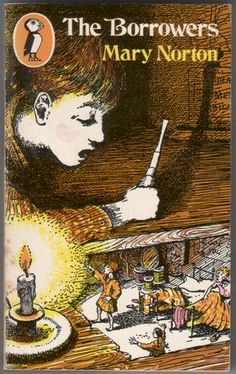
The Borrowers series by Mary Norton. Four-inch high people living secretly under the floorboards and in the walls? And scurrying out to ‘borrow’ things? You can’t scare me!
The Sword in the Stone,  T.H. White   I loved this for the use of old English expressions (eg where the hunting Tally-ho! comes from) and for strange facts such as the ‘monsters’ that people believed lived in far-away countries.
I Capture the Castle, Dodie Smith   My favourite book of all time. So romantic- girls living in poverty in a ruined castle. And then the rich Americans arrive. Sigh …
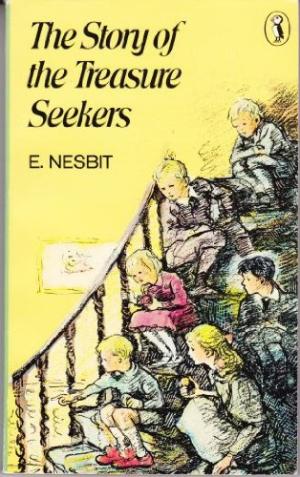
The Bastable series by E.Nesbit  eg The Story of the Treasure Seekers.  The children are so real – and the stories so clever.
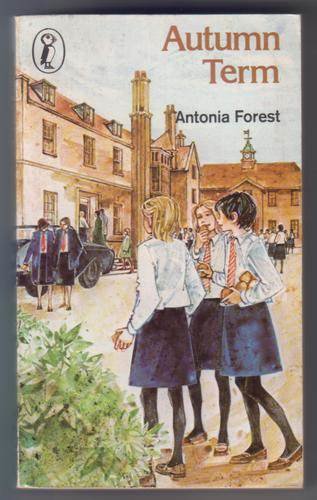
The Marlow series  by Antonia Forest   eg Autumn Term, Falconer’s Lure, The Attic Term,   Sisters at Boarding School, and In the Holidays. You’ve got to love an English boarding school story! Again, the characters are so real, and the situations they’re in very realistic. I also adored the way Antonia Forest started the series off just after WW2, and it finishes in what appears to be Swinging London times – but the characters have only aged a few years. So what? It’s fiction, isn’t it!
One more … The Little White Horse  by Elizabeth Goudge. I loved this as a child, and I was shattered to re-read it recently, and find that it now kind of made me want to vomit. Oh well …