Story behind the story 3: And Then authors on their contribution

Today in the And Then series we’re hearing from Alan Baxter (story in Vol 1),  Narrelle M. Harris, (story in Vol 1) and Michael Pryor (story in Vol 2)

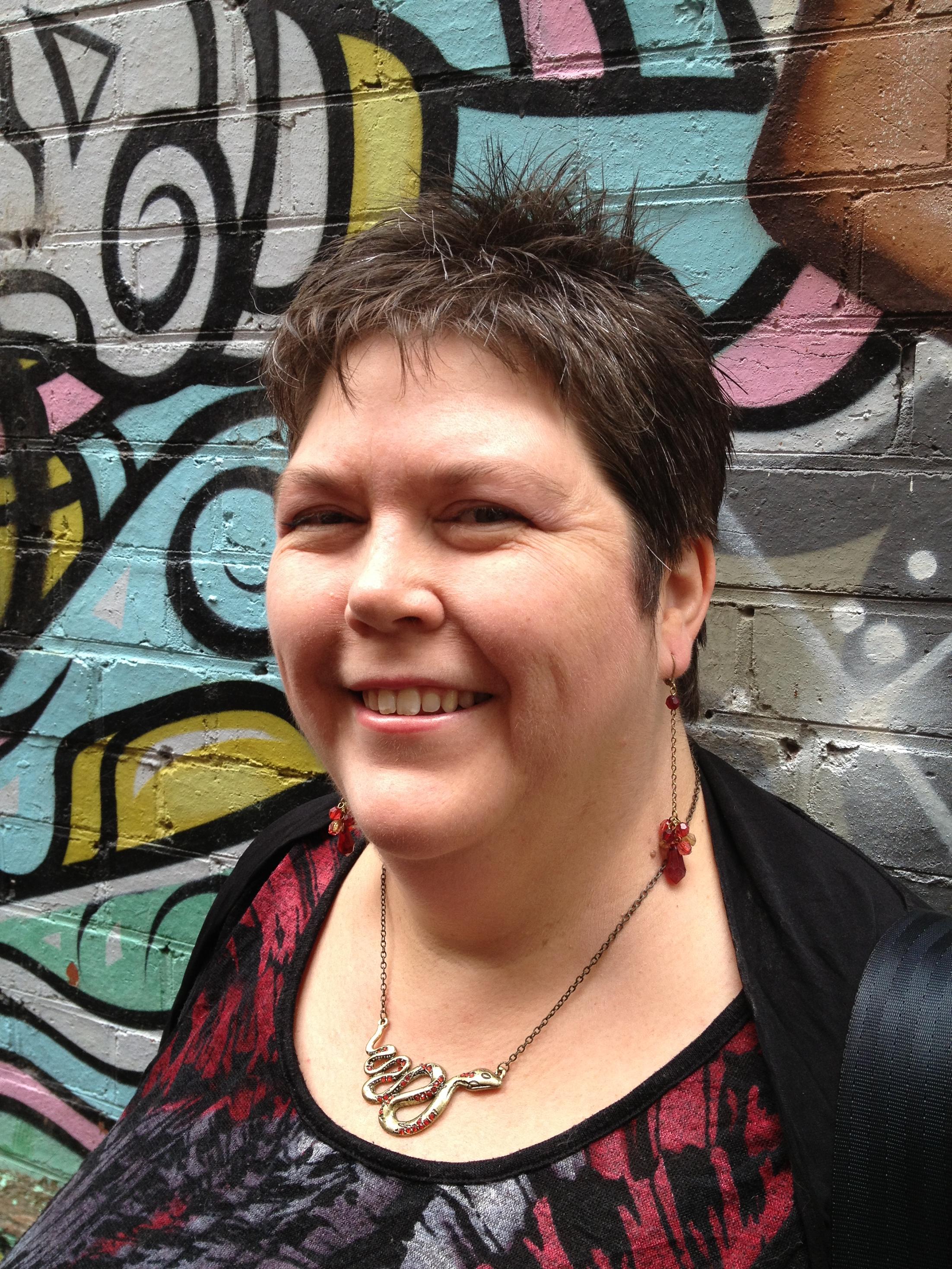
alan-by-nicole-web-crop-smallGolden Fortune Dragon Jade, Alan Baxter

My story was a chance to finally write something in the style of the wuxia and kung fu epics I’ve always loved so much. And being a kung fu instructor, with the majority of my life embedded in that culture and all it entails, it seemed I ought to write something related. The two protagonists are cousins, he a Shaolin monk, her an accomplished geomancer. The Shaolin monk, Yong Fa, is named after my teacher in a subtle homage to him, and the character shares some of my teacher’s irreverence and cheekiness, but is otherwise an entirely made up person. The geomancer, Zi Yi, is altogether more serious and focussed, but an accomplished mage in her own right. Together their skills are complimentary and that’s just as well when they realise the scale of their task, the distance they have to go to track down their missing jade dragon, and the kind of unforgiving country they’ll be led to. It was a hell of a lot of fun to write and I hope people have a lot of fun reading it too.

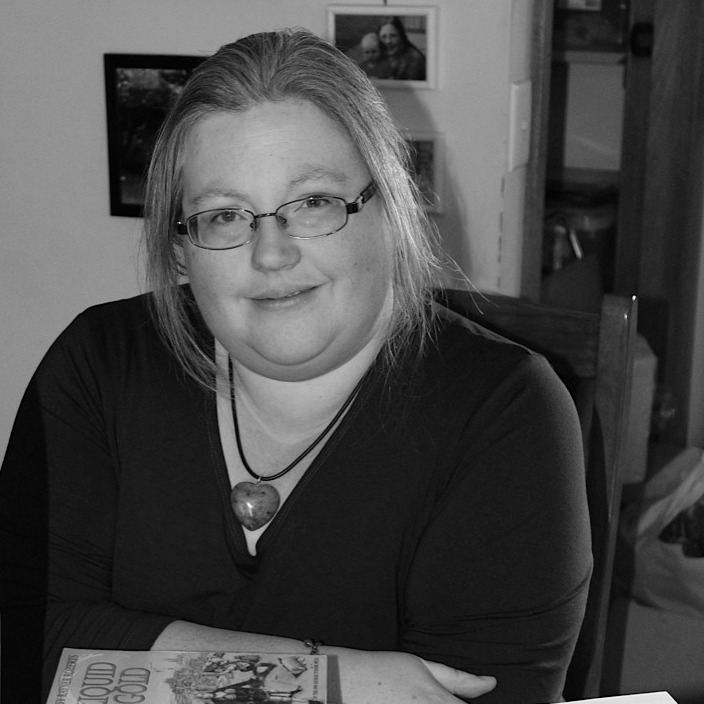
narrelle-m-harris-midVirgin Soil, Narrelle M Harris
The germ of my story came from an old building in Fitzroy, and the name, Moran and Cato, high above the streets. They were once a well known grocery chain. The building now houses the excellent Naked for Satan bar. I just liked the juxtaposition of the names, and the characters grew from there. Cato – clearly a man/rat shapeshifter. Moran, clearly a magically inclined offsider. But they were murky. Not necessarily good guys, though not necessarily bad guys. The grey guys, really. That’s how the story grew – I wanted them to do be doing dark magic but not for dark reasons. I also love writing stories set in Melbourne, whatever the era, and I’d been researching the 19th Century goldrush and Melbourne for another story, so that was a logical extension of where to set their adventure, especially since the goldrush was such a time of contrasting fortunes and full blooded adventure on its own.
(Note: You can also read an excerpt from the story here)

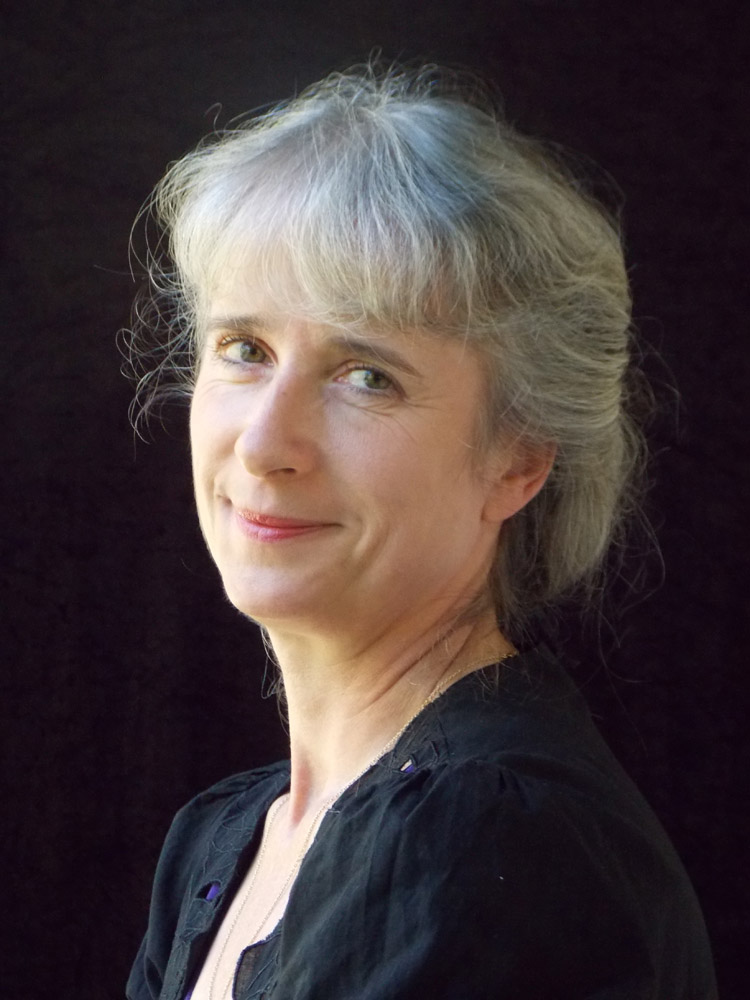
pryor2-lo-resCross Purposes, Michael Pryor

I’d been doing some unrelated research on the 1930s, and got side-tracked into reading about Errol Flynn. I started imagining what this rambunctious, charismatic ne’er do well would have got up to if he’d stayed in Australia. Adventures, I suspect, of the slightly rakish kind, all with that charming grin as his final defence. When the opportunity to contribute to ‘And Then’ came up, with a few tweaks, I had a character based on Flynn ready to go. Add to that a timely visit to Cooktown in Far North Queensland, an introduction to the Railway That Goes Nowhere, and the elements for a rip-roaring tale started to fall into place.

Story behind the story 2: And Then authors on their contribution

Today, we’ll hear from And Then contributors Tansy Rayner-Roberts(story in vol 1) Sarah Evans, (story in vol 2)  and Jason Franks (story in vol 1).

tansybwDeath at the Dragon Club, Tansy Rayner-Roberts
My story is one I had been toying with for a while — about a pair of retired assassins and siblings-of-choice who run away from their violent profession and end up joining a circus full of dragons… only to have their old and new worlds collide all over again. This book was a great excuse to write that story, and I’m so glad I did. I hold Kurt and Inga Frostad, and their beloved dragons and their snarky dialogue, very close to my heart, to the point that I got all soppy and nostalgic while proofing. And then I promptly started planning the sequel…


profile-photo-1Plumbing the Depths, Sarah Evans

Plumbing the Depths began life as an experimental entry in RWA’s First Kiss competition. I loved the idea of a vegetarian-turned-reluctant vampire canoodling (against her better judgement) with a gorgeous avenging angel. But the judges didn’t. Ho hum. The story was all but dead in the water.

Luckily vampires don’t die that easily. When CDP publisher Lindy Cameron asked for submissions for the And Then… I decided to revamp the vampire-angel story and give it a fresh twist.

Sure, the vampire, Matty Peters, was still reluctant to embrace the dark side, but the angel took on a totally new persona. From a dark and brooding love interest with a hip name, he morphed into Ted, an over-weight, retired cop caught in purgatory with his salvation relying heavily on the number of souls he can collect, including Matty’s.

Consequently, there’s no romance and definitely no canoodling. Instead, the unlikely couple end up joining forces to become very dodgy vampire slayers.

The result is a fast-paced, tongue-in-cheek adventure romp.

Enjoy!

jf_c_300pxExli and the Dragon, Jason Franks
When Lindy approached me about contributing to And Then… one of the things I liked best about it was that the brief was so wide open. I decided to take that as a challenge when I came up with “Exli and the Dragon”.
I haven’t written science fiction for a few years, so that was my first challenge: to reacquaint myself with the genre. I went at it like a glutton, helping myself to all the best bits: high performance space ships, grumpy robots, pew pew lasers and some actual, proper science. I had been wanting to write a story from the point of view of a creature that is completely non-human, so that gave me one of the two protagonists. The second protagonist is a human–something rare and strange in the galactic society in which this story takes place.
I also challenged myself to write an action story without violence. So, while our two roguish heroes face plenty of danger as they attempt to escape from space prison, neither of them are equipped for combat and they must find other ways to reach their goals. Mainly, though, I just tried to keep it twisty and fun. I hope you fine readers enjoy it.


A Writer’s Dream, guest post by Glenice Whitting

glenice-whitting-jpgI’m delighted to publish today a guest post by author Glenice Whitting. Her debut novel Pickle to Pie was shortlisted for the Victorian Premier’s Literary awards and won the Ilura Press International Fiction Quest.  During her studies from VCE to PhD she was invited to become a member of The Golden Key International Honour Society and awarded an APA scholarship. Her latest novel, ‘Something Missing’ will be published by MadeGlobal Publishing and launched at Swinburne University 11th December 2016. 

A Writer’s Dream

by Glenice Whitting

Writers often dream of being published and getting their work ‘out there’. I am no exception and I am delighted that my second novel will be launched in December 2016 by MadeGlobal Publishing. ‘Something Missing’ began life as my artefact for my PhD at Swinburne University. It is the story of  two women who changed each other’s life through a friendship that spanned two countries and many decades.

I had just completed my Masters of Creative Writing at Melbourne Uni as a mature aged student when my first novel, Pickle to Pie co-won the Ilura Press International Fiction Quest. This meant a cash advance, plus publication and I was beside myself with excitement. Pickle to Pie was the story of a boy, a great-hearted German Grossmutter and a man caught between two worlds. I had promised myself, if Pickle to Pie was ever published that I would give up my day job. Hairdressing had always augmented the family income through good times and bad. After the book launch I stuck to my promise and sold the salon. I knew I was not a J K Rowling, but I was happy.pickle-to-pie

I had often toyed with the idea of studying for my PhD but never dreamt it could happen. However, to be awarded an APA scholarship meant the opportunity to study at Swinburne University and I grabbed it with both hands. With the help of two supervisors I could learn the craft of writing and understand all the rules. I would then know why I was breaking them. This was my chance to spread my writing wings and fly to the moon.

Did I follow on from the German Australian story? Did I build on the shoe-box of old postcards written in High German found in the bottom of dad’s wardrobe after he died? Or the bookcase filled with A4 folders containing years of German/Australian research? Of course not. Instead, I decided to do what so many writers do. I chose to write something close to my heart: something entirely different. This time it would be a women’s story based on my thirty-five year pen-friendship with an older American poet. It would be a story about two women, a life changing pen-friendship and the lies that led them both to truth.

I wrote in my journal,

‘I am writing an epistolary, autoethnographic novel grounded in both feminism and post modernist paradigms with the aim of revealing women’s hidden stories in the hope of instigating social change. I believe this embedded story of the journey of self discovery and friendship will carry with it the possibility of nothing less than the restoration of faith in human kind.

What lofty aims, but here was a chance to use our letters, interspersed with text, to explore the influence this elderly poet had on a young woman who left school at fourteen to become a hairdresser: a woman who unconsciously yearned for the education given to her brother and denied to her. My ongoing journey into epistolary fiction using letter, diary and journal extracts, plus snippets of poetry, had begun.

For four years I am caught up in a world where my mind keeps bouncing backwards and forwards between my creative writing of this novel and the formal academic exegesis. I try to remain true to my research title;  A Novel and an Exegesis Beyond Epistolarity.

Friends warned me that I would have a meltdown post PhD, but I was convinced that would not happen to me. I was too strong, too resilient. That sort of breakdown only happened to other people. The wail of the ambulance soon bought me back to earth with a thud. To leave my wheelchair and walk on stage wearing the hired floppy Tudor bonnet and colourful gown was a highlight in my life. I had an overwhelming feeling of achievement and self worth that no one could take away from me.

The mature aged student journey from VCE to PhD had required passion, dogged determination and guts, but it had also been the most exciting, exhilarating time in my life. I knew I would miss it and all the friends I’d made along the way.

I took a long hard look at what I’d written, and following the suggestions of American author/editor, Cindy Vallar, I inserted quotation marks to all the dialogue and renamed the manuscript ‘Something Missing’. But, had I, over the years of study, begun to sound as if I’d swallowed a dictionary?

book-cover-newThe third rewrite of the entire manuscript is the one that is being published. It was an invaluable lesson. To be a writer I had to be myself and write the way I really wanted to write, from the heart. I took out the overarching second person narrating character, made both Maggie and Diane third person narration, threw in a handful of suspense and Voilà… ’Something Missing’ was born. It had gone beyond academia, beyond epistolarity into popular fiction. I was over the moon with excitement the day I received the email that Tim Ridgway and Melanie V Taylor of MadeGlobal Publishing loved the story and would be sending a contract etc.

I will always be grateful to fellow colleague and wonderful friend, Wendy J Dunn, author of Author of Dear Heart How Like You This, The Light in the Labyrinth, and Falling Pomegranate Seeds  who recommended I send the manuscript of my novel to her publisher .

It is every writer’s dream to hold their book in their hand. It gives them a chance to thank all the people who have helped along the way. There have been so many people I could list who have patiently and painstakingly worked with me through all three versions of this novel. However, there is an indescribable joy in finally being able to thank them formally, via the acknowledgment page, in the soon to be published last reincarnation of the manuscript, ‘Something Missing’.

 I have asked Wendy Dunn if she will endorse my novel. Below is her generous reply:

 Something Missing narrates the story of a life changing friendship that spans decades and two continents. It is a powerful and beautifully told story of how we grow through the power of friendship – and how relationships change over time. Empathetic, full of life’s truths and wise – Something Missing is a work that stays with you, and speaks to our hearts.  

Anzac Stories: Behind the Pages Exhibition and my part in it

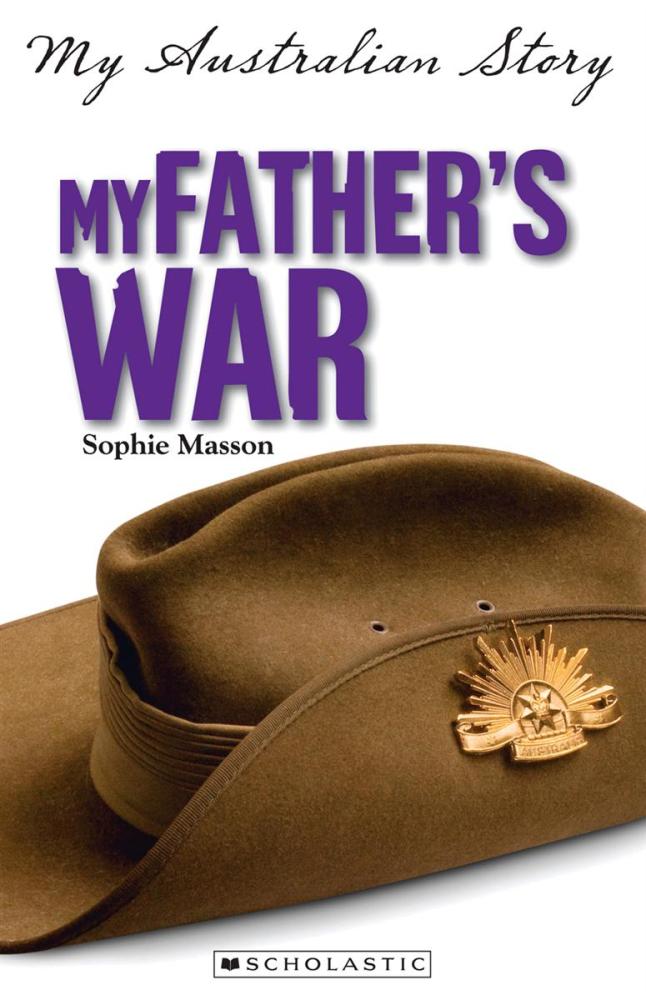
1914-coverI’m honoured to be part of the Anzac Stories: Behind the Pages exhibitions which will run throughout Australia in 2017 and 2018, and will showcase Australian and New Zealand contemporary children’s books set in wartime, and the stories behind the creation of those books. The exhibition is the brainchild of the fantastic New Zealand author Maria Gill, who initiated a similar exhibition in New Zealand earlier. Boards featuring individual books and writers will be exhibited in libraries across Australia. My two World War One novels, 1914 (Scholastic, 2014) and My Father’s War (Scholastic 2011) and the stories and research behind them, will be part of the exhibition. There’s also an Anzac Stories blog, with info about each book and a short interview with their writers. Here’s a little extract from minemy-father-s-war

Doing the research on the ground, in northern France especially, made it all become so real and so emotionally affecting. Both books blend my two main cultural influences: French and Australian, and that also felt like a very positive thing, especially as the ties between France and Australia forged during that terrible time are still very strong, particularly in the Somme region of northern France, where they have a saying, N’oublions jamais l’Australie : ‘Let us never forget Australia’

You can read the whole thing here.


Interview with Kenn Nesbitt, poet and compiler of One Minute till Bedtime

kennwithbooksIn 2014 I and many other writers received a lovely and unexpected invitation from prominent American children’s poet Kenn Nesbitt, asking if we would be interested in submitting poems for an anthology he was compiling, One Minute Till Bedtime, which would also include such contributors as Jack Prelutsky, Jon Scieszka, Jane Yolen, and Lemony Snicket. Talk about great company! And I was so thrilled when Kenn accepted my poem, Seagull Beach Party.

Two years later, and this week sees the publication of One Minute Till Bedtime. Containing the work of many poets from the US, UK, Australia and Canada, selected by Kenn, and beautifully illustrated by Christoph Niemann, the book is published by Little, Brown and is available around the world, including Australia. To celebrate its publication, I spoke to Kenn about the project, his own career, and children’s poetry in general.

First of all, congratulations on the publication of One Minute till Bedtime, Kenn! It’s lovely to see it out there. How did you come up with the idea for this unique poetry anthology?

Many years ago, the poet Bruce Lansky pointed out to me that most children’s poems can be read in an average of about one minute. Since then, I have tried to encourage teachers to take one minute of their school day to share a poem with their students.

When I was named Children’s Poet Laureate, I decided to create a website called PoetryMinute.org to give teachers a resource where they could easily find one-minute poems to share with their students for every day of the school year.

While I was in the process of creating this site, I was approached by Susan Rich at Little, Brown Books for Young Readers about creating a book around this idea of one-minute poems. She and I decided that bedtime might be the perfect time for a book of short poems, and One Minute till Bedtime was born.one-minute-till-bedtime

The contributing poets come from around the world. How did you go about sourcing poems for the anthology? 

Over the years that I have been writing children’s poems, I have developed relationships with many poets throughout the US, Canada, the UK and Australia. I called on many of these authors, and reached out to lots of other poets whose work I admire. Thank goodness for email and the Internet. A project like this would have been much more difficult 20 years ago!

With its wonderful poems, lively illustrations by Christoph Niemann, and attractive design, One Minute till Bedtime is a most appealing book for children and their parents. And obviously there’s a lot of work behind it. Can you tell us a bit about the process of putting together such a big project with the publisher, Little, Brown?

To begin, I wanted to create a collection that focused on the work of living, working children’s poets, rather than reprinting classic and public domain works. So I sent out a call for submissions to over 200 poets from around the world, looking for brand new poems that had never before appeared in print. I received submissions from roughly 170 different authors. I read them all, highlighting the ones that I thought might work. Once I knew which poems I wanted to include, I printed them all out and spread the papers around my dining room table, looking for natural pairings between poems and organizing them into sections.

Along the way, I tracked everything with spreadsheets, including submissions, selections, the order of the poems, and so on. While I was doing this, Little, Brown was on the hunt for just the right illustrator. Christoph Neimann was a truly inspired choice. His simple, yet incredibly clever illustrations compliment the poems perfectly.

Once the manuscript was completed, Little, Brown began working with Christoph on the illustrations and with me on the process of proofreading, editing, typesetting, and troubleshooting.

In the end, it all came together beautifully. I couldn’t be more proud of this book.

You are a popular and much-published poet. Can you tell us something about your own career, and how you started? What do you think has changed, if anything, over the time you’ve been published, in terms of attitudes to poetry for children?

I began writing poems as a hobby for my own amusement. I wrote for several years before I ever considered trying to get published. I also created a website, poetry4kids.com, in 1997 to share my work with readers online. I had my first poems published in 1998 in an anthology called Miles of Smiles. My first book, The Aliens Have Landed at Our School! was published in 2001. Since then, I have written many more books of children’s poetry, as well as a couple of picture books and a chapter book.

It seems that there are more poets writing for children today than ever before. At the same time, there are fewer individual poetry collections being published. Many children’s poets have instead turned their talents to writing picture books, novels in verse, etc. Large hardcover collections, such as those of Shel Silverstein and Jack Prelutsky, are becoming rare as hens’ teeth. Recent books by Alan Katz and Calef Brown are notable exceptions.

It is my hope that One Minute till Bedtime will not only introduce a new generation of parents and children to the joy of poetry, and showcase the works of today’s best children’s poets, but will also show publishers that poetry is worth pursuing.

You are the US Children’s Poetry Laureate and a tireless advocate for poetry. Why do you think poetry is so important for children? And what more do you think could be done to enhance children’s access to poetry?

I was the Children’s Poet Laureate from 2013-2015. Although I’ve passed that torch to my successor, Jacqueline Woodson, I continue to promote poetry to children, parents, and teachers around the world.

I believe poetry is important for children because it is short, fun, and memorable. (Everyone remembers something by Mother Goose, Dr. Seuss, and probably several other poets of childhood.) This combination makes poetry an easy springboard to reading and writing. Introducing children to poetry can help make them lifelong lovers of the written word.

The best champions for poetry are the earliest ones; parents and teachers. I believe the best way to enhance children’s access to poetry is to encourage parents to read to their kids, and to ask teachers to share poetry in their classrooms. Once they do, they will find that kids can’t get enough.

Interview with Therese Walsh, editor of Author in Progress

12803300_10207051919154843_5638323324479667397_nSome years ago–I think it was back in 2008–I was invited to become a regular contributor to the international writing blog, Writer Unboxed, founded by US writers Therese Walsh and Kathleen Bolton two years previously. Their idea was to create a community of writers who would find guidance, support and encouragement in WU, as well as great advice and tips. That’s certainly proven to be the case, and Writer Unboxed is one of the most popular and respected writing blogs in the world today, garnering several awards as well as an ever-increasing list of followers, a very active Facebook and Twitter presence, and the hosting of a unique conference–or Unconference, as it’s titled!

And now comes the next step: a book which gathers together a great deal of individual and collective wisdom and advice from Writer Unboxed contributors and community. Author in Progress: A No-Holds Guide to What it Really Takes to Get Published (Writers’ Digest Books), is being released today, November 1 and will be available from online booksellers such as Amazon, Barnes and Noble, etc, as well as the Writers’ Digest shop. Edited by Therese Walsh, and with an introduction by respected author James Scott Bell, it features over 50 essays from novelists, editors, agents and contributors from the WU community. The book goes well beyond the usual run of how-to-get-published books: from discussing reasons why people want to write right up to post-publication issues, and much more in between. I’m delighted to say by the way that I have an essay in the book, which is called ‘Writer as Phoenix’, and is in the final section of the book.

And today, I’m delighted to celebrate the publication day of Author in Progress by featuring an interview with its initiator: writer and editor extraordinaire, Therese Walsh.

***************

Welcome to my blog, Therese! How did the idea for Author in Progress come about? What was your vision for the book, and how did that evolve as time went on?

Thanks for having me, Sophie, and for the opportunity to talk about Author in Progress.

The book came about after I met with Phil Sexton at the Writer’s Digest conference last summer (2015). He mentioned the idea of doing a book with them, and that took root with me over a month or so. I had a follow-up phone call with Phil, and he mentioned the freedom we’d have to do the type of book we wanted to do. After that, the idea for Author in Progress fell into place rather quickly, as I considered what I knew to be true about writing a book – because there are some things I always say when someone who is not yet published asks, ‘How did you get published? What did you do?’

The book is broken into parts, following the stages a writer will likely go through on the road to publication: Pre-writing considerations, the writing itself, critique-related topics, educational considerations, rewriting, perseverance, and releasing the project once you’ve served the work.

Author in Progress is a very different kind of how-to writing book, as it doesn’t assume that the journey ends when your book is published. And it offers the advice and experience of many different contributors. How did you go about gathering and editing contributions from so many people?

Assigning essays was much easier than it might have been, in part because Writer Unboxed contributors are exceptional to work with (I’m not at all biased!). I think the other reason it was relatively easy was because of the adaptability of the contributors, in that many could write to several stages of the book. That said, there was a certain magic to the match-ups and I’m particularly pleased with how that went; everyone delivered something about an issue that resonated with them personally.

In terms of gathering and editing, I created a deadline for essayists to turn in their work and that deadline was met almost without exception. I then read over each essay, and suggested revisions when I thought they might make the book stronger. I then did a final edit for clarity—adding headers—and correcting for typos. This is what was then submitted to Writer’s Digest and our in-house editor there, who took everything to the next level in terms of polish and readiness for publication.

Author in Progress is aimed not only at aspiring authors, but also authors who have already been published. What do you think authors at different stages of their careers could get from this book?

One of the things authors will be able to see is that the stages of story creation are cyclical, repeating with every book. Sure, you learn things early on that you apply to each book thereafter, but that doesn’t mean you don’t hit each stage in some way. We’ve included some articles under a header called ‘Eye on the Prize,’ which addresses how a topic (e.g. critique) becomes important in a different way when you’re a published author (e.g. accepting notes from an agent, editor, even readers). We also have boxes throughout the book marked as ‘Pro Tips,’ which, again, help to root the reader in the reality of why something is important if you’re to make a career of writing.

All that said, I think the larger reason published novelists might want a copy of Author in Progress is because when we’re in the middle of a project—or at the start of one—we sometimes forget that all of this is normal. The anxiety, the doubt, the block, the research pitfalls, the need to go deep with character (and how to do that), the need to continue to learn and grow (and what steps you might take to push to the next level). I think even published authors need to remember that we’re not alone, and that the angst is part of the process, too.

Is there any particular tip or bit of advice that you would offer an author starting out on the journey–and those a bit further along?

I would tell that author starting out and an author a bit further along something similar. Writing a book is tough at times. Many of us might say, ‘If I knew how long it would take, what it would ask of me, maybe I wouldn’t have finished… But I’m glad that I did.” Perseverance is one of the key ingredients for any author in progress, and so I’d tell both of those writers to keep going, and remind them that they are not on that road alone. Truly, they are not.

The book is closely associated with Writer Unboxed, the writing blog you founded some years ago with Kathleen Bolton, which has become prominent and respected in both the author community and the publishing industry. Can you tell us about the blog, and about the insights into authorship it has given you?

Writer Unboxed  is my writing family, and it’s my hope that we are other writers’ online family as well. We are dedicated to producing content daily about the craft and business of fiction on our website, but it goes beyond that with our Facebook community (5,000+ writers strong in a promo-free zone) and our Twitter feed (@WriterUnboxed). Our ultimate goal is to provide positive and empowering support for writers of any genre.

I’ve learned a tremendous amount about writing simply by being present for the day-to-day business of the site, but I think the most crucial lesson is that it is truly a cyclical process. You envision. You create. You revise. You learn the lessons the book is there to teach you. You serve the work. You release. Repeat. As someone who hasn’t always had an easy road myself, there’s a lot of power for me personally in seeing that this process is what it is. It’s the job of being an author. It’s not always easy. In fact, it can be grueling and draining and crazy making at times. But it is a wonderful and gratifying thing to be able to do this job—build stories, reach readers. Writer Unboxed has helped me persevere to do just that.

Thank you again, Sophie. Write on!

redo-of-cover-copy


Visual writing or the joys of calligraphy, by Peter Taylor

Today I’m featuring an absolutely fabulous guest post by writer Peter Taylor, who’s also well-known as a calligrapher and artist-book constructor on how we can encourage children to create multi-faceted and unusual word magic. Enjoy!

Visual writing or the joys of calligraphy

Picture books are written to provide young children with a roller-coaster ride of emotions. Similarly, we plot a journey for the older reader, leaving spaces in the text so that they can use their imagination to see themselves beside the characters, but it’s by the way we tell the stories that we cause each reader to feel the characters’ pain, doubts and passion. In music, a simple change in key, harmony, melody or rhythm can shift a listener’s joy to deep despair (or the reverse) in a second, but it’s not so easy for a writer.  Perhaps it really is true that writers, who agonise over choosing perfect words, all wish they were musicians able to express themselves directly through their playing.

Calligrapher Ann Hechle has described how verbal orchestration in poetry also manipulates the depth of our feeling so that our mind, imagination and almost every part of us is engaged. The flow of Latinate words like ‘consider’ and ‘recognise’ contrasting with the thump in the guts Anglo-Saxon ‘gripe’, ‘groan’ and ‘grunt’; long and short vowels; tempo and stress; volume and density; onomatopoeia where sound shades into meaning–these are felt as physical sensations, stirring our brain’s deeper interpretation.

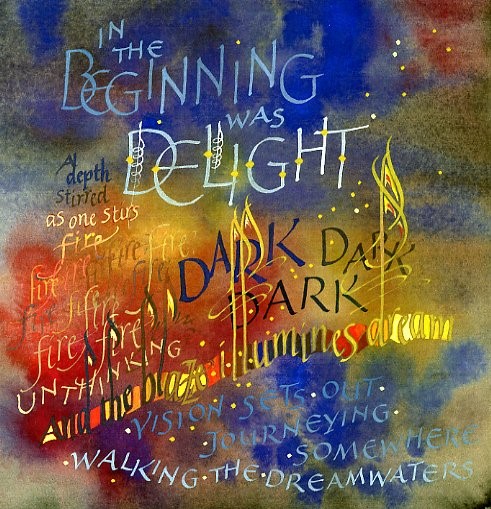
In such a world of feeling, it’s therefore surprising to me that children of all ages are not encouraged more often to interpret words visually, un-restrained by a standard size of letters and a requirement of regimented rows of words. Isn’t it natural to want to write about crashing waves by using letters and words that heave and tumble on …well …wave shaped lines, and in appropriate colours? And why not sometimes use larger and bolder letters for those words emphasised most in speech, as pioneered by Hechle in the 1960s? Such freedom may foster creative writing by children and adults alike, or engender an artistic response to any favourite text.

taylor-1

Text from Relearning the Alphabet by Denise Levertov

In the beginning was delight. A depth

stirred as one stirs fire unthinking.

Dark  dark  dark. And the blaze illumines dream.

Vision sets out

journeying somewhere,

walking the dreamwaters.

Designing the layout for words as an outward spiral may be appropriate for stories that unwind, such as: ‘Will you walk a little faster,’ said the whiting to a snail, ‘there’s a porpoise just behind us and he’s treading on my tail.’ Conversely, some stories wind up and can be written as an inward spiral, for example: ‘This is the cow with the crumpled horn that tossed the dog that worried the cat that killed the rat that lay in the house that Jack built.’ And as you will see, I have used this spiral technique and others in my combination of biblical passages.

taylor-2

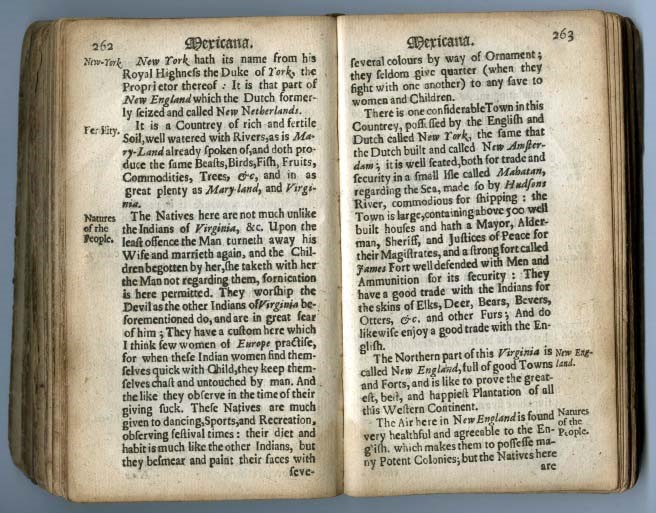
Not all children get hooked on reading and writing by initially listening to or reading stories. Some may arrive at the endpoint by predominantly first developing a love of words and of books as objects. When I stage a ‘Hands-on History of Books and Writing over 4000 Years’ experience in schools, even reluctant readers seem to enjoy handling a 2000 BC cuneiform clay sales docket, holding a hand-written vellum page from a 13th century medieval book without using white gloves, a page from one of the world’s first dictionaries printed in the 1480s, peeping inside Victorian picture books and deciphering a description of New York published in the 1679 that says that it has ‘…above 500 well-built houses’ amongst other treasures (and most then want to read more about early New York).


taylor-3-a


taylor-3


Some children may come to enjoy words and reading after calligraphic exploration. From playing with the word ‘rain’…taylor-4

…research could next find a poem that is fitting for similar presentation, with reading undertaken in the process enjoyed more than expected:

taylor-5

Poem: This Land by Ian Mudie

Designing calligraphic letter shapes can influence and add joy to creative writing, too. Letters with triangular serifs like webbed feet, for example, can give impetus to write about frogs, ducks or sea-gulls.

Verse by Peter Taylor, illustration by Anil Tortop

Verse by Peter Taylor, illustration by Anil Tortop

Sea fever, by John Masefield

Sea fever, by John Masefield

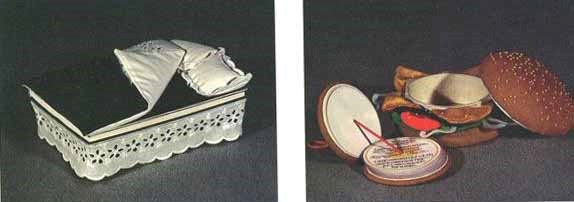
We can arouse young children’s interest in books with colour and quirkiness. But what sort of books are teens excited by? What kinds of bindings and book structures do they explore? I taught ‘Book Cover Design’ workshops to children aged 7 to 17 at the Queensland State Library. Participants used pens, scissors, paste and coloured and decorative papers to produce dust-jackets for Reference books of their choice (that were later re-shelved in their new covers). The children created the most eye-catching bold designs, but I wonder what they would have produced if they had been offered a wider range of materials and allowed more time, especially to read the books thoroughly. Would they have created a quilt cover for a book of poems titled On Going to Bed or placed hamburger recipes in a container shaped and covered to resemble a Big Mac?

taylor-8

Would they have modelled or sculpted mountain ranges to sit on top of the pages of Lord of the Rings, as famed designer-bookbinder Philip Smith has done?

taylor-10

Or designed a ‘Book Stack’, as Mike Stilkey does?

taylor-11

Maybe the children would have produced something even more original.

How many books do teens smell? Are they encouraged to write, design and bind their own books?

Is it possible that first creating a book with a special structure can provide the stimulus for writing a story to fit inside it? Or will a story provide ideas for a unique and satisfying way to display the text?

taylor-12


taylor-13


I hope children of all ages (and adults) are encouraged to explore the totality of the world of words, of language, writing, calligraphy, exciting layout designs and books of every form and structure until these become a rich, integral and important part of their lives. Sustenance for their creativity and creative thought. Let us give them experiences to savour and help them to respond with joy in their own way …to the extent that they want to bungee-jump into, read and devour our offerings of all genres with relish.

Peter Taylor’s first book was published in 1987 and he writes wacky verses, fiction and non-fiction for all ages. His picture book, ‘Once a Creepy Crocodile’ illustrated by Nina Rycroft and pub. The Five Mile Press was shortlisted for the 2015 Book of the Year award by Speech Pathology Australia. Peter is also an internationally respected calligrapher and artist’s book constructor, has been the Queensland Newsletter Editor for the Children’s Book Council of Australia, Co-ordinator of SCBWI Queensland and judge of the Dorothy Shaw Writing Competition for the deaf. He delights in sharing his extensive historical book and document collection and encouraging children and adults to love books, read, write and be creative. Peter offers workshops, talks and performances to libraries, schools and festivals. 


www.writing-for-children.com

http://brisbaneillustrators.com/peter-taylor.html

www.ptcalligraphy.com


A unique book project: an interview with romance writer Jan O’Hara

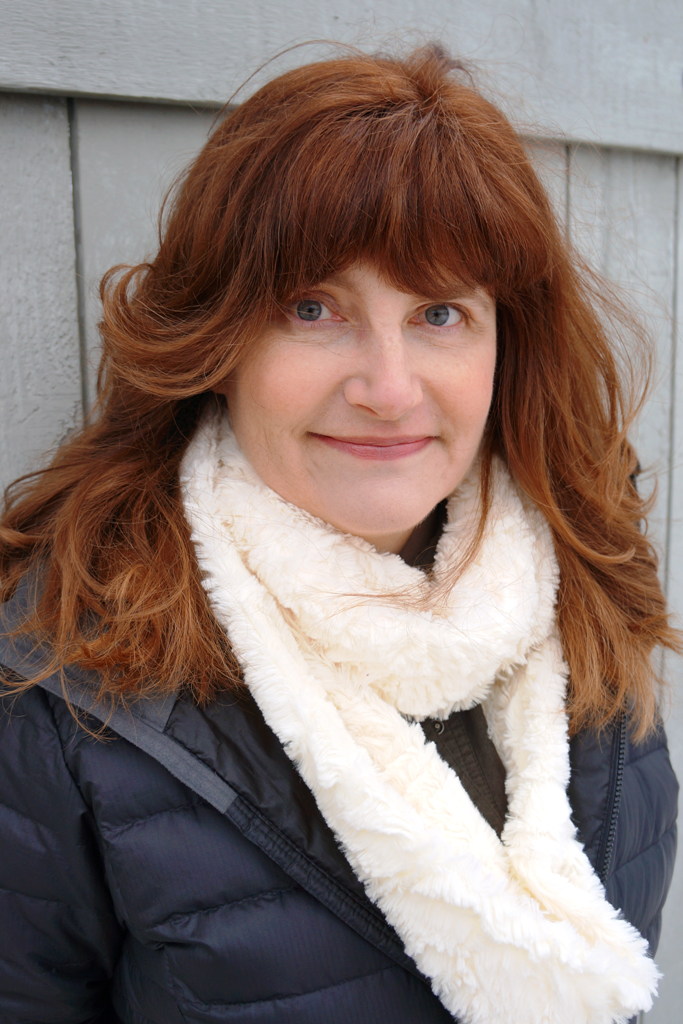
jan-ohara-writers-digestOnce a family doctor who prided herself on providing her patients with birth-to-death healthcare, Canadian writer Jan O’Hara has left medicine behind and now spends her days torturing people on paper. She writes for the popular blog, Writer Unboxed and lives in Alberta, Canada with her husband and two children.

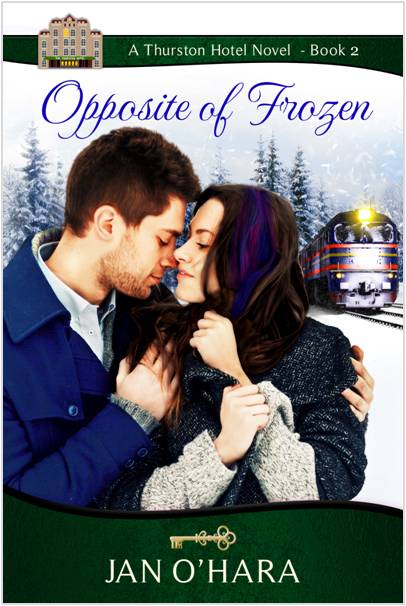
And today I’m interviewing her about her first novel, Opposite of Frozen, which has just been released and which is part of a unique and most intriguing series, the Thurston Hotel Books.

First of all, Jan, congratulations on the release of your novel, Opposite of Frozen! It’s the second in a unique, multi-author series. Can you tell us about that? How did it come about? And how did it develop?

Thank you for having me, Sophie. I’m honored.

My local chapter of the Romance Writers of America (https://www.calgaryrwa.com/) has a reputation for facilitating independent publishing and hybrid careers within its membership. In December of 2015, word went out that our treasurer, Brenda Sinclair, was looking to launch a group project, for which she had a very clear vision. I was interested because Brenda had participated in a similar project before, and had internalized many of the lessons learned during that time. Also, romance is a digital-friendly genre, and I was leaning toward independent publishing.

Accordingly, in a somewhat cloak-and-daggerish moment, the interested parties met secretly in a Calgary restaurant. Brenda loosely outlined the series idea: 12 standalone contemporary romances set in a fictitious town in the Alberta Rockies, revolving around the Thurston Hotel, its employees and long-term residents. Each author would take ownership of one month in the town’s life to tell their story. In addition to writing our own story arc, each book would tell a portion of a long-running series romance.

Brenda had already begun construction of a series bible—which she maintained throughout the entirety of the project. She had thought through the project deadlines, the cover artist, and the series editor. Her level of professionalism was vastly reassuring to this writer!

When all was said and done, 11 authors signed on, and Brenda, herself, agreed to write the first and last installments in the series. coverfinalmedwithgreyoof

Writing as part of such a unique series must have presented its own unique challenges! Tell us about how you constructed your story. And did the writing of your novel differ to other fictions you’ve written?

Though I have been writing a long time, I have never completed a piece of long-form fiction to what I consider publishable standards. As you might imagine, I was nervous about my abilities to do so while adapting my story to the requirements of 10 other writers. So from the first, I looked for a way to keep my story somewhat self-contained within the Thurston world. I wanted to limit the number of moving parts.

That was the impetus for having my characters arrive on a tour bus and depart from Harmony within the month I claimed. Also, for claiming an early month in the year, when I’d have to adapt to the fewest changes possible due to other author’s requirements. (In my case, I volunteered for February.)

Happily, those constraints ended up creating some of the story elements of which I’m most proud. For example, I needed a tour group to populate the bus, and who would most logically have the time for a prolonged multinational tour, but seniors? (I so enjoyed writing my seniors!) What unexpected event could complicate their February trip, but a hypothermic stowaway? What elements about the seniors’ lives could bring my co-protagonists together, and facilitate their healing? Etc.

I must say, it was thrilling and confidence-inducing to see how my brain could come up with story ideas to match the project’s requirements.

Also, I was dealing with time constraints and a gargantuan case of the Impostor Syndrome. Without a commitment to the other writers in the group, I’m not sure I’d have pushed through to completion. I do know OoF would not exist in its present form if not for the project’s boundaries and invitations.

The books are all set in the same town, although around different stories and characters. How did you all plan the background of the books–and will that evolve over time, or will you all keep to the same basic framework?

Between our first and second in-person meeting, each author wrote a story synopsis and shared it with the group, via private Facebook page. We also found avatars for our characters and constructed one-sheets, when applicable, so that other authors could use our characters in cameo appearances without much difficulty.

For more intensive cross-pollination, when using another writer’s characters, we sent relevant passages to one another, to ensure we weren’t violating a character’s personality or mannerisms. The same held true for micro-environments. For example, I borrowed Ellen Jorgy’ creation—a bar known as the Wobbly Dog—for several scenes in my book.

We made a good many decisions together, in-person, like the décor of the hotel, the final design of the cover art, the name of the town. Other decisions were made individually, and then coordinated with the group via Facebook.

For instance, I needed a store that sold computers, so I constructed the Tech and Tock, and invented its proprietors. One of the series continuity editors, Suzanne Stengl, then added it to the map of the town, which she maintained throughout the project.

I should mention that various authors contributed their skillset to make the project work on the whole. Win Day, for instance, used her technical background to construct the Thurston Hotel Books website. Sheila Seabrook helped with formatting issues. Everyone helped with title selection.

Without their direction, Opposite of Frozen would have been called Hypothermia and the Hottie. (A title which still makes me laugh, and would have been great for SEO, but doesn’t capture the spirit of the novel.)

Do authors in the group have input into each other other’s stories? Who edits the novels?

Beyond the planning I’ve mentioned, the group also benefited from the hard work of two continuity editors: Brenda Sinclair, who wore about five hats during this project, and Suzanne Stengl. They both read my book for continuity errors. Twice.

Then we all used the same editor, Ted Williams, for a final appraisal. He used the series bible for guidance and reportedly enjoyed seeing how Harmony came to life within different stories, told by different voices.

Tell us about the publication journey for the series. Will the books be available internationally?

We intend to put out a print version of the series in the near future. At present, the books are available exclusively in ebook via Amazon and the Kindle Lending Library, wherever Amazon exists.

The first installment was released September 29, 2016, and will be followed by another novel on each of the following 11 consecutive Thursdays. (We are using the hashtag #ThurstonThursday on Twitter and Facebook, if you’d like to follow along.)


******************

More about Opposite of Frozen:

Shepherd fifty-one seniors on a multinational bus tour, including a ninety-five-year-old with a lethal cane?

To preserve his sick brother’s travel business, retired pro athlete, Oliver Pike, would do far more. But then weather intervenes, forcing the tour bus off-route into the small mountain town of Harmony, Alberta.

In the hold of the bus, amid the walkers and luggage, lies a half-frozen stowaway. Page Maddux is commitment-averse and obviously lacking in common sense. Once revived, she’s also the person Oliver must depend upon to help him keep the “oldsters,” as she calls them, out of harm’s way.

When their week together is over, will Harmony recovery from the group’s escapades? And what of Oliver’s heart?

Jan’s website: http://janohara.net/

Facebook: http://facebook.com/janoharabooks/

Twitter: http://twitter.com/jan_ohara/

For more on the series itself: http://thurstonhotelbooks.com/

Writers reviewing books–an interview with Linda Newbery, Celia Rees and Adele Geras

Book reviewing is a real art, and one that in the last ten years or so has undergone many changes. In the past, most book reviews were published in print—in newspapers and magazines, as well as, occasionally on radio and TV. But today, as space in newspapers and magazines has shrunk, most book reviews are published online, on specialised sites, online publications, and blogs.

Today I’m interviewing three distinguished UK authors, Linda Newbery, Celia Rees and Adele Geras, who together have created a great new book review blog, called WritersReview. I was asked to be a guest reviewer on the blog recently, was intrigued by the concept, and wanted to know more!

linda-celia-adele

Left to right: Linda, Celia and Adele

Can you tell me about how and why you started WritersReview?

Linda: Recently I added a blog to my own website. I’d never had a blog before but I liked the idea of using mine for reviews, with maybe a post of two about my own work in progress or backlist titles, and contributions from writer friends. When I mentioned this to Celia, she came up with the better idea of a joint review blog. This appealed at once, as I knew that a joint blog would reach more readers and attract more contributors than I’d achieve on my own. Next time Celia and I met, we talked about how to organise the blog and decided to invite Adele to join us, knowing that she reads widely and enjoys reviewing.

All three of us have published widely for children and young adults but are now writing adult fiction, and our reviewing here is a way of extending our range. Collectively we have a great many contacts, which should make it easy to keep things turning over.

Celia: Linda and I don’t live too far from each other and we meet up every now again for a writerly chat. During one of our talks.  We started talking about reviewing, specifically online reviewing.  We both agreed that good reviewing sites were few and far between and that much of the reviewing was poor and unfair. We were both taken with the possibility of setting up a review site where writers could review other writers. Writers tend to be keen readers and are often experienced reviewers and would offer fairer, more balanced and better informed reviews than many to be found online. Linda went away and came back with some ideas for the review site. She suggested we invite Adele to join us as she’s an avid and omnivorous reader and highly respected reviewer. We would each invite other authors to make guest posts, to add variety, keep the posts current and gradually build the site. Adele and I are both History Girls and are familiar with Blogger, so that was the site we chose to use. Linda did the hard work, designing and setting up the site, sorting out teething problems and posting the first reviews.

Adele: It was really Linda’s brainchild and when she asked me to join in, and mentioned that she was asking no Celia too, I was really delighted. I’ve long felt that there were too few outlets for people’s opinions about books. Newspaper reviews and much that’s online concentrates on the eye catching, the best-selling, the obvious. Linda made her offer seem attractive by telling us we can write about what enthuses us, whatever it might be.

Another of her good ideas was to give us a chance to invite other writers to contribute as well. She did all the heavy lifting, setting up the site and making sure it looks as good as it does.

What is your vision for the site? And how do you think it might develop?

Linda: I’d like it to be wide-ranging and friendly. We, and our guests, can choose anything we like to review – anything, that is, other than children’s books (not because we have anything against them but because there are plenty of other sites that specialise in children’s). I’d like to include biography, nature writing and other non-fiction, possibly poetry – whatever we or our guests want to write about. And the books don’t have to be newly-published – part of the point is for writers to share their own enthusiasms and draw attention to books that have inspired or influenced them, or deserve to be read more widely.

I hope, as we go on, that we’ll build up a list of regular guests and that maybe people will even approach us, wanting to contribute. I hope, too, that readers will comment on our reviews and add their own opinions.

I’d love it if our blog became known and respected and if we saw our reviews quoted in publicity releases!

Adele: I’m hoping it’s the sort of site readers might go to a) to see what we’d enjoyed b) to get ideas about what they might enjoy c) to be able to comment freely about what they saw there.

Celia: From the first, we decided to review books for adults, rather than children’s or YA. That was the only rule. I guess we hope that the site will attract people who are interested in what we have to say about the books we review and to counterbalance some of the ill-informed and occasionally malicious reviews to be found in other places online. I would like to see Writers Review become a site that readers can trust and use as a guide to books that they might want to read.

How do you choose books for review? Are there types or genres of books you particularly want to concentrate on?

Linda: Many of the books won’t be chosen by us, but by our guests. We won’t, on the whole, allocate titles to reviewers, though there may be some exceptions.  I hope contemporary fiction will be well to the fore, but we’ll see how things develop without our intervention.

Celia: Other than the books have to be for adults, we can review what we like, any genre, fiction or non-fiction. The books can be newly published or old favourites. There is no pressure to review current books. Our choices are made on our own preferences, what we might be reading at the time, work we admire, books that we have enjoyed and think other readers might like, too.

Adele: It’s about sharing enthusiasms. Fiction or non-fiction, but books for adults. We are known mainly as children’s or YA writers, but wanted to go outside our perceived boundaries.

What do you think of the current situation for book reviewing today, against the background of the contemporary publishing climate?

Celia: I think that there has been a marked falling away in the standard of reviewing. The broadsheet newspapers remain the gold standard but book review space continues to be squeezed. The plethora of online reviewing sites is patchy at best and can be downright destructive and malicious. Real reviewing appears to be a dying art. Too few reviewers understand that a good review is more than an exhaustive synopsis and a few subjective opinions, or arbitrary judgements based on personal preferences, or trivial concerns like print quality or length. We have all seen shocking examples of books condemned, their star rating brought down for the most irrelevant and trivial of reasons and behind that is always the lurking spectre of sock puppetry. I’m also uneasy about the possible influence of the big publishing houses through the blandishments of their publicity departments, particularly on book bloggers. We might be swimming against a tsunami but I don’t think readers like to feel manipulated (I certainly don’t) and I hope that a site like ours might be trusted and valued by readers and publishers alike.

Adele: I think it’s very patchy. I’m not 100% sure how much reviews contribute to the success of a given book, but am sorrowfully concluding: not very much! How otherwise to account for so many LOW LOW sales for extremely well-reviewed books?

Linda: It seems that publishers have come to value review blogs, with space for print reviews so much in demand, and that online reviewing can be quite influential in passing on word-of-mouth recommendations. In the press, some books are widely reviewed while others get no coverage at all, and might as well be invisible. The ‘blog tour’ for a new book is now quite common, even for high-profile authors. So a blog like ours is likely to be appreciated by authors as well as by publishers.

Interview with Kristel Thornell, author of On The Blue Train

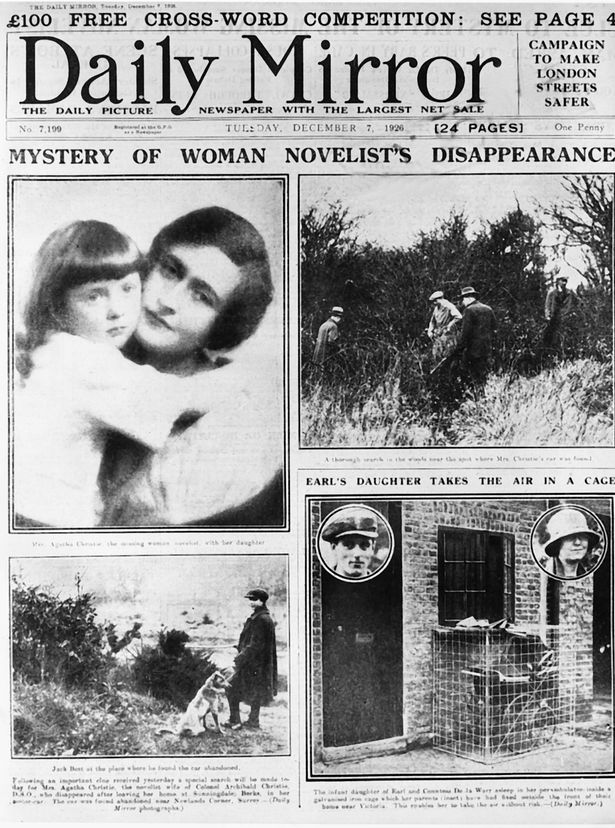
on-the-blue-trainIn December 1926, Agatha Christie, already the famous author of several detective novels, disappeared for eleven days. The press and the public were agog as a massive investigation employing more than a thousand police officers was mounted, and after her car was found abandoned, great fears were held for her safety. As titillating details emerged about the traumatic events surrounding her disappearance–her husband’s demand for a divorce on top of his infidelity, and her beloved mother’s death–the public joined in the hunt, with hundreds of amateur detectives combing for clues. Even other mystery writers joined in the hunt, including Arthur Conan Doyle and Dorothy L.Sayers! Eleven days after she first went missing, Agatha was discovered in a spa hotel in Harrogate in Yorkshire, where she was staying under the name of Teresa Neele–poignantly, the surname of her husband’s mistress.

There have been many speculations, then as now, as to what really happened. Agatha herself never explained those missing eleven days. An intensely private, even shy woman, the trauma of the time when she was in the full glare of remorseless publicity never left her, even though she went on to become a mega-selling ‘Queen of Crime’. Even today she is the most best-selling novelist of all time, with literally billions of books sold.

Now young Australian author Kristel Thornell has written a novel which, with great deftness and sensitivity, imagines what those eleven days might have been like. Foregrounding both Agatha herself and the fictional character of Australian Harry McKenna, similarly bruised by life, she draws a convincing portrait of heartbreak, the beginning of healing, and the challenges and consolations of creativity. It’s a wonderful novel which is also a touching tribute to Agatha’s unique creative gift, informed by a great deal of research. And so today I’m delighted to bring readers a fascinating interview with Kristel Thornell, in which she talks about the creation of her novel, On the Blue Train (Allen and Unwin, out now).  kristel-thornekll-better

How did you first come up with the idea for the novel?

I heard a fragment of a radio program that mentioned Christie’s “disappearance” and I was very taken with the idea of a young writer living under a pseudonym for eleven days. Perhaps because writing itself can resemble living under a pseudonym, and this parallel intrigued me. I was particularly interested in the tension suggested between public and private selves. I found myself vividly picturing a troubled, resourceful woman arriving at a hotel in the north of England in an unusual state of consciousness. I thought it could be an interesting challenge to try to give fictional depth to such an experience, exploring the combination of disorientation and freedom she might have felt. I was attracted to writing a sort of psychological mystery. One that, without being a detective novel, would salute what I most enjoy in that genre – transporting atmosphere, a hypnotic flow, the heightened awareness of details, moments, and buried impulses.

What research did you do, and what were the challenges in researching such a famous, but also mysterious episode in Agatha Christie’s life?

I began with the biographies of Christie by Janet Morgan and Laura Thompson, Christie’s autobiography, and her early novels. In the UK, I read newspapers covering her disappearance and the archive of her papers at the University of Exeter. A central part of the process was spending time in Torquay, where she grew up and loved to return, Newlands Corner, the area from which she “disappeared”, and Harrogate, where she lived for those days as Teresa Neele. In Harrogate, I stayed at the hotel she stayed at (which still exists), for the same period of time she was there, absorbing the ambience and learning to inhabit my character.

Agatha Christie in 1926

Agatha Christie in 1926

The blanks in the official record gave me a certain sense of being at liberty to invent, but it was a challenge to avoid preconceived ideas and put aside, as it were, Christie the icon, Christie the phenomenon. I had to avoid anachronistically projecting all of that symbolic weight onto my vision of a young writer. It also felt crucial to allow myself to freely imagine within the biographical contours, and to approach the biographical material itself in my own way.

You have deftly mixed your own imaginings with what’s known about what happened. How did you negotiate the intersection between fact and fiction?

This was somewhat more straightforward with “On the Blue Train” than it was with my previous novel (inspired by the Australian landscape painter Clarice Beckett). With the earlier novel, I worked with biographical facts quite loosely, sometimes purposely altering them. With “On the Blue Train”, I aimed to incorporate the known facts of Christie’s disappearance and life up until that time into the imaginary world of the novel. I didn’t consciously change anything factual that appeared significant to me. Though I was aware, of course, that simply to fictionalize a fact is to reimagine it. To shape it with language, frame and illuminate it in particular ways, give it a tone. So that even the biographical becomes semi-biographical, novelistic.

There have been many theories concerning Christie’s disappearance, ranging from amnesiac fugue to a cynical publicity stunt mixed with revenge against her unfaithful husband. In your version, Agatha is aware that she is not who she is telling the world she is, yet she cannot cope with the fact of who she is and what has happened–a syndrome perhaps like post traumatic shock. How difficult was it to portray the state Agatha is in?

Finding a voice to convey that state was the key to the whole project. Laura Thompson, who wrote the 2007 biography of Christie, sees her mental state during that episode as semi-rational, somehow poetic, and this rang true to me. Such a condition plausibly fit the omission in Christie’s autobiography. I saw the fictional Agatha/Teresa as fluctuating between extreme sensitivity and numbness, and, increasingly, a sort of playful, creative spirit, a reawakening sensuality. She was both guiding herself and drifting. I wanted the novel’s voice to reflect these complexities: to be hypnotic, slightly hallucinatory, and inflected, indeed, with shock, grief, shame, and anxiety. The voice actually came quite intuitively. I identified with it deeply.

The pain of what Agatha is going through as she struggles with the realisation that her world has come crashing down is exacerbated by her inability to write a word of the book she was planning–which of course ended up being Murder on the Blue Train. Was this episode in Agatha’s life a turning point in terms of her art as much as her personal life, and if so in what way?

Yes, it would appear so. It was at around this time that she came to see herself as a professional author. She had already been working in a determined, focused way, aware that her work could earn money. Earlier in 1926, she had published “The Murder of Roger Ackroyd”, which had done very well. However, in her autobiography she describes the experience of having to force herself to finish “The Mystery of the Blue Train” (which she was finally able to largely complete in 1928 in Tenerife) as transitional. This was the crossing over into the life of a true working writer, one who writes whether or not she feels like it. And there is the sense that she made something of a fortress of this new role, keeping her private self guarded within it. It was fascinating to me that her intense vulnerability and isolation during that time might ultimately have galvanized her, confirmed her independence and vocation.

The hounding of celebrities, the curiosity of the media and its readers in intimate details of their lives, is very much an element of your book, and also of contemporary relevance. How do you think a similar episode would play out today in the media?christie-paper

Yes, that aspect of the story struck me as extremely fresh and current. I imagine that such attention could feel even more traumatically claustrophobic today. It would certainly be amplified by recent technologies, and quickly become so much more international. And there appears to be an ever-stronger requirement for writers to be public figures. The Elena Ferrante phenomenon is interesting in this light: the novelty of her “hidden” identity, the emphasis on this and speculation over her “true” identity becoming a lucrative part of her brand, and the recent “unmasking”.

In France, Agatha Christie is regarded by critics as a popular fiction genius, with a succint elegance of style, a deftness of characterisation and an extraordinary mastery of plot. Yet in English-speaking countries she is too often dismissed as a mere purveyor of puzzles. I wrote about this disconnect myself some years ago: http://normblog.typepad.com/normblog/2006/07/writers_choice__2.html

What do you think? Does the disconnect still exist? And why?

I’ve been curious about that discrepancy, too, and I enjoyed Houellebecq’s response to Christie. It does still seem to exist and I would agree with your impression that in English-speaking countries she can be seen to represent an outmoded fairytale Englishness – one that is more attractive and soothing to foreigners. No doubt this involves some discomfort surrounding her perceived conservative upper-middle-class viewpoint. Could it be the case, also, that when a cultural product is such a powerfully popular national symbol, it can provoke a certain embarrassment?

Incidentally, I’ve read several of her novels in French and Italian, as well as in English, to see if I could come at the “essence” of them. Reading her in translation, I found it interesting that the streamlined quality of her prose – the minimally evoked settings, the emphasis on concise, bouncy dialogue, the light movement, and so on – seemed to translate very well, very smoothly.

Has writing the novel made you think of Agatha Christie, and her work, differently to before you started?

It has made me wonder at the intricacies of her inner life, and admire her strength, self-discipline, self-confidence, and forceful creative drive. I often think now of how hugely sustaining writing must have been for her.

What are your favourite Christie novels?

First edition, 1926

First edition, 1926

I think I remember most fondly “The Murder of Roger Ackroyd” and “The Mystery of the Blue Train”. The first has a wonderfully fluid, clean elegance, and an intriguing, chilling mood lightly balanced between clinical and intimate. I am attached to “The Mystery of the Blue Train” partly, perhaps, because it was a triumph for her to finish it, after having struggled with it at that very difficult time. It represents a sort of survival-through-creativity for me. Despite all

First edition, 1928

First edition, 1928

she was going through, she managed to pull off a novel that is amusingly theatrical, evocative, and sprightly.


Kristel Thornell’s debut work of fiction, Night Street, was the co-winner of the Vogel’s award in 2009 and was much acclaimed when published in 2010. On the Blue Train is her second novel.

More about On the Blue Train:

What did happen to Agatha Christie during her mysterious eleven-day disappearance just as she was on the cusp of fame? Mixing fact and fantasy On the Blue Train is an entrancing novel of creativity and grief from a winner of the Vogel Literary Award

Yes, she said, finally. Breaks are important. There are times when it’s wiser to get away. From it all.

It was the work of a moment, on 4 December 1926, Agatha Christie became Teresa Neele, resident of the spa hotel, the Harrogate Hydro. With her wedding ring left behind her, and her minimal belongings unpacked, Agatha’s lost days begin.

Lying to her fellow guests about the death of a husband and child, Teresa settles in to the anonymity she so fiercely desires. Until Harry McKenna, bruised from the end of his own marriage, asks her to dance.

Thornell says, “We are drawn to the iconic aura of Agatha Christie, as well as to a sense of her tireless imagination and drive. We continue to find her blend of cozy comforting order and hidden dark forces tantalizing and highly addictive. Her “disappearance” – a brief escape from her public identity – seems such a unique act, unusually creative and psychologically fascinating.”

With verve and sensitivity, Thornell imagines what Christie could not write.