The first Australian blockbuster: an interview with Lucy Sussex

blockbuster lucy sussexThe Mystery of a Hansom Cab, by Fergus Hume, was Australia’s first blockbuster, selling out its first run almost at once, and in world terms too was a massive success, predating the Sherlock Holmes phenomenon and writing itself into the annals of detective fiction. Well over a hundred years after its first publication in 1886, it’s still in print–in many different editions, including worldwide–and the subject of a very successful ABC TV series. But its author, who due to an unfortunate decision, did not get to enjoy the fruits of his book’s success, is less well-known–until now, when Lucy Sussex’s new book, Blockbuster: Fergus Hume and the Mystery of a Hansom Cab (Text) lifts the veil on the untold story of both author and novel. The book is released next week, and as a great fan of Hume’s novel, I caught up with Lucy recently to ask her about it.

Lucy Sussex was born in New Zealand. She has edited four anthologies, including She’s Fantastical, shortlisted for the World Fantasy Award. Her award-winning fiction includes books for younger readers and the novel The Scarlet Rider. Lucy has five short-story collections, including My Lady Tongue, A Tour Guide in Utopia, Absolute Uncertainty and Matilda Told Such Dreadful Lies. Her latest book is Blockbuster! Fergus Hume and The Mystery of a Hansom Cab. She lives in Melbourne.

What first drew your interest to the story of Fergus Hume and his bestselling novel?

Hume said he ‘belonged to New Zealand’ but when I grew up there I never heard of him. That happened when I worked as a researcher for Stephen Knight’s history of Australian crime fiction. But I read the book then, and was intrigued—not least in the resonance it still had, and how people responded to it. For instance the 2012 telemovie was sparked by a Radio National program on the book, for which I was one of those interviewed. John Barnett of South Pacific Productions heard the program, bought a copy, read it on the way back across the Tasman, and decided to film it (with Ewan lucy sussexBurnett of Burberry Productions). Clearly there was life in the old Hansom Cab.

It happened I was working with Meg Tasker at Federation University on a research project about Australian and NZ writers and journalists in London at the turn of last century. We had a file on Hume, who moved to England in 1888, in the wake of Hansom Cab’s success. One day I started following digitised links re Hume across the web. It became very clear there was a book to be written on the Hansom Cab alone.

How did you go about researching the book?

The problem with Hume is that he left no diaries, there are few letters and the most relevant publishers’ records do not survive. Those who knew him are all dead now. I did use some archives, mainly in Dunedin, where his father ran the madhouse. But there was more than enough material using digitised newspapers—Papers Past in New Zealand and Trove in Australia, mainly. What was unclear in one source could be explained in another, across the Tasman.

And was there anything you discovered that surprised you?

Well, the people who kept asking me if Hume was gay! Which led me to queer theory, the history of rent boys in Sydney, and Little Buttercup from Gilbert and Sullivan, as performed in drag.

Another surprise was the rarity and value of first editions of Hansom Cab: only four survive, and even imperfect they go for five-figure sums. Go investigate your Granny’s attic!

The Mystery of A Hansom Cab predated the first Sherlock Holmes story, A Study in Scarlet, and some mystery of hansom cab bookcritics have said that Doyle was influenced by Hume’s book. Does your research support that? 
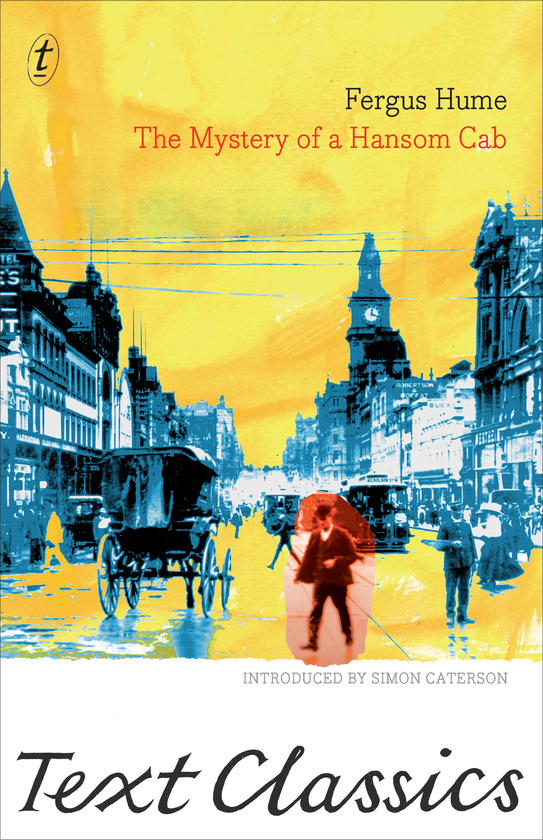
A Study in Scarlet was not published until after Hansom Cab’s great English success in late 1887. Doyle read Hume’s book, and jealously wrote to his mother “What a swindle ‘The Mystery of a Hansom Cab’ is. One of the weakest tales I have ever read, and simply sold by puffing.” [hype]. The evidence is that he and Hume had been submitting to the same publishers, around the same time, and both suffered rejections. What happened was probably synchronicity, not uncommon in crime fiction: a literary idea whose time has come. But the Hansom Cab helped create the market for Sherlock Holmes. Without it the Sherlock story might have ended with A Study in Scarlet.

I have read that Hume was inspired to write his book by the success of Emile Gaboriau’s novels–but was he also inspired by Wilkie Collins’ groundbreaking The Moonstone, published nearly 20 years previously?

He certainly read Wilkie Collins, but a bigger influence is Mary Braddon, Collins’ great rival and contemporary. She, not Collins, is cited in the Hansom Cab.

What happened to Hume and his book makes for salutary reading. Can you describe the process that led to his selling his copyright? 
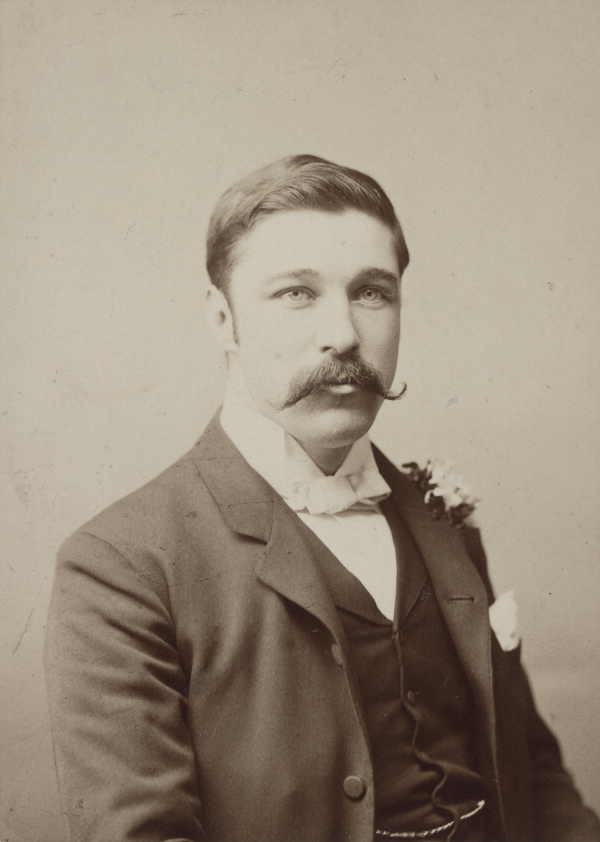
Fergus Hume

Hume wrote the book to draw attention to himself as a playwright. Although he wrote it with care and flair, he didn’t really take it seriously, career-wise. So he only registered the copyright months after the Australian success. Whether we believe the sales figures cited—25,000 copies in the Austral colonies alone, a huge figure for that time and market—the Hansom Cab was drawing attention from overseas. Thus the Hansom Cab Co. was formed to publish the book in England, and at that point Hume sold the copyright, disbelieving it would be successful outside Australia. He had taken the cultural cringe too much to heart. What he did hold onto was the dramatic rights, because that was what he thought would be more important. And yes, the play of the Hansom Cab was successful, but not in the phenomenal way of the book

Not much has previously been known about Hume and his personal life. What was your impression of Hume himself, based on your research?

I said to my initial Text editor, Mandy Brett, that he would have been fun to know. Apart from him being so utterly on the make, she replied. From various accounts he was witty good company. He liked women, supported their rights, wrote often for actresses, but there was never any suggestion of romance.

And the Melbourne–and global–literary/publishing scene at the time?

Melbourne was a major centre for reading, with high literacy, numerous bookshops, and a population with disposal income and an appetite for fiction, particularly crime. Hume networked furiously, but couldn’t establish himself as a literary man until after the Hansom Cab. When he got to London he was a literary lion, in social demand. It would have been very difficult for him not to meet Oscar Wilde, for instance. But to his annoyance people wouldn’t take him seriously as a writer because he was associated with pulp.

Do you think that the odyssey of the book’s publication, from semi-self publication onwards, has parallels in today’s changing publishing climate?

Not really. At the time you could publish in three ways, firstly by subscription, getting money from friends and the well-connected and going to a printer. Vanity publishing in our terms. The book publishers themselves used two business models. Commission was where the author paid for initial printing costs and the advertisements. If the book was a success, any profits would be shared with the publisher. Jane Austen’s first novel Sense and Sensibility was published in this fashion. The alternate model had the publisher buy the copyright, taking the risk, but also, if the book sold well, all the profits. Such was the publishing fate of Pride and Prejudice and Arthur Conan Doyle’s A Study in Scarlet.

For the first Australian edition Hume didn’t have subscribers, not for a book with disreputable crime content. 5000 copies were allegedly printed, a huge amount, when most colonial books had print runs of 200 or less. He needed a large amount of money to do so, thousands in our terms. It came from playing the stock market, with advice from a friend, Alice Cornwell, a budding gold mining magnate, the C19th equivalent of Gina Rinehart.

But Hume didn’t really self-publish. Frederick Trischler, who had worked in publishing in Australia and the US, had the business initiative and nous, and ran the Hansom Cab operation, using a Melbourne printer, Kemp & Boyce. After he and Hume quarrelled Hume wrote him out of the book’s history. But Hansom Cab couldn’t have succeeded without Trischler, who was an advertising and marketing genius.

Trischler saw the overseas potential of the Hansom Cab, and formed the Hansom Cab Publishing Co, with some enterprising but also dodgy local capitalists. Financier Jessie Taylor bought the copyright from Hume. In London the company did spectacular business: 25,000 copies a month were printed and sold for fourteen months. But it wasn’t crowd-funded—more like bank robbery!mystery of hansom cab tv

What do you believe is the place of The Mystery of A Hansom Cab, in Australian literary history–and in that of the English-speaking world?

It was the first book from Australasia to become a global publishing phenomenon. It awoke English publishers to the potential of local writing. It also showed them the gold in detective fiction, and helped consolidate crime writing as a major publishing category.

The translations were worldwide, and still happen, with a recent Chinese edition. Hume was among the first Australasian writers to be translated into Chinese.

I might add, to finish off, that THE HANSOM CAB, in its initial Melbourne appearance, shows how an author can get everything right: researching his market, writing a very good and commercial book, encountering someone who believed in it enough to hazard a large print run, producing a good-looking product, timing its appearance carefully, and conducting an effective word-of-mouth campaign. They had very little money for advertising, but they did what they could, ie hiring a hansom cab to deliver the books to bookshops.

The subsequent story shows how an author can get things VERY wrong.

 

Review of James Patterson’s Writing Masterclass

james-patterson-booksRecently I was approached by the people from Masterclass, a brand new online learning hub which features courses in different areas of the arts and sport, taught by world-famous masters of their craft–such as Dustin Hoffman for acting, Serena Williams for tennis–and James Patterson for writing. Masterclass asked if, as an experienced author, I’d be interested in checking out the course and seeing what I thought. I did some research, discovering Masterclass to be a start-up based in San Francisco that had debuted only a month ago–in May–and that it was themed around the concept that some masters in their field are also great teachers, and love to impart the knowledge and experience they’ve gained. I liked the idea and was also, I admit, curious to hear what the world’s highest-selling author had to say about his ways of working, so using the gift code provided, (the whole course costs $90 US normally, which seems very reasonable considering what you get) I set up my account, logged in and began exploring.

First of all, I want to write about how the course is structured, and then move to a discussion of whether it works, and for whom. There are four parts to the course: firstly a series of 22 videos in which James Patterson talks about different aspects of the craft of creating fiction: raw ideas; plot; creating characters; successful outlines; research; writing dialogue; building chapters, how to write good endings,  editing, and much more, through to post-creation issues such as titles, marketing–and of course getting published! There are also a few more personal themed-videos: one where the author recounts his own personal journey to publication and success; one where he rather amusingly recounts his brushes with Hollywood; and one on the experience of working with co-authors. The videos vary in length between 3 and 14 minutes, depending on the complexity of the theme, and all of them feature James Patterson talking directly to the camera, in a chatty, conversational style, truffled with anecdotes, examples, tips and pithy sayings(a favourite of mine: Passion and habit are key to a successful writing career). Secondly, there is a 72 page downloadable and printable workbook which is designed to complement and expand the videos, recapping on each theme, and providing practical exercises for students to complete on their own. The workbooks come in two versions: one which includes the very comprehensive outline Patterson wrote for his novel Honeymoon(which can be used in assignments) and one without the Honeymoon outline. Thirdly, there is a section called ‘Office Hours’ where the author answers questions video-recorded or written in by students(of course these are selected as otherwise it would be all too easy to become overwhelmed). Within this section also is a series of video critiques by Patterson looking at selected class assignments and how students have handled them–for example, he looks at a whole lot of potential book titles that have been sent in, and says whether he thinks they work, and why they do or don’t. Finally, there is a discussion facility on each theme, where students can interact with each other based initially on a moderator’s discussion question(he’s called a ‘community builder’ on the site) and exchange ideas, opinions and experiences.

So all in all, a very comprehensive structure. It’s well-thought out, very well presented and produced, easy to access and streamlined to work through. James Patterson has a direct, lively and unpretentious manner on camera which is very engaging, both in the main videos and in the critique snippets, and he’s generous with his practical tips and advice. As well, the workbook is thorough and has plenty of interesting exercises, and it’s also easy to download and print. As a self-directed course, it is worked through at your own pace, and it’s clear from the discussion boards that students have approached it in different ways, with the majority watching each video one at a time, and working on each associated exercise one at a time, while a few others report watching the whole series of videos right through, then going back and working through each individually. It’s also clear from the discussion groups and comments that it is mainly unpublished, aspiring writers who are taking the course–which of course is not a surprise–and the atmosphere seems friendly and collegial. As you might also expect, given the fact this is a very new course, there are lots more comments on the earlier videos than on the later ones.

So, that’s how the Masterclass is structured. Now,to the issue of  whether it works as a creative writing course. Continue reading

Translation pitches (and a revelation)

Ann Morgan's avatarA year of reading the world

2015-06-04_1433443812

Last night, English PEN hosted an experiment at the Free Word Centre in London. As part of European Literature Night, which in the seven years it has been going has grown from a single evening to a festival stretching over several weeks, The Translation Pitch saw eight translators pitching eight novels that have not yet been translated into English to a panel of industry experts. At stake was a £250 PEN samples grant, which would pay for a chunk of the winning text to be translated and shared in the hope of attracting an English-language publishing deal.

The competing books were varied. They included a Danish crossover novel about a school shooting (Jesper Wung-Sung’s Proper Fractions, pitched by Lindy Falk Van Rooyen), a 640-page-long work of German metafiction (Verena Rossbacher’s Small Talk and Slaughter, presented by Anne Posten) and a prize-winning collection of interlinked Hungarian short…

View original post 556 more words

The inspiration behind Hunter’s Moon

Hunter's Moon coverAs this week saw the official release of my new novel, Hunter’s Moon, and next week sees the first of the launches celebrating the book, I thought I’d feature a piece I wrote about the inspirations behind Hunter’s Moon. I first wrote this for the excellent Teachers’ Notes my publisher, Random House Australia, have created for the book, which feature discussion points, ideas for activities etc. If you’re interested, you can download the full set of notes from the Random House website, here. 

Inspirations of Hunter’s Moon

by Sophie Masson

The main inspiration behind Hunter’s Moon is of course the classic fairy tale of Snow White. This Germanic fairy tale is one of my favourites, with its blend of suspense, drama, romance, dark magic and dark secrets. It’s also become one of the world’s favourite stories, and has been told and retold many times over in novels, poems, films and even TV series.

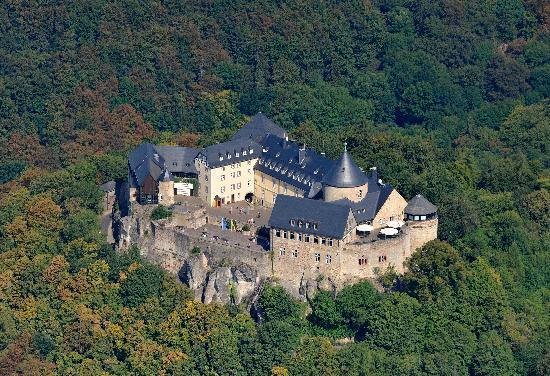
First written down in the form we know it by Jakob and Wilhelm Grimm in 1812, the story was told to them by people who had passed it down throughout the ages. Some people think it may possibly have been partly inspired by the real-life story of the 16th century beauty Margaretha von Waldeck, whose jealous stepmother forced her out of her home to live abroad, only to die poisoned at the age of 21. It’s said that the dwarves could be inspired by the fact that Margaretha’s father Count Philip owned

Schloss Waldeck, home of the Waldeck family

Schloss Waldeck, home of the Waldeck family

several copper mines, where miners worked from an early age, becoming hunched from working in such confined quarters. Others say that the story derived from sources much earlier than that, and point to variations of the Snow White story to be found in many other traditions, such as in France, Albania, Armenia, Russia and as far afield as Malaysia. Like most fairy tales, in fact, the inspiration for the story probably derived from a whole mix of things, leading to the form we know and love today.

As with most fairy tales, there are many things behind the surface of the magical action and extraordinary characters in Snow White: intriguing motifs such as a magic mirror, a poisoned apple, a glass coffin, a huntsman who takes pity on the girl he’s supposed to kill. And there are many contrasting themes, too: betrayal and friendship; beauty and cruelty; appearance and reality. When as a novelist you are working with traditional stories, it’s important to find ways in which you can mine this rich material in an original way yet also respect the themes at its heart. And for me that lay principally in reinventing Snow White herself, to make her a more complex and interesting character.

In the fairy tale, poor Snow White has to learn the hard way that nothing is what it seems and that it is a grave mistake to trust to a fair face and honeyed words. And yet she is still trusting enough to blunder into the home of strangers in the shape of dwarves, and later accepting apples from someone who just turns up at the door; her essential innocence is untouched by the painful revelation of her stepmother’s treachery and cruelty. She is also quite passive: aside from her flight into the woods when the huntsman spares her life, she doesn’t do a great deal for herself.

My Snow White character, Bianca Dalmatin, isn’t like that though she certainly starts in a similar way. Just like Snow White, Bianca has been lulled into a sense of false security by the apparent kindness of her beautiful stepmother Belladonna; like Snow White, she learns the hard way that appearances aren’t reality. Her heart is broken by the revelation; but instead of just hiding and accepting her fate, she wants to kick against it, to change things, even if it is very dangerous. And she is full of hatred for the woman who has destroyed her world. And yet like Snow White in the fairy tale, she doesn’t altogether lose her trust in others. It leads her to make mistakes—but also means that she will not turn into someone like Belladonna. Similarly, I worked with other aspects of the Snow White story, such as the seven dwarves, the truth-telling mirror, the huntsman and the glass coffin, to transform the original material whilst keeping its powerful impact.

As with my other fairy tale novels (Moonlight and Ashes; Scarlet in the Snow; The Crystal Heart) Hunter’s Moon is set in a magical alternative world, a world inspired by Europe in the late 19th century, but where ancient magic exists side by side with modern technology. In terms of specific setting, Hunter’s Moon takes the reader back to the Faustine Empire, which first appeared in Moonlight and Ashes. However Hunter’s Moon is set in a different province of the Empire: in Noricia, rather than Ashberg. Just as Ashberg in the earlier novel was based on Prague and the Czech countryside beyond, so Noricia in Hunter’s Moon is based on Austria, and its main city, Lepmest, is based on Vienna. And the inspiration for the Ladies’ Fair department store empire owned by Bianca’s father came from the gorgeous 19th century department stores that you can still find in cities such as Vienna, Paris, Moscow and London—glittering palaces of fashion and beauty housed in elegant old buildings.

And finally, Hunter’s Moon also has influences and elements from those earlier fairy tale novels of mine, including a recurring minor character who in this book takes on a bit more of a role!

Fairytale novels combined

I’m keynote speaker at the Australian Fairy Tale Society Conference

aftsI’m honoured to announce that I’m the keynote speaker at the Australian Fairy Tale Society’s Conference to be held at the NSW Writers’ Centre, in Sydney, on Sunday June 21. The theme of the conference is ‘Transformations’–the interpretation and transformation of fairy tales in Australia– and it’s a great program, with some excellent speakers, intriguing topics, and other events, including music–and the Sydney launch of Hunter’s Moon!

You can have a look at the full program here.

Hunter’s Moon launches!

PrintMy latest novel, Hunter’s Moon, comes out on June 1 and to celebrate we are having not just one but two launches: the first in Armidale on June 12, and the second in Sydney on June 21. more on the Sydney one soon but here’s an invite for the Armidale launch, designed by friend and fellow creator Trish Donald. If you live in the Armidale area, or are visiting, please do come along and help celebrate!


Northern Russian splendours: an interview with photographer Richard Davies

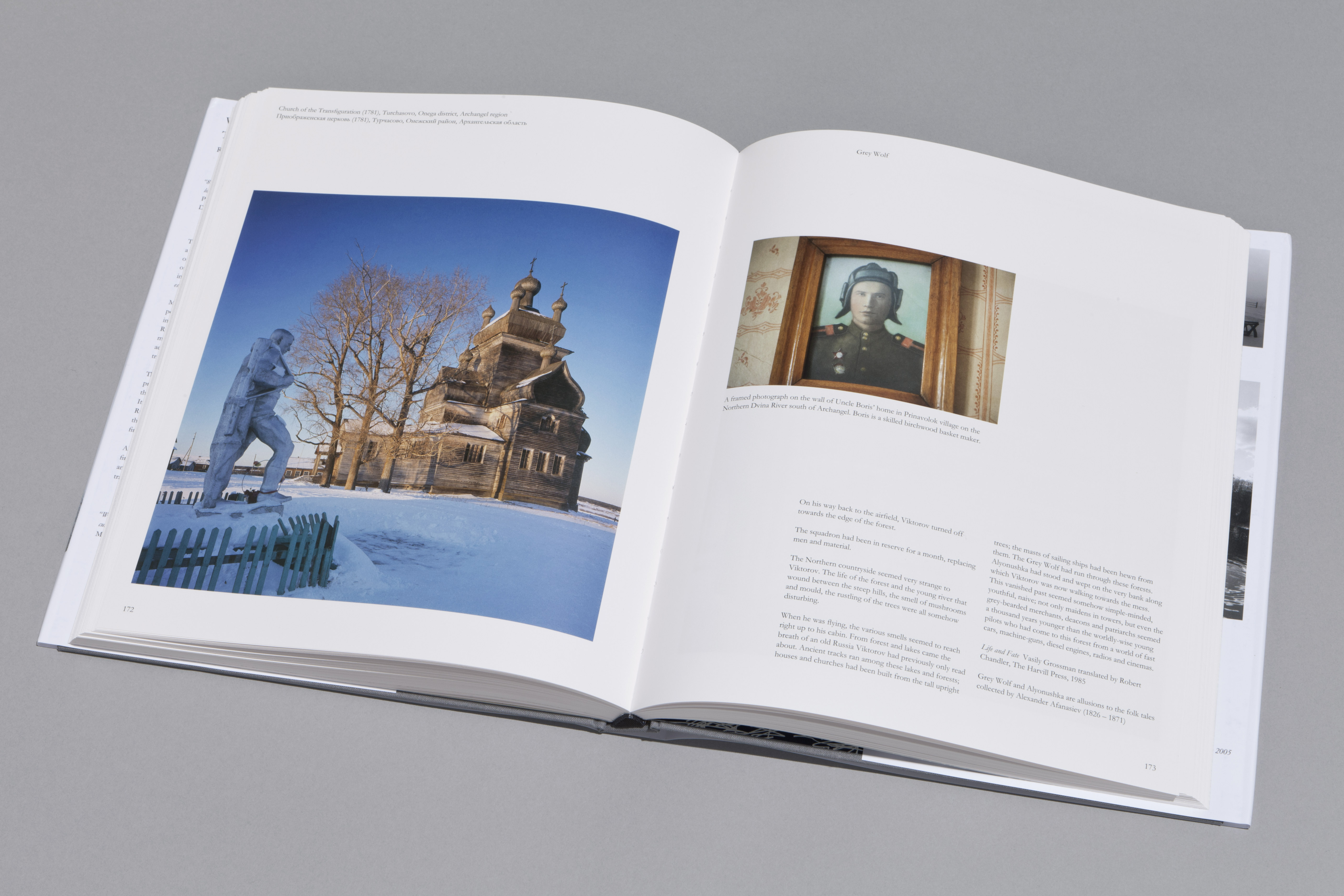
2(1)Recently I became aware of the magnificent work of  British photographer Richard Davies, who over several periods of travel in Northern Russia, has been documenting the everyday and extraordinary splendours and colours of the region, and especially its glorious wooden churches and colourful characters. Richard has published two beautiful books: Wooden Churches: Travelling in the Russian North 100 years after Bilibin(sadly out of print at the moment) and the recent Russian Types and Scenes, which you can get on Amazon (and which I can very highly recommend!). Inspired by the gorgeous work of this fellow Russophile, I got in touch with Richard, and this fascinating interview is the result. Enjoy!207RT_mod2[1]

Richard, can you tell us first about Northern Russia, which has inspired your work? How long have you been visiting the area? And what drew you to it?

I’m a Russophile! My standard story for explaining this is that one-day, my mother came home with an LP (long playing record) of Jascha Heifetz playing Mendelssohn’s violin concerto. On the flip side he was playing Prokofiev’s 2nd violin concerto. It was the most exciting thing I had ever heard and I played it continuously, day and night for weeks. It drove my father crazy, my mother was happy that I was happy. I was head banging to Prokofiev while my friends head banged to the Rolling Stones – very sad. The other influence, I remembered this recently, was our local dentist. He was an out and out Communist and a great dentist. The waiting room was strewn with copies of Soviet magazines and the patients were left to quietly soak up the propaganda. Danny Stalford, Red dentist, and local Communist Councillor obviously had some success with me – I fell in love with the country if not the system.

In the late 70’s and 80’s I took Intourist trips to Leningrad and Moscow to satisfy my Russophile needs. Concerts at the Philharmonia, opera at the Kirov, Maly and Bolshoi, art at the Hermitage, Russian, Pushkin and Tretyakov museums, day trips to Novgorod and the Golden Ring etc etc – but the countryside of Turgenev and Tolstoy was out of bounds

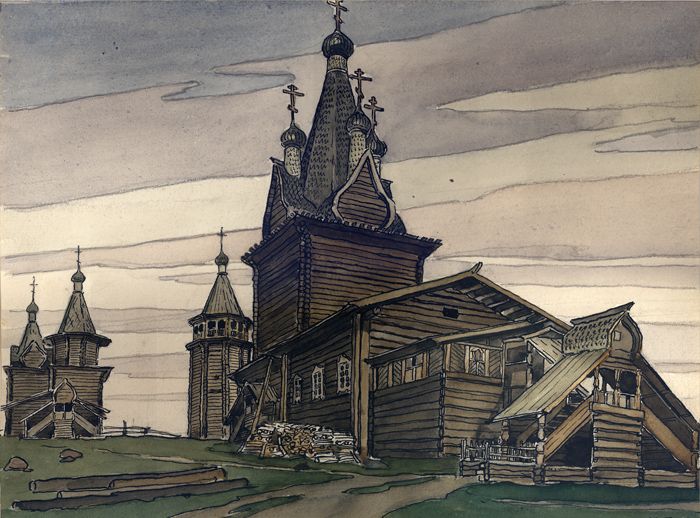
bilibin wooden church

Illustration by Ivan Bilibin

bilibin wooden church photo

Photograph by Ivan Bilibin


With the break of the Soviet Union, that changed. In 2001 I came across some postcards published at the beginning the 20th century of watercolours and photographs of wooden churches by the artist Ivan Bilibin. Bilibin had travelled to the Russian North in 1902, 1903 and 1904. Friends in St Petersburg found me a driver, Alex Popov the Professor of Atmospheric Physics at St Petersburg University, and in 2002 we set off in Bilibin’s coach tracks.

1a(1)Wooden Churches was published ten years later.

The wooden churches of northern Russia, which you have documented in your first book, are unique and fragile works of art as well as testaments of faith. What is being done both to preserve them as monuments and keep them alive as part of the distinctive religious life of the region? And what do you think might further be done?

Many of the churches that Bilibin had recorded were no more and those that had survived were in a perilous state.

During the war a wonderful book had been published in Russia celebrating the wooden architecture of the north – it was recognized as a facet of Russian culture that the armed forces where fighting to preserve. After the war, Stalin was able to blame the destruction of these cultural artifacts on the enemy and great efforts where made to restore those that had survived the revolution and the war. But with the break up of the Soviet Union funds disappeared and the churches where again left to rot, with rusting signs attached proclaiming that such and such a church was an ‘Historic Monument under the Protection of the State’.

47RTprint[1]Many churches are being re-inhabited by their local communities, roofs are being patched and plastic bagged cardboard icons are being pinned to walls but many churches, because of collectivisation, have been left with nobody to care for them.

In the summer volunteers now flock to the north, many under the flag of Obscheye Delo, an organization founded by the Moscow priest, Father Alexei, to do what they can to save the churches. There are very good professional restorers on hand but sadly the funds aren’t. The feeling is that the Church is more interested in building spanking new buildings than preserving archaic old wooden ones. And for the moment the State seems to be more interested in building up its nuclear arsenal than preserving historic churches in the far north.183RT_mod2[1]

The ‘Wooden Churches’ book has sold out – do you have plans to reprint?

I had a publisher for ‘Wooden Churches’ but they came back to me with terrible layouts– can you believe it they cropped my photographs!! So I ended up publishing the book myself. It was great fun but not a great money making venture (I did in fact get my money back) so I’m thinking hard before reprinting. I’m sure it would sell (the churches are so beautiful), but it would be good to reprint it on the back of an exhibition.

How have local people reacted to your work? 

The local people in the Russian North are naturally very kind and generous and I’m pleased to say that they have been very kind and generous to ‘Wooden Churches’. I’ve done my best to make sure that it is sitting on a good few shelves in Northern Russia. I haven’t yet had the chance to show ‘Russian Types’ to many people in Russia although I have had two reactions. 1/ The wife of the restorer Alexander Popov complained that the photograph of her husband showed his bottom and not his face. 2/Our translator on the last trip to Russia in April this year laughed out loud almost every time she turned a page – I took this as a compliment.

87RT_mod1(1)[1]What anecdotes or encounters particularly stand out for you in your travels throughout northern Russia?

Everyday, travelling in Russia is an adventure – I’ve yet to encounter a bear although I’ve heard many encountering-bear stories! I have been towed by snowmobile across a frozen lake horizontally on a sledge and arrived at our destination iced up like a frozen corpse. I’ve flown in a flimsy aircraft to land in a field next to a wooden terminal. I’ve been hauled in for questioning by the authorities at a town with an intercontinental ballistic missile site attached. I’ve venture across the White Sea to uninhabited islands and crumbling churches with twenty beautiful art history students from St Petersburg University. I’ve drunk more vodka than I should on occasions and eaten piles of bliny with honey and cream – my liver is shot and my cholesterol levels are sky high – I could go on…

In your second book, Russian Types and Scenes, you and your co-creator Alexander Mozhaev profile the everyday life and colourful characters of northern Russia in a wonderfully vivid way, through both photographs and texts. Can you tell us a bit about how the book came to be, and how you worked on it together?1_(1)

Having published one book myself, the only thing I could do was to publish another. I’d continued to travel to the North, with the students, filmmakers and friends. I had been taking photographs of people while photographing the churches and continued to do so on these trips. I love pure photographic books but I also love words so I wanted to put a book together gelling the two. Alexander Moshaev, a Moscow writer and architectural historian, was one of the friends who joined me on some of these trips. Sasha is very lively and I soon understood that he had insights into what we were seeing that I, as an Englishman, would never have (needless to say, many of the things I enjoyed he found rather banal). He would also interpret the content of my photographs in ways that I couldn’t. I read a lot of Russian stories in English, sadly I don’t speak Russian, and tracked down quotations that would fit into my photographic narrative. And as the book was coming together I would ask Sasha for suggestions and 28(1)stories.

I was also very lucky that one of the students from St Petersburg, Natasha Shalina, was studying in London while I was putting the book together. With a few deft taps on her iphone she would come up with wonderful things from Russian web sites that would inevitably lead to other wonderful things. She also helped with translating Sasha’s particular style.219ART_mod2[1]

Do you have any anecdotes about the people or occasions you’ve featured in that book?

The fun about putting these books together, ‘Wooden Churches’ over 9 years and ‘Russian Types’ over two years, is obviously that what you have at the end is the result of a great adventure. As a photographer you never know who or what will come in front of your camera each day. Matilda Moreton, the writer of Wooden Churches never knew who she would meet each day and what they would tell her. Researching the texts was equally exhilarating. I bought a copy of the New Yorker once on a whim and inside was a great story about Russian bells. I was reading the biography of a Russian children’s writer and suddenly he’s talking about wooden churches. It’s as though all these things are given to you if you loiter long enough. But then again there are the photos you missed, the people you didn’t talk to and the books you didn’t open.

Are you working on a new book at the moment?

I am. I will publish a book with a photograph I took in 1967 – by rights the book should appear in 2017. The book will have photographs and stories about seaside ‘Pleasure Piers’ – like Russian Churches they are often decorated with onion domes and they also attracts great writing and yarns!

Note: All photos aside from those by Ivan Bilibin pic are copyright to and courtesy of Richard Davies. 

The journey of Mikhail Strogoff

The crowdfunding campaign for Jules Verne’s Mikhail Strogoff has just ended and to celebrate that as well as prepare for the next stage of the project, I thought I’d share this Eagle Books video clip which takes you through Mikhail’s epic journey across Russia as he battles dangers both natural and man-made to accomplish his urgent mission. Incidentally, the lovely music is by my very talented musician/producer son, Bevis Masson-Leach.