Ever since I was a Tintin-devouring child, I’ve loved comics and graphic novels, so it’s a great pleasure today to be featuring a really interesting interview I did recently with Bruce Mutard, one of Australia’s most prominent creators in these genres.
Bruce has been writing and drawing comics for 25 years, producing 4 graphic novels: The Sacrifice (Allen & Unwin, 2008), The Silence (Allen & Unwin, 2009), A Mind of Love (Black House Comics, 2011), The Bunker (Image Comics, 2003) and a collection of short stories, Stripshow (Milk Shadow Books, 2012). He also has had short comics stories in Overland, Meanjin, The Australian Book  Review and Tango among others, and has illustrated several books for Macmillan Education’s Stories From Australia’s History, series. He has just completed a Master of Design in comics studies on the interaction of words and pictures at Monash University. He has conducted many comic workshops, and given talks at Melbourne Writers Festival, NMIT, RMIT, Edith Cowan University, University of Melbourne, Monash University, and presented papers on comic theory at Oxford University, Loughborough University and University of Arts, London among others.
Bruce is an eloquent and knowledgeable advocate for comics and graphic novels generally, and holds the comics and graphic novels portfolio within the Australian Society of Authors. Recently, his passion has led him to a new direction. Read on!
Bruce, you’re about to launch a new imprint, Fabliaux. Can you tell us about it? What motivated you to start it? What has the journey been like so far? And what kinds of books will you be publishing?
The idea for Fabliaux started a few years ago when I was still thinking of self-publishing some of my own work that wasn’t suited or wanted by my existing publishers. This was primarily my short comics collection: Sex, Politics and Religion: Stories To Break Up Families By and Alice In Nomansland – a still unpublished graphic novel that is predominately naughty humour, and unlike any other I’ve done. Those books are still floating about, though I’d much rather other  publishers took them on. Anyhow, I’d always nursed the possibility of publishing other people’s work if I thought it needed to take print form, and that there might be enough of a market to make the investment back. I chose the name Fabliaux because it has a literary pedigree and doesn’t have ‘comics’ in it, limiting the sorts of books I might be able to publish. I may one day do prose, poetry, artists books, art books or kids books. Anyhow, Fabliaux is a term given to a genre of ribald and comic tales told by jongleurs in France in the 12th and 13th Centuries; the precursors to similar bawdy tales in the Decameron and The Canterbury Tales.

from Roman de Renart, medieval French fabliau
So far the journey has been ‘artistic’, which is to say that I’ve blundered into publishing with the eye on the creative end-goal, satisfying my authors, but less concerned about the costs and how to market the work! To that end, my aim is to publish books that have a niche readership, but nevertheless one that is proven to exist, and to make sure the print quality is the best for the work. I’m an author first and foremost, so that is my main role, but since that often takes me to markets, fairs, conventions and the like, I might have an opportunity to sell some of these books. I won’t do mass-market books, as I have neither resources nor time to put into the marketing and administration of such an enterprise. I give my author’s contracts and generous terms, though no advances. I make no promises other than to publish and do my best to take the authors work to the world in my stumbling fashion. Don’t laugh, please.
The launch title of Fabliaux is the provocatively-titled Art is a Lie, by Carol Wood and Susan Butcher–a unique work indeed. Tell us about it–how did you discover it? What drew you to it so much that you chose it as the launch title of Fabliaux?
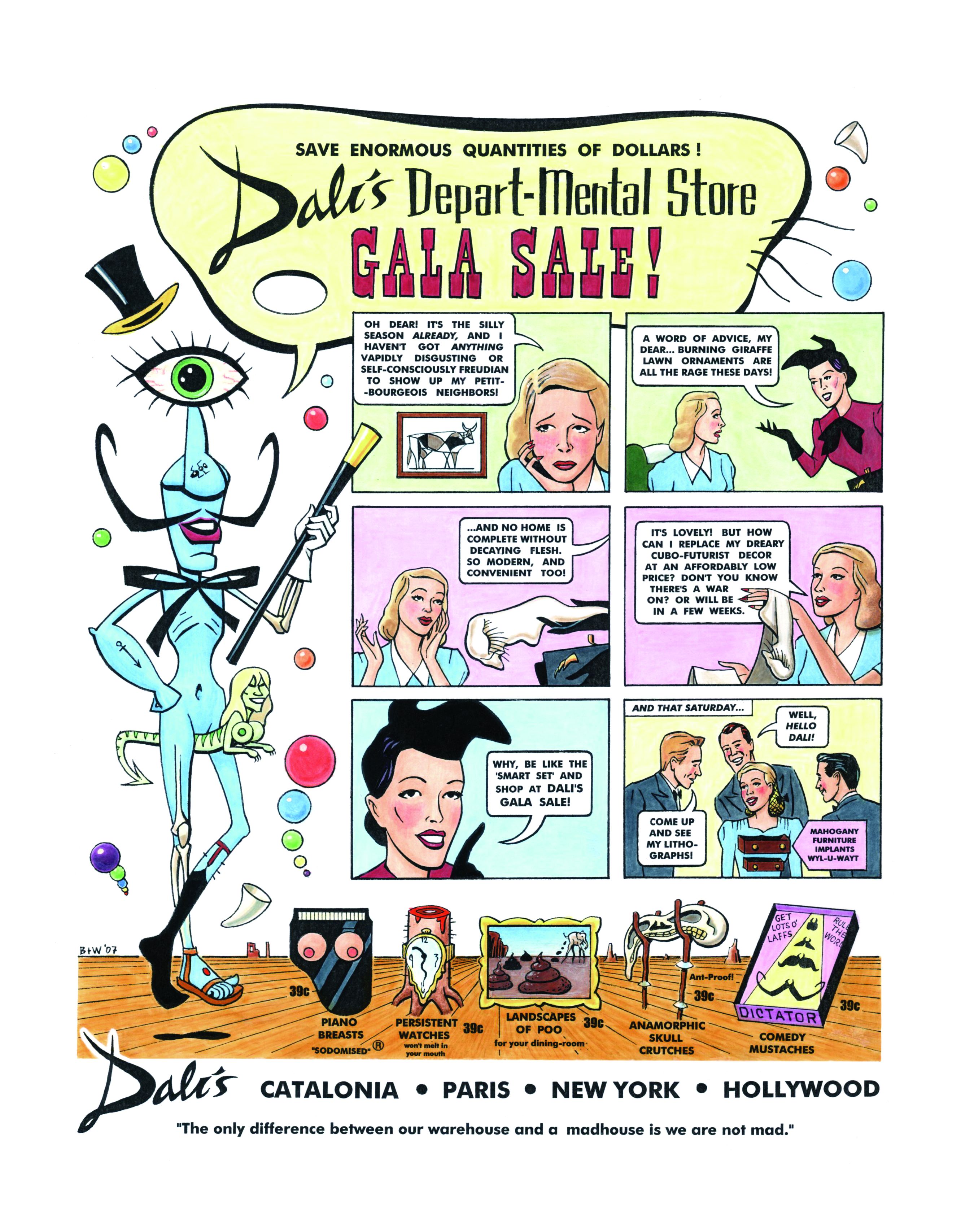
I’m pretty certain Art Is A Lie is unique. In short, it’s a collection of 1-3 page comics strips mostly first printed in a US art magazine, Artillery, over the past 9 years under the title, Dead or Alive. Essentially they are spoof biographies of famous artists, done in myriad of styles so no two 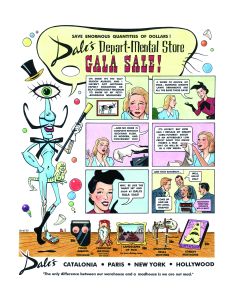 stories look the same. Imagine Picasso as done by EC Segar (Popeye), Duchamp as a Dick Tracy story, Hieronymous Bosch as done by Don Martin (MAD), or the 5000 Fakes of Dr Seuss. Imagine Frida Kahlo as a Betty Boop cartoon, or if you can, Tom of Finland as done by George Herriman. You probably can’t imagine such things, but they do exist in this book. There’s fumetti of which a couple all the characters and backgrounds are intricately constructed models that Carol in particular, makes. The level of detail in these is astonishing. In short, they are brilliant and I think the world needs to know about it! As for discovering it, I’ve known Carol and Sue for perhaps 20 odd years on and off, so when they showed me the work they’d
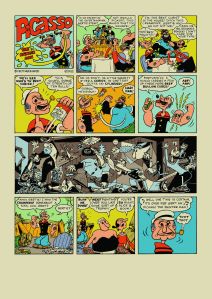 been doing for Artillery, I was blown away – laughing. Since the magazine was not available in Australia, I wondered if there would ever be a collection of the strips so I could have a well thumbed, cup ring stained, annotated copy on my bookshelf. The magazine’s publisher was in no position to produce such a book, nor were the Pox Girls. For many years, nor was I, but as the old saying goes: ‘good things happen to people who wait.’
The rise of self-publishing has been talked about a lot in recent times, but not so much another phenomenon–the rise of small presses founded by creators: authors, illustrators, graphic novelists, who are publishing other people’s work. Why do you think this is happening? And do you have any thoughts on what it means for the literary landscape and the publishing industry?
It is probably a confluence of factors. Firstly, there is the general contraction of sales across the industry that has lead to a reluctance on the part of established publishers large and small to take on new projects, even from authors they’ve published. Unless an author has earned out their advances (assuming they got one), it’s hard to place a new work, especially something that is a challenging literary work. The old template publishers worked from by having commercially successful works subsidise the publication of works of merit has diminished. But those authors who have been fortunate enough to do well out of their literary career, generally love writers, good writing, good books and having been through the mill of building a career in writing, also know how much more difficult it is to get published today. So, I think their passion for literature means they are willing to set up imprints and publish those works that the established publishers have forgone, not to prove the latter wrong, but simply to ensure good work gets published, be it in print or digital. Some may have a better business head than others (like me), but I’m sure it’s passion for the art, craft and life of words and pictures, that drives them.
The comics/graphic novels scene has both expanded and contracted in recent years in Australia. There seems to be more creators than ever yet less opportunity for them to be exposed at the traditional showcase events, such as Comicon, Supanova etc. Can you comment on that?
I would agree there has been a huge expansion in the number of creators and works being produced in recent years. The Ledgers committee (The Ledgers are the recently reinstituted annual Australian comics awards) had a long list of more than 250 to sift through last year, whittling that down to about 40 for the shortlist. There are so many more people considering comics as a medium with which to tell their stories or non-fiction. I would disagree that there are less opportunities to showcase their work; if anything, it’s the opposite. True, showcasing comics work is not overly rewarding at the pop culture expos like Supanova and Ozcomicon for the simple reason that they are nowhere near as popular as the other stuff on show. The main reason people to go to those is to dress up in cosplay, get photos and stuff signed by the stars, attend their speaking sessions, play some games, buy copslay merchandise, get prints, toys, books and dvds. It’s very rare that there is a comic guest that requires one to buy tokens in advance and line up for an hour or more to get something signed (Stan Lee is one such). 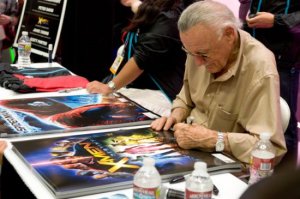 Although comicons began with all comics, they have evolved with time to embrace all the pop culture that was largely born in comics, or spec fiction. It’s a case where the children of comics have gone and built a world that left its parents and grandparents long behind. Occasionally, these elders are known to express a little pique at being marginalised or forgotten. But there’s nothing wrong with that; evolution is healthy and the events bring joy to tens of thousands of people every time they are put on.
But in the last few years, a good number of comics only events have sprouted up which probably resemble the comicons of old in their early days. There’s Comic Gong in Wollongong (which may evolve to be more pop culture); Comic Con-Versation in Sydney in September, run across several library services; the Homecooked Comics Festival in Melbourne, put on by the City of Darebin; The Central West Comics Festival in Parkes; the Zine and Indy Comics  Symposium in Brisbane, the Sticky Zine Fair in Melbourne and numerous zine fairs that are also very good places for comics creators to sell their work direct to the public. I suppose the biggest problem in Australia is that these forums are almost the only way most creators reach their public, for aside from those few of us whose work is published by mainstream book publishers, most are sold through a few local comic shops and/or online. There is no national comics distributor that reaches all the local comics shops, let alone high street bookshops that sell graphic novels. Most of the latter do not sell ‘floppies’ or mini-comics. The Australian comic shops buy 90-100% of their stock from Diamond Comics Distributors – a near monopoly comic distributor in the USA, where all the Marvel, DC, Image, Dark Horse, IDW and other popular titles come from. These stores very rarely set up accounts with anyone else, unless it’s manga, Anime, Dvds, figurines and other stuff they might sell. I know that you can’t find my books from Allen & Unwin in most Australian comic shops because they won’t set up accounts with Allied Distribution for a few local graphic novels. So, if you go to your local comics shop in your capital city (there’s a handful in major regional centres), then you’re most likely to find what is produced by creators who reside in that city, as they have personally taken their work to be sold there – usually on consignment. There have been a few attempts over the past couple of decades to create a national comics distribution system, but aside from one who failed at the first hurdle, the others foundered on the lack of support and interest from the comic shops. Australian comics are by and large marginal sellers compared to the American comics and Manga. The reasons for this are the simple fact that we don’t produce comics that compare with the slick overseas products (see question 6, below).
Tell us about your own books–and whether you’re working on something new.
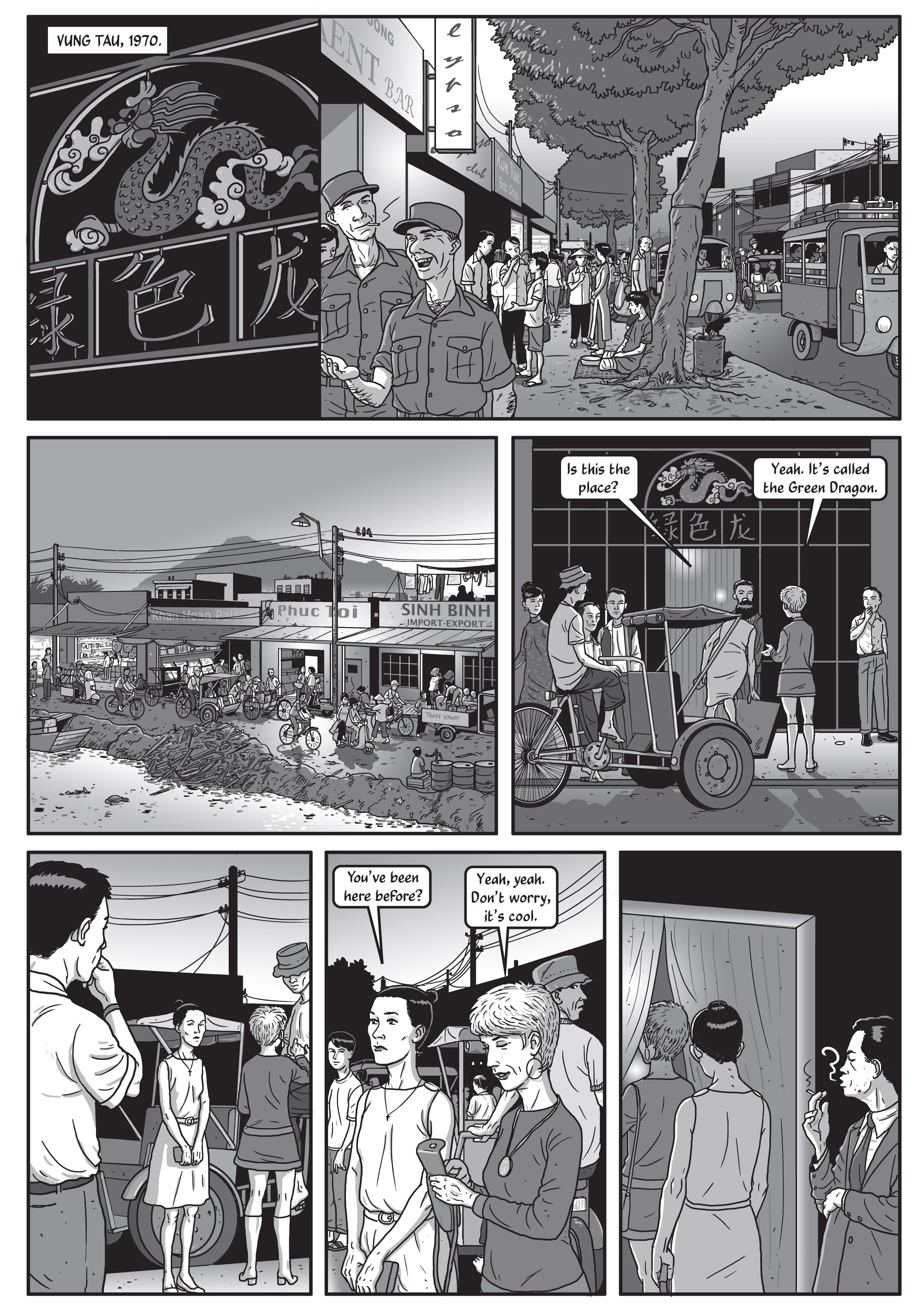
 My own books to this point, have been very specifically set in Australia and dealing with Australian themes, which has been at times appreciated for that fact because it’s uncommon. For instance, my novel, The Sacrifice, is set very specifically in Melbourne, during the years 1939-1942, following the travails, loves and life of a dedicated pacifist, whose unwillingness to enlist is corroded by a rapidly changing cultural and societal matrix as a consequence of war, and of course, the influx of American troops. The Australia of that period: ‘white’, xenophobic, English, colonial and still a bit cocky even after the bruising taken by participating in WW1, is evoked with considerable detail, to the point where due to the presence of the juxtaposed narrative images, it is a major character in the story. My next book, follows the daughter of the principal in The Sacrifice as she serves as an army nurse in Vietnam during 1970 to 1975. But there are plenty of extended parts set in Melbourne during this period, which will show the changes from the previous era, but also how much it’s changing for the better, even if it was barely perceptible during that period. I have been working on this book for the better part of 8 years and there is a considerable way to go, due to having completely revamped the story twice. On the side, I on occasion do smaller projects by commission, usually
  if they offer me a challenge to do something that I’ve never drawn before, or it’ll mean comics appearing in a place where they’ve rarely, if ever appeared. So for that reason, it is not the money that motivates me, but what I might learn by doing the work. Examples are the all-comics issue of Cordite, where artists adapted contemporary poems into comics. For me, the challenge was to take words that are usually so visually evocative and allusive, into something actually visible, but without simply illustrating them. I adapted A Frances Johnson’s poem, Microaviary (about drone warfare of all things) because when I read it, all these images by association flooded into my consciousness from my unconscious, and it was immediately apparent to me that I should simply put those images down. To that end, about half the actual words disappeared into the
  images, and where they remained, the images added new contexts and layers, so that in a sense, it was a new work. I would love to do more such ‘collaborations’ and there is talk of such.
Aside from that, I have also recently completed my Masters degree, researching what it means to ‘write with pictures’ which is how I actually think of my craft. It is another way of saying that in comics, the pictures need to do the bulk of the work of conveying the story. In cinema, they call it ‘show don’t tell’. It’s about the most sagely three words of advice I could give any budding comics artist, only it’s also one of the hardest balances to achieve. Words are easy to put down, cut and paste and have a sort of precision about them, especially compared to the polysemous nature of images. What I really learnt from my research was how little study had been made into the formal properties of what I called juxtaposed narrative images. Much ink and pixels have been devoted to the content via all sorts of prisms (feminist, Marxist, deconstructionist, structuralist, sociological, medical, Freudian, Friedman, etc.), but strangely, little has been done to place it within art theory or as a visual art. Rather than produce a new work for print, I took it into space as an exhibition, where there was no page one, no need for the meta boundaries of the page – just walls, doors and of course, the space  within the room itself. I really want to do a PhD and take this much further and develop a new theory of comics that starts with the proposition that it is a medium, not a genre of literature. So, this means technically, the answer to the question ‘Are comics literature?’ is actually, no. But I
  try not to say that in polite company.
Is there a distinctive ‘Australian’ style and approach to comics and graphic novels? Do you see your own books as fitting within that?
While I wouldn’t say there was any overarching style in terms of appearance, such as manga has, or the ‘ligne claire’ (clear line) school of BD, or the sort weightless dynamism pioneered by Jack Kirby that signifies the superhero genre, I would say there is a characteristic idiosyncrasy in Australian comics. It may sound strange to say, but comics might be one area where the ‘tyranny of distance’ is still at play. By that I mean few creators here really think they have a chance of ever being able to make a living from comics, or getting hired to work for the big comics publishers in the USA, Europe or Japan. There are a number of writers and artists who  have succeeded, particularly with the US comic publishers (speaking English helps). But since the Australian market is so small, and therefore the prospect of sales is limited to local readers, Australian creators tend to produce work that is not obviously aimed at readers in those other markets. They tend to produce comics for the sheer joy and pleasure of it, and garnering a few readers tends to satisfy them. Some might say that this
  displays a lack of ambition or professionalism, but it’s not. Those who really do want to make a living in comics doing work for hire, put in the long, hard yards at improving their skills, getting the feedback from industry professionals as they hawk their portfolios at the US shows (or European ones). As for selling ones own creator owned graphic novels to compare with say, Dan Clowes, Chris Ware, David B, Rutu Modan, Art Spiegelman and so on, have a harder row to plough. Even in the US market, few creators make a living exclusively from their comics, but at least there are substantially more and much larger comic’s shows with which to showcase and sell their work. In the last few years, some Australian creators (including myself) have made the trek to North America to sell work at shows like Toronto Comic Arts Festival, the Small Press Expo, CAKE and the like. It’s an expensive way to showcase ones work, and I’m not convinced it’s worth it given that any follow up sales have to be made via ones social media or site, necessitating shipping hard copies overseas, which has a frightful cost, (normally more than the margin between retail price and cost of production). There is no question that building a big reputation in comics would be easier if based in the USA, Canada or perhaps in Europe.
That said, not too many local works are specifically Australian in content or character either, often being set in imaginary worlds, mining the tropes of spec fiction genres. There is a strong trend to autobio comics, which depict the prosaic and quotidian with some reflective humour. I find autobio comics to be interesting in that with the presence of the image, the authors often depict themselves quite unfavourably and viscerally – a trend set by Robert Crumb. For some reason self-loathing almost seems to be a requirement for autobio comics, where the body and its liquids seem to feature prominently. I guess there is a safety in ink, where it is not possible to 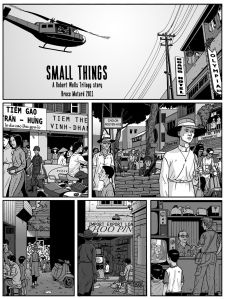 transmit physical infectious agents, though it is very prone to spreading infectious memes!
I was brought up reading within the strong French tradition of ‘bandes dessinées‘,or BD, as comics and graphic novels are known there. That whole area of publishing is mainstream in France, the books are sold in every bookshop, creators are routinely invited to general literary festivals as well as the BD-oriented ones, and the books cover many different genres and age ranges .In America and Japan, the other two great traditional centres of comics and graphic novels, the art form is similarly respected and accepted in the mainstream of publishing. But not in Britain or Australia, where the mainstream either ignores it, or looks down on it. Or both! What’s your take on this?
Long have some of us looked to France and wished the cultural acceptance of comics there, was replicated here. In Japan, it is certainly a similar case, although I believe it is not a career too many parents would hope their sons and (few) daughters would take up, as it’s punishing work and pays badly. I would disagree that comics are a respected art form in the USA. The same pejorative connotations that have tarred and feathered comics here and in the UK, applies to the Anglophone speaking world in general. This view generally runs along the lines that  comics are mostly for kids, are superficial, sub-literate, containing very little content worthy of literary merit, nor give cause for and reward consideration by academia, literature festivals and arts grants bodies. And for much of the history of Anglophone comics, including a fair proportion of what is produced today as ‘mainstream’ or superhero/action/spec fic comics, you would not find much to convince you otherwise. Despite revisionist historical appreciation of the skills of George Herriman, Winsor McCay, EC Segar, Walt Kelly, Jack Kirby, Bill Gaines (as publisher), Harvey Kurtzman, Will Eisner and so on, very few people appreciated what they did at the time they produced their work, such that Roy Lichenstein could blatantly plagiarise comics artists work without attribution or reward.
It has only been since the revisionary comics of Alan Moore, Neil Gaiman, Grant Morrison, Bill Sienkewicz, Frank Miller and Art Spiegelman in the mid 1980s, did a wider appreciation of comics as a form of literature to be taken seriously, take root and found fertile soil in which to grow. Now there’s an abundance of academic studies mining a new field of comics studies (why not; it was a new field with ground to stake like a new unfarmed fertile valley), mainstream book publishers suddenly taking an interest in a genre they hitherto ignored and republishing collections of comics, graphic novels and studies (but mostly only those creators who had  achieved considerable acclaim and attention within the comics market first). Literary festivals started to invite a few of the leading lights of comics to participate, though I think still in a way that shows they don’t get comics in the same way they don’t understand spec fiction; they are generally programmed as a separate stream, not integrated into the main program. Most importantly for me, is the sudden appearance of often substantial comics collections in public libraries (and some school libraries, though there is still an inconsistency in how to shelve it: ideally as it’s own section, not within general fiction or non-fiction). All of this points to the steady progress comics have made to enter the arts mainstream in the Anglophone world. There is still a long way to go to attain a mass readership like the Franco-Belgian world has, and it will probably never get there given the plethora of new competing forms of content (and their delivery) for the public’s attention, but it’s no longer considered a juvenile activity. There’s a level of immediate
  respect for the medium and its makers now that was largely absent as recently as 15 years ago. There is no better time to be making comics than now – even if it’s almost impossible to make a living at it. But that’s the same as being an author in general!
Recently, a librarian told me something that astonished me–she said that she had no idea how to read comics and graphic novels. It seemed to me to encapsulate a major problem: that unlike in the strong European tradition of comics and graphic novels specifically directed at children, young Australians rarely get a chance to ‘learn to read’ in those genres. And there is in fact very little for children published in those areas in Australia. Yet at the same time it seems a very natural art/literary form for children to respond to. Why do you think so few Australian comics creators write for kids?
There could be a number of explanations to the librarian’s difficulty: a structural cognitive deficit where her mind simply couldn’t interpret the iconic recurrence, and therefore ‘sculpt’ space and time within her mind in the additive way that comics requires; a kind of visual dyslexia if you will. Or, she can read words, but not ‘read’ images. It may be that she has grown up having absorbed the pejorative tag on comics and therefore, unconsciously resistant to them (when I appeared on the First Tuesday Book Club with Jennifer Byrne, she told me she didn’t ‘get’ graphic novels, either).
But you’re right, it seems in the great effort of comics to persuade the Anglophone world that comics are NOT just for kids, we’ve forgotten to keep them. Once upon a time superhero comics were all suitable for kids thanks to the requirement to receive the imprimatur of the Comics Code Authority seal (and therefore, appear on American newsstands). In the mid 1980s, the revisionism of the genre allied with the bulk of American comics being sold in specialty comics shops patronized mostly by adolescent males of all ages, meant the arrival of mature readers labels on comics, which very soon grew to encompass all genre comics, as almost all the readers were adult males. Naturally, their interests are somewhat narrow, meaning the content was (and continues to be) largely a mix of violence, gore, swearing and  badly drawn sexy women in contortionist poses to satisfy the male gaze. But that is modifying as the readership of comics expands to embrace women and a plurality of voices, there are now comics for everyone. Thank heavens!
Since most comic creators tend to love comics, there is no surprise that they write and draw the kind of material they like to read (for good or ill), which tends to the adult. I am one such creator; almost all the work I create is aimed at 15+ readers of all genders. Given what I said above regarding Australian comics and the book market here, there isn’t a lot of incentive to produce comics for kids in the way there is for picture books. But this is changing as there are few comics aimed at kids coming onto the market, like Gregory Mackay’s delightful Anders and the Comet , Sorab Del Rio’s Rudy Cool, Sarah Ellerton’s Finding Gossamyr, Ruth Starke and Greg Holfeld’s Captain Congo, (an adventure in the ‘Tin Tin’ mold).
 There has been a slowly building countervailing trend to produce comics for kids (like Toon Books, run by Francoise Mouly), especially in a pedagogical context, since many teachers I’ve spoken to are happy to find anything that kids will read. At long last the educational world has accepted that reading comics is still reading, and moreover, helps with reading by having words constantly associated with what they stand for, even emotions, smells, sounds, the sense of touch and the like. In that respect, the arguments put forward for picture books can be applied to comics as well. I hope this will lead to the presence of comics available to readers at all age groups in a manner found in Japan and Europe.
 I’m honoured to announce that I’m the keynote speaker at the Australian Fairy Tale Society’s Conference to be held at the NSW Writers’ Centre, in Sydney, on Sunday June 21. The theme of the conference is ‘Transformations’–the interpretation and transformation of fairy tales in Australia– and it’s a great program, with some excellent speakers, intriguing topics, and other events, including music–and the Sydney launch of Hunter’s Moon!











![WP_20150327_001[1]](https://firebirdfeathers.com/wp-content/uploads/2015/03/wp_20150327_0011.jpg)
 Feathers of the Firebird