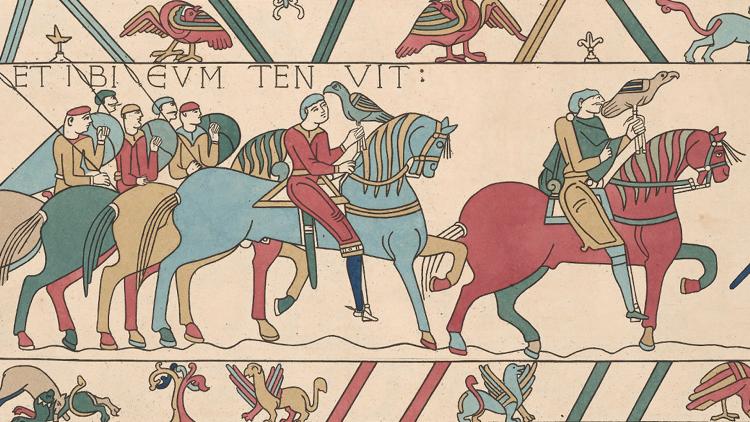
You might have read about how Bayeux Tapestry fever is high in the UK at the moment, with crowds waiting for up to four hours in line at the British Museum to catch a glimpse of the famous embroidered artwork depicting the story of the Norman Conquest of Britain in 1066. It’s the first time (I think) that it’s been moved from its home in Bayeux, and it’s stimulated a lot of renewed interest in the whole Norman/Anglo-Saxon confrontation.
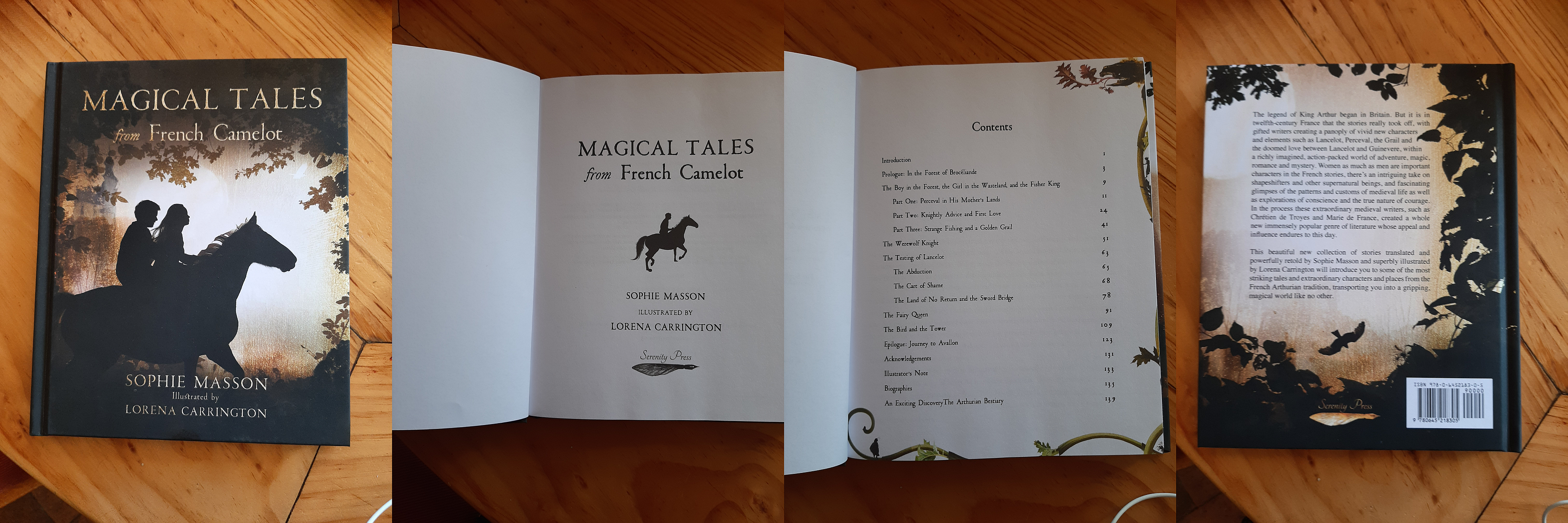
That made me think again about an article, Wicked Sheriff and Outlaw Lord, I wrote quite some time ago, when I was researching the background for the third volume in my Lay Lines/Forest of Dreams historical fantasy trilogy (which is still in print) Incidentally that volume, The Stone of Oakenfast, was only published as part of the Forest of Dreams omnibus, not separately, unlike the first two volumes, The Knight by the Pool and The Lady of the Flowers.
Anyway, I thought this was a good time to republish my piece, which tells the story of the Norman Conquest and its effect on England through the personal histories of two lesser-known players, the Norman sheriff Urse d’Abitot and the outlawed Anglo-Saxon lord, Edric the Wild.
Below is a short extract; you can read the full piece on my (free) Substack page here.

Wicked Sheriff and Outlaw Lord
The legend of Robin Hood is the quintessential English myth. In it, we find all the elements that make up the English—as opposed to the Celtic British—character in the ancient land that the Celts called Logres. Combining ancient magical and symbolic aspects with the trauma of the Norman Conquest, Robin Hood’s legend still has many reverberations in modern England. It could be said, for instance, that the vicious class conflict which characterises English social life had its origins in the almost total destruction of the native English-speaking Anglo-Saxon aristocracy and its almost complete replacement by French-speaking Norman nobles. This produced a vast gulf of misunderstanding between the two peoples which became, in effect, class-based, for ‘ordinary people’ tended to be native English, whilst ‘the upper crust’ traced its origins to foreign despoilers!
As well as preserving the memory of the hideous physical and moral destruction wrought on Anglo-Saxon culture by the Conquest, the legend of the greenwood lord Robin Hood and his merry men is a perfect distillation of that light, lively and melancholy English spirit which had its most gifted and brilliant expression in the work of William Shakespeare. The slanting, ambiguous, mischievous light of the greenwood and its magic is more powerful, in the end, than the shadow of the castle stronghold in the stories of Robin Hood: an ancient light, that predates the Normans, the Anglo-Saxons, and even the Celts, and symbolises the enduring nature of the land.
It’s always a hard one, conquest. The attempt to brutally suppress a vanquished culture and replace it wholesale usually leads to it haunting the landscape, and the cultural psyche, in a way that eventually takes its toll on the confidence and identity of the conquerors themselves. It’s been the same story all over the world, including in Australia. In England, it happened to the Normans.
In the year of Our Lord, 1066, thousands of men came ashore at Pevensey under Duke William of Normandy’s lion flag. Attired for battle, William’s warhosts were attracted by the prospect of more loot and plunder than their Norse ancestors could ever have dreamt was possible, and also by the joy of teaching their arrogant Anglo-Saxon rivals a lesson they wouldn’t forget in a hurry. Lots of men there, twitching with excitement, the thrill of the hunt and of the fabulous rewards promised to them: landless sons, and illegitimate sons; adventurers and pirates and those who followed along just to see what would happen. Like the wolf in the fable, however, they must have a good reason for gobbling up their prey. And so they had it, not one, indeed, but several. Political reason: hadn’t Harold pledged support to William’s right of kingship in England, before Edward the Confessor had died? Religious reason: the Pope had given his blessing to the invasion, because the English Church was going its own way far too often. Cultural reason: the Norse thirst for gold and blood, only thinned a little by la douce France, was rising high. No doubt many of the French breathed a sigh of relief when the Norman army was gone. Personal reason: Duke William, driven by his illegitimacy, driven to conquer England and make it his own, though always his heart stayed in his green Norman fields. That gathering of men, that roundup of reasons, was to have a far-reaching effect. Those warriors twitching to be gone to battle weren’t to know it: but this was to be the last conquest of England, because it was the most traumatic. And in its trauma would be born the greatest of the English legends: that of the outlaw Robin Hood, and his arch-enemy, the wicked Sheriff. Generations and generations into the future, the affrontement of Saxon and Norman would become metamorphosed into the age-old conflict of freedom and tyranny, of nature and authority, of summer and winter, of wild magic and castle law. And men who were once opponents would become reconciled within it. For the terrible crucible of history distils some potent brews, and the tale of the wicked sheriff and the outlaw lord was one of the most potent of all. And it is fascinating to peer into that crucible of time and watch the ingredients of legend being cooked up before your very eyes…