2BR02B: the journey of a dystopian film–an interview with Leon Coward

australian-artist-and-composer-leon-cowardI’ve known the extraordinarily talented young creator Leon Coward since he was a pre-teen reader/reviewer flatteringly enthusiastic about my books. Today, Leon’s love of creating art has  led him to work in many different fields–not only literature, but music, visual arts, and now film-making. Involved first as a concept artist for the short film 2BR02B–To Be or Naught to Be, a dystopian work based on one of Kurt Vonnegut’s short stories, Leon went on to take a much greater part in the creation of the film.

The Canadian production, which has already been selected for no less than 15 prestigious short film festivals, has its Australian premiere today, in Sydney. To mark this exciting occasion, I talked with Leon about the creative journey behind the film.

Leon, how did you become involved in the creation of  2BR02B: To be or Naught to Be? 

My background is in graphic design and traditional illustration. The producer Artin John is a childhood friend, and he began co-producing the film and asked for me to create a poster… then concept art… then the mural and other artwork. I had no idea how involved I would later become.

The film is based on a Kurt Vonnegut short story which imagines a dystopian world in which babies are only allowed to be born if another life is terminated. What were the particular challenges involved in adapting the story for film?

The tone was a challenge. It’s easy to show too little or be too graphic, be too nonchalant or be too sombre. You can try to be as true to Vonnegut’s material as possible, but at the end of the day also you’re working with the material that you as a team have generated, not just Vonnegut’s, and that’s what you’ve got to make work. There were a few things from the original story that confused our test audiences – in one instance it was putting jazz at the end of the film, and Vonnegut gets away with it because as a reader you don’t hear it, but we realised it just sounded like cinema lounge music and it spoiled the audience’s mulling over of events.
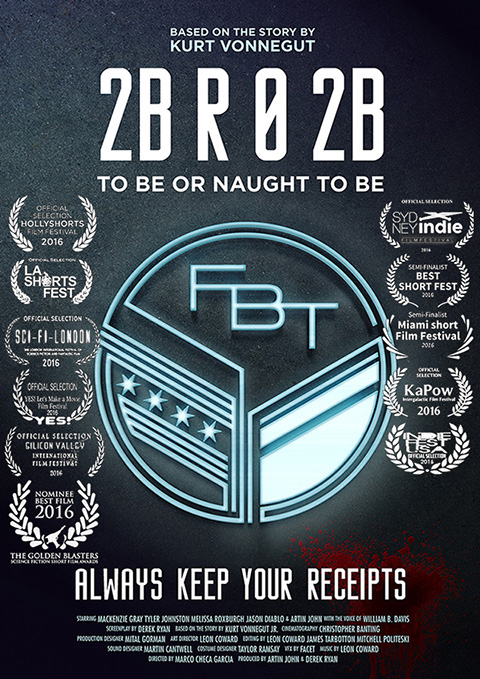
2br02b_federal-bureau-of-termination-poster2BR02B has an ensemble cast, so an editing challenge was working out the balance between them. We’d all thought the film would centre on Wehling and his internal conflict, because his dilemma motivates his actions which affect the other characters – the problem was that while we knew what he was thinking and what he’s gearing himself up to do, the audience didn’t. The first edit was melodramatic simply because the audience was asked to feel for a character they didn’t know. So I shook things up and this was hard because I took an edit to the team and, although the story itself hadn’t changed, what was emphasized had changed. For a long time we were also going for an emotional ending, but after test screenings it was clear the audience were frustrated. My grandmother suggested a twist, and I incorporated it and showed the team without warning them – that way they got to experience it as the audience would.

My own big challenges were creating the fictitious ‘Federal Bureau of Termination’ set in Chicago and the Painter’s 16-ft mural. The FBT is represented by Leora, a gas chamber hostess – but other than her and a brief shot of a gas chamber, the FBT doesn’t appear. So to convey the fact that this organization dominated the society, we gave them a brand identity that pervaded everything – corporate signage, posters, banners, badges, tags, earpieces and costume motifs. Vonnegut described a symbolic design for their logo (an ‘eagle perched on a turnstile’), but I approached it as a new branding commission and researched federal seals and local symbols for Chicago. There are a lot of references – the stars and stripes on the US and Chicago flags, the Chicago municipal device (which is a Y for their shaped river), even the wings of their state insect the Monarch butterfly. But there are also a lot of differences to real seals which make it very impersonal, very geometric, skeletal & circuit-like, and no natural symbols.

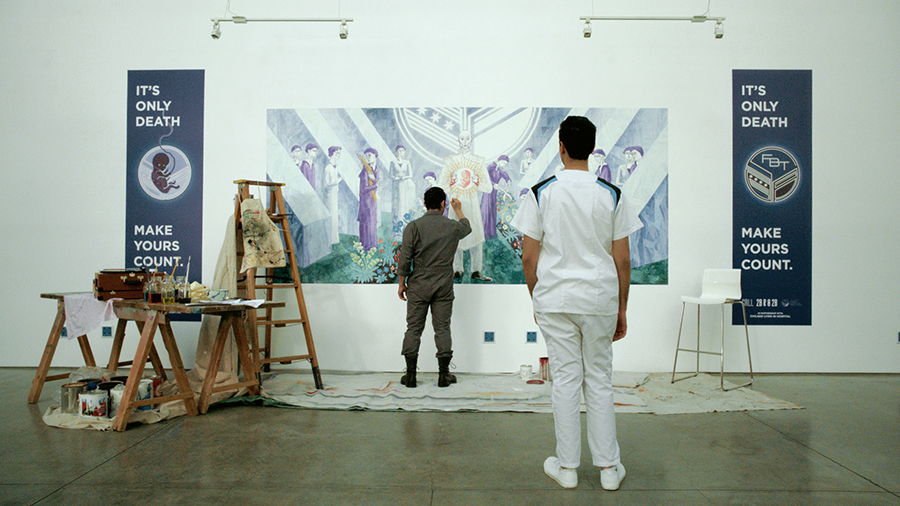
The mural took 6 months to design and finish. It was digitally painted in Sydney, then printed in Canada. All the characters discuss its symbolism and pose for it – if the mural didn’t come across as a genuine work of art, it’d devalue the acting. Its design was driven by story needs and Vonnegut’s prose. It shows a false utopian garden where nurses and FBT staff, dressed in white and purple, symbolically turn soil, plant seeds, and control life and death. Purple is traditional for sacrificial robes, and Dr. Hitz, who is the architect of population control, is painted as a ‘Zeus-like’ figure. The mural had to be recognizably propaganda and contemporary, so our director Marco instructed me to look at Russian war posters, Art Deco and Cubism. At the same time, I knew the mural had to have religious overtones. I’d experimented with a mix of Expressionism and William Blake-esque styles – trying to avoid the ‘communist cornfield worker’ interpretations I’ve seen in student versions of the film, or any specific garden-type, but I was going too far in that direction. My new layout was Art Deco-inspired, using diagonals and circles – essentially it’s an ‘X’ drawing your eyes to Hitz, and the FBT logo acts like a sun, framing Hitz’s head like a halo. I blended Cubism, Futurism and Brutalism with religious styles. The concrete flats, which also mimic the FBT logo, overpower the barest of gardens and help narrow the viewer’s focus, and the floating flower made it futuristic. The style of plants and their millefleur treatment came from The Lady and the Unicorn tapestry and the religiously-themed The Hunt of the Unicorn tapestry. Sir Edward Burne-Jones’ pilgrimage paintings, and especially his Wedding of Psyche, provided the inspiration for the figures, their poses, compositional distribution and costumes (I also referenced medical scrubs). Hitz needed a recognizable inference of himself as a messiah – so Byzantine iconography provided the inspiration for his hands (which are Christ’s) and the haloed foetus, as well as the mural’s forced perspective. For Hitz’s costume there was also a bit of SS uniform and Nehru jacket, dentist and Jedi, and a more contemporary influence from Gehn in Cyan’s Riven, a character who also sees himself as a god. Everywhere you look the message is there, and it was hard to make the mural function as a finished work of art yet still be visibly ‘in-progress’. The aim was to show a society where there is no respect for religious heritage – God is dead, and the FBT is filling the vacancy – and the mural needed to be created that way. It took months of digitally painting and scanning paint textures and brushstrokes, since the mural had to withstand close-ups. Halfway through, Paul Giamatti had scheduling conflicts, and I had to repaint the face for our Hitz replacement, Mackenzie Gray. The mural was printed in strips of paper which overlapped; clear hard-drying gel was applied to give it a texture, and Ferrero-Rocher wrappers (which have a great canvas texture) were used for the gold highlights.2br02b_mural-by-leon-coward-1

The project was an international collaboration over 3 years between crew in Australia, Canada, UK, Mexico and the Netherlands. What were the challenges and advantages involved in such a big undertaking over such distances and different time zones? What did you learn from the experience?

We had cast and crew in Vancouver, myself and other crew in Sydney, an artist in the Netherlands, and a VFX school in Mexico which did effects as part of their professional training. Footage was flown to me in Sydney and I began re-editing with James Tarbotton. Then Martin Cantwell, our brilliant sound designer in London, came onboard. The time differences were okay as calls were early morning or late night, so we’d avoid each others’ work hours – which was important since the film was not a paying project. The separation was a technical disadvantage, since exporting and transferring files adds a lot of time. It’s also important to be able to see, at least once, the person you’re communicating with, in person or Skype, because it makes email writing a lot easier. While there were disadvantages, I think the distance for me and my collaborators in Sydney allowed us to approach the project in a way we mightn’t have otherwise – especially in the editing, where we could respond as a fresh audience without preconceptions, or even knowing what the actors were like out of character.

You worked on many different aspects of the film, as art director, composer, film editor and associate producer. How did you navigate all these different roles? Was there one aspect you preferred above all?
2br02b_left-to-right_jason-diablo-and-australian-artin-johnIn a sense it hasn’t been hard to navigate between the roles because they were prepared for – I had this idea that the Painter would have a gramophone, and that he was listening to Schubert’s “Ave Maria”. When gun-shooting later ensues, the song could provide a macabre serenade. I stuck the gramophone in my concept art, and waited for the idea to take hold – it was influencing the film’s music to some extent without having to be the composer, but ironically I eventually found myself in the role and this wasn’t intentional! There is a some incidental music, but I pushed to have it that the only music was the ‘live’ gramophone so that the music was simply part of the world, and not an ‘invisible’ emotional narrator as film scores often are. The film and the Ave Maria recording were designed and edited around each other: while films are often edited to an existing temp track of unrelated music, this film was edited to a pre-existing recording of Ave Maria, which was later replaced with a tailor-made recording, post editing and sound design. It enabled us to go for a different interpretation too, which would greater contrast the action. We were fortunate to have my sister Imogen Coward, who is both a skilled soprano and conductor, record the version for us that appears in the finished film. We wanted to avoid any artificial stretching or splicing, so we had the unusual challenge of recording in one take, matching the timing of the temp version. We had 2 frames wriggle room, and the edit didn’t have any room to be changed for different timing. It was tiring, but it was worth it because it has a quality that is lost when music, especially singing, is heavily edited.

The film has so far received 5 nominations and 14 international festival selections, including for its Australian premiere at the Sydney Indie Film Festival on October 19. That’s quite an achievement! What do you think are the special qualities of the film which have made it attractive to festival selectors?

While Vonnegut created the story, it’s also the way the cast and crew have interpreted, realized and communicated the story. Derek Ryan, our screenwriter and co-producer, did a good job of cutting away story material that couldn’t be cinematic – so from the start we were all working with a document that concentrated our focus. 2BR02B really takes a cross-section of behaviours in a society where life and death are pushed to absurdities, but there’s no obvious political or moral position in its telling – just the drama of human action, and I think it allows the viewer in on their own terms. I think one of the things that’s helped is how the film feels when you watch it vs what is leaves you thinking about – cinematically it is very static up to a point, and then there’s this burst of drama and the music making it madness, and then just desolation, and that hits the audience. Vonnegut’s narrative was influenced by his experiences as a P.O.W. in Dresden, and even though his story is fiction, the themes are relevant and resonate because the wars have cast such a long shadow. It’s subtle in our film, but the hospital cross is actually a swastika, and the banners flanking the mural are inspired by Nazi banners –  Wehling’s cry “It’s only death” was used on our banners, so instead of his line being spontaneous, it becomes him quoting propaganda which the audience saw earlier.

2br02b_dystopian-chicago

What’s next for you, in terms of films, after this one?

I’m independently developing my own film project – an adaptation of Oscar Wilde’s “The Happy Prince”, and am shifting between generating its music and visual material.

You are also engaged in doing a PhD on aspects of film design. Can you tell us a bit about that?

It essentially provides an analytical process which teases apart a film’s design (if it has one) – whether the story, visuals, acting, music, sound or all their combination. The method is quite straightforward, but its theoretical justification and demonstration is very demanding. The method has had encouraging support from many industry practitioners.

As a multi-talented creator and performer, you are also involved in music, visual arts and literature. Tell us about some of your projects in those fields.

My sister Imogen is director of the chamber orchestra Camerata Academica of the Antipodes, which was founded by my siblings and a group of our young musician friends who we’ve played music together with since childhood. Our concert profits go towards helping support the Don Spencer’s Australian Children’s Music Foundation. Our orchestra has just celebrated its second anniversary and second regional tour in Australia. It’s been a very exciting time for the group. We love playing Baroque music – Vivaldi, Handel and Corelli – but our concerts also include music from a wide range of eras and styles, from the 1500s to today, and the orchestra has premiered some of my music that was written specially for the members. A lot of my own solo projects are on hold until after the PhD, including fine art prints and two picture books, written and illustrated by me, one which has been endorsed by Quentin Blake (Roald Dahl’s illustrator).

I know that you come from a family where the arts are highly valued, and your siblings are both also working in the arts. Can you tell us a bit about how you grew up, and what effect you feel it had on your adult career?

We’ve each ended up musicians – my sister  violin, viola, cello and voice, and she has her PhD in music. My brother has focused on violin, voice and guitar, and he’s also doing his PhD on music and magic performance (he’s been performing illusions for 10 years now). Our parents homeschooled us to university level, and were very keyed in to expanding our interests, skills and activities, but they didn’t try to turn us out as one thing or another and weren’t discouraging. My grandmother recently found some drawings from when I was 5, and I couldn’t draw for nuts. But I meet a lot of parents and kids who restrict activities because there’s no immediate interest or sign of potential. I think the effect it has had for my siblings and me is that we’re not afraid to venture beyond our immediate interests and skills, and that’s allowed us to develop the set of skills we have.

Leon Coward is a published artist and writer, and performed composer and choreographer. He performs on violin, viola, piano and voice with the chamber orchestra Camerata Academica of the Antipodes, and was recently art director, composer, editor and associate producer for the 2016 film adaptation of Kurt Vonnegut’s “2BR02B: To Be or Naught to Be”. He is undertaking a PhD at the University of New England, Australia, and has presented his creative work and research throughout Australasia and internationally, including for the TATE Liverpool UK. Since 2007 Leon has edited and designed the e-zine “The Online Book Group”. In 2009 Leon illustrated “Vietnam Reflections”, by award-winning author Libby Hathorn. In 2011 he was awarded a mentorship by the Australian Society of Authors.
 

Across the Tasman 3: Kyle Mewburn

kyle-mewburn-375I first met Kyle Mewburn, one of New Zealand’s most prominent writers for children, a few years ago in my capacity back then as Chair of the Australian Society of Authors, and Kyle’s as President of the New Zealand Society of Authors. Well, Kyle is still NZSA President, and very active in advancing the cause of writers and illustrators in NZ, against a not very positive background of change and difficulties in the industry there. And in this very interesting interview, he looks frankly at some of those issues, as well as his own literary work.

Kyle, your recent picture book, illustrated by Sarah Davis, The House on the Hill, recently won the Hell Children’s Choice Awards–love that award name by the way 🙂 in the New Zealand Book Awards for Children and Young Adults. Can you tell us something about the book, and how you and Sarah created it? And how have young readers responded to the book?

The idea for the story had been simmering away in the back of my mind for several years (as they do), though ‘idea’ is possibly too grandiose a term for what was, in effect, simply a refrain – “the house on the hill”. But that’s often how my stories start – with just a phrase that won’t go away. I knew there was going to be a journey of some sort, but had no idea who, or what, was going to make the journey. It wasn’t until I was Writer-in-residence at Otago University in 2011, that the story started coming to life, infused with an unexpected Edgar Allan Poe-ish vibe.

It took three weeks of solid, focussed writing for the story to come together. At the end of each day I’d go home exhausted, but satfisfied, despite having completed one stanza or less. I sent the story off to Scholastic and got a reply within an hour – “We love it.” Excellent, I thought. But over the next few months a sense of trepidation started filtering through, as the publishing team started second-guessing themselves. Was the story perhaps too scary? Fortunately, Diana Murray (publisher at the time) had a chat to the head buyer at a major bookstore chain whose verdict came as somewhat of a relief – “Embrace the darkness.” Having strived to make the story as scary as possible, having confidence in my young readers’ willingness, and enthusiasm, to have their pants scared off in a caring, controlled kind of way, I would have been hugely reluctant to water the scares down.

The next question was, of course, who should illustrate? I seldom get asked this question, but I jumped at the opportunity to put Sarah’s name forward. I’d always admired her work, not only for her undoubted technical ability, but also the fact she’s such an eclectic illustrator. Each work is unique with its own distinct style, and she was, I believed, the kind of illustrator who would push the boundaries and come up with a style to perfectly complement my story. Unfortunately, she was rather busy, so I was faced with a choice – wait 2+ years or choose house-hillsomeone else. I didn’t hesitate. Sarah it was.

One interesting, and unusual, aspect of working with Sarah was the unexpected rigour with which she addressed the text. Ultimately there were several stanzas which required re-writing and another which was dropped simply because it didn’t advance the story sufficiently. I really had no input into the illustrations, so can’t comment on that. Apart from saying they’re brilliant throughout and genius in numerous places, especially with their use of perspective. The art of illustration at its finest.

The response to the story has been phenomenal. Despite several parents, teachers and even reviewers initially worrying about the scariness level, the reality is that kids enjoy a good, safe scare and are happy to embrace the ‘game’. As one 6 year-old pointed out when his mum questioned whether or not he was scared – “No. I knew they weren’t real ghosts because there was a cat. Cats don’t like ghosts.” Winning the kids’ choice award is, I think, the ultimate accolade.

Though you are especially known for your picture books, you have also written chapter books and early readers. What are your favourite types of books to write, and what are the main differences between creating texts for all those different formats?

Picture books are my first passion. Almost a vice. My ideas are almost instinctively for picture books, and they seem to be the genre that most suits my thought processes and my writing voice. They’re also the biggest challenge and I get a lot of pleasure pursuing picture book ideas. (Also a lot of angst and anguish, but that’s another story…) Chapter books and junior fiction require a more measured approach. It’s more about building upon a concept than simply chasing an idea. For me, junior fiction (especially for so-called ‘reluctant readers’ or transitional readers) really has to begin with a strong character, ideally a child character. Once I have my hero sorted (whether that’s the first evolved boy in a Neanderthal tribe, or a shape-shifting dragon boy who wants to go to Knight School) I can view their world from their own unique perspective. It’s all about building relationships and interactions. Then, additionally, I add extra details and levels of meaning which encourage and reward re-reading.

dragon-knight

All my writing is child-centric. It’s all about creating stories which reflect their lives, or more specifically, some critical aspect of it. Generally my stories are about making or maintaining friendships. I guess the biggest difference between writing picture books and junior fiction is the former is a distillation process – reducing grand themes to its essence; while the latter is more a process of accretion – adding layers and details to a simple idea.

What are you working on now?

Currently I’m experiencing a bit of mid-career-itis, so not quite sure what I’m working on. The house on the hill was the last picture book I sold, so the drought has dragged on a bit. I’m not 100% sure why my picture books don’t seem to be hitting the mark any more. Possibly it’s me. Having never settled on a single style of story, I’ve generally always pursued whatever ideas tickled my fancy. And after writing over 25 picture books I’m reluctant to rework old ground. So I’ve been experimenting with different styles and approaches to writing, just to keep myself amused and challenged. Maybe that’s not what the market wants at the current time.

In the meantime I’m developing a new junior fiction series and tinkering with re-writing some of my early adult novels. A musical friend and I are also playing around with a script for a musical. It’s all good fun, but as the main breadwinner I can’t afford to spend too much time on non-profitable diversions, no matter how inspiring. So we’ll see what happens. 

Born and brought up in Australia but living in New Zealand for a long time now, you are one of New Zealand’s most prominent authors of children’s books, and you are also President of the New Zealand Society of Authors. In both capacities you’ve had a good deal of contact with the Australian literary world as well. How do you see the similarities and differences between literary New Zealand and literary Australia, both in terms of the kinds of books that get published, and also the literary scene–both in the children’s/YA and adult fields?dinosaur-rescue

There are enormous similarities between the two countries’ literary worlds and I’m rather perplexed by the fact there still seems to be a huge wall with respect to the sharing of books and writers. The key differences, I think, stem largely from the smallness of the local literary  community and market. Despite the size of the population (think Melbourne) there are very strong cliques and factions which are more based around protecting funding turf than  anything else. Which means local writers are very reluctant to criticise anyone or anything for fear of offending the wrong person. You could all-too-easily end up on the outer with no chance of funding or reviews. I’m sure every country has the same rivalries and divisions, but here, because of the population, it is much more distilled and rather potent.

The small market also makes it difficult to make a living. Print runs are often only 1500 and you can make the bestseller list by selling 100+ copies in a given week. I’ve been fortunate insofar as many of my stories have had some longevity (several are still being reprinted 10+ years later), and have had numerous titles published into international markets. Sadly New Zealand publishers are increasingly acting like imprints of their international parents, insofar as they have become much more focussed on publishing stories with local flavour. In the picture book market there has always been a demand for kiwi stories (literally stories about the bird) but this has become massively more so over recent years. No wonder when many bookshops report most people are buying picture books to send overseas to relatives or take away as souvenirs. There has also been a huge growth in stories translated into Te Reo (ie Maori language). While all this might be worthy and understandable from a business model point of view, it has not only made it that much harder to make a living as a writer, it has also created an unfortunate quandary – ie write for this market and accept your income is severely ring-fenced, or you don’t, and stack the odds against being published at all.

With respect to making a living as a CYA writer, I think Australia has massive advantages with respect to creating a secondary income stream from school visits and festival appearances. However it is a lot more cut-throat. In New Zealand school visits are arranged mostly through the Book Council, while in Australia it’s all done through agencies. So in Australia it’s much more a case of the more popular you are and the better your presentations, the more visits you get. Here it’s a bit more communal with visits shared around. On the negative side, we earn half as much for a visit as you do in Australia. It’s still very difficult to convince the majority of schools there is much value in author visits… as opposed to visits by sportspeople… or magicians… or the local fireman…

kisskissyuckyucklgeAs President of NZSA, you have been involved in helping to organise the first ever National Writers Forum in New Zealand, which has just been held. What are you expecting from the forum? And what are the issues that are most preoccupying authors and illustrators in New Zealand today?

The National Writers Forum was a huge success. The feedback has been extraordinary. The main goals were, firstly, to offer some serious professional development opportunities through masterclasses and expert panels. Secondly, it was about creating opportunities to discuss the business aspects of a writer’s life at every stage of their career. There’s plenty of information out there but seldom do writers get an opportunity to ask specific questions pertaining to their own, specific careers directly to a panel of experts. Finally, and for me most importantly, it was an opportunity for writers to assemble at the national level in a collegial and congenial environment. There are way too many divisions within the literary community, and this doesn’t help the literary cause in the wider context. The only way to break down barriers and cliques is to strengthen personal relationships by talking to each other directly rather than shouting at each other over the parapets.

As in most countries, the biggest issues preoccupying us in New Zealand centre on the increasing difficulties of making a living. New Zealand books are expensive in comparison to international titles available on-line, so there has been a concerted effort to exclude books from GST. Wishful thinking under the current government. We already have parallel importing, so have long ago come to terms with the long-term (all negative) consequences. As with writers everywhere we’re also concerned about the push to change (ie water down) copyright laws.

A very recent research report published by the New Zealand Book Council contained the rather disappointing finding that New Zealand readers were biased against NZ fiction, saying that they rarely read it–but also could not name any NZ authors–and that only 3-5 percent of fiction bought in the nation was by NZ authors. What are your thoughts on this? Is it a matter of cultural cringe? Do you think it could be turned around? If so, how?

Cultural cringe with two capital Cs. In many ways it reminds me of Australia in the 80s when I was at high school – nobody admitted to reading OzLit. When I arrived in New Zealand in 1990 there was a huge push to make NZ Music cool. The government pumped in $5million per year and introduced a radio quota. And (surprise!) within a generation NZ Music became cool. There was an attempt to do the same with books but with a budget of $100,000 and divisions within the industry, it gained little traction and soon disappeared. In the last 10 years, NZ has become a massively flag-waving country. Kiwis are enormously proud of their sportspeople, their music, their films (well, Peter Jackson and Weta Workshop, anyway), but there remains a total reluctance to wave the NZ flag when it comes to books and writers, despite local writers garnering increasing international awards and respect.

I suspect the cost of local books has something to do with it. It also doesn’t help that NZ “literature” is still discussed in such reverent tones while genre and/or popular fiction hardly gets a look in. It fosters the impression that local literature is rather intellectual and elitist. We have many world-class, internationally best-selling writers across all genres. It would help enormously if these were celebrated a bit more.     

Last year NZSA instigated a grassroots NZ Book Week with a very limited budget. Hopefully it will continue to grow and, over time, leach into the psyche. But generally I feel it requires a much greater level of government action and investment. It also is a long-term project. I’m constantly frustrated by the lack of commitment to involving local writers/titles in literacy programmes. The “as long as they’re reading something” approach does little to improve literacy, in my opinion. The only way to grow literacy is to promote local authors and stories and instill some pride in local literature. Imagine how few kids would be playing rugby if the All Blacks were considered also-rans, nobodies, rather than superstars. Pride – whether in rugby, music or literature – begins with aspirational role models. We need to start kids on NZLit from the get-go.


Kyle Mewburn is one of New Zealand’s finest, and most eclectic, picture book writers. His titles have been published in a dozen countries and won numerous awards including Children’s Book of the Year (Old Hu-hu), Picture book of the Year (Kiss!Kiss! Yuck!Yuck!),two Children’s Choice awards (Kiss!Kiss! Yuck!Yuck! andMelu) and a Flicker Tale award in North Dakota (Kiss!Kiss! Yuck!Yuck!). His stories are noted for being multi-layered, funny and linguistically creative.

He has been a frequent Finalist at the New Zealand Children’s Book Awards and many of his titles have been included on Notable Books Lists in both New Zealand and Australia.

As well as picture books, he has published numerous School Readers and junior fiction titles, including his popular Dinosaur Rescue series which has been published in over 20 countries. He was the Children’s Writer in Residence at Otago University in 2011 and is currently President of the New Zealand Society of Authors.

Originally from Brisbane, Kyle lives with his wife, Marion, a well-known potter, in a house with a grass roof in Millers Flat. When he’s not writing, Kyle’s free time is almost wholly consumed trying to maintain a semi-self-sufficient lifestyle … or watching the endlessly entertaining drama of chickens trying to get to bed under the watchful eyes of two teasing cats.

An interlude to introduce the Juvenilia Press

I’m delighted to learn today that the Small Beginnings series on this blog is being featured on the Facebook page and linked to the website of a wonderful specialist press publishing out of the University of NSW, the Juvenilia Press, which focusses on the very early writings of authors, including classic authors like Jane Austen! Here’s something about them:

The Juvenilia Press promotes the study of literary juvenilia, a category of literature that has been largely neglected. Its editions are slim volumes of early writings by children and adolescents (up to the approximate age of twenty), including published and unpublished works of young authors – both those who achieved greatness as adults and those who did not become adult writers but whose writing is full of percipience and zest.

Founded in 1994 by Juliet McMaster at the University of Alberta in Edmonton, the Press has since 2001 been based in the Faculty of Arts and Social Sciences at the University of New South Wales in Sydney, and has an international team of contributing editors from Britain, Canada, Japan, Spain, Switzerland, New Zealand, the United States, and Australia.

The volumes are normally devoted to one author and are edited by an expert in the field, with the assistance of one or more students, usually postgraduates. Student involvement in the research and editorial process is an essential part of the pedagogic aim of the Juvenilia Press; and the illustrations, often executed by young aspiring artists or by the original young authors themselves, aim to capture the tone of the original productions. By contributing to the recovery, publication, and critical exploration of childhood writings, the Juvenilia Press actively promotes literary research and the professional development of students. At the same time, they endeavour to provide, for a wide audience, an insight into the creative energy of this rich and varied body of writing.

Do check them out on Facebook, and visit their website for more information: https://www.arts.unsw.edu.au/juvenilia/


Speaking in Tongues: a guest post by Sophie Constable

Sophie Constable greyThe pleasure and challenge of not being restricted to just one language is a subject dear to my heart (and close to my experience!) so today I am delighted to publish on my blog a wonderful article by writer Sophie Constable about the situation for multilingualism in Australia.

Sophie Constable has worked as an Antarctic researcher and veterinarian, been an expat trophy wife in the Middle East and did her PhD on health education with remote Australian Indigenous communities.  Throughout, writing has remained her passion.

Speaking in tongues

by Sophie Constable

Exploring Australia’s language skills crisis

Rejoice!  Jules Verne’s Mikhail Strogoff has just been published in English for the first time in over 100 years.  I loved this book and I love that new generations of English speakers are getting the chance to follow the fabulously intrepid Mikhail through the Wild West of Russia’s Far East.

But the fact remains that translation of foreign language books – be they new masterpieces or old classics – is a tiny proportion of the English literary scene, as Strogoff’s translator Stephanie Smee has discussed.  And globally, native English speakers are rarely able to enjoy literary works in the original language.  Nowhere is this more true than Australia, where multilingualism, already the minority, is in steady decline.

If language, at its heart, is about humanity, as author Elizabeth Little writes, then Australians are losing their ability to understand the world.

Being bilingual, I sometimes forget multilingualism, the norm for much of the globe, isn’t the experience of most Australians.  Though we’re a multicultural nation, most people consider English to be enough for our needs and even within bilingual families, bilingualism is declining across the generations.

Are Australians just not interested in languages?  Is it too hard in a geographically isolated, monolingual society?  What’s the point in learning languages anyway, apart from an exponential increase in the to-read pile?

Imogen Weafer, a retail assistant in Darwin’s Casuarina Square shopping centre who uses Japanese in her work, certainly wasn’t interested in languages when she younger, despite her grandmother and mother being bilingual in Latvian and English.

‘My grandma taught my mother, but I wasn’t interested.  I regret that now,’ she says.

Miss Weafer considered that she grew up in a society that didn’t value foreign languages.

‘I lived among generation after generation of farmers who all speak English and nothing else, and think Sydney is overseas,’ she said.

She didn’t consider learning another language until going to Japan after year 11.  She chose to stay in Japan rather than study Japanese at school:  ‘In school, my Japanese teacher was a French teacher,’ she said, unimpressed.  It’s a common problem: more than 100 schools discontinued their languages program between 2003 and 2006, specifically due to a lack of qualified staff.

But English isn’t Australia’s only local language.  Growing up on the edge of the Barossa Valley, Ingkerreke Commercial project manager Daryl Thompson didn’t consider German a foreign language.  He grew up with it, going to a high school where many students had German heritage.  Though all students had to learn to German, by the end of high school he’d learnt more from his classmates than from the teacher.

‘I could swear at people’ he said, ‘and they can understand.’

Darryl Thompson

Darryl Thompson

Despite only speaking English at home and never having taken a language course, Mr. Thompson has since learnt parts of nine other languages.  He learned these on building sites around Australia by talking with co-workers.  ‘The Australian construction industry is a multinational industry,’ he says.  ‘Italians and Greeks do concrete, Vietnamese do the tiling, Croats and Russians do the gyprocking.  Knowing a bit of their languages shows that you are interested in them as a person; they are more amenable to do what you want them to do.  People that don’t make an effort won’t get as far.’

Sure, many find the idea of learning a language confronting.  CSC Adult Night Classes Japanese teacher Mikiko Kawano explains, ‘just like losing weight, you have to do it for a long time to see a result.’ This largely explains why those who beginning learning at a young age become more proficient.  However the idea that it’s too hard to learn other languages doesn’t hold with Mr. Thompson.  ‘That’s just excuses,’ he says.  ‘In today’s era of technology, of internet, easily purchasable online media, audio and video, there’s no reason why people can’t learn.’  CDU Indonesian lecturer Nathan Franklin agrees, finding that the opportunities to learn languages are all around us.  ‘They are walking past us in the streets,’ Dr. Franklin says, ‘they are working in the shops.’

The latest census counted almost 400 languages spoken in Australia, including over a hundred Aboriginal and Torres Strait Islander languages.  Most of Australia’s language skills come from recent immigrants: 87% of Australian secondary school students will have dropped out of language courses after two years or less.  For those who are studying languages, Australian students spend less time learning than any other OECD country.

I don’t come from a bilingual family.  Nor did I learn my second language overseas.  The reason I speak French is that my school went against the trend.  Telopea Park Public School in the A.C.T. has an agreement with the French government to import French national teachers to teach in a bilingual system from primary school onwards.  And it is one of the only schools in Australia producing entire classes of fluently bilingual students every year.

O.K., so maintaining the bi-national relationship was difficult at times.  I’ll never forget the expression on my French teacher’s face when a quarter of the secondary student body protested the testing of nuclear weapons at Mururoa atoll by refusing to stand for the French national anthem during assembly.  We experienced first-hand the impact of international relations at the personal level.  But isn’t that, after all, what language learning is all about?

Against the trend of declining bilingualism elsewhere, my new home in the Northern Territory has the highest proportion of multilinguists in Australia, and it’s rising.  I’ve come to the right place, then!

Eva McRae Williams

Eva McRae Williams

Eva McRae-Williams, Senior Researcher with Batchelor Institute of Indigenous Tertiary Education, finds exposure motivates others.  She says, ‘In Darwin you hear five different languages in the supermarket.  Warlpiri, French, Thai, Yolngu, Sudanese.’   These languages are economically important as tourism and remote community work are some of the biggest employers in the Territory.

Motivation is notoriously lacking in native English-speakers.  In French there is a saying: a man who speaks three languages is trilingual, a man who speaks two languages is bilingual, a man who speaks only one language is English.  Though English is the language which unites us, it’s also isolating us, Dr Franklin finds, because it reduces the compulsion to learn other languages.  ‘The Western mentality is that everyone needs to learn English, as English is the lingua franca of the world,’ Dr Franklin states.  Whereas ‘[English-speakers] don’t need to learn another language to get a job’, here, as well as overseas, ‘students and business-owners know they need to speak English and they learn out of necessity’.

However, in a global market place, sharing a language can markedly increase bilateral trade and reduces tariffs, according to research.  While historically this has been a boon for trade with the UK and the US, seven of the Australia’s top ten two-way trading partners are now countries where English is a second language, including China and Japan, as well as the vast majority of our fastest growing markets, including Indonesia and India.  That can put English monolinguals at a disadvantage at the negotiating table.  The rise of Asia may threaten English’s dominant economic position – and that’s a problem for many Australian businesses.

For Dr. Chie Adachi, speaking as Linguistics Lecturer at the Australian Centre for Indigenous Knowledges and Education, the value of language learning is broader than its purely economic context.   ‘If you aren’t learning a language because you don’t see a purpose in it, you are missing the point,’ she says.  ‘It’s about changing the way you think.’

New research by a team at the Stanford University is finding more evidence supporting the idea that languages affect how we think.  Lera Boroditsky’s team has found that which language you use affects concepts as varied as colour differentiation, spatial orientation, direction of time and causality.  Dr. Boroditsky’s findings make sense for Jack Wang, a Chinese-born administrative assistant.  ‘Being able to speak another language gives you a different perspective on the world around you,’ he said.   Growing up in censorship-rich China, that was ‘mind-blowing’.   Dr. Adachi agrees, ‘it allows you to think more broadly and in different ways, which can be a rare experience.’

Ms. McRae-Williams found being a minority English speaker in spaces shaped by Aboriginal languages a transformative experience, saying ‘it opened up another world for me.’ Like 80% of


Australians, Ms. McRae-Williams spoke only English at home before going to Ngukurr in the Northern Territory, where Ngukurr Kriol  is the local language.  ‘Kriol seems to have a smaller vocabulary of words but there are important subtleties when you use those words and who to,’ she says.  ‘Even though there are many English sounding words, they can be used differently, with different

Pitjantjatjara country

Pitjantjatjara country

connotations and meanings.  English speakers might think they are understanding what the Kriol speaker is saying but they are not understanding them, really.’  For example, she found  ‘that unlike English language it is rare for people speaking in Kriol to use the word “I” or “myself”, rather “mela” is used which means “we” or “us”. Her experience of how cultural perspectives and knowledge are embedded in language gave her a new insight into centuries of intercultural misunderstanding.

The misunderstandings over land are a prime example.  In Pitjanjatjara, you don’t say ‘what is that place?’ but rather ‘who is that place?’  Land is related to people like a grandfather or aunty is: land is a “person” in the Pitjanjatara world view.  The idea of “owning” your grandfather becomes nonsensical; the idea of abandoning it, impossible.

Given the historic and ongoing lack of understanding between Indigenous and non-Indigenous Australians, and the national and international consequences of wider intercultural misunderstanding, the question ought not be why learn a language, but why not?

OLYMPUS DIGITAL CAMERA

Hunting Papa in the Hills, by Alan Wilson, Pitjantjatjara elder