Lovely review of The Tyrant’s Nephew

Lovely to read a great new review of a book I wrote quite some time ago: The Tyrant’s Nephew. Here’s an extract of the review, by fabulous musician and fairy folklore expert, Louisa John-Krol.

A guild of Carpet-Enchantresses, a Jinn Cat born of smokeless flame, Suloowa (murderous mermaids), werewolf clans, Shadow Walkers… what more do we need? This is the fantasy I love, set in exotic magic-realist landscapes where cars and gasmasks are interspersed with flying rugs and rituals to separate souls from bodies. Yay! There is even a gold crystal ball with an opal sphere within, like an eyeball, set on a stand, glittering and glowing, emitting a sinister hum: invidious spyware. Yes, my kind of book.

You can read the full review here.

Authors’ pick 22: Sheryl Gwyther

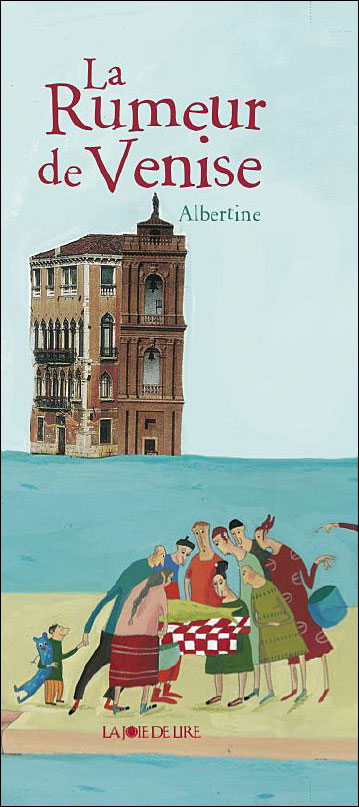
La Rumeur de VeniseToday’s authors’ pick has been chosen by Sheryl Gwyther.

How to pick one from my mostly brilliant reads this year? So tricky – they were all a joy. Books like Cass Moriarty’s moving debut novel, The Promise Seed; Claire Zorn’s YA novel, The Protected; Michael Robotham’s Close your Eyes, and Meg McKinlay’s A Single Stone.

In the end, my very favourite read was a children’s picture book… La Rumeur de Venise, by the award-winning Swiss illustrator, Albertine. I knew it had a fair chance of being special – her other works (mostly co-creations with her author partner, Germano Zullo) all have a unique way of seeing the world.

The Rumour of Venice’s images cleverly capture the pervasiveness of gossip. No words are needed as a rumour about a giant fish caught by a fisherman floats from one canal dwelling to the next, and each person’s re-telling bringing increasingly bizarre. A funny, witty concertina book adults will appreciate; and a game as children follow the action, La Rumeur de Venise is a delight. And especially so if you are open to Albertine’s magical combination of colourful collage and whimsical drawings set in Venice. A book to keep.

Award-winning author, Sheryl Gwyther writes children’s novels, short stories, school plays, and Flash Fiction for adults. Her website is at:  www.sherylgwyther.net

Sheryl Gwyther image

Authors’ pick 20: Stephen Whiteside

fanny stevensonToday’s Authors’ Pick has been chosen by Stephen Whiteside.

My best read of the year, without a doubt, was “Fanny Stevenson – Muse, Adventuress & Romantic Enigma” by Alexandra Lapierre, translated from the French by Carol Cosman, published by Fourth Estate, London, in 1995.

Fanny Stevenson was the wife of Robert Louis Stevenson, author of “Dr. Jekyll and Mr. Hyde”, “Treasure Island”, “Kidnapped”, and so many other fabulous adventure stories.
Fanny was American born, and unhappily married when she met R.L.S. (nine years her junior) in France. She was an absolute dynamo – a turbo-charged autodidact. It took my breath away reading what she achieved from very humble beginnings and minimal outside assistance. Whenever I feel I have hit a roadblock in my life, I suddenly think of Fanny, and realise I have probably only explored about one tenth of the possible solutions!
Mind you, it took its toll on her. She suffered from mental illness off and on throughout her life. Her principal pattern was loss of memory at times of stress. Putting my doctor’s hat on for a moment, I suspect she might have been suffering from a condition called TGA – total global amnesia. Then again, there was also talk of hallucinations, which complicates the picture.
In addition to her many other skills and passions, she was a consummate home-maker and (self-taught) cook.
Here is one of my favourite passages from the book:
With a cigarette between her lips, her sleeves rolled up, a battery of casseroles in progress, she lit up her ovens. Alchemist or magician, this time her bisques, her sauces and roasts reached perfection. She no longer improvised recipes but was inspired by the cookbooks she received from France and laboriously translated, with much reliance on dictionaries. She corresponded with three chefs from Louisiana, comparing their techniques, their utensils, their ingredients. Another aspect of Fanny’s originality, and one particularly unusual in the nineteenth century, was her interest in international cuisine. She was a passionate admirer of Asian cooking, and shopped in the swarming markets of Chinatown where no white woman dared set foot. She jotted down her research, her experiments, her failures, despairing of her groping efforts, aimed at excellence, and, without being in the least conscious of it, struggled to turn her culinary gifts into an art.
 
Stephen Whiteside’s collection of rhyming verse for children, “‘The Billy That Died With Its Boots On’ and Other Australian Verse”, was published by Walker Books in 2014, and won a Golden Gumleaf for “Book of the Year” at the Australian Bush Laureate Awards during the Tamworth Country Music Festival in 2015.
 

Omnimystery interview on The False Prince

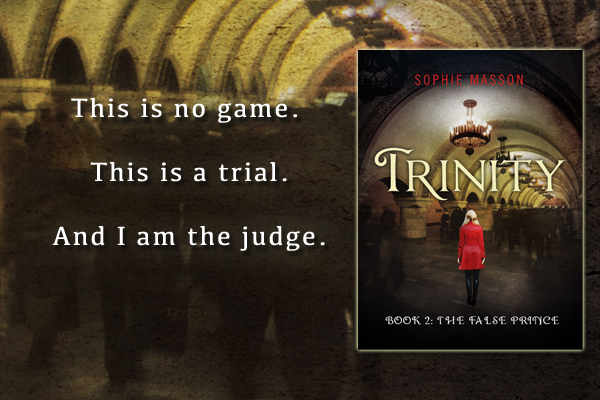
Falseprincequotes11I was interviewed recently about The False Prince for the Omnimystery site which focuses on crime, mystery and thriller novels.

Here’s a short extract:

OMN: How does the title of The False Prince relate to the story?

SM: The idea of “falsity”, betrayal, masks, secrets, are at the heart of the book. People pretending to be who they’re not. Enigmas hidden in plain sight. Hope placed in the wrong people. But also, it’s a reference back both to Russian history, and to something in the first Trinity book, The Koldun Code. Don’t want to say any more for fear of spoilers!

You can read the whole interview here.

Thunderbolt Prize winners: Joshua Nash, winner of the Non Fiction prize

Today’s interview is with Joshua Nash, winner of the Non Fiction category in the Thunderbolt Prize.

Joshua Nash is a linguist and an environmentalist. His work concerns philosophical and ontological foundations of language and place, the anthropology of religion, architecture, pilgrimage studies, and language documentation. He has conducted linguistic fieldwork on Norfolk Island, South Pacific and Kangaroo Island, South Australia, environmental and ethnographic fieldwork in Vrindavan, India, and architectural research in outback Australia. He is a postdoctoral research fellow in linguistics at the University of New England.

First of all, Joshua,congratulations on your win! How did you come up with the idea of your winning story, A Nameless Island?

A Nameless Island is a skew on crime non-fiction. I take my present linguistics research project, an island in the South Pacific with a mythical past, and ask what might comprise a criminal act. I arrived at several contradictions concerning what crime may be. The story is a musing on these incongruencies.

What attracts you to writing crime non-fiction?

A friend encouraged me to submit for this prize. Otherwise, I have written little about crime nor have I read many whodunnits. I loathe Inspector Morse type shows.

Can you tell us a bit about your background and writing career?

I am from Adelaide and moved to Armidale for work in October 2014. Professionally I studied as a linguist, but ultimately I am an environmentalist and a nature lover. Writing for me is both a scientific as well as an artistic endeavour. I have developed a corpus of peer reviewed work which straddles anthropology, geography, history, environmental studies, and pilgrimage studies. I am currently working towards finding my feet within more creative work.

You are a respected academic writer as well as a creative writer. How do those two practices work with each other?

Generally terribly. The peer review process in science can often be the one way to knock out most if not all creativity in writing. That said, I have been lucky to get some fringey creative ideas published in scientific journals.

What do you hope winning the Non Fiction prize will do for you as a writer?

Maybe the prize will give me my five minutes of fame in Armidale. It might give me the possibility to become more involved with happenings at the New England Writers’ Centre, which is definitely a good thing. As a researcher I don’t have any student contact at the moment, so I appreciate the contact with others. If I can contribute my expertise in any way, then great.

As a reader, what do you look for in a good book?

Good books show courage. Good writers take risks. Having lots of people not ‘get’ you is a sign you are doing things differently.

Anything else you’d like to add..

I am currently marking 70 third year architecture essays (ok, this is some student contact, though through digital means only). To all students in the world – please learn how to present reference lists and footnotes properly. I cannot overemphasise this point. Good reference lists lead to good marks which lead to a nicer world.
Face to face with Rasputin..

DSCN7983My new adult novel, Trinity: The False Prince, comes out very soon, as you might have realised from all the enigmatic clips I’ve been posting, with quotes from the book! And now, a piece of mine about a spooky visit I made to the scene of Rasputin’s murder, in St Petersburg, has been published on the Momentum blog.

Here’s an extract:

It’s in one of the grand gilded living rooms of the palace that you get the first glimpse of the horrible events of December 30, 1916. A group of rather creepy waxworks representing some of the conspirators is huddled around an old phonograph. ‘Waiting for Rasputin,’ the guide says, ‘they listened to the same record over and over.’ They were nervous. Rasputin was a favourite of the Tsar and his family and they could not be sure how he would react over his death.’ But it wasn’t here this room that Rasputin was lured to his death; oh no, though the prince, pretending friendship, had invited Rasputin to come and take tea at the palace, he had no intention of letting this ‘dirty peasant’ set foot in the fine rooms of the palace. No, Rasputin was to come to the basement.

You can read the whole thing here.