How working in restaurants inspired Maggie’s Kitchen

Maggies Kitchen Blog Tour posterToday I’m very pleased to be part of a blog tour by writer and producer Caroline Beecham, whose debut novel, Maggie’s Kitchen (Allen and Unwin), a most engaging historical novel about a most unusual restaurant, set against the background of World War Two, has just been published. In this interesting post, Caroline writes about one of the inspirations for her novel: and as a bonus to readers, provides a delicious recipe from the book!

How working in restaurants inspired Maggie’s Kitchen

 by Caroline Beecham

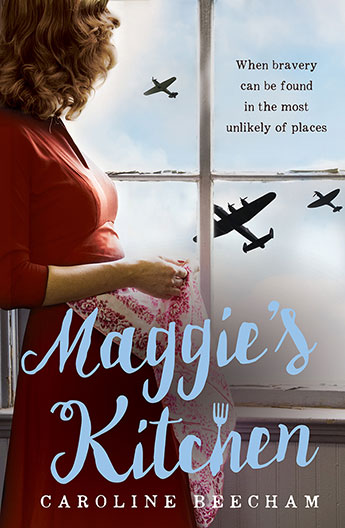
 Maggie’s Kitchen’ follows the fortunes of Maggie Johnson as she sets up and runs a British Restaurant in London during the Second World War. The story focuses on the relationships that develop with the community and in particular with Robbie, a twelve-year-old runaway, and Janek, a Polish refuge. Together they struggle through government red-tape to open the restaurant and then battle food shortages and community crisis to keep open their doors.

Caroline Beecham pic12Real events inspired me to write ‘Maggie’s Kitchen’; I was intrigued by these British Restaurants that the Ministry of Food set up during the Second World War to help with the food shortages. I felt that there was a story there, but my first thoughts were that it would be too difficult; how would you approach writing about people living on rations and not getting enough to eat and make it appealing? It was my experience working in restaurants while I was growing up that gave me the answer; you become like a family, working as a team, building relationships with regulars, dealing with difficult personalities and daily dramas—even when its not wartime! You become part of a community and I realised that it was through this microcosm that Maggie’s story could take hold.

I still had to keep a check on the food descriptions though; it didn’t seem appropriate to give mouthwatering accounts of the food so I had to restrain myself there, and I hope that I got the balance right. The research for the book took a long time as I read other fiction and non-fiction books, trawled the National Archives in London and visited Islington where the novel is set. Working through the original Ministry of Food recipes was also time-consuming as they all had to be checked and I wanted to make them so that if anyone asked me I could say that I had tasted and tested them all. With the help of friends and family, they were all tried and some adjustments made; there is no powdered egg these days!

One of my favourites is the Crisp Coated Scotch Eggs recipe below. There was a requirement for fast food that could be eaten in a hurry, hot or cold, and the humble Scotch egg fitted the bill. The recipe is also appealing because it evokes the nostalgia of childhood. That’s one of the reasons that food can be so comforting; if it’s a dish we ate often as children then it can take us back. This theme of memory and food, and courage and food, is central to the book. The comforting nature of food is emphasized through Maggie directly nurturing Robbie with food, in the same way that she is able to offer comfort and food to the community through the restaurant.

For Maggie, the simple act of cooking is nurturing for her senses; even when she is trapped underground in the air raid shelter she is: ‘rubbing the sodden dirt between her fingertips, feeling the same cold coarse texture as if she were simply making breadcrumbs for shortbread or the topping for a fresh fruit crumble.’ And again, later on: ‘By the time she was at home in her kitchen and had taken the potatoes from her pockets and washed them, she was beginning to feel more settled, soothed by the restorative act of cooking.’ In a moment of self-doubt, when she is questioning her abilities, it takes Janek to remind her that: ‘In crisis we focus on what is real. What can be more real than providing people with their most basic need?’

crisp coated scotch eggsCrisp Coated Scotch Eggs

Ingredients:

4 eggs

450 g sausage meat

Flour

Breadcrumbs

Preheat oven to 200°C/390°F. Hard-boil eggs and coat with sausage meat, moulding them into neat shapes. Dust with flour and roll in bread crumbs. Line a baking tray with baking paper and bake eggs until crispy. Serves 4.


·         Maggie’s Kitchen by Caroline Beecham is published by Allen & Unwin, RRP $29.99, available now.

Booktopia

·          Kindle

·          Apple iBooks

Maggie's Kitchen Book Cover

More about the book:

Amid the heartbreak and danger of London in the Blitz of WWII, Maggie Johnson finds her courage in friendship and food.

They might all travel the same scarred and shattered streets on their way to work, but once they entered Maggie’s Kitchen, it was somehow as if the rest of the world didn’t exist.

When the Ministry of Food urgently calls for the opening of British Restaurants to feed tired and hungry Londoners during World War II, Maggie Johnson is close to realising a long-held dream.

But after struggling through government red-tape and triumphantly opening its doors, Maggie’s Kitchen soon encounters a most unexpected problem. Her restaurant has become so popular with London’s exhausted workers, that Maggie simply can’t get enough supplies to keep up with demand for food, without breaking some of the rules.

With the support of locals, and the help of twelve-year-old Robbie, a street urchin, and Janek, a Polish refugee dreaming of returning to his native land, the resourceful Maggie evades the first threats of closure from the Ministry. As she fights to keep her beloved Kitchen open, Maggie also tries desperately to reunite Robbie with his missing father as well as manage her own family’s expectations. Until she can no longer ignore the unacknowledged hopes of her own heart, and the discovery that some secrets have the power to change everything.

More about Caroline Beecham:

Caroline Beecham grew up at the English seaside and relocated to Australia to continue her career as a writer and producer in film and television. She has worked on numerous productions including a documentary about Princess Diana lookalikes, a series about journeys to the ends of the earth, as well as a feature film about finding the end of the rainbow. Caroline decided on a new way of storytelling and studied the craft of novel writing at the Faber Academy in 2012. She has an MA in Film & Television and a MA in Creative Writing and lives with her husband and two sons by Sydney harbour. Maggie’s Kitchen is her first published adult novel.

ministry of war food


Small Beginnings 16: Gillian Rubinstein(Lian Hearn)

Jocelyn & Gillian

With my sister

My father loved poetry and had a store of favourite lines. He also knew a lot of Shakespeare by heart, and all the words to Gilbert and Sullivan songs. Books on the shelves that influenced me – because I read them over and over again – included the blue bound Oxford Books: Light Verse, Ballads and English Verse. Many I didn’t understand, some I found boring, others remained mostly unfathomable, being in dialect. But I loved their mystery and their fierce emotions. My favourite poems were Sir Patrick Spens, the Golden Vanity and the Lyke-Wake Dirge.

Making up rhymes came naturally to me. Some are still famous in my family – an early masterpiece for example about Jim my friend (a dog). I made up stories but mostly it was too much trouble to write them down, so my friends and I played them out sometimes over weeks.

Fragments of poems I wrote still remain in my memory. This is from an epic on the coming of the Romans to Britain (I was 12)

Just after dawn we came in sight of land

Dim in the morning mist on either hand

Lay strange white cliffs rising up from a stony shore

The rest has disappeared, except for the final line:


And we followed him and that great eagle on the standard that he bore

Just before my 15th birthday I went for my first time to Nigeria. I would spend six weeks here every year for the next seven years. It was only two months since my father’s sudden death. I wrote a poem about vultures which appeared in the school magazine.

But the glory of it when they fly

Carving circles in a lapis lazuli sky

In utter timelessness they wheel and climb

Their element is eternity not time.

Drifting on air, effortless and slow

The vultures fly and men below

Go on living and loving and dying

Blind to the beauty of the vultures flying.

Family

Family

When I was 15 I won a prize (3rd) at school in a short story competition. My story was about a man who becomes a priest so he can kill his lover’s husband and not be punished beyond being excommunicated. But he finds his true love is God, so his punishment in the end becomes worse than death. The judge’s comment was ‘write about what you know’. But I’ve never really followed that advice.


Gillian Rubinstein was born in England and has lived in Australia since 1973. Her first book, Space Demons, was published in 1986 and she produced many works for children of all ages until 2002, when the first book of the Tales of the Otori appeared under the name Lian Hearn. As well as the five books in this series, she has also written two historical novels set in 19th century Japan. Her latest book is The Tale of Shikanoko which is coming out in two parts in 2016: Emperor of the Eight Islands  and Lord of the Darkwood.

Small Beginnings 13: Emma Viskic

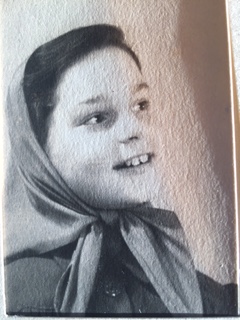
Aged about 12

Aged about 12

I grew up in a half-built suburb on the outskirts of Melbourne. Stories lurked everywhere: in the swamp at the bottom of the hill, the building sites surrounding my home, and the endless, awkward hours at school. Once I learned to read, I began writing the stories down. As an eleven-year-old heathen, I talked my way out of the weekly RE class in order to write in the library. Those hours bashing away on the librarian’s clunky Olivetti typewriter were my happiest at school.

Photo on 21-05-2016 at 7.55 pm

From the ms in question!

I wrote everything: fantasy and science fiction, thrillers and spy stories, including a John le Carré rip off, complete with atrocious English accents: “Beany, the drug operation’s gone rotten, the tip off was a bad egg, a no goer.” But a common thread ran through it all, and is still central to my work today—the observing outsider. In going through my writing for this blog, I unearthed a story from primary school about a blind man; one from my early teens with mute protagonist; and, from my late teens, one featuring a girl who becomes invisible: I spent the day watching, observing others’ blindness of me. I was unnoticed, unseen. I was invisible. I said not one word the entire day. No-one noticed.”


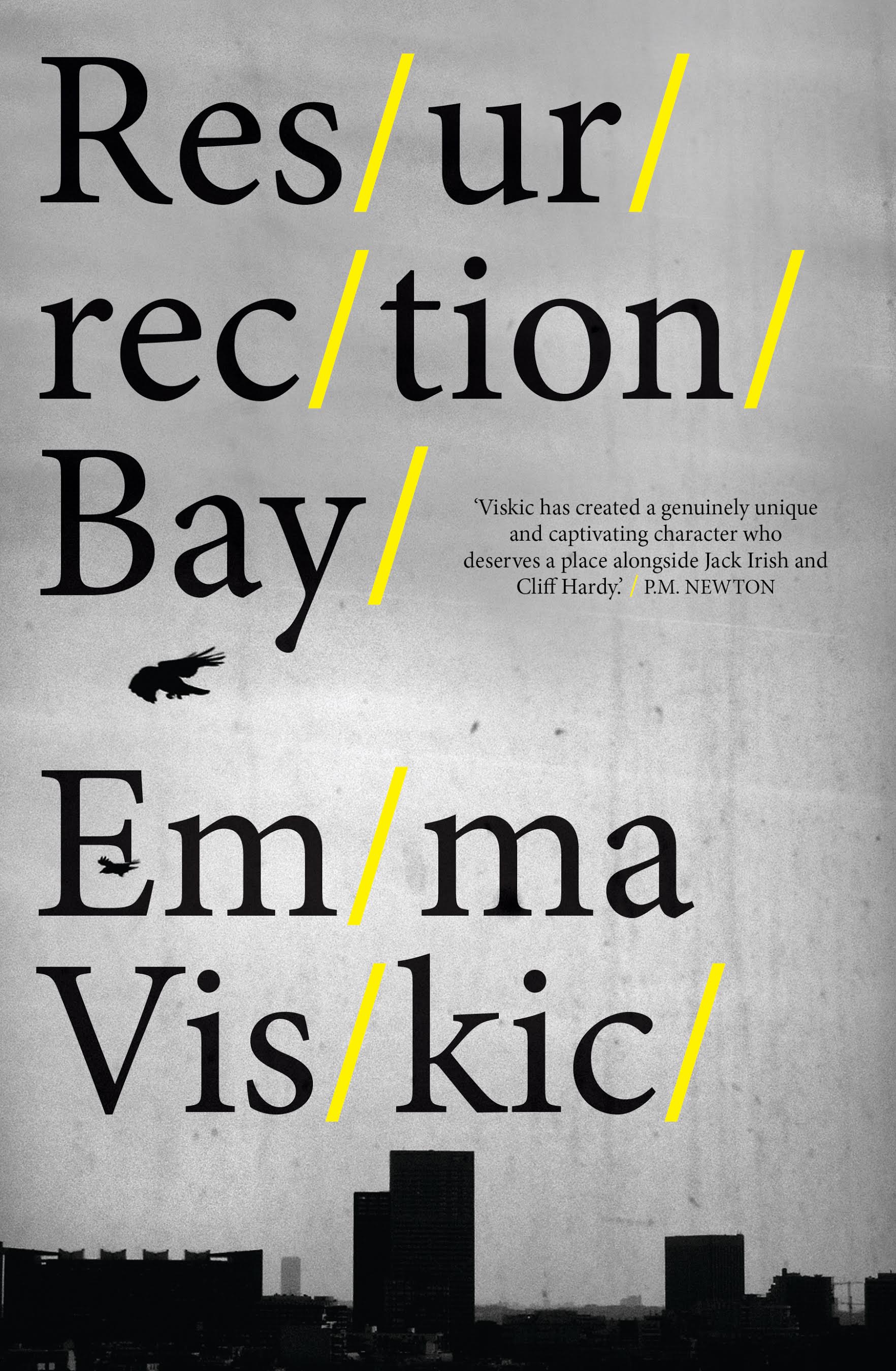
Last year my debut novel, Resurrection Bay, was published. It features a profoundly deaf detective, Caleb Zelic, who, to quote the blurb, “has always lived on the outside – watching, picking up telltale signs people hide in a smile, a cough, a kiss.”

Put together like that, it all looks a bit troubling, but luckily I’m a writer, so I get to call it a unifying theme.Res Bay cover

Emma Viskic is the author of the critically acclaimed crime novel, Resurrection Bay. She has won the Ned Kelly S.D. Harvey Award, and the New England Thunderbolt Prize for her short form fiction, and been published in Review of Australian Fiction and Award Winning Australian Writing. Also a classical clarinettist, Emma divides her time between writing, performing and teaching.
emma-viskic-author-2

Small beginnings, 6: : Adèle Geras

Aged about 9

Aged about 9

When I was a child, writing was never much on my mind. I was quite determined to be a STAR and spent most of my free time acting out with  my friends scenes we’d seen at the movies.  I was Ann Miller, or June Allyson, or Doris Day. This was in the Fifties,  before tv, when we went to the cinema as often as we could. We inhabited the world depicted in  the recent Coen brothers movie, HAIL CAESAR, and were fans particularly of musicals, and of the swimming star, Esther Williams.

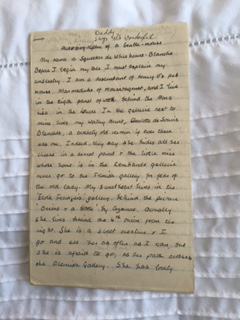
But I did like writing little poems which, when they weren’t about about nymphs and Greek gods described storms or sunsets or effused about kittens. When I was about eight, I wrote my first actual long form story. It runs to 12 of neatly written A5 pages. Looking at it now, I admire the excellently neat handwriting, so full marks to whoever it was who taught me writing. This neatness  must also mean that I wrote it out in rough and then copied it. I was clearly aware that I was embarking on  A STORY.  I’m also rather impressed by the beginning: straight in with an introduction to the main character, a mouse called Squeaker de Whiskers Blanches.  At this time of my life, (about 1953, I guess) we visited Paris often. My uncle was an artist and my Dad loved taking me round art galleries, pontificating about who was good and who wasn’t. I was overwhelmed by the Louvre, so that’s where Squeaker lives, of course.

IMG_1008


At school, I did contribute poems to the school magazine and I always loved writing essays but the poetry bug only really hit me when I fell in love.  That’s when it gets most teenagers, I suppose and I was no different. My handwriting has deteriorated since the Squeaker days, but my poetry is full of emotion and very romantic and over the top.

IMG_1010


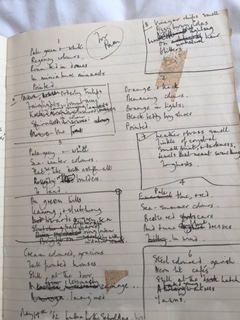
I also find it interesting that my preoccupations  haven’t changed much.IMG_1011This(above)  is basically a description of Brighton in various different moods: the buildings, the atmosphere  and so forth. I’ve always been partial to describing stuff and also interested in places.


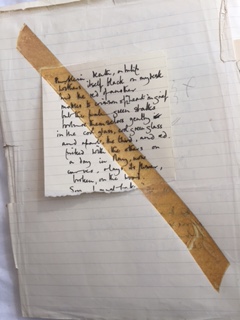
IMG_1009This(right)  is about tulips, but it goes without saying that these tulips are full of meaning and import!  I still adore tulips.  I’m going to reproduce the poem here and you can giggle at the overthetopness of it all. It’s about flowers fading but oh, so much, much more in the hands of a lovesick seventeen year old…from the general gloom, I’m concluding I must recently have been dumped. I’ve forgotten the actual occasion but here’s what I wrote:


Purple in death, a tulip

withers itself black on my desk,

and the red of another

mottles to crimson of a heart in grief.

But the pale green stalks

torture themselves gently

in the cool glass, cool green glass

and apart, the third and red

picked with the others on

a day in May,  now

curves, and lays its flower,

broken, on the wood.


Adèle Geras lives in Cambridge. She’s written many books for children and young adults, including Two Fearsome Fairytales from France published by Christmas Press. Her latest book is The Dream Quilt published by Long Barn Books and she has a novel for adults coming in June, called Love or Nearest Offer, published by Quercus.


Small Beginnings, 7: Simon Higgins

My ceaseless passion to tell stories and use images, myths and legends to excite and inspire, came online at an early age, thanks mostly to my mother. Though mum only much later published one book -her awesome memoirs of life in India, Africa and mid-revolutionary Cyprus- while a widow in a nursing home, she’d always been a gifted storyteller, the person who taught me to speak, draw, read and write.

By the age of three, I was a precocious (but creative) little monster.

One of the pictures accompanying this piece(right) shows me on the migrant ship bound for Australia, three 3 yr old Simonyears old, concentrating intensely on my first (illustrated) novel, which  mum later told me was a reboot, superhero style, of the legend of Robin Hood. In my version, Robin had weird powers, made animals help him fight the rich bad guys, and if cut with swords or shot with arrows, he could come back to life nine times, like a cat.

Apparently, a very dignified English fellow passenger, older fellow, quizzed me about my work, then commented, ‘Not the true story of Robin Hood, young chap.’ Mum, at age ninety in the nursing home, told me I leaned towards her and whispered, ‘He’s a bloody fool.’ To be honest, I still don’t always take criticism of my work that well. 🙂


When I was ten, by then a big comic/graphic novel fan, I went to hospital to have my tonsils out. While there, I wrote and illustrated my own unlicensed Marvel comic epic, ‘The Hulk Takes Asgard’ in which Thor’s brother Loki kidnaps Doctor Bruce Banner and unleashes him, brainwashed, as the spearhead of a coup to put himself on the throne. I remember being outraged when I came back from the toilet and caught three nurses sitting on my bed, hunched over my comic, reading intently. I’m fortunately a lot less precious about such things these days. I even like the fan fiction based on my stuff. 🙂


At twelve I entered an international poetry competition coordinated by the Women’s Weekly. One had to write a poem about Jose Feliciano, the blind guitarist (BTW he says ‘I’m blind’ so please, no silly PC ‘vision impaired’ lectures, thanks). The finalists were read to Jose, and the top ten global winners received autographed sets of his albums AND publication in the Women’s Weekly. Yeah, my first published work! Bagged with a poem, that in part, went like this:


A man alone, a famous star.

A man alone with his guitar.

He has no sight, yet he can see,

in a way that stuns and puzzles me


Anyhow, the important bit was that this made me a star at school for about twenty minutes, until our cricket team defeated our hated rival, and the fickle crowd forgot my greatness. Hosanna! Not for long. 🙂


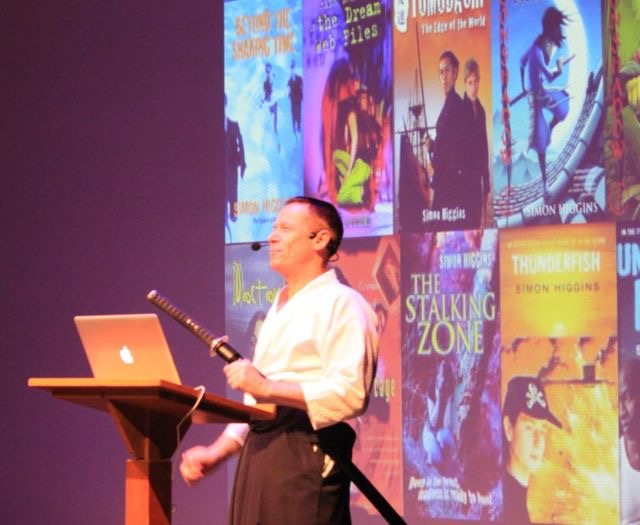
IMG_3466Flash forward beyond several careers that I sometimes describe as ‘lives.’ Marketing manager, police officer, private investigator and so on. In my maturity I turned to writing full time and out tumbled the same obsessions. I trained in martial arts. No bows and arrows like Robin, but swords and unarmed combat. Several kinds.


I spent a lot of time in Asia, where I now live, in fact, and penned a bestseller called Moonshadow about a ninja who controlled animals, whose ally was a cat. The kind of beast that would have nine lives. Sound vaguely familiar? 🙂


I just saw my thirteenth novel published, DarkSpear, my first Visual Novel, text-centred but image, music and sound effects enhanced, an exciting, evolving medium. Seems I am still that same little boy storyteller; my DarkSpear heroine, living in the near future, has special powers, and is caught up in a conspiracy of the One World Government (the new rich bad guys).IMG_3467


What do I make of this? Put simply, I was born and this is what I am. The hiatus in between the early years and professional creativity was destined input time. I grabbed life experience, reading, other forms of learning, which informed my later, somewhat more refined work.


At the core, I remained that imagining, legend-rebooting, cartooning kid.


If people don’t get my stuff, they’re bloody fools.  🙂           


DarkSpear Bannerwww.simonhiggins.net

Small Beginnings, 5: Hazel Edwards

Hazel, aged 6

Hazel, aged 6

I always knew I wanted to be an author, but wasn’t sure how to do it.

My first writing was for the children’s page in the local newspaper where you got credits & certificates. I also belonged to the ABC Radio Argonauts children’s program, where stories were read out on the wireless. Probably I was about 8, when my first writing went in the newspaper. It was about a para long. But each Saturday morning I’d race to pull out the Children’s page. I’ve always been a messy newspaper reader.

I was fascinated that black squiggles on paper were the code to get inside a writer’s head.

My Grandma read to me and I learnt to read myself before I started school.

I started diaries on January 1st but they’d usually been forgotten by the end of that month.  I was more interested in other worlds. (That’s probably why I like co-writing now).

I can’t remember what I wrote about, because I was writing most of the time.

The first book-length story I remember finishing in about Grade 6 was a kind of Enid Blyton style mystery with a group of children down a mine. I didn’t know how to finish the story, so I left them there.

Maybe that’s why I now like well plotted mysteries.

Hazel’s latest books are her memoir ‘Not Just a Piece of Cake; Being an Author’   and the co-written ‘Hijabi Girl’. ‘Hippo!Hippo! the Musical’ is touring nationally.

http://www.hazeledwards.com/page/hijabi_girl.html

http://www.hazeledwards.com/page/not_just_a_piece_of_cake_being_an_author.html   ‘Anecdultery’ the first chapter in the memoir explains the challenges  of exaggerating childhood stories.

Small Beginnings, 4: Wendy Orr

Putting on play for parents

Putting on play for parents

I started writing stories and poems as soon as I learned to read and write in English, when I turned seven. Before that, as a Canadian Anglophone child going to school in France, I wrote only in French – my mother still has letters I wrote while she was in hospital – and I wrote only letters. But English was not simply the language we spoke at home, it was the language of stories: both bedtime books, and my father’s crazy made-up

OLYMPUS DIGITAL CAMERA

stories. Learning to read in it gave me the freedom to create my own.

OLYMPUS DIGITAL CAMERA


Spring Island text 1

From ‘Spring Island’

What I remember most is not the stories – or poems or plays – themselves, but the act of creating: the taste of the thoughtfully chewed pencil, the sun coming through the window onto my paper, the never being quite comfortable kneeling to work on the coffee table – but most of all, the joy of creating something new. Something I never doubted would be extraordinary, at least until I lost interest in it and moved on to the next piece. (The project to write a poem for every letter of the alphabet fizzled out after Puppies).  But some persevered for years. When I visited my parents in Canada after a US tour for the Nim’s Island movie premiere, my mother found the story I’d written at 8 or 9: ‘Spring Island. From the changes in handwriting in the notebooks, we guessed that it covered two school years.

I quite deliberately channeled this story when I was writing Nim’s Island: not so much the story itself – a girl and boy meet after running away from their orphanages, and live alone on an island until they get adopted and get horses. In fact, until I saw the notebooks I’d forgotten that there was a boy in the story, although I then remembered his primary purpose: to kill fish. I identified too strongly with the girl to have her do it. (Don’t condemn me, this was 1963. When Nim needs to eat a fish, she kills it herself.)

Spring Island Text 2

More from ‘Spring Island’

Instead, what I drew on was the psyche of the child who wrote the original story. The child who wanted to be competent, adventurous, resourceful, or, as I heard it in my head, ‘who could do stuff.’ (Which was not necessarily me in real life.)

Early on, I started writing poetry to express emotion, a habit I’ve continued till this day.

OLYMPUS DIGITAL CAMERA

Stories and plays were written more for fun; for that joy of creating a new world, finding evil villains and, as I got older, handsome heroes. But there was always the drive to find out


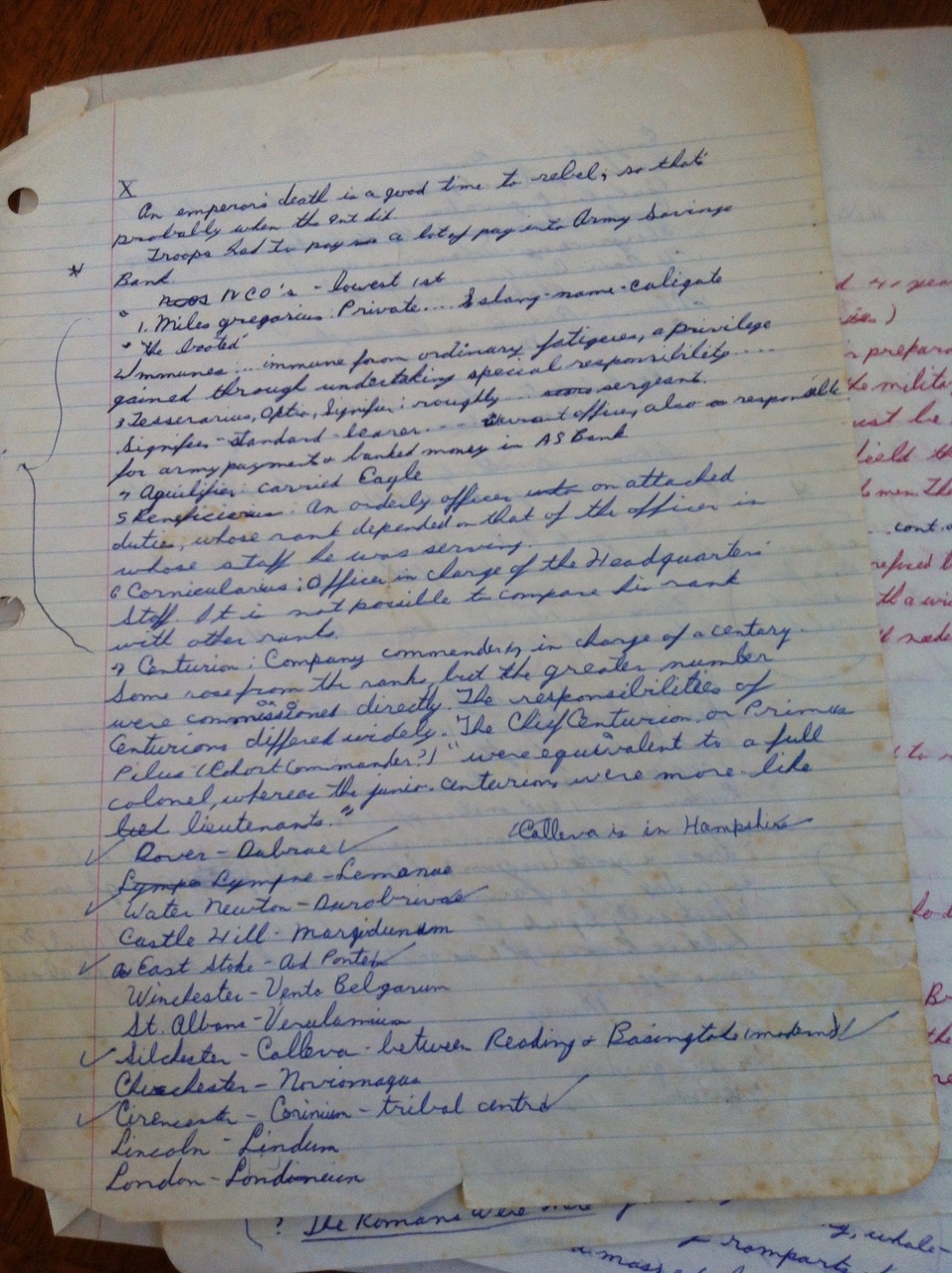
more as I explored these worlds, and even when I was revelling in a dramatic adventure or bossing the neighbourhood children into acting or watching my plays, I remember the strong sense of dedication and purpose. At twelve, I discovered Rosemary Sutcliff and started writing my own story of Roman Britain. We were living near the US Air Force Academy in Colorado at the time, so my long-suffering mother used to drive me to the library there to research Roman military history. I still have the notes, a clear image of the protagonist – and the memory of the conviction that I

Putting on play for neighbourhood children

Putting on play for neighbourhood children

would become a historical novelist.

Now, a frighteningly long period later, I’ve finally written the sort of book that the thirteen year-old me thought I might grow up to write. Dragonfly Song, to be published with Allen & Unwin in July, is set in on an Aegean island in 1450 BC – a very different setting and roughly fifteen hundred years earlier than the Roman era in Britain. However, I believe that everything we write with care and passion is laid down as a foundation for all the works that come later. The years of private poetry have led me to use sustained verse for the first time – and creating my young centurion’s world, through a mixture of research and imagination, was one of the steps that led me to this new story.

A young Wendy's notes for her Roman story

A young Wendy’s notes for her Roman story

Small Beginnings 3: Goldie Alexander

Goldie at age 16

Goldie at age 16

I didn’t really start writing my own stuff until quite late in life. Somehow there was nothing in my schooling that encouraged any form of creativity. If ever I tried to write an essay that contained a story, I was actively discouraged, told to leave that to ‘proper’ writers. We kids were instructed to keep to discursive essays.

So what I did when I was young, and still do when life gets me down, is read. And all that reading produced a wealth of imagination. I had always been a voracious reader. But when I was a kid reading was considered ‘a big waste of time’ when one ought to be doing something more ‘useful’. I got into so much trouble for always having a book with me, in fact was almost expelled from a small private school for calling the sewing teacher (I hated sewing)  a ’fat pig’ when she caught me reading under the desk instead of learning to hemstitch.

I read everything I could lay my hands on. Looking back, some books would have been regarded as inappropriate, such as ‘The Body’s Rapture’ by Jules Romains which I found in my mother’s bookshelf.   It did explain something about sex to a generation kept in blissful ignorance.

So my first true experience with writing came in my third year at university when, between countless and very boring essays, one assignment was to write a play. That was it. I fell in love with writing.

Goldie today

Goldie today

One would think all that early reading would have encouraged me to write wonderfully well right from the start. Unfortunately, that didn’t happen. I started with adult short stories, even had one accepted by ‘The Australian Literary Supplement’ that was never actually printed. But given I was now teaching English and History to secondary students and at the time there was so little written for kids in an Aussie setting I had a go at my first novel.

I don’t have it any more. All I can say is that it had a very long title – this was fashionable at the time – and questionable plot and characters. I remember when asked by a publisher what it was about, being left totally tongue tied.

What did fall into my lap was being commissioned by Greenhouse Publications in the early 90’s to write young adult novels.

I was given very specific instructions. They had to be no more than thirty two thousand words. The setting was to be contemporary. Though the story should show girls becoming more empowered – this was at the height of women’s lib – it must contain some romantic element.

Such specific instructions meant I had something to hang onto, as back then there were no creative writing classes. If it was still a matter of hit and miss, I had a terrific editor who ‘fixed up’ my mistakes.

So my very first novel called ‘EVERYTHING CHANGES’, and written under the pseudonym Gerri Lapin, opens like this:

****

JOIN DONABEL’S MUSICAL PRODUCTION OF GREASE

AUDITIONS FOR SPEAKING PARTS AND CHORUS FRIDAY 23 JUNE

“Christie and I pushed our way through the group of people milling about the noticeboard, then headed toward the canteen.

‘I saw that film on video last year’, Christie was saying. ‘The girls wear fab fifties gear; tight pants, dresses with necklines right down to here,’ she pointed to a spot barely above her waist, ’Tiny waists and full skirts.’

          We found Christie’s boyfriend Wayne, sprawled out on a chair, halfway through a Mars bar. ‘How about Donabel putting on its own production?’ Christie asked, flopping down beside him.  ‘Jo reckons we should get into it.’

***

Of course it had some romantic twists though everything ended in a satisfying way. I was so proud of my first novel that I showed it to all my friends. I remember one telling me he had picked it up in a bookshop.

I asked, ’Did you read it?’

He gave me a disdainful look. ‘Hardly,’ he said. ‘Not the sort of stuff that interests me.’

Ah well. Those books gave me, and quite a number of other well known writers, the start we needed. Since then, I have never stopped writing.


Goldie Alexander writes award winning short stories, articles, radio scripts, plays and books. Her novels are published both in Australia and overseas for readers of all ages. Her latest book, a fantasy/scifi novel for older children, is Cybertricks. Her books for adults include: ‘The Grevillea Murder Mysteries’ ‘Lilbet’s Romance’,  Dessi’s Romance’,Penelope’s Ghost

and ‘Mentoring Your Memoir’. Her first YA novel ‘Mavis Road Medley’ was a Notable CBCA, was shortlisted for by the Office of Multi-Cultural Affairs and is listed as one of the best YA books in the Victorian State Library. Her best known book for children is: ‘My Australian Story: Surviving Sydney Cove’. Her fiction for children includes three collections of short stories and several mysteries, fantasies and science fictions. Her other historical fictions include: ‘The Youngest Cameleer’, ‘That Stranger Next Door’, My Holocaust Story: Hanna’ and the verse novel ‘In Hades’. She has also co-authored a non-fiction book, The Business of Writing for Young People, with fellow writer Hazel Edwards.

Small Beginnings, 2: Nick Earls

A young Nick(foreground), with friends

A young Nick(foreground), with friends

I’ve taken Small Beginnings literally and gone back to the earliest existing examples of me coming to grips with the written word. In fact, written letters.

I turned up at school six weeks short of five years old. Storytelling was already a big part of my life by then – the revelation that it might actually be A JOB took another few years to happen. My family had always been big on books and full of stories, so I’d had a formula story that I’d told most days at Ballyholme Playgroup before lining up for one of the two classrooms at the sternly Victorian-looking Grangee School in 1968. In my stories, the central character, a bird called Tommy, would tumble into a toilet and be flushed all the way to a sewage treatment plant and another adventure among the poo and big orange diggers. My audience had all been four too, and what do four year olds love? Poo and big orange diggers. Since then,  I don’t think I’ve ever been quite so astute about writing effectively for a market.

jotter 1But Grangee wasn’t about stories, at least not that first day. It was about taking the first faltering step up the steep slope that led to literacy. I opened my school jotter (it says ‘Jotter’ on the front) and, as Mrs Pollock directed, wrote a page of ‘O’s. Note the big pink tick. Mission accomplished. Then I turned over and wrote a page of ‘X’s. Another tick. Then we went home for lunch.

Afterwards I was horrified to learn that I’d be going back. And not just going back – going back most days for the next twelve years. I thought I’d had the school experience. I’d turned up, done my page of ‘X’s and my page of ‘O’s, got my two ticks. What more could there be to know?

jotter 2Quite a bit, it turned out. How to manage a page, for a start, as my increasingly huge and truncated attempts to write ‘Dick Has the Dog’ demonstrate.

Less than two years later, I’d learned enough to write the work that could, with generous definitional stretching, be called my first book. It’s a journal of a holiday with my grandparents in Yorkshire. I can remember sitting and writing it each night at the kitchen tables of elderly relatives and family friends – people who had featured in the books of James Herriot – putting a lot of thought and work into it, even though it comes across as just the facts:


Tuesday 7th July 1970.
It was hot and sunny so we went to Knaresboro’ to see Mother Shiptons dropping well, wishing well and cave
In the afternoon we went to Ripon and looked round the Cathedral and then on to Studley Royal Park where there is a large herd of deer.


If it had been overcast, would we still have gone to  Knaresborough (I’m sure I picked up ‘Knaresboro’’ from a road sign)? I don’t know, but I can still remember the dropping well and its petrifying socks and teddy bears on strings. That stuff comes back to you in dreams at that age.

Since those days, I’ve turned to fiction, Grangee School has long closed and business seems to remain good at Mother Shipton’s, now in its 386th year as a tourist attraction. And my son, at the age of 6 1/2, is about to take a week off school for us to go to Hong Kong. In lieu of schoolwork, he’s been giving the assignment of keeping a journal of the trip.

Nick Earls has written more than twenty books for adults, teenagers and children. His latest project is the novella series Wisdom Tree, with a novella released (as a paper book, ebook and audiobook) on the first of each month from May to September 2016.

yorkshire journal


Small Beginnings 1: Dianne(Di) Bates

WP_20160426_15_08_59_Pro

Di as a child

The first writing I did as a child was, I’m told, a letter to Santa Claus. My mother said I asked for ‘a typewriter and a good temper’. I’m not sure how old I was, probably about 5 or 6. When I was in sixth grade at a new one-teacher school, I wrote an essay about my ideal home. After the teacher read it aloud, children came up to me in the playground and accused me of plagiarism. Their accusations hurt me so much I can’t remember working hard at writing thereafter.

However, in my first year of high school, I befriended Pamela, the daughter of our English head-teacher. Pamela and I loved a series that was currently showing on TV – Adventures in Paradise. We both imagined ourselves the love interest of the leading man, Troy Donaghue. Consequently we spent hours in the playground co-writing TV scripts where Troy Donaghue would fall in love with each of us.

I wish when I was young someone would have given me books – both to read and to write in. But books were simply absent from my home. Their substitute was hard work on our farm. The only books I read as a child were borrowed once a week when I took myself to the local public library. I don’t remember the librarian ever offering me any books to read other than my regular diet of Enid Blyton books. Nowadays I am never without a book in my hands! Unless I’m writing, of course.

Di Bates is the author of 130+ books, mostly for young readers. Her website, which she shares with her YA author husband, Bill Condon, is http://www.enterprisingwords.com.au. Since 2006, Di has been producing a twice monthly magazine, Buzz Words, for those in the Australian children’s book industry http://www.buzzwordsmagazine.com She is a recipient of the Lady Cutler Award for distinguished services to children’s literature.