Story behind the story 6: And Then authors and their contributions

Today it’s the turn of Jack Dann and Steven Paulsen(who collaborated on a story in Vol 2 ) and James Hopwood(story in Vol 2 ) to tell us about their And Then contributions.

jack-dann-and-steven-paulsenHarold the Hero and the Talking Sword, Jack Dann and Steven Paulsen

Jack and I have been talking for a while about doing a project together when the opportunity to write a story for Clan Destine’s ‘And Then…’ anthology came up. Jack had showed his story ‘The Talking Sword’ to Lindy Cameron. She loved it, but suggested it be expanded because the brief for the anthology was for stories with two equal protagonists; and in Jack’s original story the demon sword held sway over his ‘sidekick.

So…we started talking; and before long we were not only brainstorming the further adventures of the time-travelling sword, but we were working out how we might bring its unlikely wielder, Harold the Hero, to the fore. We took our inspiration from Homer’s Odyssey and asked ourselves what would happen if the sword somehow lost all its powers. The result is ‘Harold the Hero and the Talking Sword’. It was certainly great fun to write, and we hope it will be just as much fun to read.

hopwood-bioThe Lost Loot of Lima, James Hopwood
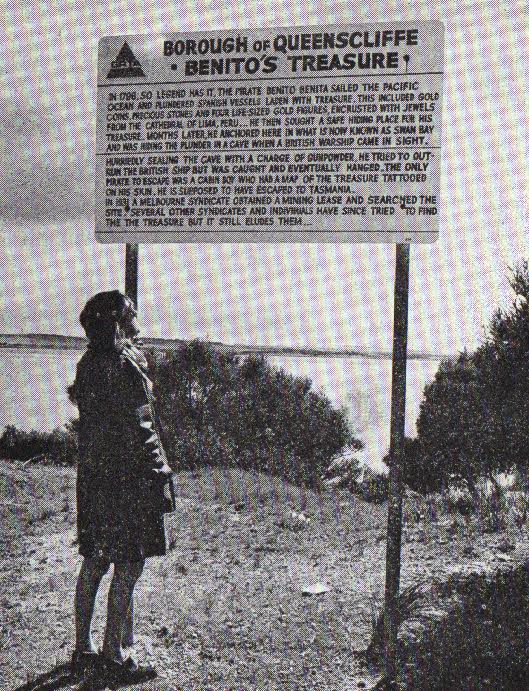
I have always wanted to write a ‘treasure hunt’ adventure story, and while trying to come up with an idea, I can across this old newspaper clipping(below) which suggested that a fantastic treasure trove known as the ‘lost loot of Lima’ was buried in Queenscliff. I immediately wanted to know more, and hit the research trail.
hopwood
My story, a globetrotting adventure, which is set in 1955, follows archaeologists Mark and Sarah Page (known as The Pages of History) as they follow the clues, and race to beat a cadre of neo-Nazis to the treasure.


Story behind the story 5: And Then authors on their contribution

Today, we’ll hear from Evelyn Tsitas(story in vol 1) and Lindy Cameron(story in Vol 2–and also the  fabulous publisher of And Then!)

evelyn-tsitas-photo-copyStealing Back the Relics, Evelyn Tsitas

 Stealing Back the Relics is a Dan Brown style art theft thriller, stealing wilfully from my intimate knowledge of the art world and academia. My day job is working in a university art gallery, so I know a thing or two about that rarefied scene. And as a speculative fiction writer, playing around with the supernatural is what comes as second nature.

 Inspiration for Relics came from a frenetic three-week trip to Europe, immersing myself in art galleries, presenting at academic conferences and catching up with an art historian friend in Germany and a journalist friend in Paris. I was up cathedrals, down catacombs, and sketching in museums where I was drawn to the grotesque and beguiling reliquaries – ornate vessels that hold sacred pieces of saints.

 The David Lodge style ‘campus novel’ twist in Relics came after a chance conversation with a friend’s husband. It turned out he was doing his third PhD. Now, still in recovery from finishing my own (first) doctorate (and not contemplating a second) this was struck me as so outrageous a passion that overnight it somehow merged in my writing subconscious with my European trip, and my newfound obsession with reliquaries. Relics and its characters emerged overnight. Of course, the female protagonist, the sassy Greek Australian journalist, may (or may not) be a self-portrait…or wish fulfilment!

lindy-cameron-3The Medusa Stone, Lindy Cameron

The idea behind what became The Medusa Stone is what prompted the idea for the whole anthology.

I love cliff-hanging page-turning Indiana Jones types adventures and wanted to write one myself. But as my original idea is part of a series of novellas I’m writing that will ultimately form a mosaic novel, I wanted to write a shorter one for And Then…

The overarching story is:

A tale of Amazons and the Great Library of Alexandria in which a time-travelling archaeologist and a writer from the 21st century meet the great-great granddaughter of Alexander the Great and Queen Thalestris.

The Medusa Stone episode, which begins in Istanbul in 1928, follows the adventures of two women, an Australian aviator and a English traveller, who battle both ancient Romans and Nazis – with the help of the Amazons of Amsara.

Story behind the story 4: And Then authors on their contribution

Today’s it’s the turn of Amanda Pillar (story in Vol 2)  Sulari Gentill(story in Vol 1) and Kat Clay (story in vol 1) to tell us something about their And Then stories.

profile3It, Amanda Pillar

‘It’ is a science fiction tale set on a planet that is plagued by a giant kraken-like monster.

And, believe it or not, it was inspired by a dream I had years ago. In fact, there are a couple of scenes that are direct reproductions of the dream!


sulari-gentillCatch A Fallen Star, Sulari Gentill

My contribution to the And Then… anthology is quite a departure from the historical crime, and mythic fiction I usually write.   Set in the near future, it imagines an Australia that has swung hard to the right, where nationalism is used to quell any resistance.  It is a storification of my own fears about the direction the world is heading.  Sadly, in the short time since I finished the writing it, Catch a Fallen Star has become a lot less speculative than I hoped it would remain.


web-portrait-kat-clayIn the company of Rogues, Kat Clay

In the Company of Rogues was born out of my love of fantasy video games, and my general amusement playing with genre tropes. You know the ones: the guy in a dark cloak chasing our heroes, giant spiders, and of course, the loveable rogue. I love rogues, but they sure do get away with a lot. I thought about what the consequences would be of this lifestyle, and so we chance upon our hero Randall the Rogue, who has developed an STD from too much ‘rogueing’. Together with his sidekick, Dennis the Budgerigar of Doom, they have to go on a quest to cure his illness, with the help of a lady rogue… and as they say in the land of Sidarth: “Never quest with another rogue, they’ll steal your heart then steal your clothes.”

Story behind the story 3: And Then authors on their contribution

Today in the And Then series we’re hearing from Alan Baxter (story in Vol 1),  Narrelle M. Harris, (story in Vol 1) and Michael Pryor (story in Vol 2)

alan-by-nicole-web-crop-smallGolden Fortune Dragon Jade, Alan Baxter

My story was a chance to finally write something in the style of the wuxia and kung fu epics I’ve always loved so much. And being a kung fu instructor, with the majority of my life embedded in that culture and all it entails, it seemed I ought to write something related. The two protagonists are cousins, he a Shaolin monk, her an accomplished geomancer. The Shaolin monk, Yong Fa, is named after my teacher in a subtle homage to him, and the character shares some of my teacher’s irreverence and cheekiness, but is otherwise an entirely made up person. The geomancer, Zi Yi, is altogether more serious and focussed, but an accomplished mage in her own right. Together their skills are complimentary and that’s just as well when they realise the scale of their task, the distance they have to go to track down their missing jade dragon, and the kind of unforgiving country they’ll be led to. It was a hell of a lot of fun to write and I hope people have a lot of fun reading it too.

narrelle-m-harris-midVirgin Soil, Narrelle M Harris
The germ of my story came from an old building in Fitzroy, and the name, Moran and Cato, high above the streets. They were once a well known grocery chain. The building now houses the excellent Naked for Satan bar. I just liked the juxtaposition of the names, and the characters grew from there. Cato – clearly a man/rat shapeshifter. Moran, clearly a magically inclined offsider. But they were murky. Not necessarily good guys, though not necessarily bad guys. The grey guys, really. That’s how the story grew – I wanted them to do be doing dark magic but not for dark reasons. I also love writing stories set in Melbourne, whatever the era, and I’d been researching the 19th Century goldrush and Melbourne for another story, so that was a logical extension of where to set their adventure, especially since the goldrush was such a time of contrasting fortunes and full blooded adventure on its own.
(Note: You can also read an excerpt from the story here)

pryor2-lo-resCross Purposes, Michael Pryor

I’d been doing some unrelated research on the 1930s, and got side-tracked into reading about Errol Flynn. I started imagining what this rambunctious, charismatic ne’er do well would have got up to if he’d stayed in Australia. Adventures, I suspect, of the slightly rakish kind, all with that charming grin as his final defence. When the opportunity to contribute to ‘And Then’ came up, with a few tweaks, I had a character based on Flynn ready to go. Add to that a timely visit to Cooktown in Far North Queensland, an introduction to the Railway That Goes Nowhere, and the elements for a rip-roaring tale started to fall into place.

Story behind the story 2: And Then authors on their contribution

Today, we’ll hear from And Then contributors Tansy Rayner-Roberts(story in vol 1) Sarah Evans, (story in vol 2)  and Jason Franks (story in vol 1).

tansybwDeath at the Dragon Club, Tansy Rayner-Roberts
My story is one I had been toying with for a while — about a pair of retired assassins and siblings-of-choice who run away from their violent profession and end up joining a circus full of dragons… only to have their old and new worlds collide all over again. This book was a great excuse to write that story, and I’m so glad I did. I hold Kurt and Inga Frostad, and their beloved dragons and their snarky dialogue, very close to my heart, to the point that I got all soppy and nostalgic while proofing. And then I promptly started planning the sequel…


profile-photo-1Plumbing the Depths, Sarah Evans

Plumbing the Depths began life as an experimental entry in RWA’s First Kiss competition. I loved the idea of a vegetarian-turned-reluctant vampire canoodling (against her better judgement) with a gorgeous avenging angel. But the judges didn’t. Ho hum. The story was all but dead in the water.

Luckily vampires don’t die that easily. When CDP publisher Lindy Cameron asked for submissions for the And Then… I decided to revamp the vampire-angel story and give it a fresh twist.

Sure, the vampire, Matty Peters, was still reluctant to embrace the dark side, but the angel took on a totally new persona. From a dark and brooding love interest with a hip name, he morphed into Ted, an over-weight, retired cop caught in purgatory with his salvation relying heavily on the number of souls he can collect, including Matty’s.

Consequently, there’s no romance and definitely no canoodling. Instead, the unlikely couple end up joining forces to become very dodgy vampire slayers.

The result is a fast-paced, tongue-in-cheek adventure romp.

Enjoy!

jf_c_300pxExli and the Dragon, Jason Franks
When Lindy approached me about contributing to And Then… one of the things I liked best about it was that the brief was so wide open. I decided to take that as a challenge when I came up with “Exli and the Dragon”.
I haven’t written science fiction for a few years, so that was my first challenge: to reacquaint myself with the genre. I went at it like a glutton, helping myself to all the best bits: high performance space ships, grumpy robots, pew pew lasers and some actual, proper science. I had been wanting to write a story from the point of view of a creature that is completely non-human, so that gave me one of the two protagonists. The second protagonist is a human–something rare and strange in the galactic society in which this story takes place.
I also challenged myself to write an action story without violence. So, while our two roguish heroes face plenty of danger as they attempt to escape from space prison, neither of them are equipped for combat and they must find other ways to reach their goals. Mainly, though, I just tried to keep it twisty and fun. I hope you fine readers enjoy it.


Story behind the story 1: And Then authors on their contributions

As part of the celebrations around the publication of the fabulous And Then adventure story anthologies, published by Clan Destine Press, I thought I’d ask my fellow contributors to write a few words for readers about the ‘story behind the story’ to tell a little about their individual creation. So I’ll be publishing these in a few instalments, starting today with words from Lucy Sussex, Jason Nahrung, and Emilie Collyer. Oh, and a word or two from me! All of these authors’ stories(including mine) appear in Volume 1.

To recap: each one of us contributing And Then authors was invited by Clan Destine’s Lindy Cameron to create an adventure story which would feature a ‘dynamic duo’, but otherwise we were left pretty much to our own devices as to the rest, and the result is a sparkling and wonderful diversity in two fantastic fat volumes! My own story, The Romanov Opal, was inspired by a conjunction of things: a visit I made to the extraordinary opal mining town of Lightning Ridge some time ago; a fascination with Russian culture and history; a love of classic Agatha Christie half-mystery, half-adventure stories like The Man in the Brown Suit, and an even greater love of Tintin-style adventures. Mix that in with the elegant and turbulent 1950’s, a pair of feisty twins and a legendary jewel, and I had the perfect ingredients for a story that was simply huge fun to write.

So what was the story behind the story for other authors? Read on!

Lucy(left) and Meredith Sussex in Borneo

Lucy(left) and Meredith Sussex in Borneo


Batgirl in Borneo, Lucy Sussex

In 2015 I went to a wedding in Sabah, Borneo. After the ceremony, assorted guests went on a bus ride across north-east Borneo. We saw orangutans and sun-bears, and narrowly avoided a meeting with terrorists. Two days after we ate at a beachside restaurant in Sandakan, Abu Sayyef came raiding across the straits from the Muslim Phillippines, in a rubber dinghy. They kidnapped the manageress, Thien Nyuk Fun and a customer, Bernard Then.  She was released months later, after a ransom, Then got beheaded.

I heard another interpretation of that story only after ‘Batgirl in Borneo’ was copyedited.  In that reading, by a Sabah expat, our visit to the restaurant was the catalyst for events.

If I write that, it would be a very different tale.

jason_bw-webMermaid Club, Jason Nahrung
This is the second of my short stories starring detective Shane Hall and her accidental partner Manasa Chalmers as they negotiate a paranormal Brisbane. This one draws on a memory of how one of my favourite venues in the city was gentrified, as well as looking for an idea of mermaids different to the fairy tale. The story also builds on a larger plot involving my dynamic duo — I really must finish that, one day!
tansybwDeath at the Dragon Club, Tansy Rayner Roberts
My story is one I had been toying with for a while — about a pair of retired assassins and siblings-of-choice who run away from their violent profession and end up joining a circus full of dragons… only to have their old and new worlds collide all over again. This book was a great excuse to write that story, and I’m so glad I did. I hold Kurt and Inga Frostad, and their beloved dragons and their snarky dialogue, very close to my heart, to the point that I got all soppy and nostalgic while proofing. And then I promptly started planning the sequel…

ecollyer_photopiajohnson_051The Panther’s Paw, Emilie Collyer

With so much dystopian fiction around – and feeling increasingly like we are living in a dystopic world of our own creation – I really wanted to write a piece set in a future where we’ve started to get a few things right. I was inspired by what I’d read of the genres solar punk and eco punk so that was my starting point. One of the wonderful things about writing is getting to play god. I had a LOT of fun constructing the social, environmental and cultural norms of this world to reflect what I think would be a fair, sustainable and enlightened way to live. In regards to the characters I wanted to explore a mismatch. Two people who would normally never spend time together but who have complementary attributes. I really love the world I have created in this story and feel there is room to expand the adventures of Eliza Wild and Dash Besen. So look out for more …

Babushka and the Star–a story for Christmas

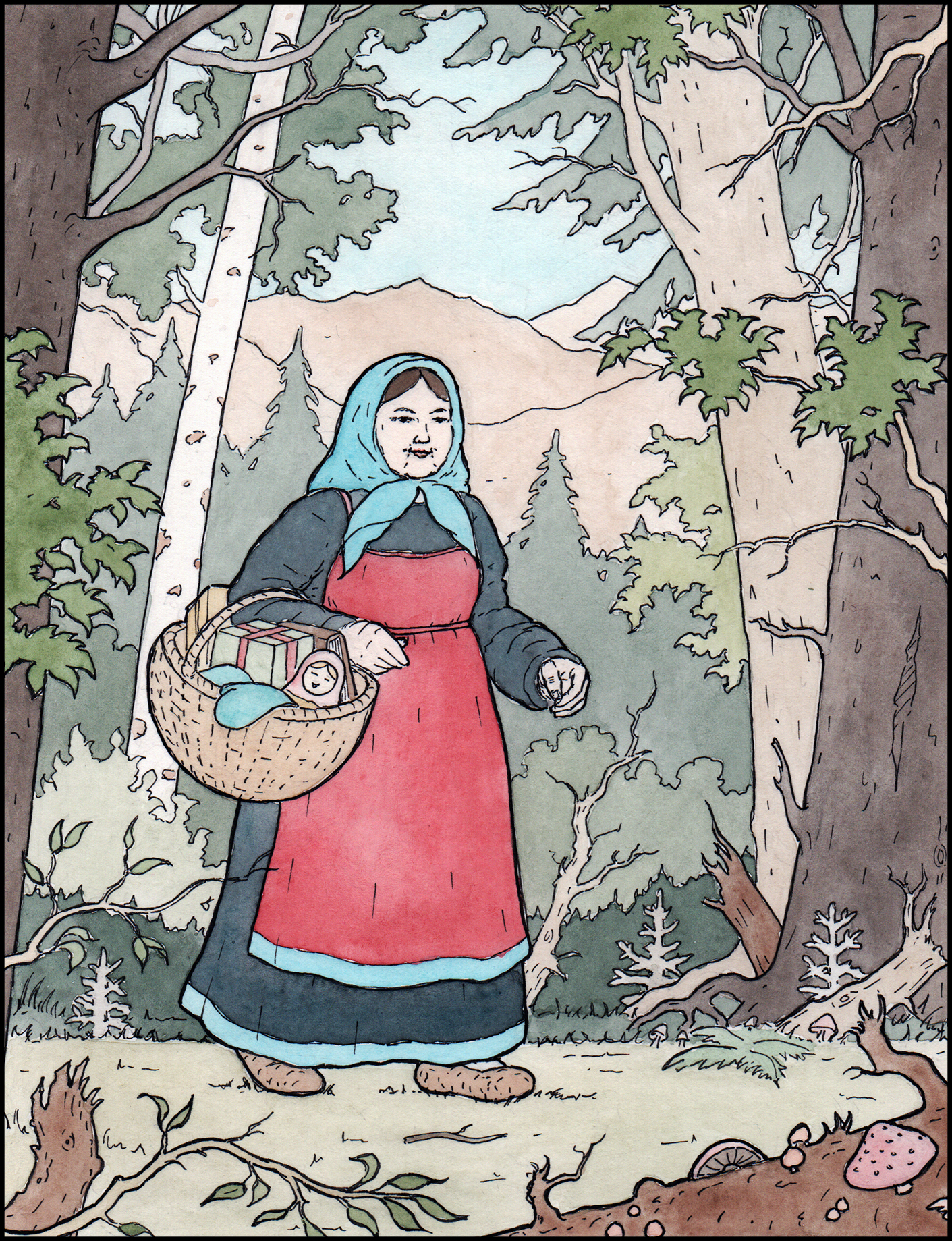
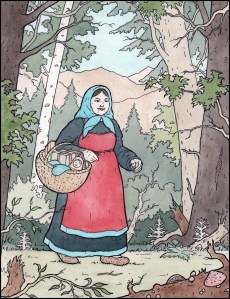
babushka-largeA story for Christmas–based on a beautiful Russian folktale which I retold and which was first published in  Once Upon A Christmas. The gorgeous illustration is by David Allan. Enjoy–and merry Christmas to everyone!

Babushka and the Star

a traditional Russian Christmas legend, retold by Sophie Masson

A long, long time ago, there lived an old woman whom everyone called Babushka, which means ‘Grandmother’ in Russian. Now Babushka was a widow who lived alone, and she was so house-proud that she spent nearly her whole time cleaning and sweeping, dusting and polishing, scrubbing and washing. Day and night, it was all the same to her, and she was so busy that she hardly had time to say good morning to her neighbours in the village, or to watch the sunset, or to hear the song of birds, or to delight in the play of children, or to smell the first roses of summer or the first fall of snow in winter. Her house was the cleanest and freshest and cosiest in all of the village, but though Babushka was kind and hospitable, and sometimes invited people in for a glass of tea, they would soon feel uncomfortable, for she would fuss with dishcloth and broom the moment they sat down.

One bright winter’s morning, Babushka was scrubbing her doorstep when out came the next door neighbour from her house. ‘Wasn’t it a beautiful star last night?’ she said.

‘What star?’ said Babushka. ‘I saw no star.’

The neighbour stared at her and said, ‘Oh! You must have seen it! It was so beautiful your heart might break just looking at it.’

Babushka shook her head. ‘I saw no star,’ she said, and having finished her doorstep, she started to dust her shutters. Soon, who should come by but the baker’s boy with his cart. Handing a loaf of bread to Babushka, he said, ‘What did you think of the star, Babushka?’

Again, Babushka said, ‘What star? I saw no star.’

The baker’s boy stared at her and said, ‘But it was big as this!’ and he spread his arms wide to show how much. ‘Big as the village! Big as the world!’

‘I saw no star,’ said Babushka, stubbornly. ‘And if you don’t mind, I’m busy.’

So off went the baker’s boy, shaking his head. Now Babushka finished dusting her shutters, and started work on polishing the brass door-knob. Soon, along came a little girl bouncing a ball.  ‘That knob is almost as bright as the star last night!’she said.

Once more, Babushka said,  ‘What star? I saw no star.’

‘Oh, but you must have done!’ said the little girl, staring. ‘It sparkled like the shiniest diamond in the world! What do you think it means?’

‘Nothing,’ said Babushka, crossly, ‘only that too many people don’t have enough to do with their time if they must stare at stars which you can see in the sky any night of the year!’

‘Oh but no!’ cried the little girl. ‘This star was not like the others! Nobody has ever seen it before, and..’

But she was talking to thin air, for Babushka had gone into her house and slammed the door.

How silly people are! Babushka thought to herself as she went about her cleaning and polishing indoors. So much work to be done, and they waste time staring at the night sky as though they’d never seen it before! Of course she could hardly remember the last time she’d looked at the night sky. But she was too busy for that.

Night had almost fallen by the time Babushka decided it was time to start cooking her dinner. She had just made a pot of mushroom soup when there came a knock on the door. She went to open it and stared in amazement for there on her well-scrubbed doorstep stood a tall black man dressed in fine golden robes, with a golden turban on his head. Behind him stood two other men, one round and blond with a bushy beard, fur-lined robes and a gold-trimmed fur hat, the other small and dark-haired and almond-eyed, with dark blue silk robes and a hat of the same colour with golden silk tassels hanging down. And behind them were three odd creatures Babushka had never set eyes on  before, tall and yellow-brown, with haughty faces and humps on their backs. Each of the beasts was richly saddled and bridled, and each of the men carried a small chest, inlaid with ivory and gold. Babushka had never seen such a sight. Why, they looked like three kings, she thought. And here they were on her very own doorstep!

‘Good evening,’ said the tall black man, very politely. ‘Is this the house of the lady Babushka?’

‘Why—why, yes,’ said Babushka. ‘And what may I do for you fine gentlemen?’

‘We are following the star,’ said the round blond man. Babushka sighed. Not the star again! She was about to say she knew nothing about it, when the dark-haired man chimed in, saying, ‘But we need a meal, and a rest, just for a few hours, just till the star comes out again.’

‘And your house is the best in the village, lady Babushka,’ said the tall black man, very politely indeed. ‘So we thought that maybe..’

Babushka beamed. She really was a kind and hospitable soul. ‘Of course! Of course!’ she said. ‘Welcome to my humble house, Your Majesties, and please make yourselves at home!’ She eyed the creatures outside. ‘And as to your—er—your animals, they can go in the cow-shed. It is warm there, and there is hay, if they do not mind sharing with the cow and the calf.’

The tall black man smiled. ‘I am sure the camels will not mind at all,’ he said.

No sooner said than done, and soon the three kings were settled in Babushka’s little kitchen, eating mushroom soup and good fresh bread and honey cakes to follow, with as much tea as they wanted. As they ate and drank, they talked, and Babushka listened in wonder. They had come from so far away, and travelled for such a long time, and all to follow that star! ‘But why?’ she asked. ‘Why did you do that?’

‘Because it heralds the birth of a great king,’ said the tall black man.

‘And we want to give the royal baby gifts,’ said the round blond man.

‘Gold and frankincense and myrrh,’ said the small dark-haired man.

‘Those are beautiful perfumes,’ said the tall black man, seeing she looked puzzled.

‘Gifts fit for a king,’ said the round blond man.

‘But aren’t you kings yourselves?’ asked Babushka, curiously.

‘Beside this child Jesus, ‘ said the dark-haired man, ‘we are just servants.’

‘Then he must be a mighty king indeed,’ said Babushka. ‘Yet he is only a baby.’

‘Yes,’ said the tall black man. ‘It is a mystery.’ He looked at Babushka and said, ‘Like the star.’

‘Oh, the star!’ said Babushka, shrugging.

‘Look,’ said the round blond man, pointing at the window. And now Babushka could see it, a star brighter than bright, shining in like the shiniest diamond, so beautiful your heart might break, seeming to get bigger even as she looked at it.  And she wondered how on earth she’d missed it before.

Now the tall black man rose to his feet and said, ‘We must leave now, lady Babushka, and follow the star, but we would like to ask you to come with us.’

Babushka looked at him and shook her head and said, ‘It is very kind of you, sire, but I really have too much work to go anywhere so soon. Maybe after tomorrow.’

‘We must go now,’ said the round blond man, ‘or else we will be too late.’

‘Oh no surely it will wait another day,’ said Babushka, ‘or maybe two, because if I am to go on a long journey, I must clean the house from top to bottom.’

‘We cannot wait two days or even one,’ said the dark-haired man. ‘We must go this very hour.’

‘Then I will follow later,’ said Babushka. ‘I will follow, with gifts of my own.’

‘Very well, as you wish,’ said the tall black man, rather sadly. ‘Make sure then to follow the star.’ And now the three kings thanked her, very politely, and left, riding on their camels just as though they were horses. How strange the world is, thought Babushka as she waved goodbye. And then she went back inside and shut her door.

But she could not sleep. So she scrubbed and cleaned. But her mind kept slipping from her work. Once, a long time ago, she’d had a baby of her own. But the child had become sick and died in his third winter. Babushka had not thought of the child in years and years. Now she could not stop. ‘I had some little toys for him,’ she thought. ‘A top, a ball, a drum, a little wooden soldier. Maybe I can bring those for the royal baby when I go to visit him. ‘ She went to the chest where they were kept. Oh! They were dusty and a little stained. They wouldn’t do. Not at all. Not in this state.

For hours, she worked on those toys. But she was so tired she fell asleep. When she awoke, it was early morning, and the star had gone. A strange feeling seized her. She could not wait. Not any longer. She had to follow those kings. She had to catch them up! So quickly she pulled on her warmest coat and hat and gloves, put all the money she had in her purse, packed all the toys in a basket and set off along the road the kings had taken.

She walked and walked and walked, for hours and hours and hours. She stopped in villages and towns to ask if they had seen the kings, and every time, people said, ‘Oh yes, they’ve only just passed, they’ve taken this road,’ and so, stopping only to buy a little food, and another toy to put in her basket, she would take the road they said, and hurry, hurry, trying to catch the three kings up. But always, they seemed to have just passed by, and she could not catch sight of them at all. When night fell, she waited for the star to come out, and sure enough it did. But it seemed fainter now, further away. Still Babushka kept walking.

Eventually she got to a place called Bethlehem. And there a man told her that only a few nights ago, the three kings had been there. They had come to give gifts to a baby, he said. Ah yes, nodded Babushka. ‘Where is the palace? I have gifts for the royal child.’

‘A palace? Oh no, this baby was born in a stable,’ said the man.

Babushka remembered what the tall black man had said, about it being a mystery. ‘Did the star shine above the stable?’ she asked.

‘Oh yes,’ said the man. ‘And there were angels. And shepherds too,’ he added.

‘And the three kings,’ said Babushka.

‘Them too,’ said the man. He looked at her. ‘And who are you?’

‘Babushka,’ she said, ‘I am just Babushka. I have come a long way to bring gifts for the child. Can you tell me where he is?’

‘He is gone,’ said the man. ‘With his parents, Mary and Joseph. They had to flee to Egypt. Because of King Herod. The three kings were to show them the way.’

‘Egypt,’ said Babushka, not listening to the rest. ‘Then Egypt is where I’ll go. Can you point out the road to me?’ And she set off again, walking, walking, walking.

She is still going, with her basket of toys on her arm. One day, maybe you might see her, trudging along the road, following a star that only she can see. She might stop in your town, and ask everyone if they have seen the three kings. And then, quietly, she will leave toys behind for all the children, to lighten her basket for the long road ahead. She will never give up. For she will never stop looking for the little child born under the miraculous star.
Guest post by Karly Lane: Life as a mum and full time writer

lane_karlyToday, I’m very pleased to present a great guest post by bestselling Australian author Karly Lane, as part of her blog tour for her new book, Third Time Lucky. 

Life as a mum and full time writer

by Karly Lane

Become a writer, they said. It’ll be fun, they said… oh, and just to make it extra interesting, do it while you have 4 kids at home and a part time job.

Writing with children…how do I explain this? Okay, picture a battlefield, with explosions and machine gun fire and bombs dropping from the air, all around you… and in the middle of all this you’re trying to write a deeply emotional love scene… that’s kinda what it’s like.

Mum! I’m hungry. Mum! He’s looking at me funny. Mum! She’s trying to put the chook into the freezer. Mum!!!!

Looking back at those first few crazy years of my writing career, I’m surprised that I managed to get one book written, little own four, before I was finally able to give up my part time job and work full time as a writer. Although giving up work was only one aspect, I still had my youngest at home for the first few years, and I can tell you with utmost confidence, Play School and Dora the Explorer DVD’s were a GODSEND. Although, I still have issues with Dora…why was this small child allowed to go exploring alone, where was her mother? She was probably and author, inside, writing a book. ‘Go outside and play, Dora…’

Those first few years were crazy. But it did teach me a lot of important things like; sleep… its completely overrated.

Coffee; will become the only vital food group. God help everyone in the household if we run out though…

It taught me to ignore the noise around you; if anyone ever tells you, you need softly playing piano music and scented candles in order to get you in a creative mood to write—they’ve obviously had far too much time on their hands and quite possibly—a nanny. I’ve written love scenes while refereeing fights between my children. You don’t need music—you need focus. If you’re a mother—you already know how to do more than one thing at a time. It’s called multitasking and if you can do that, you can write a novel while you have kids.9781760291822

I can honestly say, I got more productive writing done during the years I both worked part time and had children at home, than I’ve ever done since. Sure, now, with six hours of just me and the cat at home, writing is a lot more calmer and quiet…but it also gives me opportunities to ‘just go down and sniff the horses for a minute (they smell so good!) or, just go online and see what’s happening on facebook… All dangerous and time wasting ways not to get any writing done.

If there’s anything positive to take away from this, I hope that it’s to shut down that excuse about waiting until the kids go to school, before you start writing that book you want to write… Because putting it off—isn’t getting it written. There won’t ever be a perfect time to start writing—so find a DVD…turn on Playschool…and sit down and do it.

//cdn.thinglink.me/jse/embed.js


About Third Time Lucky:

When her marriage ends, December Doyle returns home to Christmas Creek. Will she conquer her fear of heartbreak? A heart-warming novel about betrayal, ambition and the power of love.

 After a disastrous marriage, December Doyle has returned to her home town to try to pick up the pieces of her life and start again. She’s also intent on helping breathe new life into the Christmas Creek township, so the last thing she needs is trouble.

Bad boy Seth Hunter has also returned to Christmas Creek, and trouble is his middle name. Wrongly convicted of a serious crime in his youth, Seth is now a successful businessman, but he’s intent on settling some old scores.

As teenagers, December and Seth were madly in love, and seeing each other again reawakens past feelings. But will Seth be able to overcome his destructive anger about the past, and can December conquer her fear of heartbreak to make their relationship third time lucky?

By the bestselling author of Second Chance Town, this compelling novel is about betrayal, ambition and the power of forgiveness – and love.

About Karly Lane:

Karly Lane is the best-selling author of nine novels including Second Chance Town, Gemma’s Bluff, and Bridie’s Choice. A certified small town girl, Karly is most happy in a little town where everyone knows who your grandparents were. Her novels range from romantic suspense to family saga, and she is passionate about writing stories that embrace rural Australia and the vast communities within it. She lives on the beautiful Mid North Coast of NSW with her husband and four children.

            Website: http://www.karlylane.com/


A Writer’s Dream, guest post by Glenice Whitting

glenice-whitting-jpgI’m delighted to publish today a guest post by author Glenice Whitting. Her debut novel Pickle to Pie was shortlisted for the Victorian Premier’s Literary awards and won the Ilura Press International Fiction Quest.  During her studies from VCE to PhD she was invited to become a member of The Golden Key International Honour Society and awarded an APA scholarship. Her latest novel, ‘Something Missing’ will be published by MadeGlobal Publishing and launched at Swinburne University 11th December 2016. 

A Writer’s Dream

by Glenice Whitting

Writers often dream of being published and getting their work ‘out there’. I am no exception and I am delighted that my second novel will be launched in December 2016 by MadeGlobal Publishing. ‘Something Missing’ began life as my artefact for my PhD at Swinburne University. It is the story of  two women who changed each other’s life through a friendship that spanned two countries and many decades.

I had just completed my Masters of Creative Writing at Melbourne Uni as a mature aged student when my first novel, Pickle to Pie co-won the Ilura Press International Fiction Quest. This meant a cash advance, plus publication and I was beside myself with excitement. Pickle to Pie was the story of a boy, a great-hearted German Grossmutter and a man caught between two worlds. I had promised myself, if Pickle to Pie was ever published that I would give up my day job. Hairdressing had always augmented the family income through good times and bad. After the book launch I stuck to my promise and sold the salon. I knew I was not a J K Rowling, but I was happy.pickle-to-pie

I had often toyed with the idea of studying for my PhD but never dreamt it could happen. However, to be awarded an APA scholarship meant the opportunity to study at Swinburne University and I grabbed it with both hands. With the help of two supervisors I could learn the craft of writing and understand all the rules. I would then know why I was breaking them. This was my chance to spread my writing wings and fly to the moon.

Did I follow on from the German Australian story? Did I build on the shoe-box of old postcards written in High German found in the bottom of dad’s wardrobe after he died? Or the bookcase filled with A4 folders containing years of German/Australian research? Of course not. Instead, I decided to do what so many writers do. I chose to write something close to my heart: something entirely different. This time it would be a women’s story based on my thirty-five year pen-friendship with an older American poet. It would be a story about two women, a life changing pen-friendship and the lies that led them both to truth.

I wrote in my journal,

‘I am writing an epistolary, autoethnographic novel grounded in both feminism and post modernist paradigms with the aim of revealing women’s hidden stories in the hope of instigating social change. I believe this embedded story of the journey of self discovery and friendship will carry with it the possibility of nothing less than the restoration of faith in human kind.

What lofty aims, but here was a chance to use our letters, interspersed with text, to explore the influence this elderly poet had on a young woman who left school at fourteen to become a hairdresser: a woman who unconsciously yearned for the education given to her brother and denied to her. My ongoing journey into epistolary fiction using letter, diary and journal extracts, plus snippets of poetry, had begun.

For four years I am caught up in a world where my mind keeps bouncing backwards and forwards between my creative writing of this novel and the formal academic exegesis. I try to remain true to my research title;  A Novel and an Exegesis Beyond Epistolarity.

Friends warned me that I would have a meltdown post PhD, but I was convinced that would not happen to me. I was too strong, too resilient. That sort of breakdown only happened to other people. The wail of the ambulance soon bought me back to earth with a thud. To leave my wheelchair and walk on stage wearing the hired floppy Tudor bonnet and colourful gown was a highlight in my life. I had an overwhelming feeling of achievement and self worth that no one could take away from me.

The mature aged student journey from VCE to PhD had required passion, dogged determination and guts, but it had also been the most exciting, exhilarating time in my life. I knew I would miss it and all the friends I’d made along the way.

I took a long hard look at what I’d written, and following the suggestions of American author/editor, Cindy Vallar, I inserted quotation marks to all the dialogue and renamed the manuscript ‘Something Missing’. But, had I, over the years of study, begun to sound as if I’d swallowed a dictionary?

book-cover-newThe third rewrite of the entire manuscript is the one that is being published. It was an invaluable lesson. To be a writer I had to be myself and write the way I really wanted to write, from the heart. I took out the overarching second person narrating character, made both Maggie and Diane third person narration, threw in a handful of suspense and Voilà… ’Something Missing’ was born. It had gone beyond academia, beyond epistolarity into popular fiction. I was over the moon with excitement the day I received the email that Tim Ridgway and Melanie V Taylor of MadeGlobal Publishing loved the story and would be sending a contract etc.

I will always be grateful to fellow colleague and wonderful friend, Wendy J Dunn, author of Author of Dear Heart How Like You This, The Light in the Labyrinth, and Falling Pomegranate Seeds  who recommended I send the manuscript of my novel to her publisher .

It is every writer’s dream to hold their book in their hand. It gives them a chance to thank all the people who have helped along the way. There have been so many people I could list who have patiently and painstakingly worked with me through all three versions of this novel. However, there is an indescribable joy in finally being able to thank them formally, via the acknowledgment page, in the soon to be published last reincarnation of the manuscript, ‘Something Missing’.

 I have asked Wendy Dunn if she will endorse my novel. Below is her generous reply:

 Something Missing narrates the story of a life changing friendship that spans decades and two continents. It is a powerful and beautifully told story of how we grow through the power of friendship – and how relationships change over time. Empathetic, full of life’s truths and wise – Something Missing is a work that stays with you, and speaks to our hearts.  

Visual writing or the joys of calligraphy, by Peter Taylor

Today I’m featuring an absolutely fabulous guest post by writer Peter Taylor, who’s also well-known as a calligrapher and artist-book constructor on how we can encourage children to create multi-faceted and unusual word magic. Enjoy!

Visual writing or the joys of calligraphy

Picture books are written to provide young children with a roller-coaster ride of emotions. Similarly, we plot a journey for the older reader, leaving spaces in the text so that they can use their imagination to see themselves beside the characters, but it’s by the way we tell the stories that we cause each reader to feel the characters’ pain, doubts and passion. In music, a simple change in key, harmony, melody or rhythm can shift a listener’s joy to deep despair (or the reverse) in a second, but it’s not so easy for a writer.  Perhaps it really is true that writers, who agonise over choosing perfect words, all wish they were musicians able to express themselves directly through their playing.

Calligrapher Ann Hechle has described how verbal orchestration in poetry also manipulates the depth of our feeling so that our mind, imagination and almost every part of us is engaged. The flow of Latinate words like ‘consider’ and ‘recognise’ contrasting with the thump in the guts Anglo-Saxon ‘gripe’, ‘groan’ and ‘grunt’; long and short vowels; tempo and stress; volume and density; onomatopoeia where sound shades into meaning–these are felt as physical sensations, stirring our brain’s deeper interpretation.

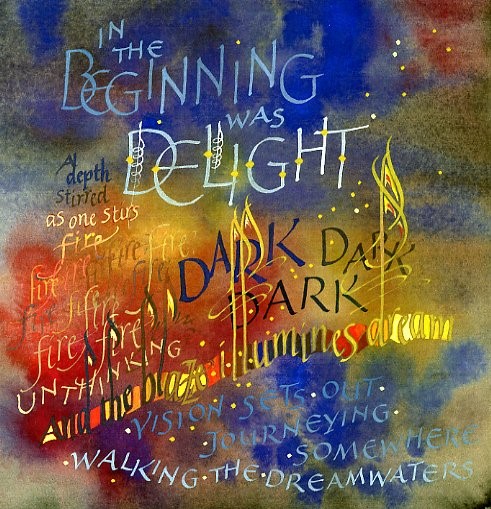
In such a world of feeling, it’s therefore surprising to me that children of all ages are not encouraged more often to interpret words visually, un-restrained by a standard size of letters and a requirement of regimented rows of words. Isn’t it natural to want to write about crashing waves by using letters and words that heave and tumble on …well …wave shaped lines, and in appropriate colours? And why not sometimes use larger and bolder letters for those words emphasised most in speech, as pioneered by Hechle in the 1960s? Such freedom may foster creative writing by children and adults alike, or engender an artistic response to any favourite text.

taylor-1

Text from Relearning the Alphabet by Denise Levertov

In the beginning was delight. A depth

stirred as one stirs fire unthinking.

Dark  dark  dark. And the blaze illumines dream.

Vision sets out

journeying somewhere,

walking the dreamwaters.

Designing the layout for words as an outward spiral may be appropriate for stories that unwind, such as: ‘Will you walk a little faster,’ said the whiting to a snail, ‘there’s a porpoise just behind us and he’s treading on my tail.’ Conversely, some stories wind up and can be written as an inward spiral, for example: ‘This is the cow with the crumpled horn that tossed the dog that worried the cat that killed the rat that lay in the house that Jack built.’ And as you will see, I have used this spiral technique and others in my combination of biblical passages.

taylor-2

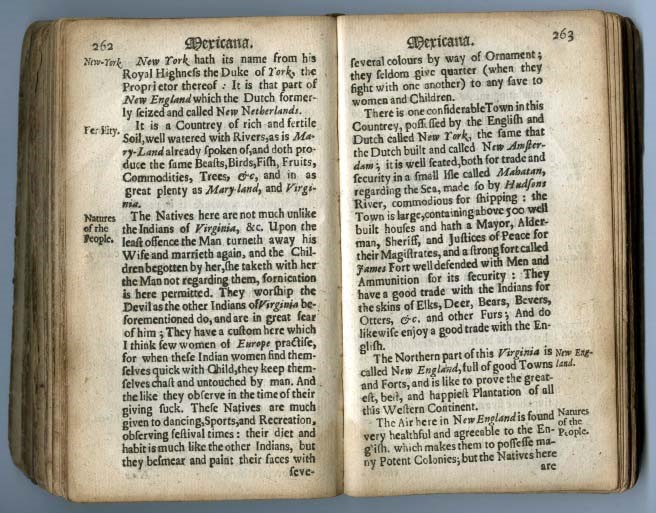
Not all children get hooked on reading and writing by initially listening to or reading stories. Some may arrive at the endpoint by predominantly first developing a love of words and of books as objects. When I stage a ‘Hands-on History of Books and Writing over 4000 Years’ experience in schools, even reluctant readers seem to enjoy handling a 2000 BC cuneiform clay sales docket, holding a hand-written vellum page from a 13th century medieval book without using white gloves, a page from one of the world’s first dictionaries printed in the 1480s, peeping inside Victorian picture books and deciphering a description of New York published in the 1679 that says that it has ‘…above 500 well-built houses’ amongst other treasures (and most then want to read more about early New York).


taylor-3-a


taylor-3


Some children may come to enjoy words and reading after calligraphic exploration. From playing with the word ‘rain’…taylor-4

…research could next find a poem that is fitting for similar presentation, with reading undertaken in the process enjoyed more than expected:

taylor-5

Poem: This Land by Ian Mudie

Designing calligraphic letter shapes can influence and add joy to creative writing, too. Letters with triangular serifs like webbed feet, for example, can give impetus to write about frogs, ducks or sea-gulls.

Verse by Peter Taylor, illustration by Anil Tortop

Verse by Peter Taylor, illustration by Anil Tortop

Sea fever, by John Masefield

Sea fever, by John Masefield

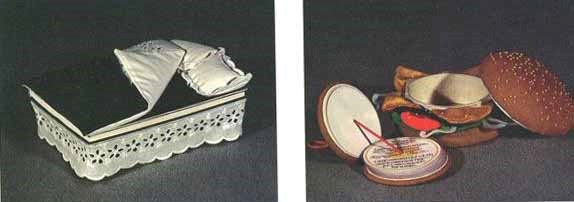
We can arouse young children’s interest in books with colour and quirkiness. But what sort of books are teens excited by? What kinds of bindings and book structures do they explore? I taught ‘Book Cover Design’ workshops to children aged 7 to 17 at the Queensland State Library. Participants used pens, scissors, paste and coloured and decorative papers to produce dust-jackets for Reference books of their choice (that were later re-shelved in their new covers). The children created the most eye-catching bold designs, but I wonder what they would have produced if they had been offered a wider range of materials and allowed more time, especially to read the books thoroughly. Would they have created a quilt cover for a book of poems titled On Going to Bed or placed hamburger recipes in a container shaped and covered to resemble a Big Mac?

taylor-8

Would they have modelled or sculpted mountain ranges to sit on top of the pages of Lord of the Rings, as famed designer-bookbinder Philip Smith has done?

taylor-10

Or designed a ‘Book Stack’, as Mike Stilkey does?

taylor-11

Maybe the children would have produced something even more original.

How many books do teens smell? Are they encouraged to write, design and bind their own books?

Is it possible that first creating a book with a special structure can provide the stimulus for writing a story to fit inside it? Or will a story provide ideas for a unique and satisfying way to display the text?

taylor-12


taylor-13


I hope children of all ages (and adults) are encouraged to explore the totality of the world of words, of language, writing, calligraphy, exciting layout designs and books of every form and structure until these become a rich, integral and important part of their lives. Sustenance for their creativity and creative thought. Let us give them experiences to savour and help them to respond with joy in their own way …to the extent that they want to bungee-jump into, read and devour our offerings of all genres with relish.

Peter Taylor’s first book was published in 1987 and he writes wacky verses, fiction and non-fiction for all ages. His picture book, ‘Once a Creepy Crocodile’ illustrated by Nina Rycroft and pub. The Five Mile Press was shortlisted for the 2015 Book of the Year award by Speech Pathology Australia. Peter is also an internationally respected calligrapher and artist’s book constructor, has been the Queensland Newsletter Editor for the Children’s Book Council of Australia, Co-ordinator of SCBWI Queensland and judge of the Dorothy Shaw Writing Competition for the deaf. He delights in sharing his extensive historical book and document collection and encouraging children and adults to love books, read, write and be creative. Peter offers workshops, talks and performances to libraries, schools and festivals. 


www.writing-for-children.com

http://brisbaneillustrators.com/peter-taylor.html

www.ptcalligraphy.com