My latest post on Writer Unboxed.
Uncategorized
Trinity’s Helen has changed..

Countdown to release of Trinity: The False Prince!
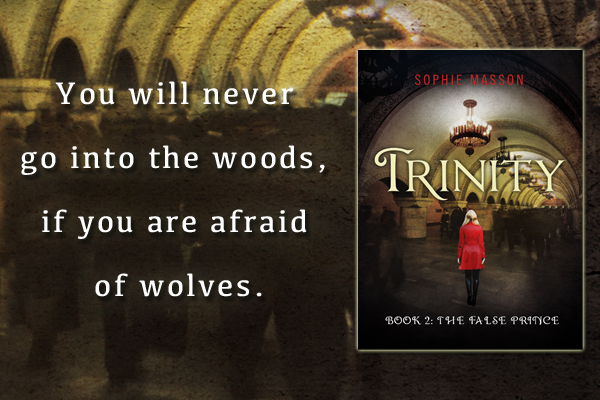 Exciting: Today it’s 28 days till my new novel, Trinity: The False Prince, the sequel to last year’s Trinity: The Koldun Code, is published on October 5 by Momentum(as an e-book first, followed by print publication a month later). To celebrate and mark the beginning of the countdown to publication day, here’s an intriguing quote from the very beginning of the book!
And in the weeks to come there’ll be more enticing quotes–watch this space!
My sister Camille’s excellent piece in Art View
 My sister Camille Masson-Talansier is a gifted and versatile artist whose spectacular paintings and installations are attracting excellent reviews and attention. Recently returned from a month-long artist residency in Karelia, northern Russia, she has written an excellent piece on the many inspirations of her art, published in the latest issue of the fabulous online cross-arts magazine Art View, and illustrated with gorgeous photos of her art. You can read it free online here. (Camille’s piece is on pages 30–33).
Interview with Katherine Pancol, French bestselling author
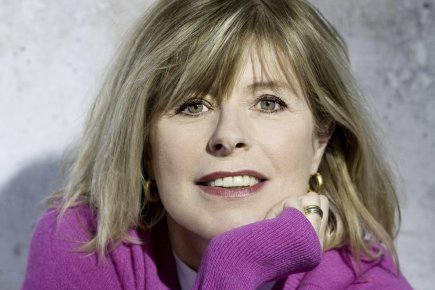
Last year, I interviewed the very popular French novelist Katherine Pancol, whose books I have much enjoyed. The interview was published in Good Reading magazine, and as I am in France at the moment I thought I would republish it for readers here.
Interview with Katherine Pancol
By Sophie Masson
Katherine Pancol is one of France’s most popular novelists, who regularly tops best-seller lists with her enthralling books, which combine gripping plots, superbly-developed characters, vivid settings, zesty language, wry humour, romance and a hint of the surreal, even supernatural. Every book’s been a success, but the biggest so far was with a trilogy which started in 2006 with Les Yeux Jaunes des Crocodiles, (The Yellow Eyes of Crocodiles)continued in 2008 with La valse lente des Tortues( The slow waltz of tortoises) and in 2010,Les ecureuils de Central Park sont tristes le lundi(The squirrels of Central Park are sad on Mondays). This trilogy has sold in excess of 6 million copies in France alone. It was translated already into 29 other languages before an English-language version of the first book finally joined them in 2013, which in Australia was published by Allen and Unwin.
I only discovered Katherine Pancol’s work myself recently, despite being of French origin, though living in Australia. I read the books in French before the English translation—which carries the wonderful story and characters well, though in my opinion, missing a little of the spicy sparkle of the French original. And interviewing her, I discovered that the author is as intriguing and engaging as her novels.
SM: How did the idea for The Yellow Eyes of Crocodiles first come to you?
KP: Isak Dinesen used to say : “I start with a tingle, a kind of feeling for the story… Then come the characters, and they take over, they make the story”.
It’s exactly that. Every time.
I was spending the summer in a seaside village in Normandy. I like to go swimming early in the morning, when the beach is empty and the sea is all mine. One morning, just as I was about to go into MY sea, another woman came in. We talked. She was a researcher at the CNRS, a university research centre in France. She’d been working on the same subject for 30 years: travelling newspaper-sellers in 18th century France! She’d written and talked about this subject all over the world.
She had a certain old-fashioned, tentative charm, and as I listened, I felt that familiar tingle!
Josephine was about to be born.
The rest was like a snowball that turns into an avalanche, as I imagined a whole personal world for Josephine.
SM: When you started this book, did you envisage it as the first in a trilogy?
KP: Not at all. I wrote the first one and thought I was through with the story. Bye Bye, everybody ! And then… I kept thinking about the characters and I was missing them. All sorts of questions came to me. What was going on in their lives? Were they happy or sad? In the end I realised I was continuing the story in my head every day so I decided to write it down and there I was with another novel ! AM: The story is told from several different points of view. How did you handle that?
I think it comes from the characters. When they are well-developed, it is they who write the story, and me, I just follow them. I trust them. To write a novel you have to know your characters very well. Like yourself. You think like them, you laugh like them, cry like them, you share the same dreams, the same fears. You are them. Each of them. I never make a plan when I write. I am the characters and they write the story.
SM: Josephine is a specialist in the 12th century, which recurs frequently as a theme–is this period one you are interested in?
KP: I chose it completely by chance, because I did not know it at all. At school in France, you usually start with the 13th or 14th centuries. So, I thought it was a good way to learn. I love to learn new things.
The 12th century is very interesting because it is very like our time. It is a century of many tumultuous changes. European countries were opening up to each other and to trade, money became all-important, it was the start of the great European fairs, the first universities, religious fanaticism was raging, women worked and represented 50 percent of the active population. It was a very modern period in a very ancient time!
SM: To me, the novel has strong fairy tale elements. And yet it’s also realistic, with great social irony and comedy. How did you combine those things?
KP: I don’t know ! It’s just my way of telling stories ! When I was a child, I read a lot, all kinds of books. I was just as happy reading myths and fairytales from Egypt, Persia, Arabia, Norway as The Brothers Karamazov, Le Père Goriot(Balzac), David Copperfield. Everything was blended in my mind. And even if say I didn’t really understand Dostoyevsky I was still enthralled by the atmosphere, and loved discovering other words, other feelings, an other world.
SM: The portrait of French society in the novel isn’t always flattering. Do you think that your years outside of France have given you a different perspective on your country?
KP: I spent ten years in New York. In that time I came to understand what was wonderful about the US and what was less wonderful. Same for France, and for Paris where I live. There are things I love and others I love not at all. There’s no such thing as a perfect country, or perfect civilisation.
In Paris, I love the beauty of the city, the stone of its buildings, the light, the sky, the food, the presence of the past, the cafes, the restaurants, the Seine, the style of Parisian girls! In New York, I love the energy that emanates from the city, the optimism, the freedom, the mix of nationalities, of languages. In New York, you tell yourself that everything is possible. You dare to go out on a limb.
In Paris, you don’t. You are less daring. More self-conscious.
I love the two cities, but differently.
It’s because I’ve lived in New York that I realised how French I am. Or rather, European. I could easily live in Rome or Madrid. I love Latin countries.
SM: I saw the ‘yellow eyes of crocodiles’ image as symbolising fear: fear of death, fear of life, fear of becoming yourself, fear of losing yourself–is that a fair comment?
Kp: Yes ! It is.
Nearly all the characters are afraid.
SM: And the character of Henriette Grobz, which is the only one with no redeeming features–is that possibly because in her cold hardness she does not allow anything as human as fear in?
KP: Henriette is only scared of one thing: not having enough money. Money is the only thing which reassures her, the only value she holds dear, her refuge. And that is her fear: to be in need of money.
She despises her younger daughter Josephine because she’s fragile, sensitive, generous. Henriette loves only force and power. She supposedly loves her older daughter Iris, but in reality she loves an image: what she could have been herself.
SM: Why do you think so many readers worldwide have loved your book? And why did it take so long for the novel to be taken up by English-language publishers?
KP: I think that we are all, in a sense, ‘Josephines’. And not only women feel this. I have received many emails from male readers, young and old, who identify with Josephine. One young Chinese soldier, even wrote ‘I am Josephine!’
I replied in some surprise and he wrote back, describing how he’d always felt inadequate in the face of life. That he was always afraid he’d not measure up. Afraid he’d do the wrong thing, of not being good enough..
So I offered him Seneca’s words: ‘It is not because things are difficult that we don’t dare to take a chance; it’s because we don’t dare that things become difficult.’
As to why it took so long for the book to come out in English—I think the Americans waited to see how the book went in territories other than France. It reassured them, when they saw it went well in Spain and Germany, for instance, and so they took the plunge.
SM: What reactions are you getting from anglophone readers?
KP: Pretty much the same as in France. On my website, http://www.katherine-pancol.com, people can contact me directly, and I’ve had all sorts of emails from English-language readers. For instance, a man wrote to me about Antoine(Josephine’s faithless, hapless husband) a woman wrote saying my book had made her feel again that life was worth living, still another wanted the rest of the trilogy. I’ve had only enthusiastic messages. People write to me as though to a friend.
SM: Will the other two books in the trilogy be published in English too?
KP: I hope so ! I cross my fingers ! If “The yellow eyes of crocodiles” is a success in English, the publisher will have the other two volumes translated. If not, well..
SM: Can you tell us a little about your writing career? And a little about your new trilogy?
KP: I studied literature at university ,taught French and Latin in a Swiss private school, then back in Paris, I became a journalist. I remember the first time I saw my name in print in a newspaper. It was in Paris-Match(a famous French weekly magazine). I was 23. I was at newspaper kiosk, and I danced for joy around that kiosk!
Later, I went to work for Cosmopolitan. One day, the publisher said I must absolutely write a novel! I resisted for six months. Then I decided to do it. To please him. And because he was convinced of my abilities, he was also convincing! So I wrote my first novel, ‘Moi d’abord’ (Me first, 1979). It was a big success. My life changed. I discovered you could write for your own pleasure, and not just for readers. It was like entering into the most wonderful sweet-shop!
 My new trilogy is called ‘Muchachas’ and tells the story of a woman, Léonie, who is a victim of domestic violence; of her daughter Stella–and of a man who is handsome, strong, brave, a fireman who saves lives but who at home beats his wife and rapes his daughter. It is Léonie’s story, Stella’s story, and the story of all those around them—those who pretend not to see what’s happening and those who try to help. It’s set in a small French provincial town. In the novel, there are characters who dream their lives away, those who endure it and those who decide to change it.And then there’s another story within it, another world, where readers will find again characters from the Josephine trilogy: Hortense and Gary, Josephine and Philippe, Shirley, Alexandre, Zoé. It’s set in England, in New York, in Paris, in Italy.
These two worlds meet in the new trilogy.
In fact, it is a single novel that I broke into three volumes when I realised it was 1500 pages long!
Memories of an inspirational childhood home
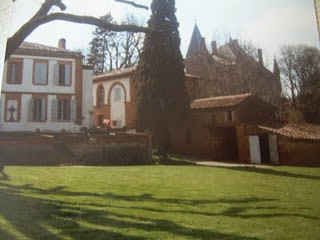 I am in France at the moment and the other day, as always when I am back here, I went back to the village where we used to spend all our time as children, when we were back in France on our periodic holidays from Australia. The beautiful old house where we used to live has been highly important to me not only personally but as a writer too, so today I thought I would republish here a piece I wrote a little while back, about the house and its place in my imagination.
The good-fairy house
The very year I was born, my parents, who were then working as expatriates in Indonesia, bought their first house, with the help of my paternal grandmother Marie-Louise Masson. A few months later, as a sickly baby, I was left with her, for the sake of my health—and stayed with her till I was five years old and my parents took me with them to Australia.
La Nouvelle Terrebonne, as my parents named their French house(after my father’s wealthy French-Canadian ancestors’ manor at Terrebonne near Montreal)was at the time a large, beautiful but damaged late-eighteenth house, with crumbling seventeenth century outbuildings, in a south-western French village called Empeaux.
It wasn’t common at the time for people to buy a country house so far out ‘in the sticks’ , especially when it was in such bad condition. Not only would the house need restoring from top to bottom, but there was massive work to do as well in its enormous overgrown garden, dotted with ancient trees including a rather sinister yew and a magnificent elm planted by one of Henri IV’s advisers, as well as fruit trees. (The garden was so big everyone called it ‘the park.’ )
Well, nothing daunted, my parents set to work, devoting a large part of their expatriate salaries to pay a succession of masons, tilers, electricians, plumbers, painters, carpenters and other local tradesmen. Slowly but surely, and with the help of much cash, the house turned from Cinderella in rags to beautiful princess admired by all. And it became our family base, our French base, to which we returned every two-three years, for two-three months.
We loved that house. In its warm, enchanted space, everything was extraordinary. The house was full of stories: some sad, like that of the heartbroken young man who’d hung himself in one of the bedrooms(haunted, it was nevertheless a beautiful room, and a great family favourite); some scary, like the well in the garden where a witch had been thrown, long ago; some touching, like that of the old gentleman who tapped at the front door once and told us how he’d spent his childhood in the house(I still dream about it, he said); some amazing, like that of the elm tree which because of its origin featured in the heritage of France(named a National Monument, it died, sadly, in the Dutch elm epidemic of the 1980’s).
The old wooden stairs creaked, the attic was spooky, the cellar smelled of the earth. In the storage antechambers that ran the length of each main room, there were lots of things to discover: the Indonesian baskets full of Balinese dance costumes in red and gold and green and gold, with their assorted jewellery made in gilded leather decorated with bits if glass; a huge oak wardrobe full of old fur coats, including one made of Canadian wolfskins; a wicker cradle with my aunt Geneviève’s lovely 1940’s doll in it, sporting a wig made of her own, blond childhood hair; and the big pottery and glass jars where in the winter goose and duck confit slept under layers of fat, for it was so cold in those unheated antechambers that they might as well have been fridges. In the ‘park’ we ran riot, screaming, running, climbing the fruit trees to gorge ourselves on cherries, greengages, figs..And sometimes we’d take our bikes and go off for hours exploring, in a freedom that we never had in our Sydney suburb.
As my mother still says, that house had a soul. The soul of a good fairy, despite the many terrible stories associated with it. It was a house that welcomed its people, which did them good, especially children. Grown up now, we regret it greatly—for our parents sold it in the late 1990’s—but nevertheless our memories are not bitter, but rather filled with the joy of having known so well a house which so enchanted our childhood. And for myself, I know that not only did La Nouvelle Terrebonne greatly enrich my childhood memories, it has forever become a part of my imaginative DNA as a writer.
Land of the Black Douglas
In Scotland at the moment and in that green forested part of it known as Galloway,which despite its romantically bucolic appearance has a history of fierce raiding lords like the Black Douglas,whose stronghold was at Castle Douglas,only a few kilometres away. Eventually he was brought to heel by James II of Scotland(this was in 15th century) and his land redistributed amongst other lords. We went to one of those places, at Orchardton–the very fortified tower showed the area wasn’t quite pacified!
The enigma of the Pied Piper
![WP_20150626_058[1]](https://firebirdfeathers.com/wp-content/uploads/2015/06/wp_20150626_0581.jpg) The other day, I went to Hamelin, the lovely Renaissance town on the River Weser in Westphalia in Germany which is famous for one thing all over the world: the spooky story of the enigmatic figure known in English as the Pied Piper and in German as the Rattenfänger, or ratcatcher. Everyone knows the story, so I will not repeat it, but it has always struck me as one of the most mysterious and chilling stories in the fairy tale corpus. People have tried to ‘explain’ it with reference to the Children`s Crusade or young settlers disappearing into Eastern Europe, but though unusually for a fairy story there is both a date–1284–and a place–Hamelin–definitely attached to it, in most other ways it has that shifting, mysterious feel of fairy tale and the Piper surely has most of the attributes of a faery being–the music, the bargain, the irresistible magic, the vanishing into a hill, and the snatching of children.
The other day, I went to Hamelin, the lovely Renaissance town on the River Weser in Westphalia in Germany which is famous for one thing all over the world: the spooky story of the enigmatic figure known in English as the Pied Piper and in German as the Rattenfänger, or ratcatcher. Everyone knows the story, so I will not repeat it, but it has always struck me as one of the most mysterious and chilling stories in the fairy tale corpus. People have tried to ‘explain’ it with reference to the Children`s Crusade or young settlers disappearing into Eastern Europe, but though unusually for a fairy story there is both a date–1284–and a place–Hamelin–definitely attached to it, in most other ways it has that shifting, mysterious feel of fairy tale and the Piper surely has most of the attributes of a faery being–the music, the bargain, the irresistible magic, the vanishing into a hill, and the snatching of children.
The Museum of Hamelin has some interesting displays around the story, and some striking set pieces including a wall of children´s shoes which sent a shiver up my spine as I remembered seeing a chilling, heart-clenching exhibit of abandoned shoes at Auschwitz..There is also a weird and creepy but effective performance piece, played by mechanical figures built out of scrap iron, and a montage of voices and music, with the vanished children represented by empty shirts floating slowly by..The horror which is so close to the surface in this story is clearly brought out there. But lest you get too overwhelmed,in the town there are also shops selling cheerfully tacky souvenirs, especially rats in all guises, made of felt wood plastic china and marzipan! And a couple of times a day, the glockenspiel bell array on the registry office plays a carillon to accompany the mechanical figures of the Piper, the rats, and then the Piper and the children, from behind metal doors high up on a wall. Hamelin has lived off the Piper for a very long time, and perhaps that was, in true fairy style, his final gift.
As an aside, it struck me recently that the theme of the Pied Piper runs like a silver thread trough several Australian novels: Picnic at Hanging Rock by Joan Lindsay, The Doubleman, by Christopher Koch, The Green Piper by Victor Kelleher, and The Golden Day, by Ursula Dubosarsky. A strange coincidence indeed, that this story should find so many echoes so far away..
Translation pitches (and a revelation)


Last night, English PEN hosted an experiment at the Free Word Centre in London. As part of European Literature Night, which in the seven years it has been going has grown from a single evening to a festival stretching over several weeks, The Translation Pitch saw eight translators pitching eight novels that have not yet been translated into English to a panel of industry experts. At stake was a £250 PEN samples grant, which would pay for a chunk of the winning text to be translated and shared in the hope of attracting an English-language publishing deal.
The competing books were varied. They included a Danish crossover novel about a school shooting (Jesper Wung-Sung’s Proper Fractions, pitched by Lindy Falk Van Rooyen), a 640-page-long work of German metafiction (Verena Rossbacher’s Small Talk and Slaughter, presented by Anne Posten) and a prize-winning collection of interlinked Hungarian short…
View original post 556 more words
Publication day for Hunter’s Moon!
Today is the official publication day for my new YA novel Hunter’s Moon, when it hits all the shops, physical and online. And in my inbox this morning was a lovely message from the fantastic children’s publishing team at Random House, which really made my day! 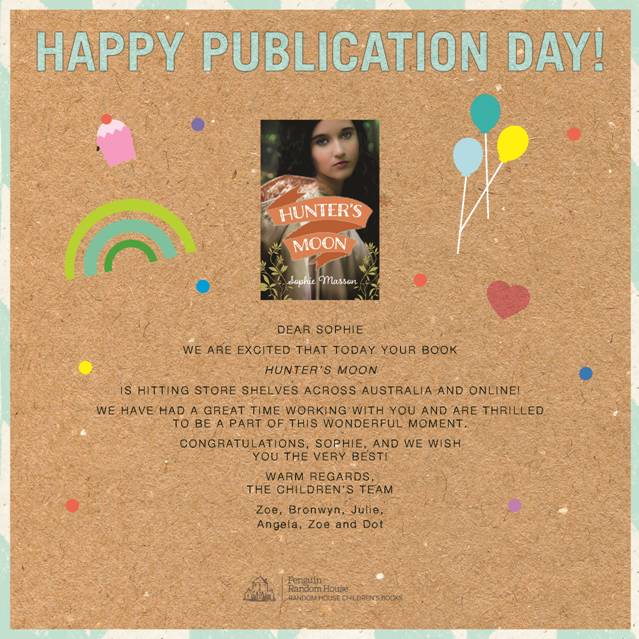
 Feathers of the Firebird